
Topic wise notes as per new NCHM-JNU syllabus (for B.Sc HHA & M.Sc HA) are are now available at our new website hospitality.institute
Select Page

Water Pollution, Sewage Pollution

by

WATER POLLUTION 

  •  Water pollution is the contamination of water bodies (e.g. lakes, rivers, oceans, aquifers, and groundwater).
  • Water pollution occurs when pollutants are discharged directly or indirectly into water bodies without adequate treatment to remove harmful compounds.
  • Water pollution affects plants and organisms living in these bodies of water.
  • In almost all cases the effect is damaging not only to individual species and populations but also to the natural biological communities.

Polluted Water comes from 

  • Domestic sewage.
  • Industrial wastewater.
  • Agricultural wastewater.
  • Construction site stormwater.
  • Urban runoff (stormwater).
  • Petroleum hydrocarbons
  • Plastics
  • Pesticides
  • Heavy metals
  • Sewage
  • Radioactive waste
  • Thermal effluents Water Pollutant
  • Detergents
  • Chloroform
  • Food processing waste, (fats and grease)
  • Insecticides and herbicides.
  • Petroleum hydrocarbons, (gasoline, diesel fuel, jet fuels, and fuel oil).
  • Lubricants (motor oil).
  • From stormwater runoff.

 Preventing Water Pollution 

  • Conserve water by turning off the tap.
  • Mind what you throw down your sink or toilet.
  • Don’t throw paints and oils in water channels.
  • Use environment-friendly household products, such as washing powder, household cleaning agents, etc.
  • Take great care, not to overuse pesticides and fertilizers.
  • Don’t throw litter into rivers, lakes or oceans.
  • Help clean up any litter you see on beaches or in rivers and lakes, make sure it is safe to collect the litter and put it in a nearby dustbin.

Treating Polluted Water

  • Suspended, solid particles and an inorganic material can be removed by the use of filters.
  • Use of biological filters and processes can naturally degrade the organic waste material.
  • After the above two steps, chemical additives are supplied to get rid of any left-over impurities.


Sewage Pollution

Domestic households, industrial and agricultural practices produce wastewater that can cause pollution of many lakes and rivers.

  • Sewage is the term used for wastewater that often contains feces, urine, and laundry waste.
  • There are billions of people on Earth, so treating sewage is a big priority.
  • Sewage disposal is a major problem in developing countries as many people in these areas don’t have access to sanitary conditions and clean water.
  • Untreated sewage water in such areas can contaminate the environment and cause diseases such as diarrhea.
  • Sewage in developed countries is carried away from the home quickly and hygienically through sewage pipes.
  • Sewage is treated in water treatment plants and the waste is often disposed into the sea.
  • Sewage is mainly biodegradable and most of it is broken down in the environment.
  • In developed countries, sewage often causes problems when people flush chemical and pharmaceutical substances down the toilet. When people are ill, sewage often carries harmful viruses and bacteria into the environment causing health problems.

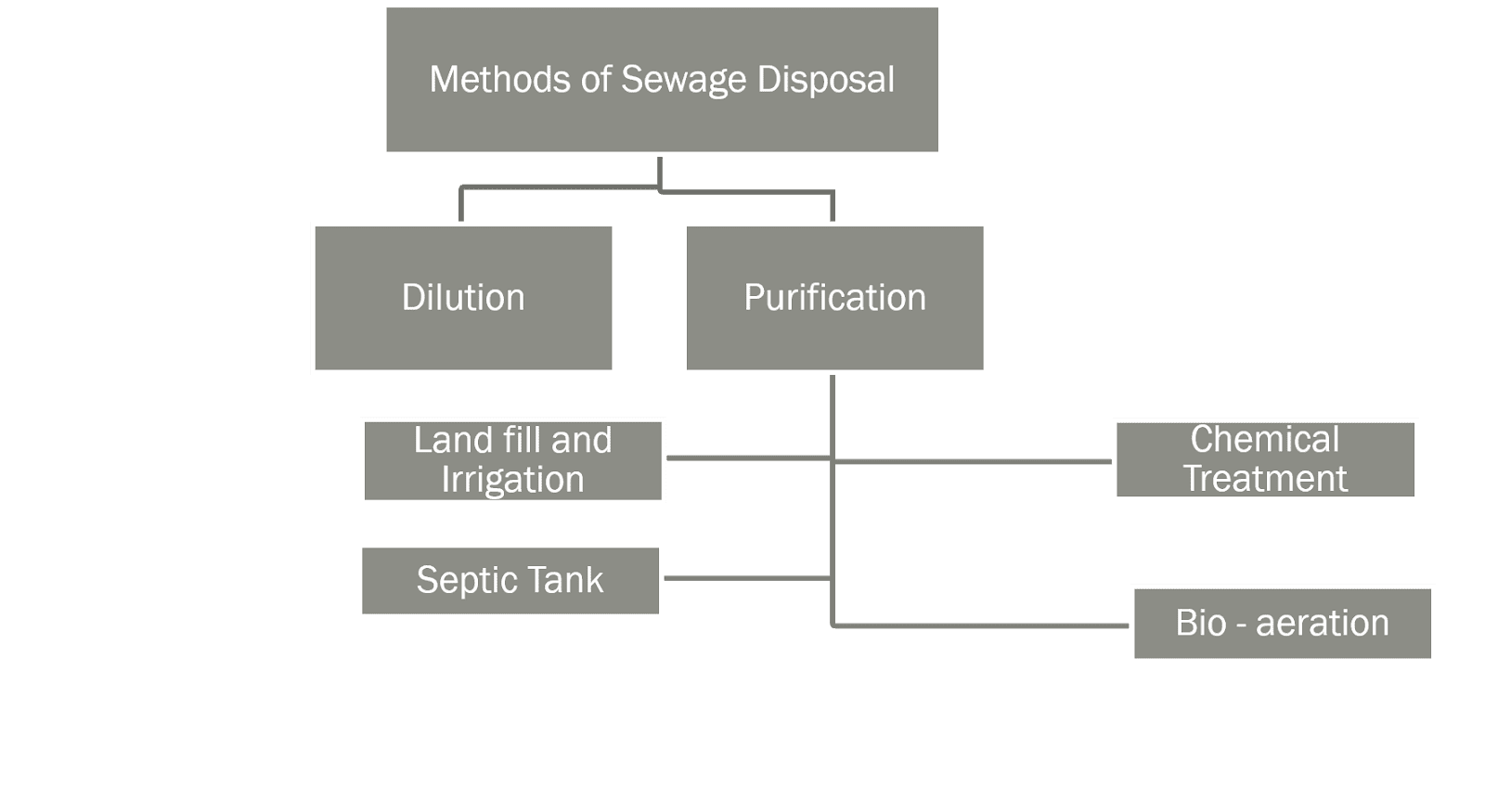
Methods of Sewage Disposal

Sewage  disposal is broadly classified  into the following types:
Water Pollution, Sewage Pollution 1

Methods of Sewage Disposal

Dilution – Raw sewage or partly treated sewage is thrown into natural water bodies such as sea, river, lake, marshy land, etc. Self-purification is the mechanism in this process, which is helped by the following factors:

  • Dilution of contaminants by dispersion in flowing water.
  • Sedimentation of particles to the water bed.
  • Oxidation of organic matter by dissolved oxygen in the water.
  • Sunlight, which kills harmful bacteria.
  • Microbial organisms consuming the solid organic matter in sewage.

How useful was this post?

5 star mean very useful & 1 star means not useful at all.

Average rating 3.7 / 5. Vote count: 3

No votes so far! Be the first to rate this post.

We are sorry that this post was not useful for you! 😔

Let us improve this post!

Tell us how we can improve this post?

Syllabus BHM106

01 Maintenance

  1. Introduction
  2. Preventive and breakdown maintenance, comparisons
  3. Role & Importance of maintenance department in the hotel industry with emphasis on its relation with other departments of the hotel.
  4. Organization chart of maintenance department, duties and responsibilities of maintenance department

02 Fuels used in the catering industry

  1. Introduction
  2. Types of fuel used in catering industry; calorific value; comparative study of different fuels
  3. Calculation of amount of fuel required and cost.

03 Gas

  1. Introduction
  2. Heat terms and units; method of transfer
  3. LPG and its properties; principles of Bunsen burner, precautions to be taken while handling gas; low and high-pressure burners and their corresponding heat output
  4. Gas bank, location, different types of manifolds

04 Electricity

  1. Introduction
  2. Fundamentals of electricity, insulators, conductors, current, potential difference resistance, power, energy concepts; definitions, their units and relationships, AC and DC; single phase and three phases and its importance on equipment specifications
  3. Electric circuits, open circuits and close circuits, symbols of circuit elements, series and parallel connections, short circuits, fuses; MCB, earthing, the reason for placing switches on the live wire side.
  4. Electric wires and types of wiring
  5. Calculation of electric energy consumption of equipment, and safety precautions to be observed while using electric appliances.
  6. Types of lighting, different lighting devices, incandescent lamps, fluorescent lamps, other gas-discharged lamps, illumination, and units of illumination.
  7. External lighting
  8. Safety in handling electrical equipment

05 Water systems

  1. Introduction
  2. Water distribution system in a hotel
  3. Cold water systems in India
  4. Hardness of water, water softening, base exchange method
  5. Cold water cistern swimming pools
  6. Hot water supply system in hotels
  7. Flushing system, water taps, traps and closets.

06 Refrigeration & Air-conditioning

  1. Basic principles, latent heat, boiling point and its dependence on pressure, vapour compressor system of refrigeration and refrigerants.
  2. Vapour absorption system, care and maintenance of refrigerators, defrosting, types of refrigerant units, their care and maintenance.
  3. Conditions for comfort, relative humidity, humidification, dehumidifying, due point control, unit of air conditioning
  4. Window type air conditioner, central air conditioning, preventive maintenance
  5. Vertical transportation, elevators, escalators

07 Fire prevention and fire fighting system

  1. Classes of fire, methods of extinguishing fires (Demonstration)
  2.  Fire extinguishers, portable and stationery
  3.  Fire detectors and alarm
  4. Automatic fire detectors cum extinguishing devices
  5. Structural protection
  6. Legal requirements

08 Waste disposal and pollution control

  1. Solid and liquid waste, sullage and sewage, disposal of solid waste
  2.  Sewage treatment
  3. Pollution related to the hotel industry
  4. Water pollution, sewage pollution
  5. Air pollution, noise pollution, thermal pollution
  6. Legal Requirements

09 Safety

  1. Accident prevention
  2. Slips and falls
  3. Other safety topics

10 Security

11 Equipment replacement policy

  1. Introduction
  2. Circumstances under which equipment are replaced.
  3. Replacement policy of items which gradually deteriorates
  4. Replacement when the average annual cost is minimum
  5. Replacement when the present cost is minimum
  6. The economic replacement cycle for suddenly failing equipment

12 Audio-visual equipment

  1. Various audio-visual equipment used in hotel
  2. Care and cleaning of an overhead projector, slide projector, LCD and PowerPoint presentation units
  3. Maintenance of computers
  4. Care and cleaning of PC, CPU, Modem, UPS, Printer, Laptops
  5. Sensors – Various sensors used in different locations of a hotel – type, uses and cost-effectiveness

13 Contract maintenance

  1. Introduction
  2. The necessity of contract maintenance, advantages and disadvantages of contract maintenance
  3. Essential requirements of a contract, types of contract, their comparative advantages and disadvantages.
  4. Procedure for inviting and processing tenders, negotiating and finalizing