
Table of Contents
Q.1. What is Operation Management? What are the roles and responsibilities of operation manager? (3+7=10)
Operations management
Operations management (OM) is the administration of business practices to create the highest level of efficiency possible within an organization. It is concerned with converting materials and labor into goods and services as efficiently as possible to maximize the profit of an organization. Operations management teams attempt to balance costs with revenue to achieve the highest net operating profit possible.
Operations management is chiefly concerned with planning, organizing and supervising in the contexts of production, manufacturing or the provision of services. As such, it is delivery-focused, ensuring that an organization successfully turns inputs to outputs in an efficient manner. The inputs themselves could represent anything from materials, equipment and technology to human resources such as staff or workers.
Roles and responsibilities of operation manager
The functions of a operations manager even though vary with the nature of the products or services, it can typically have following commonalities
1. Production Planning and Control
This involves deciding the course of action for actual production after the receipt of orders. Usually, Sales or Marketing Department receives or books orders from the customers and send their requisitions for manufacturing to Production Planning and Control Department and progress the job to ensure the execution of orders of meeting the customers’ satisfaction. Effective production planning and control, therefore, ensure meeting the prime objectives of production, i.e., to manufacture and to deliver, meeting customers’ requirements.
2. Production
After production planning and control, the next important function of a production manager is to ensure manufacturing or the production of finished goods in conformity with the plans.
3. Inspection
After production process is over, inspection or quality checking is necessary. This type of inspection is known as final inspection. However, for the increased emphasis on quality control, many organizations now also carry out in-process inspection. This minimizes the problem of rejection. In addition, inward inspection is also carried out for controlling the quality of raw materials and components.
4. Engineering
Manufacturing or production activities are also needed to be supported by design and development, which not only include designing tools, jigs and fixtures (this is done by independent Tool Room Department in large organizations) but also involves R&D activities for innovative product design and changes.
5. Industrial Engineering
A production manager is also required to carry out periodic work study, following method study or work measurement technique for systematic investigation of activities in order to ensure effective use of human and material resources. (While method study helps in finding the best way of doing a work, work measurement helps in assessing the time required for doing a job).
6. Maintenance
Production manager is also responsible for time-to-time maintenance of plant and machineries to minimize machine downtime and consequent loss of production. While traditional concept is breakdown maintenance, i.e., to attend plant and machineries only, when they become dysfunctional, modern concept is Total Productive Maintenance, which also calls for preventive maintenance action to minimize machine downtime.
7. Interdepartmental Coordination
A production manager is also required to maintain contacts with other departments, like, Sales Department with regard to production plan, Personnel Department for manpower availability and training and Materials Department for procurement of raw materials and other components.
The responsibilities of a production & operation manager can be summarized as follows.
1. Forecasting the requirements of the production in order to achieve the production target.
2. Making most efficient utilization of the available sources for production.
3. Minimizing ‘throughput time’ and ‘work in process inventory’. This can be achieved by systematic production planning and also by very efficient execution of the plans.
4. One of the most important responsibility of a production manager deals with reducing material handling cost, which generally is achieved by the use of efficient material handling system and also by using plant layouts which must be developed in a proper or correct way.
5. Reducing the quality cost with the help of analysis of non conformances on periodic basis and also by following suitable actions (both corrective and preventive).
6. Building team spirit among the workmen and also motivating by means of personal involvement. This task of motivation can also be achieved by designing and implementing suitable financial incentive schemes.
7. To device accurate methodology involving method study of manufacturing, along with the other engineering economic principles.
8. Improving the productivity level of the workers on continuous basis by workmen’s training and by bringing into use the standards of the performance derived from work measurement studies etc.
Q.2. List and explain the various techniques used in classification of inventories. (10)
Inventory Management is a practice of tracking and controlling the inventory orders, its usage and storage along with the management of finished goods that are ready for sale. Improper inventory management can lead to an increase in storage cost, working capital crunch, wastage of labor resources, increase in idle time, disruption of the supply chain, etc. All this leads to a reduction in sales and unsatisfied customers. Therefore, inventory management is an important aspect of the business which the management cannot afford to ignore. Effective and efficient management of the same is a must.
Inventory Management Techniques
There are various types of inventory management techniques which can help in efficient inventory management. They are as follows:
1. ABC Analysis
ABC analysis stands for Always Better Control Analysis. It is an inventory management technique where inventory items are classified into three categories namely: A, B, and C. The items in A category of inventory are closely controlled as it consists of high-priced inventory which may be less in number but are very expensive. The items in B category are relatively lesser expensive inventory as compared to A category and the number of items in B category is moderate so control level is also moderate. The C category consists of a high number of inventory items which require lesser investments so the control level is minimum.
2. Just In Time (JIT) Method
In Just in Time method of inventory control, the company keeps only as much inventory as it needs during the production process. With no excess inventory in hand, the company saves the cost of storage and insurance. The company orders further inventory when the old stock of inventory is close to replenishment. This is a little risky method of inventory management because a little delay in ordering new inventory can lead to stock out situation. Thus this method requires proper planning so that new orders can be timely placed.
3. Material Requirements Planning (MRP) Method
Material Requirements Planning is an inventory control method in which the manufacturers order the inventory after considering the sales forecast. MRP system integrates data from various areas of the business where inventory exists. Based on the data and demand in the market, the manager would carefully place the order for new inventory with the material suppliers.
4. Economic Order Quantity (EOQ) Model
Economic Order Quantity technique focuses on taking a decision regarding how much quantity of inventory should the company order at any point of time and when should they place the order. In this model, the store manager will reorder the inventory when it reaches the minimum level. EOQ model helps to save the ordering cost and carrying costs incurred while placing the order. With the EOQ model, the organization is able to place the right quantity of inventory.
5. Minimum Safety Stocks
The minimum safety stock is the level of inventory which an organization maintains to avoid the stock-out situation. It is the level when we place the new order before the existing inventory is over. Like for example, if the total inventory in an organization is 18,000 units, they place a new order when the inventory reaches 15,000 units. Therefore, the 3,000 units of inventory shall form part of the minimum safety stock level.
6. VED Analysis
VED stands for Vital Essential and Desirable. Organizations mainly use this technique for controlling spare parts of inventory. Like, a higher level of inventory is required for vital parts that are very costly and essential for production. Others are essential spare parts, whose absence may slow down the production process, hence it is necessary to maintain such inventory. Similarly, an organization can maintain a low level of inventory for desirable parts, which are not often required for production.
7. Fast, Slow & Non-moving (FSN) Method
This method of inventory control is very useful for controlling obsolescence. All the items of inventory are not used in the same order; some are required frequently, while some are not required at all. So this method classifies inventory into three categories, fast-moving inventory, slow-moving inventory, and non-moving inventory. The order for new inventory is placed based on the utilization of inventory.
Q.3. What is MRP? List and explain the various elements involved in MRP.
Material Requirement Planning
MRP is a system of planning and scheduling the time-phased materials requirement for production operations. If the delivery schedule for the end products is known, then Me sue and timing of the requirements of the various lower-level work-in-process items and raw-materials can he planned exactly by simple arithmetical calculation. Such planning is known as Material Requirement Planning (MRP).
Although MRP is easy to understand, it can he used in two different ways: MRP-I and MRP-II.
• MRP-I
It is an inventory control system, which releases manufacturing and purchase orders at the right time to support the maser schedule. This system launches orders to control work-in-process and raw materials inventories through proper timing of order placement. MRP-I doesn’t include capacity planning. Henceforth the terminology MRP-I and MRP will be used interchangeably.
• MRP-II
It is an information system used to plan and control inventories and capacities in manufacturing companies. The MRP-fl system coordinates sales, purchasing, manufacturing, finance, and engineering by adopting a focal production plan and by using one unified data tame to plan and update the activities in all the systems. The subsequent sections shall cover MRP followed by MRP-II.
Objectives of MRP
MRP provides the following objectives:
• Inventory reduction
• Reduction in production and delivery lead times
• Increased efficiencies
Elements of MRP
1. Master Scheduling
By controlling the master schedule, top management can control customer service, inventory levels, and manufacturing costs. The purpose is to specify the output of the operations function. Top managers can not perform the master scheduling task by themselves, because there are too many details. They can set master-scheduling policy, thereby controlling the materials planning function. Top management should also interface with manufacturing through the aggregate production plan.
2. Bill of Materials (BOM)
It is a structure list of all the materials or parts needed to produce a particular finished product, assembly, subassembly, manufactured parts, or purchased parts. It is as good as a recipie used for cooking. Some companies have several BOMs for same product. Engineering has one BOM, manufacturing hat: a different version and cost accounting has still different. An MRP system requires a single BOM for the entire company. BOMs are constantly undergoing change as products are redesigned.
3. Inventory Records
In practice constant effort is required to keep inventory records accurate. Traditionally, inventory accuracy has been assured by annual physical inventory count, where the plant is shut down for a day or two and everything is counted from wall to wall. With cycle counting, a small percentage of the items are counted each day by storeroom personnel. Errors are corrected in the records and an attempt is made to find and correct the procedure which caused them.
4. Capacity Planning
The necessary elements of an order-launching materials requirement planning system have been described above. This system requires master scheduling, a DOM, inventory records and parts explosion. The parts explosion process assumes that the master schedule is feasible with respect to capacity. Using the master schedule as, input, parts are exploded to produce shop orders and purchase orders. If sufficient capacity is not available, then either capacity or the master schedule must be changed until the master schedule is feasible.
5. Purchasing
The purchasing function is greatly enhanced by the use of an MRP system. First, past-due ‘ orders are largely eliminated because MRP generates valid due dates and keeps them up to dam. By developing and executing a valid materials plan, management can .eliminate much of the order expediting which is usually done by purchasing. With an MRP system, it is possible to provide vendors with reports of planned future orders. The practice of giving vendors planned orders more closely interlocks them with the company’s own material plan.
Q.4. What is JIT? Explain wastes referred in JIT. (3+7=10)
JIT
Just-in-Time (JIT) is a Japanese innovation, and key features of this were perfected by Toyota. Some facets of the management practices Toyota developed are ideologically related to Japan’s unique customs, culture, and labour – management relations.
However there is nothing uniquely Japanese about JIT production and it is usable anywhere. The concepts have been applied successfully in many companies throughout the world. JIT production means producing and buying in very small quantities just in time for use. It is simple hand to mouth mode of industrial operations that directly cuts inventories and also reduces the need for storage space, racks, conveyors, forklifts, computer terminals for inventory control and of course material control personnel. Products are assembled just before they are sold, subassemblies are made just before the products are assembled, and components are fabricated just before the subassemblies are made – so work-in-process (WIP) inventory is low and production lead times are short.
Just-in-time systems are known by many different names, including zero inventory synchronous manufacturing , lean production, stock less production (Hewlett- Packard), material as needed (Harley – Davidson ), and continuous flow manufacturing (IBM).
Wastes in JIT
There are seven types of waste:
• Waste from overproduction.
• Waste of waiting time.
• Transportation waste.
• Processing waste.
• Inventory waste.
• Waste of motion.
• Waste from product defects.
Q.5. What is aggregate planning? What are the various ways or techniques of aggregate planning?
Aggregate Planning
Aggregate planning is a marketing activity that does an aggregate plan for the production process, in advance of 6 to 18 months, to give an idea to management as to what quantity of materials and other resources are to be procured and when, so that the total cost of operations of the organization is kept to the minimum over that period.
The quantity of outsourcing, subcontracting of items, overtime of labour, numbers to be hired and fired in each period and the amount of inventory to be held in stock and to be backlogged for each period are decided. All of these activities are done within the framework of the company ethics, policies, and long term commitment to the society, community and the country of operation.
Aggregate planning has certain pre-required inputs which are inevitable. They include:
• Information about the resources and the facilities available.
• Demand forecast for the period for which the planning has to be done.
• Cost of various alternatives and resources. This includes cost of holding inventory, ordering cost, cost of production through various production alternatives like subcontracting, backordering and overtime.
• Organizational policies regarding the usage of above alternatives.
“Aggregate Planning is concerned with matching supply and demand of output over the medium time range, up to approximately 12 months into the future. The term aggregate implies that the planning is done for a single overall measure of output or, at the most, a few aggregated product categories. The aim of aggregate planning is to set overall output levels in the near to medium future in the face of fluctuating or uncertain demands. Aggregate planning might seek to influence demand as well as supply.
Techniques for aggregate planning
Techniques for aggregate planning range from informal trial-and-error approaches, which usually utilize simple tables or graphs, to more formalized and advanced mathematical techniques.
This general procedure consists of the following steps:
Step 1.
Determine demand for each period.
Step 2.
Determine capacity for each period. This capacity should match demand, which means it may require the inclusion of overtime or subcontracting.
Step 3.
Identify company, departmental, or union policies that are pertinent. For example, maintaining a certain safety stock level, maintaining a reasonably stable workforce, backorder policies, overtime policies, inventory level policies, and other less explicit rules such as the nature of employment with the individual industry, the possibility of a bad image, and the loss of goodwill.
Step 4.
Determine unit costs for units produced. These costs typically include the basic production costs (fixed and variable costs as well as direct and indirect labor costs). Also included are the costs associated with making changes in capacity. Inventory holding costs must also be considered, as should storage, insurance, taxes, spoilage, and obsolescence costs. Finally, backorder costs must be computed. While difficult to measure, this generally includes expediting costs, loss of customer goodwill, and revenue loss from cancelled orders.
Step 5.
Develop alternative plans and compute the cost for each.
Step 6.
If satisfactory plans emerge, select the one that best satisfies objectives. Frequently, this is the plan with the least cost. Otherwise, return to step 5.
OR Define design capacity, normal capacity. A plant has a normal capacity of 1000 units. The actual capacity achieved is 800 units. Calculate the efficiency of the plant. (3+3+4=10)
Design Capacity
Design capacity refers to the maximum designed service capacity or output rate and the effective capacity is the design capacity minus personal and other allowances.
Normal Capacity
Normal capacity is the amount of production volume that can be reasonably expected over the long term. Normal capacity takes into account the downtime associated with periodic maintenance activities, crewing problems, and so forth. When budgeting for the amount of production that can be attained, normal capacity should be used, rather than the theoretical capacity level, since the probability of attaining normal capacity is quite high. The normal capacity level can decline over time as production equipment ages, since the equipment requires more maintenance effort.
Two functions of capacity can be used to find the efficiency and utilization. These are calculated by the formulas below:
• Efficiency = Actual Output/ Effective Capacity x 100%
• Utilization = Actual Output/ Design Capacity x 100%
Given,
Normal capacity = 1000
Actual Capacity = 800
Efficiency = Actual Output/ Effective Capacity x 100%
= (800/1000)× 100%
= 80%
Q.6. What is total productive maintenance (TPM)? Explain the principles involved in TPM. (10)
TPM –
Total Production Maintenance
(TPM) approach has the capability of providing almost a seamless integration of production and maintenance through development of strong partnership. Work culture directed towards excellence, the presence of effective work teams, and a basic maintenance management system operating reasonably will improve and accelerate TPM implementation.
In TPM ‘Total’ means:
• Total equipment/machine effectiveness.
• Total employee/workman involvement, and
• A Total maintenance delivery system
In fact total productive maintenance (TPM) is the combination of the American system of Preventive Maintenance (PM) and the Japanese Concept of Total Quality Control (TQC) plus the Total Employee Involvement (TEI).
The net outcome is an innovative system for the maintenance of equipment which optimizes effectiveness, eliminates failures (breakdowns) and promotes autonomous operator maintenance through day-to-day activities.
On this score, the Japanese have shown a new path to the world of management by ceaselessly working towards the ideal goals of zero breakdowns and zero defects or zero defectives. This means less the breakdown of machinery, the less would be the proportion of defective quality.
Principles of TPM
1. Autonomous Maintenance
Operators are in charge of routine maintenance tasks and inspection. This gives them more responsibility, increases their knowledge of the equipment they use on a daily basis and makes it more likely that potential issues will be spotted early on.
2. Planned Maintenance
Scheduled maintenance tasks that reduce instances of unplanned stops and enable better inventory management of spare parts.
3. Quality integration
Apply route cause analysis to eliminate recurring problems and reduce cost by catching defects early.
4. Focused improvement
Employees work together to achieve regular, incremental improvements to equipment operation.
5. Early equipment management
Use knowledge gained above to improve design of new equipment, reducing start up issues.
6. Training and education
Fill in knowledge gaps to develop skills of operators as well as maintenance teams.
7. Safety, health and environment
Maintain safe environments to achieve the target of an accident-free workplace.
8. TPM in administration
Reduce waste in administrative functions and support production through improved admin operations.
Q.7. Write short notes on any two of the following: (2×5=10)
a. Flexible manufacturing system
A flexible manufacturing system (FMS) is a production method that is designed to easily adapt to changes in the type and quantity of the product being manufactured. Machines and computerized systems can be configured to manufacture a variety of parts and handle changing levels of production.
A flexible manufacturing system (FMS) can improve efficiency and thus lower a company’s production cost. Flexible manufacturing also can be a key component of a make-to-order strategy that allows customers to customize the products they want.
The concept of flexible manufacturing was developed by Jerome H. Lemelson (1923-97), an American industrial engineer and inventor who filed a number of related patents in the early 1950s. His original design was a robot-based system that could weld, rivet, convey, and inspect manufactured goods.
A flexible manufacturing system may include a configuration of interconnected processing workstations with computer terminals that process the end-to-end creation of a product, from loading/unloading functions to machining and assembly to storing to quality testing and data processing. The system can be programmed to run a batch of one set of products in a particular quantity and then automatically switch over to another set of products in another quantity.
Pros of Flexible Manufacturing System
The main benefit is the enhancement of production efficiency. Downtime is reduced because the production line does not have to be shut down to set up for a different product.
Cons of Flexible Manufacturing System
Disadvantages of FMS include its higher upfront costs and the greater time required to design the system specifications for a variety of future needs.
There also is a cost associated with the need for specialized technicians to run, monitor, and maintain the FMS. Advocates of FMS maintain that the increase in automation typically results in a net reduction in labor costs.
b. Economic order quantity
Economic order quantity (EOQ) is the ideal order quantity a company should purchase to minimize inventory costs such as holding costs, shortage costs, and order costs. This production-scheduling model was developed in 1913 by Ford W. Harris and has been refined over time. The formula assumes that demand, ordering, and holding costs all remain constant.
• The EOQ is a company’s optimal order quantity that minimizes its total costs related to ordering, receiving, and holding inventory.
• The EOQ formula is best applied in situations where demand, ordering, and holding costs remain constant over time.
• One of the important limitations of the economic order quantity is that it assumes the demand for the company’s products is constant over time.
Formula and Calculation of Economic Order Quantity
The formula for EOQ is:
Q² = 2DS/H
where:
Q=EOQ units
D=Demand in units (typically on an annual basis)
S=Order cost (per purchase order)
H=Holding costs (per unit, per year)
The goal of the EOQ formula is to identify the optimal number of product units to order. If achieved, a company can minimize its costs for buying, delivering, and storing units. The EOQ formula can be modified to determine different production levels or order intervals, and corporations with large supply chains and high variable costs use an algorithm in their computer software to determine EOQ.
EOQ is an important cash flow tool. The formula can help a company control the amount of cash tied up in the inventory balance. For many companies, inventory is its largest asset other than its human resources, and these businesses must carry sufficient inventory to meet the needs of customers. If EOQ can help minimize the level of inventory, the cash savings can be used for some other business purpose or investment.
The EOQ formula determines a company’s inventory reorder point. When inventory falls to a certain level, the EOQ formula, if applied to business processes, triggers the need to place an order for more units. By determining a reorder point, the business avoids running out of inventory and can continue to fill customer orders. If the company runs out of inventory, there is a shortage cost, which is the revenue lost because the company has insufficient inventory to fill an order. An inventory shortage may also mean the company loses the customer or the client will order less in the future.
c. Use of computers in production and operation management
Computer and Information Technology have taken a leading position in business today. Operations Management is noway different in this regard. Manufacturing technologies like CAD, CAM, CIM, FMS, JIT and TQM etc, have taken the major advantages by using computers. One can say that computer and related softwares can change a total setup of an organisation by effectively utilising the information sharing among different functional areas of management. In today’s liberalised environment if an organisation wants to be competitive, then adoption of new technology is inevitable with computer as a part of the system. The effective interactions among the social sub-system, the technical sub-system and the environmental subsystem is only possible if computer interact effectively with all subsystems.
Computerization of operations management helps in continuous improvement moving towards zero defects. Understanding the customer need and forecasting the requirement of the future help is taking decision is capacity planning process selection and new technology,` and facility planning, Obviously computers come into action. Computers are playing a. role of underpinning technology is multimedia creation, designing and evaluating the alternatives. One cannot overlook computers in purchasing & material management functions, planning, scheduling & control of projects and manufacturing of products & services. Industrial electronics will play a greater role in measuring process variables on a continuous basis, monitoring & managing the process conditions. Computers will be increasingly used in organising assembling of components automatic movement of material through robots, positioning of components in correct place for assembling, screwing, or fastening sub assemblies. The rapid changes in technologies mainly integration of computers, will change the ways of managing operations. IT is much more than computers & computing, It covers the micro electronics, robots, telecom & satellite communication and interacting with different operations.
Q.8. Define any five of the following terms: (5×2=10)
a. Scheduling and sequencing
Sequencing
• Sequencing is the order of tasks to be done in chain. Hence the next task is started once the previous one is completed.
• Prioritize jobs assigned to a resource
• If no order specified use first-come first-served (FCFS)
Scheduling
Scheduling, on the other hand is the process in which people are assigned to time to accomplish different tasks.
• Operations scheduling is critical to the success of an organization; however, it can be a very complicated task.
• Effective schedules are needed to meet promised customer delivery dates or inventory targets.
• It covers the following areas in particular:
• Assign job to a particular work center/ machine
b. Productivity
Productivity is the efficiency of production of goods or services expressed by some measure. Measurements of productivity are often expressed as a ratio of an aggregate output to a single input or an aggregate input used in a production process, i.e. output per unit of input, typically over a specific period of time.
c. Capacity planning
Capacity planning is the process of determining the production capacity needed by an organization to meet changing demands for its products. In the context of capacity planning, design capacity is the maximum amount of work that an organization is capable of completing in a given period.
d. Standard time
The standard time is the time required by an average skilled operator, working at a normal pace, to perform a specified task using a prescribed method. It includes appropriate allowances to allow the person to recover from fatigue and, where necessary, an additional allowance to cover contingent elements which may occur but have not been observed.
Standard time = Normal time + Allowance
Where; normal time = Avg. time × rating factor.
e. Quality
Crosby defined as “Quality is conformance to requirement or specifications”. Juran defined as “Quality is fitness for use”. “The Quality of a product or service is the fitness of that product or service for meeting or exceeding its intended use as required by the customer.”
f. Breakdown maintenance
Breakdown maintenance is maintenance performed on equipment that has broken down and is unusable. It is based on a breakdown maintenance trigger. It may be either planned or unplanned.
Examples of breakdown maintenance
An example of planned breakdown maintenance is run-to-failure maintenance, where an organization has decided that letting a piece of equipment break down before servicing is the most cost-effective and least disruptive option.
g. Job enrichment
Job enrichment is a method of motivating employees where a job is designed to have interesting and challenging tasks which can require more skill and can increase pay.
The Job Enrichment is the job design technique used to increase the satisfaction among the employees by delegating higher authority and responsibility to them and thereby enabling them to use their abilities to the fullest.
Q.9. What is forecasting? What are the objectives of demand forecasting? (10)
Forecasting
Forecasting is a technique that uses historical data as inputs to make informed estimates that are predictive in determining the direction of future trends. Businesses utilize forecasting to determine how to allocate their budgets or plan for anticipated expenses for an upcoming period of time. This is typically based on the projected demand for the goods and services offered.
Investors utilize forecasting to determine if events affecting a company, such as sales expectations, will increase or decrease the price of shares in that company. Forecasting also provides an important benchmark for firms, which need a long-term perspective of operations.
Forecasting addresses a problem or set of data. Economists make assumptions regarding the situation being analyzed that must be established before the variables of the forecasting are determined. Based on the items determined, an appropriate data set is selected and used in the manipulation of information. The data is analyzed, and the forecast is determined. Finally, a verification period occurs where the forecast is compared to the actual results to establish a more accurate model for forecasting in the future.
The objectives of demand forecasting are-
1. Formulating production policy
Helps in covering the gap between the demand and supply of the product. The demand forecasting helps in estimating the requirement of raw material in future, so that the regular supply of raw material can be maintained. It further helps in maximum utilization of resources as operations are planned according to forecasts. Similarly, human resource requirements are easily met with the help of demand forecasting.
2. Formulating price policy
Refers to one of the most important objectives of demand forecasting. An organization sets prices of its products according to their demand. For example, if an economy enters into depression or recession phase, the demand for products falls. In such a case, the organization sets low prices of its products.
3. Controlling sales
Helps in setting sales targets, which act as a basis for evaluating sales performance. An organization make demand forecasts for different regions and fix sales targets for each region accordingly.
4. Arranging finance
Implies that the financial requirements of the enterprise are estimated with the help of demand forecasting. This helps in ensuring proper liquidity within the organization.
5. Deciding the production capacity
Implies that with the help of demand forecasting, an organization can determine the size of the plant required for production. The size of the plant should conform to the sales requirement of the organization.
6. Planning long-term activities
Implies that demand forecasting helps in planning for long term. For example, if the forecasted demand for the organization’s products is high, then it may plan to invest in various expansion and development projects in the long term.
OR Following table indicates forecasted and actual demand during a six week period:
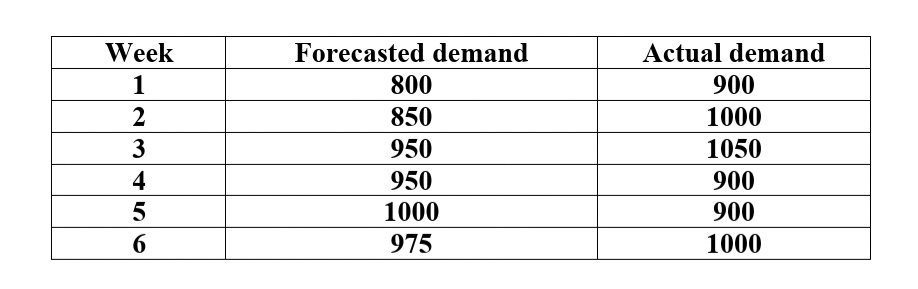
Compute Mean Absolute Deviation and tracking signal. Comment on your results. (4+4+2=10)
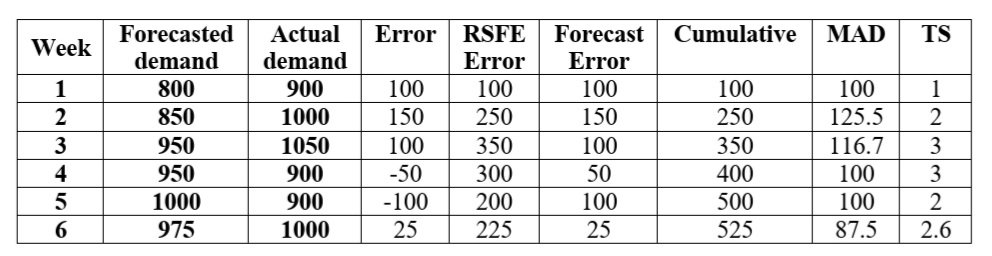
In forecasting, a commonly used forecasting error is mean absolute deviation or MAD. It is a forecast error measure that is the average forecast error without regard to direction; calculated as the sum of the absolute value of forecast error for all periods divided by the total number of periods evaluated. It is mathematically defined as:
MAD = Sum of the absolute value of the forecast error for all periods / No. of periods
= ∑(Forecast demand – actual demand)/ n
,Where n is the number of periods
MAD is used to determine whether the forecast is tracking with the actual time-series values. To determine this, a tracking signal is computed, as follows:
Tracking signal = Running sum of forecast error/ MAD
= RSFE/ MAD
Q.10. What is work method study and analysis? Explain the steps involved in work method study. (10)
Work Method Study
Methods Study is the systematic recording and critical examination of the factors and resources involved in existing and proposed ways of doing work, as a means of developing and applying easier and more effective methods and reducing costs.
Methods Study basically deals with finding better ways of doing work and it helps improve productivity by eliminating unnecessary work, avoidable delays and other types of waste. These are achieved by
• Improved working procedures
• Improved layout
• Improved working environment
• Improved product design
Steps of method study
The basic procedure of Methods Study consists of the following six steps:
1. SELECT the work to be studied
2. RECORD all the relevant facts of the present/proposed method
3. EXAMINE the facts critically
4. DEVELOP the most practical. economic and effective method, with due regards to all contingent circumstances
5. INSTALL the developed method as standard practice
6. MAINTAIN the standard practice by periodic reviews
The steps are:
1. Select
Select the work worth studying and define the objectives to be achieved. An objective may be to reduce the manufacturing cost, or to reduce bottlenecks or to reduce fatigue incurred by the workers in order to increase their efficiency.
2. Record
Record all the relevant information pertaining to the existing method (if any) in details and in the form of a chart to obtain a more clear picture about the same.
3. Examine
Examine the recorded events critically and in sequence. Critical examination involves answer to a number of questions. An activity can be eliminated, simplified or combined with another.
4. Develop
Develop the best method as resulted from critical examination and record it.
The developed method should be:
• Practical and feasible,
• Safe and effective,
• Economical, and
• Acceptable to design, production control, quality control and sales departments.
5. Install
Install the (best) developed method or the improved method. Installation involves three phases, namely-planning, arranging and implementing. During first two stages the programme of installation (phase-wise) and a time table, are planned and the necessary arrangements of resources, equipment, tools and instructions to workers, over-time, etc., are made.
6. Maintain
Maintain the new method, i.e., ensure the proper functioning of the installed method by periodic checks and verifications. The purpose of checks and reviews is to find if the method being practised is the same or it has deviated from the authorised one.
OR A work inspector records the following time while observing a worker who is engaged in packing a food product. He made six observation and following are the timings observed:
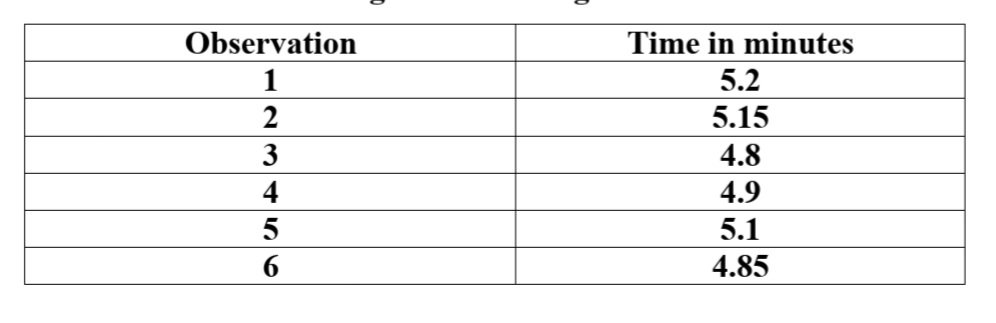
Performance rating of the worker for this task is 1.2
Relaxation allowances given is 20%
Calculate: (5+5=10)
a. Normal time
b. time for packing the product.
Given,
Average time = 5 min
Performance rating = 1.2
Relaxation allowance = 20% = 0.2
Hence
Normal time = (Average time × Performance Rating)/ No. Of units
= 5×1.2/1 = 6 min
Standard time for packaging = Normal time / ( 1- Allowance)
= 6/1-0.2 = 7.5 min.