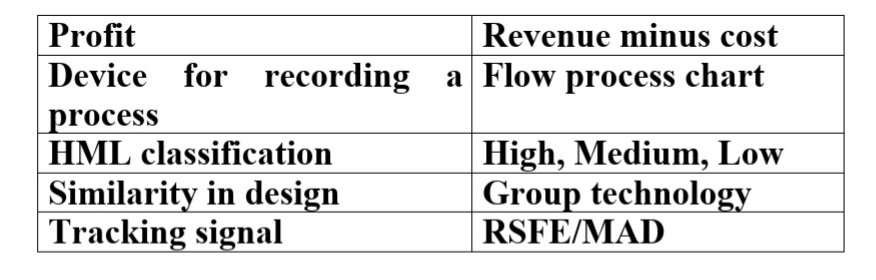
Table of Contents
Q.1. Explain organized problem solving in detail. (10)
Organized problem solving
Problems have several viewpoint perspectives. Solving the problems in an organized manner helps realize the maximum benefits. Organized problem solving assists solvers to analyse the causes thoroughly before jumping into conclusions. It helps generate maximum ideas from members in a team.
The problem solving process involves understanding the existing process(es), and collecting facts, figures and information to help define the problem. A problem well defined is half solved. Data analysis is done and the assumptions are re-examined.
Techniques are used to generate ideas for developing potential solutions. All the alternative solutions are evaluated and the best ones are selected and implemented.
Steps involved in creative problem solving along with the corresponding seven quality control tools are shown in figure below
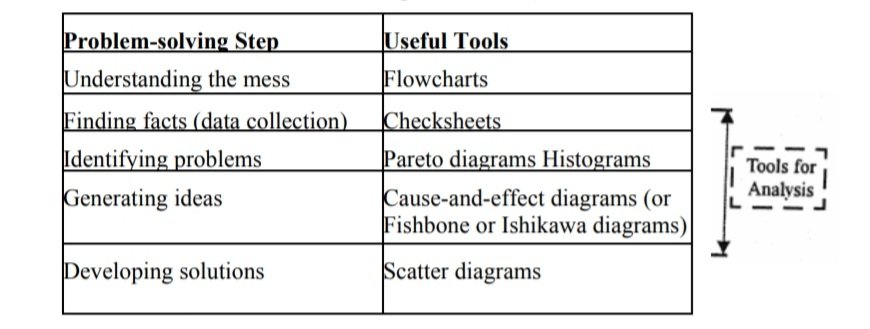
Problem Solving & QC tools
Apart from these tools we have other basic tools, such as, brainstorming, grouping and stratification to help guide the problem solving process.
• Brainstorming is a group process in which group members express their ideas in a creative atmosphere. All ideas are acceptable. The objective is to generate a lot of ideas which can be further defined in stages to identify the root causes of problems.
• Grouping helps in focusing the problem solving efforts. Sometime problems can be slated in several different forms by different individuals. These can be grouped under one key topic.
• Stratification helps in breaking down data into levels (for example, data collection by time, shifts, machines, stages etc.). Sometimes it is more meaningful to analyze stratified data.
Organized problem solving involves defining the problem, identifying the root cause of the problem, identifying the various solutions, selecting the best solution, and recommending corrective action procedures for either controlling, reducing, or eliminating problems.
• Improving the process
Control means maintaining a certain level of performance while improvement means achieving a higher level of performance. The difference between control and improvement. To monitor the performance, processes must be measurable.
We use statistical process control (SPC) techniques to measure and analyze variations in a process. In any process, the process-performance measures fluctuate randomly, due to common causes, around a certain target value (or average value known as process mean). However, due to some special causes we also have non-random variations taking place.
• Process Capability Studies
Continuous improvement leads to process improvement which means variability reduction through enhancement of process capability. TQM organizations that depend on outside suppliers often expect their suppliers to provide process capability data along with the parts that are supplied.
Q.2. Explain different types of layout with a neat diagram. (10)
Types of layout
1. Process or Functional Layout
A process layout is the arrangement of facilities and equipments in groups according to function performed. Different orders follow different paths through the system, depending on their special processing requirements.
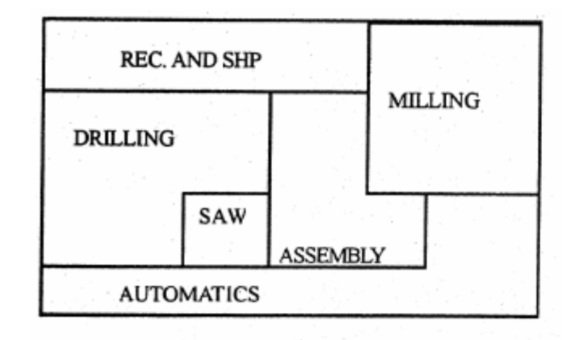
Process layout
This grouping, in a process layout. results in departments like drilling, milling, sawing turning, painting, receiving and shipping etc. It may be noted that there is no loss in efficiency (in the context of operation) if machines used to convert materials into products are located long distance apart. The problem is about the loss of time, wasted effort and cost of moving materials. This grouping of machines by function is characteristic of job shops and batch type production facilities.
2. Product or Line Layout
A product layout is an arrangement of facilities and equipment in the same sequence as that of the operations needed to complete each unit of the product or the service offered. Successive units follow the same path through the system.
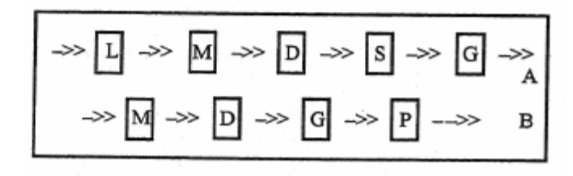
Product layout
Examples of such layouts, which are characteristic of mass or continuous production, may be found in such industries as cement manufacturing, oil refining, machining of engine cylinder blocks, crankshafts, domestic appliances, automobile assembly and mass production of similar hard discrete items. In contrast to process layouts, product layouts are not flexible since they are specifically designed for making or assembling a single product.
3. Fixed Position Layout
A fixed position layout is the arrangement of facilities and equipment so that resources needed in the form of workers, equipment, materials etc. flow to the item being produced or serviced.
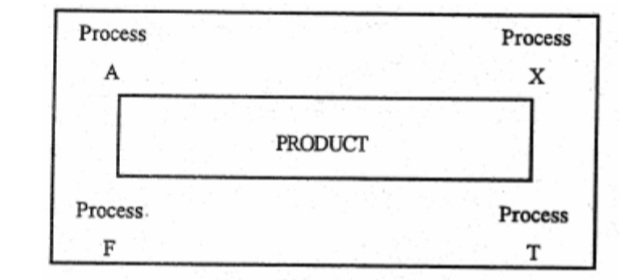
Fixed position layout
This type of layout is characteristic of such jobs as assembling large steam turbines, ship building, bus body building etc. Unlike the previously discussed layouts, this requires both people and machines to be brought to the product being made or assembled.
This selection of a fixed position layout is often dictated by the complexity, the size or some other unique feature of the task performed. The size and weight of a ship or jumbo jet do not allow any alternatives. Similarly the maintenance of a steel mill, a power plant,-or a building dictate that resources be moved to the place where the work must be performed.
The crucial aspect in the application of this type of layout is the requirement for effective scheduling, coordination and control of the productive activities involved and the resources used in the process (project scheduling).
4. Combination Layout
Very often a combination of layouts is used. Typically, a process layout is combined with a product layout. For example, in refrigerator manufacturing, a process-oriented layout is used to produce various parts (i.e. metal forming, welding, heat treatment). For the final assembly of the refrigerator, all these functions-are placed in a product-oriented layout.
Q.3. Explain the Basic Inventory Model. (10)
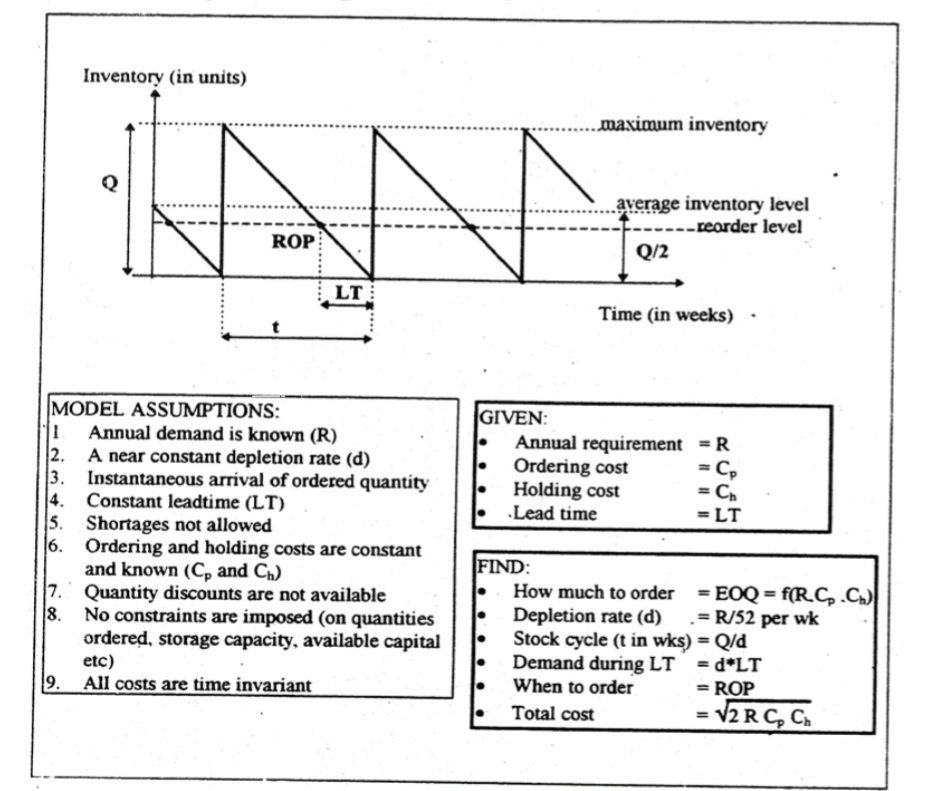
Inventory model is a mathematical model that helps business in determining the optimum level of inventories that should be maintained in a production process, managing frequency of ordering, deciding on quantity of goods or raw materials to be stored, tracking flow of supply of raw materials and goods to provide uninterrupted service to customers without any delay in delivery.
Three of the most popular inventory control models are Economic Order Quantity (EOQ), Inventory Production Quantity and ABC Analysis.
Basic Inventory Model
Each model has a different approach to help you know how much inventory you should have in stock. Which one you decide to use depends on your business.
The economic order quantity tells us how much, to order in each cycle. But we would also like to know when to place the order. As we know, there is a certain time needed to process an order by both the customer and the supplier. The time between placing an order and its arrival is known as the lead time.
Q.4. Explain the elements required for MRP implementation. (10)
Elements required for MRP implementation are
1. Master Scheduling
By controlling the master schedule, top management can control customer service, inventory levels, and manufacturing costs. The purpose is to specify the output of the operations function. Top managers can not perform the master scheduling task by themselves, because there are too many details. They can set master-scheduling policy, thereby controlling the materials planning function.
Top management should also interface with manufacturing through the aggregate production plan. The aggregate production plan deals with families of products or product lines, not the specific products, models. For example in car manufacturing the aggregate production plan might contain various types of cars, but not the particular type of engine, hydraulic options, other features which can be selected by the customer. It seeks to make the resources, equipment,’ people, and other facilities available for the future. As a result of an inflated master scheduling, the order priorities are no longer valid.
2. Bill of Materials (BOM)
It is a structure list of all the materials or parts needed to produce a particular finished product, assembly, subassembly, manufactured parts, or purchased parts. It is as good as a recipe used for cooking. Some companies have several BOMs for same product. Engineering has one BOM, manufacturing hat: a different version and cost accounting has still different. An MRP system requires a single BOM for the entire company. BOMs are constantly undergoing change as products are redesigned.
3. Inventory Records
In practice constant effort is required to keep inventory records accurate. Traditionally, inventory accuracy has been assured by annual physical inventory count, where the plant is shut down for a day or two and everything is counted from wall to wall. With cycle counting, a small percentage of the items are counted each day by storeroom personnel. Errors are corrected in the records and an attempt is made to find and correct the procedure which caused them.
4. Capacity Planning
The necessary elements of an order-launching materials requirement planning system have been described above. This system requires master scheduling, a DOM, inventory records and parts explosion. The parts explosion process assumes that the master schedule is feasible with respect to capacity. Using the master schedule as, input, parts are exploded to produce shop orders and purchase orders. If sufficient capacity is not available, then either capacity or the master schedule must be changed until the master schedule is feasible.
5. Purchasing
The purchasing function is greatly enhanced by the use of an MRP system. First, past-due ‘ orders are largely eliminated because MRP generates valid due dates and keeps them up to dam. By developing and executing a valid materials plan, management can .eliminate much of the order expediting which is usually done by purchasing. With an MRP system, it is possible to provide vendors with reports of planned future orders. The practice of giving vendors planned orders more closely interlocks them with the company’s own material plan.
OR Forecast values and the actual values are given below: (5×2=10)
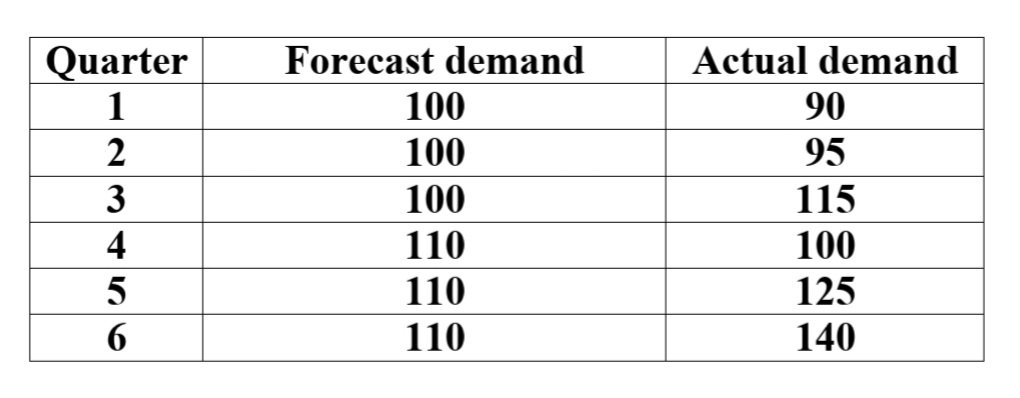
Calculate:
a. RSFE
b. Forecast error
c. Cumulative error
d. MAD
e. Tracking signal
Solution
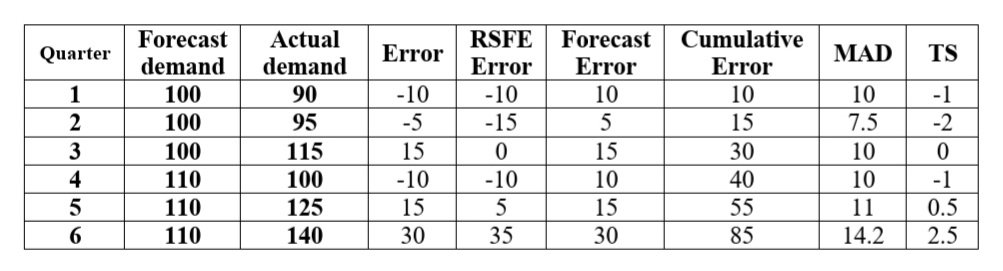
a. RSFE = Running Sum of Forecast Error
b. Forecast Error = Actual demand- Forecasted demand
c. Cumulative Error = Sum of the forecast error
d. MAD = Sum of the absolute value of the forecast error for all periods / No. of periods
= ∑(Forecast demand – actual demand)/ n
,Where n is the number of periods
MAD is used to determine whether the forecast is tracking with the actual time-series values.
e. Tracking signal = Running sum of forecast error/ MAD
= RSFE/ MAD
Q.5. Define (any five): (5×2=10)
a. Quantity control
Quantity control is an important aspect in the relationship with a supplier. To ensure that all contractual obligations have been met, and to prevent any possible disputes, a verification by an independent third party can save you a lot of trouble in the long run.
Often created by a quantity control or quota. -A quantity control, or quota, drives a wedge between the demand price and the supply price of a good; that is, the price paid by buyers ends up being higher than that received by sellers.
b. Rating
Rating is the process in which the time study analyst assesses the rate of working of the worker with respect to his own concept of normal rate. Rating is carried out because the worker being observed may be working at a rate different from file ‘normal’ rate. Therefore, an adjustment factor. known as performance rating, is used by the observer to adjust the ‘observed time’ to ‘normal time’.
The observed time, OT= ∑xî/n
Where x sum of observed times,
n = number of observations
Normal Time, NT = OT× R .
where, OT = Observed time,
R = Performance rating
This assumes that a single performance rating has been made or the entire job, If, however, ratings are made on an element-by-element basis, the normal time is obtained by multiplying each element’s average time by performance rating and summing the values:
NT = ∑ (x ×Ri)
where x = Average time for element,
Ri = Performance rating for element
For example, performance rating of 0.8 means that the pace is 80 percent of normal whereas a rating of 1.20 indicates a pace that is faster than normal by 20 percent.
c. Methods study
Methods Study is the systematic recording and critical examination of the factors and resources involved in existing and proposed ways of doing work, as a means of developing and applying easier and more effective methods and reducing costs.
Methods Study basically deals with finding better ways of doing work and it helps improve productivity by eliminating unnecessary work, avoidable delays and other types of waste. These are achieved by
• Improved working procedures
• Improved layout
• Improved working environment
• Improved product design
d. TQM
“Total Quality Management (TQM) is an approach to improving the effectiveness and flexibility of business as a whole. It is essentially a way of organising and involving the whole organisation, every department every activity, every single person at every level.” -Oakland
TQM is a philosophy that believes in a company-wide responsibility toward quality via fostering a quality culture throughout the organisation; involving continuous improvement in the quality of work of all employees with a view to best meeting the requirements of customers.
e. Operations process chart
An operation process chart (OPC) represents the sequence of operations to be performed on a component. It gives a bird’s-eye view of the various operations, inspections, and storage done in sequence for all the components that go into a particular product or assembly.
f. Volume flexibility
Volume flexibility is the ability of a manufacturing system to be operated profitably at different overall output levels. It demonstrates the competitive potential of the firm to increase production volume to meet rising demand and to keep inventory low as demand falls.
Q.6. Explain the characteristics of JIT system. (10)
JIT
Just-in-time systems focus on reducing inefficiency and unproductive time in the production process to improve continuously the process and the quality of the produce or service. Employee involvement and inventory reduction are essential to JIT operations. Just-in-time systems are known by many different names, including zero inventory synchronous manufacturing , lean production, stock less production (Hewlett- Packard), material as needed (Harley – Davidson ), and continuous flow manufacturing (IBM).
Characteristics of JIT are
1. People Involvement
Probability all management efforts have some behavioural aspects, because management is working through other people to accomplish the organization’s objectives. Management plans and decisions only lay the groundwork. This is the resulting human behaviour that determines a company’s success or failure.
2. Teamwork
First, and foremost, a culture of mutual trust and teamwork must be developed in an organization. Managers and workers must see each other as co-workers committed to the company’s success.
3. Discipline
This open, improvement – driven atmosphere does not mean, however, that any employee is free to work by any method he or she choose to try. Usually there is a standard way each job is to be done. If an improvement is suggested and approved, a new standard procedure will be adopted. This standardization prevents variations in products or services which can cause defects. Defects occur- because some variation has been introduced into a material or procedure that normally products good result.
4. Total Quality Management (TQM)
JIT systems seek to eliminate scrap and rework in order to achieve a uniform flow of materials. Efficient JIT operations require conformance to product or service specifications. JIT systems control quality at the source, with workers acting as their own quality inspectors.
5. Pull Method of Material Flow
Just-in-time systems utilize the pull method of material flow. However, another popular method of material flow is the push method. To differentiate between these two systems, we consider the production system for a fast food dish at a restaurant. There are two workstations. The dish maker is the person responsible for producing; this dish: the cutlets must be prepared; buns must be toasted and then dressed with ketchup, pickles, onions, lettuce, and cheese; and the cutlets must be inserted into buns and put on a tray. The final assembler takes the tray, wraps the buns in paper, and restocks the inventory.
6. Small Lot Sizes
Rather than building up a cushion of inventory, users of JIT systems maintain inventory with lot sizes that are as small as possible. Small lot size have three benefits. Small lot sizes reduce cycle inventory, the inventory in excess of the safety stock carried between orders. The average cycle inventory equals one-half the lot size: As the lot size gets smaller, so does cycle inventory. Reducing cycle inventory reduces the time and space involved in manufacturing and holding inventory.
7. Short Setup Times
Reduced lot sizes have the disadvantage of increased setup frequency. In operations where the setup times are normally low, small lots are feasible. However, in fabrication operations with sizable setup times, increasing the frequency of setups may result in wasting employee and equipment time. Theses operations must reduce setup times to realize the benefits of small-lot production.
8. Uniform Workstation Loads
The JIT systems work. best if the daily load on individual workstation is relatively uniform. Uniform loads can be achieved by assembling the same type and number of units each day, thus creating a uniform daily demand at all workstations. Capacity planning, which recognizes capacity constraints at critical workstations, and line balancing are used to develop the monthly master production schedule.
9. Standardized Components and Work Methods
The standardization of components, called part commonality or modularity, increases repeatability. For example, a firm producing 10 products from 1000 different components could redesign its products so that they consist of only 100 different components with large daily requirements. Because the requirements per components increase, so does repeatability; that is, each worker performs a standardized task or work method more often each day.
10. Product Focus
A product focus can reduce the frequency of setups. If volumes of specific products are large enough, groups of machines and workers can be organized into a product layout to eliminate setups entirely. It volume is insufficient to keep a line of similar products busy, group technology can be used to design small production lines that manufacture, volume, in families of components with common attributes. Changeovers from a component in one product family to the next component in the same family are minimal.
11. Automated Production
Automation plays a big role in JIT systems and is a key to low-cost production. Sakichi Toyota, the founder of Toyota, once said “whenever there is money, invest it into machinery”. Money freed up because of JIT inventory reductions can be invested in automation to reduce costs. The benefits, of course, are greater profits, greater market share (because prices can be cut), or both. Automation should be planned carefully, however, many managers believe that if some automation is good, more is better. That isn’t always the case.
Q.7. Explain the concept of forecast with a neat diagram. (10)
Usually forecasting and predicting are used interchangebly in general usage. Adam and Ebert in their book Production and operation management have defined and distinguished the two as follows:
Forecasting: “Is a process of estimating a future event by casting forward past data. The past data are systematically combined in a predetermined way to obtained the estimate of the future”.
Prediction: “Is a process of estimating a future event based on subjective considerations other than just past data; these subjective considerations need not be combined in a predetermined way”.
Thus forcast is an estimate of future values of certain specified indicators relating to a decisional/planning situation. In some situations forecast regarding single indicator is sufficient, where as, in some other situations forecast regarding several indicators is necessary. The number of indicators and the degree of detail required in the forecast depends on the intended use of the forecast.
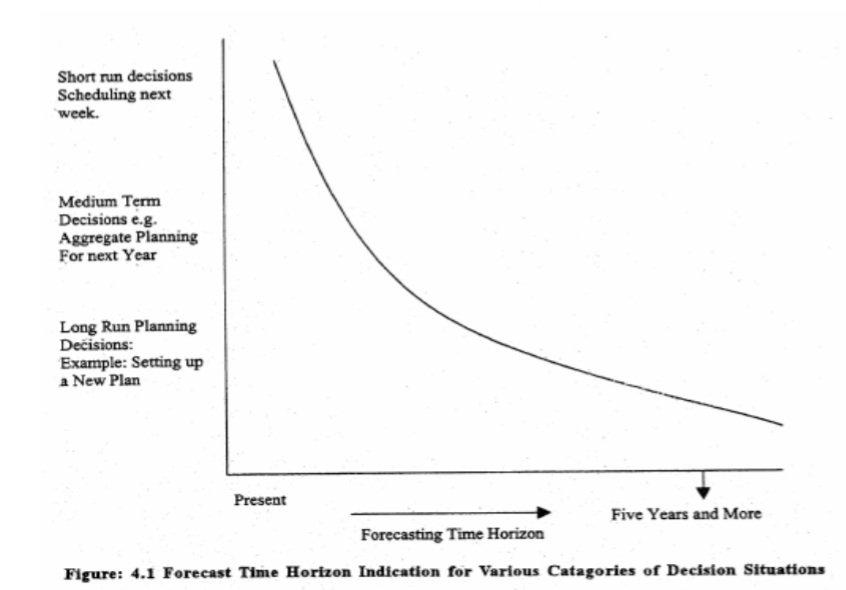
Concept of Forecast
What methodology is to be used for projecting the past data into future? – depends on :
a. Type of past data
b. Pattern of past data
c. Time horizon of forecast
This method of projecting the past into future is termed as FORECASTING MODEL. A large many statistical forecasting models are available suitable to different decisions.
Q.8. What are the various issues in Materials Management? (10)
Major activity groups involved in materials management in any manufacturing organisation, several issues emerge, which need to be considered while discharging its functions some of these are
A. Issues related to materials planning
1. Materials Identification
2. Standardisation
3. Make or buy
4. Coding & Classification
5. Quality Specification
B. Issues related to purchase
1. Centralisation vs Decentralisation
2. Single Source vs Multiple Source
3. Vendor/Ancillary Development
4. Vendor Rating
5. Size and Timing of Purchase Orders
C. Issues Relating to Storage and Material Handling
1. Optimum Level of Inventory
2. Location and Layout of Store
3. Storage System
4. Receiving Inspection and Record Keeping
5. Material Handling and Equipment.
OR Explain the importance and application of forecasts in production operations management. (10)
Applications of forecasting in operations management
Forecasting is helpful in operations management as regard to the aggregate demand forecast. It is obtained by estimating expected volumes of sales, expressed in dollars, and then converting the sales dollars into homogeneous production units. Production unit can be subdivided into component parts and converted into labor or material requirements.
1. Planning the system
Managers need to forecast demands so that they can design or redesign processes necessary to meet demand. Automated, continuous flows facilitate high production volumes; manual or semi-automated, intermittent flows are generally more economical for smaller production volumes. The demand forecast is critical to this design.
2. Scheduling the system
Job scheduling in intermittent and continuous operations is more stable if demand forecasts are accurate. Accurate demand forecasting is needed for best utilisation of the existing conversion system. Managers need intermediate run demand forecasts for three months, six months, and a year into the future. Both current and future workforce levels and production rates must be established from these forecasts.
3. Controlling the system
In regards to controlling inventory, production, labor, and overall costs, managers need accurate demand forecast. Accurate forecasts are needed for the immediate future- hours, days, and weeks ahead. Thus a computerised forecasting system may be needed for these decisions.
4. Some other applications
• New plant for production expansion
• Seasonal production planning
• Capacity planning
• Intermediate operational planning
• Short run production adjustment
• Scheduling Production
• Product development
Q.9. Write short notes on: (5+5=10)
a. Steps in aggregate planning
Steps in Aggregate Planning
1. Begin with a sales forecast for each product that indicates the quantities to be sold in each time period (usually weeks, months, or quarters) over the planning horizon (usually 3 months to 12 months).
2. Total all the individual product or service forecasts into one aggregate demand. If the products are not additive because of heterogeneous units, a homogeneous unit of measure must be selected that both allows the forecasts to be added and links aggregate outputs to production capacity.
3. Transform the aggregate demand for each time period into workers, materials machines, and other elements of production capacity required to satisfy aggregate demand.
4. Develop alternative resource schemes for supplying the necessary production capacity to, support the cumulative aggregate demand.
5. Select the capacity plan from among the alternatives considered that statistics aggregate demand and best meets the objective of the organisation.
b. Various classification of production system
Production systems can be classified as
1. Job-Shop Production
Job-shop production are characterized by manufacturing one or few quantity of products designed and produced as per the specification of customers within prefixed time and cost. The distinguishing feature of this is low volume and high variety of products.
2. Batch Production
American Production and Inventory Control Society (APICS) defines Batch Production as a form of manufacturing in which the job pass through the functional departments in lots or batches and each lot may have a different routing. It is characterized by the manufacture of limited number of products produced at regular intervals and stocked awaiting sales.
3. Mass Production
Manufacture of discrete parts or assemblies using a continuous process are called Mass Production.
This production system is justified by very large volume of production. The machines are arranged in a line or product layout. Product and process standardization exists and all outputs follow the same path.
4. Continuous Production
Production facilities are arranged as per the sequence of production operations from the first operations to the finished product. The items are made to flow through the sequence of operations through material handling devices such as conveyors, transfer devices, etc.
Q.10. A. Choose the right answer: (5)
1. A unique Japanese information system that harmoniously controls the production quantities in each process:
a. Kanban system
b. Japanese system
c. Elbert system
d. Shiego system
Ans – a. Kanban system
2. Input is equal to:
a. Excess +Waste
b. Output minus Waste
c. Output +Input
d. Output +Waste
Ans – d. Output + Waste
3. An average that is repeatedly updated is known as:
a. Composition Average
b. Repeated Average
c. Summation Average
d. Moving Average
Ans – d. Moving Average
4. SPT refers to:
a. Shortest processing time
b. Shortest production time
c. Shortest prevention time
d. Shortest publishing time
Ans – a. Shortest processing time
5. When goods and services are produced by performing same activities in specified sequence repetitiveness, we call it a:
a. Batch production
b. Job shop production
c. Mass production
d. Assembly line production
Ans – c. Mass production
B. Match the following: (5)
Answer