
Table of Contents
Q.1. Discuss the emerging roles of Production & Operations manager in India. (10)
Depending on the nature of company, operations managers need to perform various managerial functions like, planning, directing, coordinating operations, decision taking, policy framing, controlling inventory, supply chain management, job scheduling, job-wise manpower allocation, etc.
The functions of a operations manager even though vary with the nature of the products or services, it can typically have following commonalities
1. Production Planning and Control
This involves deciding the course of action for actual production after the receipt of orders. Usually, Sales or Marketing Department receives or books orders from the customers and send their requisitions for manufacturing to Production Planning and Control Department and progress the job to ensure the execution of orders of meeting the customers’ satisfaction. Effective production planning and control, therefore, ensure meeting the prime objectives of production, i.e., to manufacture and to deliver, meeting customers’ requirements.
2. Production
After production planning and control, the next important function of a production manager is to ensure manufacturing or the production of finished goods in conformity with the plans.
3. Inspection
After production process is over, inspection or quality checking is necessary. This type of inspection is known as final inspection. However, for the increased emphasis on quality control, many organizations now also carry out in-process inspection. This minimizes the problem of rejection. In addition, inward inspection is also carried out for controlling the quality of raw materials and components.
4. Engineering
Manufacturing or production activities are also needed to be supported by design and development, which not only include designing tools, jigs and fixtures (this is done by independent Tool Room Department in large organizations) but also involves R&D activities for innovative product design and changes.
5. Industrial Engineering
A production manager is also required to carry out periodic work study, following method study or work measurement technique for systematic investigation of activities in order to ensure effective use of human and material resources. (While method study helps in finding the best way of doing a work, work measurement helps in assessing the time required for doing a job).
6. Maintenance
Production manager is also responsible for time-to-time maintenance of plant and machineries to minimize machine downtime and consequent loss of production. While traditional concept is breakdown maintenance, i.e., to attend plant and machineries only, when they become dysfunctional, modern concept is Total Productive Maintenance, which also calls for preventive maintenance action to minimize machine downtime.
7. Interdepartmental Coordination
A production manager is also required to maintain contacts with other departments, like, Sales Department with regard to production plan, Personnel Department for manpower availability and training and Materials Department for procurement of raw materials and other components.
The responsibilities of a production manager can be summarized as follows.
1. Forecasting the requirements of the production in order to achieve the production target.
2. Making most efficient utilization of the available sources for production.
3. Minimizing ‘throughput time’ and ‘work in process inventory’. This can be achieved by systematic production planning and also by very efficient execution of the plans.
4. One of the most important responsibility of a production manager deals with reducing material handling cost, which generally is achieved by the use of efficient material handling system and also by using plant layouts which must be developed in a proper or correct way.
5. Reducing the quality cost with the help of analysis of non conformances on periodic basis and also by following suitable actions (both corrective and preventive).
6. Building team spirit among the workmen and also motivating by means of personal involvement. This task of motivation can also be achieved by designing and implementing suitable financial incentive schemes.
7. To device accurate methodology involving method study of manufacturing, along with the other engineering economic principles.
8. Improving the productivity level of the workers on continuous basis by workmen’s training and by bringing into use the standards of the performance derived from work measurement studies etc.
Q.2. Explain the Qualitative and Quantitative method of demand forecasting with relevant examples. (10)
Demand forecasting is a process of predicting the demand for an organisation’s products or services in a specified time period in the future.
Techniques & methods of demand forecasting are –
A. Qualitative Techniques
1. Survey Methods
2. Opinion polls
3. Delphi Method
4. Market studies and experiments
B. Quantitative Techniques
1. Time Series Analysis
2. Smoothing Techniques
3. Barometric Methods
4. Econometric Methods
Qualitative Techniques
Qualitative techniques rely on collecting data on the buying behaviour of consumers from experts or through conducting surveys in order to forecast demand.These techniques are generally used to make shortterm forecasts of demand.
Qualitative techniques are especially useful in situations when historical data is not available; for example, introduction of a new product or service. These techniques are based on experience, judgment, intuition, conjecture, etc.
1. Survey Methods
Survey methods are the most commonly used methods of forecasting demand in the short run. This method relies on the future purchase plans of consumers and their intentions to anticipate demand.
Thus, in this method, an organization conducts surveys with consumers to determine the demand for their existing products and services and anticipate the future demand accordingly. The two types of survey methods are explained as follows:
• Complete enumeration survey
This method is also referred to as the census method of demand forecasting. In this method, almost all potential users of the product are contacted and surveyed about their purchasing plans.
Based on these surveys, demand forecasts are made. The aggregate demand forecasts are attained by totalling the probable demands of all individual consumers in the market.
• Sample survey
In this method, only a few potential consumers (called sample) are selected from the market and surveyed. In this method, the average demand is calculated based on the information gathered from the sample.
2. Opinion poll
Opinion poll methods involve taking the opinion of those who possess knowledge of market trends, such as sales representatives, marketing experts, and consultants.
• Expert opinion method
In this method, sales representatives of different organisations get in touch with consumers in specific areas. They gather information related to consumers’ buying behaviour, their reactions and responses to market changes, their opinion about new products, etc.
3. Delphi method
In this method, market experts are provided with the estimates and assumptions of forecasts made by other experts in the industry. Experts may reconsider and revise their own estimates and assumptions based on the information provided by other experts.
4. Market studies and experiments
This method is also referred to as market experiment method. In this method, organisations initially select certain aspects of a market such as population, income levels, cultural and social background, occupational distribution, and consumers’ tastes and preferences.
Quantitative Techniques
Quantitative techniques for demand forecasting usually make use of statistical tools. In these techniques, demand is forecasted based on historical data.
These methods are generally used to make long-term forecasts of demand. Unlike survey methods, statistical methods are cost effective and reliable as the element of subjectivity is minimum in these methods. Different types of quantitative methods:
1. Time Series Analysis
Time series analysis or trend projection method is one of the most popular methods used by organisations for the prediction of demand in the long run. The term time series refers to a sequential order of values of a variable (called trend) at equal time intervals.
Using trends, an organisation can predict the demand for its products and services for the projected time. There are four main components of time series analysis that an organisation must take into consideration while forecasting the demand for its products and services.
2. Smoothing Techniques
In cases where the time series lacks significant trends, smoothing techniques can be used for demand forecasting. Smoothing techniques are used to eliminate a random variation from the historical demand.
This helps in identifying demand patterns and demand levels that can be used to estimate future demand. The most common methods used in smoothing techniques of demand forecasting are simple moving average method and weighted moving average method.
The simple moving average method is used to calculate the mean of average prices over a period of time and plot these mean prices on a graph which acts as a scale.
3. Barometric Methods
Barometric methods are used to speculate the future trends based on current developments. This methods are also referred to as the leading indicators approach to demand forecasting.
Many economists use barometric methods to forecast trends in business activities. The basic approach followed in barometric methods of demand analysis is to prepare an index of relevant economic indicators and forecast future trends based on the movements shown in the index.
4. Econometric Methods
Econometric methods make use of statistical tools combined with economic theories to assess various economic variables (for example, price change, income level of consumers, changes in economic policies, and so on) for forecasting demand.
The forecasts made using econometric methods are much more reliable than any other demand forecasting method. An econometric model for demand forecasting could be single equation regression analysis or a system of simultaneous equations.
Q.3. What are the location factors to be considered for a Restaurant? How will you decide the layout after identifying the location of the restaurant site? (5+5=10)
Important Factors are
1. Parking
Ideally, a new restaurant location should have its own parking lot. If that isn’t an option for example, in a major city consider partnering with a hotel in the area that has its own parking options. Many famous restaurants are housed in hotels, and for a good reason. Not only is there parking, but the benefit of foot traffic that is staying right upstairs is incalculable.
2. Accessibility
There’s a reason that major restaurant chains are often located near highway exits: It makes them accessible for customers. Certain restaurants can get away with food or service that isn’t the best simply because their locations are so accessible, like restaurants near the Eiffel Tower or Collisseum. There is plenty of foot traffic in urbanized areas, and restaurants only need to attract customers from the street into their business. Most successful restaurants other than the truly elite are easy to find, and you will find them in city centers or unique locations throughout the world.
3. Visibility
This goes along with accessibility and is very important for new restaurant locations. People have to know the restaurant is there, either in person or on their mobile devices. It is why property prices in downtown districts and developed strips are higher than in other areas. They offer a level of visibility that can bring in a great deal of walk-in business. Consider advertising in search engines and social media to enhance your presence across all forms of media. Make sure to register your restaurant in search engines as the type of food you offer and your price point, as it will be easier to attract the clientele you want when they go to search.
4. Population Base
Are there enough people in the area to support your business? There need to be enough people who live in or pass through the area regularly to keep you busy. To determine a particular area’s population base, you could do a site study. However, these can cost up to $25,000. Most people looking at their first restaurant don’t have enough money in their budget for a professional survey.
5. Space Size
The space you rent or buy needs to fit your size requirements. For every restaurant seat, you need about five square feet of kitchen space, so if you have eighty seats in your restaurant, your kitchen needs to have 400 square feet of space minimum. Larger spaces reduce workplace accidents by minimizing slips, trips, and falls, the most common workplace accident according to OSHA.
4. Crime Rates
Crime rates are unglamorous considerations, but if you place your restaurant in a crime-laden area, are your target customers going to visit? High crime rates can make potential customers uncomfortable, and if they feel they’ll be mugged walking to their cars, it will only drive away business, no matter how legendary your coq au vin.
5. Surrounding Businesses and Competitor Analysis
You’ll want to do your research surrounding businesses. Are they doing well? Is the area affluent? Is there enough room for your business? Also, you’ll want to know what types of restaurants do well in the area; however, you don’t want to open a pizzeria if there are four in the area. Areas can only support so many of the same type of restaurant. What will distinguish any new restaurant is excellent service and consistently wonderful food.
Things to Consider During Restaurant Site Selection
Keep the following points in mind while deciding the location of the restaurant.
1. Market Research
Before doing anything else for the restaurant site selection, we must do market research and an industry analysis on the location where we wish to open our restaurant. The area where we are going to open a restaurant must be scrutinized on all levels: right from the current competition to our potential customers.
2. Front Location Restaurant site selection that will help the business grow.
A front location can do wonders for the restaurant. A restaurant right at the front of the building has maximum visibility and generates the highest footfalls compared to the other areas. Customers usually choose the restaurant that is right in front of them. If the restaurant is not readily visible or requires customers to take a detour, chances are the customer would not go to the restaurant at all.
3. Upper Floor or Rooftop Location
Upper floor locations should ideally be avoided during the restaurant site selection process. Rooftop locations have less visibility, and it is also difficult for customers to reach the top floor restaurant. If we must set up your restaurant on an upper floor, at least ensure that the building has an elevator.
4. Size
The size of the location is an essential factor to be considered during the restaurant site selection process. The size of the restaurant does not just imply the dining space. The site should be big enough to accommodate all the kitchen equipment. Walk-in freezer, cooking stations, etc. all require large spaces. Depending on the concept we can decide the size of the seating area, bar, etc. A cramped up space to accommodate more customers often works the opposite and drives customers away because of the small and narrow dining space.
5. Building Amenities
We need to check whether the building that we have chosen for our restaurant has the desired amenities or not. Complete power backups must always be present in the restaurant building. Having a bathroom is also a must in the restaurant, and must not be ignored during the restaurant site selection.
6. Budget
All the factors mentioned above decide the price of the property. Prime locations with better facilities cost more. A good spot is essential; however, it does not make sense to spend a fortune on the restaurant site. The cost of the site must never exceed more than 10% of your revenues. Choosing a restaurant site that fulfills all the requirements, and yet is cheap can be a daunting task, and is, therefore, one of the biggest challenges of setting up a restaurant.
Q.4. Define any five of the following terms: (5×2=10)
a. Capacity utilization rate
Capacity utilization rate is a metric which is used to compute the rate at which probable output levels are being met or used. The output is displayed as a percentage and it can give a proper insight into the general negligence that the organization is at a point of time. Capacity utilization rate is also called as operating rate.
Capacity utilization rate also helps in verifying the level at which piece costs will rise. Capacity utilization rate is best when used for companies that manufacture physical products instead of services, as it is easy to quantify goods than services.
Formula used to measure Capacity Utilization Rate:
The capacity utilization rate can be ascertained using the formula
= Actual Output / Potential Output x 100
For Example,
If company ABC produces 15,000 computer chips at a cost of around $0.50 per unit, and if it has been determined that the company can further produce 20,000 units without a rise in the cost of production, the company is found to be working at a capacity utilization rate of 75% i.e., (15000/20000*100)
The capacity utilization rate provides with the value of production capacity which is actually being utilized over a specified period, and by providing the output in percentages, it can provide you a clearer idea of the total utilization of resources and how better the production company can fare in case the total output is increased without it effecting the cost of production to the company.
b. Job shop production system
In jobbing production system, variety of products is larger than the batch production and quantities to he produced at a time are significantly lower. In jobbing industry, it is very difficult to predict the type of work and its requirement in terms of demand.
Besides, each order or job maybe quite different in terms of operations, their sequence and time taken at a workstation. A job shop would also use general-purpose machines, grouped together into departments only when the total volume of business is large. Job shops are usually small and suffer from lack of support services and functions. Uneven loads at different machines or departments is quite common in practice small and suffer from lack of support services and functions. Uneven loads at different machines or departments is quite common in practice.
c. Decision tree analysis
A Decision Tree Analysis is a graphic representation of various alternative solutions that are available to solve a problem. The manner of illustrating often proves to be decisive when making a choice. A Decision Tree Analysis is created by answering a number of questions that are continued after each affirmative or negative answer until a final choice can be made.
A Decision Tree Analysis is a scientific model and is often used in the decision making process of organizations. When making a decision, the management already envisages alternative ideas and solutions.
By using a decision tree, the alternative solutions and possible choices are illustrated graphically as a result of which it becomes easier to make a well-informed choice.
d. Kaizen
Kaizen is a Japanese term meaning “change for the better” or “continuous improvement.” It is a Japanese business philosophy regarding the processes that continuously improve operations and involve all employees. Kaizen sees improvement in productivity as a gradual and methodical process.
The concept of kaizen encompasses a wide range of ideas. It involves making the work environment more efficient and effective by creating a team atmosphere, improving everyday procedures, ensuring employee engagement, and making a job more fulfilling, less tiring, and safer.
• Kaizen is a Japanese business philosophy that focuses on gradually improving productivity by involving all employees and by making the work environment more efficient.
• Kaizen translates to “change for the better” or “continuous improvement.”
• The small changes used in kaizen can involve quality control, just-in-time delivery, standardized work, the use of efficient equipment, and the elimination of waste.
• Changes can come from any employee anytime and don’t have to happen slowly, although kaizen recognizes that small changes now can have big future impacts.
Many companies have adopted the kaizen concept. Most notably, Toyota employs the kaizen philosophy within its organization and has esteemed it as one of its core values. Within its production system, Toyota encourages and empowers all employees to identify areas of potential improvement and create viable solutions.
e. Breakeven analysis
Break-even analysis entails calculating and examining the margin of safety for an entity based on the revenues collected and associated costs. In other words, the analysis shows how many sales it takes to pay for the cost of doing business. Analyzing different price levels relating to various levels of demand, the break-even analysis determines what level of sales are necessary to cover the company’s total fixed costs. A demand-side analysis would give a seller significant insight into selling capabilities.
• Break-even analysis tells you how many units of a product must be sold to cover the fixed and variable costs of production.
• The break-even point is considered a measure of the margin of safety.
• Break-even analysis is used broadly, from stock and options trading to corporate budgeting for various projects.
f. Service facility layout
Service facility layout are designed based on degree of customer contact and the service
needed by a customer. These service layouts follow conventional layouts as required. For example, for car service station, product layout is adopted, where the activities for servicing a car follows a sequence of operation irrespective of the type of car. Hospital service is the best example for adaptation of process layout. Here, the service required for a customer will follow an independent path.
g. Motion study
The profounder of this concept was Frank Gilbesth. He defined motion study as the “Science of eliminating wastefulness resulting from ill-directed and inefficient motions”. The main aim of motion study is to find the scheme of least wastage of labour. Subsequently, the scope of Motion Study was enlarged and it was named as Method Study.
The method of study can also be defined as “Systematic recording and critical examination of existing and proposed ways of doing work as a means of developing and applying easier and more effective method and thereby reducing cost”. Method Study is a technique which includes the standardisation of equipment, method and working conditions, and training of the operator to follow the standard method.
Q.5. With the following data calculate standard production per shift of 8 hours duration: (10)
Observed time per unit = 8 minutes
Total allowance = 30% of normal time
Rating factor =150%.
Given,
Observed time – 8 Minutes
Rating factor = 150 %
Total allowance = 30 % of Normal time
Normal time per unit = Observed time / unit × Rating factor
= 8 ×(150 /100 ) = 12 minutes
Allowances = 30% of normal time
= (30×12)/100 = 3.6 minutes
Standard time/unit = Normal time/unit + Allowances
= 12 + 3.6 = 15.6 minutes/unit
Standard production in shift of 8 hours
= (8 ×60 )/15.6 = 30.76 units.
OR Explain the relevance of Management Information System in production, planning and control. (10)
Today the development of computer and communication technology (the combination of which is referred to as IT. information Technology) has dramatically reduced the cost, and increased the speed, reliability and global reach of information production and distribution. This development has ushered in a new age which is basically characterized by the production, distribution and utilization of large volumes of information unfettered by the constraints of physical distances, and an accompanying increase in-IT employment. For the purpose of this paper, we will focus only of electronic information that is transmitted between individuals or organizations regarding events and ides via computer and communication equipment.
The concept of production management emerges with the development of the factory system. As the factory system becomes more complicated, dedicated and integrated, the tasks and functions involved in production management have been expanding. The basic problem associated with traditional manufacturing systems is improper information flow among various departments which results in problems such as excessive inventories, large work in process, long manufacturing lead times, confusion and congestion on the shop floor and poor utilisation of resources. Industries with significant investments on capital equipment understand the importance of proactive planning systems to manage and maintain. Industries that maintain their investments at an optimum level of functionality and availability are able to realise the improvement in profits along with effective capacity utilisations and revenues increase.
Liberalisation, privatisation and’ globalisation have forced Indian industry to strive for productivity and quality to face competition from multinational companies (MNCs).
Integrated approach to factory management has clearly demonstrated its impact in many developed nations. In this, the role of computer aided integrated information system is not only of vital importance but essential.
The concept of production management emerges with the development of the factory system. As the factory system becomes more complicated, dedicated, and integrated, the tasks and functions involved in production management have been expanding. This makes comparison of the achievement in production management between firms very difficult, if not impossible. The three basic functions Of production management have been classified as production planning, resource planning and materials supply. The three basic functions are elaborated into eighteen subjects as shown below:
• Design of manufacturing processes
• Management of product design
• Facility planning
• Work measurement
• Materials handling
• Production planning
• Purchasing management
• Control and Management of production progress
• Statistical quality control
• Storage and warehousing management
• Management, of occupational safety
• Management of equipment and tools maintenance management and reliability
• Data (released to production management) collection and analysis
• Implementation of production information system
• Suggestion systems
• Coherence of manufacturing and marketing
• Total quality management
Q.6. A copper manufacturing company has designed capacity of 80,000 tons of copper per day, effective capacity is 70,000 tons per day and an actual output is 65,000 tons per day. Compute the efficiency of the plant and its utilization. (10)
Given,
Designed Capacity = 80000 tons
Effective Capacity = 70000 tons
Actual Capacity = 65000 tons
Utilization of the plant = (Actual Capacity / Design Capacity) ×100
= (65000/80000) × 100
= 81.25 %
Efficiency of the plant = (Actual Capacity /Effective Capacity) ×100
= (65000/70000)× 100
= 92.85%
OR Explain the purpose, scope and steps involved in aggregate production planning. (10)
Purpose of Aggregate Planning
• Aggregation
The aggregate plan is useful because it focuses on a general course of action, consistent with the company’s strategic goals and objectives, without getting bogged down in detail’s, for example, it allows managers to determine whether they can satisfy budgetary goals without having to schedule each of the company’s thousands of products and employees. Even. if a planner could prepare such a detailed plan, the time and effort required to update it would make it uneconomical.
Aggregate planning is normally done at the product type level of aggregation and at the facility level, rather than at the corporate level.
Assigning items to families and product types is easier than it may at first appear. One of the tricks to making this assignment is somewhat counter intuitive. Product types, families, and item from a hierarchy, with product types being the highest level of the three.
• Product Families
Sometimes, products families relate to market grouping or in the case of production plans, to specific manufacturing processes. A fur can aggregate its products or services into a set of relatively broad families, avoiding too much detail at this stage of the planning process. Common and relevant measurements, such as units, rupees, standard hour or litre, should be used. For example, consider the bicycle manufacturer that has aggregated all products into two families: mountain bikes and road bikes, this facilitates production planning for the assembly lines in the plant. A firm that socializes in quick oil changes might aggregate the services it offers into two categories: the basic service and special services.
• Labour
A company can aggregate labour in various ways, depending on workforce flexibility. For example, if workers at the bicycle manufacturer are trained to work on either mountain bikes or road bikes, for planning purposes management can consider its work force to be a single aggregate group, even through the skills of individual workers may differ.
Alternatively, management can aggregate labour along product family lines by splitting the work force into subgroups and assigning a different group to the production of each product family devoting production lines and even entire plants to separate product families. in service operations, such as a city government, workers are aggregated by the type of service they provide: fire fighters, police officers, Sanitation workers, and administrators.
• Time
A planning horizon is the length of time covered by an aggregate plan. Typically, the planning horizon is one year, although it can differ in various situations to avoid the expense and disruptive effect of frequent changes in output rates and the work force adjustment usually are made monthly or quarterly. In other words, the company rather than days or hours. Some companies use monthly planning periods for the near portion of the planning horizon and quarterly periods for the later portion.
Steps in Aggregate Planning
1. Begin with a sales forecast for each product that indicates the quantities to be sold in each time period (usually weeks, months, or quarters) over the planning horizon (usually 3 months to 12 months).
2. Total all the individual product or service forecasts into one aggregate demand. If the products are not additive because of heterogeneous units, a homogeneous unit of measure must be selected that both allows the forecasts to be added and links aggregate outputs to production capacity.
3. Transform the aggregate demand for each time period into workers, materials machines, and other elements of production capacity required to satisfy aggregate demand.
4. Develop alternative resource schemes for supplying the necessary production capacity to, support the cumulative aggregate demand.
5. Select the capacity plan from among the alternatives considered that statistics aggregate demand and best meets the objective of the organisation.
Q.7. Distinguish between the following (any two): (2×5=10)
a. Scheduling and sequencing
Sequencing
• Sequencing is the order of tasks to be done in chain. Hence the next task is started once the previous one is completed.
• Prioritize jobs assigned to a resource
• If no order specified use first-come first-served (FCFS)
• Other Sequencing Rules
FCFS – first-come, first-served
LCFS – last come, first served DDATE – earliest due date
CUSTPR – highest customer priority
SETUP – similar required setups
SLACK – smallest slack
CR – smallest critical ratio
SPT – shortest processing time
LPT – longest processing time
Sequencing Jobs
• Operations schedules are short-term plans designed to implement the sales and operations plan
• An operation with divergent flows is often called a job shop
Scheduling
Scheduling, on the other hand is the process in which people are assigned to time to accomplish different tasks.
• Operations scheduling is critical to the success of an organization; however, it can be a very complicated task.
• Effective schedules are needed to meet promised customer delivery dates or inventory targets.
• It covers the following areas in particular:
• assign job to a particular work center/ machine
• time of assignment of job and completion
• allocation of resources like manpower and materials
• time sequence of operations
• feedback and control function to take care of deviations
Objectives of Scheduling
• Making efficient use of the labour.
• Making best possible use of the equipment that are available for the use.
• Increasing the profit.
• Increasing the output.
• Improving the service level.
b. Forward scheduling and backward scheduling
Forward operations scheduling
• Classified on the basis of the time.
• All the activities are scheduled from the date of the planned order release.
• First task of the job is scheduled.
• Its subsequent task is scheduled on the scheduled completion of the first task.
• Like this, accordingly all the tasks of the job are scheduled.
Backward operations scheduling
• Also classified on the basis of the time.
• Activities are scheduled from the date or the planned receipt date.
• The last activity is scheduled first.
• Time of the start of the last task is considered as the time for the start of the previous activity.
c. Mass production and batch production system
Batch Production System
Batch production is a technique that utilizes various steps to produce numerous units. This form of production is typically used when a large number of high-quality items need to be produced. The units are moved from one step to another as a “batch”. Take, for example, a batch of cookies. The same step will be performed on numerous cookies all at once before they are moved on to the next step.
During batch production, products are made in “batches” that travel through the entire production process together. As mentioned, this process is highly recommended for manufacturers who insist upon maintaining a high level of quality throughout each and every item being produced. As a result, batch production generally requires a smaller workforce than mass production techniques and the workers are often expected to be experts in their fields.
Mass production
Mass production is a technique that creates the continuous production of items throughout a series of steps that are all performed simultaneously. This form of production is generally employed to achieve a greater output than batch production techniques. When items are mass produced, the different pieces of equipment used for the production of the items are all used at the same time.
Differences between batch production and mass production
• Batch production is generally utilized to create unique batches of items. In other words, the same production equipment can be used to make different batches of different items at different times.
For example, once a bakery has completed its production of cookies, it can use the same equipment to produce muffins. In between the creation of the two different batches, the equipment being used can be cleaned and reconfigured.
• Mass production, on the other hand, has the ability to produce a variety of different items all at the same time. Let’s suppose a company produces different types of juice. Using this production technique, its apple juices, orange juices and grape juices can all be produced concurrently.
• Batch production is commonly used to produce several hundred products at a time. In addition to cookies or muffins, think books and Blu-ray discs.
• Mass production is often used to produce a larger number of larger-sized products at a time. As a result, large-scale machinery is necessary. The products being made will have to pass through various stages during the course of production. Think cars, as an example.
Q.8. Explain the concept of Total Productive Maintenance (TPM) along with various types of maintenance. (10)
TPM –
Total Production Maintenance
(TPM) approach has the capability of providing almost a seamless integration of production and maintenance through development of strong partnership. Work culture directed towards excellence, the presence of effective work teams, and a basic maintenance management system operating reasonably will improve and accelerate TPM implementation.
In TPM ‘Total’ means:
• Total equipment/machine effectiveness.
• Total employee/workman involvement, and
• A Total maintenance delivery system
In fact total productive maintenance (TPM) is the combination of the American system of Preventive Maintenance (PM) and the Japanese Concept of Total Quality Control (TQC) plus the Total Employee Involvement (TEI).
The net outcome is an innovative system for the maintenance of equipment which optimizes effectiveness, eliminates failures (breakdowns) and promotes autonomous operator maintenance through day-to-day activities.
On this score, the Japanese have shown a new path to the world of management by ceaselessly working towards the ideal goals of zero breakdowns and zero defects or zero defectives. This means less the breakdown of machinery, the less would be the proportion of defective quality.
Types of Maintenance
1. Planned Maintenance
Planned maintenance is also known as scheduled maintenance or productive maintenance. Breakdown of a machine or an equipment does not occur in a planned manner but maintenance work can be planned well in advance.
Planned maintenance involves the inspection of all plants and equipment’s, machinery, buildings according to a pre-determined schedule in order to overhaul, service, lubricate or repair before actual breakdown in service occurs. The purpose is to reduce the machine stoppage due to sudden breakdown requiring emergency maintenance.
Features of Planned Maintenance:
• A maintenance work which is well organized and pre-planned.
• It is carried out with prior planning, foresightedness controls and records.
• It is carried out in a scientific way.
• It covers comprehensive planning as well as the execution part for any job concerning maintenance.
• It is generally carried out according to some pre-defined maintenance programme.
• It is applicable to any type of maintenance work such as corrective, preventive as well as replacement work.
Basic Requirements of Planned Maintenance:
• A well-defined maintenance policy is to be followed.
• Maintenance policy planned in advance is applicable.
• The maintenance work is to conform to the pre-decided maintenance plan.
• Historical and statistical records which are compiled and maintained provide guidelines for future maintenance policy.
In view of the tough competition the manufacturing organizations want to manufacture products at most economical cost. So the maintenance plan must be well conceived and organized to achieve this basic aim of any manufacturing enterprise. So not only the maintenance and production functions but the economic aspects should also be taken into consideration.
2. Unplanned Maintenance
It is an operation/activity carried out without any prior planning. Generally it is very urgent in nature.
Such type of maintenance operations are required in case of heavy and total breakdowns which may occur without any prior indication. Such breakdowns are generally harmful to the system and they may cause loss of human life also. In order to fight such unwanted situations provisions are made to provide maintenance with prior planning, preparations, and scheduling etc.
Thus in most of the cases the unplanned maintenance is emergent in nature in view of the fact that here the recovery time is the most important factor in order to minimize the consequences of serious breakdown. The examples of such failures or breakdown may be bursting of boilers or failure of pipe lines carrying fluids/gases.
3. Emergency Maintenance
In reality emergency maintenance is a special type of unplanned maintenance operation which is performed with prior planning. It is necessary to implement immediately in order to avoid serious consequences of a heavy breakdown. Heavy loss of production, heavy maintenance cost and sometimes even loss of human life are the serious consequences.
Thus emergency maintenance may be defined as a sort of unorganized maintenance activity which should be executed only by utilizing available resources in minimum possible time. Emergency maintenance is essential to minimize the time delays as well as heavy production losses by virtue of serious break- down or unpredictable failures.
4. Breakdown Maintenance
• It may be planned or unplanned.
• The nature of failure is normal or not very serious.
• Permissible time lag may be allowed.
• Maintenance cost is the first priority.
• Generally occurs in general engineering work, where the delay in timely repair is not very risky.
• Implementation is not very urgent but corrective in nature.
• The effect of delay in implementation is not very serious.
5. Corrective maintenance
Corrective maintenance is implemented right after a defect has been detected on a piece of equipment or a production line: its objective is to make the piece of equipment work normally again, so that it can perform its assigned function. Corrective maintenance can either be planned or unplanned depending on whether or not a maintenance plan has been created.
6. Preventive maintenance
Preventive maintenance is applied by technicians teams and managers before any breakdown or failure occurs. Its aim is to reduce the probability of breakdown or degradation of a piece of equipment, component or spare part. In order to implement such maintenance, teams have to take the part’s history into consideration and keep track of the past failures. They are therefore able to identify the time ranges during which a piece of equipment might break down.
Q.9. Explain the concept of Material Requirement Planning along with its objectives. (10)
Material Requirement Planning
MRP is a system of planning and scheduling the time-phased materials requirement for production operations. If the delivery schedule for the end products is known, then Me sue and timing of the requirements of the various lower-level work-in-process items and raw-materials can he planned exactly by simple arithmetical calculation. Such planning is known as Material Requirement Planning (MRP).
Although MRP is easy to understand, it can he used in two different ways: MRP-I and MRP-II.
• MRP-I
It is an inventory control system, which releases manufacturing and purchase orders at the right time to support the maser schedule. This system launches orders to control work-in-process and raw materials inventories through proper timing of order placement. MRP-I doesn’t include capacity planning. Henceforth the terminology MRP-I and MRP will be used interchangeably.
• MRP-II
It is an information system used to plan and control inventories and capacities in manufacturing companies. The MRP-fl system coordinates sales, purchasing, manufacturing, finance, and engineering by adopting a focal production plan and by using one unified data tame to plan and update the activities in all the systems. The subsequent sections shall cover MRP followed by MRP-II.
Objectives of MRP
MRP provides the following objectives:
• Inventory reduction
MRP enables a manager to determine how many of a component are needed and when, in order to meet the master schedule. It avoids the costs of excessive inventory.
• Reduction in production and delivery lead times
MRP identifies materials and component quantities, timings, availability, and procurement and production actions required to meet delivery dead lines. MRP help avoid delays in production. It prioritises production activities by putting due dates on customers job orders.
• Increased efficiencies
MRP provides close coordination among various works centers as products progress through them. MRP focuses on having all components available at appropriately scheduled times. The information provided by MRP encourages production efficiencies.
OR Explain the role of MIS in planning and controlling of activities in hospitality sector. (10)
The MIS is an idea which is associated with man, machine, marketing and methods for collecting information’s from the internal and external source and processing this information for the purpose of facilitating the process of decision-making of the business.
MIS is not new, only the computerization is new , before computers MIS techniques existed to supply managers with the information that would permit them to plan and control business operations. The computer has added on more dimensions such as speed, accuracy and increased volume of data that permit the consideration of more alternatives in decision-making process.
Management information system is an integrated set of component or entities that interact to achieve a particular function, objective or goal. Therefore it is a computer based system that provides information for decisions making on planning, organizing and controlling the operation of the sub-system of the firm and provides a synergistic organization in the process.
The management information services are capable of taking advantage of the computational ability of the company like processing, storage capacity among others.
Based on this relevancy, management information system should be installed and upgraded in various organizations since today’s managers need them to access information for managerial decision making and also management functions.
The scope and purpose of MIS is better understood if each part of them is defined individually, thus
• MANAGEMENT
Management has been define in process or activities that describe what managers do in the operation for their organization plan, organize, initiate and control operations. They plan by setting strategies and goals and selecting the best course of action to achieve the goals. They organize the necessary tasks for the operational plan, set these tasks up into homogenous groups and assign authority delegation; they control the performance standards and avoiding deviation from standard.
• INFORMATION
Data must be distinguished from information and the distinction is clear and important for present purpose. Data are facts and figures that are not currently being used in a decision-making process and usually are taken from the historical records that are recorded and filled without immediate intent to retrieve for decision-making.
Information consists of data that have been retrieved, processed or otherwise used for information or interference purpose, argument or as a basis forecasting or decision-making regarding any business unit.
• SYSTEM
The system can be described as a set of elements joined together for a common objective. A subsystem is a part of a larger system with which one is concerned. All systems for our purpose the organization is the system and the parts (divisions, departments, functions, unit etc) are the subsystem.
MIS is an organized method of providing past, present and projection information relating to internal operations and externals intelligence. It supports the planning, control and operational functions of an organization by furnishing uniform information in proper time frame to help the process of decision-making.
Management Information System is generally defined as an integrated user-machine system for providing information to support operations, management and decision-making functions in an organization. The system utilizes computer hardware and software, manual procedure, models for analysis. Information is viewed as a resource much like land, labor and capital. It must be obtained processed, stored, manipulated and analyzed, distributed etc. An organization with a well-defined information system will generally have a competitive advantage over organization with poor MIS and no MIS.
Role of MIS
The role of the MIS in an organization can be compared to the role of heart in the body. The information is the blood and MIS is the heart. In the body the heart plays the role of supplying pure blood to all the elements of the body including the brain. The heart work faster and supplies more blood when needed. It regulates and controls the incoming impure blood, processed it and sends it to the destination in the quantity needed. It fulfills the needs of blood supply to human body in normal course and also in crisis.
The MIS plays exactly the same role in the organization. The system ensures that an appropriate data is collected from the various sources, processed and send further to all the needy destinations. The system is expected to fulfill the information needs of an individual, a group of individuals, the management functionaries: the managers and top management.
Here are some of the important roles of the MIS:
• The MIS satisfies the diverse needs through variety of systems such as query system, analysis system, modelling system and decision support system.
• The MIS helps in strategic planning, management control, operational control and transaction processing. The MIS helps in the clerical personal in the transaction processing and answers the queries on the data pertaining to the transaction, the status of a particular record and reference on a variety of documents.
• The MIS helps the junior management personnel by providing the operational data for planning, scheduling and control , and helps them further in decision-making at the operation level to correct an out of control situation.
• The MIS helps the middle management in short term planning, target setting and controlling the business functions. It is supported by the use of the management tools of planning and control.
• The MIS helps the top level management in goal setting, strategic planning and evolving the business plans and their implementation.
• The MIS plays the role of information generation, communication, problem identification and helps in the process of decision-making. The MIS, therefore, plays a vital role in the management, administration and operation of an organization.
Q.10. A . Match the following: (5)
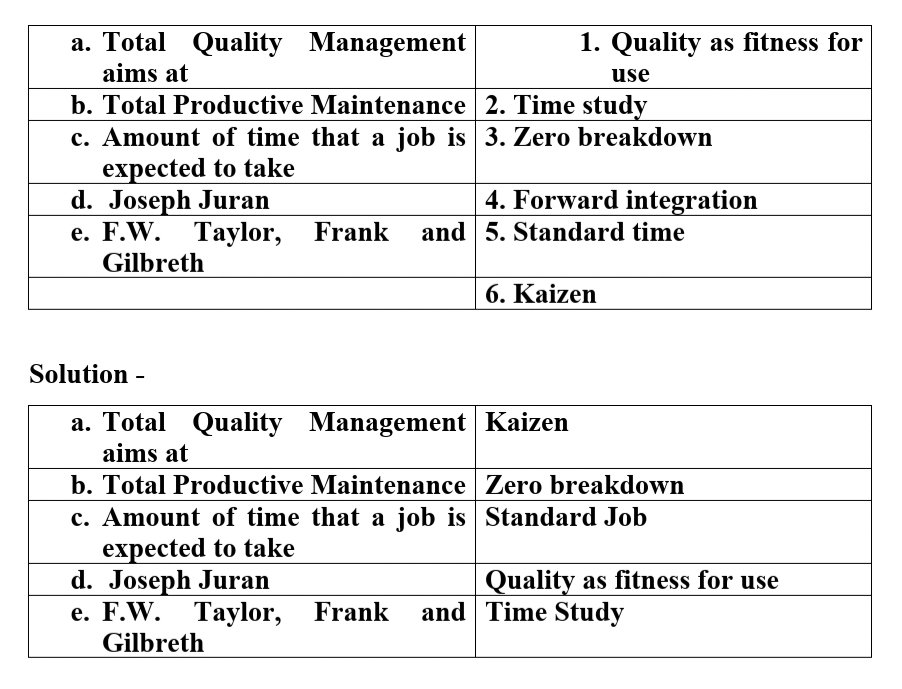
B. State True or False: (5)
1. JIT is based on Pull System.
True
2. One of the assumptions of Economic Order Quantity (EOQ) is that lead time is constant.
True
3. Process design is concerned with the design of the individual manufacturing operation.
False
4. P.D.C.A. cycle is associated with W. Edward Deming.
True
5. The assignment of jobs at various work centres is called dispatching.
False