
Table of Contents
Q.1. What is the role of Forecasting in capacity planning? Explain with a suitable example. (10)
Forecasting is the projection of those identified patterns on business growth patterns to understand the impact on business processes.
Capacity planning is the response to forecasts that ensures the integrity of business processes.
Capacity planning refers to determining what kind of labour and equipment capacities are required and when they are required. Capacity is usually planned on the basis of labour or machine hours available within the plant. Thus, capacity planning is planning for quantity or scale of output.
There are four major considerations in capacity planning:
- Level of demand
- Cost of production
- Availability of funds
- Management policy.
Production has no meaning unless its products can be sold at a remunerative price. Generally, the capacity of plant is limited by the level of current demand. Stable demand makes the task of capacity planning simple while fluctuations in demand create problems concerning the acquisition of resources and matching them up with demand levels. Estimation of demand is, therefore, the first step in capacity planning. Size of the market depends upon the sales potential rather than on the geographical areas.
Demand Forecasts
Demand forecasting is fundamental to effective capacity and sales planning. A demand forecast establishes link between the internal management of the firm and its external environment. Before making a demand forecast, the period of forecast should be decided and an appropriate method of forecasting should be selected.
The nature of product to be sold, the size and characteristics of population, the disposable income, degree of competition, fashion, trends, political conditions, import, export policy of Government, etc., should be taken into consideration. In case of multiple products, product line forecast is useful in deciding the priority of different products in the allocation of limited resources. For example, Delhi Cotton Mills Ltd., may like to know whether to produce more of sugar or textiles.
Importance of forecast lies in its ability to help the managers /planners to help them take better actions regarding future and also to help to help them in discharging their functions more effectively.
A manager invariably continues to discharge his functions-forecast or no forecast.
When a forecast is available:
1. The manager is comparatively better informed so as to set up his objectives more clearly.
2. His thinking, and generation and choice of alternatives becomes more focused.
3. Because sufficient time is available, it is possible to organise and implement his actions in a more effective way.
The importance is directly proportional to:
(Results of an action based on forecast) -(Results of an action for the same situation without any forecast).
If the difference in positive and large then the importance is more, otherwise it is not important.
Importance of forecast and of ability of used statistical forecasting techniques to generate reliable/accurate forecasts, are directly related. If in general forecasts are not accurate i.e. quantum of forecast error is more; then difference of results of actions as stated above may not be relevant. Because both become unreliable.
Applications of Forecasting
1. New plant for production expansion
2. Seasonal production planning
3. Capacity planning
4. Intermediate operational planning
5. Short run production adjustment
6. Scheduling Production
7. Product development
Q.2. Explain the process layout and give the advantages and disadvantages. (10)
Process Layout
A process layout is the arrangement of facilities and equipments in groups according to function performed. Different orders follow different paths through the system, depending on their special processing requirements.
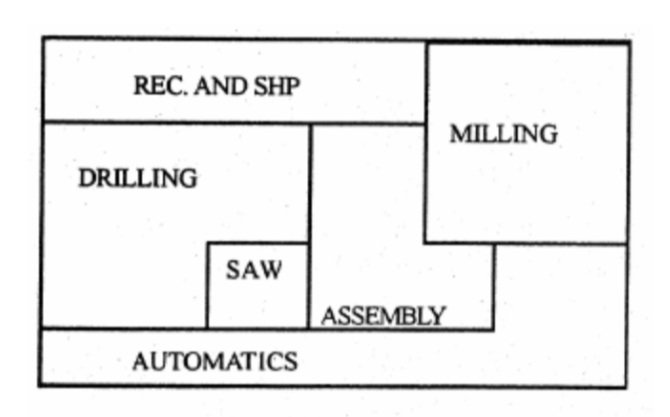
Process Layout
This grouping, in a process layout. results in departments like drilling, milling, sawing turning, painting, receiving and shipping etc. It may be noted that there is no loss in efficiency (in the context of operation) if machines used to convert materials into products are located long distance apart. The problem is about the loss of time, wasted effort and cost of moving materials. This grouping of machines by function is characteristic of job shops and batch type production facilities.
Steps in Developing Process Layout
1. Analyse the product or products to be produced
2. Determine the process required to manufacture the product
3. Prepare layout planning charts
4. Determine the work stations
5. Analyse storage area requirements
6. Establish minimum aisle widths
7. Establish office requirements
8. Consider personnel facilities and services
9. Survey plant services
10. Provide for further expansion
Advantages
1. Less duplication of equipment and hence lower total investment in equipment.
2. Greater flexibility of production. Flexibility with respect to accommodating
• design changes,
• production volume changes, and
• new products and new machines.
3. Capability to handle breakdown of equipment by transferring the work to other machines.
4. Better and more efficient supervision possible through specialisation.
5. Greater incentive to efficient individual workers
Disadvantages
1. Inefficient material handling
2. High space requirement
3. High investment in inventory
4. High supervision cost
5. Longer production time
6. Skilled labor required
Q.3. Explain the inputs and outputs in material requirement planning. (10)
MRP is a simple system of calculating arithmetically the requirements of the input materials at different points of time based on the actual production plan. MRP can also be defined as a planning and scheduling system to meet time-phased materials requirements for production operations. MRP always tries to meet the delivery schedule of end products as specified in the master production schedule.
• MRP is the scientific way of determining the requirements of raw materials, spares, components, and all other items required for production within the economic investment policies of the productive system.
• MRP converts the Master schedule for the final product into a detailed schedule for raw materials and all other items required for production.
• MRP helps to understand about order time, the delivery time of all the materials necessary for smooth production function.
• The logic of MRP is based on the principle of dependent demand. i.e. the direct relationship between the demand of one item and demand of its main assembly (e.g. wheel and bicycle).
• MRP projects not only the demand but also the timing of the inventory demand.
• MRP determines quantity and timing for material planning.
Inputs to MRP
1. Supplier lead time: Supplier lead time need to be an essential part of how you plan production.
2. On hand inventory: If resource material is available in inventory, then there is no necessity to purchase new. This saves money. This helps to optimize on the materials already in the inventory. Keeping promises of customers is also easy.
3. Current forecasting: If there is knowledge about what you have already forecasted, then this can alert the organization to make changes that need to be made. This helps to line up demand and inventory.
4. Work and machine center capacity
• Knowledge person capacity is a must to do MRP.
• Whenever a customer wants material, we should make it available to the customer.
• If capacity at work is known, then the planning of material available for dispatch can be calculated.
• As per such calculation, we can give promises to the customers.
5. Order history and season
• There should be an idea about seasonal trends.
• This knowledge helps to optimize production rate as per the demands. Also, in addition to the above, the following are a few more inputs for effective MRP.
6. Price trends of the materials.
7. Import policy of the government.
Input Files of MRP
• Master Production Schedule (MPS)
MPS is designed to meet the market demand (both the firm orders and forecasted demand) in the future in the taken planning horizon. MPS mainly depicts the detailed delivery schedule of the end products. However, orders for replacement components can also be included in it to make it more comprehensive.
• Bill of Materials (BOM) File
BOM represents the product structure. It encompasses information about all sub-components needed, their quantity, and their sequence of buildup in the end product. Information about the work centers performing buildup operations is also included in it.
• Inventory Status File
Inventory status file keeps an up-to-date record of each item in the inventory. Information such as item identification number, quantity on hand, safety stock level, quantity already allocated and the procurement lead time of each item is recorded in this file.
Output Of MRP
• Planned Orders Receipts
This is the order quantity of an item that is planned to be ordered so that it is received at the beginning of the period under consideration to meet the net requirements of that period. This order has not yet been placed and will be placed in the future.
• Planned Order Release
This is the order quantity of an item that is planned to be ordered in the planned time period for this order that will ensure that the item is received when needed. Planned order release is determined by offsetting the planned order receipt by the procurement lead time of that item. Planned Order Release includes inventory forecast, purchase commitment reports, stock-out incidences, etc.
• Order Rescheduling
This highlights the need for any expediting, de-expediting, and cancellation of open orders, etc. in case of unexpected situations.
MRP Outputs Reports
The material requirements planning program generates a variety of outputs that can be used in the planning and management of plant operations.
These outputs include:
1. Order release notice, to place orders that have been planned by the MRP system
2. Reports showing planned orders to be released in future periods
3. Rescheduling notices, indicating changes in due dates for open orders
4. Cancellation notices, indicating cancellation of open orders because of changes in the master schedule
5. Reports on inventory status
The outputs of the MRP system listed above are called primary outputs by Orlicky. In addition, secondary output reports can be generated by the MRP system at the user’s option.
These reports include:
1. Performance reports of various types, indicating costs, item usage, actual versus planned lead times, and other measures of performance
2. Exception reports, showing deviations from schedule, orders that are overdue, scrap, and so on
3. Inventory forecasts, indicating projected inventory levels (both aggregate inventory as well as item inventory) in future periods.
Q.4. Explain the characteristics of just-in-time system. (10)
JIT
Just-in-time systems focus on reducing inefficiency and unproductive time in the production process to improve continuously the process and the quality of the produce or service. Employee involvement and inventory reduction are essential to JIT operations. Just-in-time systems are known by many different names, including zero inventory synchronous manufacturing , lean production, stock less production (Hewlett- Packard), material as needed (Harley – Davidson ), and continuous flow manufacturing (IBM).
Characteristics of JIT are
1. People Involvement
Probability all management efforts have some behavioural aspects, because management is working through other people to accomplish the organization’s objectives. Management plans and decisions only lay the groundwork. This is the resulting human behaviour that determines a company’s success or failure.
2. Teamwork
First, and foremost, a culture of mutual trust and teamwork must be developed in an organization. Managers and workers must see each other as co-workers committed to the company’s success
3. Discipline
This open, improvement – driven atmosphere does not mean, however, that any employee is free to work by any method he or she choose to try. Usually there is a standard way each job is to be done. If an improvement is suggested and approved, a new standard procedure will be adopted. This standardization prevents variations in products or services which can cause defects. Defects occur- because some variation has been introduced into a material or procedure that normally products good result.
4. Total Quality Management (TQM)
JIT systems seek to eliminate scrap and rework in order to achieve a uniform flow of materials. Efficient JIT operations require conformance to product or service specifications. JIT systems control quality at the source, with workers acting as their own quality inspectors.
5. Pull Method of Material Flow
Just-in-time systems utilize the pull method of material flow. However, another popular method of material flow is the push method. To differentiate between these two systems, we consider the production system for a fast food dish at a restaurant. There are two workstations. The dish maker is the person responsible for producing; this dish: the cutlets must be prepared; buns must be toasted and then dressed with ketchup, pickles, onions, lettuce, and cheese; and the cutlets must be inserted into buns and put on a tray.The final assembler takes the tray, wraps the buns in paper, and restocks the inventory.
6. Small Lot Sizes
Rather than building up a cushion of inventory, users of JIT systems maintain inventory with lot sizes that are as small as possible. Small lot size have three benefits. Small lot sizes reduce cycle inventory, the inventory in excess of the safety stock carried between orders. The average cycle inventory equals one-half the lot size: As the lot size gets smaller, so does cycle inventory. Reducing cycle inventory reduces the time and space involved in manufacturing and holding inventory.
7. Short Setup Times
Reduced lot sizes have the disadvantage of increased setup frequency. In operations where the setup times are normally low, small lots are feasible. However, in fabrication operations with sizable setup times, increasing the frequency of setups may result in wasting employee and equipment time. Theses operations must reduce setup times to realize the benefits of small-lot production.
8. Uniform Workstation Loads
The JIT systems work. best if the daily load on individual workstation is relatively uniform. Uniform loads can be achieved by assembling the same type and number of units each day, thus creating a uniform daily demand at all workstations. Capacity planning, which recognizes capacity constraints at critical workstations, and line balancing are used to develop the monthly master production schedule.
9. Standardized Components and Work Methods
The standardization of components, called part commonality or modularity, increases repeatability. For example, a firm producing 10 products from 1000 different components could redesign its products so that they consist of only 100 different components with large daily requirements. Because the requirements per components increase, so does repeatability; that is, each worker performs a standardized task or work method more often each day.
10. Product Focus
A product focus can reduce the frequency of setups. If volumes of specific products are large enough, groups of machines and workers can be organized into a product layout to eliminate setups entirely. It volume is insufficient to keep a line of similar products busy, group technology can be used to design small production lines that manufacture, volume, in families of components with common attributes. Changeovers from a component in one product family to the next component in the same family are minimal.
11. Automated Production
Automation plays a big role in JIT systems and is a key to low-cost production. Sakichi Toyota, the founder of Toyota, once said “whenever there is money, invest it into machinery”. Money freed up because of JIT inventory reductions can be invested in automation to reduce costs. The benefits, of course, are greater profits, greater market share (because prices can be cut), or both. Automation should be planned carefully, however, many managers believe that if some automation is good, more is better. That isn’t always the case
Q.5. Define the meaning in two lines for any five of the following: (5×2=10)
i. ERP
Enterprise resource planning (ERP) is a process used by companies to manage and integrate the important parts of their businesses. Many ERP software applications are important to companies because they help them implement resource planning by integrating all of the processes needed to run their companies with a single system. An ERP software system can also integrate planning, purchasing inventory, sales, marketing, finance, human resources, and more.
Some benefits of ERP include the free flow of communication between business areas, a single source of information, and accurate, real-time data reporting.
An ERP system can be ineffective if a company doesn’t implement it carefully.
ii. Motion study
The propounder of this concept was Frank Gilbesth. He defined motion study as the “Science of eliminating wastefulness resulting from ill-directed and inefficient motions”. The main aim of motion study is to find the scheme of least wastage of labour. Subsequently, the scope of Motion Study was enlarged and it was named as Method Study.
The method of study can also be defined as “Systematic recording and critical examination of existing and proposed ways of doing work as a means of developing and applying easier and more effective method and thereby reducing cost”. Method Study is a technique which includes the standardisation of equipment, method and working conditions, and training of the operator to follow the standard method.
iii. JIT
The just-in-time (JIT) inventory system is a management strategy that aligns raw-material orders from suppliers directly with production schedules. Companies employ this inventory strategy to increase efficiency and decrease waste by receiving goods only as they need them for the production process, which reduces inventory costs. This method requires producers to forecast demand accurately.
Just-in-time manufacturing is also known as the Toyota Production System (TPS) because the car manufacturer Toyota adopted the system in the 1970s.
Kanban is a scheduling system often used in conjunction with JIT to avoid overcapacity of work in process.
iv. Scheduling and sequencing
Sequencing is the order of tasks to be done in chain. Hence the next task is started once the previous one is completed.
Scheduling, on the other hand is the process in which people are assigned to time to accomplish different tasks.
It improves the delivery performance and reduces the manufacturing time and cost.
v. Operation management
Operations management (OM) is the administration of business practices to create the highest level of efficiency possible within an organization. It is concerned with converting materials and labor into goods and services as efficiently as possible to maximize the profit of an organization. Operations management teams attempt to balance costs with revenue to achieve the highest net operating profit possible.
Operations management is concerned with converting materials and labor into goods and services as efficiently as possible.
Corporate operations management professionals try to balance costs with revenue to maximize net operating profit.
vi. Project management
Project management is the process of leading the work of a team to achieve goals and meet success criteria at a specified time. The primary challenge of project management is to achieve all of the project goals within the given constraints. This information is usually described in project documentation, created at the beginning of the development process. The primary constraints are scope, time, budget. The secondary challenge is to optimize the allocation of necessary inputs and apply them to meet pre-defined objectives.
The objective of project management is to produce a complete project which complies with the client’s objectives.
vii. Codification
Codification is used to properly classify equipment’s, raw materials, components and spares to suit the particular needs of any organisation. Codification is helpful to prevent duplication and multiplicity of stores and the mistakes which are caused by the normal practice of describing the material.
Q.6. Distinguish between qualitative and quantitative methods of forecasting and also explain some applications of forecasting in operations management.
(10)
Quantitative method
Quantitative method of forecasting uses numerical facts and historical data to predict upcoming events. The two main types of quantitative forecasting used by business analysts are the explanatory method that attempts to correlate two or more variables and the time series method that uses past trends to make forecasts.
Qualitative method
Qualitative method of forecasting is often employed where the key trends or developments are hard to capture or where such data is not available. In such a case business analysts used subjective information such as intuition or informed opinion for forecasting the future results. This type of forecast is essential for new products where no historical information is available and primarily used for medium & long term planning. Qualitative techniques include the use of information gathered from Expert opinion, Market research, Focus groups, Historical analogy, Delphi method and Panel consensus.
Applications of forecasting in operations management
Forecasting is helpful in operations management as regard to the aggregate demand forecast. It is obtained by estimating expected volumes of sales, expressed in dollars, and then converting the sales dollars into homogeneous production units. Production unit can be subdivided into component parts and converted into labor or material requirements.
1. Planning the system
Managers need to forecast demands so that they can design or redesign processes necessary to meet demand. Automated, continuous flows facilitate high production volumes; manual or semi-automated, intermittent flows are generally more economical for smaller production volumes. The demand forecast is critical to this design.
2. Scheduling the system
Job scheduling in intermittent and continuous operations is more stable if demand forecasts are accurate. Accurate demand forecasting is needed for best utilisation of the existing conversion system. Managers need intermediate run demand forecasts for three months, six months, and a year into the future. Both current and future workforce levels and production rates must be established from these forecasts.
3. Controlling the system
In regards to controlling inventory, production, labor, and overall costs, managers need accurate demand forecast. Accurate forecasts are needed for the immediate future- hours, days, and weeks ahead. Thus a computerised forecasting system may be needed for these decisions.
4. Some other applications
• New plant for production expansion
• Seasonal production planning
• Capacity planning
• Intermediate operational planning
• Short run production adjustment
• Scheduling Production
• Product development
Q.7. What are various steps involved in work method analysis and the role of flow process chart in analysis procedure? (10)
The steps are:
1. Select
Select the work worth studying and define the objectives to be achieved. An objective may be to reduce the manufacturing cost, or to reduce bottlenecks or to reduce fatigue incurred by the workers in order to increase their efficiency.
2. Record
Record all the relevant information pertaining to the existing method (if any) in details and in the form of a chart to obtain a more clear picture about the same.
3. Examine
Examine the recorded events critically and in sequence. Critical examination involves answer to a number of questions. An activity can be eliminated, simplified or combined with another.
4. Develop
Develop the best method as resulted from critical examination and record it.
The developed method should be:
• Practical and feasible,
• Safe and effective,
• Economical, and
• Acceptable to design, production control, quality control and sales departments.
5. Install
Install the (best) developed method or the improved method. Installation involves three phases, namely-planning, arranging and implementing. During first two stages the programme of installation (phase-wise) and a time table, are planned and the necessary arrangements of resources, equipment, tools and instructions to workers, over-time, etc., are made.
6. Maintain
Maintain the new method, i.e., ensure the proper functioning of the installed method by periodic checks and verifications. The purpose of checks and reviews is to find if the method being practised is the same or it has deviated from the authorised one.
Role of flow process chart in analysis procedure
The Flow process Chart is a simple half-text, half-picture method of showing the steps in a process, using symbols to indicate the type of action being taken and text to give details of the action. The chart can selectively be used to show what happens to selected people, materials or equipment.
A particularly useful feature of the chart is that it can be drawn up as the process is happening. Thus you can follow a part around a factory floor, for example, noting how and when it is machined, stored, moved, etc.

Parts of flow process chart
Flow chart can be used to
• To develop understanding of how a process is done
• To study a process for improvement
• To communicate to others how a process is done
• When better communication is needed between people involved with the same process
• To document a process
• When planning a project
Q.8. Write short notes on any two of the following: (2×5=10)
a. CPM
The critical path method (CPM) is a step-by-step methodology, technique or algorithm for planning projects with numerous activities that involve complex, interdependent interactions. CPM is an important tool for project management because it identifies critical and non-critical tasks to prevent conflicts and bottlenecks. CPM is often applied to the analysis of a project network logic diagram to produce maximum practical efficiency.
CPM is commonly employed in many diverse types of projects. These include product development, engineering, construction, aerospace and defense, software development and research projects. Several CPM software solutions are available.
Critical Path Method (CPM) is an algorithm for planning, managing and analyzing the timing of a project. The step-by-step CPM system helps to identify critical and non-critical tasks from projects’ start to completion and prevents temporary risks.
Critical tasks have a zero run-time reserve. If the duration of these tasks changes, the terms of the entire project will be “shifted”. That is why critical tasks in project management require special control and timely detection of risks.
The method was developed by one of the American companies in 1957. Its employees planned to close, repair and restart chemical plants. The tasks in this project were numerous and complex, that’s why they required such a method. After that, Critical Path Method was quickly spread to agricultural and construction projects where people wanted to learn how to avoid routine tasks. Today, this method of identifying critical tasks is widely used in many industries, including software development.
Advantages of CPM:
• The method visualizes projects in a clear graphical form.
• It defines the most important tasks.
• Saves time and helps in the management of deadlines.
• Helps to compare the planned with the real status.
• Identifies all critical activities that need attention.
• Makes dependencies clear and transparent.
Limitations of Critical Path Method
It is believed that the methodology was developed for routine and complex projects with the possibility of a minimum change in the completion time of tasks. CPM loses its usefulness in more chaotic projects.
There are alternatives, for example, PERT-diagrams, which allow changing the duration of each activity.
A critical path imitates events and activities in a project, presenting them in an interconnected network. Activities are rendered as “nodes,” and the beginning and end of the activities look like arches and lines between nodes.
The basic steps employed in CPM are:
• Determine required tasks
• List required tasks in sequence
• Create a flowchart including each required task
• Identify all critical and non-critical relationships (paths) among required tasks
• Assign an expected completion/execution time for each required task
• Study all critical relationships to determine all possible alternatives or backups for as many as possible
Often a major objective in CPM is to complete the project in the shortest time possible. One way to do this is called fast tracking, which involves performing activities in parallel (simultaneously) and adding resources to shorten critical path durations (called crashing the critical path). This may result in expansion, which leads to increasing project complexity, duration or both.
b. Total productive maintenance
Total Production Maintenance (TPM) approach has the capability of providing almost a seamless integration of production and maintenance through development of strong partnership. Work culture directed towards excellence, the presence of effective work teams, and a basic maintenance management system operating reasonably will improve and accelerate TPM implementation.
In TPM ‘Total’ means:
• Total equipment/machine effectiveness.
• Total employee/workman involvement, and
• A Total maintenance delivery system
In fact total productive maintenance (TPM) is the combination of the American system of Preventive Maintenance (PM) and the Japanese Concept of Total Quality Control (TQC) plus the Total Employee Involvement (TEI).
The net outcome is an innovative system for the maintenance of equipment which optimizes effectiveness, eliminates failures (breakdowns) and promotes autonomous operator maintenance through day-to-day activities.
On this score, the Japanese have shown a new path to the world of management by ceaselessly working towards the ideal goals of zero breakdowns and zero defects or zero defectives. This means less the breakdown of machinery, the less would be the proportion of defective quality.
Breakdown of equipment can occur in the following different ways:
1. Equipment stops performing its function properly. So there are downtime losses of repair, set up and adjustment time.
2. Equipment deteriorates and its performing ability has reduced leading to a reduction in function such as a reduction in the speed of the equipment leading speed and/or yields lower than designed. The net result may be minor stoppages and production of more defectives.
3. Equipment has hidden defects which do not become apparent until the breakdown situation is reached.
The rationale behind the Total Productive Management is that breakdowns of all types are to be eliminated.
The crux of TPM is that the manpower engaged in production activities is to share the efforts of preventive maintenance personnel. When the equipment is down, and together they work on equipment and process improvements in team activities.
The aim of TPM is productivity improvement by improving its personnel and plant by changing the corporate culture. The people engaged in maintenance work such as external inspection, clean up, lubrication and tightening so that equipment/machines does not breakdown.
A comprehensive definition of TPM includes the following main elements:
• Goal of TPM is to change corporate culture in order to maximize overall effectiveness of the production systems.
• A sound system is established in order to prevent all types of losses (may be due to breakdowns or defectives) due to equipment.
• TPM is implemented in all other departments such as sales, product design and development etc.
c. Kanban systems
Kanban is an inventory control system used in just-in-time (JIT) manufacturing. It was developed by Taiichi Ohno, an industrial engineer at Toyota, and takes its name from the colored cards that track production and order new shipments of parts or materials as they run out. Kanban is the Japanese word for sign, so the kanban system simply means to use visual cues to prompt the action needed to keep a process flowing.
• Kanban (Japanese for sign) is an inventory control system used in just-in-time (JIT) manufacturing to track production and order new shipments of parts and materials.
• Kanban was developed by Taiichi Ohno, an industrial engineer at Toyota, and uses visual cues to prompt the action needed to keep a process flowing.
• One of the main goals of kanban is to limit the buildup of excess inventory at any point on the production line.
The kanban system can be thought of as a signal and response system. When an item is running low at an operational station, there will be a visual cue specifying how much to order from the supply. The person using the parts makes the order for the quantity indicated by the kanban and the supplier provides the exact amount requested.
For example, if a worker is bagging product on a conveyor belt, a kanban may be placed in the stack above the last 10 bags. When the worker gets to the card, he gives the floor runner the card to bring more bags. A station further from the supply room might have the kanban placed at 15 bags and a closer one at five. The flow of bags and the placement of cards are adjusted to make sure no station is left bag-less while the belt is running.
The kanban system can be used easily within a factory, but it can also be applied to purchasing inventory from external suppliers. The kanban system creates extraordinary visibility to both suppliers and buyers. One of its main goals is to limit the buildup of excess inventory at any point on the production line. Limits on the number of items waiting at supply points are established and then reduced as inefficiencies are identified and removed. Whenever a limit of inventory is exceeded, it points to an inefficiency that needs to be addressed.
As containers of parts or materials are emptied, cards appear, color-coded in order of priority, allowing the production and delivery of more before a hold-up or shortage develops. A two-card system is often used. T-kanban transportation cards authorize the movement of containers to the next workstation on the production line, while P-kanban production cards authorize the workstation to produce a fixed amount of products and order parts or materials once they have been sold or used.
Toyota, Ford Motor Company and Bombardier Aerospace are among the manufacturers that use e-kanban systems. These electronic systems still provide visual signals, but the systems are also usually enabled to automate parts of the process, such as transport through the factory or even filing purchase orders.
Q.9. Define TQM. What is the role of employee motivation and process control in TQM? (10)
“Total Quality Management (TQM) is an approach to improving the effectiveness and flexibility of business as a whole. It is essentially a way of organising and involving the whole organisation, every department every activity, every single person at every level.” -Oakland
“Total Quality Management is a combination of socio-technical process towards doing the right things (externally), everything right (interally), first time and all the time with economic viability considered at each stage of each process.” – Zaire and Simintiras
“TQM is the systematic analysis, but the focus is turning from a process driven by external controls through procedure compliance and enhancement to a process of habitual improvement where control is embedded within and is driven by the culture of the organisation.” -Foster and Whittle
TQM is a philosophy that believes in a company-wide responsibility toward quality via fostering a quality culture throughout the organisation; involving continuous improvement in the quality of work of all employees with a view to best meeting the requirements of customers.
Elements of TQM
The following are the basic elements of TQM:
• Meeting Customers’ Requirements
Customer satisfaction is the key to the survival and growth of an organisation. TQM aims at best satisfying the requirements of customers which never remain constant; but keep changing with changes in environment and needs, preferences etc. of customers.
• Continuous Improvement
TQM is a total concept. It involves the integration of all functions and processes within an organisation, in order to achieve continuous improvement in the quality of products/services. Moreover, quality is a dynamic concept.
With advancement in technology, an organisation must adopt new processes and redesign products to yield continuous improvement in quality to give the best advantage of technology to customers.
• Involvement of all Employees
TQM is called people’s success. According to TQM philosophy, quality is not the responsibility only of production personnel. Rather it is a company-wide responsibility. TQM can be successful only when the total organisation is quality-conscious.
Advantages of TQM
Total quality management benefits and advantages:
• Strengthened competitive position
• Adaptability to changing or emerging market conditions and to environmental and other government regulations
• Higher productivity
• Enhanced market image
• Elimination of defects and waste
• Reduced costs and better cost management
• Higher profitability
• Improved customer focus and satisfaction
• Increased customer loyalty and retention
• Increased job security
• Improved employee morale
• Enhanced shareholder and stakeholder value
• Improved and innovative processes
Employee motivation and process control in TQM
Processes cannot be improved if employees are either not fully involved or fully empowered. Employee involvement means each employee contributes toward achieving the organizational goals. These contributions are valued by the management and they both recognize that the organization’s success depends on total employee involvement.
Employee empowerment means authorization of employees to identify and solve problems hindering quality efforts. Process owners need to be empowered by the management to recognize and solve problems. We discussed how non-random variations in the process lead to root cause identification of the underlying problem. For effective TQM implementation, the process owners must be empowered to use organizational resources for eliminating such problems. Similarly without employee involvement we cannot have process control tools being effectively used for quality improvement.
Employee involvement also requires management’s willingness to empower subordinates. At the same time empowered employees who are not sensitized to the organizational goals cannot apply their empowerment effectively. It is the management’s responsibility to define the common vision for the organization so that empowered employees know what their roles are in achieving these objectives. Empowered employees must be trained properly to take up organized problem solving initiatives. Organizational resources, if necessary for implementing the suggestions, must be provided to help them perform better. There could be improvement concepts that cannot be approved by the management. In such cases the management must give reasons as to why it cannot be implemented.
Thus employee involvement and empowerment are essential to tap the full potential of the workforce in attaining organizational objectives. Discretionary efforts of empowered employees are recognized and tapped for ensuring the success of continuous improvement programs. Top management must be committed and involved in setting up systems to support TQM activities. Mechanisms must be in place so that their subordinates can take up greater responsibility.
Q.10 Multiple choice type questions (5)
a. Strategic analysis and choice does not involve:
i. Corporation mission
ii. Company strength and weakness
iii. Invention
iv. External threats and opportunities
Ans – i. Corporation mission
b. Which One of the following is not a project type by size:
i. Large project
ii. Medium project
iii. Small project
iv. Miniature project
Ans – iv. Miniature project
c. Which One of the following is not a type of capacity:
i. Design capacity
ii. Intended capacity
iii. Effective capacity
iv. Actual capacity
Ans – ii. Intended capacity
d. The following is not part of a supply chain:
i. Manufacturer
ii. Distributor
iii. Bank
iv. Retailer
Ans – iii. Bank
e. A product structure is part of:
i. Inventory
ii. Demand forecast
iii. MRP
iv. Group technology
Ans – iii. MRP
B. State True or False: (5)
i. It is possible to use mass customization for manufacturing all types of products.
Ans – True
ii. LCL country mean low cost labour country.
Ans – False
iii. Factor and location ratings are used to screen for better location options.
Ans – True
iv. Effective capacity is the maximum possible capacity requirements planning.
Ans – True
v. Project in direct cost is mainly the cost of supervision during the implementation of the project.
Ans – False