
Table of Contents
Q.1. Discuss on environmental (factors) that have contributed to the growth of the Indian tourism industry. (10)
In the last few years, India has gained exceptional growth in the tourism industry. It owns the status of one of the most preferred destinations for overseas and domestic travellers today.
Apart from being a great source of revenue, this industry also aims to provide the tourists with an opportunity to understand and experience the cultural diversity of the country through tourism. According to the estimates of an Indian official, tourism in India has outperformed global tourism in terms of its growth, development, the volume of tourists, and even revenue.
Size of the tourism industry in India
The World Travel and Tourism Council estimated that the amount generated through tourism was worth the US $240 billion and around 9.2% of India’s GDP in 2018. It led to the generation of 42.673 million jobs, 8.1% of total employment in India in the same year. This sector is predicted to grow at an annual rate of 6.9% to the US $450 billion by 2028, thereby contributing to almost 9.9% of the Indian GDP. In 2015, India’s medical tourism sector was projected to be approximately US $3 billion, and it will probably grow to the US $7–8 billion by 2020. Almost 184,298 foreign patients travelled to India in 2014 to seek medical treatment.
The campaign of INCREDIBLE INDIA launched by the Ministry of Tourism in 2002 works for the promotion of tourism in India and is active till date.
Main factors responsible for the development of tourism in India
1. Weather and Climate factors
Being a vast country, the different parts of India experience different types of climate. This extraordinary asset in the form of varied climates has led to the promotion of tourism in the country, and it attracts more tourists.
Variations in the climate of India are caused due to five main factors:
• The large size of the country,
• Tapering of the peninsular India that divides the tip of India into two oceans
• The latitudinal extent on the two sides of the country divided by Tropic of Cancer,
• The situation in the Indian Ocean and
• The role played by the Himalayas in acting as a climatic barrier between India and central Asia, thus protecting the country from extreme cold and dry winds from central Asia.
A tourist will experience different types of climate in all parts of India- from the Great Plains of North India to the snow-covered Himalayas, the peninsular plateau area to the coastal regions. Even the climatic variations exist from one state to another and from one district to another. The strong influence of the monsoons further provides underlying unity to the climatic diversity of India. The variations in climate thus serve as a great asset to engage tourists in a variety of activities during their stay in India and are among the factors responsible for development of tourism in India.
2. Landscape factors
Geology and physiography are two main bases of landscape factors. These two aspects influence the landscape of a place and determine the rocky peaks for climbing, snowy slopes for skiing, caves for sightseeing, and that’s just the beginning. The rocks exposed in regions of Deccan plateau and Ladakh further increase tourism by attracting tourists who are interested in trekking.
There is a large scope for rural tourism also in the country. Water bodies like riversides, gorges, springs, waterfalls etc. provide spectacular views to the tourists. Forest landscapes also attract a lot of tourism in India. It is for this reason that national parks, wildlife sanctuaries and biosphere reserves are used as tourist spots. Thus, the landscape is also among the factors responsible for development of tourism in India.
3. Seascape factors
Seascape also comes under the factors responsible for development of tourism in India. Coastal regions of the mainland and that of the Andaman & Nicobar Islands in Bay of Bengal and Lakshadweep in the Arabian Sea is another major cause of tourist attraction in the country. Sandy beaches, lagoons, caves, reefs, seaside cliffs etc. are all hot spots of tourism. Sunbathes, swimming, boating and surfing are some of the fun activities performed by tourists in these regions.
4. Historical and Cultural factors
An increasing number of people visit India, especially to learn about its historical or cultural associations with the ancient past. They visit the places where art festivals, music festivals, theatre and other cultural events of importance took place. Curiosity has always been one of the major factors responsible for development of tourism in India.
There has always been a curiosity in humans about foreign lands, their people and different places. In the present technologically developed world, the mass media has made it possible for everyone to read, see and hear about different places.
The increasing interest was shown by many in the field of architecture, act, music, literature, folklore, paintings, other people’s culture, archaeological and historical remains is nothing but yet another aspect of people’s curiosity to seek more knowledge.
This curiosity has been encouraged by pore education. International events, national celebrations, exhibitions, special festivals etc. also attract thousands of tourists each year.
5. Ethnic and Family factors
This factor represents the desire of people to visit one’s relatives and friends or to meet new people to seek new friendships. A large number of people travel to India for interpersonal reasons. This is among yet other factors responsible for development of tourism in India with each passing year.
A large number of NRIs visit India in order to see their families or when they feel like visiting their homeland. Thousands of people even visit for ethnic reasons.
6. Spiritual and Religious factors
Visiting religious places has always been one of the motivators for people to travel. A large number of people make pilgrimages to religious and holy places every year.
Since India is a culturally diverse country, many religious places exist in the country. There are many pilgrimage centres and holy places of different religions that tourists come to visit from all over the world. Therefore, it will be righteous to consider this point under the factors responsible for development of tourism in India as well.
Q.2. What are the factors on which the customer evaluate the quality of the services? Take the case of airlines industry and explain steps you will take on factors influencing service quality. (10)
Today, due to increased income of Indian middle class and rapidly increasing standard of living has made Indian consumers choosy and demandable. They evaluate retail service and compare their expectations with the perceived service. If the services perceived fall below their expectations, they become dissatisfied. This lead to boycott of that store and searching for new store where the perceived service meets and exceeds their inherent expectations.
It is said that ‘customer expectations’ are based on customer’s personal trails like age, experience, knowledge, education level, income level, standard of living and so on. Expectations even vary from person to person and store to store. For instance, one person’s primary criterion to shop in a store is reasonable and convenient parking facility but for another person (an owner of luxury car), primary criterion is availability of brands in a store irrespective of parking and distance factor.
Following are the five customer service factors that they use to evaluate service quality provided:
1. Faith
It deals with the trust shown (presented) by a retailer by way of offering guarantees, warranties, exchange and return privileges.
2. Reliability
Locating a reliable retailer has always been a difficult task. Reliability stands for a retailer’s ability to satisfy all written promises.
It includes:
• Accuracy of bills with regard to quality and quantity ordered.
• Meeting delivery commitments.
• Offering discounts as and when promised.
• No false advertisement (Bait Advertisement)
3. Recognition (Empathy)
It is the retailer’s ability to recognize your details like name, address, choices, likings and disliking.
It includes:
• Offering personalized service like remembering your choices, address and other related details.
• Acknowledgements of e-mails, letters, suggestions and complaints.
• Remembering by name
4. Sense of Responsiveness
It is the retailer’s ability to be responsive towards customers’ queries, complaints, doubts and communications.
It includes:
• Call back to customers as and when required
• Offering quick service
• Attending complaints
• Returning e-mails, SMS and other modes of communications.
5. Tangibility
It is the retailer’s ability to establish a longlasting retail image (retail positioning) in customers’ minds.
It includes:
• Store layout and appearance
• Uniform (dressing) of sales staff
• Hygienic and suitable store environment
• Welcome and assistance by store staff
• Air conditioning in the store
• Store location and geographic coverage
• Shopping experiences
• Type and extent of personal assistance (attention)
• Merchandise quality, assortment, and fissionability
• Community services
In case of Airlines Industry, the customer starts evaluating services from the following
1. In booking process
2. Facilities provided in Airports
3. Price charged
4. Condition of Aeroplanes
5. Frequency of the flights
6. Time taken in Boarding
7. No. of location where facilities are available
8. Brand Name
9. Behaviour of the staff
10. Services provided in flights
Q.3. Discuss the various characteristics of services in relation to marketing of tourism. (10)
Characteristics of Services
Services have a number of unique characteristics that make them so different from products. Some of the most commonly accepted characteristics are:
1. Intangibility
When you buy a cake of soap, you can see, feel, touch, smell and use to check its effectiveness in cleaning. But when you pay fees for a term in college, you are paying for the benefit of deriving knowledge and education which is delivered to you by teachers. In contrast to the soap where you can immediately check its benefits, there is no way you, can do so in case of the teachers who are providing you the benefits.
Teaching is an intangible service. When you travel by aeroplane, the benefit which you are deriving is a service (transportation) but it has some tangible aspects such as the particular plane in which you fly (Boeing, Avro, Concorde, and the food and drink which is served). In this case the service has both a tangible and intangible aspect as compared to teaching which has no tangible aspect at all. This continuum highlights the fact that most services are in reality a combination of product and service having both tangible and intangible aspects. There are only a few truly pure tangible products or pure intangible services.
The distinguishing feature of a service is that its intangible aspect is dominant J. Bateson has described the intangible characteristics of services which make them distinct from products. These intangible features are:
• Service cannot be touched
• Precise standardisation is not possible
• There is no ownership transfer
• Service cannot be patented
• Production and consumption are inseparable
• There are no inventories of the service.
2. Inseparability
In most cases service cannot be separated from the person or firm providing it. Service is provided by a person who possesses a particular skill (singer), by using equipment to handle a tangible product (dry cleaning) or by allowing access to or use of physical infrastructure (hotel, train). A plumber has to be physically present to provide the service, the beautician has to be available to perform the massage. This is in direct contrast to products which can be produced in the factory today, stocked for the next two, three or more months and sold when an order is procured.
3. Heterogeneity
The human element is very much involved in providing and rendering services and this makes standardisation a very difficult task to achieve. The doctor who gave you his complete attention in your last visit may behave a little differently the next time.
The new bank clerk who cashes your cheques may not be as efficient as the previous one and you have to spend more time for the same activity. This is despite the fact that rules and procedures have been laid down to reduce the role of the human element and ensure maximum efficiency. Airlines, restaurants, banks, hotels have a large number of standardised procedures. You have to reserve a room in a hotel and this is a straight forward procedure for which all the steps are clearly defined. Human contact is minimal in the computerised reservation systems, but when you go to the hotel there will be a person at the reception to hand over the key of your room. The way this person interacts with you will be an important factor in your overall assessment of the service provided by the hotel. The rooms, the food, the facilities may be all perfect, but it is the people interacting with you who make all the difference between a favourable and unfavourable perception of the hotel.
4. Perishability
Services cannot be stored and are perishable. A car mechanic who has no cars to repair today, or spare berths on a train, unsold seats in a cinema hall represent service capacity which is lost forever. Apart from the fact that a service not fully utilised represents a total-loss, the other dimension of this perishability aspect is that most services may face a fluctuating demand. There is a peak demand time for buses in morning and evening (office hours), certain train routes are always more heavily booked than others. This fluctuating demand pattern aggravates the perishability characteristic of services.
5. Ownership
When you buy a product you become its owner-be it a pencil, book, shirt, refrigerator or car. In the case of service, you may pay for its use but you never own it. By buying a ticket you can see the evening film show in the local cinema theatre; by paying wages you can hire the services of a chauffer who will drive your car; by paying the required charges you can have a marketing research firm survey into the reasons for your products’ poor sales performance, etc. In case of service, the payment is not for purchase, but only for the use or access to or for hire of items or facilities.
A service is purchased for the benefits it provides. If we closely examine the reasons why products are purchased, we find that they are bought not because of their physical, tangible features but because they provide certain intangible benefits and satisfactions.
Q.4. Explain the various stages of consumer buying decision making process. (10)
Various stages of consumer buying decision making process are
Stage 1: Need recognition
In this first stage, the consumer recognizes that he has an unmet need and is driven to action by a need or desire. Unsatisfied needs create discomfort to the consumer, so that he begins to recognize that this need can be met by acquiring or consuming goods and services.
This desire to meet this need over time becomes strong enough to motivate a person to decide to make a purchase. This recognition of a need can arise internally at any time. When you are watching television, you are on the computer, you are on the boring sofa, you are stuck in traffic, etc.
Or in another case, the need may be numbed within it until an external stimulus wakes it up, such as an advertisement or the sight of a product or service.
The depletion of a product (the ink in your pen runs out) or dissatisfaction with the product you are currently using can also trigger the decision process.
However, becoming aware of the need is not enough to generate the purchase. As consumers, we have many needs and desires, but finite amounts of time and money. For this reason, there is also competition between our needs. Therefore, the consumer quickly once recognized that he has an unmet need, proceeds to the second stage of the consumer purchase decision process.
Stage 2: Information and Alternatives Search
In this second stage of the consumer buying decision process, the consumer identifies alternative products and brands that are able to meet their needs, and therefore proceeds to gather information about them from different sources. Whether asking acquaintances or searching the internet.
Most commonly, alternative products are identified first and then alternative brands. The following factors influence the search for alternatives:
The amount of information that the consumer already has from experiences and other sources.
Consumer confidence in that information.
The expected value of the additional information or, in other words, what other information is considered worth acquiring.
After identifying the different alternatives with which the consumer considers that it could meet their needs, this proceeds to what is the third stage of the process: evaluate the alternatives.
Stage 3: Evaluation of Alternatives
In this third stage of the consumer buying decision process, the consumer ponders the pros and cons of the identified alternatives.
When some satisfactory alternatives have been identified, the consumer proceeds to evaluate them before making a decision. The evaluation may involve a single or several criteria, with which the alternatives are compared. For example, price, quality, ease of use, time, durability or color.
When multiple criteria are involved, it is common that not all criteria have equal preponderance. Ease of use, for example, could be more important than price. As experience is often limited and information from sources such as advertising or friendships can be biased, evaluations may be incorrect from the point of view of the facts.
That is, the consumer may believe that the price of the A brand is more expensive than that of the B brand when in fact it is the opposite.
Stage 4: Purchase Decision
In this 4 stage of the consumer buying decision process, the consumer decides to buy or not buy, and makes other decisions related to the purchase.
After searching and evaluating, the consumer has to decide whether or not to buy. Thus, the first result is the decision to buy or not the alternative evaluated as the most desirable. This part of the process the consumer can make the decision in 1 hour or up to 1 month later. Everything will depend on the type of product or service and how large the investment is to acquire said product or service.
In this part of the process it can happen that the consumer does not make the purchase after finding complicated the way to acquire said product or service. What will make you consider other alternatives.
On the other hand, if the decision is to buy, you have to make a series of related decisions related to the characteristics, where and when to make the actual transaction, how to take possession or receive the delivery, the method of payment and other issues. So the decision to make a purchase is actually the beginning of an entirely new series of decisions that can be as time consuming and as difficult as the initial one.
Once the consumer has made the decision, he proceeds to make the purchase and feel happy for having satisfied an intrinsic desire or need.
Stage 5: Post Purchase Behavior
Finally, at this fifth stage of the consumer buying decision process, the consumer seeks to ensure that the choice he made was correct.
What the consumer learns in his journey through the purchase process has an influence on how he will behave the next time the same need is pressed. Moreover, new opinions and beliefs have been formed and the old ones have been corrected. Therefore, this time, we have a more expert consumer in the field.
Therefore, as business owners and marketers, we must also assess how they behave in consumer after making the purchase.
Or Explain the recent trends in consumer behaviour models. (10)
Two of the recent models to illustrate the developments in consumer behaviour modelling.
1. Nicosia’s Model of Consumer Decision Process
This model elaborates the decision making steps that the consumers adopt before buying goods or services. It is written in the format of a detailed computer flow chart.
For ease of understanding the model can be simplified by grouping together its various elements into fields and subfields. Various components of the model are connected through direct as well as feed back loops. Thus, the marketing organisation affects the target customers. The customers, in turn, through the effects of marketers action affect the next decisions of the marketer himself. This process goes on. The main fields and subfields of the model are as following:
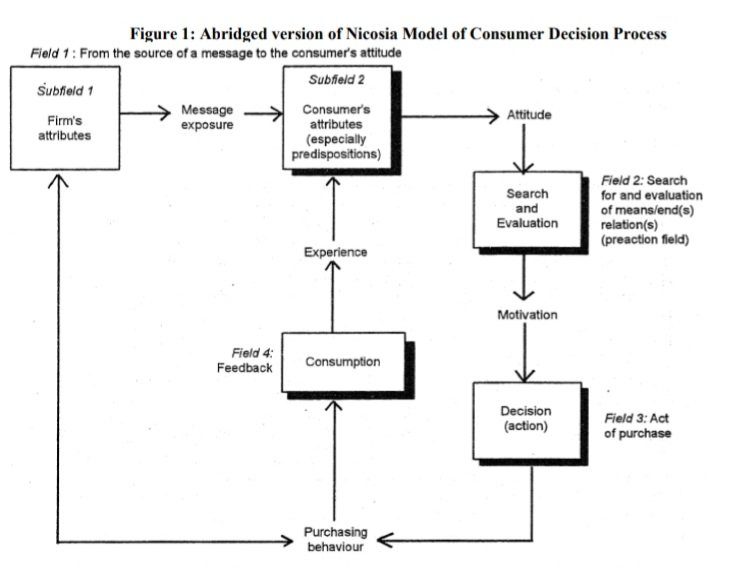
Nicosia’s Model of Consumer Decision Process
a. Marketer’s Communication affecting consumers attitude
Here the marketing communications include not only mass media and personal communications but products, price and even distribution aspects, too. The exposure of these attributes affect consumer’s attitudes as well as perceptions.
b. Consumer’s search and evaluation
This step occurs before consumer becomes motivated to purchase the product. He seeks more information and evaluates the relative merits of competing products’ attributes. The criteria for evaluation do also evolve with consumers past experiences and the marketer’s inputs in the form of marketing mix.
c. Purchase action
This is the field 3 of the Nicosia model. Here, after getting motivated to buy the brand, the customer actually shops for the product. The choice of actual retailer does also take place here.
d. Consumption experience and feedback
After purchasing the product, the experience with its consumption can affect the consumers in many ways. The negative experience may block his future purchase and lower his attitude and evaluations of the product.
Nicosia’s model may appear to be simple and obvious at the first glance. But its value lies in the integration of the body of knowledge in the area of consumer behaviour existing till its time of formulation. It does also provide insights about how the non-action kind of variables present in the environment and related to the consumers trigger actions at the consumers end.
2. Bettman’s information processing model of consumer choice
In this model the consumer is seen in the center of a host of information processing activities. The consumer is the recipient of a large amount of information from the marketer, competitors and rest of the environment. Moreover, he has his own database built over time from his experiences, personality and set of values. Since handling such a large amount of information simultaneously can be very complex, the model believes that the consumers use certain simplifying strategies. By using these decision strategies (heuristics), he need not process all the information together.
He can also follow some simple decision rules which can provide ready answers for prespecified situations.
This model is also built around several flowcharts. These flowcharts describe the components and interconnections among themselves that are involved in the decision process.

Bettman’s information processing model of consumer choice
The main components of the model are the following:
a. Processing Capacity
Each individual has a limited capacity to process information. This capacity can vary across individuals to some extent.
b. Motivation
Motivation provides the intensity and direction for the choice process to the consumer in this model. This acts as the superiding component and controls the continuation and suspension of various processes in the model like attention and scanning etc.
c. Attention and Perceptual Encoding: This model divides attention into voluntary and involuntary. The voluntary attention is the conscious attention seeking to achieve the hierarchy of goals as set by the consumer for himself. The involuntary attention is triggered when the consumers have to resolve between the conflicting information received for processing or the short term attention provided.
d. Information Acquisition and Evaluation
Within the scope of heuristics, the consumer also decides about the nature and amount of information that would be necessary and sufficient for decision making. If the available information is found to be insufficient but necessary, he goes for acquiring further information through external search.
d. Memory
Consumer memory comprises of short term memory and long term memory. In the short term memory the acquired information is stored for less than two minutes. The consumer evaluates the impinging stimuli and decides whether the information is worth transferring to long term memory or may be forgotten.
e. Decision Process
The ultimate decision of the brand is preceded by various sub-decisions about various aspects using rules of thumb or other methods of decision making. These decision processes work on the acquired and evaluated information as well as the perceptions of the consumer.
f. Consumption and Learning Processes
The experience gained through the consumption of products as well as the process of decision making are stored by the consumers. These learnings affect not only the memory for the next cycle of decision making but also affects the future heuristics for consumer decision making.
g. Scanner and Interrupt Mechanisms
These are like the information switches of the consumers. Whenever the consumer decides that he does not have sufficient information for decision making internally, he scans the environment for acquiring the necessary information.
The Bettinan’s consumer behaviour model focusses entirely on the information processing. The research attempts to validate it are also focussing upon the information handling by consumers. Consumers are encouraged to share the protocol that they mentally” go through, while taking decisions. These methods are rich in providing consumer insights but difficult to administer practically.
Q.5. Define the following terms: (5×2=10)
a. Motivation
Motivation is the ‘why’ of behaviour. It is an intervening variable between stimulus and response and a governing force of consumer behaviour.
“Motivation refers to the drives, urges, wishes or desires which initiate the sequence of events known as behaviour.” as defined by Professor M.C. Burk. Motivation is an active, strong driving force that exists to reduce a state of tension and to protect, satisfy and enhance the individual and his self-concept. It is one that leads the individual to act in a particular way. It is the complex net-work of psychological and physiological mechanisms.
Therefore, motives can be conscious or unconscious, rational or emotional, positive or negative. These motives range from a mere biological desires like hunger and thirst to the most advanced scientific pursuits like landing on the Moon or Mars.
b. Physical Evidence
The environment in which the service is delivered and where the firm and customer interact, and any tangible components that facilitate performance or communication of the service. The physical evidence of service includes all of the tangible representations of the services – such as brochures, letterhead, business cards, report formats, signage, and equipment. In some cases it includes the physical facility where the service is offered, for example, the retail bank branch facility.
In other cases, such as telecommunication services, the physical facility maybe irrelevant. In this case other tangibles such as billing statements and appearance of the repair truck may be important indicators of quality. Especially when consumers have little on which to judge the actual quality of service they will rely on these cues just as they rely on the cues provided by the people and the service process. Physical evidence cues provide excellent opportunities for the firm to send consistent and strong messages regarding the organization’s purpose, the intended market segments, and the nature of the service.
Physical Evidence also indicates about the experience of ultimate customers. A customer does not hold the proper knowledge and apprehension about the product when he or she buys a product for the first time. One requires to provide the consumers with physical evidence that can initiate the confidence in them.
c. Social Group
A collection of individuals who have regular contact and frequent interaction and who work together to achieve a common set of goals. A social group is a collection of people who interact with each other and share similar characteristics and a sense of unity.
A social group is two or more humans who interact with one another, share similar characteristics, and have a collective sense of unity. This is a very broad definition, as it includes groups of all sizes, from dyads to whole societies.
A social group exhibits some degree of social cohesion and is more than a simple collection or aggregate of individuals.
Social cohesion can be formed through shared interests, values, representations, ethnic or social background, and kinship ties, among other factors.
The social identity approach posits that the necessary and sufficient conditions for the formation of social groups is the awareness that an individual belongs and is recognized as a member of a group.
The social identity approach posits that the necessary and sufficient conditions for the formation of social groups is the awareness that the individual belongs and is recognized as a member of a group.
d. Service triangle
The service marketing triangle or the Service triangle as it is commonly called, underlines the relationships between the various providers of services, and the customers who consume these services.
As we know, relationships are most important in the services sector. The service triangle outlines all the relationships that exist between the company, the employees and the customers. Furthermore, it also outlines the importance of systems in a services industry and how these systems help achieve customer satisfaction.
As the name suggests, the service marketing triangle can also be used to market the service to consumers. The marketing completely depends on the interaction going on between the customer and the service provider. We will look at each of these interactions in detail, and also read on how to market to your customer based on the interaction.
There are 6 main relationships in the Service triangle.
1. Company to Customers
2. Company to employees
3. Company to systems
4. Customers to systems
5. Employees to system
6. Employee to Customers
e. Lifestyle
Lifestyle refers to the way consumers live and spend their time and money. It is determined by one`s past experiences, innate characteristics and life situations. Lifestyle of a person is typically influenced by his/her needs, wants and motivations and also by external factors such as culture, family, reference group and social class.
Lifestyle of a person involves his consumption pattern, his behavior in the market place, practices, habits, conventional ways of doing things, allocation of income and reasoned actions. It reflects an individual`s attitudes, values, interests and his view towards the society.
Characteristics of lifestyle
• It is a group phenomenon i.e. It influence others in a social group.
• It influence all areas of one’s activities and determines the buying behavior of a person.
• It implies a central life interest – A person`s main interest or profession is influenced by his core interests e.g. Food, Fashion, Music etc.
• It is affected by the social changes in the society – A person`s standard of living and quality of lifestyle increases with the increase in the standards and quality of the society he/she lives in.
Lifestyle of a consumer depends upon various factors and any change in one of these factors leads to a change in the behavior of the consumer. These factors are as following:
1. Age
2. Income
4. Culture
5. Education
6. Social Group
7. Buying Power
Q.6. List the individual determinants and environmental influences that affect consumption behaviour. (10)
Determinants of Consumer Behaviour
Factors influencing consumer behaviour can also be classified into Individual Determinants and External Determinants. The individual determinants shape and determine the needs and motives of a consumer and direct him towards a purchase, while the external determinants indirectly influence the purchase process by filtering through individual determinants.
Individual Determinants affecting consumption behaviour
1. Motivation
Motivation is the ‘why’ of behaviour. It is an intervening variable between stimulus and response and a governing force of consumer behaviour.
“Motivation refers to the drives, urges, wishes or desires which initiate the sequence of events known as behaviour.” as defined by Professor M.C. Burk. Motivation is an active, strong driving force that exists to reduce a state of tension and to protect, satisfy and enhance the individual and his self-concept. It is one that leads the individual to act in a particular way. It is the complex net-work of psychological and physiological mechanisms.
Therefore, motives can be conscious or unconscious, rational or emotional, positive or negative. These motives range from a mere biological desires like hunger and thirst to the most advanced scientific pursuits like landing on the Moon or Mars.
2. Perception
Marketing management is concerned with the understanding of the process of perception because, perception leads to thought and thought leads to action. Perception is the process whereby stimuli are received and interpreted by the individual and translated into a response.
In other words, perception is the process by which the mind receives, organises and interprets physical stimuli. To perceive is to see, hear, touch, taste, smell and sense internally something or some event or some relation.
Perception is selective because, and individual cannot possibly perceive all stimulus objects within his perceptional field; hence, he perceives selectively. Perception is organized because, perceptions have meaning for the individual and they do not represent a buzzing confusion. Perception depends upon stimulus factors. That is, the nature of physical stimulus itself is a determinant of perception.
The variables like colour size, contrast, intensity, frequency and movement are of this kind. Again, perception depends on the personal factors. What the individual brings to the situation governs perception his ability to see or hear the message, his needs, his moods, memory, expressions and values all these modify the message reception.
3. Attitude
The concept of attitude occupies a central position in the consumer behaviour studies in particular and social psychology in general because; attitude measurements help in understanding and prediction of consumer behaviour. ‘Attitude’ refers to a predisposition to behave in a particular way when presented with a given stimulus and the attitudes towards people, places, products and things can be positive or negative or favourable or unfavourable.
Attitudes develop gradually as a result of experience; they emerge from interaction of a person with family, friends, and reference groups. There are three distinct components of attitude namely, cognitive, affective and co-native. ‘Cognitive’ component is what an individual believes about an object, thing or an event whether it is good or bad, necessary or unnecessary, useful or useless.
4. Personality and Self concept
Very often, the word ‘personality’ is used to refer to the capacity of a person for popularity, friendliness or charisma. However, in strict sense, it refers to the essential differences between one individual and another.
Therefore, personality consists of the mannerisms, habits and actions that make a person an individual and thereby serve to make him distinct from everyone else. It is the function of innate drives, learned motives and experience.
This means that an individual responds with certain amount of consistency to similar stimuli. Personality is the interplay of three components namely, ‘id’, ‘the ego’ and the ‘super ego’.
The ‘id’ governs the basic drives and the instincts of an individual. On the other hand, the ‘super ego’ disciplines the ‘id’ by suppressing anti-social behaviour; it drives the individual in the direction of more high minded pursuits of civilizations.
5. Learning and Memory
In behavioural science, learning means any change in behaviour which comes about as a result of experience. Learning is the process of acquiring knowledge. Consumer behaviour is a process of learning because; it is modified according to the customer’s past experience and the objectives he or she has set. This process of learning is made up of four stages namely, Drive- cue-response and Reinforcement. ‘Drive’ refers to an internal state of tension which warrants action.
Thus, hunger or thirst can be a drive. A ‘cue’ is an environmental stimulus. For instance, it can be an ad on food item or soft- drink, ‘Response’ represents the person’s reaction to cues within his environment. Here, it can be purchased of food item or soft-drink. ‘Reinforcement’ is the responses reward.
Or Discuss the lifestyle marketing. How would you initiate the strategy formulation and its implementation? (10)
Lifestyle Marketing
Lifestyle marketing is a marketing technique that positions the product or service to possess ideals, aspirations, and aesthetics that the target audience identifies with. In layman’s terms, it means that brands marketed in this way are a way of life for their audience. They are immersive, encapsulate their customers’ ideas or values, and fit seamlessly into the consumer’s life.
Lifestyle marketing goes beyond the product or service being sold––it’s selling an ideal. Think of Nike. Sure, they started with and continue to sell athletic shoes. But what makes them a lifestyle brand is their empowerment of the athlete inside everyone. Nike and its products are a way of life for its fans (I mean, you don’t see a diehard Nike fan with Adidas on. Ever. ). They eat, live, breathe, and sweat the brand’s ideals.
What makes marketing these brands even more special is the idea that “specific foods, products, and apparel can help us to connect more with our ideal version of ourselves.” When you’re marketing to these higher level needs for a consumer, you’re in a whole new playing field.
Process of Life style Marketing
Becoming a lifestyle brand may be something you do consciously or unconsciously. But lifestyle marketing is a conscious choice that you need to make early on. The process can take years of careful cultivation, authenticity, transparency, and some very intentional marketing choices. After all, “the lifestyle you’re trying to sell needs to be embedded throughout your whole identity.” Here are a few steps that can help push you in the right direction.
Step 1: Live your brand story
We talk a lot about your brand story because it’s so important. For lifestyle brands, customers are looking for a product or service to give them their goal lifestyle. That means your narrative should be one “that convinces your customers that your company resonates with their ultimate version of themselves.” But this isn’t just about telling your audience what they want to hear. You have to be authentic about it. Lifestyle marketing works because these brands (and their marketers) genuinely believe and are passionate about what they’re offering. Whether that’s a community, achieving personal fitness goals, or living a natural life. Oh yeah, and be consistent.
Step 2: Build your following
This step can only happen if you’ve done your homework for lifestyle marketing criteria. Namely, have you defined, understood, and immersed yourself in your audience? Once you’ve done that, you can work on building a solid and loyal following. One way to do this is with regular, consistent, and engaging social posts. Experiential content on your social helps to “[formulate] a more connected and engaged relationship with consumers.” Another way to do this is with editorial content (think: magazines) and other touchpoints where your ideal audience already is.
Step 3: Offer something invaluable
This step is admittedly a little more ambiguous, and it will change depending on what type of brand you’re marketing. But offering something invaluable does not necessarily mean that you are marketing the latest and greatest invention. It means that your product or service provides value to consumers, preferably in a way that is fresh, inviting, and convenient. This could be turning an existing concept into a new trend. Like the many wellness or exercise brands that capitalized on the ‘white space’ (i.e. the previously untapped needs) in the industry to create a new perspective. Think Peloton or Soul Cycle. Or perhaps your brand is a culture creator like WeWork that took a mundane concept and “created a community of like-minded entrepreneurs.” But whether your brand is working with a forgotten category or one very much alive, the idea is to offer something that your audience doesn’t want to live without.
Step 4: Incorporate your brand everywhere
Repetition, repetition, repetition. We’re not suggesting that you nag your audience and pressure them to adopt your lifestyle brand. That defeats the purpose of authenticity. But you should think about how you can integrate “your product into multiple aspects of the lives of a niche audience.” For example, offering them value on social, continuing the conversation after they’ve purchased your product, and showing genuine interest in their lives. When you build a relationship with your customers, you can incorporate your brand in more ways than one. The end goal here is to make the purchase just one of the many steps in their brand journey with you.
Q.7. Explain how gap model can be used to create and deliver quality services. What are the implications of measuring and managing customer expectations for it? (10)
Gaps Model of Service Quality
Parasuraman, Zeithaml and Beiry (PZB) have done extensive work in the area of service quality. According to then1 Perceived Service Quality can be defined as ‘the extent of discrepancy between customers’ expectations or desires and their perceptions. Put simply, Perceived Service Quality = Perceived Service – Expected Service.
Based on their research work, they identified that customers consider five dimensions in their assessment of service quality, as given below:
1. Reliability: Ability to perform the promised service dependably and accurately (example: flights depart and arrive on schedule).
2. Responsiveness: Willingness to help customers and provide prompt service (example : no waitings at the hospital).
3. Assurance: Employee’s knowledge and courtesy and their ability to inspire trust and confidence. (example : knowledgeable mechanics at auto service centre).
4. Empathy: Caring, individualized attention given to customers (example: specific type of room provided to the guest based on his previous stay, acknowledges customer by name).
5. Tangibles: Appearance of physical facilities, equipment, personnel and written materials (example: seating and air conditioning in a theatre).
Of the five dimensions, reliability is considered to be the most important one. It refers to the company delivering on its promises. In a competitive market place it is absolutely essential for a firm to be reliable in order to attract customer loyalty. Assurance dimension is likely to be of great importance in case of services perceived to be of high risk by the customers or services which are rich in credence qualities e.g. health services. Tangibles may be given great importance by new customers to judge service quality especially when other cues may not be available. By focusing on empathy a service company can make the customer feel unique and special whereas responsiveness dimension emphasizes promptness in dealing with customer’s requests, complaints or problems.
PZB fhther focused on finding the deficiencies within companies that result in poor quality perceptions by customers. The reasons for gap between customers’ perceptions and expectations (Gap5 – Customer Gap) were identified as
1. Provider Gap1 : Not knowing what cilstorners expect
This gap is the difference between customer expectations of service and company , understanding of these expectations. Service firms executive may not always understand what features connote high quality to consumers in advance, what features a service must have in order to meet custoiner needs and what levels of performance on those features are needed to deliver high quality service.
2. Provide Gap 2 : Not selecting the right service designs and standards
A company might correctly perceive the customers’ needs but may not set a specificied performance standard. This may occur because management sometimes believes that customer expectations are unreasonable or unrealistic. Also availing of other factors like resources constraints, market conditions andlor management indifference – may result in discrepancy between company perception of consumer expectatioil and the actual specification established for a service
3. Provider Gap 3: Not delivering the service standards
This is the gap between service quality specifications and actual service delivery. Even if there are customer driven service standards, a high quality service delivery is not a certainty. The main reason for this gap is involvement of human beings in the service delivery – especially the role of contact personnel. The variability in employee performances makes it hard to maintain standardized quality. Failure to match demand and supply, customers not fulfilling their roles and problem with service intermediaries may also result in creating this gap.
4. Provider Gap 4: Not matching perfornzance to promises
This is essentially a gap between what you deliver and your external communication. Media advertising and other communication by a firm can affect consumer expectations. Therefore, a company must be certain not to promise more in communication that it can deliver in reality. Promising more than what can be delivered will raise initial expectations but lower perception of quality when the promises are not fulfilled.
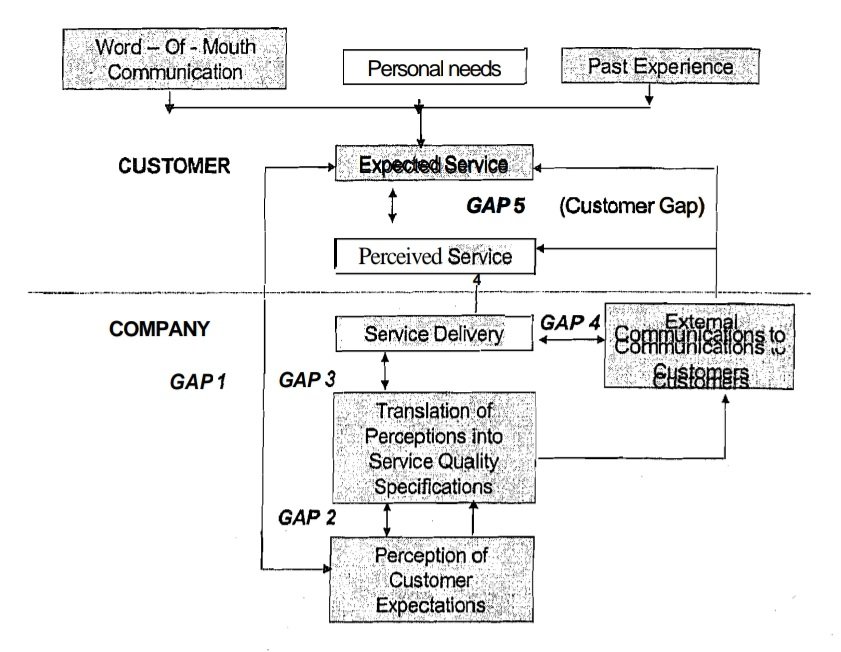
Gap Model of Service Quality
Or Describe nature of organizational buying. Identify different variables or forces influencing the organizational buyer’s behaviour. (10)
Webster and Wind, who have done some pioneering work in this area, define organisational buying as a complex process of decision making and communication, which takes place over time, involving several organisational members and relationship with other firms and institutions. According to them, it is much more than a simple act of placing an order with the suppliers. In this sense, they define organisational buying behaviour as the decision making process by which formal organisations establish the need for purchased products and services and identify, evaluate and choose among alternative brands and suppliers.
It is important here to recognise the emphasis on the decision process rather than on a single act of placing an order. The case of the desert cooler clearly brings out the process which began with identification of the need to finally placing of an order.
Characteristics of Organisational Buying Behaviour
1. Organisational buying is a multi person buying activity
2. It is a formal activity which follows the procedures laid down in an organisation
3. Longer time lag between efforts and results
4. Rational but also emotional activity
5. The uniqueness of organisations
Major factors that Influences on Organizational Buying Behaviour
1. Environmental Factors
These factors include economical, political, technical, legal or regulatory, technological, infrastructural and cultural factors. Environmental factors interact with each other to produce information, values, norms and general business conditions. The influence of environmental factors can be pervasive. A handy Indian example is that of credit squeeze announced by the commercial banks around 1975 against inventory holdings. This was based on Tandon Committee Report on the management of working capital by the firms. This single change in the environment, i.e., credit squeeze on inventories had a salutory affect on organisational buying behaviour and led to major structural and procedural changes in the buying behaviour of industrial customers.
2. Organisational Factors
While discussing the characteristics of organisational buying behaviour, it was mentioned that organisations may differ from each other due to objectives, procedures, organisational structure, systems and technology : It is important to recognise the influence of such organisational factors ‘on the buying behaviour.
3. The Interpersonal Factors
Organisational buying is a multi-person activity. The concept of buying centre highlights the roles which different members of the buying organisation may play in the entire buying decision making exercise. The situation becomes more complex due to different statuses, authority, empathy and persuasiveness of the members of the buying centre. These may lead to conflicts.
Though difficult, but an organisational marketer may make, attempts to become familiar with the internal dynamics of the buying process within a customer organisation. Sheth has identified four ways which organisations use for conflict resolutions:
a. Problem Solving Approach: It involves information acquisition and deliberation for more time.
b. Persuasion: Attempt is made to influence the opinions of dissenting members by asking them to reduce the importance of the criteria they are using in favour of better overall achievements of organisational objectives.
c. Bargaining: A more typical situation in which a conflict arises is due to fundamental differences in buying goals and objectives. This is usually true for new buying situations. In such a situation, conflict is resolved not by changing the differences in relative importance of the buying goals or objectives of the individuals involved, but by the process of bargaining. In this a single party is allowed to decide autonomously in the spec situation in return for some favour orpromise of reciprocity in future decisions.
d. Politicking: When the earlier three fail, the parties may resort to tactics which may be unhealthy and lead to casting of aspersions on the dissenting members.
According to Sheth, both `problem solving’ and `persuasion’ are rational methods. Politicking and bargaining are considered as non-rational methods.
4. The Individual Factors
In spite of the environmental, organisational and interpersonal factors, it must be recognised that ultimately individuals, and not organisations, take buying decisions. Each member of the buying centre has a unique personality, a particular set of learned experience, a specified organisational function to perform, and perceptions of how best to achieve both personal and organisational goals. An industrial marketer should be aware of the differing buying perceptions and their influences on the ultimate buying decision. Perhaps, an understanding of the `perceived risk and its management’ at the individual level holds the key to identifying the individual influences on organisational buying behaviour in specific, situations.
Q.8. Discuss the role of information technology in the growth of tourism industry. (10)
Information Technology has played an important role in the hospitality and tourism industry over the last decade. Technology has helped reduce costs, enhance operational efficiency, and improve services and customer experience. Both customers and businesses can benefit from improved communication, reservations, and guest service systems.
Technology has helped tourism and hospitality industries replace expensive human labor with technological labour. This helps reduce labour costs, but also helps avoid customer service issues.
Here are some examples of the ways that IT continues to improve the hospitality and tourism industry.
1. Internet and Marketing
The internet has a powerful impact on hospitality and tourism. A customer’s first experience with your business is a visit to your website. This includes looking at pictures and reviews from past guests. It is vital for a business to effectively utilize online advertising, social media, blogs, and online purchasing to help convenience their customers, especially when your competitors are doing the same thing.
2. Computer Systems
Computer systems allow communication between larger hotel chains with multiple locations to connect easier. They also help keep staff on the same page and make it easier to access information, making your guests experience much better. Guest requests, housekeeping information, and reservations can all be found on one system.
3. Mobile Communication
Mobile tablets and smartphones have replaced large desktop computers, making them virtually extinct. This is helpful, because many travellers take some type of mobile device with them on a trip. This helps hospitality businesses keep customers advised of changes and delays to their reservations, offer deals, and advertise by using GPS tracking.
4. Reservations Systems
You can easily book a hotel room for anyone via the booking facility available online which allows easy access to consumers and travel (millennial) professionals; the systems enable individuals to make reservations and compare prices online. Many, like Expedia, make my trip and Orbitz, are available through online interfaces. Now, major hotels have a 24*7 AI Powered chatbot to increase direct bookings on website.
5. In-Room Technology
Nowadays traveller carries numerous electronic devices and reliable, wireless Internet connectivity ranks at the top of the list for customer needs. Guests can use the hotel’s Web application to access room service options via online or an e-dining Internet site, or use an interactive service that finds nearby restaurants, transportation or shopping stops for them.
6. Self-Service Booking
One of the largest impacts on the travel industry (which comes under the hospitality industry) has been the rise of online or e-booking. Customers looking to book a trip no longer need to visit an agency they can go online to companies such as Expedia, Make my trip or Priceline and book an entire trip themselves. Airlines and hotels themselves also have cut off the travel agent altogether by allowing customers to book tickets and lodging directly from their sites.
The use of Technology in the hospitality and tourism industry has helped speed up operations and helped the traveling process much more enjoyable and efficient. Technology not only helps large chain hotels, but can also be useful to B and B’s and other smaller companies in the industry.
Or Explain the elements of marketing mix for services. (10)
Marketing Mix
1. Product
The service product requires consideration of the range of services provided, the quality of services provided and the level of services provided. Attention will also need to be given to matters like the use of branding, warranties and after-sale service. The service product mix of such elements can vary considerably and may be seen in comparisons of service range between a small local building society and one of the largest in the country; or between a small hotel offering a limited menu range and a four star hotel offering a wide range of meals.
2. Price
Price considerations include levels of prices, discounts allowances and commissions, terms of payment and credit. Price may also pay a part in differentiating one service from another and therefore the customers perceptions of value obtained from a service and the interaction of price and quality are important considerations in many service price sub mixes.
3. Place
The location of the service providers and their accessibility are important factors in services marketing. Accessibility relates not just to physical accessibility but to other means of communication and contact. Thus the types of distribution channels used (e.g. travel agents) and their coverage is linked to the crucial issue of service accessibility.
4. Promotion
Promotion includes the various methods of communicating with markets whether through advertising, personal selling activities, sales promotion activities and other direct forms of publicity, and indirect forms of communication like public relations.
Expanded mix for services
Because services are usually produced and consumed simultaneously, customers are often present in the firm’s factory, interact directly with the firm’s personnel, and are actually part of the service production process. Also, because services are intangible customers will often be looking for any tangible cue to help them understand the nature of the service experience.
These facts have led services marketers to conclude that they can use additional variables to communicate with and satisfy their customers. For example, in the hotel industry the design and decor of the hotel as well as the appearance and attitudes of its employees will influence customer perceptions and experience.
5. People
All human actors who play a part in service delivery and thus influence the buyer’s perceptions: namely, the firm’s personnel, the customer, and other customers in the service environment. All of the human actors participating in the delivery of a service provide cues to the customer regarding the nature of the service itself. How these people are dressed, their personal appearance their attitudes and behaviors all influence the costumers perceptions of the service.
The service provider or contact person can be very important. In fact, for some services, such as consulting, counselling, teaching, and other professional relationship – based services, the provider is the services. In other cases the contact person may play what appears to be a relatively small part in service delivery, for instance, a telephone installer, an airline baggage handler, or an equipment delivery dispatcher. Yet research suggests that even these providers may be the focal point of service encounters that can prove critical for the organization.
6. Physical Evidence
The environment in which the service is delivered and where the firm and customer interact, and any tangible components that facilitate performance or communication of the service. The physical evidence of service includes all of the tangible representations of the services – such as brochures, letterhead, business cards, report formats, signage, and equipment. In some cases it includes the physical facility where the service is offered, for example, the retail bank branch facility.
In other cases, such as telecommunication services, the physical facility maybe irrelevant. In this case other tangibles such as billing statements and appearance of the repair truck may be important indicators of quality. Especially when consumers have little on which to judge the actual quality of service they will rely on these cues just as they rely on the cues provided by the people and the service process. Physical evidence cues provide excellent opportunities for the firm to send consistent and strong messages regarding the organization’s purpose, the intended market segments, and the nature of the service.
7. Process
The actual procedures, mechanism and flow of activities by which, the service is delivered the service delivery and operating systems. The actual delivery steps the customer experiences, or the operational flow of the service, will also provide customers with evidence on which to judge the service.
Some services are very complex, requiring the customer to follow a complicated and extensive series of actions to complete the process. Highly bureaucratized services frequently follow this pattern, and the logic of the steps involved often escapes the customer.
Another distinguishing characteristic of the process that can provide evidence to the customer is whether the service follows a production-line/standardized approach or whether the process is an empowered/customized one. None of these characteristics of the service is inherently better or worse than another.
Rather, the point is that these process characteristics are another form of evidence used by the consumer to judge service. For example, two successful airline companies, Southwest in the United States and Singapore Airlines, follow extremely different process models. Southwest is no-frills (no food, no assigned seats), no exceptions, low-priced airline that offers frequent, relatively short length domestic flights.
All of the evidence it provides is consistent with its vision and market position. Singapore Airlines, on the other hand, focuses on the business traveller and is concerned with meeting individual traveller needs. Thus, its process is highly customized to the individual, and employees are empowered to provide nonstandard service when needed. Both airlines have been very successful.
The three new marketing-mix elements (people, physical evidence, and process) are included in the marketing mix as separate elements because they are within the control of the firm and any or all of them may influence the customer’s initial decision to purchase a service, as well as the customer’s level of satisfaction and repurchase decisions.
Q.9. Write short note on any two of the following: (2×5=10)
a. Factors influencing market segmentation of tourism industry
A market includes large number of buyers with different interests, tastes, age, sex, habits etc. In case of a movie, some people like action movies, others may like romantic or horror etc. Segmenting a market is a kind of dividing and rue principle. This dividing is done through grouping of customers according to their preferences, tastes, habits etc. Philip Kotler explains market segmentation is subdividing the heterogeneous market into homogeneous subsection of market. Factors influencing market segmentation are:
Resource of the organization is the first factor comes under discussion. Segmentation is a costly process. It involves expenditure for conducting surveys, designing and implementing different market mix etc. If the organization has sufficient fund, it can go for a good segmentation. Otherwise undifferentiated strategy is desirable . The competition existing in the market plays yet another role in deciding the market segmentation. A marketer while taking any decision must look at the competitor’s policy. If the marketer enjoys monopoly, then there is no need of segmentation . But in a competitive market, marketer should understand competitor’s policy.
Product life cycle is another factor that determines the market segmentation. A product has different stages in its life such as introduction, growth, maturity, saturation and decline. During Introduction segmentation cannot carry on as the market cannot collect required information. During growth and maturity segmentation is possible. But during decline there is no segmentation. Also, the nature of product is a determinant of segmentation . In the case of homogeneous product, no segmentation is essential. It will be consumed by all classes of consumers . But for heterogeneous products, segmentation is necessary. The example of heterogeneous products is the clothing industry has segmentation such as kids, men, women, wedding etc. The nature of market is another factor too. If the market is sufficient large and consumers have different taste and preferences, market should be segmented . In the case of small scale market undifferentiated policy will be successful.
Market Segmentation is the first step of a marketing strategies and can help in marketing decision making as well. It involves segmenting the market based on various factors such as demographic, geographic, psychographic etc.
Target the right customer depends entirely on the market segmentation which you have finalised. For example, you have decided that your market segmentation will include only A class customers. Thus, in this case your target customers are likely to be in the urban city and that too in cream areas only. Thus, targeting the customer becomes easier after market segmentation.
b. Search quality and experienced quality
Search Quality
A search quality good is a product or service with features and characteristics easily evaluated before purchase. In a distinction originally due to Philip Nelson, a search good is contrasted with an experience good.
Search goods are more subject to substitution and price competition, as consumers can easily verify the price of the product and alternatives at other outlets and make sure that the products are comparable. Branding and detailed product specifications act to transform a product from an experience good into a search good.
They are those with attributes that can be evaluated prior to purchase or consumption. Consumers rely on prior experience, direct product inspection and other information search activities to locate information that assists in the evaluation process. Most products fall into the search goods category (e.g. clothing, office stationery, home furnishings).
Experienced quality
An experience good is a product or service where product characteristics, such as quality or price, are difficult to observe in advance, but these characteristics can be ascertained upon consumption. The concept is originally due to Philip Nelson, who contrasted an experience good with a search good.
Experience goods pose difficulties for consumers in accurately making consumption choices. In service areas, such as healthcare, they reward reputation and create inertia. Experience goods typically have lower price elasticity than search goods, as consumers fear that lower prices may be due to unobservable problems or quality issues.
They are those that can be accurately evaluated only after the product has been purchased and experienced. Many personal services fall into this category (e.g. restaurant, hairdresser, beauty salon, theme park, travel, holiday).
c. Impact of tourism on Indian economy
Traveling and Tourism has been an integral part of Indian Culture &Tradition. Tourism Industry is the most vibrant tertiary activity and a multibillion industry in India. The potential and performance of India’s tourism industry needs to gauge in terms of its socio- economic magnitudes. India is emerging as a popular tourist destination in the world, driven by the focus on innovation and creating value for tourists.
Positive Impact
1. Generating Income and Employment
2. Source of Foreign Exchange Earnings3. Preservation of National Heritage and Environment
4.Developing Infrastructure
5. Promoting Peace and Stability
6 .The Multiplier Effect
7. Regional Development
8. Economic Value Of Cultural Resource
9. Promotion Of International Understanding
Negative Impact
1. Undesirable Social and Cultural Change
2. Increase Tension and Hostility
3. Creating a Sense of Antipathy
4. Adverse Effects on Environment and Ecology
5. Import Leakage
6. Seasonal Character Of Job
7. Increase In Prices
Q.10. Choose the correct options: (1×10=10)
1. Consumer behavior may be defined as:
a. The interplay of forces that takes place during a consumption process, within a consumers’ self and his environment
b. Related to product distribution
c. Managing the organizational structure
d. None of the above
Ans. – d. None of the above
2. Consumer behavior focuses specifically on the:
a. Initiator
b. User
c. Buyer
d. Decider
Ans – c. Buyer
3. In terms of consumer behaviour, culture, social class, and reference group influences have been related to purchase and ____________
a. Economic situation
b. Situational Influences
c. Consumption decisions
d. Physiological influences
Ans. – c. Consumption decisions
4. Which of the following are components of physical environment?
a. Colours, aroma, music and crowding
b. Normal and expanded usage
c. Utilitarian and hedonic product characteristics
d. Moods and momentary conditions
Ans. – a. Colours, aroma, music and crowding
5. __________ is/are transmitted through three basic organisation, the family, religious organization & educational institutions, and in today’s society education institutions are playing an increasingly greater role in that regard
a. Consumer feedback
b. Marketing Information system
c. Market share estimates
d. Cultural Values
Ans. – d. Cultural Values
6. _____________ is the characteristics of services.
a. Heterogeneous
b. Intangibility
c. Consistency
d. None of the above
Ans. – b. Intangibility
7. Which is not related to marketing mix
a. Promotion
b. Price
c. Planning
d. Place
Ans. – c. Planning
8. Which term is not applicable to consumer behaviour?
a. Personality
b. Learning
c. Attitude
d. Co-ordination
Ans. – d. Co-ordination
9. Tax advice, counselling services are examples of:
a. Pure services
b. Pure product
c. Product with some services
d. None of the above
Ans. – a. Pure services
10. The organisations systematic attempt to connect service failure and retain customer good will is
a. Service processes
b. Service recovery
c. Service encounter
d. Service failure
Ans. – b. Service recovery