
Table of Contents
Q.1. Define the term ‘Physical Evidence’ and discuss the importance of physical evidence for hotel and restaurant services. (10)
Cleanliness in a doctor’s clinic, the exterior appearance and iilterior decor of a restaurant, the comfort of the seating arrangement in a cinema hall, adequate facility for personal needs at the airport all contribute towards the image of the service (organisation) as perceived by the customer. The common element in these is that they all physical, tangible and controllable aspects of a service organisation. They constitute the physical evidence of the service.
There may be two kinds of physical evidence:
1. Peripheral evidence
Peripheral evidence is actually possessed as a part of the purchase of service but by itself is of no value. An airline ticket, a cheque book, or receipts for a confirmed reservation in a hotel are examples of peripheral evidence. A cheque book is of value only if you have money in the bank-without that is of no significance. Peripheral evidence adds on to the value of essential evidence.
In a hotel you may find a matchbox, writing pad, pen, complimentary flowers and drinks, which you may take away. These are representations of peripheral evidence. Such evidence must be designed keeping in mind the overall image which the organisation wishes to project and the reminder value of the evidence in its ability to remind the customer about the organisation.
2. Essential Evidence
Whereas peripheral evidence is possessed and taken away by the customer, the essential evidence cannot be possessed by the cumber; the building, its size and design, interior layout and decor, logo and Equipments etc. are constituents of the essential evidence. The essential evidence is a very critical input in determining the atmosphere and environment of the service organisation.
Contrast the essential evidence of a five star hotel (its long driveway, grand entrance manned by a liveried doorman, sophisticated decor of lobby) with that of a fast food outlet (with bright colours, loud music, and bright lights) and judge the kind of rich and formal atmosphere of the former with the relaxed and casual atmosphere of the latter. We can use physical evidence to build a strong association in the customers’ mind and also to differentiate our service from the competition. As a marketing manager it is our responsibility to manage the physical evidence in order to create the ideal environment for our service. We can do this in two ways: one by making the service more tangible, and two, by making it easier fot the customer to grasp the concept of the service.
Importance of Physical Evidence
The primary role of evidence management is to support the organisation’s marketing programme by making it possible to manage both intended and unintended cues which can give adequate evidences to customers and thereby influence perceptions. Interestingly, the physical evidences also influence employees who interact with customers during the service delivery.
Parsuraman et. al. identified six specific roles of evidence
1. Shaping first impression
2. Managing Trust
3. Facilitating Trust of service
4. Changing the image
5. Providing sensory stimuli
6. Socialising employees
Each one them is also applicable in hotel and restaurant industry
Q.2. Give some examples of services that are high in credence qualities. How do high credence qualities affect the consumer behaviour for these services? (10)
The credence qualities i.e. characteristics which the consumer can not evaluate even after the consumption, like auto repair or medial diagnosis. For example, it may be difficult for a patient to assess whether or not a hospital provided appropriate services. Such characteristics exist invariably in services.
Goods with credence characteristics feature high pre-buying costs and high post-buying costs of quality detection. The utility cannot be exactly determined even after consumption. Examples for such goods are health services, legal advices, and child day care, religious and spiritual guidance
In nutshell, most goods are high in search qualities and most services are high in experience or credence qualities.
Examples
Television Repair, Legal Services, Root Canal, Auto Repair, Medical Diagnosis.
As services are rich in experience and credence qualities, the following important aspects related to consumer decisions making process need to be understood
• Information Search
• Criteria for evaluating Quality
• Evoked set of alternative
• Innovation diffusion
• Perceived Risk
• Brand loyalty
• Perceived control
• Attribution of dissatisfaction
Affect of High Credence Services on Consumer Behaviour
Credence products or services have attributes buyers cannot confidently evaluate, even after one or more purchases. Thus, buyers tend to rely on the reputation of the brand name, testimonials from someone they know or respect, service quality, and price. Credence products and services include health care; legal, accounting, advertising, consulting, and IT services; baldness cures; pension, financial, and funeral services; and even pet food (since you have to infer if your pet likes it or not). Credence services are more likely than other types to be customized, making them difficult to compare to other offerings. Because there are fewer substitutes to a customized service and there is more risk in purchasing these types of services, price sensitivity tends to be relatively low — that is, the majority of customers purchasing credence services are relatively price insensitive compared to search or credence goods.
Q.3. Discuss the various forms of consumer sales promotion schemes which can be used by hotels. Give suitable examples in support of your answer. (10)
Sales promotion is aimed at generating immediate response in terms of a buying decision. For a hotel which wishes to cash in on sales promotion, the specific part of the business which stands to benefit, i.e., room sales or food and beverage sales, has to be clearly identified and a promotion drive which will bring about the desired increase of sales must be launched. For instance, a hill station hotel which normally has almost empty rooms during winter or off-season may promote its accommodation and other facilities when a famous winter sports festival is to be held in that area or a national or international conference is to take place or any other special convention or workshop where participating delegates also need relaxation. People who would normally not visit the hill station in winter will do so when presented with such an opportunity.
There are two ways in which one can examine sales promotion. First, schemes which can be defined in terms of time, and second, as an ongoing permanent activity/function. Irrespective of these distinctions one can clearly identify three groups of activities under sales promotion: trade promotions; consumer promotions; and displays.
Trade promotions are schemes which are generally intended to induce or persuade the travel trade or the distribution channel to generate more demand.
The term “travel trade” has been used in its generic form-to refer to all the available distribution channels or outlets to the hotel industry. Trade promotions are, therefore, schemes which are intended to induce or persuade the travel trade to sell more of the hotel product or hotel service and for this purpose a variety of incentives are given.
Consumer promotions are schemes to persuade the consumer, i.e., the potential hotel guest or the user of hotel services, to buy a particular hotel product or service, at a particular point of time. Consumer promotions should be understood as the first definition of sales promotion schemes which are defined in terms of time and are finite.
The third group of activities which include product display and related point-of-sale material, i.e., posters, show cards, display units, etc., help keep in perspective the view that one can’t obviously display the actual hotel product or service at the point of sale and so one has to depend on the descriptions and representations of the actual product.
Q.4. Identify the important buying roles which the members of a family can play in the process of purchase by citing suitable examples. (10)
Buying Roles
In order to function as a cohesive unit, purchase roles or tasks are assigned and carried out by one or more family members. When trying to reach families, therefore, marketers need to realise that a set of purchase roles exist and come into play within the family. These roles can be identified and they determine how families make decisions.
The important buying roles include:
1. The Instigator (Initiator)
This is the person who first suggests the idea of a product or service and initiates the purchase process, to begin with. The Initiator can even be a stranger. For example, you may see someone walking down the street, wearing a new style of sweater or shirt, and decide tilt you would like a similar one. Or, you may go over to a friend’s house and notice a new stereo.
Your friend (the instigator), turns it on to demonstrate the sound quality. The matter is then discussed at home with your family members (co-decision makers) and you decide whether the brand suits your requirements.
2. The Influencer
This is someone whose opinion is valued in the decision-making process. An influencer may b e a friend, brother, sister, spouse, doctor or other influential person. All these persons have a direct or indirect influence on the final purchase decision.
3. The Decider
This is the person who makes the final decision on what brand or make to buy, after all aspects such as price, quality, servicing, have been thought over.
4. The Purchaser (Buyer)
This is the individual who actually purchases the product, pays for it, takes it home or arranges for delivery. Very often, the purchaser and the decider are the same person, particularly for big value items.
5. The Consumer
He is the user of the goods or service.
Although these five buying roles are performed whenever a purchase is made, the individual performing each role may vary from purchase to purchase, and from family to family. The number and identity of the family members who fill these roles thus varies. In any given situation, the same member may take on several or all roles.
Thus, in some cases, a single family member may independently assume a number of roles, in which case, it is really an individual decision within a family context. In other cases, a single role will be performed jointly by two or more family members. Multiple roles, too, may be performed by one of the family members.
The assignment of roles to specific members of the family, has an impact on the overall buying behaviour. There is a sensitive interplay of roles and the different roles are reflected in the relative influence of husband and wife.
The extend and nature of husband-wife influence is an interesting factor to consider in family decisions, because it is likely to shift, depending on the specific stage of the decision-making process and the specific product features under consideration.
When a single person decides to eat out, the decision is based on only his or her own needs. But when that person gets married, the situation changes. A household forms and its members are confronted with various decisions that reflect the needs of the family unit. Who will pay the bills? Who will do the grocery shopping: Who will wash the clothes? Who will cook the dinner?
It has consistently been found that, most husband-wife influence studies classify consumer decisions as husband-dominated, wife-dominated, joint or syncratic and, autonomic or unilateral. This gives us four main decision type categories, namely:
• Wife-dominant decisions: Wives have been found to dominate decisions on food purchase, groceries, household furniture and appliances.
• Husband-dominant decisions: Husbands have been found to dominate the decisions on purchases such as automobiles and life insurance.
• Syncratic decisions (Joint decisions): These are decisions in which husbands and wives share influence. Vacations, choice of schools for children, for example, are jointly decided.
• Autonomic decisions (Unilateral decisions): Decisions of lesser importance that either the husband or wife make independently.
In a joint decision, several persons will be involved in performing a particular role in deciding what to buy (or not buy). Shared consumption and joint decision-making are characteristic of family living. As children grow older, their opinions about products also become important.
An interesting aspect of the role specialisation in the purchase decision process is that, in several families, particularly in traditional households, the husband takes on the roles that are external to the home such as arranging finances, buying the product and so on. The wife performs tasks internal to the home, as in grocery shopping, decorating and cleaning.
Q.5. Discuss the application of life cycle marketing with suitable examples. (10)
The most striking uses of lifestyle concept and allied research have been made in positioning of new products, repositioning of existing products, developing new product concepts and creating new product opportunities in specific fields. In congruence to the product concept chosen, lifestyle research is utilised for selecting media, formulating media and promotion strategies and improving retail performance. Lifestyle concept is also utilised as a framework for presenting research recommendations, since it is capable of offering to the marketers, potraits of target group expressed in an uncomplicated manner.
1. Positioning of New Products
Positioning comprises finding the most profitable niche for a new product in terms of target market. Lifestyle research, for example, an AIO portrait, of heavy users for any given consumer product not only tells us how old they are, where they live and to what socio-economic group they belong, it also tells us what products are they likely to buy, what their interests and opinions are. This provides an unusually rich body of data for use in marketing decisions related to the positioning of a new product.
Decisions concerning the precise target group at which the product is to be aimed, the product image to be designed, the media vehicle and the type of promotion strategy to be taken so that the complete product package is in conformity with a particular lifestyle/styles.
2. Repositioning an Old/Existing Product
Sometimes existing products may sell well below their forecast potential or the company may discover a new, more profitable niche, nearer to the core market where it may now want to position the product. Repositioning is often a contingency planned for in the new product development process, primarily as a remedial measure. Generally in markets where the competitive activity is high, the need while positioning the product for the fixed time is to get a foot hold in the market. After gaining market penetration, establishing distribution and creating a certain degree of market acceptability, the manufacturer may, through repositioning, or a series of repositioning move the product closer to the core market. Lifestyle marketing strategies help considerably in reducing the amount of `market grouping’ that repositioning may entail.
3. Developing New Product Concepts
Lifestyle Marketing Study of existing market segments and analysis of their needs have typically been used to conceptualise on new product opportunities. Traditionally, demographic segmentation, or standard consumer classification of major groups like the educated youth, the young collegiate, the urban housewife etc. have been used to define and study the segments. Lifestyle studies on the other hand can be used to complement the demographic studies in terms of market needs, customer and non-customer attitudes, the opinions related to product usage and the interests of the target customers, to be able to define the product attributes which may be congenial to certain lifestyles. For example users of fluoride toothpaste may have different expectations from it. Some use it as a medicinal aid to oral hygiene; others feel it should give cosmetic benefit. Even among these who use it as a medicine, there are two sets of expectations, some believing that a medicine ought to taste like a medicine while others strongly feel that just because the fluoride toothpaste has a medicinal ingredient, it need not taste like one. In developing the concept of a new fluoride toothpaste, you will find that a complete inventory of Attitudes, Interests and Opinions of the consumers will help you in defining the attributes of the final product, as you can define the requirements of the different lifestyle segment and then conceptualize as to which segment you wish to aim the product at.
4. Creating Promotional Strategies
Lifestyle information is helpful in developing promotional strategies in a number of ways. It gives the decision maker a much more complete profile of the type of consumer who will be at the receiving end of the communication. Lifestyle data suggests the style of language, the tone of voice and even the appeal that may be utilized to reach that kind of consumer. Further, lifestyle information indicates how the product or service fits into people’s lives, how they feel about it and how they may be using the product or service to communicate with others. This information can be utilized by the marketer to decide upon the kind of image he wants to imbue the product with.
The Indian marketing scenario, especially for consumer durables, is becoming fiercely competitive. Hence companies are realizing that merely highlighting the attributes of their product or of the company in terms of demographic or geographic dimensions is not enough to be successful in the market place. Marketers have come to appreciate that buying behaviour is influenced by the consumer’s lifestyle. Companies dealing in cosmetics, apparel, packaged food etc. are seeking opportunities in lifestyle segmentation.
Or What is organisational buying behaviour? Discuss the major influencing factors on organisational buying. (10)
Webster and Wind, who have done some pioneering work in this area, define organisational buying as a complex process of decision making and communication, which takes place over time, involving several organisational members and relationship with other firms and institutions. According to them, it is much more than a simple act of placing an order with the suppliers. In this sense, they define organisational buying behaviour as the decision making process by which formal organisations establish the need for purchased products and services and identify, evaluate and choose among alternative brands and suppliers.
It is important here to recognise the emphasis on the decision process rather than on a single act of placing an order. The case of the desert cooler clearly brings out the process which began with identification of the need to finally placing of an order.
Characteristics of Organisational Buying Behaviour
1. Organisational buying is a multi person buying activity
2. It is a formal activity which follows the procedures laid down in an organisation
3. Longer time lag between efforts and results
4. Rational but also emotional activity
5. The uniqueness of organisations
Major factors that Influences on Organizational Buying Behaviour
1. Environmental Factors
These factors include economical, political, technical, legal or regulatory, technological, infrastructural and cultural factors. Environmental factors interact with each other to produce information, values, norms and general business conditions. The influence of environmental factors can be pervasive. A handy Indian example is that of credit squeeze announced by the commercial banks around 1975 against inventory holdings. This was based on Tandon Committee Report on the management of working capital by the firms. This single change in the environment, i.e., credit squeeze on inventories had a salutory affect on organisational buying behaviour and led to major structural and procedural changes in the buying behaviour of industrial customers.
2. Organisational Factors
While discussing the characteristics of organisational buying behaviour, it was mentioned that organisations may differ from each other due to objectives, procedures, organisational structure, systems and technology : It is important to recognise the influence of such organisational factors ‘on the buying behaviour.
3. The Interpersonal Factors
Organisational buying is a multi-person activity. The concept of buying centre highlights the roles which different members of the buying organisation may play in the entire buying decision making exercise. The situation becomes more complex due to different statuses, authority, empathy and persuasiveness of the members of the buying centre. These may lead to conflicts.
Though difficult, but an organisational marketer may make, attempts to become familiar with the internal dynamics of the buying process within a customer organisation. Sheth has identified four ways which organisations use for conflict resolutions:
a. Problem Solving Approach: It involves information acquisition and deliberation for more time.
b. Persuasion: Attempt is made to influence the opinions of dissenting members by asking them to reduce the importance of the criteria they are using in favour of better overall achievements of organisational objectives.
c. Bargaining: A more typical situation in which a conflict arises is due to fundamental differences in buying goals and objectives. This is usually true for new buying situations. In such a situation, conflict is resolved not by changing the differences in relative importance of the buying goals or objectives of the individuals involved, but by the process of bargaining. In this a single party is allowed to decide autonomously in the spec situation in return for some favour orpromise of reciprocity in future decisions.
d. Politicking: When the earlier three fail, the parties may resort to tactics which may be unhealthy and lead to casting of aspersions on the dissenting members.
According to Sheth, both `problem solving’ and `persuasion’ are rational methods. Politicking and bargaining are considered as non-rational methods.
4. The Individual Factors
In spite of the environmental, organisational and interpersonal factors, it must be recognised that ultimately individuals, and not organisations, take buying decisions. Each member of the buying centre has a unique personality, a particular set of learned experience, a specified organisational function to perform, and perceptions of how best to achieve both personal and organisational goals. An industrial marketer should be aware of the differing buying perceptions and their influences on the ultimate buying decision. Perhaps, an understanding of the `perceived risk and its management’ at the individual level holds the key to identifying the individual influences on organisational buying behaviour in specific, situations.
Q.6. Explain the importance of branding of financial services by giving suitable examples. (10)
Branding is critical in the financial sector given its integral role in society. In a time where there is increasing difficulty differentiating between companies, branding has never been more important. Branding gives a company a unique personality that sets it out from the rest and helps build the company a strong reputation and as well as creating value.
Importance
1. Branding is a key component in gaining recognition.
Every aspect, from a website, to photography, to corporate design, to e-promos is defined by your brand. Every touch point is an opportunity to increase brand awareness and improve client loyalty.
2. Branding creates and builds trust.
Building a strong brand with loyal clients is of crucial importance as it provides considerable competitive and economic benefits to a firm. People are a lot more likely to do business with a company that is well polished and presented.
3. Branding is a valuable asset.
Branding builds financial value and generates future business. Brands strengthen differentiation against peers, driving demand and sales, helping market share growth and building shareholder value.
4. A strong brand generates referral business, bringing you new clients.
People love telling others about brands they have positive experiences with.
5. Strong brands attract talent and motivate staff
By giving them something to believe in and to stand behind.
Branding is at the heart of every business. It’s vital to define what your brand stands for. Your brand is the way your client and potential client perceive you. It is fundamental to be aware of your brand experience and to make sure it is an experience you would want to have. Good branding elevates and differentiates your products and services, and gives clients a reason to choose you over your peers. A strong brand doesn’t just happen; it takes time, effort and a well thought out plan. As niche specialists in the sector we are uniquely placed to help provide insight on how our clients can find a point of difference.
Or Explain the Howard Sheth Model of Consumer Decision Process. (10)
The Howard Sheth Model is an approach for analyzing the combined impact of the social, psychological and marketing factors on the buying behaviour or preference of the consumers and the industrial buyers into a logical order of information processing.
John Howard and Jagadish Sheth introduced the Howard Sheth Model in the year 1969. The concept was published in their book ‘The Theory of Buyer Behaviour’.
Three Levels of Decision-Making in Howard Sheth Model
The model has described the three significant stages of the buyer’s decision-making or selection of a particular brand.
Three Levels of Decision Making
1. Extensive Problem Solving
This is the initial stage of decision-making, where the buyer is new to the market. He/she has no or little information about the brands and has no preference for a particular product or service.
Thus, a consumer is an information seeker at this level, who check out different brands available in the market, before making a buying decision.
2. Limited Problem Solving
At this level, the buyer has inadequate or incomplete information about the product, market or the brands operating in it. Sometimes the buyer is confused among the various alternatives.
Therefore, to make a buying decision, he/she look for a comparative study of the different brands and the products available in the market.
3. Routinized Response Behaviour
The habitual response behaviour stage is where the buyer is entirely aware of the products offered by different brands and the features, pros and cons of each product.
He/she is capable of evaluating and comparing the multiple options available in the market.
Here, the buyer decides in advance, which product is to be purchased.
To understand the Howard Sheth Model, we must have an idea of its arrangement. So, let us have a look at the design of this model:

Howard Sheth Model
Variables of Howard Sheth Model
Beginning with the stage of extensive problem solving, the buyer slowly converts into a regular customer of the organization, at the routinized response behaviour level.
This whole process of buyer’s decision-making functions on four pillars of this model or the four essential elements of this model. These variables are elaborated below:
A. Input Variables
The stimulus inputs refer to the idea or information clue about the brand and its product in terms of product quality, distinctiveness, price, service offered and availability.
These can be further classified as follows:
• Significant Stimuli: The significant stimuli are the physical traits of the product and the brand. It includes the product’s price, quality, availability, distinctive characteristics and service.
• Symbolic Stimuli: The marketing strategies like advertisement and publicity creates a psychological impact on the buyer’s perception of a product’s rhetorical and visible features.
• Social Stimuli: The social stimuli comprises of the various environmental factors which are considered as a source of information for the buyers. It includes family, social class and reference groups.
2. Hypothetical Constructs
The hypothetical constructs depict the central part of the model. It includes all those psychological variables which play a vital role in the buyer’s decision-making process.
It can be further bifurcated into the following two categories:
• Perceptual Constructs
These components define the consumer’s procurement and perception of the information provided at the input stage.
It is an essential element since it drives the buyer’s brand selection and purchases, which includes:
• Learning Constructs
The learning constructs define the buyer’s knowledge, opinion, attitude and end decision on product or brand selection.
B. Output Variables
The output or as we say, the result of the buyer’s decision-making can be seen in the form of his/her response towards the input variables.
It consists of five major components which are arranged systematically below:
• Attention: The buyer’s level of concentration and alertness with which he/she understands the information provided, is termed as attention.
• Brand Comprehension: The awareness of the buyer regarding a particular brand and its products is known as brand comprehension.
• Attitude: The buyer’s evaluation of a brand in terms of individual likes and dislikes, determines his/her behaviour, interest and awareness towards it.
• Intention: The aim or objective of the buyer for purchasing a product can be seen as the buying intention.
• Purchase Behaviour: All the above elements result in the actual purchase of a product by the buyer.
C. Exogenous Variable
There are certain other external factors which influence the buying behaviour of an individual or a firm by hampering the product purchase of a preferred brand.
The exogenous variables are the environmental forces or components of this model. These are as follows:
• Importance of Purchase: If the buyer perceives the product to be less crucial, involving a low cost, then there is a little brand preference.
• Personality Variables: Personal traits like ego, self-esteem, anxiety, dominance, authoritarian, etc. influences a buyer’s decision-making while purchasing a product.
• Social Class: A buyer’s social group, including the family, friends and other reference groups impact the selection or rejection of a particular brand.
• Culture: The buyer’s values, beliefs and ideas frame his/her purchase motive and inhibitors.
• Organization: The buyer’s interaction with the social groups define their authority, status and power. The hypothetical constructs of a buyer are affected by such formal or informal communications.
• Time Pressure: The buyer, at times, is under the pressure of taking a timely decision, which makes him/her look for alternatives if the product of the preferred brand is unavailable at the moment.
• Financial Status: The buyer’s inability to purchase a product or unaffordability restricts him/her from buying it.
The Howard Sheth Model majorly emphasizes repetitive buying behaviour of the consumers or industrial buyers.
This is an empirical approach towards understanding the buyer’s mind-set while purchasing a product or service. It has been intensively applied and tested to check its viability.
Q.7. Define the term ‘Service Quality’ and explain the Gronroos Perceived Service Quality Model. (10)
Service Quality
Quality came to the service literature at the beginning of the 1980’s. This is quite in contrast to the manufacturing sector wherein quality management has a long and rich history. In the twentieth century, especially ‘the second half, increasing global competition forced many manufacturing companies to develop and adopt quality management practices aimed at increasing competitiveness by eliminating waste, increasing efficiencies, reducing costs, improving customer satisfaction and involving every member of the organisation in doing so.
However, from 1980’s the interest in service quality has increased tremendously. One reason why service quality is becoming an important issue is that all the developed countries as well as a number of developing countries have become service economies.
The term ‘Service Quality’ has been defined in different ways. Given below are some of the definitions :
• Service quality as perceived by customers, can be defined as ‘the extent of discrepancy between customers’ expectations or desires and their perceptions ‘ (Zeithaml, Parasuraman and Berry, 1 990)
• Quality is whatever customers say it is, and the quality of particular product or service is whatever the customer perceives it to be (Buzzel and Gale, 1987)
• Service quality is the delivery of excellent or superior service relative to customer expectations (Zeithaml and Bitner, 1996)
• Quality of a service, as perceived by the customer is the result of a comparison between the expectations of the customer and his real-life experiences (Gronroos, 1982)
Gronroos Perceived Service Quality Model
This model suggests that the quality of a service as it is perceived by customers has two dimensions, namely, a technical or outcome dimension i.e. what the customers get and a functional or process related dimension i.e. how the process and service encounter are perceived. These two have been termed as ‘technical quality’ and ‘functional quality’. For example, a restaurant customer will judge the service on the basis of his perception of the food (what is being delivered-technical quality) as well as how ‘the food was sewed Functional quality). A patient will judge the services of a hospital not only on the basis of cure element (technical quality) but on care element (functional quality) as well. Gronroos postulated that as long as the outcome or the technical quality is acceptable, the process dimension, or functional quality, frequently may be more critical to consumer’s overall quality perception. Also, in certain cases the technical quality or the outcome may be difficult for the customers to judge and in such cases the quality perceptions will be based to a large extent on functional quality.
The quality perception process includes much more than just the two dimensions of service quality. Good perceived quality is obtained when the experienced quality meets or exceeds the expectations of the customer, that is, the expected quality. This means that even if the experienced quality is good, the total perceived quality may still be low, if the expectations of the customers are very high or unrealistic. Conversely, the total perceived quality may be high even if experienced quality is not very good, if the customer has very low expectation.
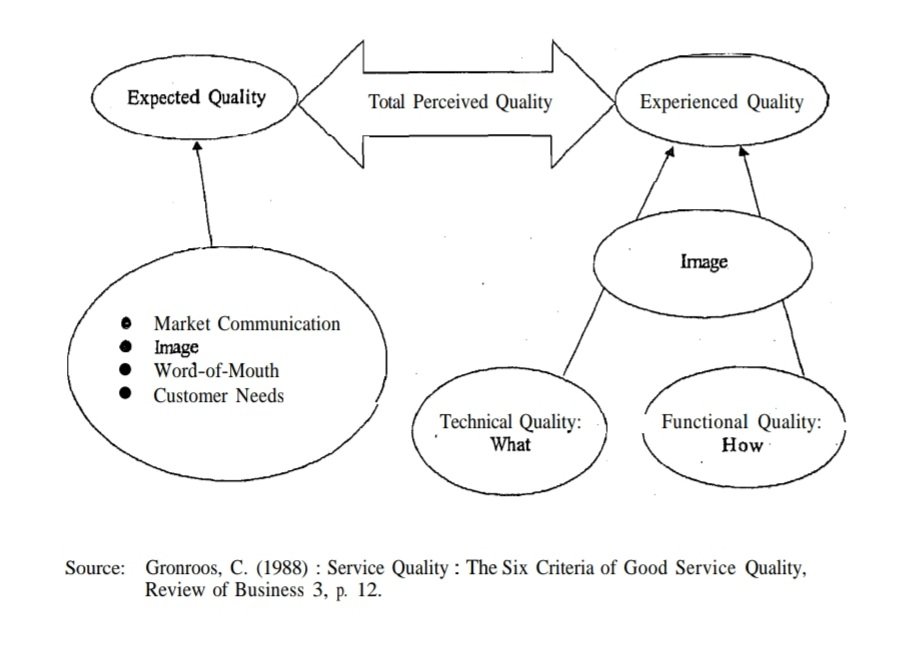
Gronroos Perceived Service Quality Model
The image of the company doesn’t only have an impact on the expected quality but also on perception of the quality experienced. It works as a filter i.e. if the image of the service provider is good in the minds of the customer, minor errors or mistakes are likely to be overlooked and conversely if the image is negative the impact of a mistake is likely to be greater than it otherwise would be. The model suggests that the total perceived quality is not determined by the level of the technical and functional quality dimensions only, but rather by the gap between the expected and experienced quality.
The expected quality depends on a number of factors like market communication, image, word of mouth communication, corporate image and customer needs, few of which are directly under firm’s control and others only indirectly controlled, Factors under firm’s direct control include advertising, direct mail, public relations, sales campaign etc. (i.e, market communication) whereas factors like image, word-of-mouth and customer needs are not directly under firm’s control but can be influenced. The marketers should understand from this not to overpromise. Delivering on promises is an important aspect of perceived service quality. Also, it should be appreciated that customer expectations are not static but keep on changing over period of time.
Or Discuss the Gaps Model of Service Quality by taking into consideration all the five dimensions of service quality. (10)
Gaps Model of Service Quality
Parasuraman, Zeithaml and Beiry (PZB) have done extensive work in the area of service quality. According to then1 Perceived Service Quality can be defined as ‘the extent of discrepancy between customers’ expectations or desires and their perceptions. Put simply, Perceived Service Quality = Perceived Service – Expected Service.
Based on their research work, they identified that customers consider five dimensions in their assessment of service quality, as given below:
1. Reliability: Ability to perform the promised service dependably and accurately (example: flights depart and arrive on schedule).
2. Responsiveness: Willingness to help customers and provide prompt service (example : no waitings at the hospital).
3. Assurance: Employee’s knowledge and courtesy and their ability to inspire trust and confidence. (example : knowledgeable mechanics at auto service centre).
4. Empathy: Caring, individualized attention given to customers (example: specific type of room provided to the guest based on his previous stay, acknowledges customer by name).
5. Tangibles: Appearance of physical facilities, equipment, personnel and written materials (example: seating and air conditioning in a theatre).
Of the five dimensions, reliability is considered to be the most important one. It refers to the company delivering on its promises. In a competitive market place it is absolutely essential for a firm to be reliable in order to attract customer loyalty. Assurance dimension is likely to be of great importance in case of services perceived to be of high risk by the customers or services which are rich in credence qualities e.g. health services. Tangibles may be given great importance by new customers to judge service quality especially when other cues may not be available. By focusing on empathy a service company can make the customer feel unique and special whereas responsiveness dimension emphasizes promptness in dealing with customer’s requests, complaints or problems.
PZB further focused on finding the deficiencies within companies that result in poor quality perceptions by customers. The reasons for gap between customers’ perceptions and expectations (Gap5 – Customer Gap) were identified as ;
1. Provider Gap1 : Not knowing what customer expect
This gap is the difference between customer expectations of service and company , understanding of these expectations. Service firms executive may not always understand what features connote high quality to consumers in advance, what features a service must have in order to meet customer needs and what levels of performance on those features are needed to deliver high quality service.
2. Provide Gap 2 : Not selecting the right service designs and standards
A company might correctly perceive the customers’ needs but may not set a specified performance standard. This may occur because management sometimes believes that customer expectations are unreasonable or unrealistic. Also availing of other factors like resources constraints, market conditions and/or management indifference – may result in discrepancy between company perception of consumer expectations and the actual specification established for a service
3. Provider Gap 3: Not delivering the service standards
This is the gap between service quality specifications and actual service delivery. Even if there are customer driven service standards, a high quality service delivery is not a certainty. The main reason for this gap is involvement of human beings in the service delivery – especially the role of contact personnel. The variability in employee performances makes it hard to maintain standardized quality. Failure to match demand and supply, customers not fulfilling their roles and problem with service intermediaries may also result in creating this gap.
4. Provider Gap 4: Not matching performance to promises
This is essentially a gap between what you deliver and your external communication. Media advertising and other communication by a firm can affect consumer expectations. Therefore, a company must be certain not to promise more in communication that it can deliver in reality. Promising more than what can be delivered will raise initial expectations but lower perception of quality when the promises are not fulfilled.
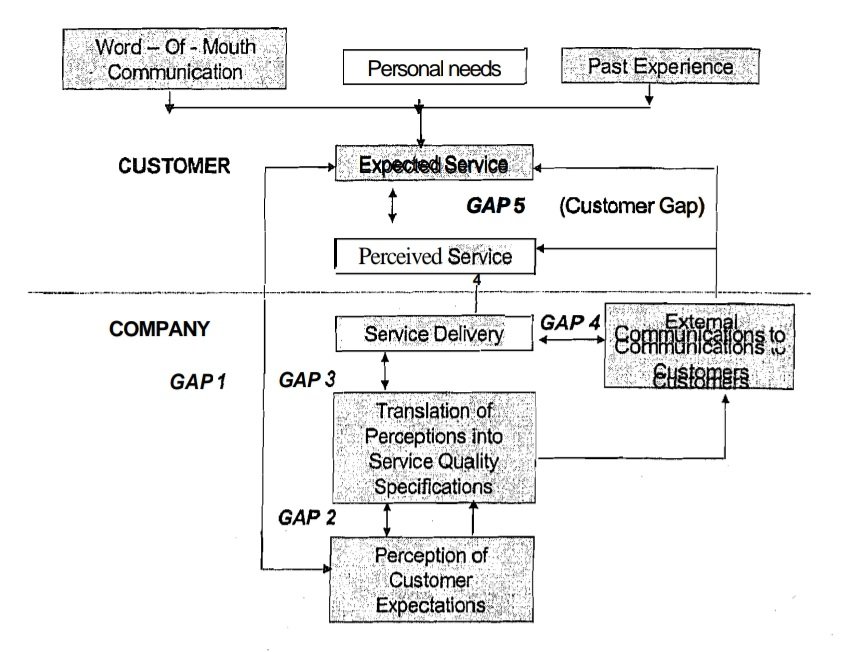
Gap Model of Service Quality
Q.8. What is the significance of Post Purchase Dissonance for a health club?
Many times in our own personal life, we buy products which we later regret buying. It could be costly shoes, small items or anything which was an impulse buying or researched buying, but one we regret after buying. The unhappiness which comes after the purchase is known as Post Purchase Dissonance.
Post Purchase Dissonance is when the customer’s state of the mind and perception is quite uneasy after purchasing the product or service offering of the brand. This results in the customer either regretting the brand or in returning the product back from where he purchased.
There could be many reasons for Post purchase dissonance leaving the customer unsatisfied or uneasy about the purchase.
• He thinks that he has overpaid for the product that he has purchased.
• He has realized that the competitor’s product is far better in terms of price, features, and attributes as compared to the brand’s product.
• There is a disparity between his prior evaluation of the product and his final purchase. So he doesn’t want the product anymore.
• Maybe it was an Impulse purchase and the customer regrets the impulse.
One of the major reasons behind this regret after the purchase is the evolving tastes and preferences of the customer and the growing competition in the market.
The factor of Post Purchase Dissonance can be applicable to any product or service available in the market
There is a certain threshold for the customer to reach the level of Post Purchase Dissonance. In general, we can divide into three levels
1. Tolerance level – Where the customer is Fine with the product he has brought and goes ahead with the purchase.
2. Inconsistency level – Here the customer is undecided whether he really likes the product and whether the purchase was really upto mark.
3. Post Purchase Dissonance – The final stage where the customer begins regretting the purchase.
Causes of Post Purchase Dissonance
1. External pressure
2. Wide variety of options
3. Lack of research and knowledge:
4. Quality of the product:
5. Unique characteristics of the product
Q.9. Write short notes on any two of the following (2×5=10)
a. Zone of tolerance
The zone‐of‐tolerance (ZOT) is an innovative concept that has attracted recent attention in the services marketing domain. The ZOT represents a range of service performance that a customer considers satisfactory, which recognizes multiple expectation standards, specifically adequate and desired expectations.
The zone of tolerance has emerged from both the service quality and satisfaction literature to represent both a range of expectations and an area of acceptable outcomes in service interactions.
The Zone of Tolerance Model of Customer Satisfaction is a refinement of the gap model described here and has been around since the 1990’s.
The Tolerance GAP is the difference between desired service and the level of service considered adequate. The larger that gap, the more likely the customer will be dissatisfied.
The chief strength of this is that it explains something the expectation models do not — why customers return to companies where the service is bad.
The model suggests that there is a wide zone of customer service quality that is…well, OK. Barely adequate. So long as the company stays within that zone, the customer will not have a highly emotional reaction, and so will remain a customer.
So, the implication of the model is that you have to be quite bad to actually lose a customer forever, but the flip side is that it’s also hard to WOW a customer too.
That seems to correspond well to how real people actually behave when they encounter poor service, particularly the fact that they often return, particularly if the establishment has other desired characteristics — lower price, more convenient, closer location, etc.
It’s important to remember that customer behavior, wants, needs, expectations are very fluid — they depend on an immediate context, and this applies here. It would be a mistake to think that customers have some consistent rule — let’s say they’ll only wait 5 minutes, that they apply to every single interaction.
Even at the same establishment, the rules or norms a customer applies will change depending on his or her situation. So a mother late picking up her child from school is clearly going to apply a different “rule” about how long she will wait in line compared to someone out for leisurely shopping.
b. Services marketing triangle
The Services Marketing Triangle (or Services Triangle) shows the key actors involved in marketing a service business. It also shows the key marketing activities that occur between those actors.
The Services Marketing Triangle is shown in the following diagram. It shows the key marketing activities that happen between the key actors within services businesses.
Services Marketing Triangle
Each actor works together to develop, promote, and deliver a company’s service. As you can see from the diagram we represent actors by the points of the triangle.
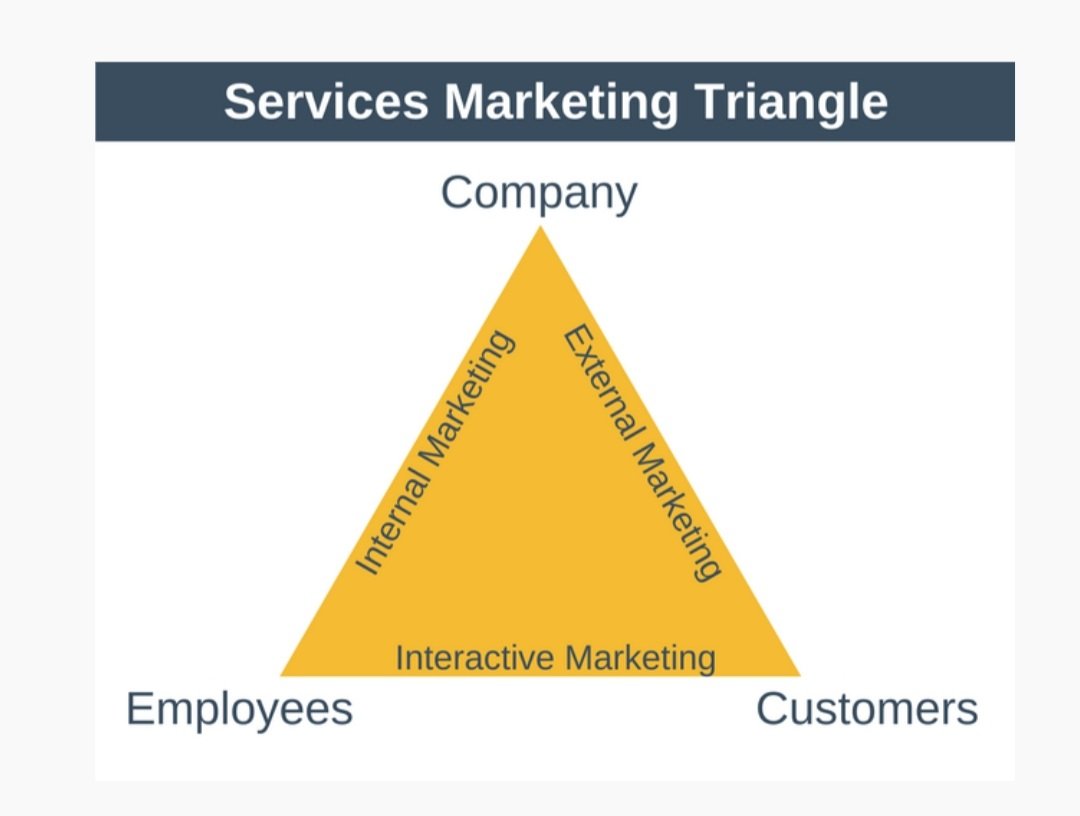
Service Marketing Triangle
Our actors are:
• Company: refers to the leadership team of the company in question.
• Employees: refers to all employees, including subcontractors who deliver the company’s service.
• Customers: refers to all customers and potential customers of the company.
The lines between the points show the different types of marketing that must occur:
• External Marketing: occurs between the company and its customers.
• Internal Marketing: occurs between the company and its employees.
• Interactive Marketing: occurs between the employees and the customers
Services Marketing Triangle Example
First, let’s consider external marketing. A luxury hotel may want to educate customers through advertising and public relations. Here, they will want to inform customers that their rooms have the finest quality fixtures, fittings, and toiletries. They are likely to also want to convey that their staff are knowledgeable and very willing to help with whatever request a customer may have.
To deliver these promises the company focuses on internal marketing. It establishes more concierge roles within the hotel than the industry average. This helps ensure that staff feel they have the time they need to help each customer to the best of their ability. Employees are also trained on the local area, local activities, and excursions. The company also teaches every employee how to handle and diffuse difficult guests and situations.
One of the ways that the hotel handles interactive marketing is as follows. They employ someone to manage their social media presence and reputation.
Now suppose a guest tweeted that they are in their room preparing for an important meeting the next day. This would be noticed by the member of staff managing the hotel’s social media presence. Then, whilst the guest is at their meeting the hotel might leave a handwritten note and some chocolates in their room.
The note will wish that their meeting went well. The chocolates will make them feel cared about and listened to. This makes the customer feel valued in the short term. It also makes them more likely to remain a customer over the long-term.
c. Trait theory of personality
Trait theory of personality is one of the recent and slightly `implementable theory of personality. The approach here is to focus on the quantitative measurement of traits, or identifiable characteristics that define a person. For example, people can be distinguished by the degree to which they are socially outgoing (the trait of extroversion). Some specific traits that are relevant to consumer behaviour include innovativeness (the degree to which a person likes to try new things), materialism (amount of emphasis placed on acquiring and owning products), self-consciousness (the degree to which a person deliberately monitors and controls the image of the self that is projected to others), and, need for cognition (the degree to which a person likes to think about things and by extension expend the necessary effort to process brand information). Thus, the approach tires to identify the dimensions and make up the personality of the consumer. This way, comparisons can be made over the segments as well cultures. Marketers have used the approach quite often. For this purpose a variety of personality scales have developed and employed.
Trait theory attempts to describe people in terms of their predispositions on a series of adjectives.Many such lists have been developed. Researchers then use these trait inventories to investigate the personality profiles of groups of consumers of competing brands.
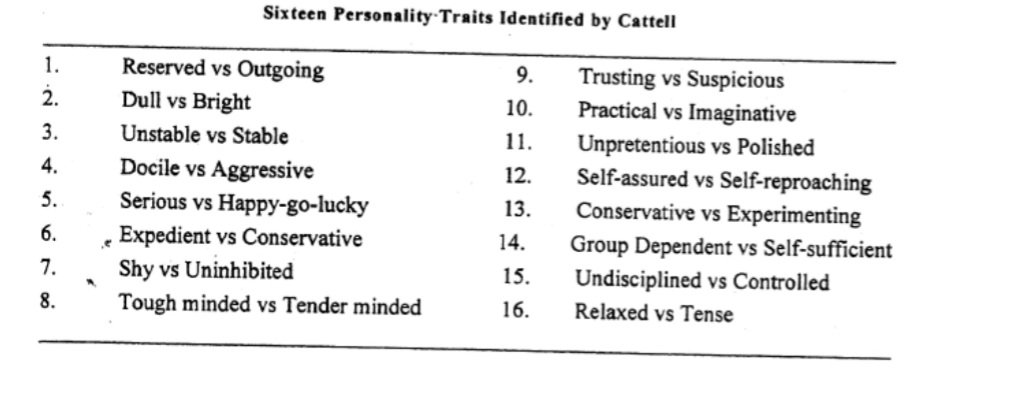
Sixteen personality traits identified by Cattell
Trait theory is based on certain assumptions namely that :
1. Traits are relatively stable characteristics.
2. There are a limited number of traits common to most people. People differ in the extent to which they possess these common traits.
3. The degrees to which individuals possess certain traits can be measured by using a questionnaire. For example, a consumer may be viewed as possessing some degree of each trait along a continuum such as :
Trusting Versus Suspicious
Self-assured Versus Insecure
a. Trusting …………Suspicious
b. Self-assured …….Insecure
A rating toward the suspicious end of the continuum would indicate a much tougher customer than one toward the `trusting’ end. Similarly a self-assured person would be more likely to try new products than an insecure customer. Again, dogmatic people are found to be less receptive to unfamiliar stimuli and to new styles and products.
Factor theories involve the application of Trait theory by subjecting large numbers of individuals to personality tests the results of which are subsequently analysed by a statistical technique called factor analysis. This enables common factors or traits to be identified in groups of people who constitute market segment.
Q.10. Choose the correct option: (10×1=10)
1. Which among the following is not an element of physical evidence?
a. Employee dress
b. Employee training
c. Equipment
d. Facility design
Ans – b. Employee training
2. Difference between customer expectation and customer perception is called:
a. Customer delight
b. Customer satisfaction
c. Customer gap
d. Supplier gap
Ans – c. Customer Gap
3. Which amongst the following is not a service?
a. Banking
b. Hotels
c. Tax preparation
d. Computer software
Ans – d. Computer Software
4. The employee skills in serving the client may be described as:
a. Internal marketing
b. External marketing
c. Relationship marketing
d. Interactive marketing
Ans – d. Interactive Marketing
5. Which of the following is not a tangible dominant?
a. Detergent
b. Investment management
c. Automobile
d. Soft drink
Ans – b. Investment Management
6. According to PZB, the most important determinants of service qualityis:
a. Responsiveness
b. Reliability
c. Assurance
d. Empathy
Ans – b. Reliability
7. Which amongst the following is not an individual characteristic influencing consumer behaviour?
a. Culture
b. Attitudes
c. Task definition
d. Social class
Ans – Task definition
8. Which amongst the following is not a component of personality?
a. Family
b. Behaviour
c. Traits
d. All of the above
Ans – All of the above
9. A set of shared values, attitudes, belief and other symbols is called:
a. Reference group
b. Culture
c. Group influence
d. Motivation
Ans – b. Culture
10. An individual’s non-living or interacting and acting pattern is called:
a. Lifestyle
b. Personality and self-concept
c. Social class
d. None of the above
Ans – a. Lifestyle