
Table of Contents
Q.1. Explain the role of government of India in the marketing of tourism sector in India. (10)
The Ministry of Tourism, is the nodal agency for the formulation of national policies and programmes and for the co-ordination of activities of various Central Government Agencies, State Governments/UTs and the Private Sector for the development and promotion of tourism in the country. This Ministry is headed by the Union Minister of State for Tourism (Independent Charge).The administrative head of the Ministry is the Secretary (Tourism). The Secretary also acts as the Director General (DG) Tourism. The office of the Director General of Tourism {now merged with the office of Secretary (Tourism)} provides executive directions for the implementation of various policies and programmes. Directorate General of Tourism has a field formation of 20 offices within the country and 14 offices abroad and one sub-ordinate office/project i.e. Indian Institute of Skiing and Mountaineering (IISM)/ Gulmarg Winter Sports Project. The overseas offices are primarily responsible for tourism promotion and marketing in their respective areas and the field offices in India are responsible for providing information service to tourists and to monitor the progress of field projects. The activities of IISM/GWSP have now been revived and various Ski and other courses are being conducted in the J&K valley.
The Ministry of Tourism has under its charge a public sector undertaking, the India Tourism Development Corporation and the following autonomous institutions:
• Indian Institute of Tourism and Travel Management (IITTM) and National Institute of Water Sports (NIWS)
• National Council for Hotel Management and Catering Technology (NCHMCT) and the Institutes of Hotel Management.
The Ministry of Tourism functions as the nodal agency for the development of tourism in the country. It plays a crucial role in coordinating and supplementing the efforts of the State/Union Territory Governments, catalysing private investment, strengthening promotional and marketing efforts and in providing trained manpower resources. The functions of the Ministry in this regard mainly consist of the following:
1. All Policy Matters, including:
• Development Policies.
• Incentives.
• External Assistance.
• Manpower Development.
• Promotion & Marketing.
• Investment Facilitation.
2. Planning Co-ordination with other Ministries, Departments, State/UT Governments Regulation:
• Standards.
• Guidelines
3. Infrastructure & Product Development.
• Guidelines
4. Human Resource Development
• Institutions.
• Setting Standards and Guidelines.
5. Publicity & Marketing:
• Policy.
• Strategies.
• Co-ordination.
6. Research, Analysis, Monitoring and Evaluation International Co-operation and External Assistance
• International Bodies.
• Bilateral Agreements.
• External Assistance.
• Foreign Technical Collaboration
7. Legislation and Parliamentary Work, Establishment matters, Vigilance matters, Implementation of official language policy, Budget co-ordination and related matters, Plan-coordination and monitoring.
The Functions of Attached Office viz. Directorate General of Tourism are as under [The office of DG (T) has now been merged with the office of Secretary (Tourism)]:
• Assistance in the formulation of policies by providing feedback from the field offices. Monitoring of Plan Projects and assisting in the Plan formulation & Regulation:
• Approval and classification of hotels and restaurants
• Approval of travel agents, Inbound tour operators and tourist transport operators, etc
• Inspection & Quality Control
• Guide service
• Complaints and redressal
• Infrastructure Development:
• Release of incentives.
• Tourist facilitation and information.
• Field publicity, promotion & marketing.
• Hospitality programmes.
• Conventions & conferences.
• Assistance for Parliamentary work.
• Establishment matters of Directorate General of Tourism
Or Explain in detail about consumer behaviour and lifestyle marketing. (10)
Consumer behavior
Consumer behavior is the study of consumers and the processes they use to choose, use (consume), and dispose of products and services, including consumers’ emotional, mental, and behavioral responses.Consumer behavior incorporates ideas from several sciences including psychology, biology, chemistry, and economics.
Consumer behavior is important because this way marketers can understand what influences consumers’ buying decisions.
By understanding how consumers decide on a product they can fill in the gap in the market and identify the products that are needed and the products that are obsolete.
Studying consumer behaviour also helps marketers decide how to present their products in a way that generates maximum impact on consumers. Understanding consumer buying behaviour is the key secret to reaching and engaging your clients, and convert them to purchase from you.
There are three categories of factors that influence consumer behavior
1. Personal factors
An individual’s interests and opinions that can be influenced by demographics (age, gender, culture, etc.).2. Psychological factors
An individual’s response to a marketing message will depend on their perceptions and attitudes.3. Social factors
Family, friends, education level, social media, income, they all influence consumers’ behavior.Lifestyle Marketing
Lifestyle marketing is a marketing technique that positions the product or service to possess ideals, aspirations, and aesthetics that the target audience identifies with. In layman’s terms, it means that brands marketed in this way are a way of life for their audience. They are immersive, encapsulate their customers’ ideas or values, and fit seamlessly into the consumer’s life.Lifestyle marketing goes beyond the product or service being sold––it’s selling an ideal. Think of Nike. Sure, they started with and continue to sell athletic shoes. But what makes them a lifestyle brand is their empowerment of the athlete inside everyone. Nike and its products are a way of life for its fans (I mean, you don’t see a diehard Nike fan with Adidas on. Ever. ). They eat, live, breathe, and sweat the brand’s ideals.
What makes marketing these brands even more special is the idea that “specific foods, products, and apparel can help us to connect more with our ideal version of ourselves.” When you’re marketing to these higher level needs for a consumer, you’re in a whole new playing field.
Lifestyle marketing criteria
If only branding were as simple as having a checklist to mark off when you meet certain criteria. Unfortunately, many brands that set out to be in the lifestyle category can miss the mark by not doing their due diligence and research.Application of Lifestyle Marketing
1. Positioning of new products2. Repositioning of old/existing products
3. Developing new products
4. Creating Promotional Strategies
Q.2. What are the factors that influence individual in buying process? (10)
The study of consumer behaviour indicates how individuals, groups and organizations select, buy, use and dispose goods, services, ideas, or experiences to satisfy their needs and desires. Consumer behaviour is affected by several factors. Marketers need to have a good knowledge of the factors affecting the consumer behaviour.In general, the factors that affect consumer behaviour are discussed in the following sections:
A. Marketing Mix Factors
Each component of the market mix—product, pricing, promotion and place of distribution—has a direct or indirect impact on the buying process of the consumers.1. Product
The special characteristics of the product, the physical appearance and the packaging can influence the buying decision of a consumer.2. Pricing
The price charged on the product or services consumed by the consumer affect the buying behaviour of the consumers. Marketers must consider the price sensitivity of the target customers while fixing prices.3. Promotion
The variables of promotion mix such as advertising, publicity, public relations, personal selling and sales promotion affect the buying behaviour of the consumers. Marketers select the promotion mix after considering the nature of the target audience.4. Place
The channels of distribution and the place of distribution affect the buying behaviour of the consumers. The marketers makes an attempt to select the right channel and distribute the products at the right place.B. Personal Factors
The personal factors such as age, occupation, lifestyle, social and economic status and the gender of a consumer may affect the buying decisions of the consumers individually or collectively.1. Age factor
The age factor greatly influences the buying behaviour. For example, teenagers prefer trendy clothes, whereas office executives prefer sober and formal clothing.2. Gender
The consumer behaviour varies across gender. For example, girls prefer certain feminine colours such as pink, purple and peach, whereas boys go for blue, black and brown.3. Education
Highly educated persons may spend on books, personal care products, and so on. But a person with low or no education may spend less on books and more on personal grooming products.4. Income level
Normally, the higher the income level, the higher is the level of spending and vice versa. But this may not be the case in developing countries, especially in the rural areas.5. Status in the society
Persons enjoying higher status in the society spend a good amount of money on luxury items such as luxury cars, luxury watches, premium brands of clothing, jewellery and perfumes.C. Psychological Factors
A person’s buying behaviour is influenced by the psychological factors such as the following:1. Learning
It refers to changes in individual behaviour that are caused by information and experience. For example, when a customer buys a new brand of apparels, and is satisfied by its use, then they are more likely to buy the same brand the next time. Through learning, people acquire beliefs and attitudes, which in turn influence the buying behaviour.2. Attitude
It is human tendency to respond in a given manner to a particular situation or object or idea. Consumers may develop a positive, or a negative, or a neutral attitude towards certain products or brands, which in turn affects their buying behaviour.3. Motives
A motive is the inner drive that motivates a person to act or behave in a certain manner. A marketer must identify the buying motives of the target customers and influence them to act positively towards the marketed products.4. Beliefs
A belief is a descriptive thought that a person holds about certain things. It may be based on knowledge, opinion, faith, trust and confidence. People may hold certain beliefs of certain brands/products. Beliefs develop brand images, which in turn can affect the buying behaviour.D. Social Factors
The social factors such as reference groups family, and social status affects the buying behaviour. Social factors in turn reflect a constant and dynamic influx through which individuals learn different meanings of consumption.1. Reference groups
A reference group is a small group of people such as colleagues at workplace, club members, friends circle, neighbours, family members, and so on.The reference groups influence the members in following manner:
a. They influence members’ values and attitudes.
b. They expose members to new behaviours and lifestyles.
c. They create pressure to choose certain products or brands.
2. Family
The family is the main reference group that may influence the consumer behaviour. Nowadays, children are well informed about goods and services through media or friends circle, and other sources. Therefore, they influence considerably in the decisions of buying both fast moving consumer goods and durable items.3. Roles and status
A person performs certain roles in a particular group such as family, club, organization, and so on. For example, a person may perform the role of a vice president in a firm and another person may perform the role of a marketing manager.E. Cultural Factors
There is a subtle influence of cultural factors on a consumer’s decision process. Consumers live in a complex social and cultural environment. The types of products and services they buy can be influenced by the overall cultural context in which they grow up to become individuals. Cultural factors includes race and religion, tradition, caste and moral values. Culture also includes subcultures, sub-castes, religious sects and languages.1. Culture
It influences consumer behaviour to a great extent. Cultural values and elements are passed from one generation to another through family, educational institutions, religious bodies and social environment. The cultural diversity influences food habits, clothing, customs and traditions. For example, consuming alcohol and meat in certain religious communities is not restricted, but in certain communities, consumption of alcohol and meat is prohibited.2. Subculture
Each culture consists of smaller subcultures that provide specific identity to its members. Subcultures include sub-castes, religious sects (Roman Catholics, Syrian Catholics, Protestant Christians, etc.), geographic regions (South Indians, North Indians) and language (Marathi, Malayali, Gujarati).The behaviour of people belonging to various subcultures is different. Therefore, marketers may adopt multicultural marketing approaches, that is, designing and marketing goods and services that cater to the tastes and preferences of the consumers belonging to different subcultures.
Or Explain the role of marketing in service sector to attract customers. (10)
Service Marketing
Services Marketing refers to the marketing of services as against tangible products.Services are inherently intangible, are consumed simultaneously at the time of their production, cannot be stored, saved or resold once they have been used and service offerings are unique and cannot be exactly repeated even by the same service provider.
Marketing of services is a relatively new phenomenon in the domain of marketing, having gained in importance as a discipline only towards the end of the 20th century.
Services marketing first came to the fore in the 1980’s when the debate started on whether marketing of services was significantly different from that of products so as to be classified as a separate discipline. Prior to this, services were considered just an aid to the production and marketing of goods and hence were not deemed as having separate relevance of their own.
Role of Service Marketing
As service is an intangible product, its marketing becomes a difficult task. However, the marketing of such intangible services is extremely important in order to sustain and survive in the market.
Following points are listed, to explain the importance of services marketing:
1. A Key Differentiator
Most of the consumers consider the services as an important element in order to judge the product or a service. For example, Dominos and Pizza Hut are known to sell similar products in the market; however the service that they provide to their customers matter a lot.Since there is not much difference in the product of the above mentioned two brands, at such times their services create an impact on the customer’s mind. Hence, “service” is defined as a key differentiator where a company can provide excellent customer services to retain their old customers and to attract new ones.
2. Importance of Relationship
Since service is an intangible product, customers will be able to buy such services based on mutual trust and confidence in the seller. Hence, it is important for the seller to maintain good relationships with the customers by listening to their needs properly and delivering exactly what they want. Hence, relationship is considered very important in a service sector, which will help the seller to retain loyal customers and also attract the new ones.3. Customer Retention
In today’s highly competitive environment, it is very important to retain old customers than to attract new ones. This is because there are a lot of sellers trying to catch from the same pool of buyers. Thus, sellers must concentrate on retaining the customers by fulfilling their changing needs.They must promote feedback amongst customers and must work on the given feedback in order to match up to their wants. This way they will be able to retain their loyal customers by offering increasing satisfaction.
4. Multiple Touch Points
Service sector does not provide any tangible services to the customers. Thus customers have to depend on intangible services like talking to many people about the services before buying the same. This creates a perception in the customer’s mind whether to go ahead with the purchase or not. These multiple touch points are important to motivate the customers to trust them and make the purchases.5. Services Proliferate
Since it is a challenge to market the intangible services to the customers, marketers should find various ways and means to market the product in such a way that it stands out from the rest of the crowd. They should invent various ways to communicate the benefits of the services to the customers in such a language which they find easy to reflect to their needs and value.6. Feedback Improves Services
Since it is difficult to match up the marketing concepts of the service sector with the needs of the customers, sellers must work on the feedback given by the customers. These feedbacks are genuine suggestions and tips given by the customers and if the seller works on the same, it will help him to match up with the changing needs and desires of the customers. Sellers must cultivate the habit of collecting regular feedbacks from the customers and working on the same.7. Technology Impacts
Technology is a big boon for the service sectors. People like to collect information on the services before actually purchasing them. Thus, internet plays a very important role here to flash the required details of the services so that customers can directly visit the website for details and this will also prevent them from talking to many other people. Service sellers must take full advantage of the growing technology and reach out to maximum customers with the required knowledge and quality.Q.3. How does culture and sub-culture behaviour influence consumer behaviour? (10)
A person’s culture & sub-culture has a huge influence on their thought processes and behaviours. Because it’s so influential on how people perceive the world around them, their place in it, and how they make decisions, it tends to play a role in determining how and why we consume goods and services.Sometimes, it’s really obvious how culture influences buying behaviour.
Cultural prohibitions against consuming products such as alcohol or meat, or cultural preferences for styles of clothing, make it easy to understand some buying patterns. Cultural behaviours, such as household size or the role of women in managing households, also influence who buys certain products or in what size.
But others are more subtle. Cultural elements such as time orientation (whether a culture tends to focus on the past, present or future) seem to bear influence on elements of online shopping such as trust and social interaction.
Of course, human personalities vary and that variety encompasses the extent to which an individual takes on board the particular influences of their culture. Indian consumers tend to be more family orientated than western ones but that doesn’t mean there aren’t Indian consumers who don’t make highly individualistic purchasing decisions – or Western ones that don’t think collectively.
To some extent, culture is simply what comes most naturally to a person – what fits within their values and belief systems, and what they see others around them doing. Culture influences what feels right, normal and desirable.
Retailers that ask consumers to swim against the social current are making it harder for the consumer to choose their services. It’s usually better practice to make it possible and easy for consumers to choose your product within their cultural comfort zone.
There are some great examples of marketing that respects and works within cultural norms. Motorbike marketing makes a good study. In the West, motorbikes tend to be thought of as the ultimate individual product and the marketing messages that surround them fit into the prevailing culture that encourages and rewards individualistic self-fulfilment.
Head over to a more collectivist culture though and you’ll find motorbikes are sold in a very different way. The idea of a “family motorbike” seems ludicrous to Western bikers but it’s a practical choice in a more collectivist, family-orientated culture in an Asian market, such as Thailand.
In this cultural context, consumers are more likely to make purchases based on how much they benefit the wider family or social group rather than themselves as an individual, so marketing needs to reflect this.
Or What do you understand by family life cycles and buying roles? Explain in detail. (10)
Life cycle
The life cycle of families has been conceptualised as a progression involving several stages:1. The Bachelor Stage (Young and single)
In the bachelor stage of the life cycle, income is low relative to future earnings, since most bachelors are just beginning their careers. However, there are few financial burdens. They therefore have relatively high discretionary incomes.They tend to spend substantial amounts on personal consumption items, food, clothing, transportation, certain luxury goods entertainment, vacations, and possibly even a car. A few basic furniture items may be acquired, as well as some kitchen equipment. However these purchases tend to be on a non-systematic basis and also minimal, because possessions restrict their freedom of movement.
2. The Newly Married Couples (Young, no children)
With marriage, the requirements and resources change. Household requirements increase. In addition, in some cases, both partners may be working. This stage therefore represents a high expenditure period. Purchases include durable goods such as refrigerators and other appliances, inexpensive durable furniture, home entertainment items such as TV sets. These items often take priority over other purchases.3. Full Nest 1 (Young, married, with child)
The arrival of a child creates major changes. Some wives may stop working and they suffer a reduction in income. The financial resources thus change significantly. Child rearing and educational responsibilities increase. Money is now directed to baby furniture, toys, chest rubs, vitamins, baby foods and baby medicines. While more shopping is done, the family also faces more medical bills. This is also the period that they become dissatisfied with their income and with their inability to accumulate earnings.4. Full Nest 2 (Older, married, with children)
The family’s financial position starts to improve because of career progress and also because many wives return to work. They present an active market for a wide variety of food products, bicycles, music lessons, magazines and also educational services as children are growing up.5. Full Nest 3 (Older, married, with dependent children)
Income is high for the family at this stage. However, they now represent experienced buyers and tend to be less interested in new product purchases.Expenditures continue to be high due to replacement buying in the later phases of the stage.
6. Empty Nest (Older, married, with no children living with them)
With no children living at home, the financial position stabilises., Savings accumulate. There may be a resurgence in self-education. Hobbies also become an important source of satisfaction. More is spent on luxury appliances, magazines. and health products. Major expenditures are on home ownership, home improvements and also on medical care.7. Solitary Survivor (Older, single, retired people)
Simple, often more economical lifestyle. A lower income due to retirement may be a restrictive factor. Health care and other services become important.The stages at which families find themselves thus affect the nature of the goods and services required, their wants and consumption patterns, as well as the volume of consumption on specific products. At each stage there are unique needs, different patterns of object accumulation, and different demands that are placed on the family.
Buying Roles
In order to function as a cohesive unit, purchase roles or tasks are assigned and carried out by one or more family members. When trying to reach families, therefore, marketers need to realise that a set of purchase roles exist and come into play within the family. These roles can be identified and they determine how families make decisions.
The important buying roles include:
1. The Instigator (Initiator)
This is the person who first suggests the idea of a product or service and initiates the purchase process, to begin with. The Initiator can even be a stranger. For example, you may see someone walking down the street, wearing a new style of sweater or shirt, and decide tilt you would like a similar one. Or, you may go over to a friend’s house and notice a new stereo.Your friend (the instigator), turns it on to demonstrate the sound quality. The matter is then discussed at home with your family members (co-decision makers) and you decide whether the brand suits your requirements.
2. The Influencer
This is someone whose opinion is valued in the decision-making process. An influencer may b e a friend, brother, sister, spouse, doctor or other influential person. All these persons have a direct or indirect influence on the final purchase decision.3. The Decider
This is the person who makes the final decision on what brand or make to buy, after all aspects such as price, quality, servicing, have been thought over.4. The Purchaser (Buyer)
This is the individual who actually purchases the product, pays for it, takes it home or arranges for delivery. Very often, the purchaser and the decider are the same person, particularly for big value items.5. The Consumer
He is the user of the goods or service.Although these five buying roles are performed whenever a purchase is made, the individual performing each role may vary from purchase to purchase, and from family to family. The number and identity of the family members who fill these roles thus varies. In any given situation, the same member may take on several or all roles.
Thus, in some cases, a single family member may independently assume a number of roles, in which case, it is really an individual decision within a family context. In other cases, a single role will be performed jointly by two or more family members. Multiple roles, too, may be performed by one of the family members.
Q.4. Discuss consumer attitude. How does attitude impact consumer decision making in buying hotel services in India? (10)
Attitude
Consumer attitudes are a composite of a consumer’s (1) beliefs about, (2) feelings about, (3) and behavioral intentions toward some object–within the context of marketing, usually a brand or retail store. These components are viewed together since they are highly interdependent and together represent forces that influence how the consumer will react to the object.
Attitude impact on consumer decision
The decision making is affected by the psychological field i.e. the internal influences. These influences include motivation, perception, learning, personality and attitudes. The output portion of consumer decision making model includes two associated activities i.e. purchase behaviour and post purchase evaluation.
An attitude is a learned predisposition to respond in a consistently favourable or unfavourable manner with respect to a market offer ( i.e. a brand, a particular shop or retail outlet, an advertisement, etc.). Attitude is a dispositional term indicating that attitudes manifest themselves in behaviour only under certain conditions. Knowing a buyer’s attitude towards a product without knowing the personal goals is not likely to give a clear prediction of his behavior. For example, someone may have a highly favourable attitude towards car insurance but stays away from buying it since he has no use for it, as he doesn’t own a car.
Attitude study is important for the marketers because it affects consumers’ selective processes, learning, and ultimately the buying decision making.
Ad by Value impression
As consumers’ attitudes influence their intention to buy, knowledge of different aspects of consumer attitudes may help marketers make a sales forecast of their products.
Measuring consumer attitudes may help a marketing executive get a better picture of both present and potential markets.
As attitudes often affect the consumer’s decision-making process, marketers must understand attitude formation and change if they expect direct marketing activities to influence consumers.
Awareness of consumer attitudes is such a central concern of both product and service marketers that it is difficult to imagine any consumer research project that does not include the measurement of some aspect of consumer attitudes.
An outgrowth of this widespread interest in consumer attitudes is a consistent stream of attitude research reported in the consumer behavior literature.
It is well understood that attitude has been one of the most important topics of study in the consumer behavior field.
Attitude study may contribute to decisions regarding new product development, repositioning existing products, creating advertising campaigns, and understanding the general pattern of consumer purchase behavior.
Thus, an understanding of what an attitude is, how it is organized, what functions it performs, how it can be measured, and how a marketer can change an existing attitude is very important for a marketer to combat competition successfully.
Following few important and generally accepted findings on consumer attitudes further justify the importance of attitude study for a marketer taken from the studies of Alvin Achenbaum; Henry Assael and George S. Day; Frederick W. Winter; and, Steward W. Bither, Ira J. Dolich, and Elaine B. Nell.
Finding #1: Product usage tends to increase as consumers’ attitudes toward a product become more favourable. Usage tends to decline as attitudes grow less favourable.
Finding #2: The reason for different market shares occupied by different sellers in a product category is the differences in consumers’ attitudes toward different brands.
Finding #3: Marketers may try to change consumers’ attitudes toward their products, aiming to increase sales through persuasive communications. But, they should bear in mind that many other variables determine the effectiveness of such communications.
Finding #4: Consumers may likely change their attitudes toward the existing products if exposed to new ones. It is, therefore, important for the marketers to even reinforce existing positive attitudes.
Or What do you understand by tourism product? What is tourism marketing segmentation? (10)
Tourism
A tourism/tourist product can be defined as the sum of the physical and psychological satisfaction it provides to tourists, during their ‘traveling and sojourn’ en route at the destinations.Since travel and tourism industry is an agglomeration of too many sectors that promote travel related services. These sectors are referred to as travel vendors and their services and goods are called ‘travel products’. A tourism product includes five main components such as physical plant, services, hospitality, freedom of choice, and a sense of involvement.
Thus, whatever the natural and man-made resources, services brought about the consumption of tourists is called tourism products.
The tourist product can be analysed in terms of its attraction, accessibility and accommodation.
Characteristics Of Tourism Products
1. Intangible
Tourism is an intangible product means tourism is such kind of product which can not be touched or seen and there is no transfer of ownership, But the facilities are available for specified time and for a specified use. For e.g. a room in the hotel is available for a specified time.2. Psychological
The main motive to purchase tourism product is to satisfy the psychological need after using the product, by getting experience while interacting with a new environment. And experiences also motivate others to purchase that product.3.Highly Perishable
Tourism product is highly perishable in nature means one can not store the product for a long time. Production and consumption take place while a tourist is available. If the product remains unused, the chances are lost i.e. if tourists do not purchase it.4. Composite Product
Tourist product is a combination of different products. It has not a single entity in itself. In the experience of a visit to a particular place, various service providers contribute like transportation The tourist product cannot be provided by a single enterprise, unlike a manufactured product.5. Unstable Demand
Tourism demand is influenced by seasonal, economic political, and other factors. There are certain times of the year that see greater demand than others. At these times there is a greater strain on services like hotel bookings, employment, and the transport system, etc.Tourism Marketing Segmentation
All tourists are not the same. Just as they may belong to different regions, they may be of different age groups and earn different incomes and have different tastes and preferences to live their lives in a certain manner; the tourists also have different choices when it comes to selecting the mode of travel, destination, and the activities at the destination.
Tourism market segmentation is the strategic tool for getting a clear picture of diversity among the tourists. The tourism researchers and the tourism industry use market segmentation information to study the opportunities for competitive advantage in the marketplace.
Market segmentation is nothing but dividing the total consumer market into groups to be able to communicate with them and provide their specific needs.
Smith (1956) introduced the concept of market segmentation as a strategic tool. He stated that “Market segmentation (…) can be viewed as a heterogeneous market (one characterized by divergent demand) as a number of smaller homogeneous markets”.
The tourism market segmentation can be broadly divided into the following types −
1. Geographic
Geographic market segmentation is done considering the factors such as tourists’ place of origin. This factor is important as the tourists belonging to different places are brought up with different cultures and show different traits of behavior. It is the most basic type of segmentation.2. Demographic
This segmentation is done by considering the tourist’s gender, age, marital status, ethnicity, occupation, religion, income, education, and family members.3. Psychographic
The marketing people do this segmentation by taking into account the psyche of the tourists. They gather information about the tourists’ interests, attitudes, their way of living life, opinions, and overall personality.4. Classes of Tourists
Depending upon the motives and the way of touring, there are various classes of tourists −• Tourists Travelling with Families
The tourists who visit places with their first and extended families, or families of relatives. One person, generally the head of the tourist family is the decision maker. The families generally travel for holidays and leisure and tend to expend sparingly. They generally are keen on receiving the best services for what they have paid. They tend to carry more luggage.• Single Tourists
They travel alone and are independent. They are alone but not lonely; as tourism is what they pursue as a hobby. The gap year travelers, unmarried persons, widows/widowers, backpackers, and solitary tourists travel single. They decide for themselves and tend to expend more. They tend to carry less stuff on the journey. They tend to behave balanced if any challenging situation occurs and are rational towards tour schedules.• Groups of Tourists
Students from schools and universities as members of educational tours, fellows of various fraternities with common interests, groups of newly-weds, or senior citizens.• Tourists Visiting Friends and Relatives
These tourists travel to meet friends or relatives, or to attend a celebration or gathering. These tourists generally plan their tours in the breaks such as Diwali holidays, Christmas holidays, or any kind of long break when most of the people have break.• Business Tourists
They are the professional tourists on the business trips. They decide for themselves but do not spend much money. For example, a sales or a marketing person travels to another city to attend a business fair, and business manager travels to another country for business deals.• Incentive Tourists
They tour for consuming the reward they received in the form of a few days’ family holiday package at some hotel or resort. Such rewards are generally distributed if an employee performs outstanding to achieve the goals.• Health Tourists
These tourists travels to places with the agenda of health on their mind. They travel to avail some special medical treatment, operation, surgery, medication, or inexpensive aesthetic surgeries available in different country. Some tourists in this category also travel if they are receiving some illness from the climate at their residence such as Asthma.Q.5. Discuss the SERVQUAL mode in detail. (10)
Measuring Service Quality (SERVQUAL)
The most widely-used measure for service quality has been the ‘SERVQUAL’ measure of Parasuraman, Zeithaml and Berry, according to which customer assessment of service quality results from a comparison of service expectations and actual performance.
The SERVQUAL scale was first published in 1988 and has undergone numerous improvements and revisions since then. This scale was developed and validated using service providers in four service sectors : retail banking, credit cards, securities brokerage and product repair and maintenance. The developers of the scale acknowledge that the five service quality dimensions are general dimensions that relate to most of the services.
It measures the service quality on the five service quality dimensions Reliability, Responsiveness, Assurance, Empathy and Tangibles. Reliability largely concerns whether the outcome of service delivery was as promised. The other four dimensions relate to the process of service delivery or how the service was delivered. Servqual scores are expressed as the difference between expectations and perceptions i.e. it measures the gap between the service that consumer think should be provided and what they think actually has been provided. Respondents complete a series of scale, which measure their expectations on five service quality dimensions and subsequently, they are asked to record their perceptions of that company’s performance o,n those same dimension. When perceived performance ratings are lower than expectations this is sign of poor quality; the reverse indicates good quality.
The original SERVQUAL instrument consisted of 22 statements covering the five service quality dimensions (4 questions on tangibles, 5 on reliability, 4 on responsiveness, 4 on assurance and 5 on empathy) – i.e. a set of 22 statements covering expectations and a set of 22 statements covering perceptions.
Expectations and perceptions statements includes aspects like (i) equipments, physical facilities, appearance of employees, materials associated wit11 the service like pamphlets or statements (tangibles) ii) timely provision of service, performing the service right the first time, meeting the promises, sincere interest in solving the problems (reliability), (iii) prompt service, willingness to help, employees never too busy to respond to customer requests (responsiveness), (iv) behaviour of employees instilling confidence, feeling of safety in transactions, employees having knowledge to answer the questions (assumable) and (v) individual attention to customers, employees understanding specific needs of customers (empathy). In addition to expectations and perceptions section the SERVQUAL contained a “point allocating question” which was used to ascertain the relative importance of the five dimensions by asking respondents to allocate a total of 100 points among the dimensions. The servqual instrument has been used extensively, with or without some modifications.
The SERVQUAL scale can be used
1. To determine a company’s service quality along each of the five service quality dimensions.
2. To find out relative importance of service quality dimensions as considered by the customer,
3. To compute overall weighted SERVQUAL score, which takes into account the relative importance of each dimension as well.
4. To track customers’ expectations and perceptions over time
5. To compare a company’s SERVQUAL score against those of competitors.
SERVQUAL instrument has been used with modifications in a number of studies. Though it is a widely used instrument, same researchers have also identified problems in using the instrument as well as the gap theory methodology. Cronin & Taylor suggest that instead of measuring expectations and perceptions, measurement of performance alone would be enough for measuring service quality. They have suggested that the performance based scale developed (SERVPERF) is efficient in comparison with the SERVQUAL scale as it reduces by 50% the number of items that must be measured.
Q.6. List the individual determinants and environmental influences that affect consumption behaviour. (10)
Determinants of Consumer Behaviour
Factors influencing consumer behaviour can also be classified into Individual Determinants and External Determinants. The individual determinants shape and determine the needs and motives of a consumer and direct him towards a purchase, while the external determinants indirectly influence the purchase process by filtering through individual determinants.
Individual Determinants affecting consumption behaviour
1. Motivation
Motivation is the ‘why’ of behaviour. It is an intervening variable between stimulus and response and a governing force of consumer behaviour.“Motivation refers to the drives, urges, wishes or desires which initiate the sequence of events known as behaviour.” as defined by Professor M.C. Burk. Motivation is an active, strong driving force that exists to reduce a state of tension and to protect, satisfy and enhance the individual and his self-concept. It is one that leads the individual to act in a particular way. It is the complex net-work of psychological and physiological mechanisms.
Therefore, motives can be conscious or unconscious, rational or emotional, positive or negative. These motives range from a mere biological desires like hunger and thirst to the most advanced scientific pursuits like landing on the Moon or Mars.
2. Perception
Marketing management is concerned with the understanding of the process of perception because, perception leads to thought and thought leads to action. Perception is the process whereby stimuli are received and interpreted by the individual and translated into a response.In other words, perception is the process by which the mind receives, organises and interprets physical stimuli. To perceive is to see, hear, touch, taste, smell and sense internally something or some event or some relation.
Perception is selective because, and individual cannot possibly perceive all stimulus objects within his perceptional field; hence, he perceives selectively. Perception is organized because, perceptions have meaning for the individual and they do not represent a buzzing confusion. Perception depends upon stimulus factors. That is, the nature of physical stimulus itself is a determinant of perception.
The variables like colour size, contrast, intensity, frequency and movement are of this kind. Again, perception depends on the personal factors. What the individual brings to the situation governs perception his ability to see or hear the message, his needs, his moods, memory, expressions and values all these modify the message reception.
3. Attitude
The concept of attitude occupies a central position in the consumer behaviour studies in particular and social psychology in general because; attitude measurements help in understanding and prediction of consumer behaviour. ‘Attitude’ refers to a predisposition to behave in a particular way when presented with a given stimulus and the attitudes towards people, places, products and things can be positive or negative or favourable or unfavourable.Attitudes develop gradually as a result of experience; they emerge from interaction of a person with family, friends, and reference groups. There are three distinct components of attitude namely, cognitive, affective and co-native. ‘Cognitive’ component is what an individual believes about an object, thing or an event whether it is good or bad, necessary or unnecessary, useful or useless.
It is based on the reason and is linked with knowledge and about the object, thing or an event whether it is pleasant or unpleasant, tasty how an individual responds to the object, thing or an event. It is based on the other two components and is related with his behaviour.
Each of the three attitude components vary according to both the situation and the person. The marketing manager’s success is determined partly by his ability to understand, predict and influence the consumer attitudes.
The marketer may be interested in confirming the existing attitudes, or change in the existing attitudes or create new attitudes depending on how his product is performing in the market.
Attitude confirmation is, perhaps, the easiest course of action which is followed in case of established products. Such an act involves only reminding the consumers as to why they like it and why they should continue it to purchase.
4. Personality and Self concept
Very often, the word ‘personality’ is used to refer to the capacity of a person for popularity, friendliness or charisma. However, in strict sense, it refers to the essential differences between one individual and another.Therefore, personality consists of the mannerisms, habits and actions that make a person an individual and thereby serve to make him distinct from everyone else. It is the function of innate drives, learned motives and experience.
This means that an individual responds with certain amount of consistency to similar stimuli. Personality is the interplay of three components namely, ‘id’, ‘the ego’ and the ‘super ego’.
The ‘id’ governs the basic drives and the instincts of an individual. On the other hand, the ‘super ego’ disciplines the ‘id’ by suppressing anti-social behaviour; it drives the individual in the direction of more high minded pursuits of civilizations.
The ‘ego’ component is the executive and makes the conscious decisions and reconciles the inflicting demands of ‘id’ and ‘super ego’, wherever necessary. For instance, ‘id’ may force an individual to make full use of consumer credit to buy an automobile, ‘super ego’ dissuades such an activity as borrowing is a kind of social sin in Indian society.
It is ‘ego’ that reconciles these and works out a compromise making the individual to pay instalments regularly without any strain on his regular budget.
5. Learning and Memory
In behavioural science, learning means any change in behaviour which comes about as a result of experience. Learning is the process of acquiring knowledge. Consumer behaviour is a process of learning because; it is modified according to the customer’s past experience and the objectives he or she has set. This process of learning is made up of four stages namely, Drive- cue-response and Reinforcement. ‘Drive’ refers to an internal state of tension which warrants action.Thus, hunger or thirst can be a drive. A ‘cue’ is an environmental stimulus. For instance, it can be an ad on food item or soft- drink, ‘Response’ represents the person’s reaction to cues within his environment. Here, it can be purchased of food item or soft-drink. ‘Reinforcement’ is the responses reward.
The food item or soft-drink. ‘Reinforcement’ is the response reward. The food item or soft drink satisfies the hunger or the thirst. When reinforcement happens, the response may be duplicated resulting in habit formation or absence of reinforcement results in extinction of learnt habit.
As most consumer behaviour is learnt behaviour, it has deep impact on consumer buying process. Prior experience and learning acts as buying guide. In-spite of such habitual behaviour, one can think of reasonable amount of brand switching, trying new products, does take place.
Q.7. Discuss the role of information technology in the growth of ‘Tourism Industry’. (10)
Information Technology has played an important role in the hospitality and tourism industry over the last decade. Technology has helped reduce costs, enhance operational efficiency, and improve services and customer experience. Both customers and businesses can benefit from improved communication, reservations, and guest service systems.Technology has helped tourism and hospitality industries replace expensive human labor with technological labour. This helps reduce labour costs, but also helps avoid customer service issues.
Here are some examples of the ways that IT continues to improve the hospitality and tourism industry.
1. Internet and Marketing
The internet has a powerful impact on hospitality and tourism. A customer’s first experience with your business is a visit to your website. This includes looking at pictures and reviews from past guests. It is vital for a business to effectively utilize online advertising, social media, blogs, and online purchasing to help convenience their customers, especially when your competitors are doing the same thing.2. Computer Systems
Computer systems allow communication between larger hotel chains with multiple locations to connect easier. They also help keep staff on the same page and make it easier to access information, making your guests experience much better. Guest requests, housekeeping information, and reservations can all be found on one system.3. Mobile Communication
Mobile tablets and smartphones have replaced large desktop computers, making them virtually extinct. This is helpful, because many travellers take some type of mobile device with them on a trip. This helps hospitality businesses keep customers advised of changes and delays to their reservations, offer deals, and advertise by using GPS tracking.4. Reservations Systems
You can easily book a hotel room for anyone via the booking facility available online which allows easy access to consumers and travel (millennial) professionals; the systems enable individuals to make reservations and compare prices online. Many, like Expedia, make my trip and Orbitz, are available through online interfaces. Now, major hotels have a 24*7 AI Powered chatbot to increase direct bookings on website.5. In-Room Technology
Nowadays traveller carries numerous electronic devices and reliable, wireless Internet connectivity ranks at the top of the list for customer needs. Guests can use the hotel’s Web application to access room service options via online or an e-dining Internet site, or use an interactive service that finds nearby restaurants, transportation or shopping stops for them.6. Self-Service Booking
One of the largest impacts on the travel industry (which comes under the hospitality industry) has been the rise of online or e-booking. Customers looking to book a trip no longer need to visit an agency they can go online to companies such as Expedia, Make my trip or Priceline and book an entire trip themselves. Airlines and hotels themselves also have cut off the travel agent altogether by allowing customers to book tickets and lodging directly from their sites.The use of Technology in the hospitality and tourism industry has helped speed up operations and helped the traveling process much more enjoyable and efficient. Technology not only helps large chain hotels, but can also be useful to B and B’s and other smaller companies in the industry.
Q.8. What do you mean by reference group? What are the different types of reference group? (10)
Reference Group
Reference groups are defined as groups that a person refers to, and identifies with, to the extent that the group becomes a norm, standard or point of reference. A reference group is, in other words, a group to which a person will compare himself or herself, to determine his or her own relative standing. Consumers also look to reference groups for guidance and advice.Reference groups are usually small groups, and are not as broad as an entire social class. The reference group concept was, in fact, originally developed in connection with small groups. These include the family, close friends, neighbours, religious groups, work groups and also, athletic groups. The family is recognised as an important reference group. In addition, various family members may play different roles in the purchase consumption process. Like the family, there are several other social groups that have an enormous influence on our lives. They regulate our lives through establishing standards of dress and conduct, and the accomplishment of tasks on a face-to-face basis.
Reference groups influence consumer behaviour in two ways:
1. They set levels of aspiration for the individual, i.e. they offer cues as to what lifestyle should be led.
2. They define items appropriate for a member of the group to lead that lifestyle.
Types of Reference group
There are many different types of reference groups, and they do not need to be in physical contact in order to be effective. Often, individuals called referent others will serve in a reference group role.
The groups are:
1. Membership or Non-membership groups
Membership groups are those to which an individual belongs. In contrast, non-membership groups are those that an individual may aspire to belong to.2. Formal or Informal Groups
This depends on whether reference group tend to take on a formal or informal structure.3. Primary or Secondary Groups
A group may be primary or secondary depending on the frequency of contact. Primary groups can be either formal or informal groups. If a person is in regular contact with certain individuals such as families, friends, peers and business associates, then these can be referred to as primary informal groups. Secondary formal groups meet infrequently; are well structured and not so closely knit. Thus, shopping groups and club membership groups constitute secondary groups because of their less frequent contact.4. Aspiration groups are classified into two types: Anticipatory aspiration groups & Symbolic aspiration
Anticipatory aspiration groups are those that a person anticipates joining at some future time. The appeal of the group is in the anticipation of eventually arriving at the top.Symbolic aspiration groups are those that an individual is not likely to belong to, such as professional sports groups, even though the person may be attracted to them. Marketers appeal to symbolic aspirations by using celebrities to advertise certain products.
Each type of reference group has importance in marketing, depending on the type of influence exerted. The common factor among these various types of reference groups is that, each is used by consumers as a point of reference at different times, to evaluate actions, beliefs and attitudes.
Q.9. Explain the concept of Bull-Whip effect? (10)
Blue-Whip Effect
The bullwhip effect is a supply chain phenomenon describing how small fluctuations in demand at the retail level can cause progressively larger fluctuations in demand at the wholesale, distributor, manufacturer and raw material supplier levels. The effect is named after the physics involved in cracking a whip. When the person holding the whip snaps their wrist, the relatively small movement causes the whip’s wave patterns to increasingly amplify in a chain reaction.
In supply chain management, customers, suppliers, manufacturers and salespeople all have only partial understanding of demand and direct control over only part of the supply chain, but each influences the entire chain with their forecasting inaccuracies (ordering too much or too little). A change in any link along the supply chain can have a profound effect on the rest of the supply chain. Given that, there are many contributors and causes of the bullwhip effect in supply chain management.
A simplified example of the bullwhip effect
The bullwhip effect often occurs when retailers become highly reactive to demand, and in turn, amplify expectations around it, which causes a domino effect along the supply chain. Suppose, for example, a retailer typically keeps 100 six-packs of one soda brand in stock. If it normally sells 20 six-packs a day, it would order that replacement amount from the distributor. But one day, the retailer sells 70 six-packs and assumes customers will start buying more product, and responds by ordering 100 six-packs to meet this higher forecasted demand.The distributor may then respond by ordering double, or 200 six-packs, from the manufacturer to ensure they do not run out. The manufacturer then produces 250 six-packs to be on the safe side. In the end, the increased demand has been amplified up the supply chain from to 100 six-packs at the customer level to 250 at the manufacturer.
This example is highly simplified but conveys the sense of exponentially increasing misalignment as actions and reactions continue up and down the chain. The bullwhip effect also occurs as a result of lowered demand at the customer level (which causes shortages when inaccurate) and can be caused at other places along the chain.
Causes of the bullwhip effect
Companies must forecast customer demand based on insufficient information, and try to predict how much product customers will actually want while accounting for the complex factors that enable that amount to be delivered correctly and on time. At every stage of the supply chain there are possible fluctuations and disruptions, which in turn influence the myriad supplier orders. Changes in customer demand directly influence all the other factors along the chain, including inventory. However, the bullwhip effect can occur even in relatively stable markets where the demand is essentially constant.Forecasting demand has always been a difficult endeavour, and the increasing complexity of today’s global supply chains intensifies that difficulty, as does increasing consumer preference for Omni channel and e-commerce.
A few of the most common dependencies that can cause a bullwhip effect are:
• Lead-time issues such as manufacturing delays
• Less-than-optimal decisions made by supply chain stakeholders at any point along the chain, for example, customer service or shipping
• A lack of communication and alignment between each link or stakeholder organization in the supply chain
• Over- or under-reacting to demand expectations, such as ordering too many units or not enough
• Customer companies, often retailers, waiting until orders build up before placing orders with their suppliers, a practice called order batching
• Discounts, cost changes and other price variations that disrupt regular buying patterns
• Inaccurate forecasts from over-reliance on historical demand to predict future demand.
Q.10. Write short note on any two of the following: (5×2=10)
a. Post and pre purchase behaviour
Consumer decision making involves a continuous flow of interactions between environmental factors and behavioral actions.The process of consumer decision making involves pre-purchase information and post-purchase outcomes.
A. Pre-Purchase Behavior
When a consumer realizes the needs, he goes for an information search. He does the same, so that he can make the right decision. He gathers the information about the following −
• Product Brands
• Products Variations
• Product Quality
• Product Alternatives.
The consumer can gather information about a product depending on his age, gender, education and product’s price, risk and acceptance.
Types of Search Activities
The information search activity can be classified into various types such as the following −
• Specific
Specific kind of activities are directly related to the problem. These kinds of requirements need immediate assistance.
• Ongoing
Consumers go on with their research for a particular period of time if they decide or if they want to buy a particular product. Ongoing activities basically show the work in progress.
• Incidental
Now, anything that we observe incidentally or just accidentally or naturally comes under incidental research. Such information can be observed in our daily routine lives.
Following are the information sources available −
The information sources are of two types which are listed under
• Internal Sources − Internal sources includes the consumer himself. Here he himself recalls the information that is stored in his memory and uses his experiences.
• External Sources − External sources of information include all sorts of interpersonal communication with the external environment such as friends, family, marketing people, through advertisements, etc.
Post-Purchase Behavior
All the activities and experiences that follow purchase are included in the post purchase behavior. Usually, after making a purchase, consumers experience post-purchase dissonance. They sometimes regret their decisions made. It mainly occurs due to a large number of alternatives available, good performance of alternatives or attractiveness of alternatives, etc.The marketers sometimes need to assure the consumer that the choice made by them is the right one. The seller can mention or even highlight the important features or attributes and benefits of the product to address and solve their concerns if any.
A high level of post-purchase dissonance is negatively related to the level of satisfaction which the consumer draws out of product usage. To reduce post-purchase dissonance, consumers may sometimes even return or exchange the product.
b. Zone of tolerance
The zone of tolerance is usually defined as the range of customer perception of a service between desired and minimum acceptable standard.The zone of tolerance (ZOT) is defined as “the difference between desired service and the level of service considered adequate”. As may be noted in this definition, the ZOT model recognizes that customers enter service encounters with different expectation levels.
The measurement of service quality has become a significant marketing tool for businesses that wish to develop a competitive advantage by learning about their customers’ consumption experiences. Especially, zone of tolerance is an innovative concept that has attracted considerable attention in the services marketing arena. The zone of tolerance is central to customer evaluations of service quality and satisfaction, and it helps managers to analyze the effectiveness of service quality and to identify problem areas that need improvement.
c. Service Marketing Triangle
The Services Marketing Triangle (or Services Triangle) shows the key actors involved in marketing a service business. It also shows the key marketing activities that occur between those actors.The Services Marketing Triangle is shown in the following diagram. It shows the key marketing activities that happen between the key actors within services businesses.
Services Marketing Triangle
Each actor works together to develop, promote, and deliver a company’s service. As you can see from the diagram we represent actors by the points of the triangle.
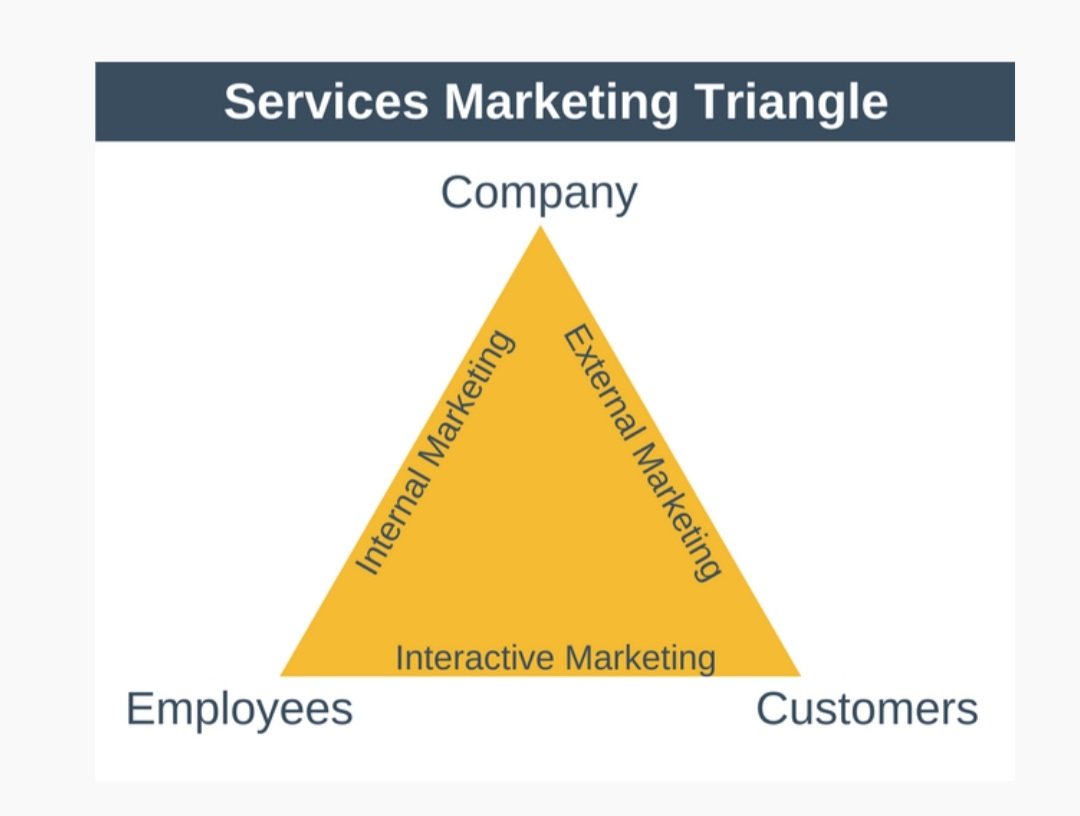
Service Marketing Triangle
Our actors are:
• Company: refers to the leadership team of the company in question.
• Employees: refers to all employees, including subcontractors who deliver the company’s service.
• Customers: refers to all customers and potential customers of the company.
The lines between the points show the different types of marketing that must occur:
• External Marketing: occurs between the company and its customers.
• Internal Marketing: occurs between the company and its employees.
• Interactive Marketing: occurs between the employees and the customers
Services Marketing Triangle Example
First, let’s consider external marketing. A luxury hotel may want to educate customers through advertising and public relations. Here, they will want to inform customers that their rooms have the finest quality fixtures, fittings, and toiletries. They are likely to also want to convey that their staff are knowledgeable and very willing to help with whatever request a customer may have.
To deliver these promises the company focuses on internal marketing. It establishes more concierge roles within the hotel than the industry average. This helps ensure that staff feel they have the time they need to help each customer to the best of their ability. Employees are also trained on the local area, local activities, and excursions. The company also teaches every employee how to handle and diffuse difficult guests and situations.
One of the ways that the hotel handles interactive marketing is as follows. They employ someone to manage their social media presence and reputation.
Now suppose a guest tweeted that they are in their room preparing for an important meeting the next day. This would be noticed by the member of staff managing the hotel’s social media presence. Then, whilst the guest is at their meeting the hotel might leave a handwritten note and some chocolates in their room.
The note will wish that their meeting went well. The chocolates will make them feel cared about and listened to. This makes the customer feel valued in the short term. It also makes them more likely to remain a customer over the long-term.
d. Marketing Mix
Marketing is performed within a certain environment which itself is always changing. The marketing activities have, therefore, to change in consonance with environment to be continuously effective. In order to appreciate this process it is easier to divide the marketing activities into four basic elements, which are together referred to as the marketing mix. These four basic elements are:1. Product
2. Price
3. Promotion, and
4. Place (or physical distribution).
As all these four start with the letter `P’ they are, at times, referred to as the four Ps of the marketing mix or the 4Ps in marketing.
The word product stands for the goods or services offered by the organisation: Once the needs are identified, it is necessary to plan the product and after that keep on analysing whether the product still satisfies the needs which were originally planned for, and if not, to determine the necessary changes.
Price refers to the money value that the customer has to pay. The product has to be adequately priced. This involves considerations of the profit margin, the cost, the possibility of sales at different prices and the concept of the right price.
Promotion is the aspect of selling and advertising, or communicating the benefits of the product or service, to the target customers or the market segment involved in order to persuade them to purchase such products or services. It includes selling through advertising as well as the sales force. Besides, a certain amount of promotion is done through special seasonal discounts, competitions, special price reductions, etc. collectively called sales promotion.
Finally, physical distribution refers to the aspect of the channels of distribution through which the product has to move before it reaches the consumer. It also includes the logistics aspects of distribution such as warehousing, transportation, etc. needed for geographical distribution of the products.
It is also concerned with the selection of distribution channels. The organisation must decide whether it should sell through wholesalers (who buy in large quantities and sell to retailers) and then to retailers (i.e., the shopkeepers, who ultimately sell to consumers), or whether directly to the consumers. There are many ways in which a product can be moved from the producer to the consumer. The optimum method has to be determined in terms of both consumer satisfaction and profitability to the organisation, or optimum use of the organisation’s resources.