
Table of Contents
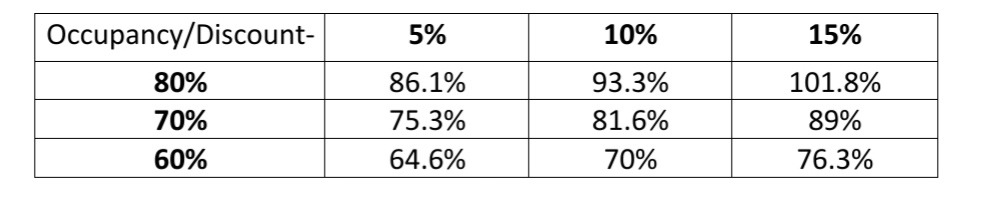
Q.1. Prepare a Discount Grid for 80%, 70% and 60% current occupancies (at Rack Rate) for discounts of 5%, 10% and 15% on Room tariff assuming the following details: (10)
Rack Rate – ₹10,000
Marginal Cost- ₹3,000
Total saleable rooms- 200
Discount Grids
- It refers to a chart indicating occupancy % necessary to achieve equivalent net revenue, given different discount levels.
- Discount grids are used to assist management in evaluating room rate discounting strategies.
- To prepare a discount grid, first calculate the marginal cost of providing a guestroom.
- Next, integrate this information into the equivalent occupancy formula and perform the calculations to fill in the grid.
Equivalent Occupancy = (Current Occupancy Percentage) × ((Rack Rate – Marginal Cost) / (Rack Rate × ((1- Discount Percentage)) – Marginal Cost)
Hence,
For 80% occupancy @5% discount
Equi. Occ = 80% × {(10000-3000)/(10000 × (1-5%)-3000)}
= 0.86 or 86.1%
- In same way 80% occupancy 10 % discount
Equi. Occ – 93.3%
- 80% occupancy 15% discount
Equi. Occ – 101.8%
For 70% occupancy @5% discount
Equi. Occ = 70% × {(10000-3000)/(10000 × (1-5%)-3000)}
= 75.3%
- In same way 70% occupancy 10 % discount
Equi. Occ – 81.6%
- 70% occupancy 15% discount
Equi. Occ – 89%
For 60% occupancy @5% discount
Equi. Occ = 60% × {(10000-3000)/(10000 × (1-5%)-3000)}
= 64.6%
- In same way 60% occupancy 10 % discount
Equi. Occ – 70%
- 60% occupancy 15% discount
Equi. Occ – 76.3%
Discount Grid
Q.2. Displacement of FIT guests to accommodate more groups may be a profitable but risky business decision. Discuss. (15)
- Displacement is the acceptance of group bookings instead of transient guests. Since transient guests or FITs pay higher room rates than group business, the reservations should consult its forecast staff whether or not to accept group business for better hotel yield.
- FIT guests are frequent travellers rather than groups.
- While taking booking of groups we need to offer more discount whereas in FIT bookings there is less discount offered and by this we can earn more revenue.
- Group sales form the majority of the room revenue is very important for hotel yield. It is common for the hotels to receive reservations for group sales from three months to two years in advance of arrival.
- Therefore understanding group booking trends and requirements is very necessary for the success of revenue management. To understand the impact of group sales on overall room revenue, the hotel should collect as much group profile information as possible, including:
- Group booking data – Groups tend to block 5-10% percent more rooms than they are likely to need. If a group has a previous business profile, management can often adjust the block on the basis of group’s booking history.
- Wash Factor- The hotel’s deletion of unnecessary group rooms from a group block is called the ‘wash factor’. However management must be careful in estimating how many rooms to be ‘washed’ from the block.
- Wash factor in group booking is more in comparison to FIT travellers.
- If a group block is reduced by too many rooms, the hotel may find itself overbooked and unable to accommodate all the members of the group and it will effect hotel yield badly.
- Group travellers are very hard to retain whereas FITs can be retained easily.
- Group booking lead time – A measurement of how far in advance group bookings are made according to which it can be decided if the lead-time changes the room can be booked for the FIT guest, this will ensure booth the benefits that is group sales as well as transeint businees will not be effected.
- Transient rooms are the rooms sold to free individual travelers. Transient business is usually booked closer to the date of arrival than group business maybe only one to three weeks before arrival. In order to maximize room revenues, front office managers may
- The booking pace and lead time should be tracked for highest occupancy rate.
- Classify rooms on the basis of their location, desirability or size, and charge more for better rooms.
- Hotels may offer deluxe rooms at standard rates to attract guests especially when demand is low to scale hotel yield.
- Discounts reduce the amount of business lost because of rate resistance and allow the hotels to sell rooms that would otherwise remain vacant. Discounts can be offered to corporate guests, government travelers, senior citizens, military and airline personnel etc.
- Controlling discounts also is very important for generating the highest revenue and hotel yield.
OR
Enlist and enumerate few reports generated by the revenue management software and mention their importance. (15)
Revenue management software is also able to generate an assortment of special reports. The following are representative of revenue management software output:
1. Market segment report: provides information regarding customer mix. This information is important for effective forecasting by market segment.
2. Calendar/booking graph: presents room-nights demands and volume of reservations daily.
3. Future arrival dates status reports: furnishes demand data for each day of the week. This report contains a variety of forecasting information that enables the discovery of occupancy trends by a comparative analysis of weekdays. It can be designed to cover several future periods.
4. Single arrival date history report: indicates the hotel’s booking patterns (trends in reservations). This report relates to the booking graph by documenting how a specific day was constructed on the graph.
5. Room statistics tracking sheet: tracks no-shows, guaranteed no-shows, walk-ins, and turn-aways. This information can be instrumental in inaccurate forecasting.
6. Weekly recap report: contains the sales rate for rooms and the number of room authorized and sold in marketing programs with special and discounted rates.
Some other reports that are generated by RMS are-
- Monthly performance report
- Star summary
- Competitive set reports
- Response report
- Segmentation summary
- Segmentation occupancy analysis
- Additional revenue analysis
- Segmentation response reports
- Daily data for the month
Importance of reports generated
-
The reports helps in knowing room category-wise guest reservation details including its source, cancelled reservation and no-shows, temporary reservations, etc for any particular date range.
-
Furthermore, the report also gives you a clear insight on your reservation summary, reservation (ADR) report, key reservation trends etc.
-
The reports ensures that you get to know which rooms are selling fast, from which sources you are getting good booking and which rate gets you maximum reservations.
-
The reports contains daily, weekly, monthly, quarterly and yearly reports that provide historical pricing information on your property’s past performance. You can analyze them and can come up with accurate forecasting. Thus, you can set the right price to sell the right room to the right guests at the right time to see more revenue.
-
The reports help you understand and provide key insights on key reservation trends from different channels and so that you get to know how each channel is working for you – from which sources you are getting good booking and which rate gets you maximum reservations.
Q.3. Hotel Blue Moon has 350 rooms. The double occupancy rate is Rs.8,000/- and the single occupancy rate is Rs.6,000/-. On a particular day when the hotel was sold out, the house count was 600. The discounts given for double occupancy was 25% and that for single occupancy was 15%.
Calculate ARR, RevPAR and Yield for that day. (3×5=15)
Given,
Rooms – 350
Double occupancy rate – ₹8,000
Single occupancy rate – ₹6,000
Discount given – 25% for double occupancy
15% for single occupancy
House Count – 600 @ 100% occupancy
ARR –
After discount on room rates
New Double occupancy rate – ₹6,000
New Single occupancy rate – ₹5,100
Rate spread – 900
Multiple occupancy % = ( No. of rooms with more than 1 pax / total room sold) × 100
= (600-350/350)× 100
= (250/350) × 100
= 71.4%
ARR = (MO% × Rate Spread)+ PASR
= ( 71.4%× 900) + 5100
= 642.6+5100
= 5742.6
RevPAR = Occupancy% × ARR
Here occupancy is 100% then,
RevPAR = ARR
Yield = ARR/PAR
then,
PASR = ₹6,000
PADR = ₹8,000
Then Rate Spread = ₹2,000
PAR = (MO% × Rate Spread)+ PASR
= (71.4% × 200) + 6000
= 1428+6000
= ₹ 7,428
Yield = 5742.6/7428
= 0.773
=or 77.3%
Q.4. Excess room inventory in all major cities in India has resulted in hotels paying maximum attention towards Revenue Management. Explain with suitable examples.(10)
In the hospitality industry, revenue management is fundamental for success.
- The goal is to maximize revenue by predicting consumer behavior and optimizing inventory and price availability.
- Once you determine who your competitors are and analyze how they are positioning themselves in the market, you can develop and implement a strategy to increase ROI.
- In the past five years, it has become increasingly difficult to predict and measure the impact of the competitive environment. Market fragmentation complicates this task, and at the same time makes it difficult to track how distribution is being managed.
- The rise of hotel comparison sites, like OTAs and metasearch engines have made it easier to compare hotel prices.
- Further complicating analysis and the implementation of future strategies are factors like parity pricing, uncontrolled intermediation or price changes in the currency regarding market of origin.
FOR EXAMPLE : Lets take the increase in the room inventory of the HILTON group of hotel and say that the HYATT Group of hotel is there competitor , so the Hyatt group of hotel have to pay there attention to there room inventory also the other factors such as the following to ensure the maxi um revenue .
Build a thorough competitive set.
- Your ‘compset’ must include others factors in addition to proximity. Revenue managers must go beyond to understand their hotel’s attributes and how they attract certain types of guests.
- You may even need to consider competitors in other markets whose existence was probably unknown to you or competitors who compete directly with you at certain times of the year.
Establish your ideal pricing strategy.
- Dropping prices to compete could cause long-term damage. In general, hotel’s that maintained higher than average daily rates (ADRs) experienced better performance. Price reductions did not boost occupancy enough to compensate for the shortfall in income.
- Additionally, price is not the only factor that is considered by travelers when booking a hotel room.
- There are a whole range of factors like location and amenities that are also considered. Travelers may perceive a lower quality with hotels that significantly reduce room prices and may cause travelers to lose interest in booking with them.
Consider the unique selling proposition of each hotel.
- Each hotel needs to consider their own advantages and not only look at their competitors. Price wars not only affect your competitors’ bottom line, but your as well.
- It’s important to analyze the market not only by room rates or units offered, but by all business units that help convert your hotel into a “perfect machine” that provides high value to travelers and profit to revenue managers.
- Once you have identified your competition by product, price, location and services, you will be better equipped to understand your market position.
Q.5. Illustrate the various available strategies of revenue management in order to maximize yield.(10)
Revenue management is defined as to sell
- The Right Product
- To the Right Customer
- At the Right Time
- For the Right Price
- Through the Right Channel
The terms revenue management and yield management are often confused, yet there is a key distinction between the two disciplines. Whereas revenue management involves predicting consumer behaviour by; segmenting markets, forecasting demand and optimizing prices for several different types of products, yield management refers specifically to maximizing revenue through inventory control.
- Revenue management is a Technique used to Maximize Room Revenues
- Revenue Management is based on Demand and Supply- demand high- price high and vice versa. When the demand exceeds supply- then prices increase, when supply exceeds demand- prices decreases.
- The Hotel Industry’s Focus is shifting from High Volume Booking to High Profit Booking. So increase price when demand exceeds supply (a high demand day) and increase booking on low demand day.
Revenue management increase revenue front office by controlling forecasting information in 3 ways:
1. Capacity Management
2. Discount Allocation
3. Duration Control
a. Capacity Management
– involves:
- Controlling and limiting Room Supply
- Hotel accepts statistically supported room reservation in excess of actual number of rooms to offset loss because of early check out, no show and cancellation. It is also called as selective overbooking.
- It reduces the risk of overselling or no selling. Generally overbooking is done on lower category of rooms and then upgraded. Overbooking price depend on the level of demand of rooms.
- Determining how many Walk-ins to accept keeping in mind no show.
b. Discount Allocation – Involves
- Restricting the Time Period and Product Mix (rooms) Available at reduced or discounted Rates. The objective of discount allocation is to protect enough high rate rooms to meet the demand mean while filling all rooms.
- Limiting Discounts by Room Type through encouraging up selling. For this staff needs to have a reliable estimate of price elasticity and probability of upgrading. (Elastic price means slight increase in prices decreases the demand, inelastic price means slight increase in price does not change the demand.)
c. Duration control –
- Places Time Constraints on accepting Reservations in order to protect Sufficient Space for Multi-Day Requests on high price – A Reservation for a One-Night Stay might be rejected, even though Space is Available that Night.
Strategies dealing with room availability are as follows:
Also known as AVAILABILITY STRATEGIES:
- Minimum length of stay: requires that a reservation must be for at least a specific number of nights. Some resorts use the approach during peak occupancy or hotels during special events or high occupancy period.
- Closed to arrival: strategies allow reservation to be taken for certain date as long as the guest arrives before those date e.g. 100 arrivals on 30th July therefore any arrival on 28th and 29th is accepted that will stay till or after 30th July.
- Sell through: strategy works like a minimum length of stay requirement except that the length of the stay can begin before the date the strategy is applied e.g. if a 3 night sell through is applied on Wednesday, then the sell through applies on Monday, Tuesday and Wednesday. Arrivals on each of those days must stay for 3 nights in order to get accepted. It is effective when 1 day is peak and management does not want the peak to affect the either side reservation.
All the three strategies may be combined together e.g. Duration control can be combined with discount allocation and so on.
Q.6. Enunciate the five major elements which must be included in the development of a successful yield strategy. (10)
ELEMENTS OF YIELD MANAGEMENT
While developing a successful Yield Strategy, the following Elements are very important:
- Group Room Sales
- Transient (FIT) Room Sales
- Food and Beverage Activity
- Local and Area-wide Conventions
- Special Events
1. Group Room Sales:
- Group Booking Data- Determines whether the Group blocks already recorded in the Reservation File should be modified or not and adjusts expectations by reviewing the Groups Booking History- Wash factor
- Group Booking Pace- Watches out for the Rate at which Group Business is being booked (Consider Historical Trends)
- Anticipated Group Business- Watches out for repetitive Group Patterns and act accordingly in order to forecast the Pressure on the Market, and hence adjust Selling Strategies
- Group Booking Lead-Time- Measures how far in advance of a stay Bookings are made. This is very important in determining whether to accept an Additional Group and at what Room Rate to book the New Group
- Displacement or Transient Business( Occurs when a Hotel accepts Group Business at the Expense of Transient Guest. This might engender Profitability Problems and Bad Reputation
2. Transient Room Sales:
The Front Office Management shall monitor the Booking Pace and Lead-Time of Transient Guests in order to understand how Current Reservations compare with Historical and Anticipated Rates
3. Food and Beverage Activities:
All local Food and Beverage Functions should be viewed in light of the Potential for Booking Groups that need Meeting Space, Food and Beverage Service, and Guest Rooms
4. Local and Area-wide Activities: Even when a Hotel is Not in the immediate Vicinity of a Convention, Transient Guests and Smaller Groups displaced by the Convention may be referred to the Hotel (as an Overflow Facility) and this may have a tremendous Impact on Hotels Revenue.
5. Special Events:
In Special Events (Concerts, Festivals, and Sporting Events), Hotels might decide to benefit from High Demand by restricting Room Rate Discounts or requiring a Minimum Length of Stay.
Q.7. Alternative strategies dealing with room availability plays an important role in controlling room rates and occupancy levels . Explain. (10)
Too much revenue management can be ineffective as no revenue management at all. So , with the following Revenue management strategies we can learn the following :
1. Demand Calendar : A hotel needs an extensive revenue management demand calendar show multiple demand indicators to appropriately analyze market situations. But , strictly following this may even lead to loss in case of global pandemic or NO show’s.
2. Market Segmentation: It allows you to target and market to a variety of consumer groups with different behavior with an offer that matches their needs and budget level. But , The price does not decide of the market segmentation. Clear distinction must also be achieved between individual and group business , or else hotel might end up loosing the revenue.
3. Forecasting: It is the path to market and customer knowledge. It reinforces the hotels pro-activeness in terms of inventory and rate management. But , Forecasts are not perfect. It is a strategic management tool . The hotel might have a great business or less one based on the previous one. This can only be assumed , there is no surety.
4. Booking Curves: A booking curve graph will help you visualize the booking pace of your hotel. But , it does not show the chances or frequency of walk in and upgraded guests as well as the effect of rate change on that particular time.
5. Stay Control : The hotel refer to the Guest In House list same period previous year including the denials/regrets. Check the patterns on the future on the books. But , it can not give the hotel idea about the under stay or overstay as it depends to guest to guest individual.
6. Displacement Calculations: A displacement calculation or analysis should be regularly performed on the main accounts to evaluate the revenue gain. But, it does not give the guarantee that the displacing revenues , can be generated by selling public transient rates.
7. Bench marking: Bench marking the competitors means bench marking on the following criteria:
- prices
- product
- level of service
- location
- distribution channels
But , A competitor may be competing only on few segments and at different time . and , focus on only one segment may lead to the diplition in other one which is not good in customer point of view.
8. Unconstrained Demand: The unconstrained demand of a hotel is the total demand for a particular date irrespective of the capacity. Hotels should identify when unconstrained demand is above the capacity of the hotel . But , strictly following this may result of loss of revenue due to end moment no show and cancellations.
9. Incentives For Direct Bookings : If the same rules are followed for every booking , it will be a great mess , because of the discount allocation to different section of the customers. So , the need to be very care full about the room rates based on the category of the reservation.
10. The revenue management strategies says that the more the occupancy is the more will be the revenue . but , this is the high time to analyse that a profitable hotel business is not the high occupancy , rather it is more revenue.
Q.8. Write short notes on any two (2×5=10)
a. Discount Allocation
- Discounting involves restricting the time period and product mix (rooms available at reduced prices (prices below rack rate). For each discounted room type, reservations are requested at various available rates, each set below rack rate.
- The theory is that the sale of a perishable item (the guestroom) at a reduced price is often better than no sale at all. The primary objective of discount allocation is to protect enough remaining rooms at a higher rate to satisfy the projected demand for rooms at that rate; while at the same time filling rooms that would otherwise have remained unsold.
- This process is repeated for each rate level from rack rate on down. Implementing such a scheme requires a reliable mechanism for demand forecasting.
- A second objective of limiting discounts by room type is to encourage upselling. This technique requires a sound estimate of price elasticity and/or the probability of upgrading. (Elasticity refers to the relationship between price and demand.)
b. Capacity Management
- Capacity Management involves a number of methods of controlling and limiting room supply.
- For example, hotels will typically accept a statistically supported number of reservations in excess of actual room availability in an attempt to offset the effects of early check-outs, cancellations, and no-shows.
- Capacity management (also called selective overbooking) balances the risk of overselling against the potential loss of revenue arising from spoilage (rooms going unoccupied after reservations were closed out).
- Other forms of capacity management include determining how many walk-ins to accept on the day of arrival based on expected cancellations and no-shows.
- Capacity management usually varies with room type. That is, it might be economically advantageous to overbook more in lower-priced rooms because upgrading to higher-priced rooms is an acceptable solution to an oversell problem.
- The amount of such overbooking depends, of course, on the demand for the higher-priced rooms. In sophisticated computerized yield management systems, capacity management may also be influenced by the availability of rooms at neighbouring hotels or competing properties.
c. Duration Control
- Duration control places time constraints on accepting reservations in order to protect sufficient space for multi-day requests (representing higher levels of revenue).
- This means that, under yield management, a reservation for a one night stay may be rejected, even though space is available.
- For example, if Wednesday is close to selling out but other nights are not, a hotel may want to optimize the revenue potential of the last few rooms on Wednesday by requiring multi-day stays, even at a discounted rate, rather than accepting reservations for Wednesday only. similarly, of the hotel will be close to capacity Tuesday, Wednesday and Thursday, then accepting a one-night stay during any of those days may be detrimental to the hotel’s overall room revenue. Hotels facing such dilemmas often require all reservations for projected full-occupancy periods to be for more than one evening.
d. Composition and role of revenue management team
Composition of Revenue Management Team
• Revenue Management team composes of important areas of the Hotel.
• The different positions involved are General Manager, Marketing & Sales Manager, Reservation Manager, Room division Manager
• The Hotel may have a dedicated Revenue Manager
• F.O. Manager & F&B Manager may also be invited at time
• Suggestions from staff members & employees are also solicited.
Role of Revenue Management Team
• It acts as satellite agents for implementing revenue management.
• Helps in determining whether past forecast were accurate and alert revenue manager to signification patterns in group or transient behaviour.
• Develops plans for interdepartmental communication.
• The team may meet, daily, weekly or monthly.
• In daily meeting , they reviews three day forecast.
• Meeting reviews previous day occupancy, ADR, Room revenue, Yield statistics, RevPAR.
• Daily pick-up analysis, strategy adjustments and reporting.
• Perform competitive benchmark studies and follow market trends.
• Create and maintain a 13 month rolling demand calendar.
• Create and develop pricing strategies in conjunction with the individuality of each hotel.
• Provide weekly dynamic forecast of expected results, variances and budget comparisons.
• Manage and oversee strategy for all 3rd party distribution
• Responsible for assessing, analysing and pricing group business strategies
• Analyse overall monthly hotel performance and provide summary report with recommendations to improve long term strategies.
• Ensure all related systems are configured correctly, validated and working to full capacity
• Oversee and audit the standards and operations of the reservations department.
Q.9. Compare the different yield management applications for Airlines and package Tours . (10)
Yield Management application For Airlines–
1. Yield management is defined as the techniques used to allocate limited resources among a variety of customers in order to optimize the total revenue or “yield” on the investment capacity.In the case of an airline, the limited resources are the seats on a future flight, and the variety of customers is business and leisure travelers.
2. The backbone of any airline’s ticket-booking sales strategy, yield management involves the optimization of two polarized factors: fully-booking flights to minimize the cost per passenger, and selling as many seats as possible at full price to maximize revenue.
3. Airlines closely monitor the number of seats sold in each booking class or “bucket,” dynamically updating the booking class ratios depending on how quickly seats are selling. If sales are slow in the weeks preceding a flight, more seats might be listed in the discounted bucket than on the same flight during busier seasons.
4. Prices are more likely to increase in the last few weeks preceding the date of departure as more seats are sold and competition increases, but there can still be last-minute price drops in the final few days.
5. Significant computational advances since yield management’s induction have increased the system’s effectiveness, leading to more efficient bookings, higher profit margins, and most importantly, more satisfied customers.
6. Yield management works best in situations where the demand exceeds supply. This allows the industry to choose the demand that it wishes to address in order to maximize the revenue. However, these systems can also be used in cases where the supply exceeds demand to phase out bookings in a manner that allows the company to achieve the best possible revenue generation, given its constraints.
7. The concept of RM was first implemented in Airlines industry, then introduced into other industries.
8. The Main goal of RM in Airlines is-
- Pricing Strategies ( High Demand Pricing & Low Demand Pricing)
- Control of Availability
- Inventory control
- Profitability
9. Thus, the strategy behind yield management in the airline industry is to sell the right seat to the right type of customer, at the right time and for the right price (Voneche). The key is to find the tradeoff between selling discount tickets as a means to filling up the aircraft completely, and selling full fare tickets and only filling up a portion of the aircraft.
10. Yield management ensures the availability of different products (i.e. – service levels on a flight) at different prices to guarantee the generation of maximum revenue fiom the existing capacity.
Yield Management application for Package Tours –
1. Yield management is the practice of implementing a variable pricing strategy that anticipates and understands consumer behavior during different time periods in order to maximize the revenue of a perishable resource.
2 With a variable pricing strategy, you can maximize the profits that you earn during the busy high season. During the summer months when your tourism business is booming, you can set a higher price for your products because they consumers will be likely to book anyway. You can increase your profits during this busy time of the year, and stockpile your savings for the slow season.
3. Tour operators, especially small, local business owners, can implement yield management by employing a mark down pricing strategy as well as a mark up pricing strategy.
4. In a mark down pricing strategy, you would offer your products at a discounted rate in order to increase the number of bookings you receive.
5. With a mark up pricing strategy, you increase the cost of your tours before offering a significant discount. The customer feels like they are getting a deal, but you are able to earn more profits on each individual tour that you book.
6. Ultimately, yield management will help you increase revenue by allowing you to book your tours and activities at all times throughout the year, and maximize the profits that you earn. This helps you grow your business, create new tours and activities and continue to generate interest in your local area.
7. With dynamic pricing, you can offer reduced pricing or add-ons to promote your quieter slots, or add special events or separate tours at a higher price for key dates.
8. Similar to airline and hotel providers, tour & activity operators will never have a budget to outbid Online Travel Agencies. Instead, operators need to leverage OTA ‘lookers’ and transform them into direct website ‘bookers’.
9. With yield management, one can increase bookings and have a steady business during the low season for traveland hence Pricing package according to the season of the business i.e. high pricing in high demand and vice versa.
10. Design a package in such a way that it attracts the customers.
11. Make package according to the location
Eg- If there is any package for religious place make it for the family i.e. 4-5 pax. & If there is package for places like Goa ,then make it for couples.
12. With the help of yield management ,your booking system, you should be aware of your peak periods and your shoulder months, and when you have enough volume in-destination or when you need to reach potential customers overseas. This data will allow you to decide when to allocate a more availability to OTAs, or when you can sell direct and take a higher profit.