Table of Contents
Q.1. Explain the concept of revenue management. Discuss the application of revenue management in hotel industry.(5+5=10)
Revenue Management (RM) is the art and science of maximizing revenue under variable conditions. It is a management tool that has the objective of increasing sales revenues by manipulating the prices at which fixed products are made available for sale in relation to the current and forecasted demand.Revenue management can be also defined as to sell
- The Right Product
- To the Right Customer
- At the Right Time
- For the Right Price
- Through the Right Channel
THE CONCEPT OF REVENUE MANAGEMENT:
- Revenue management is a Technique used to Maximize Room Revenues
- Revenue Management is based on Demand and Supply- demand high- price high and vice versa. When the demand exceeds supply- then prices increase, when supply exceeds demand- prices decreases.
- The Hotel Industry’s Focus is shifting from High Volume Booking to High Profit Booking. So increase price when demand exceeds supply (a high demand day) and increase booking on low demand day
- RM (Revenue Management) presents a more Basic Measure of Performance because it combines Occupancy Percentage with Average Daily Rate (ADR) and other factors effecting the revenue earned, into a Single Statistic called the Yield Statistic.
- Revenue management is an evaluative Tool that allows the Front Office Manager to use Potential Revenue as the Standard against which Actual Revenue can be compared.
HOTEL INDUSTRY APPLICATIONS:
Revenue management increase revenue front office by controlling forecasting information in 3 ways:
i. Capacity Management
ii. Discount Allocation
iii. Duration Control
1. CAPACITY MANAGEMENT– involves:
- Controlling and limiting Room Supply
- Hotel accepts statistically supported room reservation in excess of actual number of rooms to offset loss because of early check out, no show and cancellation. It is also called as selective overbooking.
- It reduces the risk of overselling or no selling. Generally overbooking is done on lower category of rooms and then upgraded. Overbooking price depend on the level of demand of rooms.
- Determining how many Walk-ins to accept keeping in mind no show.
2. DISCOUNT ALLOCATION– Involves
- Restricting the Time Period and Product Mix (rooms) Available at reduced or discounted Rates. The objective of discount allocation is to protect enough high rate rooms to meet the demand mean while filling all rooms.
- Limiting Discounts by Room Type through encouraging up selling. For this staff needs to have a reliable estimate of price elasticity and probability of upgrading. (Elastic price means slight increase in prices decreases the demand, inelastic price means slight increase in price does not change the demand.)
3. DURATION CONTROL–
- Places Time Constraints on accepting Reservations in order to protect Sufficient Space for Multi-Day Requests on high price – A Reservation for a One-Night Stay might be rejected, even though Space is Available that Night
- Strategies dealing with room availability are as follows:
Also known as AVAILABILITY STRATEGIES:
- Minimum length of stay: requires that a reservation must be for at least a specific number of nights. Some resorts use the approach during peak occupancy or hotels during special events or high occupancy period.
- Closed to arrival: strategies allow reservation to be taken for certain date as long as the guest arrives before those date e.g. 100 arrivals on 30th July therefore any arrival on 28th and 29th is accepted that will stay till or after 30th July.
- Sell through: strategy works like a minimum length of stay requirement except that the length of the stay can begin before the date the strategy is applied e.g. if a 3 night sell through is applied on Wednesday, then the sell through applies on Monday, Tuesday and Wednesday. Arrivals on each of those days must stay for 3 nights in order to get accepted. It is effective when 1 day is peak and management does not want the peak to affect the either side reservation.
All the three strategies may be combined together e.g. Duration control can be combined with discount allocation and so on.
OR
Evaluate objective of revenue management. Justify its applicability to the various services industry.(5+5=10)
Objective Of Revenue Management
Revenue management is the application of disciplined analytics that predict consumer behaviour at the micro-market levels and optimize product availability and price to maximize revenue growth.
The primary aim of revenue management is selling the right product to the right customer at the right time for the right price and with the right pack. The essence of this discipline is in understanding customers’ perception of product value and accurately aligning product prices, placement and availability with each customer segment.
Revenue Management is a concept that not only maximes in high period demand, it helps stimulating demand in low periods while avoiding pricing cannibalism. Revenue Management is long term strategic, takes all revenue with their profitability into consideration, can sell low rates even in high demand period.
- Adopt a healthy market segmentation for the hotel
- Assist with budgeting and develop a forecasting model adapted to the market segments
- Increase revenue by stimulating demand and use existing demand for the destination
- Push forward the hotel on potential distribution channels to enlarge the demand
- Optimize direct sales and distribution via website and phone
- Structure the pricing management
- Set strategic pricing in terms of public and negotiated rates
- Handle all Revenue management tasks on a daily, weekly and monthly basis
1. Demand Calendar : A hotel needs an extensive revenue management demand calendar show multiple demand indicators to appropriately analyze market situations.
2. Market Segmentation: It allows you to target and market to a variety of consumer groups with different behavior with an offer that matches their needs and budget level.
3. Forecasting: It is the path to market and customer knowledge. It reinforces the hotels pro-activeness in terms of inventory and rate management.
4. Booking Curves: A booking curve graph will help you visualize the booking pace of your hotel.
5. Stay Control : The hotel refer to the Guest In House list same period previous year including the denials/regrets. Check the patterns on the future on the books.
6. Displacement Calculations: A displacement calculation or analysis should be regularly performed on the main accounts to evaluate the revenue gain.
7. Bench marking: Bench marking the competitors means bench marking on the following criteria:
- prices
- product
- level of service
- location
- distribution channels
8. Unconstrained Demand: The unconstrained demand of a hotel is the total demand for a particular date irrespective of the capacity. Hotels should identify when unconstrained demand is above the capacity of the hotel .
9. Incentives For Direct Bookings : If the same rules are followed for every booking , it will be a great mess , because of the discount allocation to different section of the customers. So , the need to be very care full about the room rates based on the category of the reservation .
Q.2. Illustrate the various elements of revenue management. How the local area activities and special events influence the revenue management strategies?(6+4=10)
ELEMENTS OF YIELD MANAGEMENT
While developing a successful Yield Strategy, the following Elements are very important:
- Group Room Sales
- Transient (FIT) Room Sales
- Food and Beverage Activity
- Local and Area-wide Conventions
- Special Events
1. Group Room Sales:
Group sales form the majority of the room revenue is very important for hotel yield. It is common for hotels to receive reservations for group sales from three months to two years in advance of arrival. Therefore understanding group booking trends and requirements is very necessary for the success of revenue management. Some important terms in group room sales-
- Group Booking Data
- Group Booking Pace
- Anticipated Group Business
- Group Booking Lead-Time
- Displacement or Transient Business( Occurs when a Hotel accepts Group Business at the Expense of Transient Guest. This might engender Profitability Problems and Bad Reputation
2. Transient Room Sales:
The Front Office Management shall monitor the Booking Pace and Lead-Time of Transient Guests in order to understand how Current Reservations compare with Historical and Anticipated Rates.
3. Food and Beverage Activities:
All local Food and Beverage Functions should be viewed in light of the Potential for Booking Groups that need Meeting Space, Food and Beverage Service, and Guest Rooms.
4. Local and Area-wide Activities:
Even when a Hotel is Not in the immediate Vicinity of a Convention, Transient Guests and Smaller Groups displaced by the Convention may be referred to the Hotel (as an Overflow Facility) and this may have a tremendous Impact on Hotels Revenue.
5. Special Events:
In Special Events (Concerts, Festivals, and Sporting Events), Hotels might decide to benefit from High Demand by restricting Room Rate Discounts or requiring a Minimum Length of Stay.
Local area activities and special events influence the revenue management strategies in different ways.
Local and Area-Wide Activities
- Local and area-wide activities like conventions, meetings, etc, have a great effect on the revenue management strategies of the hotel. The front office manager should be aware of the activities and the demand for guestrooms created by them in the area. The room rates should be offered according to the demand to take full advantage of the opportunity.
- It is crucial for a front office manager to be aware of any trend or event that has the potential to affect demand for room sales.
- Convention business may render a trend analysis of group and transient activity invalid-if the booking pace of either group or transient rooms sales is significantly altered, the front office manager should immediately investigate.
- It is appropriate and legal for competitors to occasionally meet and discuss general business trends.
Special Events
- Special events such as concerts, festivals and sports events held in or near the hotel are also very important for the hotel’s yield. The front office manager should be able to take advantage of these events by controlling discounts.
- Special events in or near a hotel such as holiday celebrations, concerts, festivals, sporting events make it possible for hotels to significantly increase revenues.
- A minimum length of stay may be required and room discount may be eliminated.
- However, care must be taken not to alienate frequent travellers.
OR
Discuss the importance and relevance of the element Group room sales in Revenue Management. Explain group booking data and lead time.(6+4=10)
Group room sales and its effect on hotel yield
- Group sales form the majority of the room revenue is very important for hotel yield. It is common for hotels to receive reservations for group sales from three months to two years in advance of arrival.
- Therefore understanding group booking trends and requirements is very necessary for the success of revenue management.
- To understand the impact of group sales on overall room revenue, the hotel should collect as much group profile information as possible, including:
i. Group booking data –
- Groups tend to block 5-10% percent more rooms than they are likely to need. If a group has a previous business profile, management can often adjust the block on the basis of a group’s booking history.
- The hotel’s deletion of unnecessary group rooms from a group block is called the ‘wash factor’. However, management must be careful in estimating how many rooms to be ‘washed’ from the block.
- If a group block is reduced by too many rooms, the hotel may find itself overbooked and unable to accommodate all the members of the group and it will affect hotel yield badly.
ii. Group booking pace – The rate at which group business is being booked.
iii. Anticipated group business – Many national, regional and state associations as well as some corporations, have policies regarding the locations of annual meetings.
iv. Group booking lead time – A measurement of how far in advance group bookings are made. Measures how far in advance of a stay Bookings are made. This is very important in determining whether to accept an Additional Group and at what Room Rate to book the New Group.
v. Displacement of transient business – Displacement is the acceptance of group bookings instead of transient guests. Since transient guests or FITs pay higher room rates than group business, the reservations should consult its forecast staff whether or not to accept group business for better hotel yield.
Q.3. Discuss the potential high and excess demand tactics of revenue management with reference to the hotel industry.(10)
High Demand Tactics includes:-
1. Close or restrict discounts – Analyze discounts and restrict them as necessary to maximize the average rate. You may offer discounts to those who book longer stays, or restrict bookings to shorter stays.
2. Apply a minimum length of stay restrictions carefully – A minimum length of stay restriction can help a property increase room nights. For groups, study the groups’ patterns and decide how many days they are likely to add to their stay.
3. Reduce group room allocations is another great tactics– Communicate with group leaders on a regular basis. Make sure the group actually needs the number of rooms identified in its contract. If not, make adjustments.
4. Reduce or eliminate 6 P.M holds – Reduce or eliminate the number of unpaid rooms that are being held until 6 p.m. When demand is high, you need rooms available to fill.
5. Tighten guarantee and cancellation policies tactics– Tightening guarantee and cancellation policies helps to ensure payment for room nights. Charge credit cards for the first night’s stay on the day the reservation is made.
6. Tactics on raise rates to be consistent with the competitors – Charge rates consistent with the competition, but limit rate increases to those rates published in the central reservations systems and listed in brochures for the period.
7. Consider a rate raise for packages – If you are already offering a package discount, consider raising the rate for that package.
8. Apply full prices to suites and executive rooms – In a high-demand situation charge full price for suites and executive rooms.
9. Reserve close to arrival dates – By allowing the reservations to be taken for a certain date as long as the guest arrives before that date, a property is able to control the volume of check-ins.
10. Evaluate the benefits of sell-throughs – With a sell-through, the required stay can begin before the date the strategy is applied. This is often used when one day has a peak in occupancy and management does not want the peak to adversely affect reservations on either side of the peak day.
11. Apply deposits and guarantees to the last night of stay – For longer lengths of stay, make sure the deposits and guarantees apply to the last night of the stay, minimizing early departures.
OR
Discuss the low demand tactics of revenue management in hotel industry. What does hurdle rate signify?(10)
Low-Demand Tactics includes:-
1. Sell value and benefits tactics– Rather than just quoting rates, make sure guests know you have the right product for them at the best value. Sell the various values and benefits of staying on your property versus others that the guests may be considering.
2. Tactics on Offer packages – To increase room nights, one tactic is to combine accommodations with a number of desirable products and services into a single package with one price. Mention any additions, renovations, or new amenities. Non-room revenue can be included, for example – free movies, discounted attraction tickets, and shopping coupons.
3. Keep discount categories open – Discounts are directed toward particular markets or are instituted during a particular time or season. During low-demand time, it is important to accept discounts to encourage room nights.
4. Encourage upgrades is another great tactics– Move guests to a better accommodation or class of service to enhance their experience and encourage them to come back to the property again and again.
5. Offer stay-sensitive price incentives – A stay sensitive price incentive provides a discount for guests who stay longer. For example, a guest staying 3 nights might get an additional Rs.2000/- per night discount, while a guest staying one night might not.
6. Remove stay restrictions – Remove any stay restrictions so guests are not limited as to when they can arrive or depart. Guests who can stay only one night will be encouraged to stay as well as those who are staying for a week. This will help to maximize occupancy.
7. Involve your staff – Create an incentive contest to increase occupancy and room nights. Make sure to involve all members of revenue department as well as central reservations staff.
8. Establish relationships with competitors – Having a cordial relationship with competitors can help with referrals and can help to carry out cross-marketing efforts.
9. Lower rates tactics– There is great value in keeping guests at the property as long as you are at least covering the cost of occupancy. You may want to lower your rates as low as possible. Identify the hurdle rate, which is the lowest rate acceptable at that given date.
Hurdle Rate-
- The term Hurdle Rate also known as Lose-It Rate refers to a type of rate that sets a threshold that must be crossed by the channel manager to reserve a room. It generally frames the case at which a hotel is better off leaving the room vacant than to sell it.
- Hotels commonly do this in peak times in advance of reservations. The Hurdle Rate helps informing that rooms should be sold to whom, when and at what price to achieve maximum profitability for a hotel.
- A hotel calculates this rate if it plans on selling the rooms individually or to a group at a higher rate closer to the date.
Implementation of Hurdle Rate has many Benefits:
i. Increases revenue
ii. Marks a standard
iii. Involves employees: motivates staff
Q.4. Briefly explain any five terms (5×2=10)
a. RevPAR
RevPAR, or revenue per available room, is a performance metric in the hotel industry that is calculated by dividing a hotel’s total guestroom revenue by the room count and the number of days in the period being measured.
RevPAR = Rooms Revenue/Rooms Available
or ADR × Occupancy%
- RevPAR is rooms revenue per available room (Total rooms inventory),
- Rooms Revenue is the revenue generated by room sales
- Rooms Available as used in calculating.
b. Wash factor
- Groups tend to block 5 percent to 10 percent more rooms than they are likely to need, in optimistic ant incitation of the number of attendees.
- The hotel’s deletion of unnecessary group rooms from a group block is called the wash factor.
- Management needs to be careful in estimating how many rooms should be “washed” from t he block-if a group block is reduced by too many rooms, the hotel may find itself overbooked and unable to accommodate all of the members of the group.
c. P.A.S.R
- Potential Average Single Rate i.e. is the average rate of a room when all the rooms of the hotel is sold at rack rate as a single room
- The formula for calculating PASR is-
PASR- Total revenue ( if all rooms are sold at a rack rate of single room)/ total no. of rooms
d. Min LOS
- Minimum Length Of Stay
- At hotels, the number of nights a guest can stay is not necessarily always up to the paying customer, even if they have lots of money to spend on both rooms and in-house serves, such as food, beverages and recreational activities.
- Often, a hotel will seek to control the number of nights an individual, couple, family or group book in for, for various reasons.
- Sometimes, it is in a hotel’s best interests to minimise short stays, to help them achieve their goal of maximising profits in any trading year. In such an instance, a controlling tool called Minimum Length of Stay Min LOS is used, with implementation being particularly advised where a period of high demand for rooms follows a low one.
- Although most hotels benefit revenue-wise from walk-in guests seeking a very short stay and/or last-minute bookers who perhaps only need a room for a single night, these short-stayers need to sometimes be avoided so that reservations can be best regulated.
- Min LOS gives hoteliers the option to do this, with the added bonus that occupancy ratios on the days following or preceeding high demand can be markedly improved. These days are also referred to as shoulder days.
e. C.T.A
- CTA stands for Closed to Arrival. It is a yield tool used to close days from reservations arriving on a particular day.
- When requesting a stay on the hotel’s website, with such a day as check-in date, it will show as not available. However you can book rooms arriving before and stay through such date.
- CTA strategies allow reservation to be taken for certain date as long as the guest arrives before those date e.g. 100 arrivals on 30th July therefore any arrival on 28th and 29th is accepted that will stay till or after 30th July.
f. Equivalent occupancy
- A more effective way of evaluating whether a change in room rates is justifiable involves determining an equivalent occupancy.
- The equivalent occupancy formula can be used when management wants to know, what other combination of room rates & occupancy percentage will give the same occupancy.
Equivalent formula are
Equivalent Occupancy = (Current Occupancy Percentage) × ((Rack Rate Marginal Cost) / (Rack Rate × ((1 Discount Percentage)) Marginal Cost)
OR
Equivalent Occupancy = (Current Occupancy Percentage) × ((Contribution Margin) / (New Contribution Margin))
Q.5. Discuss the various software used for revenue management. Name and discuss five reports generated from the software.(5+5=10)
SOFTWARES USED IN HOTELS:
Some leading RMSs include:
1. BEONPRICE – It is the cloud revenue strategy solution based on Artificial Intelligence that helps in increaseing the profitability of hotel.
2. EasyRMS – Founded in 1999. EasyRMS is a global leader and provider of SaaS revenue and yield management solutions. EasyRMS is dedicated to the introduction of new generation technology and procedures within the hospitality industry and aims to deliver these services to its clients. Backed by the confidence of more than 1,000 clients.
3. Duetto – founded in San Francisco in 2012, has signed hundreds of properties in 19 countries. It has also received $33.2 million in funding.
4. iRates– was founded in 2011 in San Diego. It says it has about 100 hotel clients.
5. Pricematch– a Paris start-up, says it serves 800 hotels. Its goal is to serve 3,500 by year-end. It has raised more than $10 million in funding. It recently acquired its European rival PowerYourRoom.
6. Rainmaker– Since 2012, which has long sold RMS to gaming companies like Caesars, rolled out GuestRev, a solution aimed at hotels generally. Rainmaker has signed 100 hotels. Omni is a major client. In March Rainmaker acquired Revcaster, a rate shopping tool.
7. Hotelogix is one of the popular RMS in the world. Hotelogix has partnered with PriceMatch Revenue Management System.
Some other RMS are-
- HotelPartner Yield Management-
- Hotelsdot
- IDeaS
- LodgIQ
- MaxEngine
- RateWise
- RevPar Guru
Revenue management software is also able to generate an assortment of special reports. The following are representative of revenue management software output:
1. Market segment report: provides information regarding customer mix. This information is important for effective forecasting by market segment.
2. Calendar/booking graph: presents room-nights demands and volume of reservations daily.
3. Future arrival dates status reports: furnishes demand data for each day of the week. This report contains a variety of forecasting information that enables the discovery of occupancy trends by a comparative analysis of weekdays. It can be designed to cover several future periods.
4. Single arrival date history report: indicates the hotel’s booking patterns (trends in reservations). This report relates to the booking graph by documenting how a specific day was constructed on the graph.
5. Room statistics tracking sheet: tracks no-shows, guaranteed no-shows, walk-ins, and turn-aways. This information can be instrumental in inaccurate forecasting.
6. Weekly recap report: contains the sales rate for rooms and the number of room authorized and sold in marketing programs with special and discounted rates.
Some other reports that are generated by RMS are-
- Monthly performance report
- Star summary
- Competitive set reports
- Response report
- Segmentation summary
- Segmentation occupancy analysis
- Additional revenue analysis
- Segmentation response reports
- Daily data for the month
Q.6. Draw the organizational structure of revenue management department. Explain the duties and responsibilities of revenue manager.(4+6=10)
Organizational structure of RM –

Revenue Management team composes of important areas of the Hotel.
- The different positions involved are General Manager, Marketing & Sales Manager, Reservation Manager, Room division Manager
- The Hotel may have a dedicated Revenue Manager
- F.O. Manager & F&B Manager may also be invited at time
- Suggestions from staff members & employees are also solicited.
Duties & Responsibilities of revenue manager
1. The primary role of the revenue manager is to maximize the businesses’ opportunity for revenue and profits.
2. Oversee revenue management and distribution strategy of the hotel and manage day to day yield operations.
3. Daily pick-up analysis, strategy adjustments and reporting.
4. Perform competitive benchmark studies and follow market trends.
5. Create and maintain a 13 month rolling demand calendar.
6. Create and develop pricing strategies in conjunction with the individuality of each hotel.
7. Provide weekly dynamic forecast of expected results, variances and budget comparisons.
8. Manage and oversee strategy for all 3rd party distribution
9. Responsible for assessing, analysing and pricing group business strategies
10. Analyze overall monthly hotel performance and provide summary report with recommendations to improve long term strategies.
11. Ensure all related systems are configured correctly, validated and working to full capacity
12. Oversee and audit the standards and operations of the reservations department.
13. Ensure web site booking process is maintained up-to-date and functional.
14. Ensure hotel personnel is fully competent in the use of all systems
15. Work in liaison with hotel sales and reservations departments as a team.
16. Regularly check the input and the quality of data (segmentation, denials tracking, etc)points.
17. Conduct quarterly property performance review and develop strategic and tactical action
18. Responsible for best practice standards to include: competitor analysis; environmental scanning; market modeling; distribution yield management; business mix yield management; length of stay yield management; inventory availability by channel; pricing control and new pricing concepts
19.Evaluate performance of distribution partners and contracted rates (OTA, FIT, tour operator, corporate, consortia, crew, groups, etc).
20. Reduce the cost of distribution by finding new less expensive means of delivering business
21. Prepare outline for and support the annual revenue budget process.
22. Inspire Hotel’s HODs to further embed a revenue management culture.
23. Advice and coach the client in other operational areas.
24. Visit the hotels to get first-hand knowledge of all revenue management issues and other key areas.
25. Any other reasonable requests made by management.
Q.7. Hotel Trident has 300 guest rooms and collects an average of Rs. 2,000/- per room and is currently operating at a 70% average occupancy . The hotel offers 100 one-bedded and 200 two-bedded guestrooms .The management has established single and double rates for each room type as follows :
-
One-bedded room tariff is Rs.3,000/- when sold for single occupancy.
-
One bedded room tariff is Rs.4,000/- when sold for double occupancy.
-
Two bedded room tariff is Rs.3,500/- when sold for single occupancy.
-
Two bedded room tariff is Rs.4,500/- when sold on double occupancy .
For Trident hotel, compute the following: (5×2=10)
a. Potential average single rate
b. Potential average double rate
c. Rate spread
d. Multiple occupancy(suppose 105 rooms are occupied on multiple occupancy)
e. Potential average rate
Given,
Total rooms – 300
ADR – ₹2,000
Occupancy% – 70% = 210 rooms occupied
One bedded room -100
Two bedded room- 200
a. PASR – total revenue as room sold as single at rack rate / total rooms
= {(100×3000)+(200×3500)} / 300
= 10,00,000/300
= ₹ 3333.3
b. PADR – total revenue as room sold as double at rack rate /total rooms
= {(100×4000)+(200×4500)} / 300
= 13,00,000/300
= ₹ 4333.3
c. Rate Spread = PADR – PASR
= ₹4333.3- ₹3333.3
= ₹1,000
d. Multiple occupancy %
= No. of rooms occupied by more than one pax/Total room occupied
= 105/210
= 50%
e. Potential Average Rate
= (Multiple occupancy% × Rate Spread)+ PASR
= (50% × 1000)+ 3333.3
= ₹3833.3
Q.8. Ms. Lucy is Sales Director for the ‘The Trident Hotel’. Ms. Lucy receives a bulletin from the city convention and visitor’s bureau with a list of city wide and large conventions due in town for the next year. She notices a medical group nine months out booked at a local competitor that will fill that hotel. A few hours later, Ms. Lucy receives a call from the group leader asking for guestroom and meeting space over the same period as the medical group. The hotel currently has the guestrooms and meeting space to fill the request.(4+3+3=10)
a. What factors should Ms. Lucy consider in deciding whether to take the group?
b. Under what circumstances would it be better to take the group?
c. Under what circumstances would it be better to close out group sales and concentrate on transient business for this period?
a. Factors that should be considered in deciding whether to take the group booking-
- Demand Season
- Group size
- Group wash factor
- Negotiation Rate
- Compititors offering Rate
b. Circumstances under which it is better to take the group are-
- Low demand season
- When occupancy % is low
- We should keep in mind the revenue factor ,which group is offering more revenue.
c. Circumstances under which it would be better to close out group sales and concentrate on transient business for this period –
- High demand season
- When occupancy % is high
- Forecast sheet data
- Duration control should be practised.
Q.9. Complete the data in the space provided by calculating the key performance indicators for all the hotels with the data available: (12×1=12)
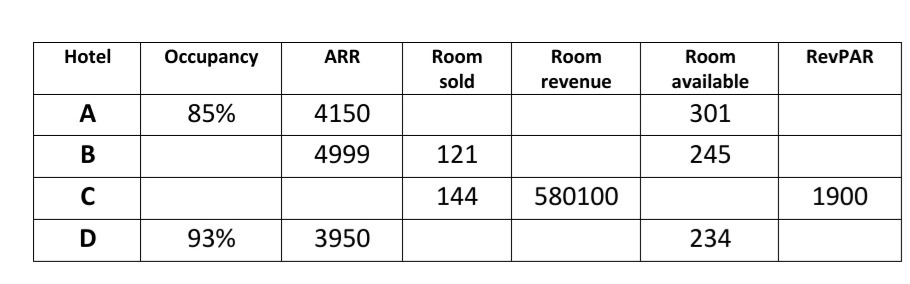
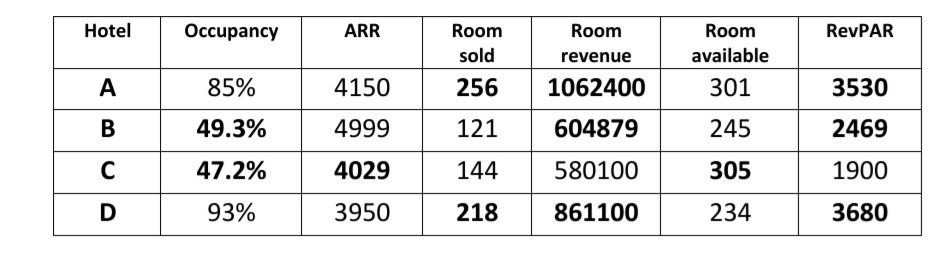
Answer
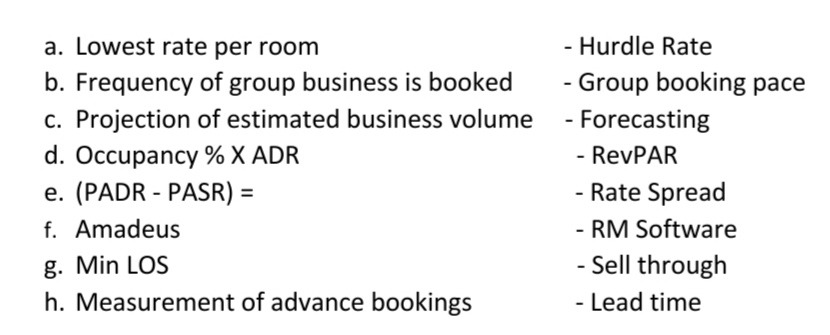
Q.10. Match the following: (8×1=8)
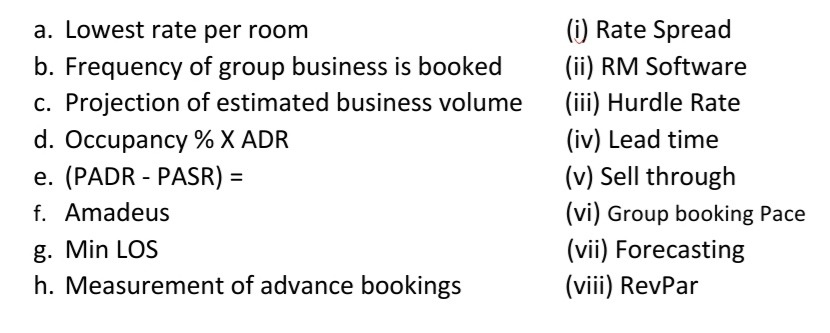
Answer