
Table of Contents
Q.1. Discuss the role and composition of revenue management team in enhancing room revenue.(10)
Composition of Revenue Management Team
• Revenue Management team composes of important areas of the Hotel.
• The different positions involved are General Manager, Marketing & Sales Manager, Reservation Manager, Room division Manager
• The Hotel may have a dedicated Revenue Manager
• F.O. Manager & F&B Manager may also be invited at time
• Suggestions from staff members & employees are also solicited.
Duties & Responsibilities of Revenue Manager
1. The primary role of the revenue manager is to maximize the businesses’ opportunity for revenue and profits..
2.Oversee revenue management and distribution strategy of the hotel and manage day to day yield operations.
3.Daily pick-up analysis, strategy adjustments and reporting.
4. Perform competitive benchmark studies and follow market trends.
5. Create and maintain a 13 month rolling demand calendar.
6. Create and develop pricing strategies in conjunction with the individuality of each hotel.
7. Provide weekly dynamic forecast of expected results, variances and budget comparisons.
8. Manage and oversee strategy for all 3rd party distribution
9. Responsible for assessing, analysing and pricing group business strategies
10.Analyze overall monthly hotel performance and provide summary report with recommendations to improve long term strategies.
11. Ensure all related systems are configured correctly, validated and working to full capacity
12.Oversee and audit the standards and operations of the reservations department.
13. Ensure web site booking process is maintained up-to-date and functional.
14. Ensure hotel personnel is fully competent in the use of all systems
15. Work in liaison with hotel sales and reservations departments as a team.
16. Regularly check the input and the quality of data (segmentation, denials tracking, etc)points.
17. Conduct quarterly property performance review and develop strategic and tactical action
18. Responsible for best practice standards to include: competitor analysis; environmental scanning; market modeling; distribution yield management; business mix yield management; length of stay yield management; inventory availability by channel; pricing control and new pricing concepts
19. Evaluate performance of distribution partners and contracted rates (OTA, FIT, tour operator, corporate, consortia, crew, groups, etc).
20. Reduce the cost of distribution by finding new less expensive means of delivering business
21. Prepare outline for and support the annual revenue budget process.
22. Inspire Hotel’s HODs to further embed a revenue management culture.
23.Advice and coach the client in other operational areas.
24. Visit the hotels to get first-hand knowledge of all revenue management issues and other key areas.
25. Any other reasonable requests made by management.
OR
List and briefly explain duties and responsibilities of a Sales & Marketing Director towards generating and maximising room’s revenue.(10)
SALES DIRECTOR DUTIES AND RESPONSIBILITIES:
1. Sales & Marketing Director has to report to General Manager
2. Maintain and promote a team work environment with effective and clear communication amongst co-workers.
3. Ensure best client service is being made available through communication amongst the team, cross training within the department and appropriate office coverage.
4.Works with sales managers to ensure understanding of sales strategy and effective implementation of this strategy for the segment.
5.Works with management team to create and implement a sales plan addressing revenue, customers and the market for the segment led by the DOS.
6. Set example through professional, friendly attitude towards clients and co-workers, timely response to clients and co-workers needs and observance of sales office standard.
7. Ensure hotel meets or exceeds budgeted goals.
8. Follow and track company cross-sell procedures.
9. Utilize company profile database to determine geographic areas for travel agent calls while maintaining top and existing travel agent accounts.
10. Organize travel agent month and travel agent appreciation rates for slow months.
11. Assists with the development and implementation of promotions, both internal and external.
12. Creating a focus on attracting new business.
13. Attending and contributing to the monthly sales strategy meeting
14. Updating and owning the sales strategy & sales plan with the General Manager.
15. Review and approves any special corporate negotiated rates by signing the CVGR (Company Volume guaranteed rate) contract.
16. Provides positive and aggressive leadership to ensure maximum revenue potential (e.g., sets example with personal booking goals).
17. Leads on-property sales functions to build long-term, value-based customer relationships that enable achievement of hotel sales objectives.
18. Recommends monthly room nights target goals for sales team members.
19. Participates in sales calls with members of sales team to acquire new business and/or close on business.
20. Develop and send informative press releases to targeted lists highlighting all activities and promotions.
21. Maintain and expand corporate incentive program via direct mail, personal visits etc.
22. Oversee and ensure the updation of rates, promotions on hotel website, OTA’s (Online travel agents), GDS etc. without any rate parity.
23. Responsible for the training of sales managers and staff.
24. Follow and promote hotel standards with guests, co-workers.
25. Evaluates and drives the hotel’s participation in the various sales channels, Market Sales, Event Booking Centres, electronic lead channels, etc.
26. Monitors all day to day activities of direct reports.
27. Executes and supports the operational aspects of business booked (e.g., generating proposal, writing contract, customer correspondence).
SUMMARY:
• To oversee and manage sales staff and reservation to ensure maximum revenue, promotional coverage and marketing opportunities are achieved.
• The DOSM should work closely with revenue management and marketing functions, to develop strategies to maximise REVPAR and grow market share.
Q.2. Hotel Taj has 280 guest rooms. The current ADR for the hotel is Rs.4,200/- and the average occupancy is 80%. This hotel offers 180 double rooms and 100 twin rooms. The rack rates offered by the hotel management are as follows:
a. Single occupancy @ Rs.4,400/-
b. Double occupancy @ Rs.4,600/-
Twin rooms:
a. Single occupancy @ Rs.4,200/-
b. Double occupancy @ Rs.4,400/-
Calculate the following: (5×2=10)
a. Multiple occupancy percentage if 154 rooms are occupied by more than one person.
b. Potential average rate
c. Room rate achievement factor
d. Yield percentage
e. RevPAR
Given,
Rooms – 280
ADR – ₹4,200
Occupancy- 80% = 80% × 280 = 224
Double room – 180
Twin Room – 100
Rack Rates of double room
Single occupancy – ₹4,400
Double occupancy- ₹4,600
Rack rates for Twin rooms
Single occupancy – ₹4,200
Double occupancy – ₹4,400
a. Multiple occupancy %
= No. of rooms occupied by more than one pax/Total room occupied
= 154/224
= 69.1%
b. Potential Average Rate
PASR = Total revenue as room sold as single at rack rate / total rooms
= (180×4400)+(100×4200) / 280
= 12,12,000/280
= ₹ 4,328.5
PADR = total revenue as room sold as double at rack rate /total rooms
= (180×4600)+(100×4400) / 280
= 12,68,000/280
= ₹ 4,528.5
Rate Spread = PADR – PASR
= ₹ 4528.5 – ₹ 4328.5
= ₹200
Hence,
PAR = (Multiple occupancy% × Rate Spread) + PASR
= (69.1%×200) + 4328.5
= 138.2+ 4328.5
= ₹ 4466.7
c. Room Rate Achievement Factor
= ARR/PAR
= 4200/4466.7
= 0.94
or 94%
d. Yield %
= Occupancy% × Achievement Factor
= 80% × 0.94
= 0.752
or 75.2
e. RevPAR
= Occupancy % × ADR
= 80% × 4200
= ₹ 3,360
Q.3. Discuss the key elements of yield management which contribute to the maximization of revenue of all the revenue centres in a five star hotel.(10)
Elements Of Yield Management
While developing a successful Yield Strategy, the following Elements are very important:
• Group Room Sales
• Transient (FIT) Room Sales
• Food and Beverage Activity
• Local and Area-wide Conventions
• Special Events
1. Group Room Sales:
Group sales form the majority of the room revenue is very important for hotel yield. It is common for hotels to receive reservations for group sales from three months to two years in advance of arrival. Therefore understanding group booking trends and requirements is very necessary for the success of revenue management. Some important terms in group room sales-
• Group Booking Data
• Group Booking Pace
• Anticipated Group Business
• Group Booking Lead-Time
• Displacement or Transient Business( Occurs when a Hotel accepts Group Business at the Expense of Transient Guest. This might engender Profitability Problems and Bad Reputation
2. Transient Room Sales:
The Front Office Management shall monitor the Booking Pace and Lead-Time of Transient Guests in order to understand how Current Reservations compare with Historical and Anticipated Rates.
3. Food and Beverage Activities:
All local Food and Beverage Functions should be viewed in light of the Potential for Booking Groups that need Meeting Space, Food and Beverage Service, and Guest Rooms
4. Local and Area-wide Activities:
Even when a Hotel is Not in the immediate Vicinity of a Convention, Transient Guests and Smaller Groups displaced by the Convention may be referred to the Hotel (as an Overflow Facility) and this may have a tremendous Impact on Hotels Revenue.
5. Special Events:
In Special Events (Concerts, Festivals, and Sporting Events), Hotels might decide to benefit from High Demand by restricting Room Rate Discounts or requiring a Minimum Length of Stay.
Q.4. Briefly explain the following terms (any two): (2×5=10)
a. Capacity Management
• involves a number of methods of controlling and limiting room supply.
For example, hotels will typically accept a statistically supported number of reservations in excess of actual room availability in an attempt to offset the effects of early check-outs, cancellations, and no-shows.
• Capacity management (also called selective overbooking) balances the risk of overselling against the potential loss of revenue arising from spoilage (rooms going unoccupied after reservations were closed out).
• Other forms of capacity management include determining how many walk-ins to accept on the day of arrival based on expected cancellations and no-shows.
• Capacity management usually varies with room type. That is, it might be economically advantageous to overbook more in lower-priced rooms because upgrading to higher-priced rooms is an acceptable solution to an oversell problem.
• The amount of such overbooking depends, of course, on the demand for the higher-priced rooms. In sophisticated computerized yield management systems, capacity management may also be influenced by the availability of rooms at neighbouring hotels or competing properties.
b. Benefits of Yield Management
• Improved forecasting
• Improved seasonal price and inventory decision.
• Identify new market.
• Identity market demand
• Increase co-ordination in FO and sales
• Better discount
• Better business planning
• Value based rates
• Reduced guest complaints and help guest query.
c. Duration Control
• Duration control places time constraints on accepting reservations in order to protect sufficient space for multi-day requests (representing higher levels of revenue).
• This means that, under yield management, a reservation for a one night stay may be rejected, even though space is available.
• For example, if Wednesday is close to selling out but other nights are not, a hotel may want to optimize the revenue potential of the last few rooms on Wednesday by requiring multi-day stays, even at a discounted rate, rather than accepting reservations for Wednesday only. similarly, of the hotel will be close to capacity Tuesday, Wednesday and Thursday, then accepting a one-night stay during any of those days may be detrimental to the hotel’s overall room revenue. Hotels facing such dilemmas often require all reservations for projected full-occupancy periods to be for more than one evening.
d. Discount Allocation
• Discounting involves restricting the time period and product mix (rooms available at reduced prices (prices below rack rate). For each discounted room type, reservations are requested at various available rates, each set below rack rate.
• The theory is that the sale of a perishable item (the guestroom) at a reduced price is often better than no sale at all. The primary objective of discount allocation is to protect enough remaining rooms at a higher rate to satisfy the projected demand for rooms at that rate; while at the same time filling rooms that would otherwise have remained unsold.
• This process is repeated for each rate level from rack rate on down. Implementing such a scheme requires a reliable mechanism for demand forecasting.
• A second objective of limiting discounts by room type is to encourage upselling. This technique requires a sound estimate of price elasticity and/or the probability of upgrading. (Elasticity refers to the relationship between price and demand.)
Q.5. List and briefly explain the various strategies and tactics used by Revenue Managers using real-time situations in maximising room revenue during high demand period.(10)
High Demand Tactics includes:-
1. Close or restrict discounts – Analyze discounts and restrict them as necessary to maximize the average rate. You may offer discounts to those who book longer stays, or restrict bookings to shorter stays.
2. Apply a minimum length of stay restrictions carefully – A minimum length of stay restriction can help a property increase room nights. For groups, study the groups’ patterns and decide how many days they are likely to add to their stay.
3. Reduce group room allocations is another great tactics– Communicate with group leaders on a regular basis. Make sure the group actually needs the number of rooms identified in its contract. If not, make adjustments.
4. Reduce or eliminate 6 P.M holds – Reduce or eliminate the number of unpaid rooms that are being held until 6 p.m. When demand is high, you need rooms available to fill.
5. Tighten guarantee and cancellation policies tactics– Tightening guarantee and cancellation policies helps to ensure payment for room nights. Charge credit cards for the first night’s stay on the day the reservation is made.
6. Tactics on raise rates to be consistent with the competitors – Charge rates consistent with the competition, but limit rate increases to those rates published in the central reservations systems and listed in brochures for the period.
7. Consider a rate raise for packages – If you are already offering a package discount, consider raising the rate for that package.
8. Apply full prices to suites and executive rooms – In a high-demand situation charge full price for suites and executive rooms.
9. Reserve close to arrival dates – By allowing the reservations to be taken for a certain date as long as the guest arrives before that date, a property is able to control the volume of check-ins.
10. Evaluate the benefits of sell-throughs – With a sell-through, the required stay can begin before the date the strategy is applied. This is often used when one day has a peak in occupancy and management does not want the peak to adversely affect reservations on either side of the peak day.
11. Apply deposits and guarantees to the last night of stay – For longer lengths of stay, make sure the deposits and guarantees apply to the last night of the stay, minimizing early departures.
OR
Evaluate the benefits of implementing revenue strategies or availability strategies towards maximisation of room’s division revenue.(10)
Strategies dealing with room availability are as follows:
Also known as Availability Strategies :
• Minimum length of stay: requires that a reservation must be for at least a specific number of nights. Some resorts use the approach during peak occupancy or hotels during special events or high occupancy period.
• Closed to arrival: strategies allow reservation to be taken for certain date as long as the guest arrives before those date e.g. 100 arrivals on 30th July therefore any arrival on 28th and 29th is accepted that will stay till or after 30th July.
• Sell through: strategy works like a minimum length of stay requirement except that the length of the stay can begin before the date the strategy is applied e.g. if a 3 night sell through is applied on Wednesday, then the sell through applies on Monday, Tuesday and Wednesday. Arrivals on each of those days must stay for 3 nights in order to get accepted. It is effective when 1 day is peak and management does not want the peak to affect the either side reservation.
All the three strategies may be combined together e.g. Duration control can be combined with discount allocation.
Benefits –
• Improved forecasting
• Improved seasonal price and inventory decision.
• Identify new market.
• Identity market demand
• Increase co-ordination in FO and sales
• Better discount
• Better business planning
• Value based rates
• Reduced guest complaints and help guest query.
● Increase the benefits through an optimal occupation forecast and adequate price policies
● Avoid overbooking
● Improve workflows and optimize the human resources involved in the management of the establishment
● Increase rates by constantly studying the competition, with the help of existing technological tools in the market and the intelligent use of the different distribution channels.
Q.6. Discuss the role of revenue management software in supporting the compilation of room demand forecast and pricing of rooms at various channels and sources.(10)
The most effective way of handling data and generating yield statics is through a computer. Sophisticated revenue management soft-wares are available that can integrate room demand and room price statics and can stimulate high room revenue producing scenarios.
Software provides information and supports the managerial decisions. Computer store, retrieve and manipulate large data and can help management create models that produce probable result of decision. Decision models are based on historical data forecast and booked business.
Working Of Revenue Management Software
• RMS helps management to create models that produce probable results of decisions.
• Decision models are based on historical data, forecasts and current business.
• RMS stimulates high revenue producing product scenarios.
Features of RMS
• Channel Management
• Multiple Property view
• Group Management
• Competitive set analysis
• New hotels services success packages
• Certified integrated information
• Cluster regional yielding
Advantages of Revenue Management Software
1. Best available rate : RMS helps management to decide best available rate according to the situation i.e high demand, low demand.
2. Continious monitoring : RMS also hepls the management to have a continuous monitoring of its products & find out what can be improved.
3. Consistency : RMS is an established technology that guarantees database consistency and durability.
4. Organized information : Using of RMS helps us in getting the information in an organized manner, which leads in saving time and make the decision making process easy.
5. Budgeting : RMS also helps in the budgeting process, as it keeps the record of the expense and revenue. It also provides us information that on which area we have to focus more.
6. Performance tracking : RMS also acts as an performance tracker, which keep the record the product’s sell& because of this record the management is able to know about their products performance.
Q.7. Briefly explain the role of yield management in: (5+5=10)
a) Airlines
Yield Management application For Airlines
1. Yield management is defined as the techniques used to allocate limited resources among a variety of customers in order to optimize the total revenue or “yield” on the investment capacity.In the case of an airline, the limited resources are the seats on a future flight, and the variety of customers is business and leisure travelers.
2. The backbone of any airline’s ticket-booking sales strategy, yield management involves the optimization of two polarized factors: fully-booking flights to minimize the cost per passenger, and selling as many seats as possible at full price to maximize revenue.
3. Airlines closely monitor the number of seats sold in each booking class or “bucket,” dynamically updating the booking class ratios depending on how quickly seats are selling. If sales are slow in the weeks preceding a flight, more seats might be listed in the discounted bucket than on the same flight during busier seasons.
4. Prices are more likely to increase in the last few weeks preceding the date of departure as more seats are sold and competition increases, but there can still be last-minute price drops in the final few days.
5. Significant computational advances since yield management’s induction have increased the system’s effectiveness, leading to more efficient bookings, higher profit margins, and most importantly, more satisfied customers.
6. Yield management works best in situations where the demand exceeds supply. This allows the industry to choose the demand that it wishes to address in order to maximize the revenue. However, these systems can also be used in cases where the supply exceeds demand to phase out bookings in a manner that allows the company to achieve the best possible revenue generation, given its constraints.
7. The concept of RM was first implemented in Airlines industry, then introduced into other industries.
8. The Main goal of RM in Airlines is-
- Pricing Strategies ( High Demand Pricing & Low Demand Pricing)
- Control of Availability
- Inventory control
- Profitability
9. Thus, the strategy behind yield management in the airline industry is to sell the right seat to the right type of customer, at the right time and for the right price (Voneche). The key is to find the tradeoff between selling discount tickets as a means to filling up the aircraft completely, and selling full fare tickets and only filling up a portion of the aircraft.
10. Yield management ensures the availability of different products (i.e. – service levels on a flight) at different prices to guarantee the generation of maximum revenue fiom the existing capacity.
b) Cruise lines
1. The role of yield management is to maximize the profit with low input to get maximum output.
2. In cruise lines, the most important task is to attract guest/ consumers. Hence RM helps in deciding & making best strategies.
3. To use the every bit of the resources, we have to generate profit such as room reservation can be clubbed with deck parties.
4. To offer the loyalty program to consumers to attract them towards the business.
5. For making reservations use of various reservation channels such as OTA, TA, website, online platform can be beneficial.
6. The revenue can be managed for advertisement and marketing policies.
7. The cruise are planned and operational in a specific season, therefore selective reservation should be made.
8. Revenue strategies such as early bird discount, cancellation policies to be made necessary.
9. Overall, the yield management is very importantas it provides profit in business as well as market stability and helps the company to servive in competitive era.
Q.8. Explain the following terms (any two): (2×5=10)
a. Selective Overbooking
-
Capacity management (also called selective overbooking)
-
Capacity Management involves a number of methods of controlling and limiting room supply.
-
For example, hotels will typically accept a statistically supported number of reservations in excess of actual room availability in an attempt to offset the effects of early check-outs, cancellations, and no-shows. Capacity management (also called selective overbooking) balances the risk of overselling against the potential loss of revenue arising from spoilage (rooms going unoccupied after reservations were closed out).
-
Other forms of capacity management include determining how many walk-ins to accept on the day of arrival based on expected cancellations and no-shows. Capacity management usually varies with room type. That is, it might be economically advantageous to overbook more in lower-priced rooms because upgrading to higher-priced rooms is an acceptable solution to an oversell problem. The amount of such overbooking depends, of course, on the demand for the higher-priced rooms. In sophisticated computerized yield management systems, capacity management may also be influenced by the availability of rooms at neighboring hotels or competing properties.
b. Pricing & inventory management
- Industries that have successfully implemented yield management techniques tend to have certain features in common. The products of these industries are perishable, their supply is limited, their demand varies with time, their market can be segmented, their product or service can be sold in advance, and their marginal costs are low.
- As mentioned previously, airline seats are perishable, as they cannot be sold after a specific point in time (i.e. – departure of a flight). Yield management minimizes wasted inventory without weakening revenue.
- Supply is limited in the airline industry, as it is costly and difficult to increase capacity. Due to the difficulty and cost associated with the addition of capacity, airlines have a physical limit on the number of passengers that can be accommodated at any one time
- Furthermore, because capacity is limited, varying demand can be managed best with price fluctuation. Lower prices tend to increase the quantity demanded, just as high prices tend to decrease the quantity demanded.
- Yield management can effectively manage both limited supply, and varying Airline Yield Management demand, by dynamically controlling price and inventory, and capturing as much of the revenue opportunity as possible .
- Yield management ensures that as much inventory as possible is sold at optimum price to ensure maximum revenue and minimum wastage.
- Modern revenue managers understand, anticipate, and react to market demand to maximise their businesses’ revenues. They often do so by analysing, forecasting, and optimising their fixed, perishable inventory, and time-variable supply, through dynamic prices.
- The role of pricing and revenue management systems is to optimise the product for different kinds of customers. Pricing and revenue managers use data-driven, yield management systems to allocate adequate and sufficient capacity to profitable customers.
- Effective and efficient inventory distribution plays a major role in the overall revenue management strategy for hotels. A well- thought- out inventory management strategy helps revenue managers to sell the right room via the right channel to the right customer at the right time to maximize revenue.
- Reduce overbooking, double booking and under booking , through management of correct inventory of the rooms and other food and beverage supplies , plays a important role in revenue generation . we can avoid the situation such a the over booking , under booking and double booking and hence the better customer satisfaction and repeat business.
c. Market Segmentation
- Market segmentation is the process of dividing a market of potential customers into groups, or segments, based on different characteristics.
- Proper market segmentation allows a hotel to price and apply inventory controls in order to maximize revenue from various lines of business.
- In order to be as successful as possible, hotel management must ensure that they use the most logical method possible for tracking their business.”
- Hospitality market segments can focus on three key areas: product, pricing, and distribution. Many hospitality sales and marketing executives spend countless hours and cumulatively millions of dollars defining their respective market segments.
- Once defined, these same executives focus their sales and marketing efforts to mine customers from those segments. Revenue managers on the other hand use segmentation to deliver a more profitable customer through focused product, pricing and distribution, and to ensure proper reporting and tracking.
- The need for market segmentation is more prominent in the hospitality industry now due to the rapid changes in customer needs and the vast amount of product offerings.
Market segmentation can be in following categories:
- Geographic – region, size, population, and climate.
- Demographic – age, gender, lifestyle, income, occupation.
- Psychographic – activities, social interest, values.
- Behavioral – features, benefits, usage, loyalty, and occasion.
d. Demand forecast and displacement analysis
Demand forecast
- Demand Forecasting is the process in which historical sales data is used to develop an estimate of an expected forecast of customer demand.
- Without an accurate forecast, pricing and yield tactics cannot be effectively applied.
- Demand forecasts are an essential part of a Revenue Management System. For example in a hotel, a demand forecast is usually calculated by taking the actual number of reservations on hand (actual number of rooms booked) and adding the predicted number of rooms that will be booked (this is sometimes known as pickup).
- Historical demand and booking patterns per market segment should help managers predict peaks and troughs in demand and assist the hotelier in more effectively aligning demand with supply.
Displacement analysis
- For a hotel, the idea of making money through accepting group business bookings sounds like a good idea – an obvious thing to do.
- Sometimes it would be prudent to deny a group booking in favour of leaving rooms available to transient (non-business) customers and walk-in guests. The method used to make this judgement is called Displacement Analysis.
- By using Displacement Analysis, a hotel can calculate the value of the group booking compared to what transient and walk-in bookings would generate by contrast. Based on the results of the Displacement Analysis, it can then make a decision on whether to accept a group business booking or not.
- With any hotel booking, you have to consider the total value, not just the room rates. All food and beverage spending, meeting room rental, and any additional outlet spending (minus any costs) involved, as well as random ancillary in-house spending, will have to be factored into the Displacement Analysis calculation.
- If the value of the displaced transient booking is less than that of the group business booking, then it would make sense to accept the group booking, of course (and vice versa).
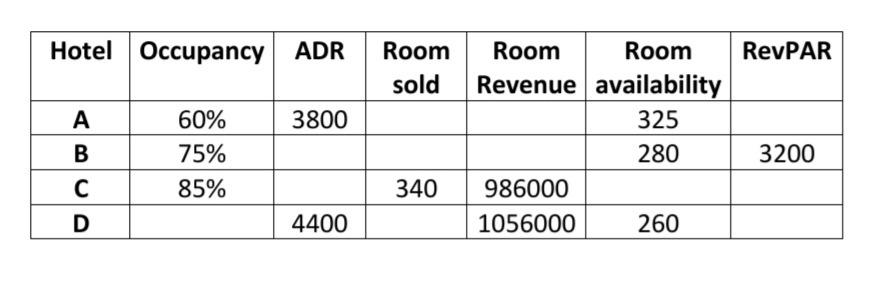
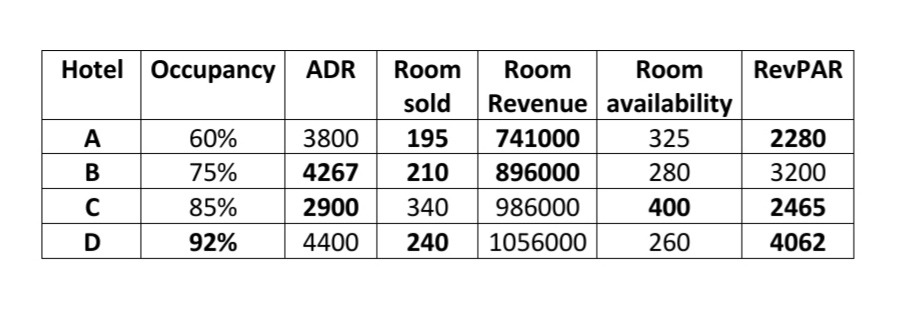
Q.9. From the following information, calculate the key performance indicators for all the hotels and formulate a table with market share, fair share and variance of the same: (10)
Answer
Q. 10. Discuss the importance of the following factors in developing room’s availability forecast: (10)
a. Historical demand and booking patterns
- The historical demand of the hotel room and the booking pattern of the customer/guest helps the hotel to make a forecast regarding the future demand of the room and understand the booking patter to reduce the no shows and cancellations and can take risk of overbooking.
- For example: Suppose the hotel made good revenue in the previous year in the month of December, therefore for coming year the hotel should make strategies to sell the hotel room in a much higher price , because the demand of the room will be high .
- With the help of previous data and reports the sales team can predict the room inventory ,for the season and analyse the best that how consumer booking pattern effects the room .
- The main motive or use of historical data and pattern for consumption of services is to be well prepared in advance to offer our products and services at best rate possible and to generate as much revenue as possible.
- Historical demand and booking patterns helps managers predict peaks and troughs in demand and assist the hotelier in more effectively aligning demand with supply.
b. Booking leadtime
Booking Lead Time is the period of time between when a guest makes a reservation, and the actual check-in date.
• If a guest makes a reservation on March 1 and the check-in date is Mar 30, then the booking lead time for that reservation is 30 days.
• Alternatively, if a guest makes a reservation on the same day as check in, then the booking lead time is 0 days.
• A measurement of how far in advance bookings are made. Measures how far in advance of a stay Bookings are made. This is very important in developing room’s availability forecast.
- Understanding the pace in which guests are booking short-term rentals is a critical part of any host or property manager’s pricing strategy. Whether it’s gearing up for normal annual seasonality, a major annual event, or a special one-time city-wide celebration, having this information gives you a competitive edge for maximizing booking revenue.
- This usually applies to an offer, which is available up to a certain number of days prior to arrival. Can be combined with other restrictions.
- For example a 15% discount, which is non-refundable, up till 30 days prior to arrival. Such promotion are set-up not to coincide with the regular booking window, in order not to down trade ADR on your normal demand.
c. No show and cancellation analysis
- If a guest fails to arrive on a certain date to fulfil a booking (as all so often happens) and does not cancel; that does not necessarily mean the hotel will lose money. No. Hotels can cover themselves for this eventuality by integrating into their pricing structure something called a No-Show fee. That’s right, in the Hospitality Industry, a person who does not arrive where and when they should at a hotel or motel, and makes no explanatory contact, is called a No-Show.
- By checking the guest history , we can identify the faulter guest , who often make reservations but don’t show up , we can do overbooking of such rooms , so that the hotel should get the revenue.
- Although no hotel likes canceled reservations, when a prospective customer contacts them to withdraw a booking, the hotel at least knows where they stand. In this circumstance, the cancellation may or may not be charged a cancellation fee, depending upon hotel policy.
- Where a cancellation fee is charged (generally to the value of the first day of the reservation), it is usually because the person who made the initial booking failed to notify the hotel of their cancellation in enough time prior to the agreed date.
- So , therefore by doing the analysis of No show and Cancellation , the hotel can be well prepared inn advance for such situations and good strategies can be made and implemented during such situations.
d. Information systems
- Effective management information is essential for successful RM whether the hotelier is operating a manual or computerized system.
- However, information technology can assist greatly in the sorting and manipulation of required data.
- The use of artificial intelligence (AI) has enormous potential for handling the complexities of RM because of its abilities in complex problem solving, reasoning, perception, planning, and analysis of extensive data (Russell and Johns, 1997).
- Expert systems (ES) are knowledge based software packages that reflect the expertise in the area of the application and these types of systems have extensive capacity in dealing with non-numeric, qualitative data.