
Table of Contents
Q.1. Define menu. List factors to be considered for planning a good menu. Explain each factor in brief. (2+3+5=10)
A menu is a list of food items, in a specific order, offered for a meal along with prices whether set for individual items or for the whole meal. In commercial establishment it will also include the prices (either set for individual items or for the whole meal), taxes and other charges applicable
1. Colour repetition– repetition of colour in the dishes of a menu will be monotonous for a guest which would harm the appetite of the guest
2. Balance of Heaviness– while fixing a menu the balance of heaviness should always be kept in mind i.e., from light to heavy and ultimately to light
3. Repetition of Ingredients– As with repetition of colour, repetition of ingredients or taste will also harm the appetite of a guest and will be monotonous and irritating for the guest
4. Kitchen Skills– the efficiency of kitchen department and its output capacity is an essential factor in determining the type of menu
5. Seasonal Favorites– availability and usage of seasonal fresh fruits and vegetables are other factors to be considered while planning a menu. A good menu should always include seasonal favorites in its courses for example mango in summers,carrot in winters etc.
6. Local Favorites– The favorites of the local people, their eating habits and food culture needs to be taken into consideration while planning a menu
7. Availability of equipments- while planning the menu, availability of the equipments required to prepare as well as serve the food needs to be considered
OR What are different types of menu used in catering establishments? Explain each in brief. (2+8=10)
TYPES OF MENU
- TABLE D HOTE(table of the host): It is a fixed menu generally of a starter, a main course, a dessert and a beverage at last, and is served at a stated price which is for the entire meal.Cater to a large number of people in a short period of time like institution, industries, transport catering etc.
- À LA CARTE (in the style of a card): It is the selection from the menu card where each item is priced separately.In this the menu is presented in form of a card. All the food items are listed along with their individual respective pricing. It is most popularly used menu.
Other forms of menu are:-
- CYCLIC MENUS – It is a series of table d’ hote menus for a set period of time, say for four weeks, which are repeated for a particular period, say for six months. After six months, a new set of menus will be prepared.The length of the cyclic menu depends on season of year, availability of ingredients, and catering policy of the establishment. After a certain period, a new set of menu is prepared.The consumers pay for the meals wither in advance or at the end of the month.
- WINE / BAR MENU: It is made to be used for selection of beverages by the consumer.It contains the list of snacks which can go with the beverages. The price of the drink will be printed on the bar menu and will normally be of 30 ml or 60 ml.
- CARTE DU JOUR- (menu for the day): It is a card comprising of food items listed with composite pricing and has been planned for the day. Mostly used for institutional/ industrial/ welfare catering.
- PLAT DU JOUR- (dish of the day/ chef’s special): A special food item prepared by the chef for a particular day. It is quite expensive.
- PLATS DU JOUR-(plates/ dishes of the day): When there are multiple special items it is not verbally promoted but written in a card with individual pricing.
- STATIC MENU: A static menu is a menu that is often laminated for easy cleanup. It is usually separated into groups such as appetizers, soups and salads, entrees, desserts, etc. Fast food restaurants often have these types of menus. They are the most common.
- DOORKNOB MENU CARD: A type of menu card which is hung behind the doorknob of a particular room comprising of all the available dishes and beverages for breakfast and for the major meals plus snacks with the rates indicated adjacent to the dishes. The guest may order his/ her choice over the telephone to the room service personnel and get the items ordered served in the room.
- DEGUSTATION MENU: A degustation menu is a tasting menu that is given to a guest. It can involve sampling small portions of all of a chef’s signature dishes in one sitting. Usually consisting of eight or more courses, it may be accompanied by a matching wine degustation also called flights which complement each dish.
Q.2. In a tabular form list the courses of French classical menu with their English equivalents and give three examples of dishes from each course.(10)
S.NO |
FRENCH MENU |
ENGLISH |
EXAMPLES |
1 |
Hors d’ oeuvre |
Appetizer |
Fish Mayonnaise, Canapés, Corn on the cob |
2 |
Potage |
Soup |
Crème de Tomate, consommé royal, Tortue Claire |
3 |
Poisson |
Fish |
Sole Colbert, Poisson grille, Sole Italienne |
4 |
Entrée |
Entrance(1st meat course) |
Chop de porc- pork chops, Vol au vent au rognon, Rognon Saute Bercy- kidney with brown sauce |
5 |
Reléve |
Main- meat course |
Porc Roti (Roast Pork), Irish Stew, Steak Diane |
6 |
Sorbet |
Flavoured water |
Sorbet a la poire (Pear Sorbet),Sorbet a la framboise (Raspberry Sorbet), Sorbet a la peche (Peach Sorbet), |
7 |
Rôti |
roast |
Dindon Roti (roasted turkey),Poulet Roti (roasted chicken),Pigeon Roti (Roast Pigeon) |
8 |
Légumes |
Vegetables |
Crepe de Legumes, Ratatouille Nicoise, Pigeon Roti (Roast Pigeon) |
9 |
Entremet |
Sweets |
custard, puddings, Souffles |
10 |
Bonne Bouche |
Savoury and
cheese |
IvanHoc (creamed haddock on toast), Foie Lyonnaise,Angel’s aux Cheval (oyster rolled in bacon and grilled)
Mozzarella, Parmesan, Cheddar,Brie |
11 |
Dessert
Cafe |
Fresh fruits & nuts
Coffee |
Papaya, Avacardo, Watermelon
Espresso, Latte, Capachinno |
Q.3. Explain the various types of food service found in hotels.
Types of food service are as follows:-
-
Silver Service or Platter to Plate Service:
This type of service is most elegant and time-tested. In this, the highest skill of the waiter and the chef is demonstrated to the guest.The silver dish is basically placed on a neatly folded waiter’s cloth – a glittering pair of service spoons and service fork is kept on the side of the silver dish or carried in the right hand, the left hand is used for bringing the silver dish. From the left with great care food is transferred artistically on the plate. Such service is highly personalized and the guest feels extremely cared for which adds to goodwill.It gives the guest the choice of selecting and quantifying, the food served to him, therefore less possibilities of wastage and embarrassment. Food not taken by one guest of a table can be served to others and vice versa. Leftover food can be taken for a second round, by keeping the food on a hot plate at the sideboard. Accompaniments and garnishes can also be similarly handed around (served) making the service look substantive.
- Pre-plated Service or American Service or Blue Plate Service:
The most popular methods of service. This involves food decorated on plates of individual portions kept warm by putting them in hot cases or salamander, under infrared radiators (bulbs), in microwave chambers or in magnetic induction plates (only enamel plates are used).Service and clearance are done from the right-hand side. In this type of service a waiter can with his skill carry about five plates fixing them in between two hands. The mass catering or bulk service can be effectively carried out in this manner. The service is without any paraphernalia and minimum presence of the waiter is required. This type of service is prevalent in mid-cap restaurants, fast food restaurants, coffee shops, discotheques and in five-star hotels.
It is quick and simple. There is less spilling, less investment, less skill and less piling of dishes.No maintenance of silver items.On the plate, looks superb. Its a strong portion control mechanism.Standards can be set and maintained.Fewer chances of complaints.
-
Side table service or Gueridon Service or Cart service:
The most expensive and most exquisite method of food presentation. Originated in France, it has spread to all exclusive clubs in aristocratic gatherings. Although, it does not have many takers as it involves cooking in the restaurant which at times is offensive to diners, requires too much of space, extensive training, and skill of the service staff. The basics of side table service is bringing semi-cooked food in different colourful containers giving finishing touches right before the diners and serve as per the directions of the guest who can keep directing the nitty-gritty during the process of preparation and service. The grace of this service is that minimum two waiters are required, one who holds the plate, the other using service set neatly places the food on the plate from the pan. Other
activities include making various dressings like mayonnaise, vinaigrette, Thousand Island dressing, cutting and peeling of vegetables and fruits to make a salad, carving of a whole turkey, chicken, and leg of mutton into delicate portions as per the choice of the guest.Another area of excellence is flambe or slashing alcohol overcooked food and lighting it out to create a romantic effect in moderately dark surroundings. The patronage for such restaurants is only possible from high society who has the leisure of time and appreciation to understand and pay for same.The demerits of this service are a lot of space is required for carrying, trolleys. Smokes of fuel, alcohol, and aroma of food may be offensive to few guests. At times restaurant looks smoggy. It is expensive and time-consuming.
- English service or Butler service or Family style service:
It is a service where a butler, first footman, and second footman are involved in helping the host to conduct the service smoothly.Here the bowls and platters are brought on trolleys or trays kept before the host to portion out and carve the items and holding the plate for him to place the food and serve as directed. The host normally offers the first portion to his own wife as per tradition, then rest of the people.Often the butler and the assistants take the bowls and platters around for second helping.Clearing is done side by side and it is a very informal, private kind of service which normally does not exceed 15-20 people. It is customary for the host to show his closeness and favorites through his portions offered.
- Russian Service
This type of service has come from the era Tsar of Russia who believed in show. The basic element in Russian service derives from the old style of having large joints, whole fish or birds often decoratively placed on platters with elaborate garnishes on the sideboard visible to the guests before being served. The food is then collected on smaller platters by the waiter and served to guest on the table just as in silver service. This form of service enjoyed slight popularity in Europe in the 19th century otherwise Russian Service as a distinct and separate form of service no longer remains.
- Cafeteria Service:
This service exists in industrial canteens, colleges, hospitals or hotel cafeterias. To facilitate quick service, the menu is fixed and is displayed on large boards.The guest may have to buy coupons in advance, present them to the counter waiter who then serves the desired item. The food is served pre-plated and the cutlery is handed directly to the guest. Guests may then sit at tables and chairs provided by the establishment. Sometimes high tables are provided where guests can stand and eat.
- Buffet Service:
A self-service where food is displayed on tables. The guest takes his plate from a stack at the end of each table or requests the waiter behind the buffet table to serve him.The waiter may serve a few courses like the appetizer and soup at the table.
- Room Service:
It implies serving of food and beverage in guest rooms of hotels.The guest places his order with the room service order taker. The waiter receives the order and transmits the same to the kitchen. Meanwhile, he prepares his tray or trolley (small orders are served in trays while major meals on trolleys). He then goes to the cashier to have a cheque prepared to take along with the food order for the guests’ signature or payment. Usually, clearance is done half an hour or an hour later. However, the guest can call the Room Service for the clearance as and when he has finished with the meal.
- Lounge service:
Lounge service ranges from the service of continental breakfast, morning coffee, luncheon snacks, afternoon tea, dinner or late evening snacks as well as alcoholic beverages.The lounge staff generally has a small cupboard, of which only they have the key, and which holds a basic stock of items that they may need in case of emergency. These items may be as follows: Small linen stock Ashtrays Salvers Glasses Cups and saucers Basic alcoholic drink stock Cocktail snacks: olives, cherries, peanuts, etc. Beverages: coffee, Bovril etc. Check pads, bill pads, stock sheets, for alcoholic drinks.
Q.4. With a flow chart, explain the triplicate checking system. Name three cash handling equipment found with a restaurant cashier.(10)
TRIPLICATE CHECKING SYSTEM
This is a control system used in the majority of medium and large first-class establishments. As the name implies the food check consists of three copies.To ensure efficient control the waiter or waitress must fill in the information required in the four corners of the check, this being:
• Table number
• Number of covers
• Date
• Signature of waiter/waitress taking the order
 THE FIRST KOT goes to the kitchen and is received by a buyer who shouts the order to various sections for preparation of items and puts up spike in chronological order of table numbers. After the pickup of dishes kitchen order tickets are puts up in a kitchen order ticket box (locked) and taken out for making production and consumption sheet and later sent by the chef to food and beverage control department for comparative analysis.
- THE SECOND KOT is given to restaurant cashier. He prepares the sales summary sheet on the basis of that. The guest check is presented to guest for settlement either by cash or credit. The sales summary sheet is sent to front office clerk for making entry into various books like cash book, guest folio, city ledger etc. only kitchen order tickets and vouchers are sent to food and beverage control for comparative statements.
- THE THIRD KOT is used by the steward for pickup purpose as well for preparing guest voucher. Abbreviations may be used when taking the order as long understood by everyone and not misinterpreted by the kitchen causing the wrong order to be put up, and therefore a delay in the service to the guest.
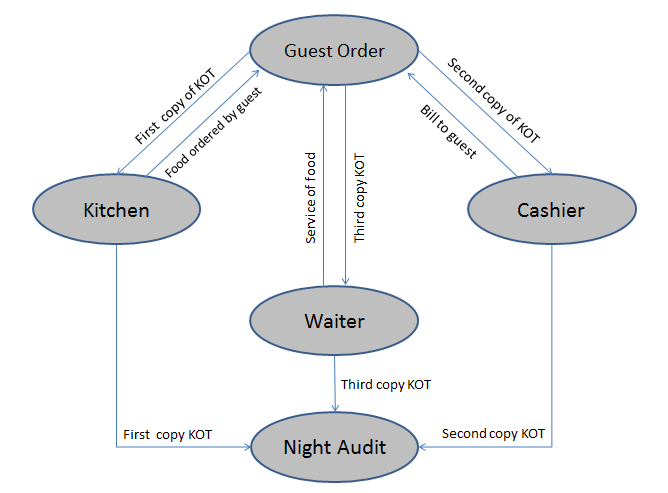 THE FIRST KOT goes to the kitchen and is received by a buyer who shouts the order to various sections for preparation of items and puts up spike in chronological order of table numbers. After the pickup of dishes kitchen order tickets are puts up in a kitchen order ticket box (locked) and taken out for making production and consumption sheet and later sent by the chef to food and beverage control department for comparative analysis.
Q.5. Draw the format of a KOT and a bill. (5+5=10)

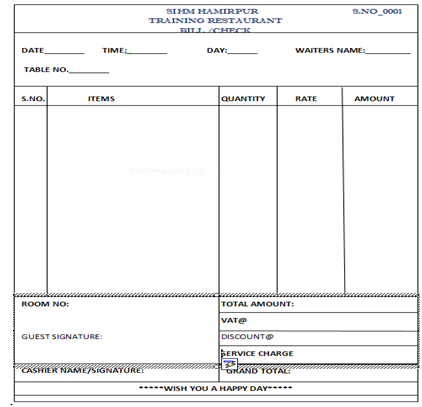
OR List and describe any five special checks used in restaurants. (10)
1) RETOUR OR RETURN CHECK
If a food item has to be returned for some reason, another check or KOT has to be made out, marked return and sent with the dish in order to cancel the transaction. It has to be ensured that the item is taken off the bill by sending the copy to the cashier.
2) EN PLACE
It literally means “in its place”. In case of a table d hote menu the guest may wish a slight change in a particular dish, for example, jacket potatoes instead of French fries. So, an en place check has to be made. The check has to be signed by a senior authority like the restaurant manager to show that this alteration is permitted at no extra charge.
3) SUIVANT
Where it is necessary to write out more than one food check for a meal, e.g., when a sweet dish check or KOT is written out after the main course has been served. At the head of this check word, SUIVANT should be written, which means the following check, and shows that one check has already been written out for that particular table.
4) SUPPLEMENT CHECK
Sometimes a waiter requires ingredients from various sources to finish a dish. For e.g. for a cocktail or a mocktail lemon is required. A special check or a written supplement has to be made out in this case. This should be signed by the restaurant manager and normally there is no extra charge.
5) NO CHARGE
Any complimentary items served to the guest or the executives of the hotel who are entitled to have food in the restaurant are written on this check and no bill is raised
6) ACCIDENT CHECK
It occasionally happens that the waiter may have an accident in the room and perhaps some food dishes are dropped. These must be replaced without any extra charge to the guest. Here a check must be made named ACCIDENT CHECK. It will show the number of portions of the particular dish required and should be signed by the restaurant manager. No charge is made.
Q.6. Classify cigars on the basis of the colour of their wrapper and size.
CIGAR CLASSIFICATION – ON BASIS OF THEIR COLOUR
| CCC | CLARO, LIGHT |
| CC | COLORADO –CLARO, MEDIUM |
| C | COLORADO-DARK |
| CM | COLORADO MADURO, VERY DARK |
| M | MADURO, EXCEPTIONALLY DARK |
CIGAR CLASSIFICATION – ON BASIS OF THEIR SIZE AND SHAPE DESCRIPTION
| CORONA | A STRAIGHT SHAPE CIGAR WITH ROUNDED TOP ABOUT 5 ½ INCHES LONG |
| PETIT CORONA | ABOUT 5 INCHES LONG |
| TRES PETIT CORONA |
ABOUT 4 ½ LONG |
| HALF A CORONA | ABOUT 3 ¾ LONG |
| LONSDALE | SAME AS CORONA ABOUT 6 ½ INCHES LONG |
| IDEALES | A SLENDER TORPEDO SHAPED CIGAR, TAPERED AT THE LIGHTING END ABOUT 6 ½ INCHES LONG |
| BOUQUET | A SMALL TORPEDO SHAPED CIGAR |
| LONDRES | A STRAIGHT CIGAR, ABOUT 4 ¾ INCHES LONG |
| PANATELA | IS A LONGISH THIN CIGAR OPEN AT BOTH ENDS USUALLY ABOUT 5 INCHES IN LENGTH |
| A CHEROOT | A THIN CIGAR, OPEN AT BOTH ENDS USUALLY THICKER AND STUBBIER THAN PANATELA |
OR What is a cigar? List and explain parts of a cigar. Name six international brands of cigar. (2+5+3=10)
A cigar is a rolled bundle of dried and fermented tobacco leaves made to be smoked. They are produced in a wide variety of sizes and shapes. A cigars is made up of three distinct components: the filler, the binder leaf which holds the filler together, and a wrapper leaf. Often the cigar will have band printed with the cigar manufacturer’s logo.
A cigar consists of three parts:
- Filler – The filler is the inner core that forms the body and shape of the cigar.
- Binder – The binder is the leaf in which the filler is wrapped to form what is known as cigar bunch.
- Wrapper – The wrapper or outer covering of cigar consists of a ribbon leaf rolled spirally around the cigar bunch. Wrapper leaf must be strong, elastic and silky in texture and of
even colour and it must possess good flavour and burning properties. It is the most expensive leaf used in cigars.
CIGAR INTERNATIONAL BRAND NAMES
- JR Alternative Cigars.
- Romeo y Julieta Cigars.
- Montecristo Cigars.
- Macanudo Cigars.
- Arturo Fuente Cigars.
- Punch Cigars.
- La Gloria Cubana Cigars
Q.7. Differentiate between Mise-en-place and Mise-en-scene. Explain five duties under each. (5+5=10)
| Mise-en-scene | Mise-en-place |
| It means to “prepare the environment and make it presentable” | It means to “put in place” at the right position in a correct way. |
| It involves cleaning of service areas,tables, chairs, side-station, food trolley, brushing and cleaning of floor, vacuuming/hoovering of carpets, doors and windows, etc. | It is a preliminary preparation, which includes getting ready both food and beverage equipments and surroundings. |
| This function generally precedes mise-en-place. | This function succeeds mise-en-scene. |
5 Duties – Mise en scene
- The opening of the restaurant and the windows
- Switch on air-conditioning and music
- Aligning of table and chair and Wobble check of the table
- Stacking the refrigerator (depending on the need for the day for e.g. Coke bottle 100 required for the day)
- Filling bud vases with cold water and placing buds (flowers).
5 Duties – Mise en place
- Wiping of cutlery, crockery, and glassware
- Getting you side station (dummy waiter, service console, service station) ready for the service
- Stack service station properly (according to the standard operating procedure).
- Getting menu cards ready (wiped and cleaned)
- Getting KOT (kitchen order ticket) and BOT (bar order ticket) issued from food and beverage manager- in case if the system not fully automatic.
- Attend briefing by the manager available on the shift.( grooming, kits, and VIPs for the day are discussed for the shift with the log for the previous day)
Q.8. Give the accompaniments of (any five):(5×2=10)
(a) Oysters
Cayenne Pepper, Peppermill, Chilli vinegar, Tabasco sauce, Half a lemon, Brown bread and butter
(b) Tomato juice
Worchester sauce
(c) Melon
Ground ginger and castor sugar
(d) Bortsch
sour cream(Smetana), beetroot juice and small pies stuffed with duck forced meat.
(e) Minestrone soup
Toasted flutes
(f) Chicken Maryland
corn fritters, bananas, grilled tomatoes, corn on the cob, bacon curls and pineapple rings, together with green salad.
(g) Roast turkey
Cranberry sauce, Bread sauce, Chestnut Stuffing, Chipolatas, Game chips, Watercress, Roast Gravy
(h) Fish orly
Tomato sauce
(i) Cheese
Balsamic Vinegar, Bread, Chutney, Crackers, Cured Meats.
(j) Roast leg of lamb
Mint sauce and roast gravy
Q.9. Explain in brief:(5×2=10)
(a) Café complete
Cafe’ complet / The’ complet: When coffee is served with the continental breakfast
(b) Hi-tea
Between lunch and dinner i.e. 4:00pm to 7:00pm. Normally tea or coffee offered with heavy snacks.
SAMPLE MENU
Assorted sandwiches
Pastry/gateaux
Tea/Coffee
Sometimes certain light fish/meat item can also be served.
(c) Russian service
This type of service has come from the era Tsar of Russia who believed in show. The basic element in Russian service derives from the old style of having large joints, whole fish or birds often decoratively placed on platters with elaborate garnishes on the sideboard visible to the guests before being served. The food is then collected on smaller platters by the waiter and served to guest on the table just as in silver service. This form of service enjoyed slight popularity in Europe in the 19th century otherwise Russian Service as a distinct and separate form of service no longer remains.
Formal and elegant service very similar to (but faster and less expensive than) french service, except that the food is completed (prepared and garnished) in the kitchen and only one waiter (server) is used.
(d) Doorknob card
A type of menu card which is hung behind the doorknob of a particular room comprising of all the available dishes and beverages for breakfast and for the major meals plus snacks with the rates indicated adjacent to the dishes. The guest may order his/ her choice over the telephone to the room service personnel and get the items ordered served in the room.
(e) Storage of cigars
The ideal temperature of storage of cigar is 16-18°C and a relative humidity required is 65-70%.That’s why it is best to keep cigars in a glass case with a humidifier. The cigars remain best in their own cedar boxes because it has unique quality of releasing moisture when needed and absorbing when not required in surrounding areas. The advantage of keeping cigar in cedar wood boxes is that mild fragrance of cedar wood mingles well with cigar. Remember not to place cigars near items which emanate its flavours or fragrance or absorb the flavour and fragrance of surrounding e.g. milk will pick up tobacco flavour and cheese will impregnate its mouldy flavour to cigar.