
Table of Contents
Q.1. Enlist and explain the various types of menu. (10)
TYPES OF MENU
- TABLE D HOTE(table of the host): It is a fixed menu generally of a starter, a main course, a dessert and a beverage at last, and is served at a stated price which is for the entire meal.Cater to a large number of people in a short period of time like institution, industries, transport catering etc.
- À LA CARTE (in the style of a card): It is the selection from the menu card where each item is priced separately.In this the menu is presented in form of a card. All the food items are listed along with their individual respective pricing. It is most popularly used menu.
Other forms of menu are:-
- CYCLIC MENUS – It is a series of table d’ hote menus for a set period of time, say for four weeks, which are repeated for a particular period, say for six months. After six months, a new set of menus will be prepared.The length of the cyclic menu depends on season of year, availability of ingredients, and catering policy of the establishment. After a certain period, a new set of menu is prepared.The consumers pay for the meals wither in advance or at the end of the month.
- WINE / BAR MENU: It is made to be used for selection of beverages by the consumer.It contains the list of snacks which can go with the beverages. The price of the drink will be printed on the bar menu and will normally be of 30 ml or 60 ml.
- CARTE DU JOUR- (menu for the day): It is a card comprising of food items listed with composite pricing and has been planned for the day. Mostly used for institutional/ industrial/ welfare catering.
- PLAT DU JOUR- (dish of the day/ chef’s special): A special food item prepared by the chef for a particular day. It is quite expensive.
- PLATS DU JOUR-(plates/ dishes of the day): When there are multiple special items it is not verbally promoted but written in a card with individual pricing.
- STATIC MENU:A static menu is a menu that is often laminated for easy cleanup. It is usually separated into groups such as appetizers, soups and salads, entrees, desserts, etc. Fast food restaurants often have these types of menus. They are the most common.
- DOORKNOB MENU CARD: A type of menu card which is hung behind the doorknob of a particular room comprising of all the available dishes and beverages for breakfast and for the major meals plus snacks with the rates indicated adjacent to the dishes. The guest may order his/ her choice over the telephone to the room service personnel and get the items ordered served in the room.
- DEGUSTATION MENU: A degustation menu is a tasting menu that is given to a guest. It can involve sampling small portions of all of a chef’s signature dishes in one sitting. Usually consisting of eight or more courses, it may be accompanied by a matching wine degustation also called flights which complement each dish.
OR (a) Discuss the objectives of menu planning.(5)
The objectives of a menu planning are as follows:
-
. The menu must satisfy guest expectations:
Because guest satisfaction is a byword of dining service management, a menu must reflect the tastes and preferences – neither the chef’s, the food and beverage director’s nor those of the manager of the particular dining outlet but of the guests.
-
The menu must attain marketing objectives:
Marketing is discovering what guests want and providing for their needs at convenient locations and times and at prices that they are willing and able to pay. Excellent product development, pricing, and promotion will convince the guest desires.
-
The menu must help achieve the quality objective:
High quality and good nutrition go hand – in – hand. A menu that helps achieve quality objectives would also offer enough choices to the guests so that they can order a nutritionally well-balanced meal. Other aspects of food quality include flavor, texture, color, shape, consistency, palatability, flair and guest appeal. While the textures, colors, shapes and flavors should not be repetitive.
-
The menu must be cost-effective:
While planning a menu for a commercial or an institutional operation, selection of menu items must be within the operation’s budget.Generally, commercial properties cannot attain their profit objectives unless their product costs, which the menu often dictates, fall within a specific range. In institutional food service operations, minimizing costs is also the menu planner’s responsibility.
-
The menu must be accurate:
The menu must not mislabel a product, describe it inaccurately, or deceive the guest by your menu presentation. The menu is a powerful advertising tool. It can influence what guests order and their expectations. If the food service operation does not deliver the type of products that the menu represents, the guests may feel cheated and may never return.
(b) Differentiate between a la carte and table d’hôte menu.(5)
| Table d’ hote | A la carte |
|
|
|
|
|
|
|
|
|
|
|
|
|
|
|
|
|
|
|
|
|
|
|
|
|
|
|
|
|
|
Q.2. Enlist and explain the courses of French classical menu with their respective covers and suitable examples. (10)
FRENCH CLASSICAL MENU (11 Course)
Hors d’ oeuvre
Potage
Poisson
Entrée
Sorbet
Releve
Roti
Legumes
Entremet
Savoureux /Fromage
Dessert
1) HORS D’OEUVRE (APPETIZER): This course is a starter which is basically tasty and tangy and stimulates our hunger and increases our appetite.They are of two types- Classical- all Pre plated and the cover is item specific General- most of them platter to plate and cover is fish knife and fish fork
2) POTAGE (SOUP): Liquid extract of solid ingredients, classified as food.Of two types-
Thick Soup – a) Cream soup b) Puree c) Bisque d) Chowder.Cover– Soup Bowl/ Soup Plate, underplate, soup spoon, doily/ paper napkin.Examples– Crème de Tomate, Bisque d’homard, Puree of lentils
Thin Soup – a) With Garnish-Consommé brunoise, consommé julienne etc.Cover-Soup Bowl, doily, underplate, soup spoon b)Without garnish- Consommé clair, consommé en tasse etc.Cover– Double handled consommé cup, underplate, doily and dessert spoon.
3) POISSON (FISH): Preparation- smoked fish, grilled fish, fried fish etc.Cover– Fish Knife, fish fork and half plate. Popular dishes– Poisson frit l’ orly (Batter) – tomato ketchup, Poisson grille- lemon butter sauce
4) ENTREE (ON ENTRY): Entry of light meat items.Cover– small fork, small knife and half plate.Popular dishes–Rognon Saute Bercy- kidney with brown sauce, Chop de porc- pork chops, Vol au vent au rognon
5) RELEVE (MAIN COURSE): It is the main course; we serve joints of large animals like shoulder, leg etc of beef, pork and mutton.Cover– Large knife, large fork and large plate.Accompaniments- sauce, bread, vegetables (devoid of potato), potato preparations etc.Examples: Boeuf roti(roasted beef)- sauce raifort(horseradish sauce), Gigot d agneau roti (roasted leg of lamb) – sauce de menth (mint sauce), Cuissot de porc roti (roasted hind pork) – sauce des pommes (apple sauce).
6) SORBET(FLAVOURED WATER): It is a mid-course of meal. It is the time for the guest to relax. Classically it is a glass of very chilled water flavoured with a few drops of champagne, which is served for the guest to sip it casually. Often strong cigarettes and cigar were also served. It is supposed to rinse out taste buds.Cover– champagne saucer/ pony tumbler, underplate, teaspoon
7) ROTI (ROAST): It is the main course, usually roasted and grilled games, bird, poultry like turkey, chicken, goose, wild rabbit, deer, wild boar etc.Cover– large knife, large fork and large plate.Examples: Dindon Roti (roasted turkey) – sauce d’airelle (cranberry sauce), Poulet Roti (roasted chicken) – sauce de pain (bread sauce),Lapin Roti (roasted rabbit) – Jus Roti
8) LEGUME (VEGETABLES): Vegetables like cauliflower, cabbage, peas, carrots, asparagus etc are served after preparations.Cover– small knife, small fork and half plate. Examples: Choux fleur Mornay, Asperges Chaud- Beurre fondu, Legume au gratin
9) ENTREMETS DE SUCRE (DESSERT): Two types –
a. General – All continental sweet preparation excepting ice-cream.Cover– Dessert plate, dessert fork and dessert spoon.Examples– custard, puddings, gateaux etc.
b. Ice Cream-1. Plain-chocolate, strawberry, vanilla, etc.Cover– Ice cream cup, underliner (quarter plate), doily and ice cream spoon
2. Parfait- trutty fruity, chocolate fudge etc.Cover– parfait glass, parfait spoon, underliner (quarter plate), doily
10) SAVOUREAUX (SAVOURY): This course is inducted in order to change the taste of the sugar palate.
a. Meat Savoureaux: Preparation of kidney, liver of mutton or chicken served.Cover– small fork, small knife and half plate.Examples– Auges aux Cheval (oyster rolled in bacon and grilled),canapés diane.
b. Fish Savoureaux: Fish preparation like Tuna sur Croute (tuna served on toast), Ivanhoe(creamed haddock on toast).Cover– Fish knife, fish fork and half plate.
c. Fromage (cheese): Classified in four ways 1. Hard cheese- parmesan, Derby 2. Semi-hard Cheese-cheddar, Edam 3. Soft/ cream Cheese-brie, feta 4. Blue-veined Cheese- gorgonzola, Stilton.Cover- quarter plate and small knife/ small fork.Accompaniment- Brown Bread, cream cracker biscuit, celery sticks, watercress, radish etc.
11) DESSERT (FRESH FRUITS AND NUTS): Fruit basket or stand is provided.Cover– Half plate, fruit/small knife, fruit/ small fork.Essential accompaniment- sugar dredger (caster sugar).Exception- Raisins Frais (grapes) – half plate, Grape scissors, a bowl of water to rinse the grapes, doily, underliner (quarter plate) for the bowl and scissor and finger bowl.
12) CAFE (COFFEE): This is the last course in which coffee is served in demi-tasse. The service portion is 94.7ml.Accompaniment- Milk, sugar, cream, Petit four; Alcoholic accompaniment- Brandy, Tia Maria, Kahlua.
Q.3. Discuss different types of breakfasts in detail along with their respective menus.
Four types of breakfast are:
1.CONTINENTAL BREAKFAST
Continental breakfast is an institutional meal plan based on lighter Mediterranean breakfast traditions. It is a light meal meant to satisfy breakfaster until lunch. A typical Continental breakfast consists of the following:
- Choice of fresh Fruit Juice(Mango juice, pineapple juice, tomato juice, orange juice or grapefruit juice)
- Choice of Assorted Breads (toast, croissants, rolls, brioche, muffins etc)
- Served with Preserves (Jam, marmalade), Honey.
- Beverages (Tea / Coffee / Chocolate)
If tea is served as a beverage with the above breakfast then it is known as ‘The Complet’. If coffee is served with the above breakfast then is it is known as ‘Café Complet’.
COVER:
- Juice glass, Under liner, Tea spoon
- Sideplate
- BandB Knife
- Napkin
- Bread Boat
- Butter Dish on a doily on a sideplate with butter knife
- Preserve Dish on a doily on a sideplate with preserve spoon
- Breakfast cup and saucer and a teaspoon
- Sugar Basin and tongs
- Slop Basin, Tea Strainer
- Jug of cold milk
- Ashtray
- Stands or underplates for pots or hot milk/ water jugs
2.ENGLISH OR FULL BREAKFAST
The full or English breakfast is a more elaborate meal and requires more preparation in the dining room before service than other meals. The menu may consist of from two to eight courses.
- Choice of fresh Fruit Juice (orange, pineapple, tomato)
- Cut Fruits (grapefruit, melon, papaya, pears, bananas)
- Stewed Fruits (plums, apples, figs, prunes)
- Choice of Cereals (Muesli, Porridge, Rice flakes, wheat flakes etc) Sen/ed with hot/cold milk
- Fish: (Boiled, Grilled, Poached, Steamed – Sole, Herring, Haddock)
- Eggs: (Fried, boiled, poached, plain or savoury omelette)
- Meat: (Bacon, Sausages, Salami etc – fried or grilled)
- Choice of Assorted Breads (toasts, brioches, croissant, rolls, brown bread Served with butter and preserves (honey, jam, marmalade)
- Beverages: (Tea, Coffee, Hot Chocolate, Milk, Horlicks, etc)
COVER FOR A FULL / ENGLISH BREAKFAST:
- Joint Knife and Fork
- Juice glass, Under liner, Tea spoon
- Fish Knife and Fork
- Dessert Spoon and Fork
- Side-plate
- BnB Knife
- Napkin
- Bread Boat
- Toast Rack
- Butter Dish on a doily on a side-plate with butter knife
- Preserve Dish on a doily on a side-plate with preserve spoon
- Breakfast cup and saucer and a teaspoon
- Sugar Basin and tongs
- Slop Basin, Tea Strainer
- Cereal Bowl on doily on an underplate
- Jug of cold milk
- Salt and Pepper Cruet
- Ashtray
- Stands or under-plates for pots or hot milk water jugs
3.AMERICAN BREAKFAST
The American Breakfasts also offers multiple courses as a part of the meal, and Is similar to an English Breakfasts, except that American Breakfast does not offer any fish dish on the menu.
- Choice of fresh Fruit Juice Or Cut Fruits Or
- Stewed Fruits
- Choice of Cereals (Rice flakes, wheat flakes etc)
- Served with hot/cold milk
- Eggs (Fried, boiled, poached, omelet)
- Meat (Bacon, Sausages, Salami etc)
- Choice of assorted breads Served with butter and preserves
- Beverages (Tea, Coffee, Hot Chocolate, Horlicks etc)
COVER:
- Joint Knife and Fork
- Dessert Spoon and Fork
- Sideplate
- BandB Knife
- Napkin
- Bread Boat
- Toast Rack
- Butter Dish on a doily on a sideplate with butter knife
- Preserve Dish on a doily on a sideplate with preserve spoon
- Breakfast cup and saucer and a teaspoon
- Sugar Basin and tongs
- Slop Basin, Tea Strainer
- Cereal Bowl on doily on an underplate
- Jug of cold milk
- Salt and Pepper Cruet
- Ashtray
4.INDIAN BREAKFAST
An Indian breakfast varies from region to region and is mostly vegetarian.In East India (Orissa, Bengal) -Idly, Bara, Puri and Upma. These are served with Ghuguni (Peas curry) or potato curry and also sweets like Rasogula, chenapoda etc.In South India(Tamil Nadu), the main dishes are, idlis, vadas, dosas and chapatis served with hot sambar and chutnies.In the North, breakfast consists of stuffed paratha breads or unstuffed parathas (they resemble oily milee crepes) with fresh butter, cooked spicy vegetables especially aloo sabzi. Popular accompaniments include sweets like jalebi, halwa, and sweetened milk and in the Central India (Maharashtra), Poha, Upma or Shira (similar to Kesaribath) is frequently eaten for breakfast.
- Juice – Mango, Pineapple. Orange. Grapes. Tomato
- Fruit salad- Fresh, seasonal fruit accompanied with yoghurt or honey
- Sweet dishes- sweet porridge, jalebi. halwa. and sweetened milk.
- Eggs- Boiled egg, omlette. scrambled eggs on white or whole meal bread toast served with crumbled homemade paneer cheese & chopped spinach
- Breads- Toast or plain white / brown breads, butter sandwiches
- Indian speciality items- Idlis. Vadas. dosas and chapatis served with sambar and chutneys. Bara.Puri and Upma. Pongal. Poha, or Shira (similar to Kesaribath)
- Stuffed paratha breads or unstuffed parathas with cooked spicy vegetables especially aloo sabzi.
- Beverages- Tea, coffee or hot beverages like Bourn vita, Milo. Horlicks, Ovaltine
OR Plan a five-course continental lunch menu and draw the cover for the various courses. (10)
- Hors d’oeuvre or soup
Vegetables vinaigrette(Grated vegetables tossed in vinaigrette);Cover- Fish knife, Fish Fork and Half Plate
Pumpkin Soup (Soup au Potiron’ is a traditional recipe from the French region Auvergne);Cover-Soup Bowl, underplate, soup spoon
- Fish course
Blue Trout (truite au bleu) with hollandaise sauce Cover – Fish knife , fish folk and hot fish plate
- Main course with vegetables and potatoes or salad
Gigot D’ Agneau Roti: (Roast leg om mutton, served with pan gravy, mint sauce and red current jellu, Accompanied with pomme de terre duches;Cover– Large knife, large fork and large plate.
- Sweet
Mocha Pots de Crème (Pudding like chocolate desert);Cover– small spoon and half plate
- Savory
Angel’s aux Cheval (oyster rolled in bacon and grilled);Cover– small fork, small knife and half plate
Q.4. Enlist and discuss various types of food service followed in the catering industry.(10)
Some of the main methods of services are as follows:
Types of food service are as follows:-
-
Silver Service or Platter to Plate Service:
This type of service is most elegant and time-tested. In this, the highest skill of the waiter and the chef is demonstrated to the guest.The silver dish is basically placed on a neatly folded waiter’s cloth – a glittering pair of service spoons and service fork is kept on the side of the silver dish or carried in the right hand, the left hand is used for bringing the silver dish. From the left with great care food is transferred artistically on the plate. Such service is highly personalized and the guest feels extremely cared for which adds to goodwill.It gives the guest the choice of selecting and quantifying, the food served to him, therefore less possibilities of wastage and embarrassment. Food not taken by one guest of a table can be served to others and vice versa. Leftover food can be taken for a second round, by keeping the food on a hot plate at the sideboard.Accompaniments and garnishes can also be similarly handed around (served) making the service look substantive.
- Pre-plated Service or American Service or Blue Plate Service:
The most popular methods of service. This involves food decorated on plates of individual portions kept warm by putting them in hot cases or salamander, under infrared radiators (bulbs), in microwave chambers or in magnetic induction plates (only enamel plates are used).Service and clearance are done from the right-hand side. In this type of service a waiter can with his skill carry about five plates fixing them in between two hands. The mass catering or bulk service can be effectively carried out in this manner. The service is without any paraphernalia and minimum presence of the waiter is required. This type of service is prevalent in mid-cap restaurants, fast food restaurants, coffee shops, discotheques and in five-star hotels.
It is quick and simple. There is less spilling, less investment, less skill and less piling of dishes.No maintenance of silver items.On the plate, looks superb. Its a strong portion control mechanism.Standards can be set and maintained.Fewer chances of complaints.
-
Side table service or Gueridon Service or Cart service:
The most expensive and most exquisite method of food presentation. Originated in France, it has spread to all exclusive clubs in aristocratic gatherings. Although, it does not have many takers as it involves cooking in the restaurant which at times is offensive to diners, requires too much of space, extensive training, and skill of the service staff. The basics of side table service is bringing semi-cooked food in different colourful containers giving finishing touches right before the diners and serve as per the directions of the guest who can keep directing the nitty-gritty during the process of preparation and service. The grace of this service is that minimum two waiters are required, one who holds the plate, the other using service set neatly places the food on the plate from the pan. Other activities include making various dressings like mayonnaise, vinaigrette, Thousand Island dressing, cutting and peeling of vegetables and fruits to make a salad, carving of a whole turkey, chicken, and leg of mutton into delicate portions as per the choice of the guest.Another area of excellence is flambe or slashing alcohol overcooked food and lighting it out to create a romantic effect in moderately dark surroundings. The patronage for such restaurants is only possible from high society who has the leisure of time and appreciation to understand and pay for same.
- English service or Butler service or Family style service:
It is a service where a butler, first footman, and second footman are involved in helping the host to conduct the service smoothly.Here the bowls and platters are brought on trolleys or trays kept before the host to portion out and carve the items and holding the plate for him to place the food and serve as directed. The host normally offers the first portion to his own wife as per tradition, then rest of the people.Often the butler and the assistants take the bowls and platters around for second helping.Clearing is done side by side and it is a very informal, private kind of service which normally does not exceed 15-20 people. It is customary for the host to show his closeness and favorites through his portions offered.
- Russian Service
This type of service has come from the era Tsar of Russia who believed in show. The basic element in Russian service derives from the old style of having large joints, whole fish or birds often decoratively placed on platters with elaborate garnishes on the sideboard visible to the guests before being served. The food is then collected on smaller platters by the waiter and served to guest on the table just as in silver service. This form of service enjoyed slight popularity in Europe in the 19th century otherwise Russian Service as a distinct and separate form of service no longer remains.
- Cafeteria Service:
This service exists in industrial canteens, colleges, hospitals or hotel cafeterias. To facilitate quick service, the menu is fixed and is displayed on large boards.The guest may have to buy coupons in advance, present them to the counter waiter who then serves the desired item. The food is served pre-plated and the cutlery is handed directly to the guest. Guests may then sit at tables and chairs provided by the establishment. Sometimes high tables are provided where guests can stand and eat.
- Buffet Service:
A self-service where food is displayed on tables. The guest takes his plate from a stack at the end of each table or requests the waiter behind the buffet table to serve him.The waiter may serve a few courses like the appetizer and soup at the table.
- Room Service:
It implies serving of food and beverage in guest rooms of hotels.The guest places his order with the room service order taker. The waiter receives the order and transmits the same to the kitchen. Meanwhile, he prepares his tray or trolley (small orders are served in trays while major meals on trolleys). He then goes to the cashier to have a cheque prepared to take along with the food order for the guests’ signature or payment. Usually, clearance is done half an hour or an hour later. However, the guest can call the Room Service for the clearance as and when he has finished with the meal.
- Lounge service:
Lounge service ranges from the service of continental breakfast, morning coffee, luncheon snacks, afternoon tea, dinner or late evening snacks as well as alcoholic beverages.The lounge staff generally has a small cupboard, of which only they have the key, and which holds a basic stock of items that they may need in case of emergency. These items may be as follows: Small linen stock Ashtrays Salvers Glasses Cups and saucers Basic alcoholic drink stock Cocktail snacks: olives, cherries, peanuts, etc. Beverages: coffee, Bovril etc. Check pads, bill pads, stock sheets, for alcoholic drinks.
Q.5. Write short notes on the following:(5+5=10)
(a) Mise-en-place
Mise-en-place is a French term which means to “put in place”. Before starting the actual work in the restaurant, everything should be in its place at the right position in a correct way.It is a preliminary preparation, which includes getting ready both food and beverage equipments and Surroundings so that the serving of food and beverage can be carried out efficiently. Performing mise-en-place should involve keeping ready in advance the customers’ arrival in the restaurant.
Different Area of Mise-en-place
- Restaurant Cleaning: Brush and dust tables and chairs every day. Polishing of all brass fixtures/ sideboards/windows and door frames as per requirement.
- Linen: Collect all dirty linens and get them exchanged from housekeeping, spare linen to be kept in the cupboard.
- Silver: Clean and wipe all cutleries and keep them in their respective slots in the cupboard. Clean all ashtrays and keep them on tables and spares in the cupboards
- Crockery: Collect all crockery from dishwashing, count and keep the breakage aside and later inform the captain about the same. Wipe all the crockery out by using moist cloth and then by a dry cloth.
- Side Boards/Cupboards: Items must be kept on the sideboard after proper cleaning and wiping.Items like – All assorted cutlery Assorted crockery Folded napkins Service trays and salvers Soup ladles Bread baskets. KOT/BOT pad, rough pads etc. In case Gueridon service is operated, then Gueridon equipment must be kept ready.
- Bar/Pub: Clean the bar counter and cupboards. Check stock and bring the stock from the stone if required. Department and clean the glassware and keep properly. Clean cocktail equipment and display properly the counter. Prepare all the items for garnishes and accompaniments. Chill the wines, beers, soft drinks etc. Display all the liquors properly in the display rack. Glassware to be arranged as required
(b) Mise-en-scene
Mise-en-scene is a French term which refers to “prepare the environment and make it presentable” Food and beverage outlets should be pleasant, comfortable, safe and hygienic to ensure better environment to accept guests. Mise-en-scene involves cleaning of service areas, tables, chairs, side station, food trolley/cart, brushing and cleaning of the floor, vacuuming/hoovering of carpets, doors, and windows, etc. This function generally precedes mise-en-place.
- Opening of restaurant, Opening of windows (for 15 minutes of so)
- Switch on air-conditionin, Switch on music
- Aligning of table and chair , Wobble check of the table
- Stacking the refrigerator (depending on the need for the day for e.g. Coke bottle 100 required for the day)
- Getting table cloth and napkin issued from laundry,Laying of table cloth
- Salt, pepper and oil and vinegar cruet filling.
- Filling bud vases with cold water and placing buds (flowers).
- Getting preservatives ready (honey, jam, and marmalade).
Q.6. Explain the various types of bills used in the catering industry.(10)
1. Bill as a check
When a guest requires the bill, the waiter checks everything is entered on the duplicate copy of the food and drinks check and then totals the bill. It is presented to the guest as previously mentioned. One of the two methods of payments may now occur. The guest may pay at the cash desk on the way out or may pay the cash directly to the waiter who will give any change that is necessary. The cashier usually keeps the bill on payment but if the guest wishes to have a receipt, then a special bill is written out and receipted.
2.Separate Bill
This billing method is usually found running in conjunction with triplicate checking system. On receiving the duplicate copy of the food check from the waiter the cashier opens the bill in duplicate according to the table number on the food check. All sets of bill are serial numbered for control purposes. As the checks are received by the cashier from the waiter, he enters the items ordered as per the bill together with their correct prices. When this is done the bill and the duplicate checks are pinned together. When the guest requests for the bill the waiter collects it from the cashier, who first checks that all items are entered and priced correctly and then total it up. It is advisable for the waiter to double check the addition. The top copy of the bill is presented to the guest on a folder, on receiving the necessary payment from the guest; the waiter returns the bill and cash to the cashier. The cashier receives and stamps both the copy and returns the first copy along with the change to the waiter which is returned to the guest.
3. Bill with order
This billing method may take a variety of forms depending upon the requirements of the establishment and the depth of the management control information to be realized. It is further simple form of checking. This may be used in cafés, quick turnover restaurant and departmental stores. A simple form of control such as this is adopted for use in various forms of take away establishments.The menu is normally limited with little or no choice, the waiter takes the order and marks down the guest requirements, calls for the order verbally over the hot plate and when the guest requests for the bill, the waiter writes down the price on the order sheet and hands it to the guest. The guest then hands it to the cashier on leaving and pays the required amount. There is only one copy of this order and the bill combined and the cashier for control purpose retains this once the guest has made the necessary payment. This system speeds up the process of billing for the customer and allows specific control over cash received and change given as well as
controlling all stock items held.
4. Prepaid
This billing methods happens when prepayment and perhaps required for a specific occasion or event and allows the organizer to determine exact number prior to the day. In this instance, upon arrival at the event, admission or receipt of the food is obtained by handing in ones ticket or card.
5. Voucher
Here a customer has perhaps been issued credit by third party, his/her employer, in form of a luncheon voucher. This voucher can be exchanged for goods, food and non- alcoholic beverages to the maximum value indicated by the voucher. If the guest has consumed less value than mentioned in the voucher the difference is not paid to the guest. But if the guest consumes more than the value mentioned in the voucher the guest has to pay for the difference.
In the same way voucher may be issued for a specific value to be given in exchange for goods or services received. These credit vouchers are then used by the suppliers of goods or services to claim cash owing from the employer, firm or agency who issued them in the first instance.
6. No charge
This is when the guest is not charged in exchange of any services or goods. He/she should be asked only to sign for the goods and services received and the bill should then be sent to the firm or company supplying the hospitality. In some instances the customer will require to show some type official form or letter authorizing that the hospitality may take place.
7. Deferred
In deferred billing a service has been requested by an individual, firm or company that has been confirmed and taken place. The bill for the total services received is then sent after the event and will be paid by the organizing person or body. Payment in this manner will normally relate the function catering events.
OR Explain the various types of KOT’s used in the catering industry.(10)
Types of KOT’s used in the catering industry are as follows:
1) RETOUR OR RETURN CHECK
If a food item has to be returned for some reason, another check or KOT has to be made out, marked return and sent with the dish in order to cancel the transaction. It has to be ensured that the item is taken off the bill by sending the copy to the cashier.
2) EN PLACE
It literally means “in its place”. In case of a table d hote menu the guest may wish a slight change in a particular dish, for example, jacket potatoes instead of French fries. So, an en place check has to be made. The check has to be signed by a senior authority like the restaurant manager to show that this alteration is permitted at no extra charge.
3) SUIVANT
Where it is necessary to write out more than one food check for a meal, e.g., when a sweet dish check or KOT is written out after the main course has been served. At the head of this check word, SUIVANT should be written, which means the following check, and shows that one check has already been written out for that particular table.
4) SUPPLEMENT CHECK
Sometimes a waiter requires ingredients from various sources to finish a dish. For e.g. for a cocktail or a mocktail lemon is required. A special check or a written supplement has to be made out in this case. This should be signed by the restaurant manager and normally there is no extra charge.
5) NO CHARGE
Any complimentary items served to the guest or the executives of the hotel who are entitled to have food in the restaurant are written on this check and no bill is raised
6) ACCIDENT CHECK
It occasionally happens that the waiter may have an accident in the room and perhaps some food dishes are dropped. These must be replaced without any extra charge to the guest. Here a check must be made named ACCIDENT CHECK. It will show the number of portions of the particular dish required and should be signed by the restaurant manager. No charge is made.
Q.7. Explain the triplicate checking system followed in sale control in detail.
Triplicate checking system is a control system used in the majority of medium and large first-class establishments. As the name implies the food check consists of three copies. To ensure efficient control the waiter or waitress must fill in the information required in the four corners of the check, this being:
• Table number
• Number of covers
• Date
• Signature of waiter/waitress taking the order
 THE FIRST KOT goes to the kitchen and is received by a buyer who shouts the order to various sections for preparation of items and puts up spike in chronological order of table numbers. After the pickup of dishes kitchen order tickets are puts up in a kitchen order ticket box (locked) and taken out for making production and consumption sheet and later sent by the chef to food and beverage control department for comparative analysis.
- THE SECOND KOT is given to restaurant cashier. He prepares the sales summary sheet on the basis of that. The guest check is presented to guest for settlement either by cash or credit. The sales summary sheet is sent to front office clerk for making entry into various books like cash book, guest folio, city ledger etc. only kitchen order tickets and vouchers are sent to food and beverage control for comparative statements.
- THE THIRD KOT is used by the steward for pickup purpose as well for preparing guest voucher. Abbreviations may be used when taking the order as long understood by everyone and not misinterpreted by the kitchen causing the wrong order to be put up, and therefore a delay in the service to the guest.
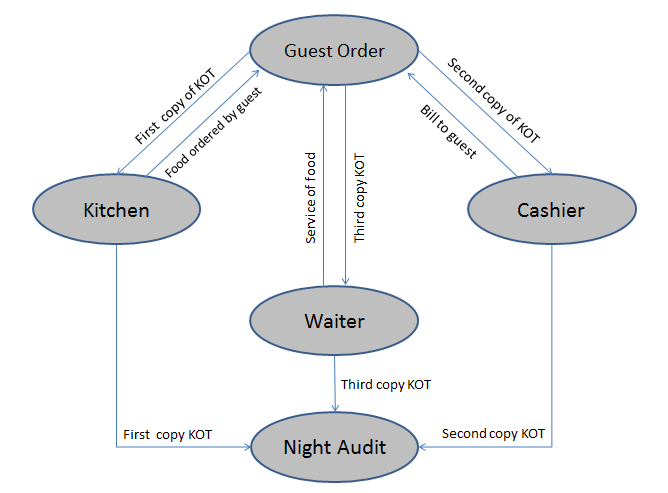 THE FIRST KOT goes to the kitchen and is received by a buyer who shouts the order to various sections for preparation of items and puts up spike in chronological order of table numbers. After the pickup of dishes kitchen order tickets are puts up in a kitchen order ticket box (locked) and taken out for making production and consumption sheet and later sent by the chef to food and beverage control department for comparative analysis.
Q.8. Explain the processing of tobacco for cigarettes, pipe tobacco and cigars.
Cigarette Tobacco Processing:
- In the manufacture of cigarettes Virginian separately or in carefully blended mixtures. As in pipe tobacco, bundles from warehouses are received and stripped of midribs by machine or hands. The leaves then go to a machine which cuts them into fine shreds. Excessive moisture is removed from the tobacco and also the impurities. The tobacco is left for a day or two to mature following which it goes to a cigarette manufacturing machine.
- The papers for the cigarettes are unloaded from a disc and enter the machine and receive the tobacco flowing in a constant stream. Paper and tobacco move together. The paper is rolled round the tobacco and gummed at the end. The continuous tube of cigarette then runs beneath knives which cuts it into cigarettes of required lengths and stocks them neatly.
- Packaging: The cigarettes are not packed immediately but are left to dry for 24 hours. The machines used for packing are equally ingenious as those which make cigarettes. So human is this equipment that a carton or packet incompletely filled is automatically rejected. The tins if required for export are vacuum sealed. Cigarettes making requires high degree of skill
Pipe Tobacco Processing: Virginia is the most popular type used in pipe tobacco. It is mild in nature and has the highest level of sugar which gives a light taste after blending e.g. Dunhill, Rattray, Marlin Flake. Pipe mixtures are composed almost entirely of Empire tobacco, the Rhodesian leaves being mainly flavoured.
- The cured leaves are spread out on the floor in a lightly compressed mass;
- Bundles of tobacco are separated and put in steam-heated chambers (at 120°F and 160°F). Then the stalks and midribs are removed by hand or machine.
- The stripped leaves are left in ordinary heaps for about 24 hours to impregnate with additional moisture which renders them supple and usable.
- The blending of various mixtures of stronger tobaccos like Latakia and Perique with lighter tobacco.
- Blended leaves are compressed into machines to form a hard cake, then, shredded finely or coarsely with knives or shredding machines.
- Any excess moisture is removed by panning or stoving, a process which brings out aroma.
- After panning, tobacco is spread out on trays to cool down to the temperature of air, followed by tests of moisture content of legal limit at/below 32%.
- The tobacco is left for a day or two to mature
Cigar Tabacco Processing:
The cured leaf is fermented or sweated before use in the cigar in order
- to reduce the content of harsh and bitter compounds and
- to develop the mild and aromatic properties of the leaf.
Wrapper leaves, which receive the greatest care, are tied on a bundle of 40-50 leaves. Heat is generated in bulk which aids in fermentation.
OR (a) Classify cigars according to the colour of their wrappers.(5)
CIGAR CLASSIFICATION – ON BASIS OF THEIR COLOUR
| CCC | CLARO, LIGHT |
| CC | COLORADO –CLARO, MEDIUM |
| C | COLORADO-DARK |
| CM | COLORADO MADURO, VERY DARK |
| M | MADURO, EXCEPTIONALLY DARK |
(b) Discuss “care and storage” of cigarettes and cigars.
The ideal temperature of storage of cigar is 16-18°C and a relative humidity required is 65-70%.That’s why it is best to keep cigars in a glass case with a humidifier. The cigars remain best in their own cedar boxes because it has unique quality of releasing moisture when needed and absorbing when not required in surrounding areas. The advantage of keeping cigar in cedar wood boxes is that mild fragrance of cedar wood mingles well with cigar. Remember not to place cigars near items which emanate its flavours or fragrance or absorb the flavour and fragrance of surrounding e.g. milk will pick up tobacco flavour and cheese will impregnate its mouldy flavour to cigar.
Q.9. Give the food accompaniments for the following dishes:
(a) Roast chicken
Bread sauce, Roast gravy parsley and thyme stuffing Bacon rolls game chips watercress
(b) Chilled melon”
Ground ginger and castor sugar
(c) Caviar
Blinis (buckwheat pancake), hot breakfast toast, butter, segments of lemon, finely chopped shallots, sieve hard boiled yolk and white egg
(d) Fried fish
Segments of lemon or slices of lemon with skin removed sauces: Tartare sauce, Remoulade sauce, Gribiche sauce
(e) Oyster
Cayenne pepper, Peppermill, Chilli vinegar, Tabasco Sauce, Half a lemon, Brown bread, and butter
Q.10. Fill in the blanks:
(a) Pre-plated food is served from __________ side.
(b) Silver service is also known as __________.
(c) Roast turkey comes under ________ course in courses of menu.
(d) Sorbet course is served after _________ course.
(e) Diameter of a large plate is _________ inches.
(a) Pre-plated food is served from Right side.
(b) Silver service is also known as Plater to plate Service.
(c) Roast turkey comes under Roti course in courses on the menu.
(d) Sorbet course is served after Entrée course.
(e) The diameter of a large plate is 10.5 inches.