
Table of Contents
Q.1. Explain the various types of menu.
There are various types of menus in the hospitality industry, each designed for different purposes and occasions. Below are some of the most common types of menus:
- A La Carte Menu: This type of menu allows guests to order individual dishes from a wide selection of appetizers, main courses, and desserts. Each item is priced separately, giving customers the flexibility to create their own meal according to their preferences and budget.
- Table d’Hôte Menu: This is a fixed-price menu that offers a limited selection of dishes, usually consisting of an appetizer, main course, and dessert. Table d’Hôte menus are typically more affordable than A La Carte menus and are designed for customers who prefer a faster and simpler dining experience.
- Cyclical Menu: A cyclical menu is a series of menus that rotate over a specific period, such as a week or month. This type of menu is commonly used in institutional settings, like schools or hospitals, to provide variety while maintaining cost control and efficient food production.
- Buffet Menu: Buffet menus offer a selection of dishes displayed on a serving table, allowing guests to serve themselves. This type of menu can be used for various occasions, such as weddings, parties, or conferences, and is popular because it provides a wide variety of food options for guests to choose from.
- Static Menu: A static menu is one that remains unchanged for an extended period. This type of menu is commonly found in fast food restaurants, where consistency and speed are key factors in their business model.
- Du Jour Menu: Du Jour menus are daily menus that change based on the availability of fresh ingredients and the chef’s creativity. This type of menu is typically found in fine dining establishments and encourages customers to try new and seasonal dishes.
- Prix Fixe Menu: A prix fixe menu is a set menu with a fixed price, usually including multiple courses. This type of menu is often used for special occasions or promotions and allows guests to enjoy a pre-selected variety of dishes at a set cost.
- Degustation Menu: Also known as a tasting menu, a degustation menu is a carefully curated selection of small dishes, showcasing the chef’s culinary skills and creativity. Guests are offered multiple courses in smaller portions, allowing them to experience a wide range of flavors and textures. This type of menu is typically more expensive due to its complexity and the high-quality ingredients used.
By understanding the various types of menus, hospitality professionals can cater to the diverse needs and preferences of their guests, providing an exceptional dining experience tailored to each occasion.
Q.2. Explain the various types of food service followed in catering industry.
The catering industry offers a variety of food service styles to suit different types of events and customer preferences. Here are some of the most common types of food service in the catering industry:
- Buffet Service: In a buffet service, food is displayed on serving tables, and guests serve themselves. This type of service is popular for large events, such as weddings, conferences, or parties, as it allows guests to choose from a wide variety of dishes and caters to diverse dietary needs.
- Plated Service: Also known as sit-down service, plated service involves serving individually plated meals to guests at their tables. Servers are responsible for bringing each course to the guests and clearing the table between courses. This type of service provides a more formal and structured dining experience.
- Family-Style Service: In family-style service, large platters of food are placed on the table, and guests serve themselves or pass the dishes around to share with others. This type of service creates a casual and social atmosphere, encouraging interaction between guests.
- Action Stations: Action stations, also known as live cooking stations or chef stations, are interactive food stations where chefs prepare dishes to order in front of guests. This type of service adds an element of entertainment to the dining experience and allows guests to customize their meals.
- Tray Service: Tray service is commonly used for cocktail parties or standing receptions. In this type of service, servers circulate through the event with trays of hors d’oeuvres, small plates, or beverages, offering them to guests. This allows for a more informal and mingling atmosphere.
- Cafeteria Service: In a cafeteria service, guests select their food from a serving line and carry it on trays to their seats. This type of service is often used in institutional settings, such as schools, hospitals, or workplace cafeterias, as it allows for efficient service and cost control.
- French Service: French service is an elegant and highly formal style of food service, where a server presents a large platter of food at the table and serves each guest individually. This type of service requires highly skilled servers and is typically reserved for upscale dining establishments or special events.
- Gueridon Service: Gueridon service is a personalized tableside service, where food is prepared, finished, or carved directly in front of guests. This type of service adds an interactive and theatrical element to the dining experience and is commonly found in high-end restaurants or special events.
Understanding the various types of food service in the catering industry enables hospitality professionals to tailor their offerings to the needs and preferences of their clients, ensuring a successful and memorable event.
Q.3. Explain the courses of French classical menu with relevant example from each course.
The French classical menu is a traditional menu structure that consists of multiple courses, each designed to provide a unique dining experience. Here are the courses of a French classical menu with relevant examples:
- Hors d’oeuvre: The hors d’oeuvre course consists of small, savory appetizers designed to stimulate the appetite. These dishes are typically served cold.
- Example: Shrimp cocktail, smoked salmon, or a selection of pâtés
- Potage: The potage course is a soup course, which can be hot or cold, creamy or broth-based.
- Example: French onion soup, vichyssoise, or lobster bisque
- Poisson: The poisson course features a fish dish, usually cooked with a delicate sauce and accompanied by a light garnish.
- Example: Sole meunière, salmon en papillote, or seared tuna with a beurre blanc sauce
- Entrée: The entrée course is a smaller, more substantial dish that usually contains meat or poultry, but can also be vegetarian.
- Example: Duck confit, beef bourguignon, or mushroom and spinach crepes
- Sorbet: The sorbet course is a palate cleanser, typically a small serving of a light, fruit-based sorbet to refresh the palate before the main course.
- Example: Lemon sorbet, grapefruit sorbet, or green apple sorbet
- Relevé: The relevé course is the main course, featuring a larger portion of meat or poultry with accompanying vegetables and sauce.
- Example: Chateaubriand with béarnaise sauce, roast rack of lamb, or coq au vin
- Salade: The salade course is a light, refreshing salad that helps to cleanse the palate after the main course.
- Example: Mixed green salad with vinaigrette, endive and Roquefort salad, or a simple tomato and cucumber salad
- Fromage: The fromage course is a cheese course, typically featuring a variety of regional French cheeses.
- Example: Camembert, Roquefort, or Brie served with crusty bread and fruit
- Dessert: The dessert course is a sweet course that may include pastries, cakes, or fruit-based dishes.
- Example: Crème brûlée, tarte Tatin, or chocolate mousse
- Café: The café course is a coffee course, usually accompanied by petits fours or other small sweets.
- Example: Espresso, cappuccino, or café au lait served with macarons or chocolate truffles
The French classical menu showcases the culinary artistry and richness of French cuisine, providing diners with a memorable and elegant dining experience.
OR Discuss different types of breakfasts in detail along with their respective menus.
Breakfast is an important meal that can vary greatly across cultures and personal preferences. Here are some common types of breakfasts along with their respective menus:
- Continental Breakfast: A continental breakfast is a light breakfast that typically consists of bread, pastries, jams, butter, and hot beverages. This type of breakfast is common in European countries and hotels worldwide.
- Menu: Croissants, baguettes, toast, assorted pastries, fruit preserves, butter, cheese, yogurt, fruit, coffee, tea, and fruit juice
- Full English Breakfast: A full English breakfast is a hearty meal originating in England, traditionally featuring a variety of hot and cold items, including eggs, bacon, sausages, and more.
- Menu: Scrambled, fried, or poached eggs, bacon, sausages, black pudding, grilled tomatoes, sautéed mushrooms, baked beans, toast or fried bread, and tea or coffee
- American Breakfast: The American breakfast is a substantial meal that often includes a combination of sweet and savory dishes, such as eggs, breakfast meats, and pancakes or waffles.
- Menu: Scrambled, fried, or poached eggs, bacon or sausage, hash browns, pancakes or waffles with syrup, toast or English muffins, butter and jam, coffee, tea, and orange juice
- Mediterranean Breakfast: A Mediterranean breakfast typically consists of fresh, wholesome ingredients, emphasizing vegetables, fruits, and whole grains. This type of breakfast is common in countries around the Mediterranean Sea, such as Greece, Italy, and Spain.
- Menu: Greek yogurt with honey and nuts, fresh fruit, whole-grain bread, tomatoes, cucumber, olives, feta cheese, hummus, hard-boiled eggs, and tea or coffee
- Scandinavian Breakfast: The Scandinavian breakfast focuses on cold items, such as open-faced sandwiches, cold cuts, and dairy products, and is commonly enjoyed in Nordic countries like Denmark, Sweden, and Norway.
- Menu: Open-faced sandwiches with a variety of toppings (e.g., cured salmon, cheese, sliced vegetables), pickled herring, cold cuts, boiled eggs, yogurt or skyr, fresh fruit, crispbread, and coffee or tea
- Asian Breakfast: Asian breakfasts can vary greatly depending on the country or region, but they often include rice or noodle dishes, soups, and a variety of savory items.
- Menu (Japanese Example): Steamed rice, miso soup, grilled fish, tamagoyaki (rolled omelette), pickled vegetables, nori (seaweed), and green tea
- Menu (Chinese Example): Congee (rice porridge) with various toppings, steamed buns (baozi) with meat or vegetable fillings, fried dough sticks (youtiao), soy milk, and tea
Understanding the different types of breakfasts and their respective menus can help hospitality professionals cater to the diverse tastes and preferences of their guests, ensuring a satisfying start to the day.
Q.4. Explain the processing of tobacco for cigarettes, cigars and pipe tobacco.
Tobacco processing involves several steps, from cultivation to final product, to produce cigarettes, cigars, and pipe tobacco. Here is an overview of the processing of tobacco for these different products:
- Cultivation: Tobacco plants are grown in various regions around the world, with different strains and varieties suitable for different products. The plants are cultivated and carefully tended to, ensuring they receive proper nutrients, water, and sunlight.
- Harvesting: Once the tobacco leaves reach maturity, they are harvested either by hand or using machinery. The leaves are usually harvested in stages, starting with the bottom leaves and working up the plant, as leaves mature at different rates.
- Curing: Curing is the process of drying the tobacco leaves to remove moisture and develop their flavor and aroma. There are several methods of curing, including:
- Air-curing: Leaves are hung in well-ventilated barns and allowed to dry naturally over several weeks. This method is commonly used for Burley tobacco, which is used in cigarettes and pipe tobacco.
- Flue-curing: Leaves are hung in enclosed barns with controlled heat and humidity, typically using propane or natural gas burners. This method is mainly used for Virginia tobacco, a key component in cigarettes.
- Sun-curing: Leaves are laid out in the sun to dry, which is a common method for Oriental tobacco, often used in pipe tobacco blends and some cigarettes.
- Fire-curing: Leaves are hung in barns with smoldering fires, which impart a smoky flavor to the tobacco. This method is used for dark, air-cured tobacco, such as that used in cigars and some pipe tobaccos.
- Fermentation: After curing, tobacco leaves are sorted by quality, color, and size, then bundled and placed into large piles or barrels to ferment. During fermentation, the leaves undergo chemical changes that further develop their flavors and reduce harshness. The fermentation process can take several months to years, depending on the desired result and the type of tobacco.
- Blending: Blending is the process of combining different types of tobacco to achieve specific flavors, aromas, and burning characteristics. Master blenders create precise mixtures based on the requirements of each product, such as cigarettes, cigars, or pipe tobacco.
- For cigarettes: The tobacco is cut into fine shreds, and additives, such as flavorings, humectants, and preservatives, may be added. The shredded tobacco is then rolled into a paper casing to create cigarettes.
- For cigars: The tobacco leaves are selected and prepared for each part of the cigar: the filler, binder, and wrapper. The filler is a blend of tobacco leaves, while the binder holds the filler together, and the wrapper is a high-quality leaf that forms the outer layer of the cigar. Skilled workers hand-roll or machine-roll the cigars, which are then stored for further aging.
- For pipe tobacco: The tobacco is cut into various shapes and sizes, depending on the desired smoking characteristics. Flavors and additives may be introduced during blending to create unique blends. The finished product is packaged in pouches or tins for sale.
- Aging: After blending and production, some tobacco products, particularly cigars and certain pipe tobaccos, are aged to further enhance their flavors and aromas. This process can last anywhere from a few months to several years.
The processing of tobacco for cigarettes, cigars, and pipe tobacco involves a series of steps and techniques to develop the unique characteristics and flavors associated with each type of product.
OR (a) Mention how to take care and storage to be done of cigarettes and cigars.
Proper care and storage are essential to maintain the quality, flavor, and freshness of cigarettes and cigars. Here are some tips for taking care of these tobacco products:
Cigarettes
- Keep away from heat and moisture: Store cigarettes in a cool, dry place away from direct sunlight, heat sources, and moisture. High temperatures and humidity can cause the tobacco to dry out or become too moist, affecting the flavor and burning characteristics.
- Use a protective case: To protect cigarettes from damage and exposure to environmental factors, use a cigarette case or a hard-shell pack. This will help maintain the structural integrity of the cigarettes and prevent them from being crushed or bent.
- Avoid prolonged exposure to air: Once a pack of cigarettes is opened, try to consume them within a reasonable timeframe. Prolonged exposure to air can cause the tobacco to dry out, leading to a harsher taste and a faster burn.
Cigars
- Use a humidor: The ideal storage solution for cigars is a humidor, a specially designed container that maintains a consistent humidity level, typically between 65-72%. A humidor helps to preserve the moisture content of cigars and prevents them from drying out or becoming too damp, which can affect their flavor, aroma, and burning properties.
- Maintain proper humidity: To ensure optimal storage conditions, use a hygrometer to monitor the humidity level inside the humidor. If necessary, use a humidification device, such as a sponge, humidification pack, or electronic humidifier, to maintain the desired humidity level.
- Maintain proper temperature: Store cigars at a consistent temperature, ideally between 65-70°F (18-21°C). Avoid exposing cigars to extreme temperature fluctuations, as this can cause the tobacco to expand and contract, leading to cracks in the wrapper or uneven burning.
- Rotate cigars: Periodically rotate the cigars within the humidor to ensure even exposure to humidity and maintain consistent moisture levels. This helps to prevent mold and mildew growth and ensures that all cigars age uniformly.
- Avoid mixing flavors: Store flavored or infused cigars separately from traditional cigars, as the flavors can mingle and alter the taste of the cigars. Use separate humidors or a humidor with dividers to isolate different types of cigars.
By following these care and storage tips for cigarettes and cigars, you can help to preserve their quality, flavor, and freshness, ensuring an enjoyable smoking experience.
(b) What are the popular shapes and size of cigar?
Cigars come in various shapes and sizes, which can affect their smoking characteristics and overall experience. Here are some popular cigar shapes and sizes:
- Parejo: Parejo cigars have a straight, cylindrical shape with a rounded cap. This is the most common cigar shape. Some popular parejo sizes include:
- Corona: Approximately 5.5 inches (14 cm) in length with a ring gauge of 42-44. This size offers a balanced smoking experience and is considered a classic cigar size.
- Robusto: Typically 4.5 to 5 inches (11-13 cm) in length with a ring gauge of 48-54. Robustos are known for their shorter smoking time and full flavor.
- Churchill: Approximately 7 inches (18 cm) in length with a ring gauge of 47-50. Named after Winston Churchill, this size offers a longer smoking experience and is well-suited for special occasions.
- Figurado: Figurado cigars have an irregular shape, often with a tapered or pointed head, a bulging middle, or a closed foot. Some popular figurado shapes include:
- Torpedo: This shape has a closed, pointed head that tapers towards the foot. Torpedos are typically 6-6.5 inches (15-16.5 cm) in length with a ring gauge of 52-54.
- Pyramid: Similar to the torpedo, the pyramid shape has a pointed head but features a more dramatic taper from the head to the foot. Pyramids are usually around 6-7 inches (15-18 cm) in length with a ring gauge that starts at 52-54 and tapers to around 40 at the foot.
- Belicoso: This shape has a slightly tapered head and is often shorter and thicker than a torpedo. Belicosos are typically 5-5.5 inches (13-14 cm) in length with a ring gauge of 50-54.
- Perfecto: This shape features a closed, rounded foot and a bulging middle that tapers toward the head. Perfectos can vary in length, usually ranging from 4.5 to 9 inches (11-23 cm) and have a ring gauge of 38-48 at the foot, expanding in the middle.
- Short and thin cigars: Some smokers prefer smaller or thinner cigars for a shorter smoking experience or a more concentrated flavor. Examples include:
- Petit Corona: Approximately 4-4.5 inches (10-11 cm) in length with a ring gauge of 40-42. This size offers a shorter smoking time and a more intense flavor.
- Panatela: Typically 5-6 inches (13-15 cm) in length with a ring gauge of 34-38. The panatela’s slender shape delivers a concentrated flavor profile.
These popular cigar shapes and sizes offer a range of smoking experiences, flavors, and burn times, allowing aficionados to choose the perfect cigar for any occasion.
Q.5. With the help of flow chart, explain triplicate KOT system control.
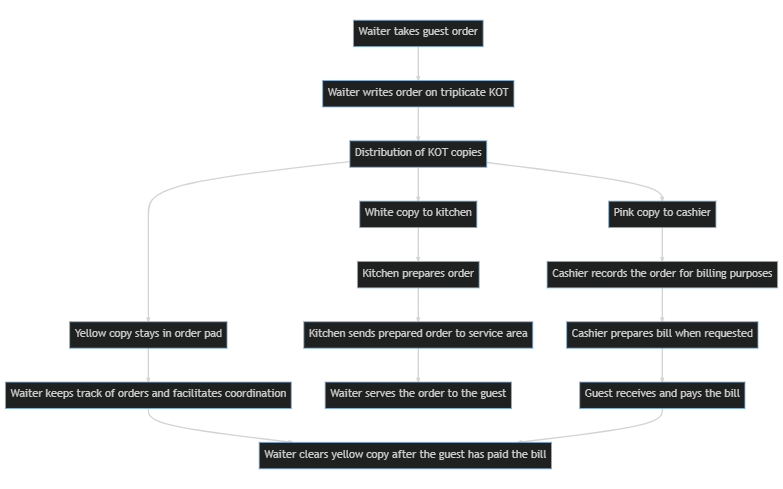
This flowchart depicts the steps involved in the triplicate KOT system control:
- Waiter takes the guest order.
- Waiter writes the order on a triplicate KOT.
- Distribution of KOT copies:
- White copy goes to the kitchen.
- Pink copy goes to the cashier.
- Yellow copy stays in the order pad.
- The kitchen prepares the order and sends it to the service area.
- The cashier records the order for billing purposes.
- The waiter keeps track of orders and facilitates coordination.
- The waiter serves the order to the guest.
- When requested, the cashier prepares the bill.
- The guest receives and pays the bill.
- The waiter clears the yellow copy after the guest has paid the bill.
OR List and explain the different types of KOTs.
Kitchen Order Tickets (KOTs) are an essential communication tool between the front-of-house and back-of-house teams in a restaurant. There are several types of KOTs, each serving a specific purpose:
- Standard KOT: This is the most common type of KOT used in restaurants. It includes essential information about the order, such as table number, dish names, quantities, any special instructions or modifications, the waiter’s name or ID, and the order timestamp. Standard KOTs help the kitchen staff keep track of orders and ensure that dishes are prepared according to the guest’s preferences.
- Triplicate KOT: In the triplicate KOT system, three copies of the KOT are produced. Each copy serves a distinct purpose:
- White copy: Sent to the kitchen for order preparation.
- Pink copy: Sent to the cashier for billing purposes.
- Yellow copy: Retained by the waiter in the order pad for tracking and coordination. This system helps to maintain better control over orders and billing.
- Duplicate KOT: Similar to the triplicate KOT system, the duplicate KOT system involves two copies of the KOT:
- White copy: Sent to the kitchen for order preparation.
- Pink copy: Sent to the cashier for billing purposes. The waiter relies on their memory or other means for order tracking and coordination.
- Beverage KOT: Beverage KOTs are specifically used for orders involving drinks, such as cocktails, soft drinks, or other beverages. These KOTs are usually sent to the bar or beverage service area instead of the kitchen. Beverage KOTs help to ensure that the bar and kitchen staff can work independently and efficiently.
- Special KOT: Special KOTs are used for unique situations or orders that require special attention. For example, a special KOT might be used for guests with dietary restrictions, allergies, or for VIP guests with specific preferences. Special KOTs help the kitchen staff identify and prioritize orders that require extra care.
- Digital KOT: With the increasing use of technology in the hospitality industry, digital KOTs are becoming more common. Orders are entered into a Point of Sale (POS) system, and the digital KOT is sent electronically to the kitchen, bar, or other service areas. Digital KOTs help reduce paper waste, streamline communication, and minimize errors due to illegible handwriting or lost tickets.
Each type of KOT serves a specific purpose and is designed to improve communication, efficiency, and accuracy in the order-taking and preparation process within a restaurant.
Q.6. Explain the following (any four):
(a) Crumbing procedure
Crumbing procedure refers to the process of cleaning the table of any crumbs or food particles during a meal service, usually after the main course and before dessert. This is done using a crumber or a folded napkin, which the server carefully sweeps across the tablecloth to collect debris and maintain a clean dining surface.
(b) Types of caviar
Caviar is the processed, salted roe (fish eggs) of sturgeon, a large fish native to the Caspian and Black Sea regions. There are several types of caviar, including:
- Beluga: This is the most expensive and rarest type of caviar, derived from the Beluga sturgeon. It features large, delicate eggs with a creamy and buttery flavor.
- Osetra: Osetra caviar comes from the Osetra sturgeon and is known for its medium-sized eggs, nutty flavor, and firm texture.
- Sevruga: Derived from the Sevruga sturgeon, this caviar has smaller eggs with a more intense, briny flavor and a firm texture.
- Sterlet: Sterlet caviar comes from the smaller Sterlet sturgeon and features small, golden eggs with a rich and creamy flavor.
(c) B.O.T.
B.O.T. stands for “Bacon, Lettuce, and Tomato” sandwich. It is a classic sandwich made with crispy bacon, fresh lettuce, juicy tomatoes, and mayonnaise, typically served on toasted bread. The B.O.T. is a popular choice for lunch or a light meal.
(d) Supper
Supper refers to a light evening meal, usually served later than dinner. In some cultures, supper is the last meal of the day, while in others, it may be a smaller meal consumed between dinner and bedtime. Supper can include a variety of foods, such as sandwiches, salads, soups, or light entrées.
(e) High tea
High tea, also known as “afternoon tea,” is a British tradition that involves serving a variety of small sandwiches, scones, pastries, and cakes, accompanied by tea. High tea is typically served between 3 pm and 5 pm and is considered a light meal or snack between lunch and dinner. In some cases, high tea may also include more substantial dishes, such as quiches or savory pies.
(f) Brunch
Brunch is a combination of breakfast and lunch, usually served between 10 am and 2 pm. This meal is popular on weekends and holidays when people have more leisure time and can enjoy a relaxed, extended meal. Brunch menus often feature a mix of breakfast and lunch dishes, such as eggs, bacon, pancakes, salads, sandwiches, and pastries. Brunch may also include specialty cocktails like mimosas or Bloody Marys.
Q.7. Explain the points to be considered while planning a menu.
- Type of establishment: The type of establishment (restaurant, hotel, café, etc.) influences the menu’s style, price range, and cuisine.
- Target audience: Consider the preferences and demographics of the target audience, such as age, income, and dietary restrictions.
- Cuisine: Select a cuisine or a combination of cuisines that will appeal to the target audience and complement the establishment’s concept.
- Menu balance: Ensure a balance of dishes in terms of flavors, textures, colors, and cooking methods to create an appealing and varied menu.
- Nutritional value: Offer a variety of dishes that cater to different dietary needs, including options for vegetarian, vegan, and gluten-free guests.
- Food cost and pricing: Analyze the cost of ingredients and labor to determine appropriate pricing for each dish while maintaining profitability.
- Availability of ingredients: Choose dishes with ingredients that are readily available and in season to ensure freshness, quality, and lower costs.
- Kitchen equipment and capacity: Consider the available kitchen equipment, workspace, and staff capacity when selecting dishes to ensure efficient preparation and service.
- Skill level of staff: Assess the skill level of the kitchen and service staff and choose dishes that can be consistently prepared and presented to a high standard.
- Menu size: Determine the appropriate number of dishes to offer, taking into account the establishment’s capacity, staff, and guest preferences.
- Specials and promotions: Plan daily or weekly specials to keep the menu fresh and interesting, and to encourage repeat business.
- Menu design and layout: Design the menu in a visually appealing and easy-to-read format, highlighting popular or signature dishes.
- Menu testing: Test and evaluate the proposed menu items before finalizing the menu, gathering feedback from staff and a sample of the target audience.
- Menu updates and revisions: Regularly review and update the menu to keep it current, incorporating new trends, guest feedback, and seasonal ingredients.
By considering these points while planning a menu, restaurant owners and managers can create a well-rounded and successful menu that appeals to their target audience and meets the establishment’s operational and financial goals.
OR Explain Mise-en-place and Mise-en-scene.
In the context of Food and Beverage (F&B) services, mise-en-place refers to the preparation and organization of everything required for efficient service in a restaurant, café, or other dining establishments. This includes:
- Table setting: Preparing the table with appropriate tableware, glassware, cutlery, and linen based on the menu and the type of service.
- Side stations: Setting up side stations with necessary items such as extra tableware, condiments, water jugs, trays, and cleaning supplies.
- Beverage station: Organizing the beverage station with an adequate stock of beverages, glassware, ice, garnishes, and equipment.
- Reservation management: Ensuring that the reservations are in order and the tables are reserved accordingly.
- Staff briefing: Conducting a pre-service briefing to discuss the menu, daily specials, and any other relevant information.
Mise-en-place in F&B services aims to streamline the dining experience for guests and ensure efficient, well-coordinated service by the staff.
Mise-en-scene (F&B Services)
In F&B services, mise-en-scene refers to the overall atmosphere, presentation, and visual appeal of the dining environment. This includes:
- Interior design: The style, colors, lighting, and layout of the dining space, creating a specific mood and ambiance.
- Table presentation: The arrangement of tableware, glassware, cutlery, linen, and centerpieces, contributing to the visual appeal of the dining experience.
- Food presentation: The plating and garnishing of dishes, showcasing the food in an aesthetically pleasing manner.
- Staff appearance: The uniforms, grooming, and overall appearance of the service staff, conveying a sense of professionalism and consistency.
- Ambiance: The choice of background music, lighting, and other elements that contribute to the overall atmosphere and mood of the dining space.
Mise-en-scene in F&B services plays a crucial role in creating a memorable dining experience, helping to set the establishment apart from its competitors and meet the expectations of the target clientele.
Q.8. Write the accompaniments of any five:
(a) Cheese
- Crackers or sliced baguette
- Fresh or dried fruits (grapes, apples, figs, or dates)
- Nuts (walnuts, almonds, or pecans)
- Fruit preserves or chutneys
- Olives or pickles
- Honey or maple syrup
(b) Oyster
- Lemon wedges
- Mignonette sauce (a mixture of vinegar, shallots, and pepper)
- Cocktail sauce (ketchup, horseradish, Worcestershire sauce, and lemon juice)
- Hot sauce (such as Tabasco)
- Freshly grated horseradish
- Saltine crackers
(c) Caviar
- Blini (small Russian pancakes) or toast points
- Crème fraîche or sour cream
- Finely chopped hard-boiled eggs
- Finely chopped red onion or shallots
- Fresh dill or chives
- Capers
(d) Chilled melon
- Thinly sliced prosciutto or Parma ham
- Fresh mint leaves
- Fresh berries (strawberries, blueberries, or raspberries)
- Lime or lemon zest
- Balsamic glaze or reduction
- Yogurt or cottage cheese
(e) Smoked salmon
- Capers
- Thinly sliced red onion
- Fresh dill
- Lemon wedges
- Cream cheese or crème fraîche
- Toast points, bagels, or crackers
(f) Irish stew
- Crusty bread or soda bread
- Steamed or sautéed vegetables (carrots, peas, or cabbage)
- Mashed or boiled potatoes
- Horseradish sauce or mustard
- Chopped fresh parsley
- Pickles or chutneys
These accompaniments enhance the flavors and textures of the main items, providing a balanced and enjoyable dining experience.
Q.9. Give French names of any ten of following:
- Egg: Œuf
- Spinach: Épinard
- Cheese: Fromage
- Soup: Soupe
- Apple: Pomme
- Fish: Poisson
- Chicken: Poulet
- Duck: Canard
- Mushroom: Champignon
- Butter: Beurre
- Prawn: Crevette
- Lobster: Homard
Q.10. Match the following:
(a) Cigar (i) Pancake
(b) Asparagus (ii) Humidor
(c) Ravioli (iii) Hash brown potatoes
(d) Omelette (iv) Pasta
(e) Tomato juice (v) Vegetable
(f) Crêpes suzette (vi) Worcestershire sauce
(g) Sorbet (vii) Champagne
(h) Caviar (viii) Table d’hôte
(i) Menu (ix) French classical menu
(j) Minestrone (x) Italy
| Term | Match |
|---|---|
| (a) Cigar | (ii) Humidor |
| (b) Asparagus | (v) Vegetable |
| (c) Ravioli | (iv) Pasta |
| (d) Omelette | (iii) Hash brown potatoes |
| (e) Tomato juice | (vi) Worcestershire sauce |
| (f) Crêpes suzette | (i) Pancake |
| (g) Sorbet | (vii) Champagne |
| (h) Caviar | (ix) French classical menu |
| (i) Menu | (viii) Table d’hôte |
| (j) Minestrone | (x) Italy |