Table of Contents
Q.1. What are the objectives of material handling? List the guidelines for effective utilisation of material handling equipment. (5+5=10)
The primary objective of material handling is to reduce the unit cost of production.
Some other objectives are-
1. Reduction in Cost
Reduction in total cost of production can be achieved by either reducing materials handling or by improved handling procedure or both.
The objective of reduction in cost of production through improved materials handling can be achieved by:
(a) Reducing material handling labour.
(b) Material handling work should not be assigned to skilled or semi-skilled labour.
(c) Reducing indirect labour expenses on activities connected with storage, inspection, quality control, repair, tool room, shipping etc.
(d) Reducing damage of materials during handling.
2. Increase in Capacity
Improved materials handling system results in increase of capacity by better utilisation of space.
Improved handling system can increase the capacity in the following ways:
(a) By better utilisation of space:
(b) By reducing travel space or excessive wastage of space
(c) By improving equipment utilisation
(d) By faster loading or unloading
3. Improvement in Working Conditions
(a) Safety aspects:
Safety of men, material and associated equipment not only prevents loss of money but also enhances the moral of workers.
(b) Easy working:
By using proper handling equipment heavy jobs can be handled with ease, faster speed and at a constant rate throughout the period of production. This enables high morale and lower workers turnover.
(c) Fool proof operation:
Due to absence of manual handling, there are no chances of confusion resulting in placing of material at wrong location or disruption of production.
4. Improved Customer Service
Customer’s service will be improved by following proper and improved materials handling system which will enable regular and timely market supply by avoiding disruption in production schedule. These are the main sources of good customer service.
5. Increasing Warehouse Capacity
When materials are not stored correctly in a warehouse, much of the facility is being wasted. This wastage adds to the cost of the product. Focusing on efficient storage in terms of cubic as well as floor space becomes important. Minimizing aisle space is also necessary with respect to increasing the amount of storage space. In both cases effective use of material handling will help to reduce warehousing cost of materials.
6. Improving Layout to Reduce Waste
A complete analysis of the flow of materials between operations, volumes, flow paths and timing is a must for efficient material handling. When space requirements are optimized and travel times reduced through the use of efficient handling systems and equipment, material handling becomes more cost effective. Further, this will lead to enhanced productivity.
7. Optimal Equipment Utilization
Expensive equipment often fails to operate at full potential simply because the material handling system does not permit it to. For example, the rate at which materials are supplied or removed could cause a drop in equipment performance by simply leaving it standing idle. With a proper material handling system in place or more efficient control of an existing system, equipment utilization can soon be maximized.
8. Reduce Cost of Handling
By
a. Decreasing Inventory level
b. Utilizing space to better advantage
c. Increasing productivity.
9. Reduce delay and damage
10. Maintain or Improve product quality
11. Control Inventory
Guidelines For Effective Utilisation Of Material Handling Equipments
The following guidelines are invaluable in the design and cost reduction of the materials handling system:
1. As material handling adds no value but increases the production cycle time, eliminate handling wherever possible. Ideally, there should not be any handling at all!
2. Sequence the operations in a logical manner so that handling is unidirectional and smooth.
3. Use gravity wherever possible as it results in the conservation of power and fuel.
4. Standardize the handling types of equipment to the extent possible as it means interchangeable usage, better utilization of handling types of equipment, and lesser spares holding.
5. Install a regular preventive maintenance program for material handling types of equipment so that downtime is minimal.
6. In the selection of handling equipment, criteria of versatility and adaptability must be the governing factor. This will ensure that investments in special purpose handling equipment are kept at a minimum.
7. The weight of the unit load must be maximum so that each ‘handling trip’ is productive.
8. Work-study aspects, such an elimination of unnecessary movements and a combination of processes should be considered while installing a material handling system.
9. Non-productive operations in handling, such as slinging, loading, etc., should be kept at a minimum through appropriate design of handling equipment. Magnetic cranes for scrap movement and loading in furnaces combination of excavators and tippers for ores loading and unloading in mines are examples in this respect.
10. The location of the stores should be as close as possible to the plant which uses the materials. This avoids handling and minimizing investment in the material handling system.
11. Application of OR techniques such as queuing can be very effective in the optimal utilization of materials handling the equipment.
12. A very important aspect in the design of a material handling system is the safety aspect. The system designed should be simple and safe to operate.
13. Avoid any wasteful movements-method study that can be conducted for this purpose.
14. Ensure proper coordination through judicious selection of equipment and training of workmen.
Q.2. Define Material Management. Discuss the objective and importance of material management.(10)
Definitions of Materials Management:
(i) ‘Materials Management’ is a term used to connote “controlling the kind, amount, location, movement and timing of various commodities used in production by industrial enterprises”.
(ii) Materials Management is the planning, directing, controlling and coordinating those activities which are concerned with materials and inventory requirements, from the point of their inception to their introduction into the manufacturing process.
It begins with the determination of materials quality and quantity and ends with its issuance to production to meet customer’s demand as per schedule and at the lowest cost.
(iii) Materials Management is a basic function of the business that adds value directly to the product itself
(iv) Materials Management embraces all activities concerned with materials except those directly concerned with designing or manufacturing the product.
(v) Materials Management deals with controlling and regulating the flow of material in relation to changes in variables like demand, prices, availability, quality, delivery schedules etc.
Thus, material management is an important function of an organisation covering various aspects of input process, i.e., it deals with raw materials, procurement of machines and other equipment’s necessary for the production process and spare parts for the maintenance of the plant.
Objectives of Materials Management:
Materials management contributes to the survival and profits of an enterprise by providing an adequate supply of materials at the lowest possible costs.
The fundamental objectives of materials management activities can be:
(i) Material Selection:
The correct specification of material and components is determined. Also, the material requirement in agreement with the sales program are assessed. This can be done by analyzing the requisition order of the buying department. With this standardization, one may have lower cost and the task of procurement, replacement, etc. may be easier.
(ii) Low operating costs:
It should endeavour to keep the operating costs low and increase the profits without making any concessions in quality.
(iii) Receiving and controlling material safely and in good condition.
(iv) Issue material upon receipt of appropriate authority.
(v) Identification of surplus stocks and taking appropriate measures to produce it.
Importance of Material Management:
Material management is a service function. It is as important as manufacturing, engineering and finance. The supply of proper quality of materials is essential for manufacturing standard products. The avoidance of material wastage helps in controlling cost of production. Material management is essential for every type of concern.
The importance of material management may be summarized as follows:
1. The material cost content of total cost is kept at a reasonable level. Scientific purchasing helps in acquiring materials at reasonable prices. Proper storing of materials also helps in reducing their wastages. These factors help in controlling cost content of products.
2. The cost of indirect materials is kept under check. Sometimes cost of indirect materials also increases total cost of production because there is no proper control over such materials.
3. The equipment is properly utilized because there are no break downs due to late supply of materials.
4. The loss of direct labour is avoided.
5. The wastages of materials at the stage of storage as well as their movement is kept under control.
6. The supply of materials is prompt and late delivery instances are only few.
7. The investments on materials are kept under control as under and over stocking is avoided.
8. Congestion in the stores and at different stages of manufacturing is avoided.
OR
Quality control is an essential tool for long term success. Discuss various techniques that can be used in a bread making unit to control (from raw material to final product stage). (10)
The assessment of bread quality by bread consumers is highly subjective and is influenced by ethnic, cultural and personal preferences. The quality factors assessed and the standards applied may also vary with the type of bread being consumed.
However in spite of these variables the ultimate measure of the quality of commercial breads must be the level of consumer satisfaction achieved by individual manufacturers. Where customers have a choice of brands and varieties, sales figures and changes in sales figures are indicators of consumer preferences and can be correlated with specific features of the finished product.
The twofold challenge to bread bakers and cereal technologists is to translate consumer preferences as measured this way into objective measurable aspects of bread quality and to relate these measurements to processing factors which may be controlled so that bread with the most desirable consumer characteristics is produced.
Steps where different quality control steps can be followed-
1. Quality check points for incoming raw materials
2. Magnets at the flour silo to remove metal objects in flour.
3. Flour Screens for flour going into the mixer to remove foreign (non-metal) objects
4. Infestation or pest control checks on incoming bagged ingredients
5. X-ray sorting system for mixed seeds and grain blends
6. Recording lot numbers of raw ingredients on every batch mixing sheet
7. Training for employees on getting injured on the job.
8. Using brightly coloured gloves for different departments or allergens.
9. Final metal detection after the packaging process.
10. Trained QA personnel to watch for food safety issues.
Q.3. What is work measurement ? Explain any five work measurement techniques.(3+7=10)
Work measurement may be defined as “the art of observing and recording the time required to do each detailed element of an Industrial activity/operation.”
The term industrial activity includes mental, manual and machining operation, where
(i) Mental time includes time taken by the operator for thinking over some alternative operations.
(ii) Manual time consists of three types of operations i.e. related with handling of materials, handling of tools and handling of machines.
(iii) Machining time includes time taken by the machines in performing the requisite operations.
Thus time study standardizes the time taken by average worker to perform these operations.
The essence of work measurement is ascertaining the work content of the particular activity under consideration. It helps in:
● Evaluating worker’s effectiveness
● Making comparison between two methods
● Developing labour standards, for planning and controlling operations.
The estimated time, needed by a qualified worker for carrying out the task, at a normal rate, is known as the standard time. The standard time acts as a benchmark for productivity.
Objectives of Work Measurement:
1. To compare the times of performance by alternative methods.
2. To enable realistic schedule of work to be prepared.
3. To arrive at a realistic and fair incentive scheme.
4. To analyse the activities for doing a job with the view to reduce or eliminate unnecessary jobs.
5. To minimise the human effort.
6. To assist in the organisation of labour by daily comparing the actual time with that of target time.
Techniques of Work Measurement:
Work measurement is investigating and eliminating ineffective time. It not only reveals the existence of ineffective time. But it can be used to set standard times for carrying out the work so that ineffective time does not evolve later. It will be immediately found out by the increased standard time. For the purpose of work measurement, work may be regarded as repetitive work and non-repetitive work.
The principal techniques of work measurement are
1. Direct Time Study
Direct time study refers to the ascertainment of the time needed to carry out a unit of work. In this method, observation and recording of time is necessary for undertaking each unit of an operation are done, with a view to ascertaining, the actual time, in which the work can be accomplished.
2. Synthesis Method
Synthesis from standard data method synthesizes time standards that are built up or synthesized from element times previously obtained from direct time-study. Most of the organizations that have an independent work study department, build up a synthetic table converting the commoner elements. However, some units also use such time record of other organizations as standard data. For obvious non-commonality of technology, skill, process, and working environments, this type of synthesis may not always be correct.
3. Analytical Estimating
Analytical estimation is normally used in plant maintenance and repair work. This is a compromise between straight rate fixing and time-study. Since maintenance and repair jobs require adequate planning and also because such jobs, by their very nature, call for creativity and innovativeness, it is difficult to enforce straight rate fixing. Analytical estimation is difficult in nature and is also not always fool-proof for the inexperience of the work-study men.
4. Predetermined Motion Time System (PMTS)
Pre-determined motion time standards have been developed for different job elements based on the elementary movement. Usually, for time measurement, work factor and basic motion, times are recorded in any predetermined time standards. Work study analysts use such time-standards as the basis for comparing the observed time of the present workers. This enables the work-study men to quickly decide the efficiency or otherwise of the workers and to make decisions accordingly.
5. Work Sampling or Ratio Delay Method
A work measurement method, Ratio-delay is a sampling technique. Instead of going for the complete job study under ratio-delay techniques, a sufficiently large number of readings are taken at random intervals.
Like all other sampling techniques, under this method also there are bound to be some errors. However, since the cost of such study is not much, many organizations which have the expertise prefer this method. Moreover, under this method, because rating is not done and the time is recorded directly using a stopwatch, it encounters no resistance from the workers.
Work measurement techniques helps in preparing realistic work schedules, by proper evaluation of human work. It helps in comparing the actual time taken by the worker, with the time allowed, to keep a check on the workers and avoid idle time.
OR
Discuss the packaging and distribution techniques adopted by various food outlets.(10)
Packaging is the first thing that contributes to the user experience, it can set the stage for a great user experience or damage the user’s product satisfaction before they’ve even used your product.
Packaging strategy should fulfil six functions: unique, functional, safe, easy to remove, promote product benefits and reinforce the brand. An effective packaging strategy can contribute to the firm’s competitive advantage.
a. Unique Packaging
The packaging “must stand out from the crowd” and be different from your competitors. You do not want consumers to confuse your product with that of your competitors. However non branded supermarket goods may do the opposite and produce packaging which is similar to popular brands for example cereals, coke and ketchup. This is to convince customers that they are getting a quality product, which is just as good as the branded version. “Copy Cat” packaging strategies could also be designed to confuse customers into inadvertently purchasing the product, in the hope that they will like it and purchase it in the future
b. Functional Packaging
If the packaging has more than one function, ensure that it performs all of its functions. For example the packaging for Muller’s corner range of yogurts is divided into two sections; one section contains the yogurt and the other contains the topping. The packaging enables consumers to decide how to mix their yogurt and is therefore interactive.
c. Safe Packaging
The packaging must be tested to make sure consumers can safely use it. The packaging should also safeguard people living with the consumer such as children. For example medicine bottles are designed with caps that children can not remove easily.
d. Easy to Remove Packaging
Consumer give up products, if packaging makes it difficult to access or use the product. Packaging must also allow consumers to remove it without damaging the product. Some manufacturers will provide labelling on the packaging to help consumers remove it, for example arrows showing which side is the top of the product or instructions on how to remove lids from medicine bottles.
e. Promotional Packaging
Packaging must be designed to promote the benefits of the product. When consumers are deciding on which product brand to choose, they will use the packaging to make their decision. Ensure that the packaging highlights product benefits especially unique benefits not found in competitor products.
f. Brand Reinforcement Packaging
The packaging of the product must reinforce not just the product brand but also the corporate brand. Will it follow the corporate colour scheme? Will the fonts be similar to other products within your product range? Will the packaging follow the family brand strategy and make the most of brand equity.
DISTRIBUTION CHANNEL
The primary purpose of any channel of distribution is to bridge the gap between the producer of a product and its user.
Functions of a Channel
The primary purpose of any channel of distribution is to bridge the gap between the producer of a product and the user of it, whether the parties are located in the same community or in different countries thousands of miles apart. The channel of distribution is defined as the most efficient and effective manner in which to place a product into the hands of the customer. The channel is composed of different institutions that facilitate the transaction and the physical exchange.
Institutions in channels fall into three categories:
● The producer of the product: a craftsman, manufacturer, farmer, or other extractive industry producer
● The user of the product:an individual, household, business buyer, institution, or government
● Certain middlemen at the wholesale and/or retail level
A channel performs three important functions. Not all channel members perform the same function. The functions are:
● Transactional functions: buying, selling, and risk assumption
● Logistical functions: assembly, storage, sorting, and transportation
● Facilitating functions: post-purchase service and maintenance, financing, information dissemination, and channel coordination or leadership
These functions are necessary for the effective flow of product and title to the customer and payment back to the producer.
There are basically four types of marketing channels:
● Direct selling;
● Selling through intermediaries;
● Dual distribution; and
● Reverse channels.
Essentially, a channel might be a retail store, a web site, a mail order catalogue, or direct personal communications by a letter, email or text message.
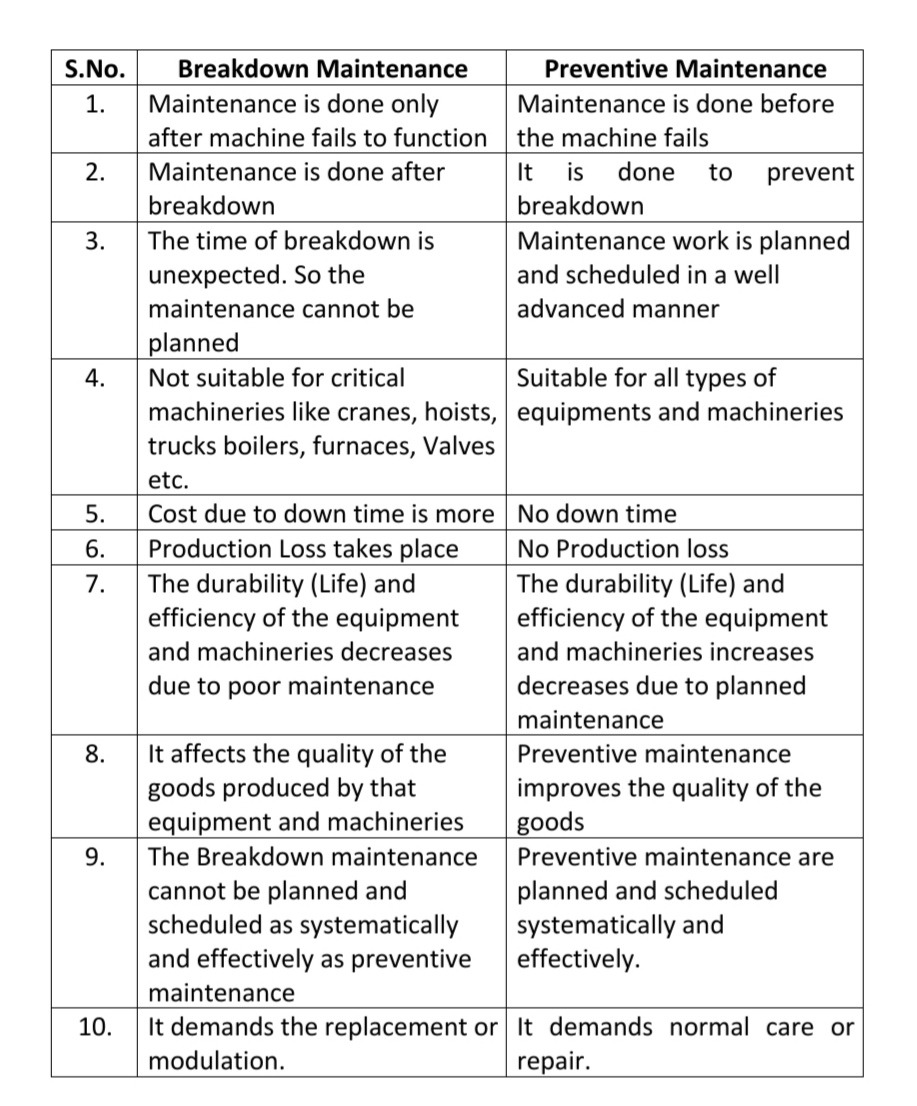
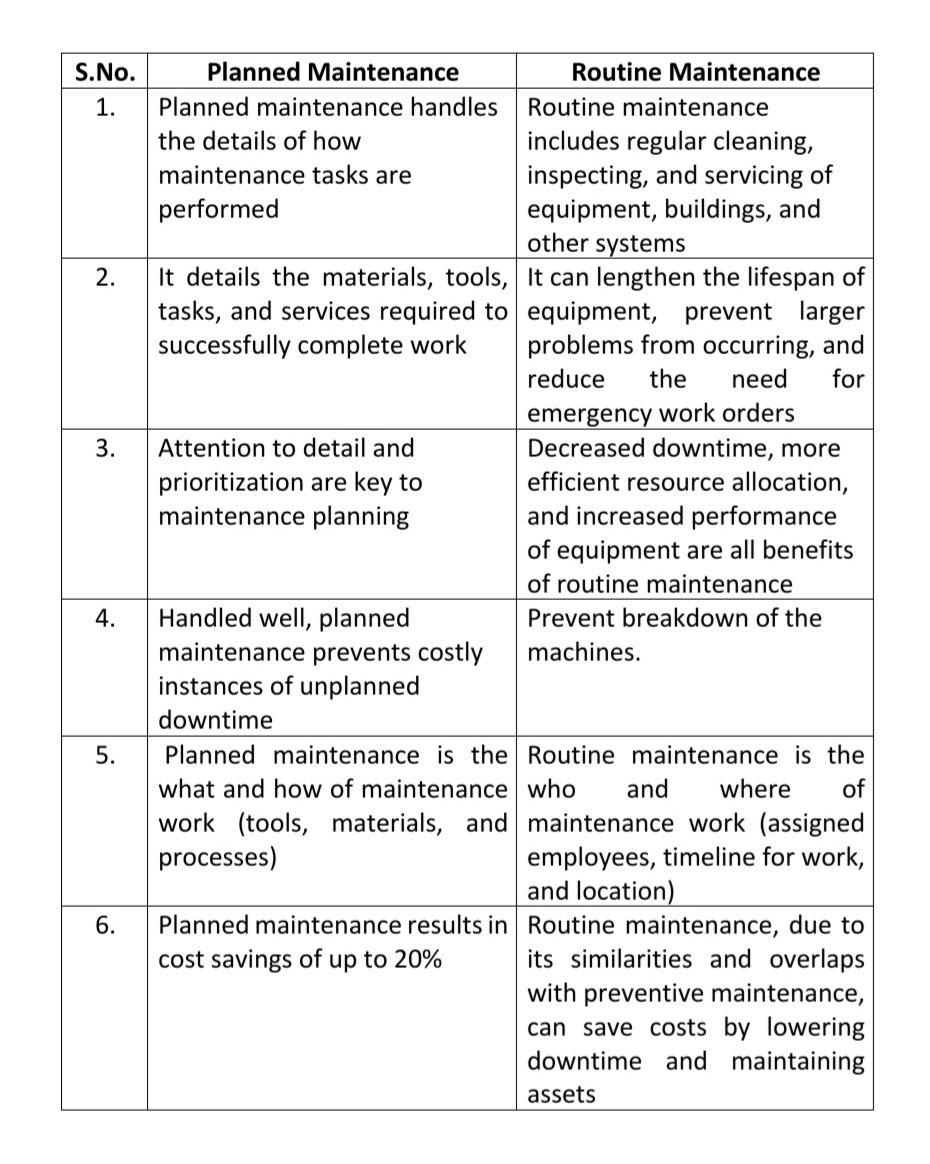
Q.4. Differentiate between (5+5=10)
a. Breakdown v/s Preventive Maintenance
b. Planned v/s Routine Maintenance
Q.5. Write Short Note on any four (5×4=10)
a. Just In Time (JIT)
The just-in-time (JIT) inventory system is a management strategy that aligns raw-material orders from suppliers directly with production schedules. Companies employ this inventory strategy to increase efficiency and decrease waste by receiving goods only as they need them for the production process, which reduces inventory costs. This method requires producers to forecast demand accurately.
The JIT inventory system contrasts with just-in-case strategies, wherein producers hold sufficient inventories to have enough product to absorb maximum market demand.
Just-in-Time (JIT) Advantages
JIT inventory systems have several advantages over traditional models. Production runs are short, which means that manufacturers can quickly move from one product to another. Furthermore, this method reduces costs by minimizing warehouse needs. Companies also spend less money on raw materials because they buy just enough resources to make the ordered products and no more.
Disadvantages of the Just-in-Time
The disadvantages of JIT inventory systems involve potential disruptions in the supply chain. If a raw materials supplier has a breakdown and cannot deliver the goods in a timely manner, this could conceivably stall the entire production process. A sudden unexpected order for goods may delay the delivery of finished products to end clients.
Example of a JIT inventory system is a car manufacturer that operates with low inventory levels but heavily relies on its supply chain to deliver the parts it requires to build cars, on an as-needed basis. Consequently, the manufacturer orders the parts required to assemble the cars, only after an order is received.
b. Computer Aided Maintenance
Computer-aided maintenance refers to systems that utilize software to organize planning, scheduling and support of maintenance and repair. A common application of such systems is the maintenance of computers, either hardware or software, themselves.
It can also apply to the maintenance of other complex systems that require periodic maintenance, such as reminding operators that preventive maintenance is due or even predicting when such maintenance should be performed based on recorded past experience.
The first computer-aided maintenance software came from DEC in the 1980s to configure VAX computers.
The software was built using the techniques of artificial intelligence expert systems, because the problem of configuring a VAX required expert knowledge. During the research, the software was called R1 and was renamed XCON when placed in service. Fundamentally, XCON was a rule-based configuration database written as an expert system using forward chaining rules. As one of the first expert systems to be pressed into commercial service it created high expectations, which did not materialize, as DEC lost commercial pre-eminence.
c. Selection of Material Handling equipment
Selection of Material Handling equipment is an important decision as it affects both the cost and efficiency of the handling system.
Factors Affecting the Selection of Material Handling equipment
The following factors are to be taken into account while selecting material handling equipment.
1. PROPERTIES OF THE MATERIAL
Whether it is solid, liquid or gas, and in what size, shape and weight it is to be moved, are important considerations and can already lead to a preliminary elimination from the range of available equipment under review. Similarly, if the material is fragile, corrosive or toxic this will imply that certain handling methods and containers will be preferable to others.
2. LAYOUT AND CHARACTERISTICS OF THE BUILDING
Another restricting factor is the availability of space for handling. A low-level ceiling may preclude the use of hoists or cranes, and the presence of supporting columns in awkward places can limit the size of the material-handling equipment. If the building is multi-storied, chutes or ramps for industrial trucks may be used. The layout itself will indicate the type of production operation (continuous, intermittent, fixed position or group) and can indicate some items of equipment that will be more suitable than others. Floor capacity also helps in selecting the best material handling equipment.
3. PRODUCTION FLOW
If the flow is fairly constant between two fixed positions that are not likely to change, fixed equipment such as conveyors or chutes can be successfully used. If, on the other hand, the flow is not constant and the direction changes occasionally from one point to another because several products are being produced simultaneously, moving equipment such as trucks would be preferable.
4. COST CONSIDERATIONS
This is one of the most important considerations. The above factors can help to narrow the range of suitable equipment, while costing can help in making a final decision. Several cost elements need to be taken into consideration when comparisons are made between various items of equipment that are all capable of handling the same load. Initial investment and operating and maintenance costs are the major cost to be considered. By calculating and comparing the total cost for each of the items of equipment under consideration, a more rational decision can be reached on the most appropriate choice.
5. NATURE OF OPERATIONS
The selection of equipment also depends on the nature of operations like whether handling is temporary or permanent, whether the flow is continuous or intermittent and material flow pattern-vertical or horizontal.
6. ENGINEERING FACTORS
The selection of equipment also depends on engineering factors like door and ceiling dimensions, floor space, floor conditions, and structural strength.
7. EQUIPMENT RELIABILITY
The reliability of the equipment and supplier reputation and the after-sale service also plays an important role in selecting material handling equipment.
d. Codification
Codification of materials can also be termed as the identification of materials. This deals with uniquely identifying each item in the inventory. It is useful in requisitioning items or the operational departments, in placing of orders by the purchase department, in receiving and expediting the items on receipt from the supplier, in having a unique record of each of the items in stores and in work-in-process or in warehouse so as to facilitate the control over the inventory levels, and also in having a good control over the loss, deterioration, obsolescence, non-movement, or pilferage of the items in the inventory.
Unique identification of the materials – whether they are raw materials, work-in-process or finished goods – is the first step towards a good materials management system. Without it, the control over inventory by rigorous exercises such as inventory techniques is not very effective. Without it, confusion might prevail in the operational departments.
Moreover for a good quality control system a unique identification is a pre-requisite. There are many other advantages such as variety reduction and standardization etc.
For proper stock taking a good identification is of immense help. Many cases have been observed in large corporations where the concerned people do not even know what materials have been lying in the inventory for a large duration of time. These materials could easily be eliminated from the list, salvage value recovered and the storage space freed.
It is also not uncommon to observe that although a material is available with the stores in reality due to duplication of the identity it is often quoted as ‘not available’ and thus, many production programs suffer with consequent loss to the organization as a whole Proper identification of inventory items helps in simplification of all the processes such as storing, receiving, procuring, manufacturing, warehousing and this results in a multiplicity of benefits to the company.
It is a simple concept. If followed it might produce results of proportions equivalent to that of a rigorous application of the inventory control principles with, perhaps much less effort.
e. Standardization
Standardization means producing maximum variety of products from the minimum variety of materials, parts, tools and processes. It is the process of establishing standards or units of measure by which extent, quality, quantity, value, performance etc., may be compared and measured.
Advantages of Standardization
All the sections of company will be benefited from standardization as mentioned below.
Benefits to Manufacturing Department
1. Lower unit cost.
2. Better quality products.
3. Better methods and tooling.
4. Increased interchangeability of parts.
5. Better utilization of manpower and equipment.
6. Accurate delivery dates.
7. Better services of production control, stock control, purchasing, etc.
8. More effective training.
Benefits to Purchase and Stock Control Department
1. Holding of stock of standard items leads to less paper work and fewer requisitions and orders.
2. Storage and part location can be improved.
Newer techniques can be used for better control of stocks.
3. Because of large purchase quantities involved, favorable purchase contracts can be made.
Benefits to Quality Control Department
1. Better inspection and quality control is possible.
2. Quality standards can be defined more clearly.
3. Operators become familiar with the work and produce jobs of consistent quality.
Other Benefits
1. Work study section is benefited with efficient break down of operations and effective work measurement.
2. Costing can obtain better control by installing standard costing.
3. More time is available to the supervisors to make useful records and preserve statistics.
4. Reduced reductions and scrap.
5. Helps supervisors to run his department efficiently and effectively.
Disadvantages of Standardization
Following are the disadvantages of standardization:
1. Reduction in choice because of reduced variety and consequently loss of business or customer.
2. Standard once set, resist change and thus standardization may become an obstacle to progress.
3. It tends to favour only large companies.
4. It becomes very difficult to introduce new models because of less flexible production facilities and due to high cost of specialized production equipment.
Q.6. A factory uses annually 24000 unit of raw material which cost ₹1.25 per unit. Placing each order cost ₹25 and carrying cost is 6% per year of the average inventory. Calculate Economic Order Quantity. (10)
Given,
Annual Required Unit (RU) – 24,000
Inventory Unit Cost (UC) – ₹1.25 per unit
Ordering cost (OC) – ₹25 per unit
Carrying Cost (CC) – 6% of unit cost
Hence,
EOQ = √(2×RU×OC)/(UC×CC%)
= √(2×24,000×25)/(1.25×6%)
= √12,00,000/0.075
= √1,60,00,000
= 4000
Hence EOQ = 4000
OR
Waste Management plays a major role in controlling pollution. Comment (10)
As the number of people on Earth increase, naturally, we need more resources to satisfy everyone’s needs and wants. With the current population at 7.4 billion, which is only increasing as the days pass by, we cannot expect to utilize lesser number of resources. We need more land, more water, more food, more oil, more factories, etc. Naturally, this means that more waste will also be generated. Let’s understand what happens to the waste that we add to the environment.
In our day-to-day activities, we generate a lot of rubbish. Things include empty medicine bottles, clothes and shoes that are old and torn, used stationary items including pens with plastic bodies, rulers, sharpeners, pencils made of wood, glass bottles, etc.
It is important to understand that not all of these items will decompose and disappear, if we dump them into the earth.
Hence, Waste management or Waste disposal is all the activities and actions required to manage waste from its inception to its final disposal. This includes amongst other things, collection, transport, treatment and disposal of waste together with monitoring and regulation. It also encompasses the legal and regulatory framework that relates to waste management encompassing guidance on recycling etc.
● Better Environment
Probably the biggest advantage of managing waste is that it eventually leads to a better and fresher environment.
Waste disposal units also contribute to the well-being of people by helping them become disease-free. The best part: all of this happens while the unnecessary is duly disposed of in a proper and sanitary manner.
Multiple waste disposal units should be placed in tier-1 and tier-2 cities in a bid to prep up the process of waste disposal. This will also help implement remarkable safety measures in the long run.
● Reduces Pollution
When waste is managed the right way, it doesn’t merely eliminate the subsequent waste but also reduces the impact and the intensity of harmful greenhouse gases like carbon-di-oxide, carbon mono-oxide, and methane that are often exuded from accumulated wastes in landfills.
Managing waste reduces our reliance on landfills while also significantly cutting down the many factors that adversely impact our environment.
● Conserves Energy
Recycling is one of the biggest aspects of waste management, and over time, it helps conserve energy. One of the biggest instances of this advantage can be traced to the practice of recycling paper.
All of us are probably aware that thousands of trees are cut to produce paper. When a used paper is recycled to create new paper, the need of cutting trees is significantly minimized. This helps conserve energy while also reducing your carbon footprints.
All these benefits finally helps in controlling pollution.
Q.7. What is Inventory Management? Explain inventory control techniques used in hotel industry.(2+8=10)
Inventory management or control refers to the management of idle resources that have future economic value. Alternatively, Inventory may be defined as usable but idle resources that have economic value.
Inventory Management refers to maintaining, for a given financial investment, an adequate supply of something to meet an expected demand pattern. It thus deals with the determination of optima policies and procedures for procurement.
In business management, inventory consists of a list of goods and materials held or available in stock.
Management of inventory or Inventory management is all about handling functions related to the tracking and management of material. Inventory management is very important in the case of Production Oriented Enterprises.
Inventory management techniques are-
1. ABC ANALYSIS
ABC analysis stands for Always Better Control Analysis. It is an inventory management technique where inventory items are classified into three categories namely: A, B, and C. The items in A category of inventory are closely controlled as it consists of high-priced inventory which may be less in number but are very expensive. The items in B category are relatively lesser expensive inventory as compared to A category and the number of items in B category is moderate so control level is also moderate. The C category consists of a high number of inventory items which require lesser investments so the control level is minimum.
2. JUST IN TIME (JIT) METHOD
In Just in Time method of inventory control, the hotel keeps only as much inventory as it needs during the production process. With no excess inventory in hand, the company saves the cost of storage and insurance. The hotel orders further inventory when the old stock of inventory is close to replenishment. This is a little risky method of inventory management because a little delay in ordering new inventory can lead to stock out situation. Thus this method requires proper planning so that new orders can be timely placed.
3. MATERIAL REQUIREMENTS PLANNING (MRP) METHOD
Material Requirements Planning is an inventory control method in which the organization order the inventory after considering the sales forecast. MRP system integrates data from various areas of the business where inventory exists. Based on the data and demand in the market, the manager would carefully place the order for new inventory with the material suppliers.
4. ECONOMIC ORDER QUANTITY (EOQ) MODEL
Economic Order Quantity technique focuses on taking a decision regarding how much quantity of inventory should the company order at any point of time and when should they place the order. In this model, the store manager will reorder the inventory when it reaches the minimum level. EOQ model helps to save the ordering cost and carrying costs incurred while placing the order. With the EOQ model, the organization is able to place the right quantity of inventory.
6. Maintaining Par levels
Par levels are the minimum amount of product that must be on hand at all times. When the inventory stock dips below the predetermined levels, then it’s time to order more. Make inventory management easier by setting “par levels” for each of the products.
Par levels vary by product and are based on how quickly the item sells and how long it takes to get back in stock. Although setting par levels requires some research and decision-making up front, having them set will systemize the process of ordering.
7. First-In First-Out (FIFO)
“First-in, first-out” is an important principle of inventory management. It means the oldest stock (first-in) gets sold first (first-out), not the newest stock. This is especially important for perishable products so the hotel don’t end up with unsellable spoilage.
It’s also a good idea to practice FIFO for non-perishable products. If the same boxes are always sitting at the back, they’re more likely to get worn out. Plus, packaging design and features often change over time.
In order to manage a FIFO system, we will need an organized warehouse. This typically means adding new products from the back, or otherwise making sure old product stays at the front.
8. Regular auditing
Regular reconciliation is vital. In most cases, hotels will be relying on software and reports from store to know how much product is in stock. However, it’s important to make sure the facts match up.
Q.8. Explain the following in 2 to 3 lines (5×2=10)
a. Buffer Stock
A buffer stock is a system or scheme which buys and stores stocks at times of good harvests to prevent prices falling below a target range (or price level), and releases stocks during bad harvests to prevent prices rising above a target range (or price level).
The primary action of buffer stocks, creating price stability, is often combined with other mechanisms to meet other goals such as the promotion of domestic industry. That is achieved by setting a minimum price for a certain product above the equilibrium price, the point at which the supply and demand curves cross, which guarantees a minimum price to producers, encouraging them to produce more, thus creating a surplus ready to be used as a buffer stock. The price stability itself may also tempt firms into the market, further boosting supply.
b. Tools for Quality Control
The tools of quality is a designation given to a fixed set of graphical techniques identified as being most helpful in troubleshooting issues related to quality.
They are called basic because they are suitable for people with little formal training in statistics and because they can be used to solve the vast majority of quality-related issues.
The seven tools for Quality Control are:
1. Cause-and-effect diagram (also known as the “fishbone diagram” or Ishikawa diagram)
2. Check sheet
3. Control chart
4. Histogram
5. Pareto chart
6. Scatter diagram
7. Stratification (alternatively, flow chart or run chart)
c. Codification
This is the system adopted for accurate identification of materials by allotting a numerical number for each item procured and stored.
Codification of materials can also be termed as the identification of materials. This deals with uniquely identifying each item in the inventory. It is useful in requisitioning items or the operational departments, in placing of orders by the purchase department, in receiving and expediting the items on receipt from the supplier, in having a unique record of each of the items in stores and in work-in-process or in warehouse so as to facilitate the control over the inventory levels, and also in having a good control over the loss, deterioration, obsolescence, non-movement, or pilferage of the items in the inventory. Unique identification of the materials – whether they are raw materials, work-in-process or finished goods – is the first step towards a good materials management system.
d. Material Handling
Material Handling is the process of moving goods and materials short distances within a building, factory, facility, or warehouse.
Or
Material Handling refers to activities, equipment, and procedures related to the moving, storing, protecting and controlling of materials in a system.
Material handling includes a wide range of different types of materials, ranging from tiny boxes to large and heavy components for manufacturing. To conduct this process of material handling, there is a wide range of material handling equipment. The types of equipment range from:
● Manual
● Semi-automated
● Automated equipment
e. Ergonomics
Ergonomics is the study of people’s efficiency in relation to the working environment.
Ergonomics is the study of how humans interact with manmade objects. The goal of ergonomics is to create an environment that is well-suited to a user’s physical needs.
While ergonomics is relevant in many areas, it is commonly applied to the workplace environment. For example, ergonomics is often used to create comfortable workstations for employees. This may involve choosing customized desks and chairs that fit each individual’s body type. It may also include providing employees with ergonomic keyboards and wrist rests that provide better typing posture.
Q.9.
A. State True or False (5)
a. Economic Order Quantity is all about ordering right quantity at right time.
= True
b. Kanban is physical control system consisting of cards and containers.
= True
c. Fixing Accountability can lead to failure in quality management.
= False
d. Wastage level in manufacturing influences the productivity.
= True
e. Synthesis Method for work sampling involves observation on particular staff.
= False
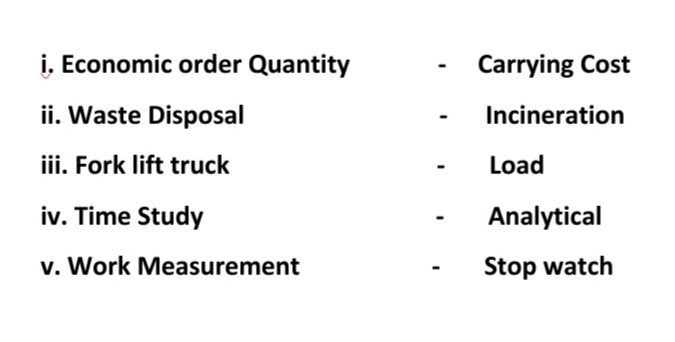
B. Match the following. (5)
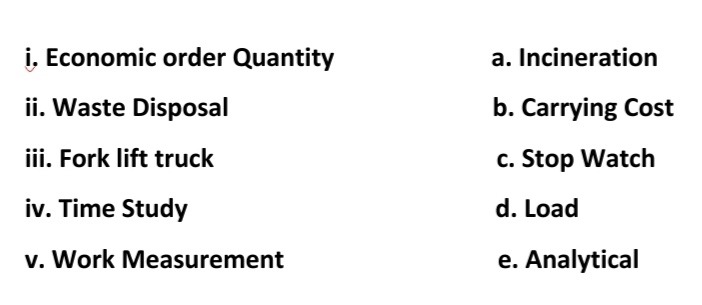
Answer-