
Table of Contents
Q.1. Define the term Material Handling and briefly explain the various factors that affects the selection of material handling equipment.(10)
Material Handling is the process of moving goods and materials short distances within a building, factory, facility, or warehouse.
Or
Material Handling refers to activities, equipment, and procedures related to the moving, storing, protecting and controlling of materials in a system.
Material handling includes a wide range of different types of materials, ranging from tiny boxes to large and heavy components for manufacturing. To conduct this process of material handling, there is a wide range of material handling equipment. The types of equipment range from:
● Manual
● Semi-automated
● Automated equipment
Selection of Materials Handling Equipment
Selection of Material Handling equipment is an important decision as it affects both the cost and efficiency of the handling system.
Factors Affecting the Selection of Material Handling equipment
The following factors are to be taken into account while selecting material handling equipment.
1. PROPERTIES OF THE MATERIAL
Whether it is solid, liquid or gas, and in what size, shape and weight it is to be moved, are important considerations and can already lead to a preliminary elimination from the range of available equipment under review. Similarly, if the material is fragile, corrosive or toxic this will imply that certain handling methods and containers will be preferable to others.
2. LAYOUT AND CHARACTERISTICS OF THE BUILDING
Another restricting factor is the availability of space for handling. A low-level ceiling may preclude the use of hoists or cranes, and the presence of supporting columns in awkward places can limit the size of the material-handling equipment. If the building is multi-storied, chutes or ramps for industrial trucks may be used. The layout itself will indicate the type of production operation (continuous, intermittent, fixed position or group) and can indicate some items of equipment that will be more suitable than others. Floor capacity also helps in selecting the best material handling equipment.
3. PRODUCTION FLOW
If the flow is fairly constant between two fixed positions that are not likely to change, fixed equipment such as conveyors or chutes can be successfully used. If, on the other hand, the flow is not constant and the direction changes occasionally from one point to another because several products are being produced simultaneously, moving equipment such as trucks would be preferable.
4. COST CONSIDERATIONS
This is one of the most important considerations. The above factors can help to narrow the range of suitable equipment, while costing can help in making a final decision. Several cost elements need to be taken into consideration when comparisons are made between various items of equipment that are all capable of handling the same load. Initial investment and operating and maintenance costs are the major cost to be considered. By calculating and comparing the total cost for each of the items of equipment under consideration, a more rational decision can be reached on the most appropriate choice.
5. NATURE OF OPERATIONS
The selection of equipment also depends on the nature of operations like whether handling is temporary or permanent, whether the flow is continuous or intermittent and material flow pattern-vertical or horizontal.
6. ENGINEERING FACTORS
The selection of equipment also depends on engineering factors like door and ceiling dimensions, floor space, floor conditions, and structural strength.
7. EQUIPMENT RELIABILITY
The reliability of the equipment and supplier reputation and the after-sale service also plays an important role in selecting material handling equipment.
Q.2. Explain the following in two lines (any five): (5×2=10)
a. Logistic Management
Logistics management may be defined as follows:
Logistics management consists of the process of planning, implementing and controlling the efficient flow of raw-materials, work-in-progress and finished goods and related information-from point of origin to point of consumption; with a view to providing satisfaction to the customer.
Objectives of Logistics Management
Logistics management is significant for the following reasons:
(i) Cost Reduction and Profit Maximization
(ii) Efficient Flow of Manufacturing Operations
(iii) Competitive Edge
(iv) Effective Communication System
(v) Sound Inventory Management
b. Economic Order Quantity
Economic order quantity (EOQ) is the ideal order quantity a company should purchase to minimize inventory costs such as holding costs, shortage costs, and order costs.
EOQ is the purchase order quantity for replenishment that minimizes total inventory costs. The purchase order is triggered when the inventory level hits the reorder point. The EOQ is calculated in order to minimize a combination of costs such as the purchase cost (which may include volume discounts), the inventory holding cost, the ordering cost, etc. The order quantity optimization is complementary to the safety stock optimization that focuses on finding the optimal threshold to trigger the reorder.
Formula and Calculation of Economic Order Quantity (EOQ)
EOQ = √(2×RU×OC)/(UC×CC%)
where:
RU= Required units (typically on an annual basis)
OC =Order cost (per purchase order)
UC = Unit Cost
CC = Carrying Cost
c. Computer Aided Maintenance
Computer-aided maintenance refers to systems that utilize software to organize planning, scheduling and support of maintenance and repair. A common application of such systems is the maintenance of computers, either hardware or software, themselves.
It can also apply to the maintenance of other complex systems that require periodic maintenance, such as reminding operators that preventive maintenance is due or even predicting when such maintenance should be performed based on recorded past experience.
d. Method and Work Study
Work study is the investigation, by means of a consistent system of the work done in an organization in order to attain the best utilisation of resources i.e. Materials, Machines, Men and Money. All the technologies and management systems are related with productivity.
Work study is used to describe a complete set of techniques with the help of which work can be simplified, standardized and measured.
Work study is a generic term for those techniques particularly “Method study” and “Work Measurement” which are used in the examination of work in all its contexts and which leads systematically to the investigation of all the factors which affect the efficiency and economy of the situation being reviewed in order to incorporate improvements at various levels.
One phase of work study called Method Study or Motion Study aims at determining the best possible manufacturing procedure which involves least time and cause minimum fatigue to workers employed for performing the work.
In short method study is concerned with determination of the best way of doing a job. Method study may be defined as the systematic investigation of the existing method of doing a job in order to develop and install an easy, quick, effective, efficient and comparatively less tiring method or procedure for doing the same job at cheaper rates.
e. Waste disposal techniques
Methods of Waste Disposal
1. Landfill
The Landfill is the most popularly used method of waste disposal used today. This process of waste disposal focuses attention on burying the waste in the land
2. Incineration/Combustion
Incineration or combustion is a type disposal method in which municipal solid wastes are burned at high temperatures so as to convert them into residue and gaseous products.
3. Recovery and Recycling
Resource recovery is the process of taking useful discarded items for a specific next use. These discarded items are then processed to extract or recover materials and resources or convert them to energy in the form of useable heat, electricity or fuel.
Recycling is the process of converting waste products into new products to prevent energy usage and consumption of fresh raw materials. Recycling is the third component of Reduce, Reuse and Recycle waste hierarchy. The idea behind recycling is to reduce energy usage, reduce volume of landfills, reduce air and water pollution, reduce greenhouse gas emissions and preserve natural resources for future use.
4. Plasma gasification
Plasma gasification is another form of waste management. Plasma is a primarily an electrically charged or a highly ionized gas. Lighting is one type of plasma which produces temperatures that exceed 12,600 °F . With this method of waste disposal, a vessel uses characteristic plasma torches operating at +10,000 °F which is creating a gasification zone till 3,000 °F for the conversion of solid or liquid wastes into a syngas
f. Quality Control tools
The tools of quality is a designation given to a fixed set of graphical techniques identified as being most helpful in troubleshooting issues related to quality.
They are called basic because they are suitable for people with little formal training in statistics and because they can be used to solve the vast majority of quality-related issues.
The seven tools for Quality Control are:
1. Cause-and-effect diagram (also known as the “fishbone diagram” or Ishikawa diagram)
2. Check sheet
3. Control chart
4. Histogram
5. Pareto chart
6. Scatter diagram
7. Stratification (alternatively, flow chart or run chart)
g. Over- Stocking Cost
Overstock is the exact opposite, where the supply exceeds consumer demand. The reasons for overstocking are similar to those around understocking. Poor to no planning is a big contributor while you can also attribute it to not understanding your market well enough to know what they want.
And cost involved in the overstocking of the inventory is known as over – stock cost.
Q.3. Explain the various Maintenance Management techniques used in major departments of the hotels. (10)
Maintenance is a combination of actions carried out to retain an item/machine/equipment system/plant in order to restore it to an acceptable working condition.
The purpose of maintenance is to increase the system availability. The term maintenance covers the following aspects:
a) Inspection of the item/plant/equipment/machine/system.
b) Repair of the defects if any
c) Minor modification in order to reduce maintenance efforts
Hotel maintenance is the upkeep of the various systems and components used in the hospitality industry. These systems include general building operations such as HVAC, electrical, and plumbing, but also many needs specific to hotels and their customers. These specific needs are widely varied and their scope depends on the size of the hotel and the services they offer.
Maintenance is the key for providing better built environment to building customers and users. Maintenance of the hospitality building
is significance as its effectiveness will directly affect the quality of services, which have direct and significance effect on satisfying customers’ wants and expectations.
Classification of maintenance management
1. Servicing is essentially a cleaning operation undertaken art regular interval of varying frequency and is sometimes termed day-to-day maintenance.
2. Rectification is work usually occurs fairly early in the life of the building and arises from shortcomings in design, inherent faults in or unsuitability of components, damage of good in transit installation and incorrect assembly.
3. Replacement problems involve items that degenerate with use or with the passage of time and those that fail after a certain amount of use or time. Items that deteriorate
are likely to be large and costly (e.g., machine tools, trucks, ships…etc.).
Introduction and Scope in Hotels
• Works almost behind the scenes.
• Fulfils tremendously important function of providing the atmosphere & comforts demanded by the guests.
• Requires the principles of management & their application for efficient operations
• Care & operation of physical plant is the responsibility of engineering or maintenance department.
• Lodging establishments are in constant quest for better guest service & edge in the market place, with the help of various technological innovations. As the lodging facilities have grown in size, they have also grown in their complexity of design, systems & services viz. HVAC, hot & cold water system, storm & sanitary sewer, lighting, telephone. Refrigeration, cable TV, Fire protection, vertical transportation like elevators & escalators, PCs in guest rooms etc.
• Either directly or indirectly affects the operations of other departments— as the departments depend upon the efficient, updated physical plant like grounds, building structure, building systems, interior finishes viz. Paints carpeting, wall paper etc, & FFE I.e. furniture, fixtures & equipment’s.
A. BUILDING & SYSTEM’S OPERATION
● Continuous attention is required for operating the buildings effectively.
● Building & installed systems require basic maintenance, repair or replacement of failed parts, calibration of controls & equipment, attention to the factors posing safety problems & inevitably a major renovation or rehabilitation. Failure to pay attention to these needs leads to poor operating performance of the building, ultimately affecting the guest’s perception of Quality, employees & profitability of the operation.
● Failure of systems to work property, viz. AC that is maintaining the types of indoor conditions that result in guest comfort draws unnecessary attention & creates managerial nightmares, which should be almost invisible to the guest.
B. BUILDING MAINTANCE
• A large number of basic activities need to be undertaken if the building is to preserve its initial appearance & function.
• Approximately 5% of the POM budget is spent on non-labour aspects of the building maintenance.
• Involves taking care of the deterioration of the building surfaces, pitting & erosion of the exterior surfaces + cleaning of the exterior surfaces without worsening & damaging them + protective treatments to retard corrosion & repel the attack of moisture –entrained pollutants + Repair of roofing leakages, reproofing the entire building, roofing system maintenance also are important concerns.
C. MAINTENANCE OF GUESTROOMS, FURNISHINGS & FIXTURES-
• These very visible features contribute to the overall experience either positively or negatively.
• Proper maintenance of these is the direct responsibility of the department’s staff.
• Because of lot of use, these are replaced within first 10 years by the department itself or under supervision of the outside contractors.
D. EQUIPMENT MAINTENANCE & REPAIR:
• Astounding amount of equipment representing 30-40%of the initial investment in the property is installed in a modern hotel or motel in the guest room, public spaces, pools, kitchen , laundry etc.
• Repair & maintenance of these is the responsibility of the engineering department i.e. to keep in an existing state or to preserve from failure or decline as failure to operate them effectively affects the customer satisfaction, energy expenditure due to reduced efficiency, significant safety problems endangering the guests, employees or both & the ability of other departments to operate effectively.
OR
Define the term ‘Maintenance’ and explain the various types of maintenance with relevant examples.(10)
Maintenance management is the process of maintaining a company’s assets and resources. The purpose is to ensure that production proceeds efficiently and that resources are used effectively.
Maintenance management is one of those aspects of managing a company that is usually not explored in depth.
Maintenance management involves keeping track of assets and parts. The purpose is to ensure that production proceeds efficiently and the minimum amount of resources are wasted. This is generally accomplished by a tailored combination of software, practices, and personnel that focus on achieving these goals.
Types of Maintenance-
1. Preventive maintenance
Preventive maintenance is the most popular type of proactive maintenance. Preventive maintenance is a type of proactive maintenance that includes adjustments, cleaning, lubrication, repairs, and parts replacements. PM keeps assets in good order and reduces unscheduled downtime and major repairs. However, with preventive maintenance, the organization runs the risk of over-scheduling maintenance tasks because tasks are scheduled based on time rather than actual conditions. That said, preventive maintenance achieves 12% to 18% cost savings over other maintenance.
Ex- Lube chains for critical equipment every seven days.
2. Predictive maintenance
Predictive maintenance is a type of condition-based maintenance that monitors the condition of assets using sensor devices. These sensor devices supply data in real-time, which is used to predict when the asset will require maintenance and prevent equipment failure.
Predictive maintenance is the most advanced type of maintenance currently available. With time-based maintenance, organizations run the risk of performing too much maintenance or not enough.
Ex- A centrifugal pump motor in a coal preparation plant is a vital asset for day-to-day operations. To prevent unscheduled downtime, the maintenance team decides to use predictive maintenance technology.
3. Breakdown Maintenance
Breakdown maintenance is obviously not for every industry. In particular, industries that are directly responsible for people’s safety should never use breakdown maintenance. However, it can be useful when working with disposable, cheap parts or equipment that cannot be repaired by normal means.
The bottom line for breakdown maintenance is that it requires planning and coordination—an organization should never allow breakdown maintenance to be exploited or used improperly.
Ex- Maintenance of lift after it has stopped working
4. Scheduled maintenance
Scheduled maintenance is any repair and upkeep work performed within a set timeframe. It details when given maintenance tasks are performed and by whom. Scheduled maintenance may occur at repeating intervals or in response to a work request.
Scheduled maintenance tasks such as routine inspections help detect minor problems before they develop into system failures. By adhering to a regular, well-designed maintenance schedule, maintenance technicians can detect problems early.
Ex- Maintenance of the lift at a given period of interval
5. Planned maintenance
Planned maintenance is work that’s prepared for in advance of it taking place.
Scheduled maintenance is often lumped together with planned maintenance, but the two are actually two separate endeavors. Planned maintenance deals with the processes and materials required to successfully complete needed work, whereas scheduled maintenance handles who performs the work and when.
The two go hand in hand, and they rely on one another to make sure maintenance tasks are completed in an efficient manner.
Ex- Changing the oil because the vehicle had gone 3,000 miles is planned maintenance.
6. Routine maintenance
Routine maintenance is a form of time-based maintenance and preventive maintenance, though some organizations differentiate between routine maintenance and preventive maintenance. They use the latter for smaller tasks (i.e. cleaning) performed at higher frequencies (hourly, daily) and the former for larger tasks (i.e. inspections) performed at lower frequencies (weekly, monthly, annually).
Ex- Routine cleaning of the machine.
7. Emergency Maintenance
Emergency maintenance is a type of reactive maintenance that is used to prevent a threat to lives, property, profitability, or viability of an organization.
Ex- A broken water line or flooding.
8. Corrective Maintenance
Corrective maintenance (also called breakdown maintenance) are maintenance tasks that are performed in order to rectify and repair faulty systems and equipment. The purpose of corrective maintenance is to restore broken down systems.
Ex- Service Outages- Restoring services that are down.
Q.4. Calculate the standard production per shift of 8 hours duration, with the following data (10)
a. Observed time per unit is 5 min
b. Rating Factor is 120% and
c. Total allowance is 33% of normal time.
Given,
Observed time/unit = 5 min
Rating Factor = 120%
Total Allowance = 33% of normal time
Hence,
Normal time = Observed time × Rating Factor
= 5 × 120%
= 6 min
Allowance @ 33% = 6 × 33 %
= 1.98 or 2 min
Hence,
Standard Time = Normal time + Allowance
= 6 + 2
= 8 min
Production in 8hr shift or 480 min = 480 ÷ 8
= 60 units
OR
What do you understand by Waste Management? Explain the various techniques involved in control and disposal of waste. (10)
Waste management (or waste disposal) include the activities and actions required to manage waste from its inception to its final disposal. This includes the collection, transport, treatment and disposal of waste, together with monitoring and regulation of the waste management process.
Waste can be solid, liquid, or gas and each type has different methods of disposal and management. Waste management deals with all types of waste, including industrial, biological and household. In some cases, waste can pose a threat to human health.
Waste is produced by human activity, for example, the extraction and processing of raw materials. Waste management is intended to reduce adverse effects of waste on human health, the environment or aesthetics.
Waste Disposal Method
1. Landfill
In this process, the waste that cannot be reused or recycled are separated out and spread as a thin layer in low-lying areas across a city. A layer of soil is added after each layer of garbage. However, once this process is complete, the area is declared unfit for construction of buildings for the next 20 years. Instead, it can only be used as a playground or a park.
2. Incineration
Incineration is the process of controlled combustion of garbage to reduce it to incombustible matter such as ash and waste gas. The exhaust gasses from this process may be toxic, hence it is treated before being released into the environment. This process reduced the volume of waste by 90 per cent and considered as one of the most hygienic methods of waste disposal. In some cases, the heat generated is used to produce electricity. However, some consider this process not quite environmentally friendly due to the generation of greenhouse gases such as carbon dioxide and carbon monoxide.
3. Waste Compaction
The waste materials such as cans and plastic bottles are compacted into blocks and sent for recycling. This process prevents the oxidation of metals and reduces air space need, thus making transportation and positioning easy.
4. Biogas Generation
Biodegradable waste, such as food items, animal waste or organic industrial waste from food packaging industries are sent to bio-degradation plants. In bio-degradation plants, they are converted to biogas by degradation with the help of bacteria, fungi, or other microbes. Here, the organic matter serves as food for the micro-organisms. The degradation can happen aerobically (with oxygen) or anaerobically (without oxygen). Biogas is generated as a result of this process, which is used as fuel, and the residue is used as manure.
5. Composting
All organic materials decompose with time. Food scraps, yard waste, etc., make up one of the major organic wastes we throw every day. The process of composting starts with these organic wastes being buried under layers of soil and then, are left to decay under the action of microorganisms such as bacteria and fungi.
This results in the formation of nutrient-rich manure. Also, this process ensures that the nutrients are replenished in the soil. Besides enriching the soil, composting also increases the water retention capacity. In agriculture, it is the best alternative to chemical fertilizers.
6. Vermicomposting
Vermicomposting is the process of using worms for the degradation of organic matter into nutrient-rich manure. Worms consume and digest the organic matter. The by-products of digestion which are excreted out by the worms make the soil nutrient rich, thus enhancing the growth of bacteria and fungi. It is also far more effective than traditional composting.
7. Recycling
Recycling is the process of converting waste products into new products to prevent energy usage and consumption of fresh raw materials. Recycling is the third component of Reduce, Reuse and Recycle waste hierarchy. The idea behind recycling is to reduce energy usage, reduce volume of landfills, reduce air and water pollution, reduce greenhouse gas emissions and preserve natural resources for future use.
8. Plasma gasification
Plasma gasification is another form of waste management. Plasma is a primarily an electrically charged or a highly ionized gas. Lighting is one type of plasma which produces temperatures that exceed 12,600 °F . With this method of waste disposal, a vessel uses characteristic plasma torches operating at +10,000 °F which is creating a gasification zone till 3,000 °F for the conversion of solid or liquid wastes into a syngas.
Q.5. Explain the various quality control techniques adopted by Quick Services Restaurant (QSRs). (10)
Quality management is the management of activities and functions which are involved in determination of quality policy and its implementation. It ensures that the relevant organization, product or service is consistent.
The four main components of quality management are quality planning, quality control, quality assurance and quality improvement.
The aim of quality management is not only to focus on product and service quality, but also pay attention to the different ways to achieve it. The main principals of quality management as defined by International Standard for Quality Management (ISO 9001:2008) and other organizations are following:
• Customer focus
• Leadership
• Process approach
• Involvement of people
• Benchmarking
• Continuous improvement
• System approach to management
• Factual approach to decision making
• Mutually beneficial supplier relationship
QSRs has a set of management teams for the inspection of food item quality and their control for the successful business. Quality service and quality control are properly checked by the management team. The quality management team deals with the quality service and quality control as given below.
1. Quality service
The food- The quality of meat, bun, vegetables etc should be good and up to the standard.
2. The Employees- The quality management team has a look at the timing, neat dress and cleanliness of an employee. The team work is always preferred in the McDonald’s to get maximum benefits.
3. The Restaurant– The management team looks that the restaurant should be clean, tidy and sparking. While they also tried to provide the fast, accurate and friendly service.
• The quality management team makes it sure to fulfill the basic criteria set for the operation of QSRs.
• They also listen and get feedback from the customer to make their business improve.
• They also have a relationship with the scientific community to provide best and safe food among the people.
• They also try to have solutions for special health issues among children, and prepare a hygienic food for them.
• The inspection is also a part of their strategy. HACCP (Hazard Analysis & Critical Control Point)is the applied system of QSRs to keep nice and good food items to the customers.
• The quality management team also looks at the diet contents and nutrition of each food items.
• The health related issues are handled by the quality management team and nutrition is properly controlled.
Q.6. Explain the concept of purchasing along with various techniques involved for strategic purchasing. (10)
Purpose of Purchasing Strategies
Companies implement purchasing strategies in order to:
• Make cost effective purchasing decisions from a group of efficient vendors who will
• Deliver quality goods
• On time and at
• Mutually agreeable terms
Examples of Purchasing Strategies –
Some purchasing strategies may include such choices as making procurement savings by using centralized purchasing which is concentrating the entire procurement activities within one principal location & source of authority.
1. Single Source Procurement
For example some companies may decide to undertake a single source procurement strategy that involves obtaining excellent dedicated service from a single vendor. These strategies are predominant when sourcing for IT or indirect purchasing such as office supplies and cleaning.
2. Purchasing Cycle
Other companies may use a procurement strategy of using a core purchasing cycle. This is where they order from a group of regular vendors and use outsourcing procurement for their larger and ad hoc purchases.
3. Procurement Auctions
Still others, particularly when they are seeking labor for short-term projects will use procurement auctions in order to obtain the best pricing levels.
Regardless of the size of the company, there is a core group of 7 purchasing strategies that most of them implement.
1. Supplier Optimization & Relationship Building
The company chooses an optimum mix of vendors who can provide the best prices and terms. This process usually means that the less able suppliers who cannot provide a quality service at the terms and prices required are discarded. This is by far the most common of the various purchasing strategies.
2. Total Qualify Methods (TQM)
Total Quality Methods, require the vendors to provide an ever increasing quality service with zero errors. The supplier ensures purchasing best practices using a number of tools such as six sigma.
3. Risk Management
As more companies obtain their supplies from countries such as China and India, they are more concerned with the risk management of this supply chain. Whilst these countries can supply products at very advantageous prices, these advantages can be soon negated by a natural or human disaster.
4. Global Sourcing
Large multinational companies see the world as one large market and source from many vendors, regardless of their country of origin.
Implementing a global strategic sourcing strategy means efficiently sourcing goods and services from any country that can manufacture the goods or provide the service more economically.
While Global Sourcing is here to stay, organisations need to tread carefully and have plans in place to manage risks.
5. Vendor Development
Depending on the scale and depth of services or goods a vendor provides, it might be necessary to work closely with such vendors. Helping in developing processes that assist these vendors to come with better or cheaper products, helps companies to reduce costs.
Or in cases where a company is dependent upon just one supplier for their products & the supplier is unable to perform to the required standards, the purchaser may assist the vendor in improving their service or implement processes to improve their procurement cycle. This ultimately would help the purchaser/buyer have a reliable supplier and product deliveries.
6. Green Purchasing
This is one of the more common purchasing strategies for governments and local governments. This strategy champions the need for recycling and purchasing products that have a negative impact on the environment.
7. Building & Training People’s Procurement Skills
While training people is the soft-side of purchasing & procurement strategies, this is probably the most important strategy – all the other strategies above would have to be implemented by people, and if they don’t have the necessary skills to deliver the procurement strategy, the strategy delivery will fail.
OR
What do you understand by inventory management? Explain the various techniques used for inventory control. (10)
Inventory management or control refers to the management of idle resources that have future economic value. Alternatively, Inventory may be defined as usable but idle resources that have economic value.
Inventory Management refers to maintaining, for a given financial investment, an adequate supply of something to meet an expected demand pattern. It thus deals with the determination of optima policies and procedures for procurement. In business management, inventory consists of a list of goods and materials held or available in stock.
Management of inventory or Inventory management is all about handling functions related to the tracking and management of material. Inventory management is very important in the case of Production Oriented Enterprises.
Inventory management techniques are-
1. ABC ANALYSIS
ABC analysis stands for Always Better Control Analysis. It is an inventory management technique where inventory items are classified into three categories namely: A, B, and C. The items in A category of inventory are closely controlled as it consists of high-priced inventory which may be less in number but are very expensive. The items in B category are relatively lesser expensive inventory as compared to A category and the number of items in B category is moderate so control level is also moderate. The C category consists of a high number of inventory items which require lesser investments so the control level is minimum.
2. JUST IN TIME (JIT) METHOD
In Just in Time method of inventory control, the hotel keeps only as much inventory as it needs during the production process. With no excess inventory in hand, the company saves the cost of storage and insurance. The hotel orders further inventory when the old stock of inventory is close to replenishment. This is a little risky method of inventory management because a little delay in ordering new inventory can lead to stock out situation. Thus this method requires proper planning so that new orders can be timely placed.
3. MATERIAL REQUIREMENTS PLANNING (MRP) METHOD
Material Requirements Planning is an inventory control method in which the organization order the inventory after considering the sales forecast. MRP system integrates data from various areas of the business where inventory exists. Based on the data and demand in the market, the manager would carefully place the order for new inventory with the material suppliers.
4. ECONOMIC ORDER QUANTITY (EOQ) MODEL
Economic Order Quantity technique focuses on taking a decision regarding how much quantity of inventory should the company order at any point of time and when should they place the order. In this model, the store manager will reorder the inventory when it reaches the minimum level. EOQ model helps to save the ordering cost and carrying costs incurred while placing the order. With the EOQ model, the organization is able to place the right quantity of inventory.
6. Maintaining Par levels
Par levels are the minimum amount of product that must be on hand at all times. When the inventory stock dips below the predetermined levels, then it’s time to order more. Make inventory management easier by setting “par levels” for each of the products.
Par levels vary by product and are based on how quickly the item sells and how long it takes to get back in stock. Although setting par levels requires some research and decision-making up front, having them set will systemize the process of ordering.
7. First-In First-Out (FIFO)
“First-in, first-out” is an important principle of inventory management. It means the oldest stock (first-in) gets sold first (first-out), not the newest stock. This is especially important for perishable products so the hotel don’t end up with unsellable spoilage.
It’s also a good idea to practice FIFO for non-perishable products. If the same boxes are always sitting at the back, they’re more likely to get worn out. Plus, packaging design and features often change over time.
In order to manage a FIFO system, we will need an organized warehouse. This typically means adding new products from the back, or otherwise making sure old product stays at the front.
8. Regular auditing
Regular reconciliation is vital. In most cases, hotels will be relying on software and reports from store to know how much product is in stock. However, it’s important to make sure the facts match up.
Q.7. Write short note on any two (2×5=10)
a. TQM
Total quality management (TQM) is the continual process of detecting and reducing or eliminating errors in manufacturing, streamlining supply chain management, improving the customer experience, and ensuring that employees are up to speed with training. Total quality management aims to hold all parties involved in the production process accountable for the overall quality of the final product or service.
● Total quality management (TQM) is an ongoing process of detecting and reducing or eliminating errors.
● It is used to streamline supply chain management, improve customer service, and ensure that employees are trained.
● The focus is to improve the quality of an organization’s outputs, including goods and services, through continual improvement of internal practices.
● Total quality management aims to hold all parties involved in the production process accountable for the overall quality of the final product or service.
Total quality management benefits and advantages
● Strengthened competitive position
● Adaptability to changing or emerging market conditions and to environmental and other government regulations
● Higher productivity
● Enhanced market image
● Elimination of defects and waste
● Reduced costs and better cost management
● Higher profitability
● Improved customer focus and satisfaction
● Increased customer loyalty and retention
● Increased job security
● Improved employee morale
● Enhanced shareholder and stakeholder value
● Improved and innovative processes
b. Value analysis
Value Analysis is one of the major techniques of cost reduction and control. It is a disciplined approach which ensures the necessary functions for the minimum cost without diminishing quality, reliability, performance and appearance.
Value analysis is an organised approach to identify unnecessary costs associated with any product, material, part, component, system or service by analysis of function and efficiently eliminating them without impairing the quality functional reliability or its capacity to give service.
The objective and benefits of value analysis are
• Value analysis aims to simplify products and process. There by increasing efficiency in managing projects, resolve problems, encourage innovation and improve communication across organization.
• Value analysis enables people to contribute in the value addition process by continuous focus on product design and services.
• Value analysis provides a structure through cost saving initiatives, risk reduction and continuous improvement.
c. JIT
The just-in-time (JIT) inventory system is a management strategy that aligns raw-material orders from suppliers directly with production schedules. Companies employ this inventory strategy to increase efficiency and decrease waste by receiving goods only as they need them for the production process, which reduces inventory costs. This method requires producers to forecast demand accurately.
The JIT inventory system contrasts with just-in-case strategies, wherein producers hold sufficient inventories to have enough product to absorb maximum market demand.
Just-in-Time (JIT) Advantages
JIT inventory systems have several advantages over traditional models. Production runs are short, which means that manufacturers can quickly move from one product to another. Furthermore, this method reduces costs by minimizing warehouse needs. Companies also spend less money on raw materials because they buy just enough resources to make the ordered products and no more.
Disadvantages of the Just-in-Time
The disadvantages of JIT inventory systems involve potential disruptions in the supply chain. If a raw materials supplier has a breakdown and cannot deliver the goods in a timely manner, this could conceivably stall the entire production process. A sudden unexpected order for goods may delay the delivery of finished products to end clients.
Example of a JIT inventory system is a car manufacturer that operates with low inventory levels but heavily relies on its supply chain to deliver the parts it requires to build cars, on an as-needed basis. Consequently, the manufacturer orders the parts required to assemble the cars, only after an order is received.
d. Ergonomics
Ergonomics is the study of people’s efficiency in relation to the working environment.
Ergonomics is the study of how humans interact with manmade objects. The goal of ergonomics is to create an environment that is well-suited to a user’s physical needs.
While ergonomics is relevant in many areas, it is commonly applied to the workplace environment. For example, ergonomics is often used to create comfortable workstations for employees. This may involve choosing customized desks and chairs that fit each individual’s body type. It may also include providing employees with ergonomic keyboards and wrist rests that provide better typing posture.
Q.8. Explain the packaging and distribution system of Railway Catering in India.(10)
In India the packaging and distribution system is controlled by IRCTC (Indian Railway Catering and Tourism Corporation).
IRCTC is one of the largest hospitality and catering companies of the country with a vast gamut of businesses in hospitality and catering spread over passenger trains, railway stations, station premises and other ancillary business activities.
IRCTC manages the entire on-board catering services of Indian Railways in more than 460 passenger trains with pantry cars that includes Rajdhani trains, Shatabdi trains, Duronto Trains, Gatimaan Express and Mail/Express trains and also in newly introduced passenger trains such as Vande Bharat Express and Tejas Trains. In all the above mentioned trains, the on-board catering services is being provided from the pantry cars.
- Food: The menu of prepaid trains has been revised to upgrade the quality of meal served to the passengers
- Packaging of meal items: The meal Trays of bio-degradable material with air tight sealed cover for packing of meals from kitchens has been implemented in the trains.
- Qualification of Service staff: In order to upgrade and to bring professionalism in catering services, the qualification and experience in the relevant field for on board staff has been fixed.
- Hygiene: Provision of hand sanitizers has been introduced in prepaid trains and the same is provided to the travelling passengers before service of meal. Further, hand gloves have also been made mandatory
- Monitoring of catering services: IRCTC has deployed Supervisors for on-board monitoring of catering services in mobile units. The on board monitoring staff have been provided with pre-installed complaint/feedback monitoring application on Tablets. Further, CCTV cameras have been installed in Base Kitchens for real time monitoring.
- Up-gradation of Kitchens: 16 number of Base Kitchens have been up-graded with modern and mechanised equipments. Food Safety Supervisors have been deployed in IRCTC managed base kitchens for audit of food safety, hygiene and sampling of the cooked food and raw material used for preparation of meals.
- Service trolleys: Service trolleys have been introduced in Rajdhani and Duronto trains for smooth service in trains to the travelling passengers.
- Implementation of POS Machines: Billing by POS machines in selected mobile units initially under IRCTC to avoid overcharging of meal by service providers. Further, the other mobile units are also being covered progressively.
- Uniforms: New uniforms have been introduced for service and production staff of service providers.
- Service through Train Side Vending: Facilitating of TSV services over Indian Railways through Refreshment Rooms, Jan Aahars and Cell Kitchens.
- Ready to Eat Meals: Introduction of Ready to Eat Meals in order to enable the passengers to have variety in meals
- Distribution of food packets- Food packages are prepared according to the order received from the different trains ,then the food packages are transported from the IRCTC kitchen to the train in the favourable environment so that the quality of food can be mainted, and then the food are stored in train coach pantry in refrigerator or the other useful equipment and are distributed to the passenger according to the meal time.
OR
Explain the physical distribution channel adopted by FMCG (Fast Moving Consumer Goods) companies in India. (10)
Indian FMCG market is 4th largest sector in the Indian economy and its growth has a significant impact on the economic structure of the country. With India being a wide country geographically, the distribution networks form a complex structure and it gets difficult for must of us to understand its hierarchy.
In a country like India, where the majority of people who consume FMCG goods live away from the source of production. The distribution network forms an important part of our economy and can also prove as a strategic advantage for most FMCG companies.
FMCG Distribution
FMCG distribution channels are pathways along which the FMCG products travel from manufacturers to consumers. They are channels along which the goods, information and finance flow in the system. While some FMCG manufacturers prefer dealing directly with consumers, most manufacturers use a distribution network to transfer goods to their consumers.
Thorough planning, effective thought process, effort and investment is required to set up a distribution channel. Distribution channel margin and the expense occurred in managing the distribution channels forms a substantial part of overall marketing cost.
Even from a public perspective, setting up a distribution channel opens new job opportunities for labors and also helps in making FMCG products available to people with a wide socio-economic spectrum.
From a competitive perspective, having a robust distribution network gives manufacturing companies an edge over their competitors. Therefore, channel management and distribution form an important element in a company’s business strategy.
In India, most manufacturing companies face the problem of designing, constructing and effectively managing the distribution channel.
The FMCG Distribution Channels
Distribution channels can be understood by studying the elements that form these distribution channels. Distribution channels consist of different independent businesses which are aligned with the manufacturing companies to distribute the products from the source to the ultimate customer.
FMCG distribution channels consist of three important entities: agents, merchants and facilitators.
● Agents generate sales by promoting a company’s product but they never stock or buy the product themselves. An agent can be an independent person or a member of the company itself.
● Merchants such as retailers, wholesalers or stockists buy and stock the products in bulk and them supply them to other retailers or sometimes directly to the consumer. Merchants are usually independent but sometimes a manufacturing unit has their own wholesale or retail departments.
● Facilitators, as the name indicates, facilitates the transportation of goods manufactured from one place to another. Facilitators include logistic services, warehouse owners, independent distributors who are just involved in storing and transporting the manufactured product and not promoting or trading them.
FMCG distribution channels are designed using these three entities depending on the market needs, type of product and by also considering the competitive strategy.
Structure Of FMCG Distribution Channels
The FMCG channel structure varies across countries but all channels can be described using simple concepts such as directness, levels, density, variety, novelty.
Directness refers to the transactions occurring between the manufacturers and customers without the aid of the intervening member. Indirect distribution occurs when the manufacturer uses distribution channels to supply products to the consumer.
The concept of level refers to the number of channels involved in transferring the product from the manufacturer to the ultimate consumer. In the automobile sector, manufacturers are involved with franchise dealers who in turn supply the products to the end consumer. This is one level channel.
In the FMCG industry, manufacturers often sell the goods to wholesalers, who sell it to the retailers, who in turn sell it to the consumers. This is a two level channel.
Density refers to the number of outlets available within a particular area. Depending on the number of outlets, a distribution channel is considered as exclusive or intensive. The distribution of automobiles have fewer outlets in a city and is considered ass exclusive while the distribution of soaps with hundreds of outlets including wholesalers, supermarkets, grocery stores is considered as intensive.
Variety refers to the various type of outlet a product is sold. Biscuit distribution may exhibit high variety since they are sold at various outlets including paan shops, grocery store, canteens, supermarket, general stores and even online etc. While the distribution of sarees may exhibit low varieties since they are sold only at particular stores.
Novelty refers to the new channels utilized by manufacturing companies to distribute their product. Like online sales and vending machines is relatively new to India and considered as a novelty.
Structure Of Distribution Channels In India
The structure of the distribution channel in India is very traditional and unique
The major components in the Indian distribution channel include – retail network, wholesale network and logistics infrastructure.
The consumer majorly interacts with retail outlets. India has over 9 million retail outlets in the distribution channel. These include grocery stores, paan shops, supermarkets etc.
India has only 8% of the organized retail distribution penetration.
Traditional retail in India offers consumers a number of advantages like convenience, home delivery, credit, and personalised service.
On the other hand, modern retail offers periodic promotional offers, lower prices, wider assortment, a better ambience, and higher quality brands.
The reason for such widespread existence of the traditional market is due to the availability of lower rentals, cheap labour cost, credit from suppliers, fewer tax duties and a legal framework which prevented the Foreign Direct Investment (FDI) until recently.
Q.9. Distinguish between the following (2×5=10)
a. Time Study and Motion Study
The difference between time and motion study are –
1. Time study is a proven method of work measurement which sets a reasonable time for carrying out a particular task. On the other hand, motion study is a method of recording and analysing body movements, while the performance of a task, to develop a technique which excludes wasteful motions.
2. Time study involves tracking of the time spent in performing each and every activity, whereas motion study involves the determination of all the movements or say physical efforts made by the workers while performing the task.
3. Time study is performed to identify the standard time required in completing the task. As against, motion study aims at reducing wastage of time and energy in unnecessary movements.
4. Time measuring devices such as a decimal minute stopwatch or computer-assisted electronic stopwatch is used to conduct a time study. On the contrary, video recorder or surveillance camera are the devices used to undertake motion study.
5. Time study tends to increase labour productivity and efficiency. In contrast, motion study often helps in reducing the efforts or movements of the labours.
6. Time Study is performed with the aim of ascertaining fair day’s work. On the flip side, motion study is conducted to develop a new technique for improving work methods.
b. Standardisation and Codification
Standardisation
Mass production techniques of industrial production are based on the principle of uniformity and interchange ability of many parts, components and material used in the production process. Standard products can be manufactured on a mass scale and their production cost can be kept minimum. Standardisation leads to cheaper and easier procurement and cost of replacement can also be reduced.
In our country Indian Standards Institution (ISI), now known as the Bureau of Indian Standards (BIS), is the national body which deals with standardisation at national level. There are various committees dealing with different industries who formulate national standards.
Codification
Codification of materials can also be termed as the identification of materials. This deals with uniquely identifying each item in the inventory. It is useful in requisitioning items or the operational departments, in placing of orders by the purchase department, in receiving and expediting the items on receipt from the supplier, in having a unique record of each of the items in stores and in work-in-process or in warehouse so as to facilitate the control over the inventory levels, and also in having a good control over the loss, deterioration, obsolescence, non-movement, or pilferage of the items in the inventory.
Unique identification of the materials – whether they are raw materials, work-in-process or finished goods – is the first step towards a good materials management system. Without it, the control over inventory by rigorous exercises such as inventory techniques is not very effective. Without it, confusion might prevail in the operational departments.
c. Preventive Maintenance and Predictive Maintenance
Preventive Maintenance
• Preventive maintenance measures are planned and performed on equipment with the purpose of ensuring that failures do not occur and to mitigate the consequences of breakdowns. These are routine measures that are completed regardless of the current operating condition, i.e. whether it is working well or not.
• These measures are usually determined by time (e.g. every 6 months), events (e.g. every 500 uses) or meter readings (e.g.every 3,000 miles) with parameters that are based on statistics gathered on the expected or average life of the equipment.
• This type of maintenance has many advantages compared with Corrective Maintenance which is only performed after equipment failures or breakdowns are reported.
• One problem with Preventive Maintenance is that reports are not based on the actual condition of the equipment. This can lead to some unnecessary maintenance steps being organised which can cost time and money.
Predictive Maintenance
• Contrary to Preventive Maintenance, this approach, also known as condition-based maintenance, is based on the current operating condition of an asset at the given tie of maintenance rather than on statistics and previously defined schedules.
• The idea is to predict the occurrence of a failure before it ever even happens. This is done by constantly monitoring and testing the condition and performance of the asset in question using techniques such as vibration analysis or oil analysis.
• When unwanted conditions such as general wear are detected, a repair is scheduled before any actual failure occur. By doing this, you can guarantee that the repairs are both required and on-time which isn’t always the case with Preventive or Corrective Maintenance.
• However, the implementation of a Predictive Maintenance strategy is usually more costly than Preventive as there is a need to invest in specific monitoring equipment and to train staff to use it and to interpret the data collected.
Q.10.
A. Match the following (5)

Answer-
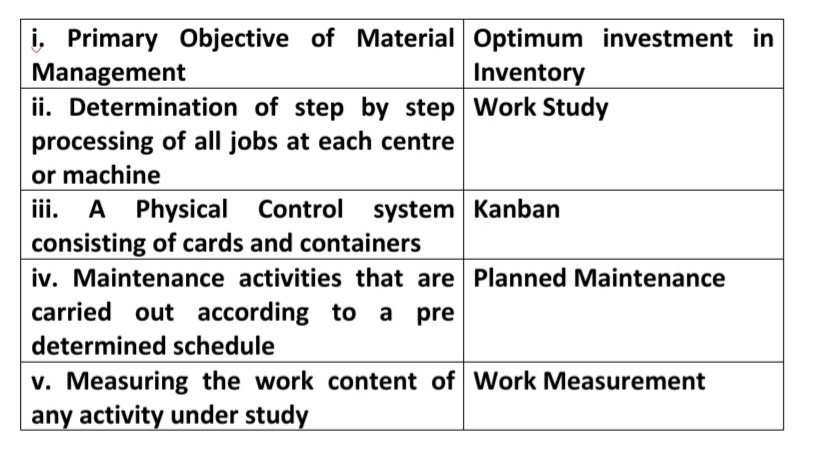
B. Choose the right answer (5)
i. Equipment oriented system of material handling consist of:
a. Manual System
b. Transferring System
c. Conveyor System
d. Bulk Handling System
Answer- c. Conveyor System
ii. JIT concept was implemented by :
a. General Electric Co.
b. Mc. Donald
c. Toyota Motors Co.
d. General Motors
Answer- c. Toyota Motors Co.
iii. Assignment of Jobs to various work centres or machines for future processing:
a. Sequencing
b. Expediting
c. Scheduling
d. Loading
Answer- c. Scheduling
iv. Basic Codification System includes:
a. Alpha- Numeric System
b. Factor rating
c. Point System
d. None of these
Answer- a. Alpha- Numeric System
v. Technology which uses computers for designing and development of new products:
a. MRP
b. Multimedia
c. Ergonomics
d. Computer Aided Design
Answer- d. Computer Aided Design