Table of Contents
Q.1. What is Material Handling? List and briefly explain any five material handling equipment. (3+7=10)
Material Handling is the process of moving goods and materials short distances within a building, factory, facility, or warehouse.
Or
Material Handling refers to activities, equipment, and procedures related to the moving, storing, protecting and controlling of materials in a system.Material handling includes a wide range of different types of materials, ranging from tiny boxes to large and heavy components for manufacturing. To conduct this process of material handling, there is a wide range of material handling equipment.
The types of equipment range from:
● Manual
● Semi-automated
● Automated equipment
Material Handling Equipment are –
1. Hand trucks
This is a simple, two-wheel hand-operated truck or trolley, usually with a metallic frame and a toe-plate. Hand trucks are designed to ease the transportation of small items. Some come in a folding variety that packs flat when not in use.
2. Pallet jacks
A pallet jack, truck or pump is used to transport materials that have been stacked on pallets. These jacks have twin forks, which slide under the pallet. The handle is then used to raise the forks with a pumping force, creating a hydraulic action that lifts the pallet, and enables transportation.
3. Walkie stackers
A walkie stacker is the next stage up from a pallet jack or truck. The basic design is the same, except that the stacker is motorized. The ‘truck’ aspect of the walkie stacker is similar to the fork alignment and design of a forklift truck. The whole assembly can be moved around by hand, and pallets can be lifted to the second shelf of a warehouse stacking system. They are ideal for small capacity items, indoor use and on concrete floors. Walkie stackers are also less expensive than forklift trucks.
4. Order Picker
The order picker is a small-sized forklift truck that’s larger than a walkie stacker and is capable of bearing more weight. Order pickers can typically retrieve and replace stacked items from heights of between 10 – 30 feet.
5. Side loader
Side loaders are used to load and unload from the side of the machine, as opposed to the front-positioned forks of a standard forklift. Side loaders are best used in narrow aisles and doorways, but they are not as manoeuvrable as forklifts.
6. Conveyor belts
A conveyor belt is a motor-driven belt that forms part of a conveyor system. Items that require transportation are simply placed on one end of the belt, and the motorized system moves them to their destination.
7. Reclaimers
A machine that has a rotating scoop at one end of a conveyor system. The scoop gathers up small, loose items and places them on the conveyor belt. The items are then transported along the belt until they reach their destination.
8. Bucket elevators
Also called a grain leg, a bucket elevator is used to transport small, loose items vertically. It is usually a motorized device, but can be hand-cranked as well. A series of small buckets are attached to a belt. The buckets scoop up the materials when at the bottom of the belt, then lift and disperse the materials at the top. Some bucket elevators may be inclined.
9. Hoppers
Another device for handling small, loose items, a hopper is basically a large funnel. The items are placed in the top of the hopper, and gravity moves them down to the bottom, which features a narrow aperture, which allows for flow control. The only disadvantage with hoppers is that they can become blocked fairly easily.
10. Manual Handling Equipment
Commonly used to assist in moving smaller loads where larger equipment would struggle, manual handling equipment such pallet trucks, trolleys and sack trucks can be an essential part of any material handling.
11. Yard ramp
A yard ramp, sometimes called a mobile yard ramp, is a movable metal ramp for loading and unloading of vehicles. A yard ramp is placed at the back of a vehicle to provide access for forklifts to ascend the ramp. Using a yard ramp for vehicle loading or unloading allows the work to be carried out by a forklift.
12. Cranes
Cranes are used to transport loads over variable (horizontal and vertical) paths within a restricted area and when there is insufficient (or intermittent) flow volume such that the use of a conveyor cannot be justified. Cranes provide more flexibility in movement than conveyors because the loads handled can be more varied with respect to their shape and weight. Cranes provide less flexibility in movement than industrial trucks because they only can operate within a restricted area.
Q.2. Effective operational layout can help in better selection of material handling equipment. Comment
Relationship between operational layout and Material Handling Equipment
There is a close connection between the concepts of plant layout and material handling. A good plant structure can ascertain the least material handling process and inexpensive material handling the equipment.
The material handling factors to be considered while designing the plant layout are:
1) Excessive material movement damages the materials and causes loss of valuable man-hours in shifting materials. A layout should be designed such that it suits the manufacturing requirement of the products and reduces the material handling to a minimum.
2) If the workers are compelled to search through the entire workshop for a particular material, their productive time is bound to go wasted. For maximum utilization of their time the plant should be equipped with:
a) Identified and well-named functional areas.
b) Distinct areas for raw materials, tools, work-in-process, inspection, and finished goods.
3) For an effective and speedy movement of materials there should be an effective use of:
a) Bins, trolleys, racks, and trays to keep materials instead of placing them on floors
b) Proper packaging techniques before dispatching
c) Conveyors, chutes, inclined planes, and gravity feed bins to automate, materials movement.
4) Public utilities should be located at easily accessible distances and should not require distant walks on part of the workers.
5) Economical use of space should be aimed. Machines and equipment should be placed in such a way that there is a minimal or no wastage of space and yet there should be an optimum choice for expansion.
6) Maximum opportunity for a greater width of aisles, heights of ceilings and other areas of storage so the need for later alterations will be reduced.
A good plant layout thus facilitates an efficient material handling system. It offers minimum material handling by making material movements shorter, faster and economical. Overcrowding is prevented. Delays in supplying are avoided due to smooth manufacturing activity and hence it is generally desirable to adopt a good plant layout that facilities minimum handling.
OR
An auto industry purchases spark plugs @ ₹25 per piece. The annual consumption of spark plug is 18000 (in no.). If the ordering cost is ₹250 per order and carrying cost is 25% per annum, what would be the Economic Order Quantity? (10)
Given,
Annual Required Unit (RU) – 18,000
Inventory Unit Cost (UC) – ₹25 per unit
Ordering cost (OC) – ₹250 per unit
Carrying Cost (CC) – 25% of unit cost
Hence,
EOQ = √(2×RU×OC)/(UC×CC%)
= √(2×18,000×250)/(25×25%)
= √90,00,000/6.25
= √14,40,000
= 1200
Hence EOQ = 1200
Q.3. Define Method study. What are the factor that forces an organisation to conduct method study?(2+8=10)
Method Study may be defined as:
“A procedure for examining the various activities associated with the problem which ensures a systematic, objective and critical evaluation of the existing factors and in addition and imaginative approach while developing improvements”.
means..
Method study is the process of subjecting work to systematic, critical scrutiny to make it more effective and/or more efficient. It is one of the keys to achieving productivity improvement.
Steps Involved in Methods Study
The basic approach to method study consists of the following eight steps.
1. SELECT the work to be studied and define its boundaries.
2. RECORD the relevant facts about the job by direct observation and collect such additional data as may be needed from appropriate sources.
3. EXAMINE the way the job is being performed and challenge its purpose, place sequence and method of performance.
4. DEVELOP the most practical, economic and effective method, drawing on the contributions of those concerned.
5. EVALUATE different alternatives to developing a new improved method comparing the cost- effectiveness of the selected new method with the current method with the current method of performance.
6. DEFINE the new method, as a result, in a clear manner and present it to those concerned, i.e., management, supervisors and workers.
7. INSTALL the new method as a standard practice and train the persons involved in applying it.
8. MAINTAIN the new method and introduce control procedures to prevent a drifting back to the previous method of work.
Factor that forces an organisation to conduct method study
Method study is a continuous activity and must be used at definite intervals of time to ensure the good health of an organization, as we know that prevention is better than cure.
However, there are certain organizations which may need the immediate use of Method study. Here are such factors, whose presence can warrant the need for an immediate application of Method Study:
1. Dissatisfaction among the clients/Beneficiaries.
2. Escalating operating costs.
3. Low morale of the staff .
4. Lack of discipline among the employees, visible through late comings, not available during the office hours etc.
5. Operating costs-running higher than normal or gradually increasing
6. High wastage-poor use of materials, machinery, labour, space and services
7. Excessive movement and backtracking ions, handling of materials and men
8. Existence of production bottlenecks
9. Excessive overtime
10. Excessive rejections and reworks
11. Complaints about quality
12. Complaints from workers-poor working condition of heavy job etc.
There are certain factors which are to be taken into account while selecting the work for method study:
(1) Economic factors:
Only those jobs are selected which keep good economic importance. Jobs involving bottlenecks which hold up other production operations, operations involving repetitive work etc. are the works that are investigated and studied.
(2) Technical factors:
Availability of the technical knowledge with which study is to be carried out is an important consideration that is to be kept in mind while selecting the job. Take an example of a machine tool which in not running at a speed at which the efficiency is maximum.So, study will say that speed should be increased but, can the tool be speeded up or in the machine structure able to take up this increased load are the questions which always comes in mind while selecting the job to be studied.
(3) Human considerations:
Human reactions are always very difficult to predict. So, the experience of local personnel and conditions will reduce the problems. So, if the works selected involves the unpleasant features like dirty jobs or lifting of heavy weight are readily accepted by the workers.
OR
Write an essay on recycling and disposal of water.(10)
Recycling is the process of collecting and processing materials that would otherwise be thrown away as trash and turning them into new products. Recycling can benefit your community and the environment.
Recycling is the process of converting waste materials into new materials and objects. The recyclability of a material depends on its ability to reacquire the properties it had in its virgin or original state.
Recycling is a key component of modern waste reduction and is the third component of the “Reduce, Reuse, and Recycle”.All water is recycled and reused as a part of natural water processes such as the hydrologic cycle.
Man-made water recycling, also known as water reclamation or water reuse, centers on using treated wastewater.
Recycling wastewater can extend water supplies, improve water quality, reduce discharge and disposal costs of wastewater, and save energy.
Water Recycling
Cities, farms, and industries are using recycled water as an alternative for a wide variety of not-potable and potable uses (treated drinking water for consumption). Non-potable uses include:
● landscape and crop irrigation
● stream and wetlands enhancement
● industrial processes
● recreational lakes, fountains and decorative ponds
● toilet flushing and gray water applications
● as a barrier to protect groundwater supplies from seawater intrusion
● wetland habitat creation, restoration, and maintenance
● groundwater rechargeUsing recycled water for such applications reduces reliance on increasingly scarce and expensive surface water.
It can also minimize groundwater overdraft and reduce discharges of treated wastewater into rivers and oceans.
For different uses of water, there are different levels of treatment. The extent of treatment —secondary, tertiary or advanced —is determined by the initial quality of the water, the end-use application and state laws.
Wastewater disposal, a division of community water management, essentially comprises the collection, removal, treatment and disposal of wastewater.
The most common types of onsite wastewater treatment systems are:
• septic tanks
• aerated wastewater treatment systems (AWTS)
• biological filter systems
• composting toilets (dry and wet)
Q.4. Write short note on any four- (4×5=20)
a. Predictive Maintenance
Predictive maintenance is maintenance that monitors the performance and condition of equipment during normal operation to reduce the likelihood of failures.
Predictive maintenance techniques are designed to help determine the condition of in-service equipment in order to estimate when maintenance should be performed. This approach promises cost savings over routine or time-based preventive maintenance, because tasks are performed only when warranted.
The main promise of predictive maintenance is to allow convenient scheduling of corrective maintenance, and to prevent unexpected equipment failures. The key is “the right equipment lifetime, increased plant safety, fewer accidents with negative impact on environment, and optimized spare parts handling.
Predictive maintenance differs from preventive maintenance because it relies on the actual condition of equipment, rather than average or expected life statistics, to predict when maintenance will be required.
Predictive maintenance evaluates the condition of equipment by performing periodic (offline) or continuous (online) equipment condition monitoring. The ultimate goal of the approach is to perform maintenance at a scheduled point in time when the maintenance activity is most cost-effective and before the equipment loses performance within a threshold.
This results in a reduction in unplanned downtime costs because of failure where for instance costs can be in the hundreds of thousands per day depending on industry.
b. Integrated Inventory Management
Inventory management or control refers to the management of idle resources that have future economic value. Alternatively, Inventory may be defined as usable but idle resources that have economic value.Inventory management is one important aspect of the total management of an enterprise. It is ultimately the responsibility of the top management to achieve trade-offs among marketing, finance, production, and other functions so as to obtain, as far as possible, an optimized and relatively balanced trade-off so as to maximize the overall performance of the enterprise.
Inventory Management refers to maintaining, for a given financial investment, an adequate supply of something to meet an expected demand pattern. It thus deals with the determination of optima policies and procedures for procurement. In business management, inventory consists of a list of goods and materials held or available in stock.Management of inventory or Inventory management is all about handling functions related to the tracking and management of material. Inventory management is very important in the case of Production Oriented Enterprises.
The task of ABC analysis, lot tracking, cycle counting support, etc. can even be a part of inventory management. Inventory control is concerned with minimizing the total cost of inventory.
The three main factors in inventory control decision-making process are:
• The cost of holding the stock (e.g., based on the interest rate).
• The cost of placing an order (e.g., for row material stocks) or the set-up cost of production.
• The cost of shortage, i.e., what is lost if the stock is insufficient to meet all demand.
The third element is the most difficult to measure and is often handled by establishing a “service level” policy, e. g, a certain percentage of demand will be met from stock without delay.
c. Total Quality Management
Total quality management (TQM) is the continual process of detecting and reducing or eliminating errors in manufacturing, streamlining supply chain management, improving the customer experience, and ensuring that employees are up to speed with training.
Total quality management aims to hold all parties involved in the production process accountable for the overall quality of the final product or service.
● Total quality management (TQM) is an ongoing process of detecting and reducing or eliminating errors.
● It is used to streamline supply chain management, improve customer service, and ensure that employees are trained.
● The focus is to improve the quality of an organization’s outputs, including goods and services, through continual improvement of internal practices.
● Total quality management aims to hold all parties involved in the production process accountable for the overall quality of the final product or service.Total quality management benefits and advantages:
● Strengthened competitive position
● Adaptability to changing or emerging market conditions and to environmental and other government regulations
● Higher productivity
● Enhanced market image
● Elimination of defects and waste
● Reduced costs and better cost management
● Higher profitability
● Improved customer focus and satisfaction
● Increased customer loyalty and retention
● Increased job security
● Improved employee morale
● Enhanced shareholder and stakeholder value
● Improved and innovative processes
d. Objective of Material Handling
The primary objective of material handling is to reduce the unit cost of production.Some other objectives are-
1. Reduction in Cost:
Reduction in total cost of production can be achieved by either reducing materials handling or by improved handling procedure or both.
The objective of reduction in cost of production through improved materials handling can be achieved by:
(a) Reducing material handling labour.
(b) Material handling work should not be assigned to skilled or semi-skilled labour.
(c) Reducing indirect labour expenses on activities connected with storage, inspection, quality control, repair, tool room, shipping etc.
(d) Reducing damage of materials during handling.
2. Increase in Capacity:
Improved materials handling system results in increase of capacity by better utilisation of space.
Improved handling system can increase the capacity in the following ways:
(a) By better utilisation of space
(b) By reducing travel space or excessive wastage of space
(c) By improving equipment utilisation
(d) By faster loading or unloading
3. Improvement in Working Conditions:
(a) Safety aspects:
(b) Easy working:
(c) Fool proof operation
4. Improved Customer Service:
Customer’s service will be improved by following proper and improved materials handling system which will enable regular and timely market supply by avoiding disruption in production schedule. These are the main sources of good customer service.
5. Increasing Warehouse Capacity
When materials are not stored correctly in a warehouse, much of the facility is being wasted. This wastage adds to the cost of the product. Focusing on efficient storage in terms of cubic as well as floor space becomes important. Minimizing aisle space is also necessary with respect to increasing the amount of storage space. In both cases effective use of material handling will help to reduce warehousing cost of materials.
6. Improving Layout to Reduce Waste
A complete analysis of the flow of materials between operations, volumes, flow paths and timing is a must for efficient material handling. When space requirements are optimized and travel times reduced through the use of efficient handling systems and equipment, material handling becomes more cost effective. Further, this will lead to enhanced productivity.
7. Optimal Equipment Utilization
Expensive equipment often fails to operate at full potential simply because the material handling system does not permit it to. For example, the rate at which materials are supplied or removed could cause a drop in equipment performance by simply leaving it standing idle. With a proper material handling system in place or more efficient control of an existing system, equipment utilization can soon be maximized.
8. Reduce Cost of Handling– By:
a. Decreasing Inventory level
b. Utilizing space to better advantage
c. Increasing productivity.
9. Reduce delay and damage
10. Maintain or Improve product quality
11. Control Inventory
e. Factors affecting quality standard in manufacturing unit
The nine fundamental factors (9 M’s), which are affecting the quality of products and services, are:
1. Market: Because of technology advancement, we could see many new products to satisfy customer wants. At the same time, the customer wants are also changing dynamically. So, it is the role of companies to identify needs and then meet it with existing technologies or by developing new technologies.
2. Money: The increased global competition necessitates huge outlays for new equipments and process. This should be rewarded by improved productivity. This is possible by minimizing quality costs associated with the maintenance and improvements of quality level.
3. Management: Because of the increased complex structure of business organization, the quality related responsibilities lie with persons at different levels in the organization.
4. Men: The rapid growth in technical knowledge leads to development of human resource with different specialization. This necessitates some groups like, system engineering group to integrate the idea of full specialization.
5. Motivation: If we fix the responsibility of achieving quality with each individual in the organization with proper motivation techniques, there will not be any problem in producing the designed quality products.
6. Materials: Selection of proper materials to meet the desired tolerance limit is also an important consideration. Quality attributes like, surface finish, strength, diameter etc., can be obtained by proper selection of material.
7. Machines and mechanization: In order to have quality products which will lead to higher productivity of any organization, we need to use advanced machines and mechanize various operations.
8. Modern information methods: The modern information methods help in storing and retrieving needed data for manufacturing, marketing and servicing.
9. Mounting product requirements: Product diversification to meet customers taste leads to intricacy in design, manufacturing and quality standards. Hence, companies should plan adequate system to tackle all these requirements.
Q.5. What is work measurement? Explain any five techniques that can be used for work measurement.(2+8=10)
Work measurement may be defined as “the art of observing and recording the time required to do each detailed element of an Industrial activity/operation.”
The term industrial activity includes mental, manual and machining operation, where
(i) Mental time includes time taken by the operator for thinking over some alternative operations.
(ii) Manual time consists of three types of operations i.e. related with handling of materials, handling of tools and handling of machines.
(iii) Machining time includes time taken by the machines in performing the requisite operations.
Thus time study standardizes the time taken by average worker to perform these operations.The essence of work measurement is ascertaining the work content of the particular activity under consideration. It helps in:
● Evaluating worker’s effectiveness
● Making comparison between two methods
● Developing labour standards, for planning and controlling operations.
The estimated time, needed by a qualified worker for carrying out the task, at a normal rate, is known as the standard time. The standard time acts as a benchmark for productivity.
Objectives of Work Measurement:
1. To compare the times of performance by alternative methods.
2. To enable realistic schedule of work to be prepared.
3. To arrive at a realistic and fair incentive scheme.
4. To analyse the activities for doing a job with the view to reduce or eliminate unnecessary jobs.
5. To minimise the human effort.
6. To assist in the organisation of labour by daily comparing the actual time with that of target time.
Techniques of Work Measurement
Work measurement is investigating and eliminating ineffective time. It not only reveals the existence of ineffective time. But it can be used to set standard times for carrying out the work so that ineffective time does not evolve later. It will be immediately found out by the increased standard time. For the purpose of work measurement, work may be regarded as repetitive work and non-repetitive work.The principal techniques of work measurement are
1. Direct Time Study
Direct time study refers to the ascertainment of the time needed to carry out a unit of work. In this method, observation and recording of time is necessary for undertaking each unit of an operation are done, with a view to ascertaining, the actual time, in which the work can be accomplished.
2. Synthesis Method
Synthesis from standard data method synthesizes time standards that are built up or synthesized from element times previously obtained from direct time-study. Most of the organizations that have an independent work study department, build up a synthetic table converting the commoner elements. However, some units also use such time record of other organizations as standard data. For obvious non-commonality of technology, skill, process, and working environments, this type of synthesis may not always be correct.
3. Analytical Estimating
Analytical estimation is normally used in plant maintenance and repair work. This is a compromise between straight rate fixing and time-study. Since maintenance and repair jobs require adequate planning and also because such jobs, by their very nature, call for creativity and innovativeness, it is difficult to enforce straight rate fixing. Analytical estimation is difficult in nature and is also not always fool-proof for the inexperience of the work-study men.
4. Predetermined Motion Time System (PMTS)
Pre-determined motion time standards have been developed for different job elements based on the elementary movement. Usually, for time measurement, work factor and basic motion, times are recorded in any predetermined time standards. Work study analysts use such time-standards as the basis for comparing the observed time of the present workers. This enables the work-study men to quickly decide the efficiency or otherwise of the workers and to make decisions accordingly.
5. Work Sampling or Ratio Delay Method
A work measurement method, Ratio-delay is a sampling technique. Instead of going for the complete job study under ratio-delay techniques, a sufficiently large number of readings are taken at random intervals.Like all other sampling techniques, under this method also there are bound to be some errors. However, since the cost of such study is not much, many organizations which have the expertise prefer this method. Moreover, under this method, because rating is not done and the time is recorded directly using a stopwatch, it encounters no resistance from the workers.
Work measurement techniques helps in preparing realistic work schedules, by proper evaluation of human work. It helps in comparing the actual time taken by the worker, with the time allowed, to keep a check on the workers and avoid idle time.
Q.6. Discuss the importance of inventory management in relation to ensuring smooth operations. Also list any five inventory management techniques. (6+4=10)
Inventory management is a good practice for any company. If you are not keeping a watchful eye on your inventory or counting stock regularly, you are setting yourself up for potential inventory errors and challenges. Proper inventory management really can make or break your business. Keep the following benefits in mind as you weigh the cost of not implementing an inventory management strategy:
1. A good inventory management strategy improves the accuracy of inventory orders.
Proper inventory management helps you figure out exactly how much inventory you need to have on-hand. This will help prevent product shortages and allow you to keep just enough inventory without having too much in the warehouse.
2. A good inventory management strategy leads to a more organized warehouse.
A good inventory management strategy supports an organized warehouse. If your warehouse is not organized, you will have a hard time managing your inventory. Many companies choose to optimize their warehouses by putting the highest selling products together and in easily accessible places in the warehouse. This, in turn, helps speed up the order fulfilment process and keeps customers happy.
3. A good inventory management strategy helps save time and money.
Inventory management can have real-time and monetary benefits. By keeping track of which products you have on-hand or ordered, you save yourself the effort of having to do an inventory recount to ensure your records are accurate. A good inventory management strategy also helps you save money that could otherwise be wasted on slow-moving products.
4. A good inventory management strategy increases efficiency and productivity.
Inventory management devices, such as barcode scanners and inventory management software, can help drastically improve your efficiency and productivity. These devices will help eliminate manual processes so your employees can focus on other – more important – areas of the business.
5. A good inventory management strategy keeps your customers coming back for more.
It’s a fact that good inventory management leads to what you are constantly striving for – repeat customers. If you want your hard-earned customers to come back for your products and services, you need to be able to meet customer demand quickly. Inventory management helps you meet this demand by allowing you to have the right products on-hand as soon as your customers need them.
6. Makes re-ordering easier
Using manual Word docs to copy purchase orders can lead to inaccuracies regarding item numbers, currency exchanges, or item spec descriptions. Good inventory management will enable you to copy recent purchase orders and choose specific item numbers and specs from a simple dropdown menu to help avoid errors.With these benefits, you can see why implementing a solid inventory management system is beneficial to your business operations. Even if your operations are small, automating your inventory management can go a long way in helping your business grow while maintaining manageability. You’ll be able to keep both employees and customers consistently satisfied, while at the same time you can remain happy about how your business runs, without any of the complications that can come with a lack of inventory management.
Inventory management techniques are-
1. ABC ANALYSIS
ABC analysis stands for Always Better Control Analysis. It is an inventory management technique where inventory items are classified into three categories namely: A, B, and C. The items in A category of inventory are closely controlled as it consists of high-priced inventory which may be less in number but are very expensive. The items in B category are relatively lesser expensive inventory as compared to A category and the number of items in B category is moderate so control level is also moderate. The C category consists of a high number of inventory items which require lesser investments so the control level is minimum.
2. JUST IN TIME (JIT) METHOD
In Just in Time method of inventory control, the hotel keeps only as much inventory as it needs during the production process. With no excess inventory in hand, the company saves the cost of storage and insurance. The hotel orders further inventory when the old stock of inventory is close to replenishment. This is a little risky method of inventory management because a little delay in ordering new inventory can lead to stock out situation. Thus this method requires proper planning so that new orders can be timely placed.
3. MATERIAL REQUIREMENTS PLANNING (MRP) METHOD
Material Requirements Planning is an inventory control method in which the organization order the inventory after considering the sales forecast. MRP system integrates data from various areas of the business where inventory exists. Based on the data and demand in the market, the manager would carefully place the order for new inventory with the material suppliers.
4. ECONOMIC ORDER QUANTITY (EOQ) MODEL
Economic Order Quantity technique focuses on taking a decision regarding how much quantity of inventory should the company order at any point of time and when should they place the order. In this model, the store manager will reorder the inventory when it reaches the minimum level. EOQ model helps to save the ordering cost and carrying costs incurred while placing the order. With the EOQ model, the organization is able to place the right quantity of inventory.
5. Maintaining Par levels
Par levels are the minimum amount of product that must be on hand at all times. When the inventory stock dips below the predetermined levels, then it’s time to order more. Make inventory management easier by setting “par levels” for each of the products.
Par levels vary by product and are based on how quickly the item sells and how long it takes to get back in stock. Although setting par levels requires some research and decision-making up front, having them set will systemize the process of ordering.
6. First-In First-Out (FIFO)
“First-in, first-out” is an important principle of inventory management. It means the oldest stock (first-in) gets sold first (first-out), not the newest stock. This is especially important for perishable products so the hotel don’t end up with unsellable spoilage.
It’s also a good idea to practice FIFO for non-perishable products. If the same boxes are always sitting at the back, they’re more likely to get worn out. Plus, packaging design and features often change over time.In order to manage a FIFO system, we will need an organized warehouse. This typically means adding new products from the back, or otherwise making sure old product stays at the front.
7. Regular auditing
Regular reconciliation is vital. In most cases, hotels will be relying on software and reports from store to know how much product is in stock. However, it’s important to make sure the facts match up. There are several methods for doing this.
Q.7. What is maintenance management? Explain the different types of maintenance with suitable example. (2+8=10)
Maintenance management is the process of maintaining a company’s assets and resources. The purpose is to ensure that production proceeds efficiently and that resources are used effectively.
Maintenance management is one of those aspects of managing a company that is usually not explored in depth.
Maintenance management involves keeping track of assets and parts. The purpose is to ensure that production proceeds efficiently and the minimum amount of resources are wasted. This is generally accomplished by a tailored combination of software, practices, and personnel that focus on achieving these goals.
Types of Maintenance
1. Preventive maintenance
Preventive maintenance is the most popular type of proactive maintenance. Preventive maintenance is a type of proactive maintenance that includes adjustments, cleaning, lubrication, repairs, and parts replacements. PM keeps assets in good order and reduces unscheduled downtime and major repairs. However, with preventive maintenance, the organization runs the risk of over-scheduling maintenance tasks because tasks are scheduled based on time rather than actual conditions. That said, preventive maintenance achieves 12% to 18% cost savings over other maintenance.
Ex- Lube chains for critical equipment every seven days.
2. Predictive maintenance
Predictive maintenance is a type of condition-based maintenance that monitors the condition of assets using sensor devices. These sensor devices supply data in real-time, which is used to predict when the asset will require maintenance and prevent equipment failure.
Predictive maintenance is the most advanced type of maintenance currently available. With time-based maintenance, organizations run the risk of performing too much maintenance or not enough.
Ex- A centrifugal pump motor in a coal preparation plant is a vital asset for day-to-day operations. To prevent unscheduled downtime, the maintenance team decides to use predictive maintenance technology.
3. Breakdown Maintenance
Breakdown maintenance is obviously not for every industry. In particular, industries that are directly responsible for people’s safety should never use breakdown maintenance. However, it can be useful when working with disposable, cheap parts or equipment that cannot be repaired by normal means.The bottom line for breakdown maintenance is that it requires planning and coordination—an organization should never allow breakdown maintenance to be exploited or used improperly.
Ex- Maintenance of lift after it has stopped working
4. Scheduled maintenance
Scheduled maintenance is any repair and upkeep work performed within a set timeframe. It details when given maintenance tasks are performed and by whom. Scheduled maintenance may occur at repeating intervals or in response to a work request.
Scheduled maintenance tasks such as routine inspections help detect minor problems before they develop into system failures. By adhering to a regular, well-designed maintenance schedule, maintenance technicians can detect problems early.
Ex- Maintenance of the lift at a given period of interval
5. Planned maintenance
Planned maintenance is work that’s prepared for in advance of it taking place.
Scheduled maintenance is often lumped together with planned maintenance, but the two are actually two separate endeavors. Planned maintenance deals with the processes and materials required to successfully complete needed work, whereas scheduled maintenance handles who performs the work and when.The two go hand in hand, and they rely on one another to make sure maintenance tasks are completed in an efficient manner.
Ex- Changing the oil because the vehicle had gone 3,000 miles is planned maintenance.
6. Routine maintenance
Routine maintenance is a form of time-based maintenance and preventive maintenance, though some organizations differentiate between routine maintenance and preventive maintenance. They use the latter for smaller tasks (i.e. cleaning) performed at higher frequencies (hourly, daily) and the former for larger tasks (i.e. inspections) performed at lower frequencies (weekly, monthly, annually).
Ex- Routine cleaning of the machine.
7. Emergency Maintenance
Emergency maintenance is a type of reactive maintenance that is used to prevent a threat to lives, property, profitability, or viability of an organization.
Ex- A broken water line or flooding.
8. Corrective Maintenance
Corrective maintenance (also called breakdown maintenance) are maintenance tasks that are performed in order to rectify and repair faulty systems and equipment. The purpose of corrective maintenance is to restore broken down systems.
Ex- Service Outages- Restoring services that are down.
OR
ABC company has kept record of breakdown of its machine for 300 day work year, as shown below:
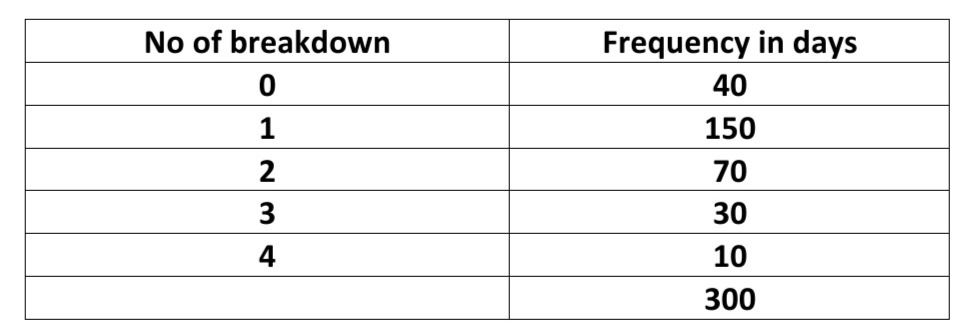
The firm estimates that each breakdown costs ₹650 and is considering adopting a preventive maintenance program which would cost ₹200 per day and limit the no of breakdown to an average of one per day. What is the expected annual saving from preventive maintenance program? (10)
Given,
No. Of days working in year = 300
Breakdown Maintenance cost = ₹650
Preventive maintenance cost = ₹200/day
Hence the total no. of breakdown = (0+150+140+90+40)
= 420
Total breakdown maintenance cost = 420 × 650
= ₹ 2,73,000
Total preventive maintenance cost for 300 days = 200× 300
= ₹ 60,000
After Preventive Maintenance breakdown will be 1 per day then,
Total breakdown maintenance cost = 300 × 650
= ₹ 1,95,000
Hence, total = 60,000 + 1,95,000
= ₹ 2,55,000
So, annual savings = ₹2,73,000 – ₹2,55,000
= ₹ 18,000
Q.8. Define the following: (5×2=10)
a. Economic Order Quantity
Economic order quantity (EOQ) is the ideal order quantity a company should purchase to minimize inventory costs such as holding costs, shortage costs, and order costs. This production -scheduling model was developed in 1913 by Ford W. Harris and has been refined over time. The formula assumes that demand, ordering, and holding costs all remain constant.
EOQ is the purchase order quantity for replenishment that minimizes total inventory costs. The purchase order is triggered when the inventory level hits the reorder point. The EOQ is calculated in order to minimize a combination of costs such as the purchase cost (which may include volume discounts), the inventory holding cost, the ordering cost, etc. The order quantity optimization is complementary to the safety stock optimization that focuses on finding the optimal threshold to trigger the reorder.
The EOQ is a company’s optimal order quantity that minimizes its total costs related to ordering, receiving, and holding inventory.
The EOQ formula is best applied in situations where demand, ordering, and holding costs remain constant over time.
Formula and Calculation of Economic Order Quantity (EOQ)
EOQ = √(2×RU×OC)/(UC×CC%)
where:
RU= Required units (typically on an annual basis)
OC =Order cost (per purchase order)
UC = Unit Cost
CC = Carrying Cost
b. Carrying cost
Carrying costs, also known as holding costs and inventory carrying costs, are the costs a business pays for holding inventory in stock. A business can incur a variety of carrying costs, including taxes, insurance, employee costs, depreciation, the cost of keeping items in storage, the cost of replacing perishable items, and opportunity costs. Even the cost of capital that helps to generate income for the business is a carrying cost.
Carrying costs are also sometimes referred to as the carrying costs of inventory.
A company pays various costs over time for holding and storing inventory before it is sold and shipped to customers. Businesses calculate these costs to evaluate the level of profit they can reasonably expect on their current inventory. It is also useful in determining whether a company should increase or decrease the production of goods.
By knowing its carrying costs, a business can stay on top of expenses and continue to generate a steady income stream.
● Carrying costs are the various costs a business pays for holding inventory in stock.
● Examples of carrying costs include warehouse storage fees, taxes, insurance, employee costs, and opportunity costs.
● Businesses can reduce their carrying costs by implementing efficient warehouse design and by using computerized inventory management systems to keep track of inventory levels.
c. Routing
Routing means determination of the route to be followed by each part/component being transformed from input/raw material into final product.”Where one single part/product is produced by fixed set of machines the job of routing becomes automatic or mechanized. In continuous production systems with line type or product type layout, no managerial effort is required for routing though different sets of machines may be utilized in manufacturing the products in such systems.
For different types of products to be manufactured like in intermittent production system, routing becomes a complex task.
Routing of a production order contains complete information of the product to be manufactured, complete details of each operation to be performed, the set up time and the standard time needed for completing the job/product.
Advantages of Routing:
(i) Effective utilization of available resources.
(ii) Reduction in production costs.
(iii) Quality improvement occurs,
(iv) Productivity of the system improves and
(v) Provides a basis for loading & scheduling.
Routing in continuous/mass manufacturing does not present any problem due to product type of layout, where the machines are arranged according to the sequence of operations which are to be performed on the components. In view of the standardized products, the number of operations and their sequence can be standardized.
d. Scheduling
Scheduling can be defined as “prescribing of when and where each operation necessary to manufacture the product is to be performed.” It is also defined as “establishing of times at which to begin and complete each event or operation comprising a procedure”.
The principle aim of scheduling is to plan the sequence of work so that production can be systematically arranged towards the end of completion of all products by due date.
Principles of Scheduling
1. The principle of optimum task size: Scheduling tends to achieve maximum efficiency when the task sizes are small, and all tasks of same order of magnitude.
2. Principle of optimum production plan: The planning should be such that it imposes an equal load on all plants.
3. Principle of optimum sequence: Scheduling tends to achieve the maximum efficiency when the work is planned so that work hours are normally used in the same sequence.
e. Logistics Management
Logistics management may be defined as follows:
Logistics management consists of the process of planning, implementing and controlling the efficient flow of raw-materials, work-in-progress and finished goods and related information-from point of origin to point of consumption; with a view to providing satisfaction to the customer.
Logistics (or Logistical Activities) may be Broadly Classified into Two Categories:
I. Inbound logistics; which is concerned with the smooth and cost effective inflow of materials and other inputs (that are needed in the manufacturing process) from suppliers to the plant. For proper management of inbound logistics, the management has to maintain a continuous interface with suppliers (vendors).
II. Outbound logistics (also called physical distribution management or supply chain management); is concerned with the flow of finished goods and other related information from the firm to the customer. For proper management of outbound logistics, the management has to maintain a continuous interface with transport operators and channels of distribution.
Objectives of Logistics Management:
Logistics management is significant for the following reasons:
(i) Cost Reduction and Profit Maximization
(ii) Efficient Flow of Manufacturing Operations
(iii) Competitive Edge
(iv) Effective Communication System
(v) Sound Inventory Management
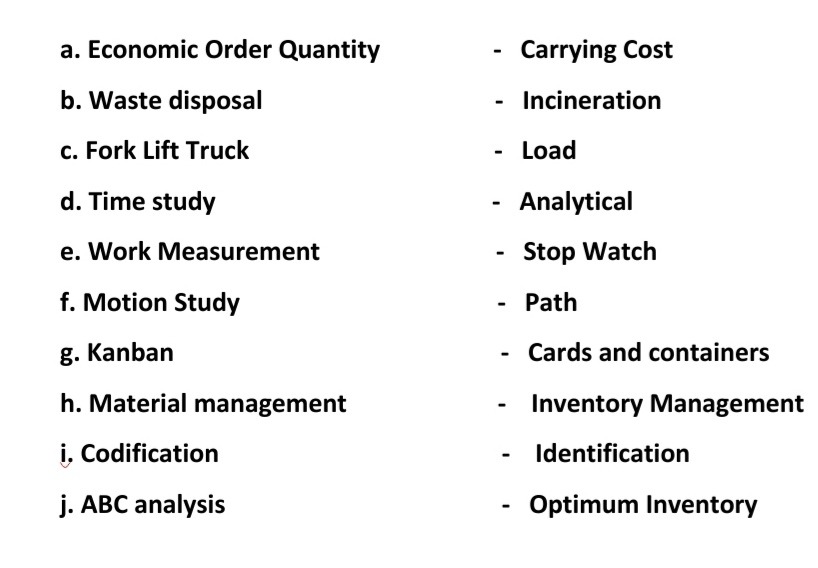
Q.9. Match the following (10×1=10)
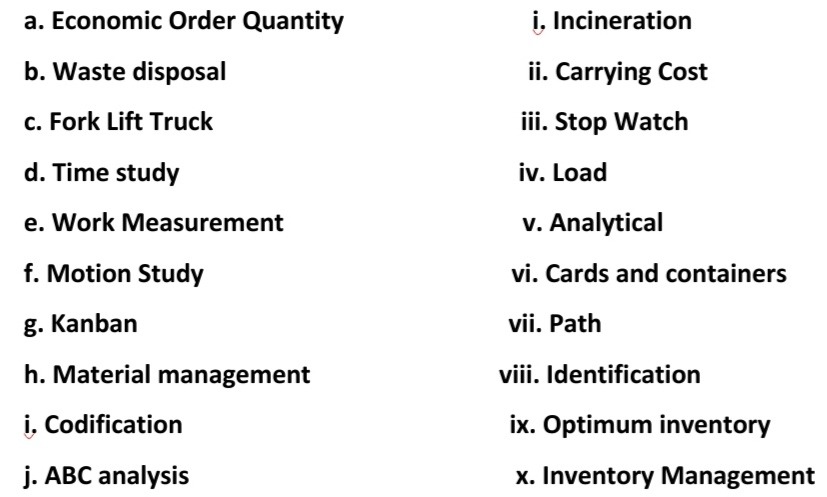
Answer-