
Table of Contents
Q.1. Define Tourism. What are the various components of Tourism? State different purposes for which people undertake Tourism.
Tourism is a multifaceted industry that encompasses various aspects of traveling for leisure, business, or other purposes. It involves people traveling from one place to another outside their usual environment for a limited time with the intention of experiencing new cultures, landscapes, and activities. The primary aim of tourism is to provide entertainment, relaxation, and education to travelers while also boosting local economies and promoting cultural exchange.
Components of Tourism:
- Accommodation: This refers to the lodging facilities available for tourists such as hotels, motels, resorts, guesthouses, and camping sites.
- Transportation: This includes the various modes of transport available to tourists such as air, water, and land transportation.
- Attractions: These are the main reasons why tourists travel to a particular destination. They include natural wonders, historical sites, cultural events, theme parks, and entertainment facilities.
- Tourism Services: These are the services provided to tourists to make their travel experience comfortable and convenient. They include tour guides, travel agents, insurance, and currency exchange services.
- Activities: These are the various activities available to tourists at their destination, such as adventure sports, cultural experiences, and outdoor activities.
Purposes of Tourism:
- Leisure and Recreation: Tourism offers people the opportunity to escape from their daily routines and engage in leisure activities such as sightseeing, adventure sports, and relaxing on a beach.
- Business: Business tourism involves people traveling for business purposes such as attending conferences, seminars, or meetings.
- Education: Tourism can also serve an educational purpose, allowing people to learn about new cultures, languages, and history.
- Religious Pilgrimages: Tourism also caters to religious tourism, where people travel to religious sites for spiritual and religious purposes.
- Health and Wellness: Medical tourism is also a popular form of tourism where people travel to a destination for medical treatment, wellness, or spa retreats.
- Cultural Exchange: Tourism can also promote cultural exchange by enabling people to learn about different cultures, customs, and traditions.
In conclusion, tourism is a vital industry that contributes significantly to the global economy while providing travelers with diverse and unique experiences. The components of tourism include accommodation, transportation, attractions, tourism services, and activities, while the different purposes of tourism include leisure and recreation, business, education, religious pilgrimages, health, and wellness, and cultural exchange. The growth of tourism continues to shape the world’s economies and cultures, making it an exciting and dynamic industry to explore.
OR
What is a Hotel? Write a note on evolution of hotel industry around the world.
A hotel is a commercial establishment that provides lodging, meals, and other services to travelers and tourists. Hotels typically offer a range of room types, from basic to luxury, along with amenities such as restaurants, bars, swimming pools, fitness centers, and conference rooms.
The hotel industry has evolved significantly over the years, with various types of lodging establishments emerging to meet the changing needs and preferences of travelers. Here is a brief overview of the evolution of the hotel industry around the world:
- Ancient Times: In ancient civilizations such as Greece and Rome, travelers could find lodging in inns, which were basic establishments that provided food and shelter. In Asia, caravanserais served as a place for merchants and travelers to rest and recuperate during long journeys.
- Middle Ages: During the Middle Ages, religious organizations such as monasteries and convents provided lodging for travelers. These establishments were often the only option for travelers, as they offered safety and security in an era of lawlessness and insecurity.
- Renaissance and Enlightenment: With the rise of the Renaissance and Enlightenment eras, travel became more popular among the aristocracy and wealthy merchants. This led to the development of the first luxury hotels, such as the Ritz in Paris and the Savoy in London.
- Industrial Revolution: The Industrial Revolution brought about significant changes in the hotel industry, as mass transportation made travel more accessible to the middle class. This led to the emergence of chain hotels, such as Hilton and Marriott, which offered standardized services and amenities across multiple locations.
- Post-World War II: In the post-World War II era, the hotel industry saw rapid growth, with the rise of international tourism and business travel. This led to the development of large, luxury hotels and resorts in popular tourist destinations around the world.
- Digital Age: With the advent of the internet and online booking platforms, the hotel industry has undergone another transformation. Today, travelers can easily research and book hotels online, and many hotels have embraced technology to enhance the guest experience, with features such as mobile check-in, keyless room entry, and personalized services.
In conclusion, the hotel industry has undergone significant changes over the years, adapting to the changing needs and preferences of travelers. From basic inns to luxury hotels and resorts, the hotel industry continues to evolve, with technology playing an increasingly important role in enhancing the guest experience.
Q.2. Classify types of hotel. Explain clientele based hotels in brief.
Hotels can be classified based on various criteria, including size, location, target market, and amenities. Here are some of the most common types of hotels:
- Luxury Hotels: These are high-end hotels that offer the highest level of service and amenities, such as gourmet restaurants, spas, and 24-hour room service. Examples include the Four Seasons and the Ritz-Carlton.
- Boutique Hotels: These are smaller, unique hotels that offer a more personalized experience, often with a focus on design and style. Examples include the Ace Hotel and the Kimpton Hotel.
- Resort Hotels: These are hotels located in vacation destinations, offering a wide range of amenities and activities such as golf, tennis, water sports, and entertainment. Examples include the Atlantis Resort in the Bahamas and the Ritz-Carlton in Maui.
- Business Hotels: These are hotels located in business districts, catering to business travelers with amenities such as conference rooms, business centers, and high-speed internet access. Examples include the Hilton and the Marriott.
- Airport Hotels: These are hotels located near airports, offering convenience to travelers with early morning or late night flights. Examples include the Sheraton and the Hyatt.
- Budget Hotels: These are low-cost hotels that offer basic accommodations and services, catering to travelers on a budget. Examples include Motel 6 and Super 8.
- Clientele-Based Hotels: These are hotels that cater to specific types of travelers based on their interests, lifestyle, or demographics. Examples include:
a. Family-Friendly Hotels: These are hotels that cater to families with children, offering amenities such as pools, playgrounds, and family suites. Examples include the Holiday Inn and the Best Western.
b. Pet-Friendly Hotels: These are hotels that allow pets to stay with their owners, offering amenities such as pet beds, food bowls, and dog-walking services. Examples include the Kimpton Hotel and the Westin.
c. Health and Wellness Hotels: These are hotels that offer fitness and wellness amenities such as gyms, spas, and healthy dining options. Examples include the Canyon Ranch and the Mandarin Oriental.
d. LGBT-Friendly Hotels: These are hotels that cater to the LGBT community, offering amenities such as rainbow flags, LGBT-themed events, and inclusive policies. Examples include the Axel Hotels and the W Hotels.
e. Women-Only Hotels: These are hotels that cater to women travelers, offering amenities such as female-only floors, women-only lounges, and safety features such as secure entrances and 24-hour security. Examples include the Dukes Hotel and the Naumi Hotel.
Clientele-based hotels cater to specific groups of travelers, offering tailored amenities and services to meet their unique needs and preferences. These types of hotels have become increasingly popular in recent years, as travelers seek out more personalized experiences. Whether it’s a family-friendly hotel or a pet-friendly hotel, clientele-based hotels offer a way for travelers to connect with like-minded individuals and create lasting memories.
OR
What are types of location based hotel? Describe any four location based hotels on given parameters – Location, Clientele, Room Rate, Duration of say, Atmosphere, Services offered.
Location-based hotels are hotels that are classified based on their geographical location. These hotels are often situated in areas with unique natural or cultural attractions that draw tourists. Here are some of the most common types of location-based hotels:
- Beach Resorts: These hotels are located on or near beaches, offering guests access to sun, sand, and water activities. The clientele for beach resorts are typically families, couples, and leisure travelers. Room rates for beach resorts can vary widely depending on the location and the level of luxury. Duration of stay can range from a few days to several weeks. The atmosphere at beach resorts is typically relaxed and laid-back, with a focus on outdoor activities and relaxation. Services offered at beach resorts often include water sports, beach chairs and umbrellas, spa treatments, and entertainment.
Example: The Ritz-Carlton, Laguna Niguel, located in Dana Point, California, is a luxury beach resort that caters to families, couples, and leisure travelers. Room rates range from $600 to $2,000 per night, depending on the type of room and season. The average duration of stay is three to four days. The atmosphere is casual yet refined, with a focus on outdoor activities such as surfing, paddleboarding, and beach yoga. Services offered include a full-service spa, oceanfront dining, and a children’s program.
- Mountain Lodges: These hotels are located in or near mountains, offering guests access to outdoor activities such as hiking, skiing, and snowboarding. The clientele for mountain lodges are typically outdoor enthusiasts, families, and adventure travelers. Room rates for mountain lodges can vary widely depending on the location and the level of luxury. Duration of stay can range from a few days to several weeks. The atmosphere at mountain lodges is typically rustic and cozy, with a focus on outdoor activities and relaxation. Services offered at mountain lodges often include guided hikes, ski rentals, and spa treatments.
Example: The Ahwahnee Hotel, located in Yosemite National Park, is a historic mountain lodge that caters to outdoor enthusiasts, families, and adventure travelers. Room rates range from $400 to $700 per night, depending on the type of room and season. The average duration of stay is three to four days. The atmosphere is rustic and cozy, with a focus on outdoor activities such as hiking and skiing. Services offered include guided hikes, bike rentals, and a full-service spa.
- City Hotels: These hotels are located in the heart of cities, offering guests access to cultural attractions, shopping, and dining. The clientele for city hotels are typically business travelers, couples, and tourists. Room rates for city hotels can vary widely depending on the location and the level of luxury. Duration of stay can range from a few days to several weeks. The atmosphere at city hotels is typically bustling and urban, with a focus on exploring the city. Services offered at city hotels often include concierge services, business centers, and transportation options.
Example: The Mandarin Oriental, located in New York City, is a luxury city hotel that caters to business travelers, couples, and tourists. Room rates range from $600 to $2,000 per night, depending on the type of room and season. The average duration of stay is three to four days. The atmosphere is bustling and urban, with a focus on exploring the city. Services offered include a full-service spa, a fitness center, and a rooftop bar.
- Safari Lodges: These hotels are located in or near wildlife reserves or national parks, offering guests access to wildlife and nature. The clientele for safari lodges are typically adventure travelers, wildlife enthusiasts, and families. Room rates for safari lodges can vary widely depending on the location and the level of luxury. Duration of stay can range from a few days to several weeks. The atmosphere at safari lodges is typically immersive and adventurous, with a focus on wildlife and nature. Services offered at safari lodges often include game drives, guided bush walks, and cultural experiences.Example: The Singita Grumeti Reserves, located in Tanzania, is a luxury safari lodge that caters to adventure travelers, wildlife enthusiasts, and families. Room rates range from $1,500 to $5,000 per night, depending on the type of room and season. The average duration of stay is four to five days. The atmosphere is immersive and adventurous, with a focus on wildlife and nature. Services offered include game drives, guided bush walks, cultural experiences, and a full-service spa.In summary, location-based hotels are an excellent way to experience the unique attractions and offerings of a particular area. Beach resorts, mountain lodges, city hotels, and safari lodges are just a few examples of the types of location-based hotels available to travelers. When choosing a location-based hotel, it’s essential to consider factors such as the clientele, room rates, duration of stay, atmosphere, and services offered to ensure that it meets your needs and expectations.
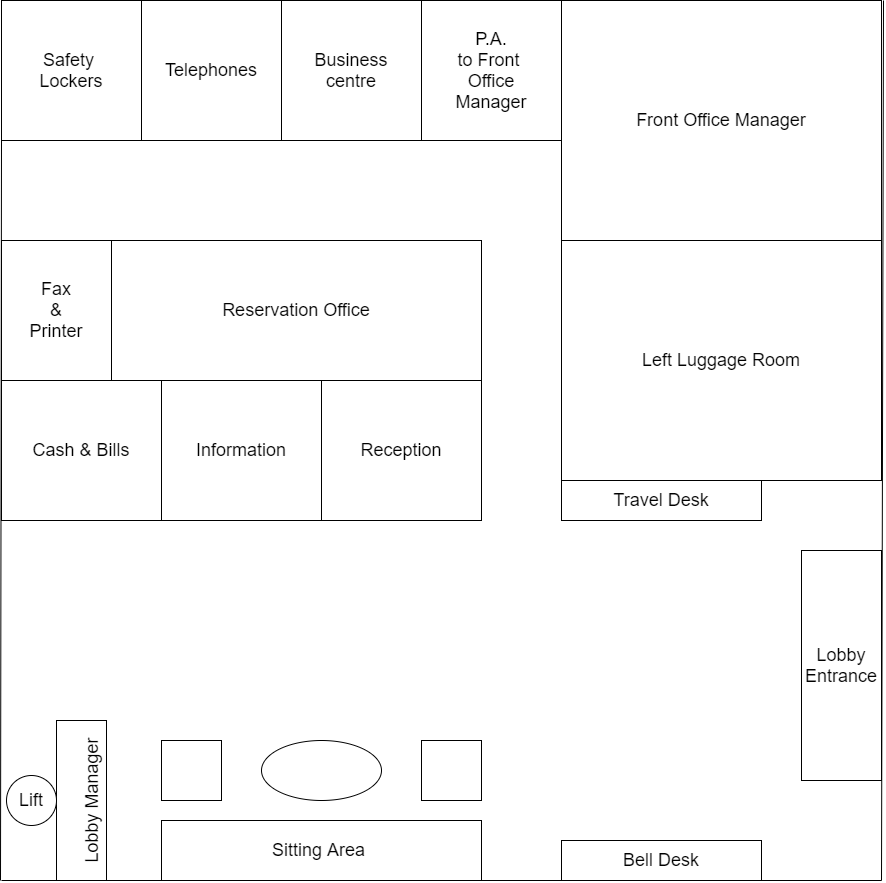
Q.3. Draw a neat lobby lay-out of a five star business hotel.
Q.4. Define the following (any five):
(a) Suite room
A suite room is a large, luxurious room that is designed to provide guests with ample space and comfort. Suite rooms typically include a separate sitting area, a bedroom, and a bathroom. They may also have additional amenities such as a kitchenette, a balcony, or a private pool.
(b) Cabana room
A cabana room is a type of room that is located near a pool or beach area and typically has direct access to the pool or beach. Cabana rooms often include a small sitting area, a bathroom, and an outdoor space such as a patio or terrace.
(c) Condominium
A condominium is a type of accommodation that is typically larger than a standard hotel room and includes a fully equipped kitchen, a living area, and one or more bedrooms. Condominiums are often rented out to guests for extended periods of time and may offer additional amenities such as a fitness center or swimming pool.
(d) Adjoining room
Adjoining rooms are two hotel rooms that are located next to each other and connected by a door. Adjoining rooms are often booked by families or groups who want to stay close to each other but still have their own separate rooms.
(e) Hospitality room
A hospitality room is a space that is used for hosting events or meetings. Hospitality rooms may be located within a hotel or conference center and often include amenities such as a large table, chairs, and audio-visual equipment.
(f) Boutique hotel
A boutique hotel is a small, stylish hotel that offers personalized service and unique amenities. Boutique hotels are often independently owned and have a distinct character or theme that sets them apart from larger chain hotels.
(g) Heritage grand
A heritage grand hotel is a type of hotel that is located in a historic building that has been restored and renovated to preserve its original character and architectural features. Heritage grand hotels often offer luxurious accommodations and high-end amenities, with a focus on preserving the building’s cultural and historical significance.
Q.5. Define Front Office. Explain the various functional areas of Front Office.
The front office is the area of a hotel or hospitality establishment that is responsible for guest service and customer-facing interactions. It is often the first point of contact that a guest has with the hotel and is therefore critical in creating a positive guest experience. In this section, we will discuss the various functional areas of the front office and their roles.
- Reception: The reception area is the first point of contact for guests, and it is responsible for greeting guests, checking them in, and handling their requests and inquiries. The receptionist is responsible for verifying guest information, assigning rooms, and issuing room keys.
- Reservations: The reservations department is responsible for receiving and processing room reservations, handling cancellations, and managing waitlists. They must have a thorough understanding of the hotel’s room inventory, pricing policies, and guest preferences.
- Cashier: The cashier is responsible for processing guest payments, maintaining accurate records of financial transactions, and managing the hotel’s cash flow. The cashier must be knowledgeable about the hotel’s billing policies, credit card processing, and currency exchange rates.
- Concierge: The concierge is responsible for providing information and assistance to guests, such as arranging transportation, booking restaurant reservations, and recommending local attractions. They must have a thorough understanding of the hotel’s facilities and services as well as the surrounding area.
- Bell desk: The bell desk is responsible for handling guests’ luggage, providing directions, and arranging transportation. They must be knowledgeable about the hotel’s layout and facilities, as well as the surrounding area.
- Guest relations: The guest relations department is responsible for ensuring that guests have a positive experience during their stay, addressing any complaints or issues that arise, and providing personalized service. They must have excellent communication and problem-solving skills.
- Telephone operator: The telephone operator is responsible for answering incoming calls, transferring calls to the appropriate department, and taking messages. They must have a friendly and professional phone manner, as well as a thorough understanding of the hotel’s facilities and services.
- Business center: The business center is responsible for providing guests with access to computers, printers, and other office equipment. They may also offer secretarial and administrative services, such as printing documents or making photocopies.
In summary, the front office is a critical area of a hotel or hospitality establishment responsible for providing excellent guest service and managing customer-facing interactions. The functional areas of the front office include reception, reservations, cashier, concierge, bell desk, guest relations, telephone operator, and business center. Each department plays a crucial role in ensuring that guests have a positive experience during their stay.
OR
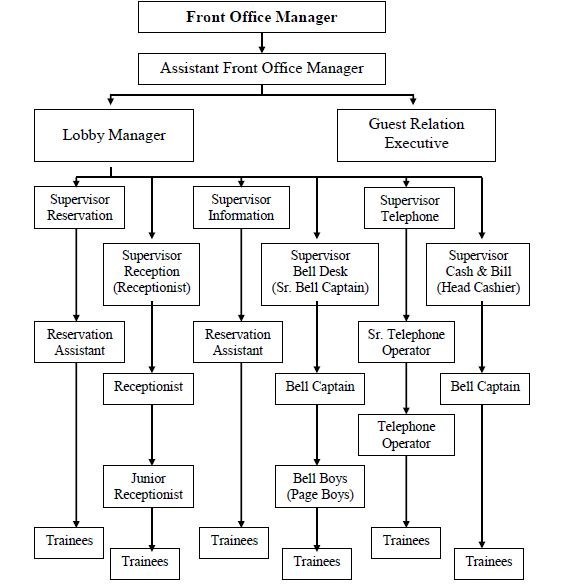
Draw an organisational chart of five star hotel in India.
Q.6. What is Time Share in Hotels? Classify their types. Explain any two with example.
Time share in hotels refers to a type of vacation property ownership in which multiple owners share ownership of a single unit or set of units. Each owner typically has the right to use the unit for a certain period of time each year, often one or two weeks. Time share arrangements are popular among those who want the benefits of owning a vacation property without the hassle and expense of full-time ownership.
Types of time share:
- Fixed week: This type of time share gives owners the right to use the same unit for the same week each year, typically during a specific season. For example, an owner might have the right to use a beachfront condo during the third week of July each year.
- Floating week: This type of time share gives owners more flexibility in choosing their vacation time. Instead of a set week each year, owners have the right to use the unit for a certain number of days or weeks each year, within a certain time frame.
- Points-based: This type of time share gives owners a certain number of points each year, which they can use to reserve time at various properties within the time share network. The number of points required to reserve a particular unit or time period may vary depending on factors such as location, size, and time of year.
Two examples of timeshare arrangements are:
- Marriott Vacation Club: Marriott Vacation Club operates a points-based time share program with properties around the world. Owners purchase points that can be used to reserve time at various Marriott Vacation Club properties, which range from studio units to multi-bedroom villas. Owners can choose when and where they want to vacation based on availability and the number of points they have.
- Disney Vacation Club: Disney Vacation Club operates a points-based time share program with properties at various Disney resorts, including Walt Disney World in Florida, Disneyland in California, and Aulani in Hawaii. Owners can use their points to reserve time at any of these properties, as well as exchange their points for stays at other time share properties around the world.
In summary, time share in hotels refers to a type of vacation property ownership in which multiple owners share ownership of a single unit or set of units, typically for a certain period of time each year. The three main types of time share are fixed week, floating week, and points-based. Examples of time share programs include Marriott Vacation Club and Disney Vacation Club.
Q.7. Explain the duties and responsibilities of the following (any two):
(a) Lobby Manager
The lobby manager is responsible for ensuring smooth and efficient operations of the hotel lobby. Some of the duties and responsibilities of a lobby manager are:
- Supervising and managing the front desk, concierge, and bell staff to ensure guest needs are met promptly and efficiently.
- Ensuring that the lobby and reception area are clean, tidy, and welcoming to guests.
- Providing assistance to guests with check-in and check-out procedures, room changes, and any other special requests.
- Managing the lobby budget, including staffing, equipment, and supplies.
- Ensuring compliance with hotel policies and procedures, as well as local laws and regulations.
- Resolving any guest complaints or issues in a timely and professional manner.
(b) Bellboy
The bellboy, also known as a bellman or porter, is responsible for providing assistance and support to guests during their stay. Some of the duties and responsibilities of a bellboy are:
- Greeting guests as they arrive and assisting with luggage and other items.
- Providing information to guests about hotel amenities, services, and local attractions.
- Delivering messages, packages, and other items to guest rooms.
- Assisting guests with transportation needs, such as calling a taxi or arranging for a shuttle service.
- Providing assistance to guests with disabilities or special needs.
- Maintaining cleanliness and orderliness of the lobby, entrance, and other public areas.
(c) Room Reservationist
The room reservationist is responsible for managing the hotel’s room inventory and ensuring that reservations are accurate and up-to-date. Some of the duties and responsibilities of a room reservationist are:
- Receiving and processing room reservation requests, either in person, by phone, or online.
- Verifying availability of rooms and rates, and providing accurate information to guests.
- Recording and updating guest information, including personal details, room preferences, and special requests.
- Coordinating with other hotel departments, such as housekeeping and front desk, to ensure smooth check-in and check-out procedures.
- Maintaining accurate and organized reservation records and files.
- Monitoring room availability and recommending strategies to maximize occupancy and revenue.
Q.8. Write a note on luggage handling process at the arrival stage. Support answer with necessary documents drawn in prescribed format.
Luggage handling is an essential aspect of hotel operations, especially at the arrival stage, where guests expect a seamless and hassle-free experience. The luggage handling process at the arrival stage typically involves several steps, as outlined below:
Step 1: Greeting the Guest As soon as the guest arrives, the bell staff should greet them warmly and offer assistance with their luggage. The bell staff should be attentive, friendly, and professional in their approach, and should make the guest feel welcome.
Step 2: Retrieving Luggage Once the guest has handed over their luggage, the bell staff should carefully retrieve it and tag it with the guest’s name and room number. The bell staff should ensure that all luggage is properly secured and protected during transportation.
Step 3: Transporting Luggage The bell staff should transport the luggage to the guest’s room using a luggage cart or trolley. The bell staff should take care to avoid any damage to the luggage or the hotel’s property during transportation.
Step 4: Delivering Luggage to Room Upon arrival at the guest’s room, the bell staff should confirm the room number and then deliver the luggage to the appropriate location within the room. The bell staff should ask the guest if they require any further assistance before departing.
To ensure the smooth and efficient handling of luggage, hotels typically use a luggage handling form, as shown below:
Name of Guest |
Room Number |
Number of Pieces |
Description of Luggage |
Arrival Date |
Arrival Time |
|---|---|---|---|---|---|
John Smith |
1201 |
2 |
1 large suitcase, 1 carry-on bag |
05/20/2023 |
3:00 PM |
The luggage handling form provides important information about the guest’s luggage, including the number of pieces, description of the luggage, and the date and time of arrival. This information can be used by the bell staff to ensure that the correct luggage is delivered to the appropriate room in a timely and efficient manner.
OR
Explain message handling and mail handling process with supported document.
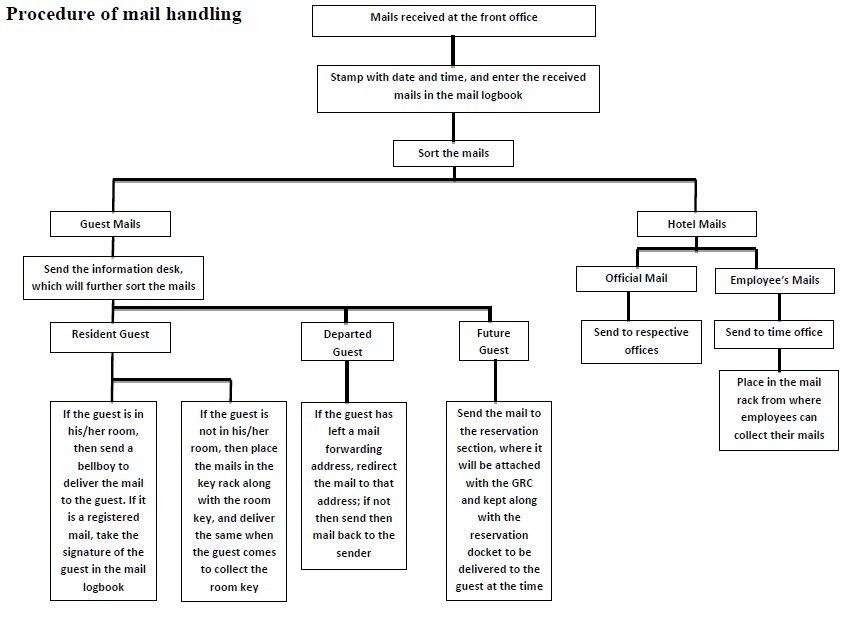
Message handling and mail handling are essential functions of front office operations in hotels. Message handling involves the process of receiving and delivering messages to guests, while mail handling involves the receipt, storage, and distribution of mail.
Message Handling Process:
Step 1: Receiving the Message When a message is received for a guest, the front desk agent should ask for the guest’s name and room number, as well as the name and contact information of the person leaving the message. The front desk agent should then record the message accurately and completely.
Step 2: Storing the Message The front desk agent should store the message in a secure location, such as a message rack or box, until it can be delivered to the guest. The message should be tagged with the guest’s name and room number to ensure that it is delivered to the correct person.
Step 3: Delivering the Message The front desk agent should deliver the message to the guest as soon as possible, using the guest’s preferred method of communication (e.g. phone, email, in-person). The front desk agent should confirm that the guest has received and understood the message before completing the transaction.
Mail Handling Process:
Step 1: Receiving the Mail When mail is received for a guest, the front desk agent should ask for the guest’s name and room number, as well as any special instructions for handling the mail. The front desk agent should then record the details of the mail, including the sender, date received, and type of mail.
Step 2: Storing the Mail The front desk agent should store the mail in a secure location, such as a mailroom or mailbox, until it can be delivered to the guest. The mail should be tagged with the guest’s name and room number to ensure that it is delivered to the correct person.
Step 3: Delivering the Mail The front desk agent should deliver the mail to the guest as soon as possible, using the guest’s preferred method of delivery (e.g. in-person, room delivery). The front desk agent should confirm that the guest has received and understood the mail before completing the transaction.
To ensure accurate and efficient message and mail handling, hotels typically use a message and mail log, as shown below:

The message and mail log provides a record of all messages and mail received and delivered, including the guest’s name and room number, the date and time received, and the type of message or mail. This information can be used to track and manage the flow of messages and mail within the hotel, ensuring that guests receive their messages and mail in a timely and efficient manner.
Q.9. Match the following:
(a) Dimanche (i) Summer
(b) L’hiver (ii) Thursday
(c) Dix-huit (iii) Tomorrow
(d) Demain (iv) Winter
(e) Jeudi (v) Eighteen
(f) Hier (vi) Sunday
‘ (g) L’e’te (vii) Sixty eight
(h) Soixante-huit (viii) Good evening
(i) Bonjour (ix) Yesterday
(j) Bonsoir (x) Good morning
(a) Dimanche – (vi) Sunday
(b) L’hiver – (iv) Winter
(c) Dix-huit – (v) Eighteen
(d) Demain – (iii) Tomorrow
(e) Jeudi – (ii) Thursday
(f) Hier – (ix) Yesterday
(g) L’e’te – (i) Summer
(h) Soixante-huit – (vii) Sixty eight
(i) Bonjour – (x) Good morning
(j) Bonsoir – (viii) Good evening
Q.10. State True or False:
(a) Floatel entertains walk in guest.
(a) False. Floatel is a type of hotel that is located on water, usually in a boat or a ship, and typically caters to guests who prefer to stay on water. It does not entertain walk-in guests.
(b) All transit hotel can be airport hotel but all the airport hotel cannot be
transit hotel.
(b) True. Transit hotels are designed for passengers who need to stay overnight during a layover or a connecting flight. They are often located near airports, but not all airport hotels serve as transit hotels.
(c) Left luggage is the lost and found luggage of guest.
(c) False. Left luggage refers to the luggage that a guest may leave temporarily at the hotel’s luggage storage facility. It is not considered lost and found luggage.
(d) B&B hotels only offer room with breakfast.
(d) False. B&B hotels usually offer rooms with breakfast, but some may also provide other meals and services for an additional charge.
(e) Telephone operator is responsible for giving the wakeup call service.
(e) True. Telephone operators are responsible for providing various services to guests, including wake-up call service, room service, and handling guest inquiries and complaints.
(f) Studio room offer facility of sofa-cum-bed.
(f) True. Studio rooms are designed to offer a combined living and sleeping area, and may feature a sofa-cum-bed that can be used as a seating area during the day and a bed at night.
(g) Receptionist makes the forecast of the future arrivals.
(g) True. Receptionists often make the forecast of future arrivals based on the hotel’s occupancy rates, historical data, and other factors.
(h) Front office manager prepares the duty roaster of the staff.
(h) True. Front office managers are responsible for preparing the duty roster of the front office staff, including assigning shifts and managing schedules.
(i) Management contracted hotels are owned by management company.
(i) True. Management contracted hotels are owned by a management company, which is responsible for operating the hotel under a management contract with the owner.
(j) Orphanage can be categorized as clientele based hotel.
(j) False. Orphanages are not categorized as hotels, as they do not provide lodging facilities to guests.