
Table of Contents
Q.1. Define tourism. Discuss in detail the various reasons why people undertake travel.
Tourism is the activity of traveling for leisure, business, or other purposes, which involves leaving one’s usual environment for a certain period and exploring new places, cultures, and experiences. It is a rapidly growing industry, driven by various factors such as economic, social, cultural, and environmental, that attracts millions of people from all over the world.
Here are some of the main reasons why people undertake travel:
- Leisure: This is perhaps the most common reason why people travel. Leisure tourism includes activities such as sightseeing, shopping, visiting amusement parks, beaches, and other tourist attractions, and simply relaxing and getting away from the stresses of daily life.
- Adventure: Many people seek out travel experiences that challenge them physically and mentally, such as mountain climbing, trekking, bungee jumping, or scuba diving. These types of travel experiences provide a sense of thrill and excitement that cannot be found in everyday life.
- Education: Travel can be an excellent way to learn about different cultures, histories, and ways of life. Educational tourism includes visiting museums, attending cultural events, and taking language courses.
- Business: Many people travel for business purposes such as attending conferences, meetings, and negotiations. Business travel is often necessary for building professional networks, expanding business opportunities, and conducting international transactions.
- Health and wellness: Traveling for health and wellness reasons has become increasingly popular in recent years. Wellness tourism includes activities such as yoga retreats, spa treatments, and medical tourism for elective procedures or treatments that may not be available in one’s home country.
- Visiting friends and family: Many people travel to visit friends and family who live in different parts of the world. This type of travel is often driven by a desire to reconnect with loved ones or to celebrate special occasions such as weddings, birthdays, or holidays.
- Religious and spiritual reasons: Religious tourism includes visiting holy sites, attending religious ceremonies, and participating in spiritual retreats. These types of travel experiences provide a sense of connection to one’s faith and spirituality.
- Sports and recreation: Sports tourism includes traveling to attend sporting events, participating in sports tournaments, and engaging in outdoor recreational activities such as skiing, surfing, or fishing.
In conclusion, tourism is a multifaceted industry that caters to a wide range of interests and motivations. People undertake travel for various reasons such as leisure, adventure, education, business, health and wellness, visiting friends and family, religious and spiritual reasons, and sports and recreation. The diversity of tourism motivations has led to a thriving industry that contributes significantly to the global economy and cultural exchange.
OR
Define hotel. Discuss the various facilities offered in a five-star hotel for its guests.
A hotel is a commercial establishment that provides accommodation, food, and other services to travelers for a fee. A five-star hotel is a luxury hotel that provides the highest level of comfort, luxury, and personalized service to its guests. Here are some of the facilities and amenities that are typically offered in a five-star hotel:
- Luxury Rooms and Suites: A five-star hotel typically offers luxurious and spacious rooms and suites that are well-appointed with high-quality furnishings, premium bedding, and state-of-the-art technology. The rooms may also feature amenities such as private balconies, hot tubs, and personalized butler service.
- Fine Dining Restaurants: A five-star hotel will usually have one or more fine dining restaurants that offer a range of cuisine options, including international, local, and fusion. The restaurants are often helmed by celebrity chefs and offer a high-end dining experience with an emphasis on quality ingredients and exceptional service.
- Spa and Wellness Facilities: Five-star hotels often have world-class spa and wellness facilities that include massage rooms, saunas, steam rooms, and swimming pools. Guests can enjoy a range of treatments such as massages, facials, and body wraps, designed to help them relax and rejuvenate.
- Fitness Center: A five-star hotel typically offers a fully equipped fitness center that includes state-of-the-art cardio and strength training equipment. Personal trainers are often available to assist guests with their fitness routines.
- Concierge Services: A five-star hotel will usually offer personalized concierge services to help guests with their travel needs. These services may include arranging transportation, booking tickets for events, and providing recommendations for local attractions and restaurants.
- Business Center: A five-star hotel typically has a fully equipped business center with high-speed internet, printers, and other office equipment. Guests can use these facilities to conduct business or to stay connected while on the go.
- Meeting and Event Spaces: Five-star hotels often have spacious meeting and event spaces that can accommodate large groups for conferences, weddings, and other events. These spaces are equipped with state-of-the-art audiovisual equipment and can be customized to suit the needs of the event.
- Luxury Transportation: A five-star hotel may offer luxury transportation services such as limousine and chauffeur services to transport guests to and from the airport or to local attractions.
- Room Service: A five-star hotel typically offers 24-hour room service, allowing guests to order food, drinks, and other amenities to their rooms at any time of the day or night.
- Personalized Service: One of the hallmarks of a five-star hotel is the personalized service that guests receive. Staff members are trained to anticipate guests’ needs and provide exceptional service to ensure their stay is comfortable and memorable.
In conclusion, a five-star hotel provides its guests with a wide range of luxurious facilities and amenities designed to ensure a comfortable and memorable stay. From luxury rooms and suites to fine dining restaurants, spa and wellness facilities, fitness centers, and personalized service, a five-star hotel offers the highest level of comfort and luxury to its guests.
Q.2. Write short notes on any four of the following (minimum 100 words each):
(a) Motels
A motel is a type of accommodation that is designed for motorists and provides convenient parking facilities for guests’ vehicles. The term “motel” is derived from “motor hotel”. Motels are typically located near highways or major roads, making them ideal for travelers who are looking for a place to stay while on a road trip. Motels usually offer basic amenities such as a bed, bathroom, and television, and they may also have a small restaurant or snack bar on the premises.
(b) Franchise hotels
Franchise hotels are hotels that are part of a larger chain or brand. These hotels operate under a franchise agreement with the parent company and are required to adhere to certain standards and guidelines in terms of service, amenities, and decor. Franchise hotels may offer a range of facilities and amenities depending on the brand and the location of the hotel. Examples of franchise hotels include Marriott, Hilton, and InterContinental Hotels Group.
(c) Transit hotels
Transit hotels are hotels that are located within or near airports, train stations, or bus stations, and are designed to provide convenient accommodation for travelers who have a short layover or a long wait before their next flight or journey. Transit hotels may offer basic amenities such as a bed, bathroom, and television, and they may also have a restaurant or lounge on the premises.
(d) Star hotels
Star hotels are hotels that are rated according to a set of criteria that are established by various organizations. The criteria may include factors such as the quality of the rooms, the range of amenities and facilities offered, and the level of service provided by the staff. Star ratings can range from one star to five stars, with five-star hotels being the most luxurious and high-end.
(e) Heritage hotels
Heritage hotels are hotels that are located in historic buildings or sites, such as palaces, castles, or mansions. These hotels offer guests a unique and authentic experience by providing accommodation in a setting that is steeped in history and culture. Heritage hotels may feature antique furnishings, original artwork, and other period details that help to create a sense of nostalgia and charm.
(f) Time share hotels
Time share hotels are hotels that offer guests the opportunity to purchase a share of the hotel or a specific room for a certain period of time each year. Time share owners are then able to use the hotel or room during their designated time period, typically for a week or two each year. Time share hotels may offer a range of amenities and facilities, including restaurants, swimming pools, and spa services.
(g) Standalone
A standalone hotel is a hotel that operates independently and is not part of a larger chain or brand. Standalone hotels may be owned and operated by a single individual or by a small group of investors. These hotels may offer a range of facilities and amenities, depending on their location, size, and target market.
(h) Casino hotels
Casino hotels are hotels that are located within or adjacent to a casino. These hotels typically offer a range of amenities and facilities, including restaurants, bars, nightclubs, and spa services, as well as access to the casino itself. Casino hotels may also offer gambling packages and special promotions to attract guests who are interested in gaming.
Q.3. Draw the organization chart of front office department of a five star hotel.
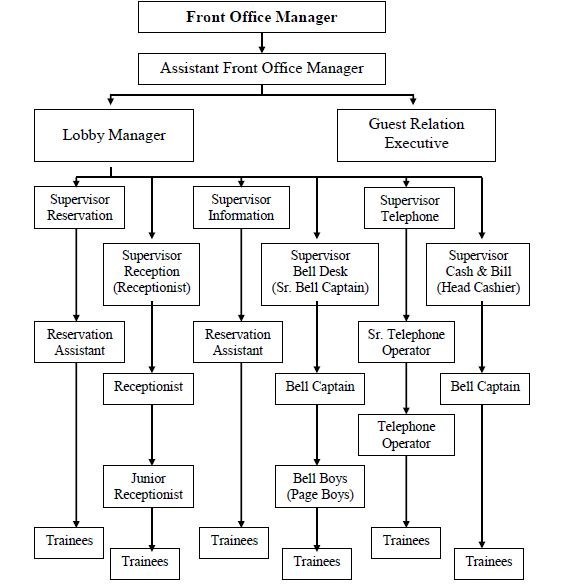
Q.4. List different types of hotel rooms available in star hotels and briefly describe them.
Star hotels offer a variety of room types to cater to the diverse needs and preferences of their guests. Some of the most common types of hotel rooms available in star hotels include:
- Standard Room: This is the most basic type of hotel room and usually includes a single or double bed, a bathroom, and basic amenities such as a television, a telephone, and a small desk.
- Deluxe Room: Deluxe rooms are usually larger than standard rooms and offer additional amenities such as a mini-fridge, a safe, and a seating area. They may also offer a better view than standard rooms.
- Executive Room: Executive rooms are designed for business travelers and offer additional amenities such as a work desk, a fax machine, and high-speed internet access.
- Suite: Suites are the most luxurious and spacious type of hotel room and usually consist of a bedroom, a separate living room, and a bathroom. They may also offer additional amenities such as a kitchenette, a dining table, and a balcony or terrace.
- Club Room: Club rooms are usually located on the top floors of the hotel and offer access to a private lounge or club where guests can enjoy complimentary snacks, drinks, and other amenities.
- Connecting Room: Connecting rooms are two or more standard rooms that are connected by a door, making them ideal for families or groups traveling together.
- Family Room: Family rooms are designed to accommodate families with children and may offer additional beds or a sofa bed, as well as children’s amenities such as toys and games.
- Accessible Room: Accessible rooms are designed for guests with disabilities and offer features such as wider doorways, grab bars, and roll-in showers to ensure ease of use.
Overall, star hotels offer a range of room types to suit different budgets, needs, and preferences. Guests can choose the type of room that best fits their requirements and enjoy a comfortable and luxurious stay.
Q.5. A Write French word for the following (any five):
(a) Monday
Lundi
(b) Winter
Hiver
(c) December
Décembre
(d) Day
Jour
(e) Hello
Bonjour
(f) June
Juin
(g) 11.30 AM
Onze heures et demie du matin (or simply “Onze heures trente”)
(h) One
Un
B Explain the procedure for handling guest messages in a five-star hotel.
Handling guest messages is an important aspect of the daily operations of a five-star hotel. It is crucial to ensure that guest messages are handled promptly and accurately to provide the best possible guest experience. Here is a step-by-step procedure for handling guest messages in a five-star hotel:
- Receiving the Message: The first step is to receive the message from the guest. This can be done through various channels such as telephone, email, or in-person communication. The hotel staff should be courteous and attentive when receiving the message to ensure that the guest feels valued and heard.
- Recording the Message: Once the message is received, it should be recorded accurately. The hotel staff should use a standard message logbook or software to record the message. The logbook should contain fields such as guest name, room number, date and time of the message, nature of the message, and the name of the staff member who recorded the message.
- Prioritizing the Message: After the message is recorded, it should be prioritized based on its nature and urgency. Messages related to emergencies such as medical assistance or fire alarms should be given top priority and attended to immediately. Other messages can be prioritized based on their nature and urgency.
- Delivering the Message: The next step is to deliver the message to the relevant person or department. The hotel staff should ensure that the message is delivered promptly and accurately to the concerned person or department. They should also follow up with the concerned person to ensure that the message has been received and attended to.
- Documenting the Follow-up: After the message has been delivered, the hotel staff should document the follow-up. They should record the date and time of the follow-up, the name of the staff member who followed up, and the status of the message. This documentation helps in tracking the progress of the message and ensures that it is attended to promptly.
- Informing the Guest: Once the message has been attended to, the hotel staff should inform the guest. They should inform the guest about the status of the message and ensure that the guest is satisfied with the resolution. The hotel staff should also thank the guest for bringing the matter to their attention and assure them that their concerns are taken seriously.
- Maintaining Confidentiality: It is important to maintain the confidentiality of guest messages. The hotel staff should ensure that the message is only shared with the concerned person or department and not with any other staff member or guest.
In conclusion, handling guest messages is a critical aspect of providing exceptional guest service in a five-star hotel. By following a standardized procedure, the hotel staff can ensure that guest messages are attended to promptly and accurately, leading to a positive guest experience.
Q.6. Explain in detail the functions of bell desk.
The bell desk is an important part of the operations of a hotel. It is responsible for providing various services to the guests, such as handling their luggage, providing information about the hotel and its surroundings, and arranging transportation. Here are some of the key functions of the bell desk:
- Handling Luggage: One of the primary functions of the bell desk is to handle the luggage of the guests. When guests arrive at the hotel, the bell staff greets them and offers to assist with their luggage. They ensure that the luggage is safely stored and delivered to the guest’s room. When the guest checks out, the bell staff retrieves the luggage and assists the guest with getting it to their transportation.
- Providing Information: Another important function of the bell desk is to provide information to the guests. The bell staff should be knowledgeable about the hotel and its facilities, as well as the surrounding area. They can provide information about nearby restaurants, tourist attractions, and transportation options.
- Arranging Transportation: The bell desk can also arrange transportation for the guests. This includes arranging taxis, limousines, and other modes of transportation. They can also provide information about public transportation options and schedules.
- Handling Guest Requests: The bell desk is often the first point of contact for guests when they have a request or need assistance. The bell staff should be able to handle a wide range of requests, such as providing extra towels, pillows, or blankets, or delivering room service orders.
- Assisting with Check-in and Check-out: The bell desk staff can assist guests with the check-in and check-out process. They can help guests with their luggage, provide information about the hotel and its facilities, and direct them to the front desk.
- Providing Security: The bell desk staff can also provide security for the guests and their belongings. They can monitor the lobby and other public areas for suspicious activity and report any incidents to the security department.
- Enhancing Guest Experience: The bell desk staff plays a crucial role in enhancing the guest experience. By providing personalized service and attending to the needs of the guests, they can create a positive impression of the hotel and encourage guests to return in the future.
In conclusion, the bell desk is an important department in a hotel that performs a wide range of functions. By providing exceptional service to the guests, the bell staff can enhance the guest experience and contribute to the overall success of the hotel.
Q.7. Draw a neat layout of a five-star hotel lobby including the ‘back office areas’.Label the layout clearly.
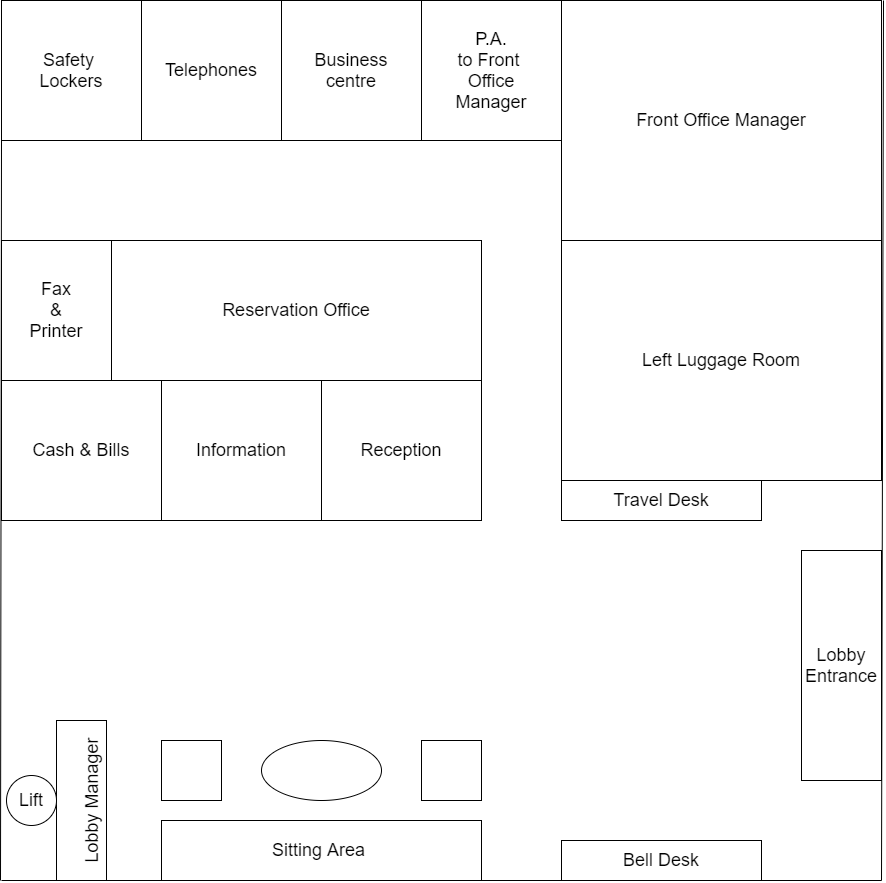
OR
List the equipment used in non-automated, semi-automated and fully automated front office system. Give the use of two equipment in each system.
The front office system in a hotel is responsible for managing guest check-ins, check-outs, and other guest-related services. There are three types of front office systems: non-automated, semi-automated, and fully automated. Here is a list of the equipment used in each system and their uses:
Non-Automated Front Office System:
a. Register book: A register book is used to record guest information such as name, address, and room number. This book serves as a manual record of all guests who have stayed in the hotel.
b. Telephone: The telephone is used to communicate with guests and other hotel departments. The front desk can receive and make calls to guests to provide information about their stay, handle requests, and resolve issues.
Semi-Automated Front Office System:
a. Computer: The computer is used to automate guest check-in and check-out processes. The front desk staff can access the hotel’s reservation system, room inventory, and billing information. The computer also allows for faster and more accurate guest registration and room assignment.
b. Electronic Key Card Reader: The electronic key card reader is used to provide secure access to guest rooms. The guest’s key card is programmed with their room number and can be used to unlock the door. The reader logs each entry into the room for security purposes.
Fully Automated Front Office System:
a. Property Management System (PMS): A PMS is an integrated software system used to manage various hotel operations, including front office, housekeeping, and accounting. The PMS allows for real-time updates to room availability, rates, and guest information.
b. Self-Check-in Kiosk: A self-check-in kiosk is a touch-screen device that allows guests to check-in, select their room, and receive their key card without assistance from front desk staff. This system speeds up the check-in process, reduces wait times, and improves guest satisfaction.
In conclusion, the equipment used in the front office system varies based on the level of automation. A non-automated system relies on manual records and basic communication tools, while a fully automated system utilizes advanced software and self-service technology. Regardless of the system in use, the equipment should be selected to enhance guest experience, improve efficiency and accuracy, and ensure the security of guest information and belongings.
Q.8. Explain in detail ten personality traits required for front office personnel.
Front office personnel are responsible for managing guest interactions, providing information, and ensuring guest satisfaction in hotels and other hospitality establishments. The job requires a combination of technical skills and personality traits. Here are ten personality traits that are essential for front office personnel:
- Friendly and Welcoming: Front office personnel should be warm, approachable, and make guests feel welcome. They should have a positive attitude and a genuine desire to help guests.
- Professional: Front office personnel should be professional in their appearance and behavior. They should dress appropriately and conduct themselves in a manner that reflects the values of the hotel.
- Attentive: Front office personnel should be attentive to guest needs and concerns. They should listen actively, ask relevant questions, and offer solutions that meet or exceed guest expectations.
- Patient: Front office personnel should be patient, especially when dealing with difficult or demanding guests. They should remain calm, respectful, and focused on resolving issues.
- Problem Solver: Front office personnel should be proactive in identifying and solving guest problems. They should be able to think critically, make quick decisions, and implement solutions that improve the guest experience.
- Flexible: Front office personnel should be adaptable and flexible to meet changing guest needs and demands. They should be able to work well under pressure and manage multiple tasks at once.
- Empathetic: Front office personnel should be empathetic and show concern for guests. They should be able to put themselves in the guest’s shoes, understand their needs and feelings, and provide appropriate support.
- Communicative: Front office personnel should have excellent communication skills. They should be able to speak and write clearly, listen actively, and convey information effectively to guests and other team members.
- Detail-oriented: Front office personnel should be detail-oriented and pay attention to the small things that can make a big difference to the guest experience. They should be able to spot errors and inconsistencies and take corrective action.
- Team player: Front office personnel should be team players who work well with others. They should be able to collaborate with other departments to ensure smooth operations and guest satisfaction.
In conclusion, the personality traits required for front office personnel are essential to create a positive guest experience. These traits include friendliness, professionalism, attentiveness, patience, problem-solving skills, flexibility, empathy, communication skills, attention to detail, and teamwork. By possessing these traits, front office personnel can provide exceptional service and ensure that guests have a memorable stay.
OR
Explain the various sections of front office in detail.
The front office is the face of a hotel, as it is the first point of contact between guests and the hotel staff. It includes various sections that work together to provide a seamless guest experience. Here are the different sections of the front office and their functions:
- Reception: The reception is the main area of the front office, where guests check-in and check-out. The receptionist greets the guests, verifies their reservation, and collects necessary information such as name, address, and payment details. They also provide guests with room keys, directions to their rooms, and information about hotel amenities.
- Reservation: The reservation section is responsible for managing room bookings. The reservation agent receives inquiries about room availability, rates, and amenities. They process reservations, confirm them, and send a confirmation email to the guest. They also maintain records of guest reservations and update them as necessary.
- Information: The information section provides guests with information about the hotel, its facilities, and local attractions. The information agent is responsible for answering questions and providing recommendations to guests. They also provide maps, brochures, and other materials that guests may need.
- Cashier: The cashier section is responsible for managing guest payments. The cashier receives payments from guests, prepares receipts, and maintains accurate records of transactions. They also handle refunds, balance cash registers, and perform other financial duties.
- Bell Desk: The bell desk is responsible for handling guest luggage and providing assistance with transportation. The bellhop greets guests, carries their luggage to their rooms, and provides information about hotel amenities. They also arrange transportation for guests, such as taxi or shuttle services.
- Concierge: The concierge section provides personalized services to guests. The concierge can assist with restaurant reservations, tour bookings, and transportation arrangements. They also provide information about local events and attractions and can help with any special requests that guests may have.
- Telephone: The telephone section handles incoming and outgoing calls. The telephone operator answers calls, transfers them to the appropriate department, and takes messages if necessary. They also provide information about hotel amenities and local attractions.
- Business Center: The business center provides services to guests who need to work or conduct business while traveling. The business center offers computers, printers, and other office equipment. They also provide printing, copying, and faxing services.
- Housekeeping: Although technically not a part of the front office, housekeeping plays a vital role in guest satisfaction. The housekeeping department is responsible for cleaning guest rooms and ensuring that they are well-maintained. They also provide additional amenities such as fresh towels, toiletries, and linens.
In conclusion, the front office of a hotel is a complex and multi-functional department. It is responsible for creating a positive first impression and ensuring that guests have a seamless and enjoyable experience. The different sections of the front office work together to provide personalized services and attention to detail, which is critical in maintaining guest loyalty and satisfaction.
Q.9. Match the following:
(a) Skipper (i) Small hotel – Switzerland
(b) Reception (ii) Electronic keys
(c) DNCO (iii) Commissionaire
(d) HRACC (iv) Cashier
(e) Doorman (v) Guest registration card
(f) Referral (vi) Star ratings
(g) VPO (vii) Scanty baggage
(h) Left luggage (viii) Bell desk
(i) Card key (ix) OYO rooms
(j) Chalet (x) Did not check out
Skipper |
(vii) Scanty baggage |
Reception |
(v) Guest registration card |
DNCO |
(x) Did not check out |
HRACC |
(vi) Star ratings |
Doorman |
(iii) Commissionaire |
Referral |
(ix) OYO rooms |
VPO |
(iv) Cashier |
Left luggage |
(viii) Bell desk |
Card key |
(ii) Electronic keys |
Chalet |
(i) Small hotel – Switzerland |
Q.10. State True or False:
(a) Lanai is not a lettable room.
True: A Lanai is an open-sided room or a balcony that is usually attached to a hotel room or suite. It is not a lettable room in itself, but an additional feature that provides an outdoor space for guests.
(b) Cash float is the money that is paid by hotel on behalf of the guest.
False: A cash float is the amount of cash that is set aside by the hotel for use by the front office staff for making change and other small transactions. It is not money that is paid by the hotel on behalf of the guest.
(c) Hotels with recreational facilities are resorts.
True: Hotels that offer recreational facilities such as swimming pools, golf courses, or spas are often referred to as resorts. These hotels are designed to provide guests with a complete vacation experience and are usually located in scenic or exotic destinations.
(d) Guests from travel agency are FITs.
False: FIT stands for Free Independent Traveler. These are guests who plan and book their own travel arrangements rather than going through a travel agency. Guests who book through a travel agency are referred to as group travelers.
(e) Room tariff always include meals.
False: Room tariff refers to the rate charged for the room only, and does not necessarily include meals. Most hotels offer meal plans as an additional charge, which may include breakfast, lunch, and dinner.
(f) F&B is a sector of hospitality industry.
True: F&B stands for Food and Beverage, which is a sector of the hospitality industry. This sector includes restaurants, bars, cafes, and other food service establishments.
(g) Suite rooms are not spacious.
False: Suite rooms are typically larger and more spacious than standard hotel rooms. They often include a separate living area, bedroom, and bathroom, as well as additional amenities such as a kitchenette or a balcony.
(h) Wake up calls are given to the guests in a five star hotel.
True: Wake-up calls are a standard service offered by most hotels, including five-star hotels. The front office staff will call the guest at a specified time to ensure that they are awake and ready for the day.
(i) Bell boy is a part of uniform service staff.
True: Bellboys or bellhops are part of the uniform service staff in a hotel. They are responsible for carrying guests’ luggage, showing them to their rooms, and providing information about hotel amenities.
(j) Supplementary accommodation includes hostels.
True: Supplementary accommodation includes budget-friendly options such as hostels, guesthouses, and backpacker lodges. These types of accommodation provide basic facilities at a lower cost compared to traditional hotels.