
Table of Contents
Q.1. (a) Define tourism.
Tourism can be defined as the act of traveling to a destination for the purpose of leisure, business or other personal reasons. It involves visiting various places, staying in different accommodations, exploring new cultures and experiencing various activities.
(b) Discuss in detail the benefits of tourism to the destination.
The benefits of tourism to a destination are numerous and can have a positive impact on the economy, culture and environment. Some of the benefits are as follows:
- Economic growth: Tourism can contribute to the growth of a destination’s economy by generating revenue through the provision of various services such as accommodation, transportation, food and beverage, tours and activities. This revenue can be reinvested into the local economy, creating jobs and enhancing infrastructure.
- Employment opportunities: Tourism can create job opportunities in various sectors such as hospitality, transportation, and entertainment. This can lead to an increase in the standard of living for local residents and a decrease in unemployment rates.
- Preservation of culture and heritage: Tourism can play a vital role in the preservation of a destination’s culture and heritage. The promotion of cultural tourism can encourage the preservation of traditions, customs and practices, and ensure that they are passed down to future generations.
- Infrastructure development: Tourism can lead to the development of infrastructure such as roads, airports, telecommunications, and other public facilities. This infrastructure can improve the overall quality of life for residents of the destination and make it more attractive to future visitors.
- Environmental conservation: Tourism can promote the conservation of the environment by encouraging responsible tourism practices. This can include sustainable tourism initiatives such as reducing waste, conserving water, and protecting natural resources.
- Exchange of knowledge and ideas: Tourism can facilitate the exchange of knowledge and ideas between visitors and locals. This can promote cultural understanding and encourage mutual respect and tolerance.
- Diversification of economy: Tourism can help diversify the economy of a destination by providing an additional source of income, reducing dependence on a single industry, and increasing resilience to economic shocks.
In conclusion, tourism can have a significant positive impact on a destination, contributing to economic growth, employment opportunities, cultural preservation, infrastructure development, environmental conservation, exchange of knowledge and ideas, and diversification of the economy. It is important for destination managers to encourage responsible tourism practices to ensure the long-term sustainability of these benefits.
OR
Outline the evolution and growth of the hotel industry mentioning various landmarks and important developments.
The hotel industry has been in existence for centuries, and its growth and evolution have been shaped by various milestones and important developments. The following are some of the key landmarks and developments that have influenced the growth of the hotel industry:
- Ancient Inns and Taverns: The earliest form of hotels can be traced back to the ancient inns and taverns of Greece and Rome, where travelers could rest and refresh themselves during their journeys.
- Medieval Inns and Guesthouses: In the Middle Ages, inns and guesthouses became more common in Europe, catering to the needs of merchants and pilgrims.
- Renaissance Hotels: In the 16th and 17th centuries, the concept of the hotel evolved in Europe, with the introduction of the first purpose-built hotels, such as the Palace of Versailles in France.
- Industrial Revolution: The Industrial Revolution in the 18th and 19th centuries brought about significant changes in the hotel industry, with the growth of rail travel and the need for accommodations for business travelers.
- Grand Hotels: In the late 19th and early 20th centuries, the era of grand hotels emerged, with the construction of luxury hotels such as the Ritz in Paris and the Waldorf Astoria in New York.
- Motor Hotels: With the growth of the automobile industry in the early 20th century, motor hotels, or motels, became popular, providing convenient accommodations for motorists.
- Post-War Expansion: The post-World War II period saw a rapid expansion of the hotel industry, with the growth of international travel and the rise of tourism.
- Boutique Hotels: In the 1980s and 1990s, the concept of boutique hotels emerged, providing unique, personalized experiences for travelers.
- Online Booking: The advent of the internet in the late 20th century brought about a revolution in the way hotels were marketed and booked, with the growth of online travel agencies and booking platforms.
- Sustainable Tourism: In recent years, there has been a growing emphasis on sustainable tourism, with hotels adopting eco-friendly practices and promoting responsible travel.
Overall, the evolution and growth of the hotel industry have been shaped by a variety of factors, including technological advances, changes in travel patterns, and shifting consumer preferences. From the humble inns of ancient times to the luxurious grand hotels of the present day, the hotel industry has played a vital role in the development of tourism and the hospitality industry as a whole.
Q.2. Classify hotels based on location and clientele.
Hotels can be classified based on various factors such as location, clientele, services, facilities, etc. Here we will classify hotels based on their location and clientele.
Classification based on location:
a) City Hotels: These are located in the heart of the city and are usually surrounded by commercial, shopping, and business districts. These hotels cater to business travelers and tourists who want to explore the city. They are usually of the deluxe and luxury category.
b) Airport Hotels: These hotels are located near the airport and are ideal for business travelers who want to catch an early morning flight or have a layover. These hotels provide easy access to the airport and have facilities like shuttle services, conference rooms, and business centers.
c) Resort Hotels: These hotels are located in secluded areas and offer a peaceful and relaxing environment. They are usually located near beaches, mountains, or other scenic locations. They offer a wide range of recreational facilities like swimming pools, spa, golf courses, and adventure sports.
d) Highway Motels: These hotels are located near highways and offer basic facilities like comfortable rooms, parking, and restaurants. They are usually preferred by travelers who are on a road trip and need a place to rest for the night.
Classification based on clientele:
a) Business Hotels: These hotels cater to the needs of business travelers who are looking for amenities like high-speed internet, meeting rooms, conference halls, and business centers.
b) Luxury Hotels: These hotels offer high-end amenities and services like butlers, spas, swimming pools, and fine dining restaurants. They cater to guests who are willing to pay a premium for luxury and comfort.
c) Budget Hotels: These hotels offer basic amenities and services at an affordable price. They are usually located in commercial areas and are preferred by budget travelers who are looking for a comfortable stay without spending too much money.
d) Boutique Hotels: These hotels are smaller in size and offer a unique experience to the guests. They are usually themed around a particular concept like art, music, or culture. They offer personalized services and attention to detail.
e) Extended Stay Hotels: These hotels offer comfortable and spacious rooms for guests who are looking for a long-term stay. They offer facilities like a fully equipped kitchenette, laundry, and housekeeping services.
In conclusion, hotels can be classified based on various factors, and the two primary classifications based on location and clientele. Each type of hotel offers a unique experience to the guests and caters to their specific needs and requirements.
OR
List the various sections of front office and briefly explain the activities of each section.
Front office is a vital department in a hotel that performs various tasks related to guest services and interactions. The main sections of the front office are as follows:
Reservation Section:
This section handles guest reservations, and it is the first point of contact between the guest and the hotel. The primary activities of the reservation section include:
- Receiving reservation requests from various sources such as telephone, email, online booking systems, and travel agencies.
- Checking room availability and making reservations for guests.
- Providing information about the hotel, room rates, facilities, and services to guests.
- Maintaining accurate and up-to-date records of reservations.
Reception Section:
This section is responsible for welcoming guests and facilitating smooth check-in and check-out processes. The primary activities of the reception section include:
- Greeting guests upon arrival and providing them with necessary information about the hotel.
- Verifying guest identities and handling registration formalities.
- Allocating rooms to guests and providing them with room keys and other necessary information.
- Assisting guests with their luggage and escorting them to their rooms.
- Collecting payment and settling guest bills upon check-out.
Cashier Section:
This section is responsible for handling financial transactions related to guest services. The primary activities of the cashier section include:
- Collecting payments for room charges, food, and other services rendered to guests.
- Issuing receipts and keeping accurate records of financial transactions.
- Handling foreign currency exchange and maintaining a cash float.
- Preparing daily cash reports and submitting them to the finance department.
Information Section:
This section is responsible for providing guests with relevant information about the hotel, its facilities, and services. The primary activities of the information section include:
- Answering guest queries and providing them with information about the hotel’s facilities and services.
- Providing guests with directions to various locations such as tourist attractions, shopping centers, and transportation hubs.
- Arranging transportation and making reservations for guests at other hotels or restaurants.
- Maintaining brochures, maps, and other informational material for guests.
Concierge Section:
This section is responsible for providing personalized services and assistance to guests. The primary activities of the concierge section include:
- Making restaurant reservations, arranging transportation, and booking tickets for shows or events.
- Providing guests with information about local attractions and activities.
- Handling guests’ requests for special services such as spa treatments, laundry, and room service.
- Providing general assistance and support to guests during their stay at the hotel.
Business Center:
This section is responsible for providing guests with necessary office services and equipment. The primary activities of the business center include:
- Providing guests with access to computers, printers, and other office equipment.
- Offering various business services such as faxing, printing, and scanning.
- Providing secretarial services and conference room facilities for business meetings.
- Maintaining office supplies and equipment.
In conclusion, each section of the front office plays a crucial role in ensuring that guests have a comfortable and enjoyable stay at the hotel. Effective coordination among these sections is essential for delivering exceptional guest services and creating a positive impression of the hotel.
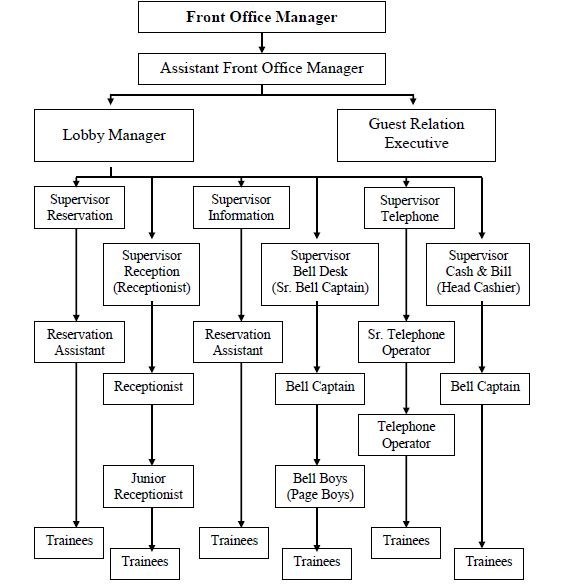
Q.3. Draw the hierarchical organisation chart of a large five-star hotel.
OR
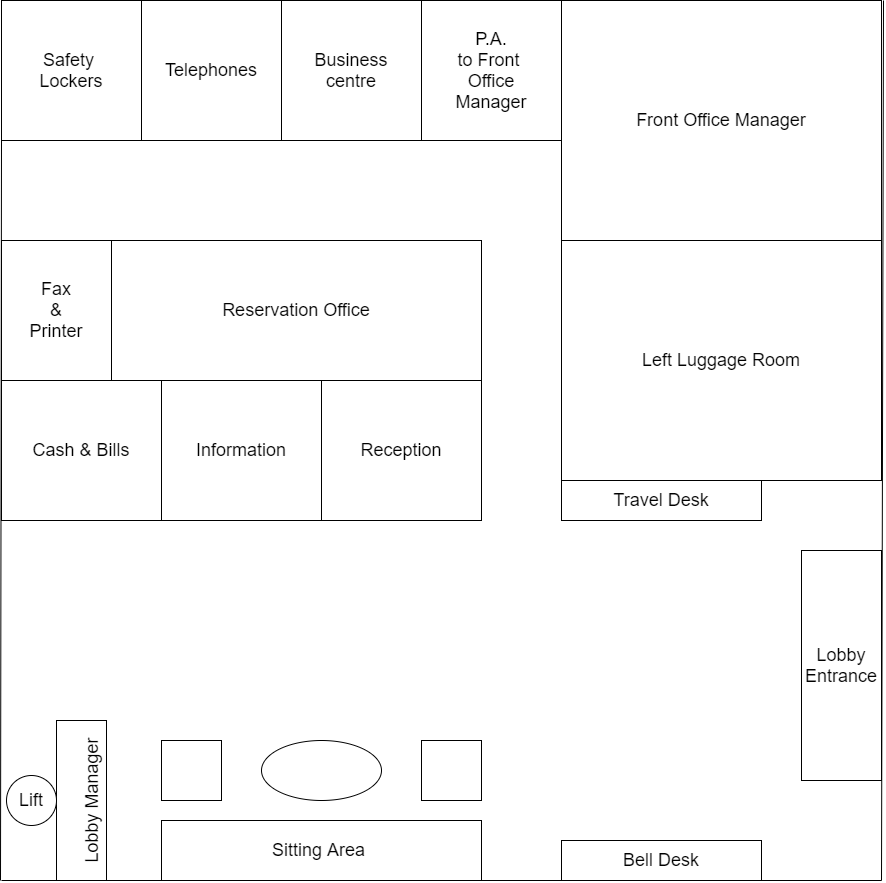
Draw the layout of the lobby and front office of a large five-star hotel and label the various sections.
Q.4. (a) What is job description?
Job description refers to a written statement that outlines the responsibilities, duties, and requirements of a particular job position. It describes the expectations of the employer and the qualifications and skills required to perform the job effectively.
(b) Write the job description of a front office assistant.
Job Description of a Front Office Assistant:
Position Title: Front Office Assistant
Reports to: Front Office Manager
Job Overview:
The Front Office Assistant is responsible for providing efficient and friendly service to guests, managing guest inquiries and concerns, and ensuring smooth front desk operations.
Key Responsibilities:
- Greet guests, check them in and out, and provide general assistance with their stay.
- Answer and direct incoming phone calls and emails, providing information and assistance as needed.
- Manage guest complaints and issues in a professional and efficient manner, escalating to the Front Office Manager as necessary.
- Process guest payments, including cash, credit cards, and other payment methods.
- Maintain accurate and up-to-date guest records, including reservations, billing, and room assignments.
- Provide guests with information about the hotel, local attractions, and amenities, and make recommendations as necessary.
- Manage front desk supplies and inventory, ordering as necessary and ensuring adequate stock levels at all times.
- Assist with other front office duties as required, such as handling mail, faxes, and other correspondence.
Qualifications and Skills:
- High school diploma or equivalent; some college or hospitality training preferred.
- Excellent communication skills, both verbal and written.
- Strong customer service orientation, with a friendly and outgoing personality.
- Ability to work well under pressure and handle multiple tasks simultaneously.
- Strong attention to detail and ability to maintain accurate records.
- Basic computer skills, including proficiency in Microsoft Office and knowledge of hotel management software.
- Knowledge of local attractions and amenities.
- Ability to work flexible hours, including weekends and holidays.
Working Conditions:
The Front Office Assistant works primarily in a hotel lobby or front desk area, and may be required to stand for long periods of time. The job may also involve some light lifting and carrying of supplies or equipment. The position typically requires working a rotating schedule that includes weekends and holidays.
This job description outlines the key responsibilities and qualifications required for a Front Office Assistant. The successful candidate must have strong communication and customer service skills, be able to multitask and work well under pressure, and have a strong attention to detail.
Q.5. Write short notes on any two:
(a) Chain hotels
Chain hotels are a group of hotels owned by the same company, organization or individual. These hotels share the same brand and operate under the same management and ownership structure. Chain hotels have a standardized level of service, amenities and design across all locations, ensuring a consistent experience for guests. The advantages of chain hotels are that they have established brand recognition, loyal customer base, and economies of scale in purchasing and advertising. However, they may be perceived as impersonal and lacking in individuality compared to independent hotels.
(b) Boutique hotels
Boutique hotels are small, independently owned hotels that offer a unique and personalized experience to guests. They are often located in urban or trendy neighborhoods and have a distinctive style, design, and character. Boutique hotels offer amenities such as luxury bedding, personalized service, high-end dining, and unique decor. They often cater to niche markets, such as business travelers, honeymooners, or art lovers. The advantages of boutique hotels are that they offer a high level of individuality, personalized service, and attention to detail. However, they may have limited facilities and higher rates compared to chain hotels.
(c) Room rack
A room rack is a device used in hotels to manage and display the availability of rooms. It is a physical chart or board that shows the current occupancy status of each room in the hotel. The room rack allows the front office staff to easily see which rooms are available, occupied, or out of order. The room rack may also display information about the room type, rate, and guest name. The advantages of a room rack are that it allows for easy tracking of room availability, reduces the risk of overbooking, and helps staff quickly assign rooms to guests.
(d) Concierge
A concierge is a member of the hotel staff who assists guests with various tasks and requests to enhance their stay. The role of a concierge is to provide personalized service and insider knowledge to help guests navigate the local area and make the most of their stay. The duties of a concierge may include making restaurant reservations, arranging transportation, booking tickets to events, providing directions, and recommending activities or attractions. A concierge should have excellent communication and interpersonal skills, a strong knowledge of the local area, and the ability to anticipate and fulfill guests’ needs.
Q.6. List the various types of hotel rooms available in a star hotel. Briefly describe any five
A star hotel offers a variety of room types to cater to the diverse needs of its guests. Some of the common types of hotel rooms available in a star hotel are:
- Standard Rooms: These are the basic rooms offered in a hotel, also known as single rooms. They usually come with a single bed or a double bed and essential amenities such as a wardrobe, study table, and attached bathroom.
- Deluxe Rooms: Deluxe rooms are larger than standard rooms and are usually designed to provide more comfort and luxury to guests. They come with additional features such as better-quality bedding, upscale furnishings, and modern amenities like flat-screen TVs, DVD players, and sound systems.
- Executive Rooms: Executive rooms are spacious and designed to cater to the needs of business travelers. They are equipped with amenities like high-speed internet, data ports, in-room fax machines, and spacious work desks.
- Suites: Suites are the most luxurious and spacious hotel rooms, offering a separate living room and bedroom area. They come with features such as king-sized beds, plush sofas, and armchairs, high-end entertainment systems, and private balconies with scenic views. Some hotels offer specialty suites such as honeymoon suites, presidential suites, or themed suites based on movies or historical events.
- Family Rooms: Family rooms are designed to accommodate families with children or groups of friends traveling together. These rooms usually come with multiple beds or bunk beds and can accommodate up to four or five people. They also offer additional amenities such as a mini-fridge, microwave, and seating area.
- Interconnecting Rooms: These are two or more adjacent rooms that can be combined to create a larger space for families or groups traveling together. Interconnecting rooms usually come with a common door that can be unlocked to create one large room.
- Accessible Rooms: Accessible rooms are designed to cater to the needs of guests with disabilities or mobility issues. These rooms are equipped with features such as wheelchair accessibility, grab bars, and roll-in showers. They are also located on the ground floor or near elevators for easy access.
Overall, a star hotel aims to offer a variety of room types to cater to the diverse needs and preferences of its guests, ensuring a comfortable and memorable stay.
Q.7. Give step-by-step procedure followed by the bell desk for handling:
(a) Scanty baggage guest
Procedure for Handling Scanty Baggage Guest at the Bell Desk:
When guests arrive at a hotel with scanty baggage, the bell desk staff must ensure that their luggage is handled appropriately. Here is a step-by-step procedure for handling scanty baggage guests at the bell desk:
- Greet the guest: The bell desk staff should greet the guest warmly and make them feel welcome. A smile and friendly attitude go a long way in making guests feel at ease.
- Check for luggage: Ask the guest if they have any luggage. If they say no, confirm with them whether they have any luggage stored in the car or taxi they used to get to the hotel.
- Confirm room reservation: Confirm the guest’s room reservation and the length of their stay.
- Offer assistance: Offer to assist the guest with their luggage. Even if they do not have any, they may appreciate the gesture.
- Escort the guest to the room: If the guest accepts your offer, escort them to their room and make sure they are comfortable.
- Explain hotel facilities: Explain the hotel facilities available to the guest and answer any questions they may have.
- Offer to provide assistance: Offer to provide any assistance the guest may require during their stay.
(b) Left luggage
Procedure for Handling Left Luggage at the Bell Desk:
Guests may need to store their luggage temporarily at the hotel when they arrive early before check-in or after check-out. Here is a step-by-step procedure for handling left luggage at the bell desk:
- Greet the guest: The bell desk staff should greet the guest warmly and make them feel welcome.
- Verify guest details: Confirm the guest’s name and room number to ensure that they are a guest of the hotel.
- Verify luggage details: Check the luggage carefully to make sure that it belongs to the guest.
- Prepare luggage tag: Prepare a luggage tag with the guest’s name, room number, and departure date. Attach the tag to the luggage.
- Confirm charges: Inform the guest of the charges for left luggage storage and ask them to sign the left luggage storage form.
- Store the luggage: Store the luggage in the designated area and give the guest a copy of the luggage tag for future reference.
- Retrieve luggage: When the guest returns to collect their luggage, verify their identity and return their luggage to them. Ask them to sign the left luggage release form.
- Collect payment: Collect payment for the left luggage storage charges.
By following these procedures, bell desk staff can efficiently handle scanty baggage guests and left luggage, providing guests with excellent service and ensuring a memorable stay.
Q.8. Differentiate between the following (any five):
(a) Front of the house and back of the house.
| Front of the House | Back of the House |
|---|---|
| Areas visible to guests | Areas not visible to guests |
| Public areas of the hotel such as the lobby, restaurant, bar, front desk, etc. | Administrative areas such as accounting, purchasing, housekeeping, maintenance, etc. |
| Staff interacts with guests | Staff may not interact with guests |
(b) Door attendants and valet parking attendants.
| Door attendants | Valet parking attendants |
|---|---|
| Greet guests and open doors | Handle guests’ vehicles and parking |
| Assist with luggage | Drive guests’ vehicles to the designated parking areas |
| Escort guests to the front desk | Retrieve guests’ vehicles when requested |
| Provide information about the hotel and its facilities | May perform minor vehicle services such as refueling and washing |
(c) Overstay and stayover.
| Overstay | Stayover |
|---|---|
| Guest remains in the room past the scheduled checkout time | Guest stays overnight and remains in the room |
| May result in additional charges for the guest | No additional charges for the guest |
| Room may not be available for incoming guests | Room is available for incoming guests after the stayover guest checks out |
(d) Skipper and DNCO.
| Skipper | DNCO |
|---|---|
| Guest who did not occupy the room despite having a reservation | Guest who did not check out on the scheduled checkout date |
| May result in a no-show charge | May result in an overstay charge |
| Room may be available for incoming guests | Room may not be available for incoming guests |
(e) Fixed time-share and floating time-share
| Fixed Time-Share | Floating Time-Share |
|---|---|
| Ownership of a specific unit or week(s) of the year | Ownership of a number of points that can be used to book stays |
| Specific unit or week(s) can be exchanged with other owners or rented out | Points can be used to book stays at different properties within the system |
| Owner has a guaranteed use of the unit or week(s) each year | Owner has more flexibility in terms of when and where to book |
(f) No-show and walk-in
| No-show | Walk-in |
|---|---|
| Guest who did not arrive on the scheduled check-in date | Guest who arrives without a prior reservation |
| Room may be available for incoming guests | Room is subject to availability |
| May result in a no-show charge | No additional charges for the guest |
(g) Referral group and Franchise.
| Referral Group | Franchise |
|---|---|
| Independent hotels that refer business to each other | Hotels that operate under a common brand and follow a set of standards |
| Members may have different ownership and management | All hotels under the same franchise have the same ownership and management |
| May have different levels of service and amenities | All hotels under the same franchise have a consistent level of service and amenities |
Q.9. Define the term ‘time-share’. Discuss the various methods of use of time-share and the advantages of time-share hotels.
Time-share refers to a concept where an individual or group of individuals jointly own a property, and each owner is allowed to use the property for a specified time during the year. The ownership of the property is usually divided into intervals of one week or longer. Time-share can also be defined as a system in which people buy a right to use a holiday home or vacation accommodation for a particular period every year.
There are various methods of using time-share, including:
- Fixed time-share: In this method, owners purchase a specific week or weeks in a particular unit each year. This type of time-share offers the greatest degree of certainty in terms of when and where the owner can use the property.
- Floating time-share: In this method, owners can reserve time in any unit at the resort, subject to availability. The owners have more flexibility with this type of time-share, but they may need to plan their vacations more carefully to ensure availability.
- Points-based time-share: This method allows owners to purchase a certain number of points, which can be used to book vacation time at any resort within the time-share network. The number of points needed to book a particular unit or time of year depends on the popularity of the destination and the time of year.
There are several advantages of time-share hotels, including:
- Cost-effective: Time-share can be a more cost-effective way to own a vacation property compared to buying a second home or paying for a hotel stay each year.
- Variety of destinations: Time-share owners have access to a variety of destinations within the time-share network, making it easy to plan vacations to different locations.
- High-quality accommodations: Time-share properties are usually of high quality, offering luxurious amenities and facilities.
- Family-friendly: Time-share properties are often designed with families in mind, offering a range of activities and facilities suitable for children.
- Hassle-free ownership: Time-share owners do not have to worry about the maintenance and upkeep of the property, as these tasks are typically taken care of by the time-share management company.
In conclusion, time-share hotels offer a cost-effective way to own a vacation property and provide access to a variety of destinations. The various methods of using time-share offer flexibility and convenience to owners. The advantages of time-share hotels include high-quality accommodations, a range of family-friendly activities and facilities, and hassle-free ownership.
Q.10. Match the following and French terms with their English meaning:
(a) Mercredi (i) Thank you
(b) Bon jour (ii) August
(c) L’été (iii) Wednesday
(d) Salle de bains (iv) Summer
(e) S’il vous plait (v) Room
(f) Aout (vi) Please
(g) Cinq (vii) See you soon
(h) Chambre (viii) Five
(i) A bientot (ix) Good morning
(j) Merci (x) Bathroom
French Terms |
English Meaning |
|---|---|
Mercredi |
Wednesday |
Bon jour |
Good morning |
L’été |
Summer |
Salle de bains |
Bathroom |
S’il vous plait |
Please |
Aout |
August |
Cinq |
Five |
Chambre |
Room |
A bientot |
See you soon |
Merci |
Thank you |