
Table of Contents
Q.1. Draw the organization chart of front office department and write the duties and responsibilities of a front desk agent.
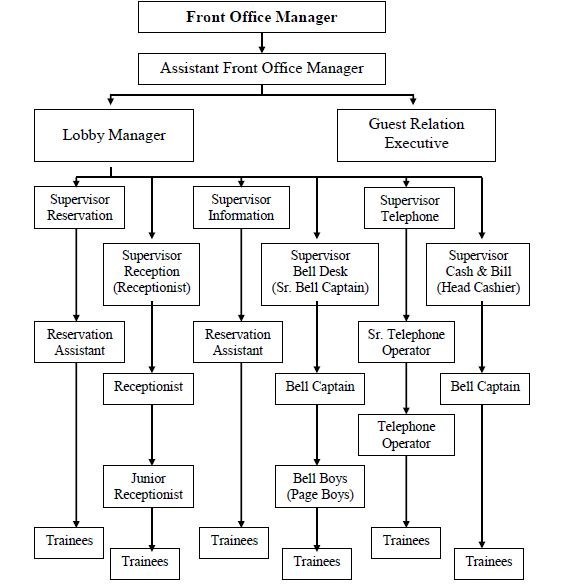
duties and responsibilities of a front desk agent.
The friendly welcome given by the receptionist to a guest changes an impersonal hotel building into a friendly and homely place and his unfriendly. hostile and indifferent attitude may convert the guest’s experience into an unpleasant and uncomfortable stay. If the front office is the hub of the hotel then the receptionist is aptly called the person who keeps this hotel world moving.
- Be informed on daily room status. Have detailed information regarding arrivals, their room requirements, and expected departures of the day.
- Check up VIP’ s reservations and issue VIP amenities, a voucher for fruits and flower beverages, etc. and any other special requests.
- Prepares all records connected with pre-registration for VIP, invalids and old people
- Handle group/crew registration as per laid down procedures as well as FIT.
- Maintain a satisfactory part of all registration of stationery.
- Room all arrivals using arrival errand cards.
- Constantly update room rack/information rack.
- Type out permanent arrival slip after registering guests and slot in racks.
- Open out guest folio without delay and transmit it to the front office cashier himself or send the GR. card to cashier for opening the guest folio.
- Maintain room fates absolutely current and up-to-date.
- Prepare room discrepancy report and ensure a double-check through lobby attendant Work closely with information assistants.
- Give all departure rooms to housekeeping promptly. Take all cleared rooms promptly from housekeeping.
- Take room reports/occupancy statistics and maintain an inventory of rooms.
- Receive and greet the guest. The friendly welcome given by the receptionist to a guest changes an impersonal hotel building into a friendly and homely place, while his unfriendly, hostile and indifferent attitude may convert the guest experience into an unpleasant and uncomfortable stay. If Front Office is the ‘Hub’ of the hotel then the receptionist can be aptly called the person who keeps the hotel world moving.
- Sell higher priced rooms and other hotel facilities through trained salesmanship and assign rooms.
- Help room service and telephone departmentally to racks.
- Handle scanty baggage diligently.
- Know color codes used in reception.
- Know room history, namely location, kind, rate, theme, if any, and the view each room commands.
- Set up and posts the guest accounts in small hotels.
- Deal with cash, credit cards, and checkouts and perform cashiers function in a small hotel.
- Provide safekeeping for guest valuables.
- Deal with complaints and emergencies.
OR
Draw the layout of front office department and indicate the location of various sections of front office department.
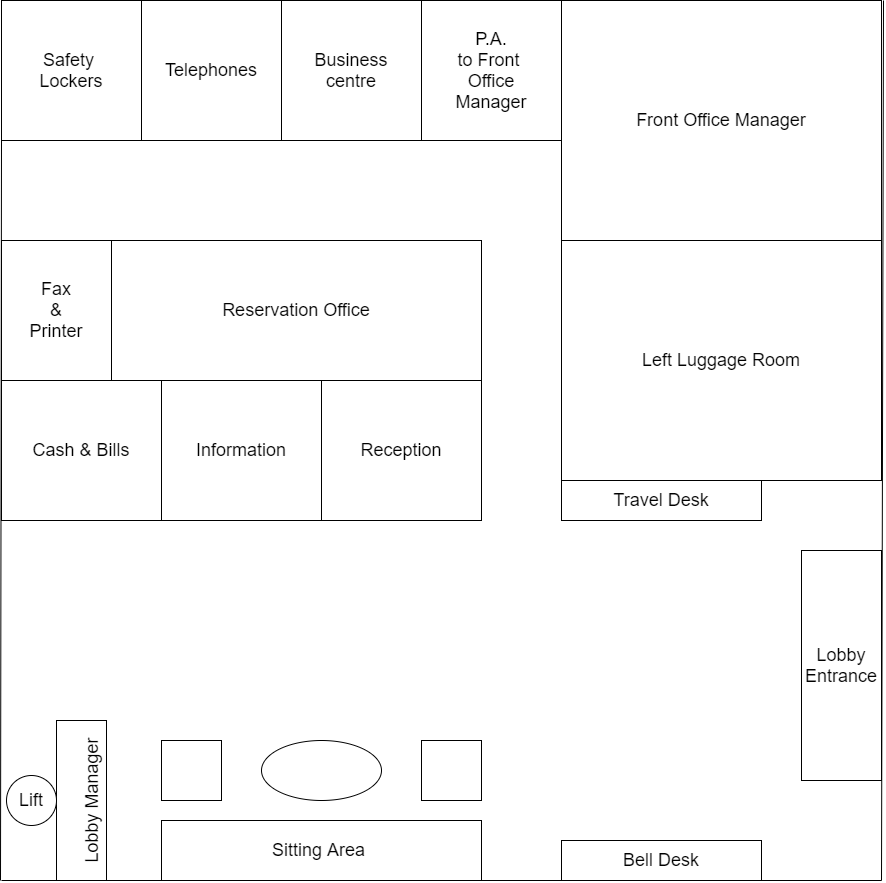
Q.2. Define the term bell desk and give step-by-step procedure for left luggage handling.
Bell desk is an extended arm of the front desk. There are many activities at the time of arrival, during the stay, and at the time of departure of the guest which cannot be carried out from the front desk but are to be carried out essentially, in order to provide services to the guest. As the name suggests it is a small desk/counter in the lobby near the main entrance of the hotel. The bell desk should be situated in clear view of the front desk, cashier, and particularly the doorman standing outside the lobby, so that the doorman may signal for a bellboy at the arrival of a guest. Further, it is also important that the bell desk is situated near the luggage center and luggage entrance.
Left Luggage Procedure
At times guest finds it inconvenient and expensive to carry their luggage to a place where they are going for a few days. Guest is expected to check out by check out time (12 noon) even if their fight is in the evening and they find it too expensive to retain the room for an extra day just to keep the luggage. Most hotels offer the left luggage room facility free of cost but some hotels do charge for it. The left luggage facility may also bring back the guest to stay in your hotel on his next visit. The procedure for receiving luggage is as such:
Before accepting the luggage, it is checked whether the guest has settled his bill or not.
- Check the baggage of the guest if it is properly locked or not. In case the baggage is damaged then the guest must be informed and note for the same must be made in the receipt. Scanty Baggage Procedure
- Luggage stickers should be pasted on all luggage pieces. A proper receipt must be made, signed by both guest and bell captain, and handed over to the guest.
- Enter the details in the left luggage register with the expected date the luggage will be picked up by the guest.
- Keep the luggage in the left luggage room under lock and key.
When the guest comes to pick up his luggage pieces from the left luggage room then the following procedure is carried out. The guest is requested to give the receipt.
In case the guest has lost the receipts then the guest is requested to sign in the left luggage register.
- Check the receipt and bring out his luggage pieces from the left luggage room.
- Make an entry in the left luggage register entering the date luggage pieces delivered.
OR
Explain the various functions of bell desk area (any ten):
Functions of Bell Desk
The senior bell captain is the in-charge of the bell desk and along with his staff performs various duties from here. The various functions performed from here are as follows.
1. Luggage handling
Luggage handling of the guest is done on various occasions such as arrival, during stay (change of room), and at the time of departure. At the time of arrival when the luggage of the guest is moved from car/taxi to the lobby and further to the allotted room, the activity is called “up bell activity”. When the luggage of the guest is moved from room to lobby and further to the car/taxi at the time of departure the activity is called “down bell activity”. The baggage is collected from the room upon request. A left luggage register is maintained in this case and an entry is made in this book. A baggage ticket (which has two parts) is used. One part is attached to the luggage and the counterfoil is given to the guest. This portion details the hotel’s liability exemption clause. When the guest comes to collect his luggage he has to produce his portion of the baggage ticket. The luggage storeroom must be secure at all times.
2. Paging
Apart from luggage handling the bell desk is also responsible for paging a guest. The paging is a system of locating the guest in the hotel. Many times the in-house guest expects a phone call or a visitor but decides not to wait in the room, and might decide to go to public areas such as a bar, restaurant. swimming pool, lobby or lounge, etc. of the hotel or may go out of the hotel. In such cases, the hotel requests the guest to tell about his whereabouts through a location form. This proforma may be kept in the stationary folds in the room as well as at the information section of the counter. Usually, it is mm in by the guest but many times it may be filled in by the hotel staff on the instructions of the guest The completed location form is kept in the key and mail racks. This information is sent to the telephone department also (the guest may directly inform or the front desk may do so). The purpose of the form is to earmark the area of paging and save time. In the case of a computer system, the information is recorded on the computer instead of the location forms.
3. Mail and Message Handling
The bell desk’s function is also to handle and distribute mail and message received by the front desk in the absence of the guests to their respective rooms. Also distribution or newspaper and magazines etc. to various rooms and the areas of the hotel and keeping a record of the same is done by the bell desk.
4. Delivery of Newspapers
As per the hotel policy, all hotel guests receive a copy of a local newspaper each morning. The bellboys in the night shift are responsible for delivering the newspapers to all occupied rooms.
The bell captain obtains the room verification report (providing information on all rooms presently occupied). The bellboy then marks the room numbers for each newspaper. The bellboy also inserts the daily newsletters in each paper provided by the public relations office the previous evening. The bellboy then distributes the newspapers. The record of numbers of newspapers received on a daily basis is maintained by the night shift bell captain.
5. Collection of Room Keys at Departure
Another very important function of the bell desk is the collection of room keys from a checkout guest and depositing the same at the information desk.
6. Miscellaneous Jobs
Miscellaneous jobs such as postage stamps handling, taking care of outgoing mail of the guest, carrying out outside errands for the guest and hotel such as buying of cinema tickets, moving of files and documents, etc. for the guest as well as going to banks, post office and FRRO police station for delivering of ‘C forms’ etc., confirming of railways/bus reservation, etc. are done by the bell desk. Bellboy shall do the outside jobs only on the instructions of hell captain. A service call slip will be prepared. Also, an entry in the logbook will be made and an entry in the bell captain’s control sheet, which is meant to control the movement of bellboys will be made. Finally when the bellboy will return an entry will be made in the service call slip and bell captain’s control sheet and will be signed by bell captain. In most hotels these days the bell desk is also responsible for car parking areas and control of revenue generated from the car parking area. At times when there is a room discrepancy, the bell desk staff helps the lobby manager in checking and sorting out of the status of the hotel.
7. Wake Call
In some hotels, the wake-up call to groups and crews is coordinated by the bell desk. In such cases, it is the responsibility of the bell captain on duty in the morning shift to prepare the wake call sheets of all the groups and crews in-house.
Q.3. Trace the history of hotel industry. Enlist the name, year of foundation, parent company and product line of five Indian and five international hotel chains.
History Of Hotels And Accommodation Industry And Their Development
The early history of accommodation for travellers can be traced back to the Greek word ‘Xenia’, which not only meant hospitality but also the protection given to a traveller from discomforts. The city was bound to offer hospitality. In Sparta city, although due to rigorous customs visitors were not encouraged, yet goddess Athena was considered as the protector of strangers and hence her name was ‘Xenia Athena’.
In this period travellers were mainly diplomats, philosophers, intellectuals and researchers. Guests were invited to stay with noblemen. In ancient Olympia, buildings constructed with the aim to accommodate strangers can be seen. They were called ‘Leonidio’ and were built in 4th century BC. The concept of hospitality can also be drawn back to ancient times. Mention of it is found in ‘Iliad’ and ‘The Odyssey’ by Homer.
During the seventh and eighth centuries, it was the monasteries that supplied hospitality to strangers and, as no charge was made for the accommodation, all travellers were expected to contribute according to their means to the Abbey funds. As more people began to travel they grouped themselves together, not only for the company but for mutual protection from highwaymen and robbers. Consequently, travellers arrived in groups at a monastery and it was often difficult to accommodate them all. In the early 19th century the concept of a hotel room was a sitting room in the front, a bedroom behind it and a storeroom to keep trunks behind the bedroom and this century is known as “Golden Age of Hotel of Hotels in Great Britain and the World”, To overcome this, separate lodging houses called ‘Inns’ (a Saxon word) were built. The word ‘lnn’ came to mean a ‘Lodging House’ and until the passing of the Hotel Proprietors Act in 1956, it was the legal term for ‘Hotel’ and hotel proprietors were legally referred to as ‘Common Innkeepers’. ‘Common’ in this sense referred to Common Law.
In the thirteenth and fourteenth centuries, manor houses, being hospitable places. willingly gave accommodation to travellers. As no payment was expected, travellers tipped the servants as a ‘thank you’ for the generous hospitality received-thus the practice of tipping was born.
When high taxes crippled the generosity and hospitality of the owners of the manor houses, many became commercial inns. During Elizabeth the First’s reign, posting houses were established and travellers, in addition to getting refreshment were able to change horses before continuing their Journey.
The turn of the century saw an era that was called the ‘Belle Epoch’ when the grand and luxurious hotels flourished. A few hotels are still operating today. In London and some other cities attempts have been made to recapture some of the grandeur of the past era in the making of modern hotels, and bring back the memories the grand hotels of olden days.
The next stage in the cycle of evolution of the hotel industry was the coming of the motor car. It enabled people to visit those parts of the country which could not be reached by railways. This gave birth to inland resorts and the hotel industry began to flourish.
International air travel has helped create the modern ‘stop-over’ hotel. With the increase in this form of travel, the number of hotels built close to airports has multiplied.
Another trend in hotelkeeping is the motel which is the twentieth-century version of the old ‘Coach Inn’. People travelling the country by car, stopping overnight here and there, require not only refreshment for themselves but also safe parking for their cars. Post Houses developed by the Trust Houses Forte Group are in fact the modern version of the old coaching inns. Great Britain is considered as “Motherland of the Hotel Industry.”
Indian chains
1) Pallanjee Pestonjee (1840): Started 1st luxurious hotel in Bombay. It was famous for its excellent cuisine, beers and wines and its excellent management. Later he opened another hotel at Fort in Bombay.
2) Auckland Hotel (1843) was established in Calcutta. Later it was renamed as Great Eastern Hotel in 1858 and later renovated for a sum of Rs 10 lacks.
3) Esplanade Hotel (1871): Was built in Calcutta by John Wakson (Britisher) a silk drapery merchant. The hotel has 130 rooms.
4) Taj Group of hotels: In 1903 JRD Tata constructed the Taj Mahal Hotel in Bombay the flagship hotel of Indian hotels company. It was the 1st hotel of international standard and repute, built by an Indian for Indians.
Taj Mahal Hotel, Mumbai
5) Welcome Group: It is the hotel division of I.T.C ltd. ITC entered into the hotel business in 1975 with the opening of Hotel Chola Madras. The logo represents a traditional Indians welcome in the form of ‘Namaste’ in an open doorway with the slogan “Nobody gives you India like we do” The motto of welcome Group is “We enjoy people”.
6) Oberoi Hotels: Rai Bahadur M.S. Oberoi started his hotel career as a clerk in 1922 at Faletti’s Cecil Hotel in Shimla. Later Mr. Ernest Clarke sold his share to Mr. M.S Oberoi who under the deed of dissolution dated August 14, 1943, became the sole, absolute and exclusive owner of Clarke’s Hotel, Shimla and Delhi. Mr. Oberoi later took over the Grand Hotel at Calcutta on lease and by the end of World War 2 the Grand Hotel became a byword for good service and elegant comfort in hotels.
International chains
1) Accor: It is a French hotel group, which operates in 92 countries Headquartered in Paris, France, the group owns, operates and franchises 3,600 hotels on 5 continents representing several diverse brands, from budget and economy lodgings to luxurious accommodations in exotic locales.
2) Best Western International: Operator of the Best Western Hotel brand is the world’s largest hotel chain, with about 4,200 hotels in over 110 countries. The chain, with its corporate headquarters in Phoenix, Arizona operates 2,163 hotels in North America alone.
3) Carlson Rezidor Hotel Group: Is an international hotel company, with headquarters in Minneapolis, USA and Brussels, Belgium. The Carlson Rezidor Hotel Group includes more than 1,300 hotels in operation and under development in over 100 countries, employing over 88,000 staff. The hotel brands include Radisson Hotels, Radisson Blu, Country Inns & Suites, Park Inns, Park Plaza Hotels & Resorts, Hotel Missoni and newly announced brands
Radisson Red.
4) Four Seasons Hotels: Is a Canadian international luxury, five-star hotel Management Company. Travel + Leisure magazine and Zagat Survey rank the hotel chain’s 98 properties among the top luxury hotels worldwide
5) Hilton Hotels: It an American global hospitality company. It is owned by the Blackstone Group, a private equity firm. The company owns, manages, and/or franchises a portfolio of brands which includes Waldorf Astoria Hotels and Resorts, Conrad Hotels & Resorts, Hilton Hotels & Resorts, Doubletree (DoubleTree by Hilton), Embassy Suites Hotels, Hilton Garden Inn, Hampton Inn and Hampton Inn & Suites, Homewood Suites by Hilton, Home2 Suites by Hilton and Hilton Grand Vacations. It was founded by Conrad Hilton in Cisco, Texas and was headquartered in Beverly Hills, California.
Q.4. Define the term hotel and classify it on different basis. Also give the single and double room sizes of star categorized hotels.
Various definitions of Hotel
- Common-Law states that a “Hotel is a place where all who conduct themselves properly, and who being able to pay and ready to pay for their entertainment, are received if there be accommodation for them, and who without any stipulated engagement as to the duration of their stay or as to the rate of compensation, are while there, supplied at a reasonable cost with their meals, lodging and other services and attention as are necessarily incident to the use as a temporary home.”
- A hotel may be called as an establishment where the primary business is to provide to the general public lodging facilities and which may also furnish one or more of the various services such as food, beverage, laundry, uniformed services etc. Hence, a hotel can also be called as home multiplied by commercial activities.
- According to the Encyclopaedia Britannica, the word ‘Hotel’ is of ancient origin, but its use in English for a house offering lodging and food for travellers is recent. The Hostlers of London took the name of Innkeeping in 1473. The word ‘Hostler’ or ‘Ostler’ has come to mean an inn servant.
- The term ‘Hotel’ was used in England in about 1760. Hotel or inn is defined by British law as a “place where a bonafide traveller can receive food and shelter, provided he is in a position to pay for and is in a fit condition to be received”.
- A hotel or an inn may also be defined as an establishment whose primary business is providing lodging facilities for the general public and which furnishes one or more of the following services
- Food and Beverage service
- Room service
- Uniformed service
- Laundry service and
- Use of furniture and fixture etc.
In legal terminology, a hotel is an inn and is required under common law to offer to its visitor’s lodging, food and protection to their baggage. Hotel service is generally based on these three fundamental necessities of life. In addition to these, a modern hotel provides its visitors with many luxuries of modern urban city living, all under one roof.
The room size or area of Single Rooms are generally between 37 m² to 45 m².
Double: A room assigned to two people. May have one or more beds. The room size or area of Double Rooms are generally between 40 m² to 45 m².
OR
Define the term inn. Give any eight examples of supplementary accommodation and explain each briefly.
Inns are generally establishments or buildings where travelers can seek lodging, and usually, food and drink. Inns are typically located in the country or along a highway; before the advent of motorized transportation they also provided accommodation for horses.
The Types of Supplementary Accommodations
These hotels offer meals and a place to sleep. The facilities in these hotels are minimal. The room charges are based on the services provided. Therefore, these types of hotels have the following advantages:
- It is more reasonable than the star hotels
- Also offers a close approach to the natural environment
- It provides a platform for social contact and amusement.
Tourist Bungalows
These bungalows are located at tourist centers to cater to the needs of travelers. The facilities are moderate and minimal. Mostly, the middle-class and budget traveler prefer these types of hotels.
Besides, we often see the budget youth travelers coming from overseas choose this type of hotel. The hotel provides the basic services and facilities that are suitable to meet the requirements of the budget travelers. The price of the room depends on the services and facilities of the hotel.
This kind of hotel provides a friendly environment that is suitable for family travelers. Therefore, the structure of the hotel is relatively smaller than the star hotels.
Circuit House
These houses are superior in terms of facilities as compares to tourist bungalows. Therefore, the hotel is suitable for senior government officials and student groups.
The guests in this hotel can use the rooms with facilities according to the requirements. Besides, there is a large hall with several single beds. Each bed has shelves, common toilets, and showers. The price of the room is nominal. However, they do not provide food.
Dak Bungalows
These hotels cater the government duty officials. Therefore, the hotel is like a small residential building with a limited number of rooms.
The hotels are located from a public works perspective in a significant location. Thus, the facilities in these hotels are moderate and the rooms are at low prices.
Boarding House
This type of hotel provides accommodation usually with meals at a definite time, week, or month. It is a small enterprise that is perfect for guests who are staying for a certain duration. Therefore, the booking has to be done in advance.
Paying guest accommodation
The idea of this type of hotel was from the British. It has now become popular in India. Many international travelers prefer this kind of hotel.
Besides, it allows travelers to communicate with Indian families because the owner and the guests stay in the same building. The advantage of this system is that it responds quickly to the seasonal needs of the guests. In Rajasthan and Goa, it is very common.
Youth Hostel
The idea was launched in 1900. A youth hostel provides a clean, easy, affordable place to stay for young individuals. This kind of hostel is popular amongst the young budget domestic travelers. Thus, young travelers while traveling on holidays or for educational reasons prefer this type of stay.
The youth hostel provides a place where young people with different social and national backgrounds can meet and understand each other. Also, the comfort is modest, stays are limits and costs are low.
Travel Lodge
This is a simple hotel located in a remote location. Besides, it is quite famous at the remote tourist destination. The lodge’s rooms are comfortable and air-conditioned.
Most of the basic requirements are serve in these lodges. Besides basic requirements, daily needs are available in these lodges. As it is not feasible for visitors to go to distant cities to buy daily needs, therefore, they provide a dining room with fixed or slightly improved menus and daily necessities such as oil, comb, towels, tea, and coffee, etc.
Hospices
This type of hotel caters to the need of people who travel primarily for a religious reason. The property owner provides housing pilgrims who can find a place to sleep, a fire to keep warm, and something to eat.
Q.5. Define the term movement list and give step-by-step procedure for check-in of a guest.
Movement list is a document that contains the name of expected arrival and expected departure for the next day.
step-by-step procedure for check-in of a guest
Stage 1: Receiving and Registration
- Receive the guest in front of the house
- Open the door and welcome the guest.
- The doorman informs the bell desk to pick-up the guest baggage.
- Bring the luggage and baggage into the lobby (Incase the bell desk team not available then the doorman should assist with the baggage.)
- Escort the guest up to reception desk (usually done by the bellboy/porter)
- Provide welcome drink and welcome gift if any (Like Spice Garland, Spice box, Juice etc.)
- Receive the guests at the reception
- Welcome the guest promptly with a cheerful and pleasant smile.
- Address with the appropriate surname, if known.
- Request for the reservation details like guest last name, confirmation no., booking source etc.
- Request for the guest id card or passport.
- Request for the guest business card.
- Register the guest – Complete the registration card or register the guest
- Verify the information on the registration against the reservation ensuring the accuracy of name, date, and payment mechanism.
- Stamp check-in time on the registration card.
- Show check-in in the hotel software/PMS.
- Carry out the final check of the registration card for the guest signature.
- Discuss room preference with guest as per the availability, or select an available room which is “ready to let” and allocate the room.
- Take a note of the expected departure details.
- Take note of the airport drop, any special request etc.
Stage 2: Allocation of the room
- Allocation of the room means assigning a vacant and ready (VR) room to the guest for staying (if this was not done already).
- For repeat guest assign room as per the preference.
- In order to allocate a guest room, accurate room status information is required. For this purpose, a room status board or room rack is kept in the reception.
- When the room has been allocated, the reception should; Block or code the room as sold.
- Prepare key card of related room number by entering the arrival and departure date, rate and offer it to the guest for signature.
- Give the room key to either the guest or the bellboy.
- Record guest arrival on daily arrival list.
Stage 3: Secure Advance Payment
- Advance payment should be done for security purpose. It is usually done by accepting a cash deposit or taking a credit card.
- While handling advance deposit, whether cash/ cheque, always:
- Issue a receipt for cash/ cheque and record the payment in the guests ‘ledger.
- Accept credit card and evaluate for its credit limit and availability.
- Get the imprint of the card and obtain a guest signature.
- Get a pre-authorization (pre-auth) from the Credit Card company or EDC machine for the required amount and record the same to the reservation.
Stage 4: Information Service
- The receptionist is responsible for informing guest about the facilities and services offered by the hotel. This helps the guest to familiarize about the hotel facilities and also to increase the sale. At this point, the receptionist should;
- Acknowledge the guest about the hotel’s activities, facilities, and service with direction and location.
- Enquire if the guest requires a wake-up call. If so, record it correctly.
Stage 5: Complete the check-in formalities
- After the check-in formalities are completed;
- The bellboy or the GRE should escort the guest up to the allocated room.
- Inform other departments and sections about the guest arrival by arrival notification slip.
Stage 6: Open the guest folio
- Open guest bill/ folio/folder and clear any old bill copies.
- Record the key information for billing purpose (room rate, number of nights, departure date and mode of payment).
- File the bill in the guests’ folio box together with the completed registration card.
OR
Briefly explain any ten personality traits of front line staff.
to be successful in any human relationship you must reflect these characteristics: –
- A warm personality, and smart appearances.
- A keen interest in people, and polite and courteous nature
- Poise under pressure, keeping his cool and problem solver.
- A desire to be helpful, but also diplomatic and tactful.
- The ability to listen, hard-working, and punctual.
- A willingness to reflect management policy should be able to make quick decisions, The ability to get along with co-workers, and a pleasant approach and a good motivator and coordinator.
- A desire to be liked, with good public relation qualities.
- The ability to help another employee without resenting it or showing imitation. You should be confident, analytical, intelligent and a good salesman.
- Neat personal habits.
- Good memory (should be able to remember names of regular guests)
- Knowledge of languages.
- Numerical ability.
- Reference point.
- Image Builder.
Q.6. Differentiate between timeshare and condominium.
Timeshare
Time-share hotels are referred to as vacation ownership hotels. The concept is that for a set period which may be one week or more in a year the person gets the right to enjoy the stay and other facilities and services in an apartment are any other type of lodging in a tourist complex. It is like an advanced purchase of time in holiday accommodation. Here the purchaser has to pay a one-time capital sum and then an annual contribution towards the maintenance of the property. The fee usually covers services such as cleaning and maintenance of apartment and public areas, electricity, gas, water, etc. Avalon resorts. Sterling resort, Mahindra holding, etc. are the few time-share hotels in India.
Condominiums
involve joint ownership of a complex. Each owner has the full benefit of a unit and shares the cost that is common to the entire complex such as taxes, maintenance, upkeep of the building, etc. each owner can occupy or sell his unit independently but is obliged under the terms of the contract to contribute towards the pool of common facilities and services. The owner can enjoy recreational exclusive to the complex and the management looks after the unit in the absence of the owner and if permitted by the owner let it out to provide income to him.
OR
Define the term timeshare hotel. Classify the different types of timeshare.
Time-share hotels are referred to as vacation ownership hotels. The concept is that for a set period which may be one week or more in a year the person gets the right to enjoy the stay and other facilities and services in an apartment are any other type of lodging in a tourist complex. It is like an advanced purchase of time in holiday accommodation. Here the purchaser has to pay a one-time capital sum and then an annual contribution towards the maintenance of the property. The fee usually covers services such as cleaning and maintenance of apartment and public areas, electricity, gas, water, etc. Avalon resorts. Sterling resort, Mahindra holding, etc. are the few time-share hotels in India.