
Table of Contents
Q.1. Draw and describe the process of Strategic Management. List the elements of Strategic Management. (5+5=10)
The strategic management process means defining the organization’s strategy. It is also defined as the process by which managers make a choice of a set of strategies for the organization that will enable it to achieve better performance.
Strategic management is a continuous process that appraises the business and industries in which the organization is involved; appraises it’s competitors; and fixes goals to meet all the present and future competitors and then reassesses each strategy.
The Strategic Management has the following steps:

1. Environmental Scanning
Environmental scanning refers to a process of collecting, scrutinizing and providing information for strategic purposes. It helps in analyzing the internal and external factors influencing an organization. After executing the environmental analysis process, management should evaluate it on a continuous basis and strive to improve it.
2. Strategy Formulation
Strategy formulation is the process of deciding best course of action for accomplishing organizational objectives and hence achieving organizational purpose. After conducting environment scanning, managers formulate corporate, business and functional strategies.
3. Strategy Implementation
Strategy implementation implies making the strategy work as intended or putting the organizations chosen strategy into action. Strategy implementation includes designing the organizations structure, distributing resources, developing decision making process, and managing human resources.
4. Strategy Evaluation
Strategy evaluation is the final step of strategy management process. The key strategy evaluation activities are: appraising internal and external factors that are the root of present strategies, measuring performance, and taking remedial / corrective actions. Evaluation makes sure that the organizational strategy as well as its implementation meets the organizational objectives.
These elements are steps that are carried, in chronological order, when creating a new strategic management plan. Present businesses that have already created a strategic management plan will revert to these steps as per the situations requirement, so as to make essential changes.
Elements of Strategic Management
Organizations are supposed to select the directions in which it will move towards. Strategic management has three major elements, which include strategic analysis, strategic choice, and strategy implementation.
1. Strategy Analysis
Strategy analysis is usually concerned with understanding the organizations strategic position. This is an element that is concerned with the changes that are going on in the environment and how the changes are going to affect the activities of the organization. Other factors that are considered in this element are the strength of the resources in the organization, in the context of the changes. It also focuses on what the associated groups in the organization aspire to and how the changes affect the present position and the future position of the organization. Strategic analysis usually aims at creating a view of the factors that can have an impact on the future and present performance of the organization. When strategic management is performed in the right manner, it helps in selecting the correct strategy.
2. 2. Strategic Choice
Strategic analysis usually creates a foundation for strategic choice. After a strategic analysis has been done, it is now ready to make a strategic choice. Strategic choice is normally defined as the practice of selecting the best possible course of action, and it is usually based on the evaluation of the available strategic options. Strategic choice has three parts that include the generation of strategic options, evaluation of the options, and selection of the strategy. During strategic choice, there may be many strategic options; therefore, it is necessary to ensure that the selected option is the best.
3. Strategy Implementation
This is the third major element of strategic management that is concerned with strategy translation into action. This is the stage where the strategy is translated to action. The implementation of the strategy requires the proper deployment of the organization resources, effective change management, careful handling of the possible changes in the structure of the organization, and also careful planning. There are several parts that are involved in strategy implementation. The first part is in the planning and allocation of resources. During implementation, it is involved with resource planning that includes the logistic of implementation. The second part is the organization’s design and structure. During strategy implementation, there are certain changes in organizational structure that should be done. It is also likely for the need to arise for adapting the system used in managing the organization. The third part is the management of strategic change.
Or a. Explain the importance of mission statement for an organisation. (5)
Importance of Mission Statement:
1. Works as a navigation tool
The growth and success of any organization are dependent on its short term and long term objectives. And it is very important for the firm to carefully craft and follow the way forward accomplishing all the aims and objectives.
When the firm and its management realize and follow the Importance of Mission Statement, they have a clear and perfect blueprint in hand as mission statement works as one of the finest navigation tools to attain all the goals and objectives amidst all the obstacles and bottlenecks at the marketplace.
2. Helps to maintain your focus, energy, and attention
The mission statement of the firm is not just framed with an intention to give you and your firm a jump start at the very beginning. In fact, the actual intention behind the same is to help and guide you through your entire professional journey amidst all the business cycles and evolutions.
3. When the firm is battling with all the internal and external market-related issues, it helps you to maintain your focus, energy, and attention on the end goal and the vision statement. And this attribute helps in ironing out all the flaws and issues in the most seamless and strategic manner.
3) Helps to come up with new and innovative ideas
As mentioned earlier that realizing the Importance of Mission Statement helps the firm to come up with the strategic ideas and way forward holds quite an imperative place for a firm. It also helps to spark new and fresh ideas that are untouched, untapped, unraveled, and outlandish in their approach.
As the mission statement is framed not with an objective to keep the firm stuck to the old and traditional ideas but to embrace the changing dynamics and the evolving tastes and preferences of the target market and audience.
4. Helps to shape the work culture
Having a mission statement well aligned with the core values and fundamentals of the firm is quite necessary as it also helps in shaping the work culture of the organization. And work culture is quite a significant element of the entire brand architecture and the organizational structure as it talks about the core values, employee motivation, and decision making aspects of the firm.
It is also the responsibility of the HR department of the firm to integrate the aspects of mission statement in the firm’s rules and policies.
5. Sends out a brand message in the market
As mentioned earlier, the mission statement of the firm is framed in alignment with the core values and objectives of the firm. It is also an integral part of the brand architecture of the firm. It is important to display the same in the company’s website, corporate brochure, brand books, and all the other crucial documents talking about the firm’s plans and objectives.
Other importance :
• Decides the direction.
• Clarify organizational aspirations.
• Acts as a reference point.
• Integrating the organisation with the environment.
• Integrating various subsystems.
• Conveys a message about the organisation.
b. Write a mission statement for upscale hotel chain. (5)
The Oberoi Group Mission
Our Guests
We are committed to meeting and exceeding the expectations of our guests through our unremitting dedication to perfection to every aspect of service.
Our People
We realise that people are our true assets. We are totally committed to their growth, development and welfare.
Our Distinctiveness
Together we shall continue the Oberoi tradition of pioneering in the hospitality industry, striving for unsurpassed excellence in high potential locations all the way from the Middle East to the Asia-Pacific.
Our Shareholders
We believe it is our responsibility and duty to create extraordinary value for our shareholders. They have reposed their trust in us and our abilities.
Q.2. What do you understand by Strategic approaches? List atleast five approaches and describe. (10)
Strategic approach is an organization’s process of defining its strategy, or direction, and making decisions on allocating its resources to pursue this strategy. It is here that priorities are set. It may also extend to control mechanisms for guiding the implementation of the strategy. Strategic planning became prominent in corporations during the 1960s and remains an important aspect of strategic management. It is executed by strategic planners or strategists, who involve many parties and research sources in their analysis of the organization and its relationship to the environment in which it competes.
The various approaches applicable for development strategies are as follows:
1. Adaptive Approach
2. Intuition approach
3. Strategic Factor Approach
4. Entrepreneurial approach
5. Niche approach
1. Adaptive Approach
This approach is based on developing strategies in view of the perceived changes in the environment at a given point of time, and formulating a set of decision rules leading towards an appropriate solution in successive steps.
2. Intuition Approach
This approach is based on developing strategies in view of the intuition of the promoter or chief executive of the organization, with little or no interference from others in the organization. They move on the basis of prior experience in a similar setting for decision making.
3. Strategic Factor Approach
This approach is based on developing strategies by determining the strategic factors are crucial for organizational success. The strategic factors existing in the different functional areas of the organization are: finance, marketing, personnel, operations and so on.
4. Entrepreneurial approach
This approach is based on developing strategies by a constant search for opportunities existing in the environment and exploiting them for the benefit of the organization.
According to Drucker, “the entrepreneur always searches for change, responds to it and exploits it as an opportunity”. This approach is generally adopted by young executives and the heads of the family-owned businesses.
5. Niche Approach
This approach is based on developing strategies by picking propitious niches in which the organization wishes to operate. A ‘niche’ is a sub segment of a major market segment that no other firm has chosen to enter directly. For example, a particular buyer group, geographical area, or segment of production line.
Or What do you understand by the term ‘objectives’ & ‘goals’ ? Explain these terms by giving five examples each. (10)
Goals and objectives are important to almost any business plan, and they help teams focus on a desired outcome. Although goal and objective are terms often used interchangeably, they hold different meanings and serve a different function. Having clear definitions of both can be a great first step in planning projects and helping your team achieve success.
Goal
A goal is an end result you want to achieve. It is typically a general and overarching idea expressed clearly, concisely and descriptively. It is a long-term and time-sensitive indicator of where you hope to be in the future. A goal is the aim of a project in terms of what should be accomplished. Goals are normally singular and expressed as a single sentence that specifies the desired outcome, the anticipated date it is to be achieved and the resources required. Your goals for your company or organization are typically aligned with your vision, mission and ideals.
Examples
1. I want to achieve success in the field of genetic research and do what no one has ever done.
2. Create and launch new product(s)
3. Increase customer conversion
4. Become market leader
5. Increase revenues
Objective
An objective is a specific action or step that you plan to take to achieve your goals. In other words, they are the smaller, more achievable parts of a goal, or the means by which a goal is attained. Objectives are time-bound and have more immediate deadlines than goals do. Objectives are easily quantifiable and delineate specific and limited actions that need to be taken at a specific time. Objectives help team members maintain a focus and keep moving toward the overall goal. As indicators of a goal being attained or approached, objectives also serve as a means of encouragement.
Objectives are strategic, clear results that an individual or team aims to achieve. They can be specific to a certain project, team or department and change periodically to help groups accomplish their overall goals.
Examples
1. I want to complete the thesis on genetic research within this month.
2. Achieving Financial Success
3. Increasing Sales Figures
4. Improving Human Resources
5. Retaining Talented Employees
6. Focusing on Customer Service
Differences between Objective & Goals
• Goals are broad, general statements
• Objectives are individual and specific
• Goals are intended to be for an entire team or organization
• Objectives are tailored to individuals and groups within a team or organization
• Goals are constant and long-term
• Objectives are specific and quantifiable steps taken to achieve a goal
• Objectives are bound to goals, but goals are not bound to objectives
Q.3. Write Short Note on any two (2×5=10)
a. Forward Integration
Forward integration is a business strategy where the company merge with or acquire a company that provides services to deliver the product to the end customer. This alliance can be with an intermediate distributor or a retailer.
E.g. If a brewery enters into an alliance with a company selling beer, this is a form of forward Integration
Disney provides a sound real life company example of forward integration where the company purchased more than 300 retail stores that sell merchandise based on Disney characters and movies.
b. SWOT analysis
SWOT analysis is a framework used to evaluate a company’s competitive position by identifying its strengths, weaknesses, opportunities and threats. Specifically, SWOT analysis is a foundational assessment model that measures what an organization can and cannot do, and its potential opportunities and threats.
The name says it: Strength, Weakness, Opportunity, and Threat. A SWOT analysis guides you to identify the positives and negatives inside your organization (S-W) and outside of it, in the external environment (O-T). Developing a full awareness of your situation can help with both strategic planning and decision-making.
The SWOT method (which is sometimes called TOWS) was originally developed for business and industry, but it is equally useful in the work of community health and development, education, and even personal growth.
SWOT is not the only assessment technique you can use, but is one with a long track record of effectiveness. The strengths of this method are its simplicity and application to a variety of levels of operation.
Use of SWOT analysis
A SWOT analysis can offer helpful perspectives at any stage of an effort. We might use it to:
• Explore possibilities for new efforts or solutions to problems.
• Make decisions about the best path for your initiative. Identifying your opportunities for success in context of threats to success can clarify directions and choices.
• Determine where change is possible. If you are at a juncture or turning point, an inventory of your strengths and weaknesses can reveal priorities as well as possibilities.
• Adjust and refine plans mid-course. A new opportunity might open wider avenues, while a new threat could close a path that once existed.
• SWOT also offers a simple way of communicating about your initiative or program and an excellent way to organize information you’ve gathered from studies or surveys.
c. McKinsey’s 7 framework
The McKinsey 7S Framework is a management model developed by well-known business consultants Robert H. Waterman, Jr. and Tom Peters (who also developed the MBWA– “Management By Walking Around” motif, and authored In Search of Excellence) in the 1980s. This was a strategic vision for groups, to include businesses, business units, and teams. The 7S are structure, strategy, systems, skills, style, staff and shared values.
The model is most often used as a tool to assess and monitor changes in the internal situation of an organization.
The model is based on the theory that, for an organization to perform well, these seven elements need to be aligned and mutually reinforcing. So, the model can be used to help identify what needs to be realigned to improve performance, or to maintain alignment (and performance) during other types of change.
Whatever the type of change – restructuring, new processes, organizational merger, new systems, change of leadership, and so on – the model can be used to understand how the organizational elements are interrelated, and so ensure that the wider impact of changes made in one area is taken into consideration.
Objective of the model
• To analyze how well an organization is positioned to achieve its intended objective
Usage
• Improve the performance of a company
• Examine the likely effects of future changes within a company
• Align departments and processes during a merger or acquisition
• Determine how best to implement a proposed strategy.
The Seven Interdependent Elements
• The basic premise of the model is that there are seven internal aspects of an organization that need to be aligned if it is to be successful
A. Hard Elements
• Strategy
• Structure
• Systems
B. Soft Elements
• Shared Values
• Skills
• Style
• Staff

d. Environmental Scanning
In any business organization, there is an internal and external environment. They comprise all the factors that can affect the business of a company in any way. And they also present opportunities for the business to grow and threats that may harm the business. So these environments need constant monitoring. This is where environmental scanning comes into the picture.
Environmental scanning meaning is the gathering of information from an organizations internal and external environments, and careful monitoring of these environments to identify future threats and opportunities. It is the analyses of all factors that may affect the future of the organization.
The purpose of this process of environmental scanning is to provide the entrepreneur with a roadmap to the changes likely to happen in the future. So this way they can adapt the business to overcome the threats and capitalize on the opportunities coming their way.
Importance of Environmental Scanning
1. SWOT Analysis
2. Best Use of Resources
3. Survival and Growth of the Business
4. Planning for Long Term
5. Helps in Decision Making
Q.4. Illustrate Environmental Threat and Opportunity Profile (ETOP) for a chain of budget hotel project ? (5)
Environmental Threat and Opportunity Profile (ЕТОР)
The Environmental factors are quite complex and it may be difficult for strategy managers to classify them into neat categories to interpret them as opportunities and threats. A matrix of comparison is drawn where one item or factor is compared with other items after which the scores arrived at are added and ranked for each factor and total weight age score calculated for prioritizing each of the factors.
This is achieved by brainstorming. And finally the strategy manger uses his judgment to place various environmental issues in clear perspective to create the environmental threat and opportunity profile.
Although the technique of dividing various environmental factors into specific sectors and evaluating them as opportunities and threats is suggested by some authors, it must be carefully noted that each sector is not exclusive of the other.
Each of the major factors pertaining to a particular sector of environment may be divided into sub-sectors and their effects studied. The field force analysis goes hand in glove with ETOP, as here also the contribution with regard to opportunities and threats posed by the environment is also a necessary part of study.
ETOP Preparation
The preparation of ETOP involves dividing the environment into different sectors and then analyzing the impact of each sector on the organization. A comprehensive ETOP requires subdividing each environmental sector into sub factors and then the impact of each sub factor on the organization is described in the form of a statement.

Q.5. Classify grand strategy alternatives. Explain any two alternatives. (5)
The Grand Strategies are the corporate level strategies designed to identify the firm’s choice with respect to the direction it follows to accomplish its set objectives. Simply, it involves the decision of choosing the long term plans from the set of available alternatives. The Grand Strategies are also called as Master Strategies or Corporate Strategies.
The Grand Strategy is classified inti 4 categories
1. Stability Strategy
Stability strategy implies continuing the current activities of the firm without any significant change in direction. If the environment is unstable and the firm is doing well, then it may believe that it is better to make no changes. A firm is said to be following a stability strategy if it is satisfied with the same consumer groups and maintaining the same market share, satisfied with incremental improvements of functional performance and the management does not want to take any risks that might be associated with expansion or growth.
Stability strategy is most likely to be pursued by small businesses or firms in a mature stage of development.
Stability strategies are implemented by ‘steady as it goes’ approaches to decisions. No major functional changes are made in the product line, markets or functions.
However, stability strategy is not a ‘do nothing’ approach nor does it mean that goals such as profit growth are abandoned. The stability strategy can be designed to increase profits through such approaches as improving efficiency in current operations.
Why do companies pursue a stability strategy?
a. The firm is doing well or perceives itself as successful
b. It is less risky
c. It is easier and more comfortable
d. The environment is relatively unstable
e. Too much expansion can lead to inefficiencies.
Situations where a stability strategy is more advisable than the growth strategy:
a. if the external environment is highly dynamic and unpredictable
b. Strategic managers may feel that the cost of growth may be higher than the potential benefits
c. Excessive expansion may result in violation of anti trust laws
Types of Stability Strategy
a. Profit Making Strategy
The Profit Strategy is followed when an organization aims to maintain the profit by whatever means possible. Due to lower profitability, the firm may cut costs, reduce investments, raise prices, increase productivity or adopt any methods to overcome the temporary difficulties.
b. No Change Strategy
The No-Change Strategy, as the name itself suggests, is the stability strategy followed when an organization aims at maintaining the present business definition. Simply, the decision of not doing anything new and continuing with the existing business operations and the practices referred to as a no-change strategy.
c. The Pause/Proceed with Caution Strategy
The Pause/Proceed with Caution Strategy is well understood by the name itself, is a stability strategy followed when an organization wait and look at the market conditions before launching the full-fledged grand strategy.
2. Retrenchment Strategy
A retrenchment grand strategy is followed when an organization aims at a contraction of its activities through substantial reduction or the elimination of the scope of one or more of its businesses in terms of their respective customer groups, customer functions, or alternative technologies either singly or jointly in order to improve its overall performance. E.g.: A corporate hospital decides to focus only on special treatment and realize higher revenues by reducing its commitment to general case which is less profitable.
The growth of industries and markets are threatened by various external and internal developments (External developments – government policies, demand saturation, emergence of substitute products, or changing customer needs. Internal Developments – poor management, wrong strategies, poor quality of functional management and so on.) In these situations the industries and markets and consequently the companies face the danger of decline and will go for adopting retrenchment strategies. E.g.: fountain pens, manual type writers, tele printers, steam engines, jute and jute products, slide rules, calculators and wooden toys are some products that have either disappeared or face decline.
Types of retrenchment strategies
a. Turnaround Strategies
Turn around strategies derives their name from the action involved that is reversing a negative trend. There are certain conditions or indicators which point out that a turnaround is needed for an organization to survive. They are:
• Persistent Negative cash flows
• Negative Profits
• Declining market share
• Deterioration in Physical facilities
• Over manning, high turnover of employees, and low morale
• Uncompetitive products or services
• Mis management
b. Divestment Strategies
A divestment strategy involves the sale or liquidation of a portion of business, or a major division. Profit centre or SBU. Divestment is usually a part of rehabilitation or restructuring plan and is adopted when a turnaround has been attempted but has proved to be unsuccessful. Harvesting strategies a variant of the divestment strategies, involve a process of gradually letting a company business wither away in a carefully controlled manner.
Reasons for Divestment
• The business that has been acquired proves to be a mismatch and cannot be integrated within the company. Similarly a project that proves to be in viable in the long term is divested
• Persistent negative cash flows from a particular business create financial problems for the whole company, creating a need for the divestment of that business.
• Severity of competition and the inability of a firm to cope with it may cause it to divest.
• Technological up gradation is required if the business is to survive but where it is not possible for the firm to invest in it. A preferable option would be to divest
• Divestment may be done because by selling off a part of a business the company may be in a position to survive
• A better alternative may be available for investment, causing a firm to divest a part of its unprofitable business.
• Divestment by one firm may be a part of merger plan executed with another firm, where mutual exchange of unprofitable divisions may take place.
• Lastly a firm may divest in order to attract the provisions of the MRTP Act or owing to oversize and the resultant inability to manage a large business.
E.g.: TATA group is a highly diversified entity with a range of businesses under its fold. They identified their non – core businesses for divestment. TOMCO was divested and sold to Hindustan Levers as soaps and a detergent was not considered a core business for the Tata’s.
c. Liquidation Strategies
A retrenchment strategy which is considered the most extreme and unattractive is the liquidation strategy, which involves closing down a firm and selling its assets. It is considered as the last resort because it leads to serious consequences such as loss of employment for workers and other employees, termination of opportunities where a firm could pursue any future activities and the stigma of failure. So it involves selling off or closing down a firm to avoid bankruptcy and securing a better deal for shareholders than running at a loss.
3. Expansion Strategy
4. Combination Strategy
Or With the help of neat diagram, explain Michael Porter’s five forces of competition. (5)
Porter’s five forces analysis is a framework for industry analysis and business strategy development formed by Michael E. Porter of Harvard Business School in 1979. It draws upon industrial organization (IO) economics to derive five forces that determine the competitive intensity and therefore attractiveness of a market. Attractiveness in this context refers to the overall industry profitability. An “unattractive” industry is one in which the combination of these five forces acts to drive down overall profitability. A very unattractive industry would be one approaching “pure competition”, in which available profits for all firms are driven to normal profit.
Three of Porter’s five forces refer to competition from external sources. The remainder are internal threats.
Five forces

1. Intensity of Competitive Rivalry
For most industries, the intensity of competitive rivalry is the major determinant of the competitiveness of the industry.
• Sustainable competitive advantage through innovation
• Competition between online and offline companies
• Level of advertising expense
• Powerful competitive strategy
2. Threat of new competition
Profitable markets that yield high returns will attract new firms. This results in many new entrants, which eventually will decrease profitability for all firms in the industry. Unless the entry of new firms can be blocked by incumbents, the abnormal profit rate will tend towards zero (perfect competition).
• The existence of barriers to entry (patents, rights, etc.) The most attractive segment is one in which entry barriers are high and exit barriers are low. Few new firms can enter and non-performing firms can exit easily.
• Economies of product differences
• Brand equity (the commercial value that derives from consumer perception of the brand name of a particular product or service, rather than from the product or service itself.)
• Switching costs or sunk costs
• Capital requirements
• Access to distribution
• Customer loyalty to established brands
• Absolute cost
• Industry profitability; the more profitable the industry the more attractive it will be to new competitors.
3. Threat of substitute products or services
The existence of products outside of the realm of the common product boundaries increases the propensity of customers to switch to alternatives. Note that this should not be confused with competitors’ similar products but entirely different ones instead. For example, tap water might be considered a substitute for Coke, whereas Pepsi is a competitor’s similar product. Increased marketing for drinking tap water might “shrink the pie” for both Coke and Pepsi, whereas increased Pepsi advertising would likely “grow the pie” (increase consumption of all soft drinks), albeit while giving Pepsi a larger slice at Coke’s expense.
• Buyer propensity to substitute
• Relative price performance of substitute
• Buyer switching costs
• Perceived level of product differentiation
• Number of substitute products available in the market
• Ease of substitution. Information-based products are more prone to substitution, as online product can easily replace material product.
• Substandard product
• Quality depreciation
4. Bargaining power of customers (buyers)
The bargaining power of customers is also described as the market of outputs: the ability of customers to put the firm under pressure, which also affects the customer’s sensitivity to price changes.
• Buyer concentration to firm concentration ratio
• Degree of dependency upon existing channels of distribution
• Bargaining leverage, particularly in industries with high fixed costs
• Buyer switching costs relative to firm switching costs
• Availability of existing substitute products
• Buyer price sensitivity
• Differential advantage (uniqueness) of industry products
5. Bargaining power of suppliers
The bargaining power of suppliers is also described as the market of inputs. Suppliers of raw materials, components, labour, and services (such as expertise) to the firm can be a source of power over the firm, when there are few substitutes. Suppliers may refuse to work with the firm, or, e.g., charge excessively high prices for unique resources.
• Supplier switching costs relative to firm switching costs
• Degree of differentiation of inputs
• Impact of inputs on cost or differentiation
• Presence of substitute inputs
• Strength of distribution channel
• Supplier concentration to firm concentration ratio
• Employee solidarity (e.g. labour unions)
• Supplier competition – ability to forward vertically integrate and cut out the BUYER
Ex.: If you are making biscuits and there is only one person who sells flour, you have no alternative but to buy it from him.
Q.6. What are the levels of Strategic Management ? Describe the characteristics of Strategic business unit. (5)
Levels of Strategic Management
Strategy can be formulated at three levels, namely, the corporate level, the business level, and the functional level. At the corporate level, strategy is formulated for your organization as a whole. Corporate strategy deals with decisions related to various business areas in which the firm operates and competes. At the business unit level, strategy is formulated to convert the corporate vision into reality. At the functional level, strategy is formulated to realize the business unit level goals and objectives using the strengths and capabilities of your organization. There is a clear hierarchy in levels of strategy, with corporate level strategy at the top, business level strategy being derived from the corporate level, and the functional level strategy being formulated out of the business level strategy.
In a single business scenario, the corporate and business level responsibilities are clubbed together and undertaken by a single group, that is, the top management, whereas in a multi business scenario, there are three fully operative levels.
In short
1. Corporate Level Strategy
• Defines the business areas in which your firm will operate.
• Involves integrating and managing the diverse businesses and realizing synergy at the corporate level.
• Top management team is responsible.
2. Business Level Strategy
• Involves defining the competitive position of a strategic business unit.
• Decided upon by the heads of strategic business units and their teams.
3. Functional Level Strategy
• Formulated by the functional heads along with their teams.
• Involve setting up short-term functional objectives.
Characteristics of Strategic Business Unit
Strategic Business Unit (SBU) implies an independently managed division of a large company, having its own vision, mission and objectives, whose planning is done separately from other businesses of the company. The vision, mission and objectives of the division are both distinct from the parent enterprise and elemental to the long-term performance of the enterprise.
Characteristics of Strategic Business Unit
• Separate business or a grouping of similar businesses, offering scope for autonomous planning.
• Own set of competitors.
• A manager who is accountable for strategic planning, profitability and performance of the division.
• A strategic business unit is specially formed to target a particular market segment, which requires expertise in production or management, not present in the parent company.
Or Explain the different leadership styles and theories. Explain any one theory with an illustration. (5)
Some of the important leadership styles are as follows:
1. Autocratic leadership style
In this style of leadership, a leader has complete command and hold over their employees/team. The team cannot put forward their views even if they are best for the team’s or organizational interests. They cannot criticize or question the leader’s way of getting things done. The leader himself gets the things done. The advantage of this style is that it leads to speedy decision-making and greater productivity under leader’s supervision. Drawbacks of this leadership style are that it leads to greater employee absenteeism and turnover. This leadership style works only when the leader is the best in performing or when the job is monotonous, unskilled and routine in nature or where the project is short-term and risky.
2. The Laissez Faire Leadership Style
Here, the leader totally trusts their employees/team to perform the job themselves. He just concentrates on the intellectual/rational aspect of his work and does not focus on the management aspect of his work. The team/employees are welcomed to share their views and provide suggestions which are best for organizational interests. This leadership style works only when the employees are skilled, loyal, experienced and intellectual.
3. Democrative/Participative leadership style
The leaders invite and encourage the team members to play an important role in decision-making process, though the ultimate decision-making power rests with the leader. The leader guides the employees on what to perform and how to perform, while the employees communicate to the leader their experience and the suggestions if any. The advantages of this leadership style are that it leads to satisfied, motivated and more skilled employees. It leads to an optimistic work environment and also encourages creativity. This leadership style has the only drawback that it is time-consuming.
4. Bureaucratic leadership
Here the leaders strictly adhere to the organizational rules and policies. Also, they make sure that the employees/team also strictly follows the rules and procedures. Promotions take place on the basis of employees’ ability to adhere to organizational rules. This leadership style gradually develops over time. This leadership style is more suitable when safe work conditions and quality are required. But this leadership style discourages creativity and does not make employees self-contented.
Leadership theories
1. Likert’s leadership styles
2. Lewin’s leadership styles
Likert’s leadership Styles
Description
Rensis Likert identified four main styles of leadership, in particular around decision-making and the degree to which people are involved in the decision.
Exploitive authoritative
In this style, the leader has a low concern for people and uses such methods as threats and other fear-based methods to achieve conformance. Communication is almost entirely downwards and the psychologically distant concerns of people are ignored.
Benevolent authoritative
When the leader adds concern for people to an authoritative position, a ‘benevolent dictatorship’ is formed. The leader now uses rewards to encourage appropriate performance and listens more to concerns lower down the organization, although what they hear is often rose-tinted, being limited to what their subordinates think that the boss wants to hear. Although there may be some delegation of decisions, almost all major decisions are still made centrally.
Consultative
The upward flow of information here is still cautious and rose-tinted to some degree, although the leader is making genuine efforts to listen carefully to ideas. Nevertheless, major decisions are still largely centrally made.
Participative
At this level, the leader makes maximum use of participative methods, engaging people lower down the organization in decision-making. People across the organization are psychologically closer together and work well together at all levels.
It is a classic 1960s view in that it is still very largely top-down in nature, with the cautious addition collaborative elements towards the Utopian final state.
Q.7. With the help of diagram, explain the concept of BCG matrix. (5)
The Matrix is divided into 4 quadrants based on an analysis of market growth and relative market share, as shown in the diagram below.
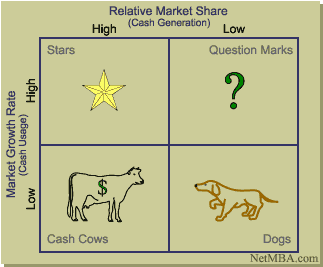
1. Dogs: These are products with low growth or market share.
2. Question marks or Problem Child: Products in high growth markets with low market share.
3. Stars: Products in high growth markets with high market share.
4. Cash cows: Products in low growth markets with high market share
Considering each of these quadrants, here are some recommendations on actions for each:
1. Dog products
The usual marketing advice here is to aim to remove any dogs from your product portfolio as they are a drain on resources.
For example, in the automotive sector, when a car line ends, there is still a need for spare parts. As SAAB ceased trading and producing new cars, a whole business emerged providing SAAB parts.
2. Question mark products
As the name suggests, it’s not known if they will become a star or drop into the dog quadrant. These products often require significant investment to push them into the star quadrant. The challenge is that a lot of investment may be required to get a return. For example, Rovio, creators of the very successful Angry Birds game has developed many other games you may not have heard of. Computer games companies often develop hundreds of games before gaining one successful game. It’s not always easy to spot the future star and this can result in potentially wasted funds.
3. Star products
Can be the market leader though require ongoing investment to sustain. They generate more ROI than other product categories.
4. Cash cow products
The simple rule here is to ‘Milk these products as much as possible without killing the cow! Often mature, well-established products. The company Procter & Gamble which manufactures Pampers nappies to Lynx deodorants has often been described as a ‘cash cow company’.
Benefits of the BCG-Matrix
• The BCG-Matrix is helpful for managers to evaluate balance in the companies’ current portfolio of Stars, Cash Cows, Question Marks and Dogs.
• BCG-Matrix is applicable to large companies that seek volume and experience effects.
• The model is simple and easy to understand.
• It provides a base for management to decide and prepare for future actions.
• If a company is able to use the experience curve to its advantage, it should be able to manufacture and sell new products at a price that is low enough to get early market share leadership. Once it becomes a star, it is destined to be profitable.
Limitations of the BCG-Matrix
• It neglects the effects of synergies between business units.
• High market share is not the only success factor.
• Market growth is not the only indicator for attractiveness of a market.
• Sometimes Dogs can earn even more cash as Cash Cows.
• The problems of getting data on the market share and market growth.
• There is no clear definition of what constitutes a “market”.
• A high market share does not necessarily lead to profitability all the time.
• The model uses only two dimensions – market share and growth rate. This may tempt management to emphasize a particular product, or to divest prematurely.
• A business with a low market share can be profitable too.
• The model neglects small competitors that have fast growing market shares.
Or Illustrate ‘product life cycle concept’ on portfolio management (5)
The Boston Consulting group’s product portfolio matrix (BCG matrix) is designed to help with long-term strategic planning, to help a business consider growth opportunities by reviewing its portfolio of products to decide where to invest, to discontinue or develop products. It’s also known as the Growth/Share Matrix.

Product Life Cycle. A new product progresses through a sequence of stages from introduction to growth, maturity, and decline. This sequence is known as the product life cycle and is associated with changes in the marketing situation, thus impacting the marketing strategy and the marketing mix.
The Boston Consulting group’s product portfolio matrix (BCG matrix) is designed to help with long-term strategic planning, to help a business consider growth opportunities by reviewing its portfolio of products to decide where to invest, to discontinue or develop products. It’s also known as the Growth/Share Matrix.