
Table of Contents
Q.1. Define Mission. Describe the components and importance of mission.
A mission is a statement that defines an organization’s core purpose, values, and objectives, providing a clear direction for its employees, stakeholders, and customers. It serves as a guiding principle that helps the organization focus on its goals and align its strategies and actions accordingly.
Components of a Mission
A well-defined mission statement typically includes the following components:
- Purpose: The primary reason for the organization’s existence, addressing the question, “Why do we exist?” This component highlights the fundamental purpose or goal the organization aims to achieve.
- Values: The core beliefs and principles that guide the organization’s actions, decision-making, and interactions with stakeholders. Values reflect the organization’s culture and ethical standards.
- Business: A description of the organization’s main products, services, or offerings that contribute to its overall purpose. This component outlines the organization’s area of expertise and the markets it serves.
- Customers: A definition of the organization’s target audience or customer segments, identifying who the organization aims to serve or benefit.
- Competitive Advantage: The unique attributes or qualities that set the organization apart from its competitors, providing a distinct edge in the market.
Importance of Mission
A mission statement holds significant importance in an organization for several reasons:
- Direction: A mission provides a clear sense of direction for the organization, helping employees and stakeholders understand the organization’s goals and objectives.
- Decision-making: A mission serves as a guiding principle for decision-making at all levels of the organization, ensuring that actions and strategies are aligned with its core purpose and values.
- Motivation: A well-crafted mission statement inspires and motivates employees, instilling a sense of purpose and commitment to the organization’s objectives.
- Performance Measurement: A mission establishes the foundation for performance evaluation, enabling the organization to measure its success in achieving its purpose and goals.
- Stakeholder Communication: A mission statement effectively communicates the organization’s purpose and values to its stakeholders, including customers, investors, and partners, helping them understand and connect with the organization’s vision.
- Brand Identity: A mission statement contributes to the organization’s brand identity, reflecting its values, culture, and unique selling points, which can help attract customers, employees, and partners.
In summary, a mission is a crucial element of an organization’s strategic planning process, providing direction, guiding decision-making, motivating employees, measuring performance, communicating with stakeholders, and shaping brand identity.
OR Explain in detail about adaptive search and intuition search.
Adaptive Search
Adaptive search is a problem-solving and decision-making approach that involves iteratively adapting and refining solutions based on feedback and experience. In the context of strategic management, adaptive search is used to find optimal solutions to complex and uncertain problems by learning from past decisions and adjusting strategies accordingly. The key elements of adaptive search include:
- Trial and error: Organizations test different strategies, actions, or tactics, and learn from the outcomes to iteratively improve their decision-making processes.
- Incrementalism: Adaptive search often involves making small, incremental changes rather than attempting radical transformations. This allows organizations to assess the impact of their decisions and adjust their strategies accordingly.
- Feedback loops: Adaptive search relies on feedback mechanisms to evaluate the effectiveness of decisions and learn from past experiences. This feedback helps organizations to adapt and improve their strategies over time.
- Flexibility: Adaptive search requires organizations to be flexible and open to change, as they continually refine their strategies and tactics based on feedback and experience.
- Learning: The adaptive search process emphasizes learning from past experiences and using this knowledge to inform future decision-making.
Intuitive Search
Intuitive search is a decision-making approach that relies on the use of intuition, gut feelings, or innate judgment to make strategic choices. Intuition is an unconscious process that draws on an individual’s accumulated knowledge, experiences, and expertise to make decisions without the need for explicit reasoning or analysis. The key elements of intuitive search include:
- Experience: Intuitive search is often based on the decision-maker’s past experiences, which help them recognize patterns, identify potential solutions, and make informed choices.
- Cognitive shortcuts: Intuition relies on cognitive shortcuts or heuristics to simplify decision-making, allowing individuals to quickly evaluate options and make choices without extensive analysis.
- Emotion: Intuitive decision-making can be influenced by emotions and feelings, which can help guide choices and inform judgments.
- Creativity: Intuition can lead to creative insights and innovative solutions, as it allows individuals to make connections and see possibilities that may not be evident through analytical reasoning.
- Speed: Intuitive search enables rapid decision-making, as it bypasses the need for time-consuming analysis and deliberation.
Both adaptive search and intuitive search play important roles in strategic management and decision-making. Adaptive search is particularly useful in complex and uncertain environments, where organizations must continually adapt and learn from their experiences. Intuitive search, on the other hand, can help guide decisions when time is limited or when traditional analytical approaches may not yield clear solutions. Ideally, organizations should use a combination of both adaptive and intuitive search methods to inform their strategic decision-making processes.
Q.2. What is the significance of expansion for an organization? Explain the various expansion strategies in detail.
Significance of Expansion for an Organization
Expansion is vital for an organization as it helps achieve long-term growth and success. The significance of expansion includes:
- Increased market share: Expansion allows an organization to capture a larger share of the market, leading to increased revenues and profits.
- Economies of scale: As organizations grow, they can take advantage of economies of scale, which lowers the average cost per unit and increases overall efficiency.
- Risk diversification: Expanding into new markets or product lines helps diversify an organization’s risk profile, reducing the impact of fluctuations in a single market or industry.
- Improved competitiveness: Expansion can strengthen an organization’s competitive position, enabling it to better respond to market changes and compete more effectively with rival firms.
- Enhanced brand reputation: A larger, more diverse organization can enhance its brand reputation, attracting new customers and increasing customer loyalty.
Various Expansion Strategies
- Market Penetration: This strategy involves increasing market share in existing markets by targeting a larger customer base or increasing the usage of a product or service. This can be achieved through aggressive marketing, promotional activities, pricing strategies, or improving product quality.
- Market Development: This strategy focuses on entering new markets or geographies with existing products or services. Organizations can expand into new regions, target different customer segments, or tap into emerging markets to increase their customer base.
- Product Development: In this strategy, organizations develop new products or services for existing markets. This can involve extending product lines, creating new product categories, or improving existing products to meet changing customer needs and preferences.
- Diversification: Diversification involves expanding into new markets with new products or services. This strategy can be further classified into two types:a. Concentric Diversification: An organization enters a new market with a product or service that is related to its existing offerings. This leverages the organization’s existing competencies and resources.
b. Conglomerate Diversification: An organization expands into a completely new market with an unrelated product or service. This strategy is riskier as it requires the organization to develop new skills and resources.
- Integration: Integration strategies involve acquiring or merging with other organizations to expand operations and gain a competitive advantage. Integration can be classified into three types:a. Horizontal Integration: An organization acquires or merges with a competitor in the same industry, leading to increased market share and reduced competition.
b. Vertical Integration: An organization acquires or merges with a supplier or distributor, allowing it to control more stages of the supply chain. This can be further divided into backward integration (acquiring a supplier) and forward integration (acquiring a distributor).
c. Conglomerate Integration: An organization acquires or merges with a company in a different industry. This strategy helps diversify the organization’s portfolio and reduce risk.
In conclusion, expansion is essential for an organization’s growth and long-term success. Various expansion strategies can be employed depending on the organization’s goals, resources, and market conditions. It is important for organizations to carefully analyze their options and choose the most appropriate strategy to achieve sustainable growth.
Q.3. Write short notes on:
(a) PLC (Product Life Cycle)
The Product Life Cycle (PLC) is a concept that describes the different stages a product goes through from its introduction to the market until its eventual decline and removal. The PLC consists of four main stages:
- Introduction: This stage begins when the product is first launched in the market. Sales growth is slow as customers are not yet aware of the product, and the organization incurs high marketing and promotional expenses to create awareness.
- Growth: As the product gains market acceptance, sales start to grow rapidly. The company focuses on expanding its market share, and competition may start to increase as new competitors enter the market.
- Maturity: In this stage, the product’s growth rate slows down, and it reaches its peak sales potential. Competition becomes intense, and companies may focus on improving product features, reducing prices, or increasing promotional activities to maintain market share.
- Decline: At this stage, sales begin to decrease due to various factors such as market saturation, the emergence of new competing products, or changing customer preferences. Companies may decide to phase out the product, cut marketing expenses, or explore new markets and opportunities.
Understanding the PLC helps organizations in making informed decisions about product development, marketing strategies, and resource allocation.
(b) Retrenchment Strategies
Retrenchment strategies are adopted by organizations when they face declining performance, financial difficulties, or changing market conditions. The primary objective of these strategies is to cut costs, improve efficiency, and restructure the organization to ensure long-term survival and growth. Retrenchment strategies can be classified into three types:
- Turnaround Strategy: This strategy aims to reverse the organization’s declining performance by addressing the underlying issues causing the decline. It may involve cost reduction measures, improving operational efficiency, or reorganizing the company’s structure.
- Divestiture Strategy: In this strategy, organizations sell off or divest non-core business units, assets, or product lines to focus on core competencies and improve financial performance. Divestiture helps the organization concentrate its resources on the most profitable areas and streamline operations.
- Liquidation Strategy: This is the most extreme form of retrenchment, in which an organization decides to shut down its operations and sell off all its assets. This strategy is usually considered as a last resort when all other options have been exhausted, and the organization is unable to recover from its financial or operational challenges.
Retrenchment strategies help organizations to overcome challenges, improve their financial and operational performance, and regain stability in difficult situations.
Q.4. Explain BCG (Boston Consultancy Group) Matrix in detail with diagram.
The BCG Matrix, developed by the Boston Consulting Group, is a strategic management tool used to evaluate a company’s business portfolio and allocate resources effectively. The matrix categorizes the company’s products or business units into four quadrants based on their market growth rate and relative market share. The matrix helps businesses make decisions on where to invest, divest, or maintain their resources.
Here’s a diagram of the BCG Matrix:
{{{TO BE ADDED}}}
The four quadrants of the BCG Matrix are as follows:
- Stars: These are products or business units with a high market share in a rapidly growing market. Stars typically require significant investments to sustain their growth and maintain their leading position. Over time, stars are expected to evolve into cash cows as market growth slows down.
- Question Marks: Also known as problem children or wildcats, these products or business units have a low market share in a fast-growing market. They require substantial resources to improve their market share, but the outcome is uncertain. Companies need to evaluate whether to invest in question marks to turn them into stars or divest if they do not show potential for growth.
- Cash Cows: These products or business units have a high market share in a slow-growing market. They generate more cash than they require for investment, as they need little investment to maintain their market share. Cash cows are crucial for funding the company’s other business units, particularly stars and question marks.
- Dogs: These products or business units have a low market share in a slow-growing market. They typically generate low profits or even losses and are not expected to improve their performance. Companies should consider divesting or discontinuing dogs to free up resources for more promising business units.
By using the BCG Matrix, businesses can evaluate their portfolio’s performance, prioritize investments, and make strategic decisions on resource allocation and growth opportunities.
OR Describe Competitive Profile Matrix in detail giving example from hospitality industry.
The Competitive Profile Matrix (CPM) is a strategic analysis tool used to compare an organization’s performance with its key competitors within the industry. The matrix helps identify the company’s strengths and weaknesses compared to its competitors and assists in developing effective competitive strategies. The CPM evaluates critical success factors (CSFs) and assigns ratings and weights to each factor to generate a total score for each competitor.
Here’s how to create a Competitive Profile Matrix:
- List critical success factors: Identify the key factors that drive success in the industry. These factors can be both internal and external, such as product quality, customer service, market share, financial stability, and management expertise.
- Assign weights: Assign a weight to each critical success factor based on its importance, with the total sum of weights equal to 1.0. The higher the weight, the more significant the factor is for achieving success in the industry.
- Rate each competitor: Rate each organization, including the company being analyzed, on each critical success factor using a scale from 1 to 4, where 1 represents a major weakness, and 4 indicates a significant strength.
- Calculate weighted scores: Multiply each organization’s rating by the assigned weight for each critical success factor to determine the weighted score.
- Total the scores: Add up the weighted scores for each organization to obtain the total score. The company with the highest total score is considered the strongest competitor.
Here’s an example of a Competitive Profile Matrix for three hotels in the hospitality industry:
Company |
Weight |
Product Quality |
Customer Service |
Market Share |
Financial Stability |
Management Expertise |
Total Score |
|---|---|---|---|---|---|---|---|
Hotel A |
3 |
4 |
2 |
3 |
4 |
3.20 |
|
Hotel B |
2 |
3 |
3 |
4 |
3 |
3.00 |
|
Hotel C |
4 |
2 |
4 |
2 |
2 |
2.80 |
|
Weight |
1.0 |
0.20 |
0.25 |
0.15 |
0.20 |
0.20 |
In this example, Hotel A has the highest total score (3.20) and is considered the strongest competitor among the three hotels. The CPM helps the company identify areas where it can improve its competitive position and develop strategies to capitalize on its strengths and minimize its weaknesses.
Q.5. Differentiate between the following (any two):
(a) Vision and Mission
Vision refers to an organization’s long-term aspirations and goals, depicting a future state the organization aims to achieve. It is an inspirational statement that outlines the organization’s purpose and the desired impact on the world.
Mission is a concise statement that defines the organization’s purpose, objectives, and the approach to achieve its goals. It focuses on the present state of the organization, describing the business activities, target audience, and guiding values.
(b) Merger and Takeover
Merger is a voluntary process where two or more companies combine their operations, resources, and assets to form a new entity. Mergers typically occur between organizations of similar size and market presence, aiming to achieve synergies, expand market share, or diversify offerings.
Takeover (or acquisition) is the process where one company acquires control over another company by purchasing a majority stake in its shares or assets. Unlike mergers, takeovers may be hostile or friendly, and the acquired company may continue to operate as a subsidiary or be integrated into the acquiring company.
(c) Autocratic and Democratic leadership
Autocratic leadership is a management style where the leader makes decisions independently, without seeking input or feedback from team members. Autocratic leaders maintain tight control over their subordinates, often dictating tasks and procedures, and may be more focused on achieving results than fostering a collaborative environment.
Democratic leadership is a management style where the leader actively involves team members in the decision-making process, encouraging open communication, feedback, and collaboration. Democratic leaders value diverse perspectives and empower their subordinates to take ownership of their work, fostering a supportive and inclusive environment.
(d) Concentric and Conglomerate Diversification
Concentric diversification is a growth strategy where a company expands its operations by adding new products or services that are related to its existing business. This strategy leverages the company’s existing resources, knowledge, and competencies, enabling it to target new market segments, increase revenue, and reduce risks associated with a single product or service line.
Conglomerate diversification (or unrelated diversification) is a growth strategy where a company expands its operations by entering new businesses or industries that are unrelated to its current operations. This strategy aims to reduce risks by diversifying the company’s portfolio, taking advantage of new market opportunities, and spreading financial resources across different industries.
Q.6. Discuss Mckinsey 7-S framework with the help of diagram and examples.
McKinsey’s 7S Framework is a strategic management tool developed by consultants at McKinsey & Company in the early 1980s. The framework identifies seven interconnected factors that organizations must consider and align to achieve success. These factors are categorized into two groups: hard elements (strategy, structure, and systems) and soft elements (shared values, skills, style, and staff). The 7S Framework is often used to analyze the current state of an organization, assess the impact of strategic initiatives, and guide organizational change.
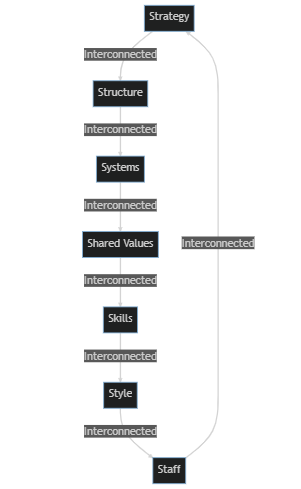
- Strategy: This refers to the organization’s long-term plans and goals, and the methods and actions it will undertake to achieve them. Strategy involves decisions about resource allocation, competitive positioning, and market entry or exit.
- Structure: This refers to the organization’s hierarchy, reporting lines, and division of labor. Structure determines how tasks and responsibilities are distributed, how authority is delegated, and how communication and coordination take place within the organization.
- Systems: This refers to the formal and informal procedures, processes, and routines that govern the organization’s day-to-day operations. Systems include decision-making processes, performance measurement, information management, and financial controls.
- Shared Values: These are the core values, beliefs, and principles that guide the organization’s behavior and decision-making. Shared values create a sense of identity and cohesion among employees and help to shape the organization’s culture.
- Skills: This refers to the organization’s collective capabilities, competencies, and expertise. Skills encompass the knowledge, abilities, and talents of employees, as well as the organization’s ability to develop and leverage them to achieve its objectives.
- Style: This refers to the organization’s leadership and management style, including how decisions are made, how employees are motivated and rewarded, and how communication and collaboration are encouraged. Style influences the organization’s culture and has a significant impact on employee engagement and performance.
- Staff: This refers to the organization’s human resources, including the number of employees, their roles and responsibilities, and their skills and competencies. Staff also encompasses recruitment, training, and development, as well as employee retention and satisfaction.
The McKinsey 7S Framework emphasizes the interconnectedness of the seven factors and the need for a holistic approach to organizational change and development. By understanding and aligning these elements, organizations can effectively implement strategic initiatives, adapt to changing market conditions, and achieve long-term success.
Q.7. Explain SWOT analysis with special emphasis on P.E.S.T. analysis.
SWOT analysis is a strategic planning tool that helps organizations identify their Strengths, Weaknesses, Opportunities, and Threats. This framework allows companies to understand their internal and external environments, enabling them to make informed decisions and develop effective strategies.
- Strengths: These are the internal characteristics that give an organization a competitive advantage, such as skilled workforce, strong brand recognition, or efficient processes.
- Weaknesses: These are the internal characteristics that hinder an organization’s performance or growth, such as outdated technology, lack of resources, or poor management.
- Opportunities: These are external factors that an organization can leverage to grow or improve its performance, such as emerging markets, technological advancements, or favorable regulations.
- Threats: These are external factors that may negatively impact an organization’s performance, such as increased competition, economic downturns, or changing customer preferences.
P.E.S.T. Analysis
P.E.S.T. analysis is a complementary tool to SWOT analysis, focusing on the external factors that influence an organization’s performance. P.E.S.T. stands for Political, Economic, Social, and Technological factors.
- Political: These factors include government policies, regulations, political stability, and trade agreements that may affect an organization’s operations or market conditions. For example, changes in taxation policies or import-export regulations can impact a company’s profitability or market access.
- Economic: These factors include macroeconomic indicators, such as inflation rates, interest rates, exchange rates, and economic growth, that can influence an organization’s financial performance and market conditions. For example, a recession may reduce consumer spending, affecting a company’s sales and profits.
- Social: These factors include demographic trends, cultural norms, and consumer preferences that can influence an organization’s products, services, or target markets. For example, an aging population may create a demand for healthcare services, while changing consumer preferences may require companies to adapt their product offerings.
- Technological: These factors include technological advancements, innovation, and digital transformation that can create new market opportunities or disrupt existing business models. For example, the rise of e-commerce has transformed the retail industry, forcing companies to adapt their operations and strategies.
By incorporating P.E.S.T. analysis into a SWOT analysis, organizations can better understand the external environment in which they operate, allowing them to identify opportunities and threats and make more informed strategic decisions.
Q.8. Give appropriate term for the following:
(a) A plan which is open ended and long term in nature.
(b) IFE stands for
(c) A co-operation strategy where two or more firms join to form a new independent company.
(d) Approach to strategy making where exploitation of opportunities and risk taking is involved.
(e) A strategy where sale or liquidation of only a portion of business takes place.
(a) Long-term plan
(b) Internal Factor Evaluation
(c) Joint venture
(d) Proactive strategy
(e) Divestiture