
Table of Contents
Stores Management
The store is an important component of material management since it is a place that keeps the materials in a way by which the materials are well accounted for, are maintained safe, and are available at the time of requirement. Storage is an essential and most vital part of the economic cycle and store management is a specialized function, which can contribute significantly to the overall efficiency and effectiveness of the materials function. Literally store refers to the place where materials are kept under custody.
Typically a store has a few processes and space for storage. The main processes of the store are (i) to receive the incoming materials (receiving), (ii) to keep the materials as long as they are required for use (keeping in custody), and (iii) to move them out of a store for use (issuing). The auxiliary process of the store is stock control also known as inventory control. In a manufacturing organization, this process of receiving, keeping in custody, and issuing forms a cyclic process that runs on a continuous basis. The organizational set up of the store depends upon the requirements of the organization and is to be tailor-made to meet the specific needs of the organization.
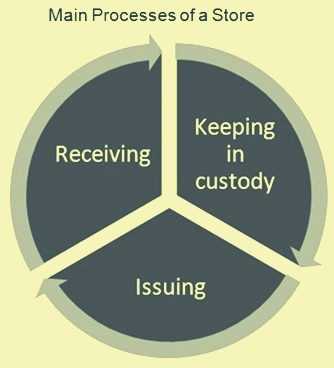
Fig 1 Main processes of a store
The store is to follow certain activities that are managed through the use of various resources. Store management is concerned with ensuring that all the activities involved in storekeeping and stock control are carried out efficiently and economically by the store personnel. In many cases, this also encompasses the recruitment, selection, induction and the training of store personnel, and much more.
The basic responsibilities of the store are to act as custodian and controlling agents for the materials to be stored and to provide service to users of these materials. Proper management of store systems provides flexibility to absorb the shock variation in demand and enable purchasing to plan ahead.
Since the materials have a cost, the organization is to manage the materials in store in such a way so that the total cost of maintaining materials remains optimum.
The store needs a secure space for storage. It needs a proper layout along with handling and material movement facilities such as cranes, forklifts, etc, for safe and systematic handling as well as stocking of the materials in the store with easy traceability and access. It is to maintain all documents of materials that are able to trace an item, show all its details and preserve it up to its shelf life in the manner prescribed or till it is issued for use. The store is to preserve the stored materials and carry out their conservation as needed to prevent deterioration in their qualities. Also, the store is to ensure the safety of all items and materials whilst in the store which means protecting them from pilferage, theft, damage, deterioration, and fire.
The task of storekeeping relates to safe custody and preservation of the materials stocked, to their receipts, issue, and accounting. The objective is to efficiently and economically provide the right materials at the time when it is required and in the condition in which it is required. The basic job of the store is to receive the materials and act as a caretaker of the materials and issue them as and when they are needed for the activity of the organization.
Once the material has been received and cleared through inspection and accepted for use, it needs safe custody of the stores. The role of custody is to receive and preserve the material. A stage comes when the material is needed for use. Store at that time releases the material from its custody to the user department and the process is called ‘issue of goods. It might also happen that after partial use, some materials having a useable value in the future are returned to the store and thus they also become part of the custody again.
Storekeeping activity does not add any value to the materials. In fact, it adds only to the cost. The organization is to spend money on space (expenditure on land, building passage and roads), machinery (store equipment), facilities (e.g. water, electricity, communication, etc.), personnel, insurance, maintenance of store equipment, stationery, etc. All of these get added to the organizational overheads and finally get reflected in the costing of the finished product. However, it is an essential function in any organization.
Objectives of store management
Efficient store management has normally the following main objectives.
- To ensure an uninterrupted supply of materials without delay to various users of the organization.
- To prevent overstocking and understocking of the materials
- To ensure safe handling of materials and prevent their damage.
- To protect materials from pilferage, theft, fire and other risks
- To minimize the cost of storage
- To ensure proper and continuous control over the materials.
- To ensure the most effective utilization of available storage space
- To optimize the efficiency of the personnel engaged in the store
Classification of stores
A store can be of a temporary nature which means that it has a limited life. A store can also be of permanent nature. Stores are classified basically in the following broad categories.
- Functional stores – Functional stores are named based on the function of the materials stored. Examples are fuel store, chemicals store, tools store, raw materials store, spare parts store, equipment store, refractories store, electric store, explosives store, and finished goods store, etc.
- Physical stores – Physically stores can be centralized stores or decentralized stores. These stores are named based on the size and location of the store. Examples are central store, sub store, department store, site store, transit stores, receipt store, intermediate store, open yard store, and covered store, etc.
- Stores are also classified by naming them after the departments to which they serve. Examples are construction stores, operation stores, rolling mill stores, blast furnace stores, and steel melting shop stores, etc.
- Stores are sometimes classified based on the nature of materials stored in them. Examples are a general store, bonded store, perishable store, inflammable store, salvage store, reject store, and quarantine store, etc.
The centralized storage of materials in a central store has advantages as well as certain disadvantages. The following are the advantages.
- A centralized store can cater to a wider range of materials which is not possible in a smaller store. Hence the user department is to look for the material of its need only in one place.
- It contributes to the inventory control in the entire organization since the requirement of all the departments gets clubbed up.
- It makes better control feasible.
- It provides the economy in storage space as materials when stored in larger quantities, occupies less specific space.
- Large stores can be provided with better and modern handling facilities. The operation can also be automated.
- Delivery at a single point decreases the cost of delivery.
- Receipt and inspection of the materials can be organized more efficiently.
- Improved opportunities are available for the standardization of inventory.
- The turnover of materials is increased because of the maintenance of lower inventory and the probability of deterioration of materials during storage is correspondingly decreased.
- Manpower requirements for managing stores get reduced. Also, the duplication of records that takes place in decentralized store system is avoided.
The disadvantages of a centralized store are as follows.
Distance from the store and the user department gets increased which requires higher transportation needs from the store to the user department.
- If there are slippages or systems not being well organized then there can be shortages of the materials which may results in unnecessary interruptions in production.
- There may be a necessity for additional internal documentation in the store.
- The risks due to the fire and thefts are higher since the entire stock of the materials are concentrated in one place.
- The variety of materials to be stored can be large and it can create complications in the systematic storage as well as in storage procedures.
Functions of a store
Store personnel are responsible for carrying out the following functions.
- Receipt of incoming materials
- Supervision of unloading of materials and tallying of materials
- Checking for damages or shortages and preparation of the report
- Filling of ‘goods inward’, ‘day book’, or ‘daily collection’ register
- Completion of vendors consignment note (challan)
- Making arrangement for inspection and getting the inspection completed
- Preparation of ‘goods receipt note’ (GRN)
- Preparation of ‘goods rejection memo’ (in case of rejection of materials)
- Sending of materials to the respective stores
- Sending of the relevant documents to the respective departments
- Ensuring all storage and material handling facilities are in proper working order
- Ensuring good housekeeping and cleanliness in the storage space
- Checking, counting and tallying of materials before an issue
- Making prompt entries in ‘Bin card’ or stock card
- Ensuring correct documentation of material receipts and material issues
- Ensuring safe and proper handling of materials so as not to damage them
- Ensuring proper record keeping and correct accounting of materials
- Ensuring regular stock verification
- Ensuring that rules and regulations relating to physical custody and preservation of materials are followed
- Ensuring the safety of materials and personnel