
Table of Contents
Hotels
As per the Hotel Proprietors Act, 1956, a hotel is an “Establishment held out by the proprietor as offering food, drink and if so required, sleeping accommodation, without a special contract to any traveller presenting himself who appears able and willing to pay a reasonable sum for the services and facilities provided and who is in a fit state to be received.” As a result of this definition establishments such as Hospitals, Hostels, Apartments and Prisons, although provide accommodation to people yet do not come under Hotels.
Various definitions of Hotel
- Common-Law states that a “Hotel is a place where all who conduct themselves properly, and who being able to pay and ready to pay for their entertainment, are received if there be accommodation for them, and who without any stipulated engagement as to the duration of their stay or as to the rate of compensation, are while there, supplied at a reasonable cost with their meals, lodging and other services and attention as are necessarily incident to the use as a temporary home.”
- A hotel may be called as an establishment where the primary business is to provide to the general public lodging facilities and which may also furnish one or more of the various services such as food, beverage, laundry, uniformed services etc. Hence, a hotel can also be called as home multiplied by commercial activities.
- According to the Encyclopaedia Britannica, the word ‘Hotel’ is of ancient origin, but its use in English for a house offering lodging and food for travellers is recent. The Hostlers of London took the name of Innkeeping in 1473. The word ‘Hostler’ or ‘Ostler’ has come to mean an inn servant.
- The term ‘Hotel’ was used in England in about 1760. Hotel or inn is defined by British law as a “place where a bonafide traveller can receive food and shelter, provided he is in a position to pay for and is in a fit condition to be received”.
- A hotel or an inn may also be defined as an establishment whose primary business is providing lodging facilities for the general public and which furnishes one or more of the following services
- Food and Beverage service
- Room service
- Uniformed service
- Laundry service and
- Use of furniture and fixture etc.
In legal terminology, a hotel is an inn and is required under common law to offer to its visitor’s lodging, food and protection to their baggage. Hotel service is generally based on these three fundamental necessities of life. In addition to these, a modern hotel provides its visitors with many luxuries of modern urban city living, all under one roof.
History Of Hotels And Accommodation Industry And Their Development
The early history of accommodation for travellers can be traced back to the Greek word ‘Xenia’, which not only meant hospitality but also the protection given to a traveller from discomforts. The city was bound to offer hospitality. In Sparta city, although due to rigorous customs visitors were not encouraged, yet goddess Athena was considered as the protector of strangers and hence her name was ‘Xenia Athena’.
In this period travellers were mainly diplomats, philosophers, intellectuals and researchers. Guests were invited to stay with noblemen. In ancient Olympia, buildings constructed with the aim to accommodate strangers can be seen. They were called ‘Leonidio’ and were built in 4th century BC. The concept of hospitality can also be drawn back to ancient times. Mention of it is found in ‘Iliad’ and ‘The Odyssey’ by Homer.
During the seventh and eighth centuries, it was the monasteries that supplied hospitality to strangers and, as no charge was made for the accommodation, all travellers were expected to contribute according to their means to the Abbey funds. As more people began to travel they grouped themselves together, not only for the company but for mutual protection from highwaymen and robbers. Consequently, travellers arrived in groups at a monastery and it was often difficult to accommodate them all. In the early 19th century the concept of a hotel room was a sitting room in the front, a bedroom behind it and a storeroom to keep trunks behind the bedroom and this century is known as “Golden Age of Hotel of Hotels in Great Britain and the World”, To overcome this, separate lodging houses called ‘Inns’ (a Saxon word) were built. The word ‘lnn’ came to mean a ‘Lodging House’ and until the passing of the Hotel Proprietors Act in 1956, it was the legal term for ‘Hotel’ and hotel proprietors were legally referred to as ‘Common Innkeepers’. ‘Common’ in this sense referred to Common Law.
In the thirteenth and fourteenth centuries, manor houses, being hospitable places. willingly gave accommodation to travellers. As no payment was expected, travellers tipped the servants as a ‘thank you’ for the generous hospitality received-thus the practice of tipping was born.
When high taxes crippled the generosity and hospitality of the owners of the manor houses, many became commercial inns. During Elizabeth the First’s reign, posting houses were established and travellers, in addition to getting refreshment were able to change horses before continuing their Journey.
The turn of the century saw an era that was called the ‘Belle Epoch’ when the grand and luxurious hotels flourished. A few hotels are still operating today. In London and some other cities attempts have been made to recapture some of the grandeur of the past era in the making of modern hotels, and bring back the memories the grand hotels of olden days.
The next stage in the cycle of evolution of the hotel industry was the coming of the motor car. It enabled people to visit those parts of the country which could not be reached by railways. This gave birth to inland resorts and the hotel industry began to flourish.
International air travel has helped create the modern ‘stop-over’ hotel. With the increase in this form of travel, the number of hotels built close to airports has multiplied.
Another trend in hotelkeeping is the motel which is the twentieth-century version of the old ‘Coach Inn’. People travelling the country by car, stopping overnight here and there, require not only refreshment for themselves but also safe parking for their cars. Post Houses developed by the Trust Houses Forte Group are in fact the modern version of the old coaching inns. Great Britain is considered as “Motherland of the Hotel Industry.”
The journey of hotel chains
Indian
1) Pallanjee Pestonjee (1840): Started 1st luxurious hotel in Bombay. It was famous for its excellent cuisine, beers and wines and its excellent management. Later he opened another hotel at Fort in Bombay.
2) Auckland Hotel (1843) was established in Calcutta. Later it was renamed as Great Eastern Hotel in 1858 and later renovated for a sum of Rs 10 lacks.
3) Esplanade Hotel (1871): Was built in Calcutta by John Wakson (Britisher) a silk drapery merchant. The hotel has 130 rooms.
4) Taj Group of hotels: In 1903 JRD Tata constructed the Taj Mahal Hotel in Bombay the flagship hotel of Indian hotels company. It was the 1st hotel of international standard and repute, built by an Indian for Indians.
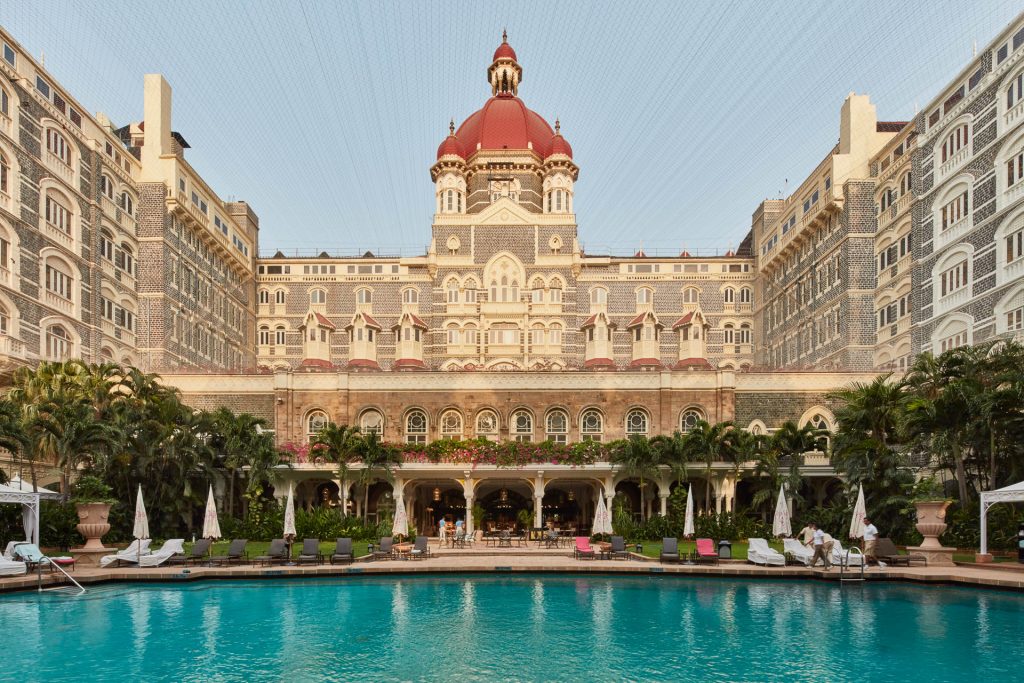
Taj Mahal Hotel, Mumbai
5) Welcome Group: It is the hotel division of I.T.C ltd. ITC entered into the hotel business in 1975 with the opening of Hotel Chola Madras. The logo represents a traditional Indians welcome in the form of ‘Namaste’ in an open doorway with the slogan “Nobody gives you India like we do” The motto of welcome Group is “We enjoy people”.
6) Oberoi Hotels: Rai Bahadur M.S. Oberoi started his hotel career as a clerk in 1922 at Faletti’s Cecil Hotel in Shimla. Later Mr. Ernest Clarke sold his share to Mr. M.S Oberoi who under the deed of dissolution dated August 14, 1943, became the sole, absolute and exclusive owner of Clarke’s Hotel, Shimla and Delhi. Mr. Oberoi later took over the Grand Hotel at Calcutta on lease and by the end of World War 2 the Grand Hotel became a byword for good service and elegant comfort in hotels.
International
1) Accor: It is a French hotel group, which operates in 92 countries Headquartered in Paris, France, the group owns, operates and franchises 3,600 hotels on 5 continents representing several diverse brands, from budget and economy lodgings to luxurious accommodations in exotic locales.

Accor property in Australia, sharing a beautiful message during COVID 19 lockdown
2) Best Western International: Operator of the Best Western Hotel brand is the world’s largest hotel chain, with about 4,200 hotels in over 110 countries. The chain, with its corporate headquarters in Phoenix, Arizona operates 2,163 hotels in North America alone.
3) Carlson Rezidor Hotel Group: Is an international hotel company, with headquarters in Minneapolis, USA and Brussels, Belgium. The Carlson Rezidor Hotel Group includes more than 1,300 hotels in operation and under development in over 100 countries, employing over 88,000 staff. The hotel brands include Radisson Hotels, Radisson Blu, Country Inns & Suites, Park Inns, Park Plaza Hotels & Resorts, Hotel Missoni and newly announced brands
Radisson Red.
4) Four Seasons Hotels: Is a Canadian international luxury, five-star hotel Management Company. Travel + Leisure magazine and Zagat Survey rank the hotel chain’s 98 properties among the top luxury hotels worldwide
5) Hilton Hotels: It an American global hospitality company. It is owned by the Blackstone Group, a private equity firm. The company owns, manages, and/or franchises a portfolio of brands which includes Waldorf Astoria Hotels and Resorts, Conrad Hotels & Resorts, Hilton Hotels & Resorts, Doubletree (DoubleTree by Hilton), Embassy Suites Hotels, Hilton Garden Inn, Hampton Inn and Hampton Inn & Suites, Homewood Suites by Hilton, Home2 Suites by Hilton and Hilton Grand Vacations. It was founded by Conrad Hilton in Cisco, Texas and was headquartered in Beverly Hills, California.
6) Hyatt Hotels: It an American international company and operator of hotels. The Hyatt Corporation was born upon purchase of the Hyatt House, at Los Angeles International Airport on September 27, 1957. In 2014, Hyatt was named one of the best 100 companies to work for (placing 95th), according to Fortune.
7) InterContinental Hotels: It a British multinational hotels company headquartered in Denham, UK. It is the largest hotel company in the world measured by rooms (with 687,000 as of February 2014) and has over 4,600 hotels across over 100 countries. Its brands include Candlewood Suites, Crowne Plaza, Even, Holiday Inn, Holiday Inn Express, Hotel
Indigo, Hualuxe, InterContinental and Stay bridge Suites.
8) Marriott International: It is an American diversified hospitality company that manages and franchises a broad portfolio of hotels and related lodging facilities. Founded by J. Willard Marriott, the company is now led by President and Chief Executive Officer Arne Sorenson. Today, Marriott International is the largest hotel company with more than 4,000 properties in over 80 countries and territories around the world, with additional 195,000 rooms in the development pipeline. In June 2014 Marriott International opened its 4,000th hotel, the Marriott Marquis in Washington, D.C.
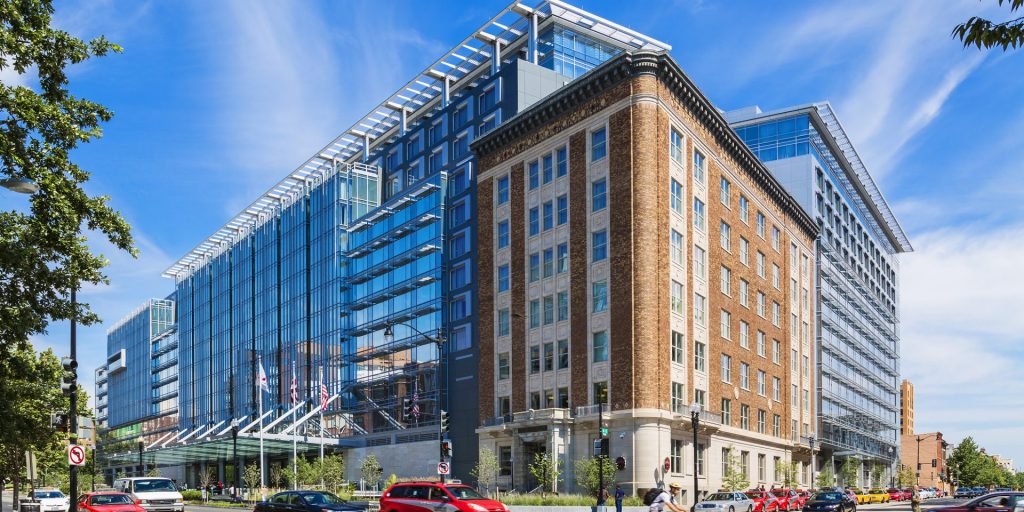
Marriott Marquis, Washington DC
9) Shangri-La Hotels and Resorts: It is a Hong Kong based company that runs the “Shangri- La”, “Kerry” and “Traders” brands of hotels. The five-star lodgings of the chain can be found across Asia, the Middle East, North America, Oceania and Europe. The first hotel of the group was the Shangri-La Hotel Singapore, opened in 1971.
10) Starwood Hotels and Resorts Worldwide, Inc. is an American hotel and leisure company headquartered in Stamford, Connecticut. One of the world’s largest hotel companies, it owns, operates, franchises and manages hotels, resorts, spas, residences, and vacation ownership properties under its nine owned brands.