
Mutton and Lamb
The terms #lamb, hogget or #mutton are named for the animals or meat of a domestic sheep. The meat of a sheep a year old or ‘ younger is generally known as lamb, whereas the meat of an older sheep is either hogget or mutton depending on its age and characteristics. All of these are known generically as sheep meats.
Find out more at Wiki about Mutton and Lambs..
A sheep less than one-year-old is known for its tender meat. Baby lamb and spring lamb are both milk-fed. Baby lamb is customarily slaughtered at between 6 and 8 weeks old. Spring lamb is usually 3 to 5 months old; regular lamb is slaughtered under a year of age. Lamb between 12 and 24 months is called yearling; when over 2 years, it’s referred to as mutton and has a much stronger flavor and less tender flesh.
Cuts of Lamb / Mutton
Breast: This cut is from the rib cage and is one of the cheapest cuts and whilst the price is similar to scrag end but
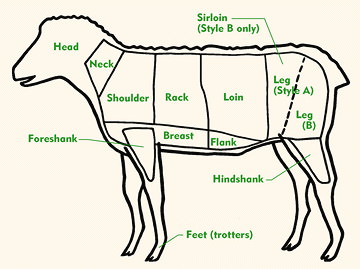
is much more versatile. It can be roasted on the bone, boned, stuffed and rolled, or when well-trimmed, can be used for mince, burgers or skewers (kebabs). Some butchers also sell this cut in strips which are ideal for barbecues.
Flank: Unlike other cuts from the loin area, the flank is much tougher and is usually sold as mincemeat.
Foreshank: Also known as Lamb shanks, this cut is suitable for slow roasting, stewing and braising. It has become very popular in recent years especially when braised when a whole shank with the bone is served per person. It is a very flavourful cut of meat.
Leg: This is a prime cut with little fat which is excellent for roasting as a joint. It is often cut into lamb steaks suitable for frying or grilling or into cubes for lean kebabs.
Loin: The loin is the most tender part of the lamb. It is from this area that loin chops come from as well as medallions, noisettes as well as roasting cuts. Suitable for roasting although the joints tend to be small unless you have a whole saddle which is made up of a double loin roast, from both sides of the backbone. Frying and grilling are excellent for the smaller cuts.
Neck: This is one of the tougher cuts and is generally sold as Stewing lamb or made into mince (ground) meat. When sold in pieces it is only’ suitable for very long, slow, moist cooking. Although tough the flavor is very good so well worth the extra cooking. Best End of the neck is traditionally used for Lancashire Hotpot.
Scrag: Also known as scrag end or neck end, this is one of the tougher cuts and is, therefore, one of the cheaper ones. The meat from this area is often fattier than other cuts and is usually sold chopped or diced for use in stews and casseroles.
Rack: A “rack of lamb” is the name given to the whole rib section on either side of the backbone between the shoulder and the loin. A tender and flavorsome cut, it is also expensive and it is suitable for dry-heat cooking such as roasting or grilling.
Shoulder: Shoulder is often sold as two separate joints, blade, and arm (knuckle). The whole shoulder is also sometimes called “square cut” which consists of the arm, blade, and rib bones. Shoulder meat is also often trimmed of fat and sold as cubes for curries, kebabs, and casseroles. Shoulder chops are suitable for panfrying, grilling or braising.