
Table of Contents
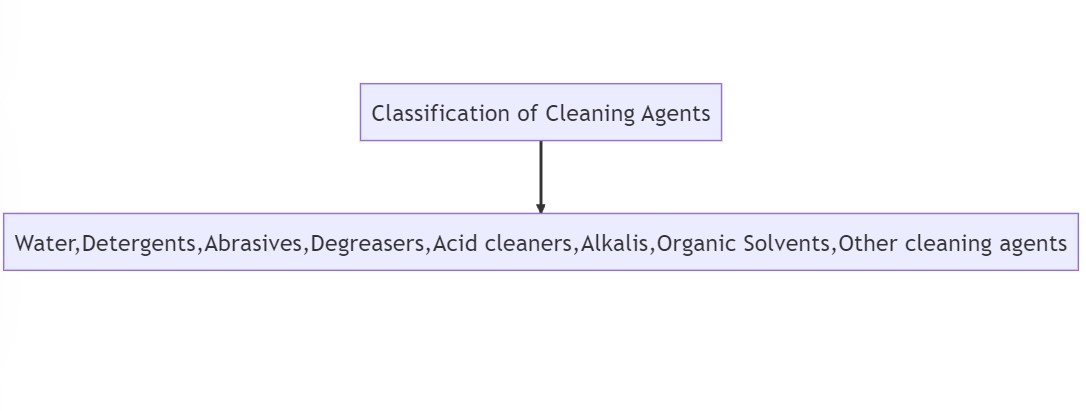
The principle classes are:
- Water
- Detergents
- Abrasives
- Degreasers
- Acid cleaners
- Alkalis
- Organic Solvents
- Other cleaning agents
1. Water
- Carry the cleaning materials to the soil
- Suspend the soil
- Remove the suspended soil from the cleaning site
- Rinse the detergent solution from the surface
- It has high surface tension and forms droplets
- It has little wetting power
- It is repelled by oil and grease
- If shaken within oil the emulsion does not prevent the formation of large droplets
- It has a low surfactant effect (surface active agent)
- Hardness: Hard water contains calcium and magnesium salts which will inhibit the cleaning of material in the following ways –
- In combination with soap, the salts form insoluble scum which reduces the efficiency of the soap and makes rinsing difficult
- Calcium combines with fat in the soil to form a soapy substance which adheres strongly to the surface
- The calcium and magnesium salts tend to cause flocculation (tendency to cause soil that is suspended in water, to redeposit on the surface being cleaned)
- The hardness of water also causes premature aging of fabrics, causes scale and fur to be deposited in machines and pipes.
2. Detergent
- Reduce the surface tension of water so that the cleaning solution can penetrate the soil
- Emulsify soil and lift it from the surface
- Be soluble in cold water
- Be effective in hard water and a wide range of temperatures.
- Be hard on the surface that has to be cleaned. Clean quickly and with little agitation.
- Suspend soil in a cleaning solution, and once the soil is removed, to hold it in suspension and not let it redeposit.
- Rinse easily and leave no streaks or scum
- Be economical to user
- Be harmless to the skin and article.
- Be bio-degradable
Chemical composition of detergent: –
- Surfactants are chemicals, whose molecules when dissolved in water possess, water seeking end (hydrophilic) and a water-repelling end (hydrophobic). They may or may not carry the positive and negative electrical charge. The molecules disperse through water and reduce the surface tension of water by overcoming the forces of attraction between the water molecules, thus allowing the water and surfactant molecules to penetrate the soil and surface.
- Builders are alkaline chemicals that influence the effectiveness of a cleaning agent in one or both of the following ways –
- They sequester (combine with) calcium ions in hard water to form water-soluble salts, thus preventing the adverse effects of calcium.
- They enhance the emulsifying by increasing the pH value of the solution and dispersing properties of the detergent
- Builders, in general, can cause a damaging effect on many surfaces, e.g. chrome, aluminum, wool, silk, paint, wood, linoleum. It may constitute up to 30% of heavily built powdered detergents and helps in softening water too.
- Foaming agents increase or stabilize the foam formed by a detergent. Foaming can be used to surfactant activity, the level of foam depending on the amount of surfactant active in a cleaning solution, e.g. ethanol amides. Alkalomomides derived from coconut oil are frequently used for this purpose. The foam will stick to all non-horizontal surfaces, increasing the contact between the surface and the cleaning chemical.
- Chelating agents are relatively complex chemicals, which are included in many liquid detergents to sequester calcium ions. They are also frequently used as a descaler, being a more acceptable alternative to strong acids.
- Suspending agents increase the amount of soil that can be held in suspension in the cleaning solution, e.g. sodium carboxymethyl cellulose.
- Bleaches will break down with oxidation, those stains that have not been removed from the surface by surfactants or builders. Sodium perborate, oxidizing weak bleach is frequently included in detergents intended for washing textiles.
- Bulking agents contribute to the volume of detergent powders, e.g. sodium sulfate.
- Conditioning agents ensure that the granules in the detergent powder are crisp, firm, and dry.
- Whiteners cause absolute ultra-violet light to transmit as visible white light.
- Enzymes are complex proteins that break down organic substances, e.g. blood stains, food stains, etc. they are effective at 30 to 50 degrees C and are inactivated at temperatures above 60 degrees C.
- Anticorrosive agents inhibit the formation of water films on the surface. Chemical reactions resulting in corrosion are generally dependant on the presence of water, e.g. sodium silicate.
- Perfumes and dyes are included to increase consumer acceptability, but increase the risk of allergic reactions.
- Germicides are also added sometimes to prevent the growth of bacteria and fungus.
3. Abrasives
- Hard surface cleaners
- Metal polishes.
Types of Abrasives
- Fine Abrasives: These include precipitated whiting (filtered chalk) and jeweler’s rouge (a pink oxide of iron) used for shining silver. They are also constituents of commercial silver polishes.
- Medium abrasives: these include rottenstone, salt, scouring powder, and scouring paste. Scouring powders are made up of fine particles of pumice mixed with soap/ detergent, and alkali and a little bleach.
- Hard / coarse abrasives: these include bath bricks, sandpaper, pumice, steel wool, and emery paper.Glass paper, calcite, sandpaper, fine ash, emery powder, and paper, jeweler’s rouge, powdered pumice, precipitated whiting (filtered chalk). Ground limestone, sand, steel wool, and nylon scourers are some commonly used abrasives.
4.Degreasing agents
5.Acids and Toilet Cleaners
ACID | pH | USES
- Concentrated HCL | 1 | Removing stubborn hard- water deposits.
- Dilute HCL | 1 | Removing stubborn scales and deposits from sanitary ware. Removing excess cement from newly cemented tiled areas.
- Oxalic | 2 | removing stubborn hard- water deposits
- Acetic acid | 3 | Removing tarnish and stains from metals such as copper and brass. Neutralizing alkalis are used in cleaning for preventing colors from running during washing.
- Sodium and sulfate | 5 | Removing hard-water deposits and scales from toilets.
6.Alkalis
- Sodium hydroxide (caustic soda) | 14 | Removing stubborn grease from ovens and equipment.
- Ammonia | 11 | removing stubborn grease
- Sodium carbonate | 10 | Used as an alkalis builder in synthetic and soapy detergents. Clearing blocked drains.
- Sodium Per-borate | 10 | Removing stains and whitening due to bleaching action at a higher temperature (above 40.C)
- Sodium Hypo-chlorite | 9 | Removing stains and whitening due to bleaching action on various types of surfaces. Acts as a disinfectant.
- Sodium Bicarbonate | 8 | Removing stubborn grease from smooth, delicate surfaces. Removing stains such s tea, coffee, and fruit juice.
- Sodium Per-borate ( borax) | 8 | Removing stubborn grease from smooth, delicate surfaces. Removing stains such s tea, coffee, and fruit juice.
- Sodium Thio-sulphite | 7 | Removing iodine stains.
7.Organic Solvents
8.Other cleansing Agents
Polishes
Metal polishes
These remove the tarnish resulting from the attack on the metal by certain compounds and some foodstuffs. They are of two basic types, one for hard metal and other for soft. Either type may be liquid or paste. Liquid polish is a fine abrasive waxed with grease solvent, and sometimes with an acid, e.g. plate powder, precipitated whiting, jeweler’s rouge, mentholated spirit, and ammonia. Abrasive when rubbed on the surface of the metal provides friction to remove the tarnish and produce a shine.
Floor polishes
They are of two basic types – Spirit-based, Water-based.
Spirit-based polishes contain a blend of mainly natural waxes, dispersed in a spirit solvent. They may be in paste or liquid form and contains silicon, but too high a silicon content makes the floor slippery. The build-up of polish can be removed by losing the wax finish with spirit and slight abrasion, and then picking up the loosened wax with a damp cloth mop. It is suitable for flooring that is harmed by water like wood, cork, linoleum, and magnesite.
Water-based polishes are emulsions in which fine particles of natural and synthetic waxes are dispersed in water. They are suitable for use on thermoplastic, rubber, PVC, asphalt, and combination floors as spirits can affect them. They can also be used on sealed flooring of wood, cork, magnesite, and linoleum. Water-based polishes are always liquid but may be fully buffable, semi-buff able, or dry bright. The build-up polish can be removed by loosening the wax synthetic resin with hot water and alkali – no detergent.
Furniture polishes
- Paste wax polish – a high proportion of wax plus silicon
- Cream polish – greater amounts of spirit to give a cleaning action.
- Liquid polish – have a great proportion of spirit requiring no buffing.
- Spray polish – also has a high proportion of spirit.
Floor Seals
- Oleo-resinous sealers: they are used for imparting an attractive surface gloss penetrating the floor darkening the color and highlighting the grain of wood floors.
- One-pot plastic sealers: they are used on wood, wood- composition, cork, and magnesite floors.
- Two-pot plastic sealers: they are also used on wood, wood- composition, cork, and magnesite floors.
- Pigmented sealers: these may be used on concrete, wood, wood-composition, magnesite, asphalt, and stone floors.
- Water-based seals: these may be used on marble, terrazzo, magnesite, linoleum, rubber, thermoplastic tiles, PVCs, asphalt, concrete, stone-, and quarry tiles.
Bleaches
Disinfectants And De-odorants
- Phenols: these are hydroxyl derivatives of the aromatic hydrocarbon benzene. They are used in dilute or high concentrations to disinfect surfaces in hospitals especially .in hotels, diluted phenols are used with their sharp smell masked by other additives.
- Halogens: the elements chlorine and iodine may be used as disinfectants. Chlorine is used both as bleach and as a disinfectant on many surfaces. Iodine is not often used to disinfectant surfaces because it tends to leave brown stains.
- Quaternary ammonium compounds: these are cationic surfactants useful as bactericides.Natural pine oils: pine oils are obtained from pine trees. They are germicidal to some extent but are mainly added changing formulation for their pleasant smell.
Window or Glass Cleaners
Absorbents
Storage of Cleaning Agents
- Ensure that the storage racks are strong and with selves. Heavier containers must be kept on the bottom shelf.
- The store should be kept clean and well-ventilated at all times.
- Ensure that the lids are tightly fitted.
- When issuing cleaning agents use appropriate dispensers and measuring apparatus.
- Ensure that no residual deposits of the cleaning agents are left around the rims of the containers.
- Avoid spillage, if a spill occurs, clean it up immediately.
- Follow a systematic procedure for rotating stocks.
- Organic solvents, strong reagents, polishes should be kept away from heat sources.
- Check stock regularly .the store should be locked when not in use.