
Table of Contents
Q.1. Draw an organization chart of the banquet department of a five-star hotel. Enlist duties and responsibilities of the banquet manager. (5+5=10)

Duties And Responsibilities of a banquet manager:
- Achievement of budgeted food sales, beverage sales, and labor costs.
- Achieve maximum profitability and over-all success by controlling costs and quality of service.
- Participation and input towards F & B Marketing activities.
- Control of Banquet china, cutlery, glassware, linen, and equipment.
- Completion of function delivery sheets in an accurate and timely fashion.
- Help in preparation of forecast and actual budget function sheets.
- Completion of forecast and actual budget function sheets, Function Summary Sheets, and weekly payroll input.
- Completion of weekly schedules. Schedule staff as necessary to ensure adequate and consistent levels of service.
- To supervise and coordinate the daily operation of meeting/banquet set-ups and service.
- Completion of Banquet Bar Requisitions.
Q.2. (a) What are the different types of banquet found in a hotel? (5+5=10)
There are various types of banquet services available
Buffet
Buffet service is very common in events with large numbers of attendees. Guests pass through a buffet line that features food choices on tables separate from the seating area. Guests serve themselves, which allows for convenience in choosing what an individual wants to eat. They then return to their table to eat. Beverages are typically delivered and refilled by attendants.
Reception
Finger food and appetizers are presented in a buffet-style arrangement where guests can serve themselves. These are generally gatherings where people mill around the room while eating and chatting.
Food Stations
Food stations, or action stations as they’re sometimes called, include a variety of courses and offerings to guests. Many times these stations are manned by chefs who are cooking or preparing food in front of guests. Popular choices for these stations include meat-carving, pasta bars, sushi stations, and desserts.
Cafeteria-style
Cafeteria-style banquet service is very similar to a buffet, where guests stand in line to choose their food. However, in cafeteria service, workers or servers dish food from the buffet line. This helps control costs since workers have control over portion sizes
Plated
In this service, guests are seated and servers bring food already portioned onto plates directly from the kitchen. This is the most efficient type of banquet service and also the least expensive. You’ll frequently see this style at formal events such as weddings, where guests have been asked their choice of protein (beef or chicken, for example) and plates are assembled and sorted by those requests.
Family-style
Common internationally, family-style service features seated guests with large quantities of food in plates or bowls brought from the kitchen and placed at the table. Guests serve themselves and pass the food around the table.
Pre-set
If you show up at an event and the food is already on the table, you’ve experienced a pre-set service. This is frequently seen with items such as bread rolls, desserts, salads, and beverages. Main entrees generally are brought out from the kitchen in this configuration.
(b) Neatly sketch the format of function prospectus.
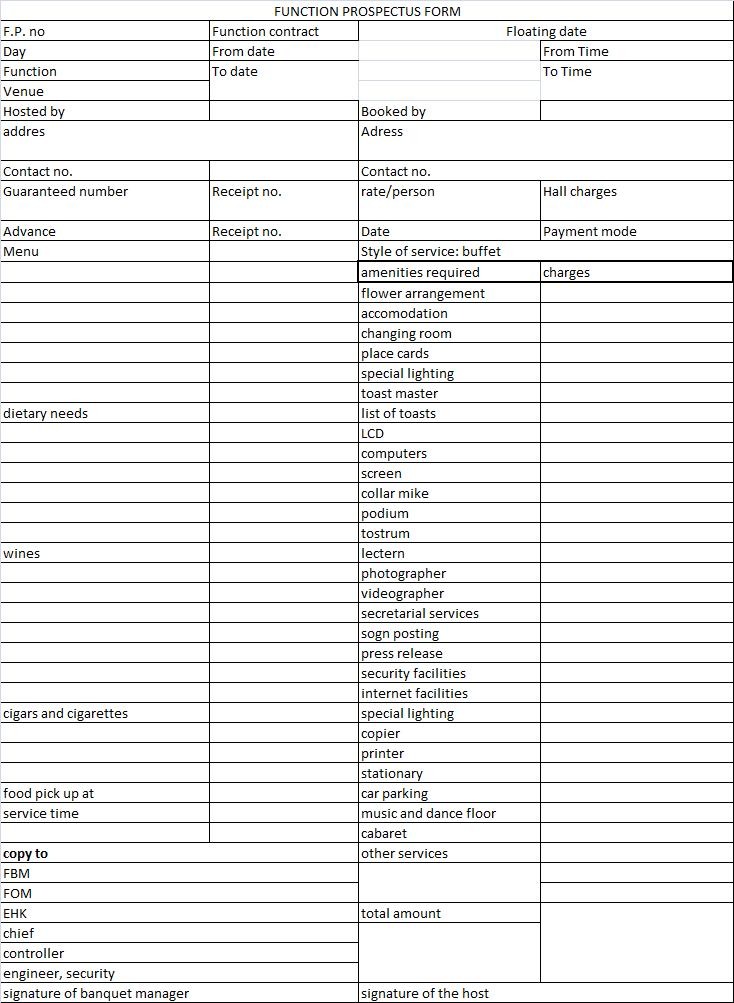
OR Sketch out a plan for 175 guest dinner informal banquet with 16 guests on the head tables and rest in sprigs. Calculate room size (area) required and the number and size of the tables for the plan. (10)
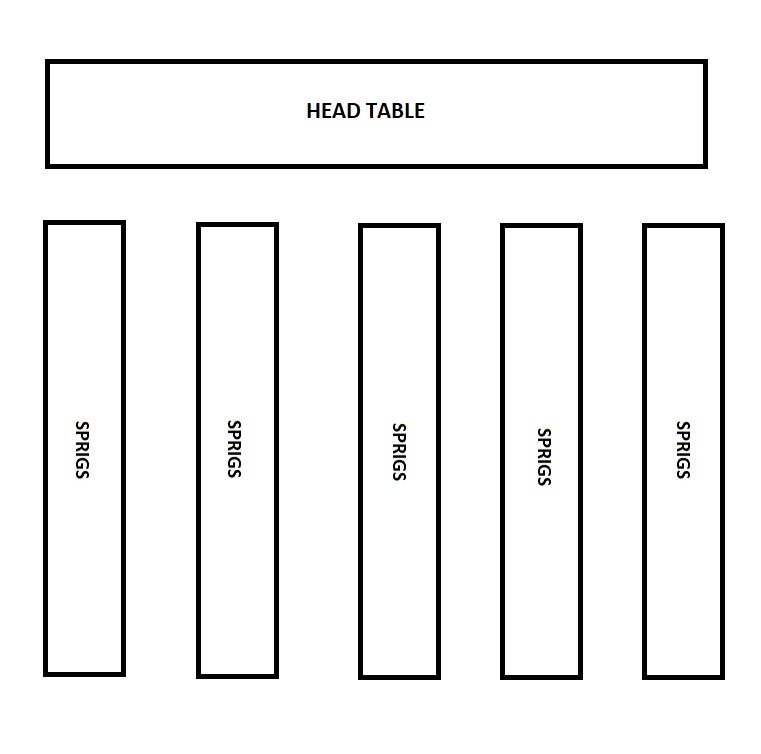
Calculation of the length of the top table:
(16 guests x length of a cover 2′) = 32′
Number of covers on the sprigs
(Total guests 175 – Top table guests 16) = 159
The sprigs should be within the length of the top table.
Assuming three sprigs:
The width of three banquet tables (3 x 2 1/2′) = 7 1/2′
Two gangways with chairs on both the tables (2×6′) =12′
Total (7 1/2′ + 12′) = 19 1/2′
Assuming four sprigs:
The width of four banquet tables (4 x 2 1/2′) = 10′
Three gangways with chairs on both the tables
(3 x 6′) = 18′
Total (10′ + 18′) = 28′
This area is LESS than the length of the top table but there is not enough space left to accommodate another sprig; therefore, the plan can use only four sprigs.
The number of guests seated at each sprig = 159/4
=> 40+40+40+39 = 165
which means 40 people will be sitting on 3 sprigs and 39 on 1. and since people will sit on both sides of the sprig, therefore, maximum covers at one side of the sprig will be 40/2=20.
Calculation of the length of the sprig
Maximum covers at one side (20) x length of cover (2′) = 40′
Area required to accommodate a top table with four sprigs is
(a) Top table-side area
Length of the top table = 32’
Gangway at both the ends of the top table (2 x 4 1/2) = 9
Total = 41′
(Since all the springs should be within the length of the table, calculation of spring width and gangways is not necessary)
- b) Sprig side area
Width of the top table = 2 ½’
the distance of Sprigs from the top table = 4 ½ ‘
Length of the sprig = 40′
Space at the end of the sprig = 3′
Total = 50′
The minimum area required for this plan is = 41′ x 50′
Q.3. What do you mean by term planning? Explain various factors to be considered while planning the layout of a new specialty restaurant. (2+8=10)
Planning is the process of thinking about the activities required to achieve the desired goal. It is the first and foremost activity to achieve the desired results. It involves the creation and maintenance of a plan, such as psychological aspects that require conceptual skills.
- Cost/ funds in Hand:- It means that how much expenses are required or available for the making, renovation, or for operating the establishment. The cost factor is always considered on the priority base and will determine the number & types of activities that can be carried out.
- Space available:- Space is also an important criterion in restaurant planning because different types of seating arrangements require different amounts of space. The area of the space at hand will determine the number and extent of activities that can be carried out in it. Besides, the shape of the space is important in planning work centers efficiently.
- Style of Service:- Style of Service also affects your restaurant planning. Suppose you want to offer Gueridon service to the guest then it is difficult to put carpet on the restaurant floor because it creates problems in the rolling of wheels. Similarly, in a kiosk, only a window counter is sufficient to pass on ready to serve prepared items to the customer. In a restaurant equipped for leisurely dining, at least 50-60 cms space on the table is required per person.
- Cover:- It means how many people you are making at the restaurant or the number of people or pax can be accommodated at a time in the restaurant. The number of covers always depends upon the available space in the restaurant.
- Type of Customer:- Type of customer you are catering will have a greater impact on the type of restaurant e.g., for the elite class, fine dining is suitable a cafeteria is suitable for office goers or shoppers.
- Number, type, and size of equipment:- The total number of meals served at any mealtime and the menu composition helps to determine the quantities of various dishes to be produced and the size and type of holding and reheating or finishing equipment necessary in the serving area.
- Man Power:- The number of staff is determined by the number of customers to be served at one time, the composition of the menu, style of service & type of the restaurant.
- Menu:- The menu is the most important factor because it works as a selling tool plus also merchandising the dishes. The menu has to be planned by the locality or target market and as per the type of restaurant you intend to plan. Its physical layout like menu paper, language, word font, etc should also match with the restaurant’s theme.
- Market trend:- The market trends should be kept in mind. The designs and layouts of all the outlets that are doing well as well as the ones that didn’t do well should be studied. And design and planning should be done accordingly.
- Competitor:- the competitors, the type of their work, cuisine, and efficiency should be kept in mind as to give a decent competition to the competitors that already exist in the market.
- Cost of repair and maintenance:- design and equipment should be done while keeping how the machines and other equipment will get out if there is any repair or maintenance required.
Or Plan the layout of 75 seater new specialty restaurants and explain how you would decide the color, décor, interiors, and equipment with reasons. (10)

The major elements of the interiors are:
Colour
The colors used in dining areas affect the atmosphere. Designers follow a wide range of rules while selecting colors. Great care must be taken while choosing the right color since food and color are closely associated. The color scheme used must reflect the character of the restaurant. Usually, white, cream, beige, blue, and yellow are the most used colors in food and beverage establishments. A combination of different colors can be used to balance and to create the desired effect. Colors also affect the mood of the guests.
Décor
Décor means decoration of the place. It mainly consists of fixtures, fittings, picture frames, paintings, and other artifacts. By changing the décor, we can change the ambiance of a restaurant. While creating a perfect décor, managers should not neglect operations. The décor should not interrupt the smooth operations. Decorative items should be of commercial quality to withstand wear and tear. They must be easy to clean and hygienic. Another major point to consider is safety.
Interior
The dining room furniture for the interior design of the restaurant is available in a wide variety, and it can fit in any atmosphere and décor if selected properly. Great care must be taken while selecting furniture because it is an expensive decision. The cost of furniture makes nearly 50 percent of the total initial investment. The next important factor to be considered is the ‘comfort’ of the guests. Heavily cushioned furniture gives a sinking feeling and is not comfortable while dining. Hard surfaces are also not suitable for long sitting and relaxed meal. Furniture should not occupy too much space. Professionals should consider the table size requirements, compatibility with the theme, and materials used for the furniture.
Equipment
Modern designers are showing interest in using a variety of equipment and light sources. A wide range of effects can be created by contrasting different lights and equipment
Decorative lighting: This kind of lighting is used to create ambiance and décor. It is a part of the decoration. This included wall bracket lamps, serial lamps, and picture focus lamps, etc.
Functional lighting: This kind of lighting is required for operation in the back area and kitchen. It is also required on tables to enable the guest to read the menu and see the food and beverage presentation. This kind of lighting amounts as much as 75 percent of the total restaurant lighting. Functional lighting is more common on tablets, at buffet counters, display articles, and on the pictures and paintings.
Q.4. Define menu planning. What are the various factors you will keep in mind while planning the menu? Explain each factor in brief. (2+8=10)
Menu planning is the process of deciding what you will eat for each meal, including main dishes, side dishes, and desserts. It also entails knowing how many meals to plan for and when to serve them. Daily activities and scheduling variations may complicate the menu planning process.
- The skill of the staff – The menu should be prepared while keeping the skill set of the staff under consideration, there should be no items or cuisine that require the knowledge or skill; set that your employees don’t have.
- Facility Layout/Design – The number of items should be limited as per the facility layout because it can get difficult to do toom many things unless an area or an area that is not constructed for the operations to happen smoothly.
- Availability of ingredients – The menu should not contain any items that require ingredients that are not readily available.
- Availability of Equipment – There should not be any items that require any special types of equipment.
- Type of target market – menu should contain items that the targeted market wants to eat and buy. It should be competitively priced too.
- Seasonality of business – the most items on the menu should be made using ingredients that are available throughout the year and then there can be some seasonally available dishes
- Quality Levels and Costs – the quality and cost should be kept in mind and not be compromised at any cost.
Q.5. Define a buffet service. Prepare a checklist of Mise-en-place for buffet service. (2+8=10)
The buffet is a style of foodservice in which the verities of ready food dishes are displayed according to the sequence on the table either hot or cold and guests serve those foods themselves. Generally, the buffet is a self-service style of dining in which the customers pays a fixed price for having food and is entitled to select as many foods as he or she wants.
Actually, in a restaurant customers pays a prize for having food and they serve food themselves by maintaining line from where different kind of ready foods are displayed in different dishes to eat, like. Starter, rich, bread, curry, vegetable, meat, fish, water, beverage, and dessert is called Buffet.
checklist of Mise-en-place for buffet service is as follows:
- Area Cleaning: Brush and dust tables and chairs every day.Polishing of all brass fixtures/ sideboards/windows and door frames as per requirement.
- Table settings: As a caterer, you must have all the necessary table settings. The checklist considers both decorative and functional elements.
- If the event is going to be buffet-style, a good set of serving equipment is essential. The right gear makes it easy to distribute food and drinks to the guests of the event.
- For a buffet-style service, you’ll have a different catering event checklist to consider. It will include all the items to set up, operate, and remove a buffet quickly. Here’s a standard catering buffet checklist.
- Tongs – For salads or other difficult to scoop items.
- Chafing dishes – To keep food warm throughout the event
- Fuel – To power the chafing dishes
- Matches or lighter – To start the dish heaters
- Plates – Go with sturdy and uniform plates
- Serving baskets – To hold fruit, bread, and other objects
- Check for the menu with the kitchen department
- Educate the employees about the menu that is to be served and the profile of guests that will be attending the event
- Final check of all of the above things on the day of the event
- Checking the uniforms and grooming of the service staff and get the event started.
Q.6. (a) What are the different types of buffets? (5+5=10)
Types of buffet found in a five-star hotel:
Sit down buffet
- The space requirement is more.
- Dishes are displayed and guests help themselves or assisted service is there.
- Common for both informal and formal functions.
- Popular for the wedding reception.
Standing buffet
- Where space is minimum this type of buffet is ideal.
- People stand and consume their meals.
- Popular in case of dealers meet etc.
Fork buffet
- Simply where flatware is used.
- When people stand and eat, it is not convenient to use a knife, hence fork is convenient to use.
Finger buffet
- No cutlery is required
- Ideal for Indian food and finger buffet is popular for wedding reception
- Popular in the smaller establishments and outdoor catering.
Cold buffet
- Displays of cold cuts and cold hors’ d oeuvre are served.
- Popular in the western world.
Smorgasbord
- It is a Swedish word that refers to the type of Scandinavian buffet style in Swedish cuisine.
- In Norway, it is called cold bord and Denmark Kolde bord.
- It’s typically a holiday or feast at which a family can help themselves from a lavish buffet in front of the lake.
Display buffet
- Display of ice carving, tallow sculpture, butter sculpture (centerpiece)
- Salad display.
- Live counter
- Tawa counter
(b) Discuss – display and decoration of buffet.
Points that should be kept in mind for a perfect buffet display are as follows
- Plan your arrangement before you begin placing the decorations. This will prevent you from wasting time rearranging it.
- Set up a logical journey down the table. Imagine yourself starting at the beginning of the table, picking up a plate, dishing up an appetizer and a salad, and then moving down to the main course dish.
- Put the plates and bowls at the beginning of the buffet table.
- Place the utensils at the end of the table. Having the utensils at the end of the table relieves people from having to hold them while trying to hold their plates and serve themselves food.
- Have multiple stacks of plates, cups, utensils, and napkins.
Points that should be kept in mind for a perfect buffet decoration are as follows:
- Have multiple stacks of plates, cups, utensils, and napkins and buy or make items related to your theme.
- Avoid overdoing the decorations. You want the decorations to be classy, not gaudy, or overwhelming.
- Elevate some of your dishes. Adding height to some dishes is aesthetically appealing and adds life to your table
- Arrange your themed decorations. Now that your dishes are placed, go ahead and fill in the spaces with the decorations that you’ve chosen.
- Set out candles. Candles are a wonderful decoration for any buffet table.
OR (a) List four advantages of buffet service. (4+6=10)
- Versatile-There can be endless variety and variations that can be done in the buffet. It gives the hotel more control over the use of ingredients and the quantity of production.
- Storage-ability-it saves a lot of space that is used during service of an a la carte menu hence making accommodating more people during breakfasts possible for the hotel.
- Minimizing the costs-A buffet dinner often costs you much less than a sit-down dinner. That’s because a buffet requires fewer servers. Plus, allowing the guests more control over what they want and don’t want to eat means that you can reduce food wastage in your event.
- Helps tackle guests with dietary restrictions- Some of your guests could be pure vegetarian. You may also have a good number of Muslim guests. In either case, a catered buffet dinner offers something for everyone.
- The Looks of your Buffet-buffet service gives the whole spread of the food including the egg preparations, juices, bread, and desserts a managed and more appealing look.
(b) Briefly explain about concept and variety of buffet. (4+6=10)
A buffet is a system of serving meals in which food is placed in a public area where the diners serve themselves. Buffets are offered at various places including hotels, restaurants, and many social events. Buffet restaurants normally offer all-you-can-eat food for a set price, but some measure prices by weight or by several dishes. Buffets usually have some hot dishes, so the term cold buffet has been developed to describe formats lacking hot food. Hot or cold buffets usually involve dishware and utensils. The essential feature of the various buffet formats is that the diners can directly view the food and immediately select which dishes they wish to consume, and usually also can decide how much food they take. Buffets are effective for serving large numbers of people at once and are often seen in institutional settings, business conventions, or large parties.
With a buffet system, you increase the variety of dishes presented and offered to the guests, different cuisines, different preferences, vegetarian and vegan options while this seems a bit restrained in the case of table service. The buffet system increases the variety of dishes served which is reserved in case of table service. In the hospitality business, Buffet systems are ideal. Your dishes will stand out in Buffet and wow your guests. Create the buffet as you pictured it in your mind and then execute it.
Q.7. Explain gueridon service. Draw and explain about flambé trolley used in gueridon service. (2+8=10)
Gueridon Service is a term used in the restaurant business to refer to “trolley service.” Food is cooked, finished, or presented to the guest at a table, from a moveable trolley. Dishes typically served like this include Crepes Suzette, Caesar Salad, Cherries Jubilee, Banana Flambé, and Steak Tartar.
The food being served is usually partially or mostly prepared in the kitchen — certainly any prep work such as chopping onions, actually cooking crêpes, etc, is done there. The waiter then does the final assembly or cooking on the trolley at the side of the restaurant customer’s table. This might involve flambéing an item, or carving it, or tossing a salad.
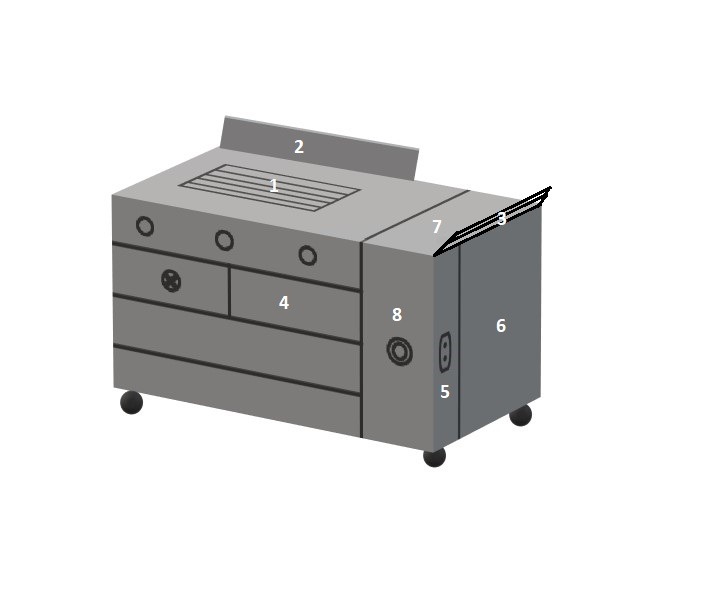
- Two Burners used to perform the flambe
- This compartment houses sauce, condiments, and the menu card which are to be used during the service.
- The handle is used to pull, push, and move the trolley around the restaurant.
- Drawers are used to store the equipment and utensils that are to be used
- Extension Port is used to get the electric supply for the plate warmer and other things
- The extended table can be used when more space is needed and can be folded down to when, not in use.
- Castors are the swivel wheels on which the trolley rolls and moves
- This compartment houses the gas cylinder.
OR (a) What is flambéing? Name the spirits used for flambéing.
Flambéing refers to the technique of dressing a hot pan with flambe liquors and as a result of the combustion, alcohol’s raw flavor is burned off but leaves behind a subtle, sweet flavor. The technique is primarily executed for dramatic tableside presentation. Flambéing plays a role in dishes such as bananas Foster, crepes Suzette, and steak Diane.
High-proof liquor such as brandy, cognac, or rum, which causes a momentary burst of flames during a flambe is called flambe liquor.
(b) List any three advantages and disadvantages of gueridon service. (4+6=10)
Advantages
- Highly personalized service. The wait staff prepares or carves the dish and serves the guest personally.
- High level of customer satisfaction. The dishes are prepared, carved, or flambéed in the guest’s presence.
- Good merchandising device. Guests will be tempted to order dishes that are served from the trolley.
- Wait staff can exhibit their culinary, carving, and service skills. The wait staff has an opportunity to impress the guests by demonstrating its cooking, flambéing, carving, and skills to them. It also gives them good job satisfaction.
Disadvantages
- The limitations are as follows:
- Slow service. The time taken to extend the service from the trolley is more.
- Low seat turnover. The number of times a seat is sold during the operation hours will low as the service takes more time.
- Expensive style of service- as it requires more service area and highly skilled staff.
Q.8. Describe the importance of the kitchen stewarding department for the smooth functioning of the F&B department. (10)
Kitchen Stewarding is one of the most important support departments of the F&B department. Kitchen stewarding contributes to the successful operation of the Food production and service department.
It performs the following functions:
- Washing kitchen pots and pans(scullery/pot wash)
- Maintaining kitchen equipment
- Cleaning all kitchen equipment and ensuring hygiene
- Garbage disposal
- Washing all service equipment including the ones used in banquets
- Polishing silverware
- Sending damaged silverware for plating
- Pest control
- Carrying transporting heavy articles
- Indenting for new crockery cutlery
- Gas connections and upkeep of tandoor
- Maintaining ppm levels for sanitizing knives and chopping boards
- Replenishment of serviceware to various outlets.
Q.9. Explain briefly: (4×2 ½ =10)
(a) Table configuration used for buffet meals.
Buffet table setting can be done in numerous ways depending upon the size and shape of the place, the menu, and the number of guests.
- The food items are placed in a sequence from lightest to heaviest, starters to desserts, or coolest to warmest.
- Cutlery is placed on the guest tables.
- Glasses, cups, and saucers are placed on a separate table to avoid congestion.
- Table decoration pieces are placed such that they do not interfere with the food items.
- Plates are stacked not more than 15 plates per stack.
- Paper napkins are placed between the plates.
(b) Cold buffet.
A cold buffet can consist of foods and drinks anywhere from fruits, sandwiches, soda, salads, etc. Anything that isn’t heated food. Displays of cold cuts and cold hors’ d oeuvre are commonly served. More popular in the western part of the world.
(c) Master of ceremonies.
A master of ceremonies (also known as an MC or emcee) is the official host for a staged event, performance, or party. Normally, a master of ceremonies introduces speakers, makes announcements, and engages with the audience to keep the ceremony agenda flowing as smoothly as possible.
(d) Suzette Pan.
It is a pan ideally used for making a thin dessert pancake, usually rolled or folded in quarters, heated in a sauce of orange-flavored liqueur, and served flambé known as crepe Suzette.
Q.10. Fill in the blanks: (10×1=10)
(a) Standard size of banquet cover 27”x15”.
(b) The minimum size of buffet cloth 2m x 4m.
(c) Work aisle required between two Sprigs 6 ft minimum.
(d) When the choice is given between thick and thin soup in the thin soup is written first.
(e) Releve course of the menu is heaviest of all courses of French classical menu.
(f) The height of buffet table is adjustable with an extender.
(g) 3 ft. space should be given behind the buffet tables for workers to move and replenish food.
(h) Caramelization is the process of turning sugar into brown color by heating.
(i) Name the equipment used for containing castor sugar, brown sugar, etc. glass rimmer
(j) Accompaniment for a Prawn cocktail is lemon wedges.