
Table of Contents
Q.1. Briefly, explain different types of services found in a hotel.(10)
Types of food service are as follows:-
-
Silver Service or Platter to Plate Service:
This type of service is most elegant and time-tested. In this, the highest skill of the waiter and the chef is demonstrated to the guest.The silver dish is basically placed on a neatly folded waiter’s cloth – a glittering pair of service spoons and service fork is kept on the side of the silver dish or carried in the right hand, the left hand is used for bringing the silver dish. From the left with great care food is transferred artistically on the plate. Such service is highly personalized and the guest feels extremely cared for which adds to goodwill.It gives the guest the choice of selecting and quantifying, the food served to him, therefore less possibilities of wastage and embarrassment. Food not taken by one guest of a table can be served to others and vice versa. Leftover food can be taken for a second round, by keeping the food on a hot plate at the sideboard. Accompaniments and garnishes can also be similarly handed around (served) making the service look substantive.
- Pre-plated Service or American Service or Blue Plate Service:
The most popular methods of service. This involves food decorated on plates of individual portions kept warm by putting them in hot cases or salamander, under infrared radiators (bulbs), in microwave chambers or in magnetic induction plates (only enamel plates are used).Service and clearance are done from the right-hand side. In this type of service a waiter can with his skill carry about five plates fixing them in between two hands. The mass catering or bulk service can be effectively carried out in this manner. The service is without any paraphernalia and minimum presence of the waiter is required. This type of service is prevalent in mid-cap restaurants, fast food restaurants, coffee shops, discotheques and in five-star hotels.
It is quick and simple. There is less spilling, less investment, less skill and less piling of dishes.No maintenance of silver items.On the plate, looks superb. Its a strong portion control mechanism.Standards can be set and maintained.Fewer chances of complaints.
-
Side table service or Gueridon Service or Cart service:
The most expensive and most exquisite method of food presentation. Originated in France, it has spread to all exclusive clubs in aristocratic gatherings. Although, it does not have many takers as it involves cooking in the restaurant which at times is offensive to diners, requires too much of space, extensive training, and skill of the service staff. The basics of side table service is bringing semi-cooked food in different colourful containers giving finishing touches right before the diners and serve as per the directions of the guest who can keep directing the nitty-gritty during the process of preparation and service. The grace of this service is that minimum two waiters are required, one who holds the plate, the other using service set neatly places the food on the plate from the pan. Other
activities include making various dressings like mayonnaise, vinaigrette, Thousand Island dressing, cutting and peeling of vegetables and fruits to make a salad, carving of a whole turkey, chicken, and leg of mutton into delicate portions as per the choice of the guest.Another area of excellence is flambe or slashing alcohol overcooked food and lighting it out to create a romantic effect in moderately dark surroundings. The patronage for such restaurants is only possible from high society who has the leisure of time and appreciation to understand and pay for same.The demerits of this service are a lot of space is required for carrying, trolleys. Smokes of fuel, alcohol, and aroma of food may be offensive to few guests. At times restaurant looks smoggy. It is expensive and time-consuming.
- English service or Butler service or Family style service:
It is a service where a butler, first footman, and second footman are involved in helping the host to conduct the service smoothly.Here the bowls and platters are brought on trolleys or trays kept before the host to portion out and carve the items and holding the plate for him to place the food and serve as directed. The host normally offers the first portion to his own wife as per tradition, then rest of the people.Often the butler and the assistants take the bowls and platters around for second helping.Clearing is done side by side and it is a very informal, private kind of service which normally does not exceed 15-20 people. It is customary for the host to show his closeness and favorites through his portions offered.
- Cafeteria Service:
This service exists in industrial canteens, colleges, hospitals or hotel cafeterias. To facilitate quick service, the menu is fixed and is displayed on large boards.The guest may have to buy coupons in advance, present them to the counter waiter who then serves the desired item. The food is served pre-plated and the cutlery is handed directly to the guest. Guests may then sit at tables and chairs provided by the establishment. Sometimes high tables are provided where guests can stand and eat.
- Buffet Service:
A self-service where food is displayed on tables. The guest takes his plate from a stack at the end of each table or requests the waiter behind the buffet table to serve him.The waiter may serve a few courses like the appetizer and soup at the table.
- Room Service:
It implies serving of food and beverage in guest rooms of hotels.The guest places his order with the room service order taker. The waiter receives the order and transmits the same to the kitchen. Meanwhile, he prepares his tray or trolley (small orders are served in trays while major meals on trolleys). He then goes to the cashier to have a cheque prepared to take along with the food order for the guests’ signature or payment. Usually, clearance is done half an hour or an hour later. However, the guest can call the Room Service for the clearance as and when he has finished with the meal.
- Lounge service:
Lounge service ranges from the service of continental breakfast, morning coffee, luncheon snacks, afternoon tea, dinner or late evening snacks as well as alcoholic beverages.The lounge staff generally has a small cupboard, of which only they have the key, and which holds a basic stock of items that they may need in case of emergency. These items may be as follows: Small linen stock Ashtrays Salvers Glasses Cups and saucers Basic alcoholic drink stock Cocktail snacks: olives, cherries, peanuts, etc. Beverages: coffee, Bovril etc. Check pads, bill pads, stock sheets, for alcoholic drinks.
Q.2. In a tabular form, list the different courses of the French Classical Menu in sequential order with their English equivalent and two examples of dishes from each course.(5+5=10)
S.NO |
FRENCH |
ENGLISH |
EXAMPLES |
1 |
Hors d’ oeuvre |
Appetizer |
Fish Mayonnaise, Canapés |
2 |
Potage |
SOUP |
Crème de Tomate, consommé royal |
3 |
Poisson |
Fish |
Sole Colbert, Poisson grille |
4 |
Entrée |
Entrance
(1st meat course) |
Rognon Saute Bercy- kidney with brown sauce, Chop de porc- pork chops, Vol au vent au rognon |
5 |
Reléve |
Main- Meat course |
Porc Roti (Roast Pork), Irish Stew |
6 |
Sorbet |
Flavoured water |
Sorbet a la peche (Peach Sorbet), Sorbet a la poire (Pear Sorbet) |
7 |
Rôti |
Roast |
Dindon Roti (roasted turkey)
Poulet Roti (roasted chicken) |
8 |
Légumes |
Vegetables |
Crepe de Legumes,Ratatouille Nicoise |
9 |
Entremet |
Sweets |
custard, puddings, Souffles |
10 |
Bonne Bouche |
Savoury and
Cheese |
Angel’s aux Cheval (oyster rolled in bacon and grilled), Ivanhoe (creamed haddock on toast)
Mozzarella, Parmesan, Cheddar |
11 |
Dessert
Cafe |
Fresh fruits & nuts
Coffee |
Mango, watermelon
Espresso, Latte |
OR Prepare a five-course table d’hote lunch considering the factors of menu planning. (10)
Waldrof Salade
(Apples, celery, walnuts and lettuce in mayonnaise and cream)
Chestnut soup
(Soup aux Chataignes’ is still popular French soup from the Aquitaine area of France due to the abundance of sweet chestnuts which are still grown here)
Oeuf Florentine
(Bread toast, spinach toast in garlic and seasoned with white sauce)
Crepe cake
(Delicate pancakes with chewy bite, served with melted butter and powdered sugar)
OR Q.3. Classify cigars on the basis of their size and colour of the wrapper. What are the parts of a cigar? How are cigars stored?(5+3+2=10)
CIGAR CLASSIFICATION – ON BASIS OF THEIR COLOUR
| CCC | CLARO, LIGHT |
| CC | COLORADO –CLARO, MEDIUM |
| C | COLORADO-DARK |
| CM | COLORADO MADURO, VERY DARK |
| M | MADURO, EXCEPTIONALLY DARK |
CIGAR CLASSIFICATION – ON BASIS OF THEIR SIZE AND SHAPE DESCRIPTION
| CORONA | A STRAIGHT SHAPE CIGAR WITH ROUNDED TOP ABOUT 5 ½ INCHES LONG |
| PETIT CORONA | ABOUT 5 INCHES LONG |
| TRES PETIT CORONA |
ABOUT 4 ½ LONG |
| HALF A CORONA | ABOUT 3 ¾ LONG |
| LONSDALE | SAME AS CORONA ABOUT 6 ½ INCHES LONG |
| IDEALES | A SLENDER TORPEDO SHAPED CIGAR, TAPERED AT THE LIGHTING END ABOUT 6 ½ INCHES LONG |
| BOUQUET | A SMALL TORPEDO SHAPED CIGAR |
| LONDRES | A STRAIGHT CIGAR, ABOUT 4 ¾ INCHES LONG |
| PANATELA | IS A LONGISH THIN CIGAR OPEN AT BOTH ENDS USUALLY ABOUT 5 INCHES IN LENGTH |
| A CHEROOT | A THIN CIGAR, OPEN AT BOTH ENDS USUALLY THICKER AND STUBBIER THAN PANATELA |
A cigar consists of three parts:
- Filler – The filler is the inner core that forms the body and shape of the cigar.
- Binder – The binder is the leaf in which the filler is wrapped to form what is known as cigar bunch.
- Wrapper – The wrapper or outer covering of cigar consists of a ribbon leaf rolled spirally around the cigar bunch. Wrapper leaf must be strong, elastic and silky in texture and of
even colour and it must possess good flavour and burning properties. It is the most expensive leaf used in cigars.
Storage of Cigar: The ideal temperature of storage of cigar is 16-18°C and a relative humidity required is 65-70%.That’s why it is best to keep cigars in a glass case with a humidifier. The cigars remain best in their own cedar boxes because it has unique quality of releasing moisture when needed and absorbing when not required in surrounding areas. The advantage of keeping cigar in cedar wood boxes is that mild fragrance of cedar wood mingles well with cigar. Remember not to place cigars near items which emanate its flavours or fragrance or absorb the flavour and fragrance of surrounding e.g. milk willpick up tobacco flavour and cheese will impregnate its mouldy flavour to cigar.
Q.4. Analyse the different meals of a day. List the outlets that may serve these meals in a hotel.(8+2=10)
The most important meals of the day are:
- EMT – Early morning tea that is offered with biscuits. Service is expected to be fast and timing of this meal is from 4.am to 6.am in the morning.
- Breakfast – It is offered in hotels are of different types which are : Continental breakfast is served from 6.00 a.m. to 9.00 a.m. in the morning. This breakfast includes coffee, tea, cocoa, rolls/ breads, croissants, butter, jam, fruit juice and honey. English break fast is served from 5.30 a.m. to 9.30 a.m. in the morning. This includes fruit juice, hot beverages, cereals, stewed fruit, meats, eggs, fish, jams and honey.Indian breakfast is served from 6.00 a.m. to 9.30 a.m. This includes puri bhaji, choice of parathas served with curd, idli, wada, uttapam, dosa, upma served with sambar along with tea and coffee.American Breakfast – Fruit juices (fresh/ canned),Cereals (cornflakes/porridge/oatmeal/wheat flakes),Eggs to order (boiled/ omelette/poached/fried/scrambled),Bread/Toast (with preserves and b utter),Tea/ coffee
- Brunch – It is a meal between breakfast and lunch. A heavy meal is taken avoiding the breakfast and also to skip the lunch. Timing 11:00am to 1:00pm (most popular in weekends).
- Elevens – Any meal taken at the eleventh hour the day generally after skipping the breakfast. The food items are generally bite sized are snacks taken at mid – morning, especially by children or housewives.
- Lunch – It starts from 12.30pm to 2.45pm and all types of menus are used. All F&B outlets cater to these meals. The variety of service differs from buffet and pre-plated in coffee shops, silver service in multi-cuisine restaurants.
- Afternoon tea – It is served from 4.00 p.m. to 5.00 p.m. in the coffee shop or in lounges to provide an informal atmosphere. It has a large choice of tea, tisanes, coffee with cookies, pastries, canopy, cocktails, sandwiches to offer.
- High tea – A heavier meal served between 5.30pm to 6.45pm. It is centred around children and offers juices, milkshakes, ice-cream, shakes, sandwiches, cutlets, french fries and Indian options like batura, dosa, pavbhaji alongside with a variety of non-alcoholic beverages.
- Dinner – It is served from 6.00 p.m. to 10.30 p.m. and all menus can be used.
- Supper and mid-night snacks: Suppers are served between 11.30pm to 1.30am.It offers limited dishes at high prices. Dishes like spaghetti bolognese, beef strongoff, grilled mushrooms, steaks, pulav with chicken butter masala and a variety of salads and deserts may be offered.Midnight snacks are limited to finger chips, fish fingers, sandwiches, canopies and such small easily prepared dishes along with tea, milkshakes, aerated drinks which can be served by a limited staff brigade throughout the night.
Q.5. What are the salient features of a good control system? Sketch the flow of KOT’s in the triplicate checking system.(3+7=10)
Every Hotel needs proper and effective control system in order to run its operations smoothly and effectively, without any fraudulent activities. The control system is applicable at each and every stage of the Food and Beverage Cycle, i.e.:-
- Taking the customer’s food or beverage order
- Announcing the orders to kitchen or bar as the case may be
- Getting the order correctly and ready on time
- Serving the order and at a correct serving temperature to the guest
- Making the correct bill
- Settling the bill
- The closing of the restaurant
Food sale is such a business if allowed unchecked can make an establishment bankrupt overnight. Therefore, it is not the F&B Staff but also the Managers and management to work together to establish an effective control system to prevent future disaster.
FLOW OF TRIPLICATE CHECKING SYSTEM
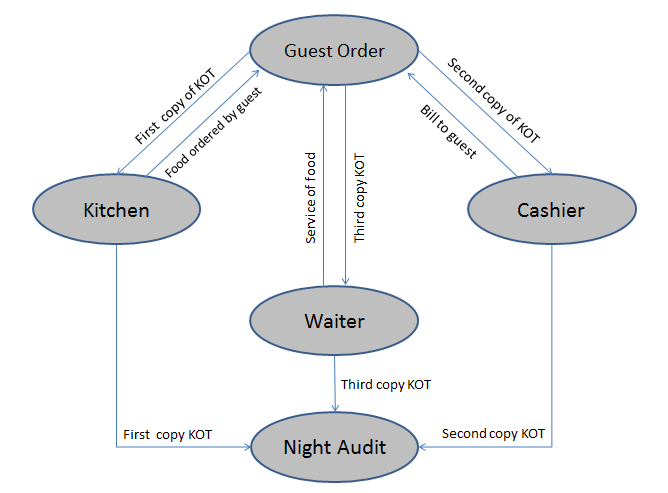
The food check has 3 copies. Each copy has a same serial number on them, and be of a different color for easy identification and demarcation. Once the order is recorded on the KOT,
- The first copy goes to the kitchen or the dispense bar on the basis of which the order is prepared. Once the waiter picks up the order, the KOT copy is dropped into the control box, which is always kept locked. The control box is maintained by the food and beverage control department to prevent any kind of fraud and malpractice.
- The second copy is given to the cashier and based on that the bill is prepared, which has 2 copies. The first copy of the bill goes to guest and another copy is retained by the cashier the cashier attached the 2nd copy of KOT to the 2nd copy of the bill and submits it along with sales summary to the food and beverage controls at the end of the day.
- The 3rd copy of KOT remains with the waiter in the KOT book for reference and checking up the order during service. It may be called for auditing at any time by the control department.
OR Briefly explain any five special checks used in F&B Service operations. List three F&B service software found in hotels. (7+3=10)
Different types of checks are used in F&B Service operations for various instances such as :
- SUIVANT – This KOT is used where it is necessary to write more than one KOT for a meal order. When a separate KOT is required to be written to order dessert for the same table after the main course is served, at the top of the KOT ‘suivant’ is written, which means the ‘following’ check of the previous one.

- SUPPLEMENT – When an extra portion of food is required because sufficient amount has not been sent (or extra portion of accompaniments are required) from the kitchen, a special KOT must be written out headed ‘supplement’. This means to ‘supplement’ what has already been sent. It should be signed by the senior caption and normally it is not charged.

- ACCIDENT – A waiter may drop a dish by accident. In this situation, a separate KOT, called ‘accident’, is raised, indicating the dish name and the number of portions required. This has to be signed by the senior caption and it is not charged.
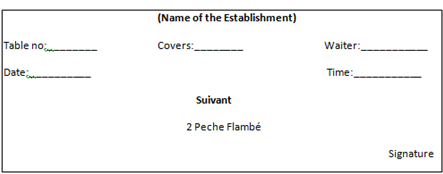
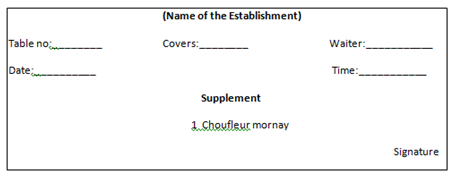
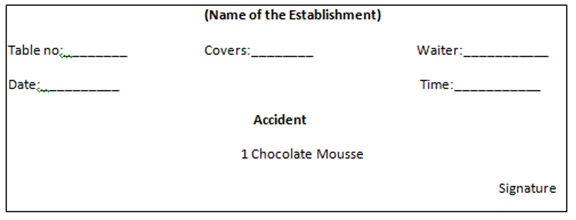
- RETOUR/EN PLACE – When a wrong dish has been ordered and has to be sent back to the kitchen and replaced, a special KOT must be made mentioning retour(return) and en place (in place). If the dishes are from an a’la carte menu, then the price should also be mentioned along with the order.

- NO CHARGE – Sometimes a waiter requires ingredients from various sources to finish a dish (which has already been charged the full price). As checks are necessary for all items, to cover issue of stock, he makes a check, for example ‘2 Curacao for crepes Suzette N/C’ which is duly signed by the head waiter. Such a check may also be used for complimentary drinks (possibly following a complaint).
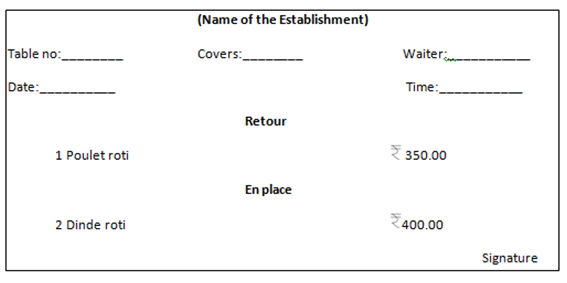
Three F&B service software found in hotels are:-
- Shawman (POS)
- Micros
- Infogenesis
Q.6. What are the different types of breakfast served in hotels? Illustrate the American Breakfast with a suitable menu.(3+7=10)
The different types of breakfast served in hotels are as follows:
- Indian breakfast: Indian breakfasts are mainly the NORTH INDIAN like puri bhaji, aloo paratha with curd and chole bhature.SOUTH INDIAN breakfasts like vada, idli, dosa etc. are popular.
- English breakfast : Fruit juices (fresh/canned);Stewed fruitsCereals (cornflakes/porridge/oatmeal/wheat flakes);Fish (fried/grilled);Eggs too order (boiled/omelette/poached/fried/scrambled);Meat (Fried/grilled/sausages);Bread/toast (with preserves and butter);Tea/coffee
- Continental breakfast: Fruit Juice (fresh/ canned);Bread/ Toast (with preserves and butter);Tea/ coffee
- American breakfast
American Breakfast
Traditional breakfasts in the United States and Canada derive from the full English breakfast and feature predominantly sweet or mild-flavored foods, mostly hot. Restaurants that serve breakfast typically base their menus around egg dishes and meats such as sausage and bacon. Pancakes and waffles are also popular. An assemblage commonly known as country breakfast in restaurants consists of eggs or omelet, sausage or bacon, hash browns, gravy, coffee, biscuits or toast with jam or jelly, and fruit juice.
- Choice of juice(Chilled fruit juices) – pineapple, orange, grapefruit etc
- Cereals – wheat flakes, muesli, oatmeal, rice crispies, porridge etc served along with hot or cold milk.
- Eggs to order – Omelettes, poached eggs, boiled eggs, fried eggs, scrambled eggs etc.
- Choice of bread – Croissant, Brioche, Muffins, Doughnuts, Danish pastry etc. Selections of preserves are always served along with it like butter, jam, honey, and marmalade.
- Choice of beverage – Tea, Coffee, Milk B
American Breakfast Cover
The cover for American breakfast would contain all the items of the previous course added with
- Half plate
- Knife and fork
- Cereal bowl or deep plate with underliner, doily, and spoon
Q.7. Differentiate between:(4×2 ½ =10)
(a) Café complet and Café simple
Cafe’ complet |
Cafe’ simple |
|
|
(b) Table d’hote menu and Àla carte menu
| Table d’ hote | A la carte |
|
|
|
|
|
|
|
|
|
|
|
|
|
|
|
|
|
|
|
|
|
|
|
|
|
|
|
|
|
|
(c) Mise-en-scene and Mise-en-place
| Mise-en-scene | Mise-en-place |
|
|
|
|
|
|
(d) Carte du jour and Plat du jour
| Carte du jour | Plat du jour |
|
|
|
|
|
|
Q.8. Write short notes on (any five): (5×2=10)
(a) Types of Caviar
Caviar is roe(processed fish eggs) of sturgeon(particular species of fish found in the Caspian Sea or black sea)
Types-
Grainy Caviar
Pressed Caviar
Grainy caviar can be further classified into Beluga- white in colour, Sevruga- dark in colour, Ossetra- black in colour
(b) Humidor
A humidor is a humidity-controlled box or room used primarily for storing cigars, cigarettes, or pipe tobacco.Humidor’s primary function is to maintain a steady, desirable moisture level inside; secondarily it protects its contents from physical damage and deterioration from sunlight. For private use, small wooden boxes holding a few dozen cigars are used. Many humidors use hygrometers to monitor their humidity levels.Types of humidor are:-
Walk-in: Most common in cigar bars or stores. One room is built as or converted to a humidor where all the cigars are stored.
Cabinet: Usually placed on the floor as a piece of furniture. Typically holds 1000–5000 cigars.
Desktop: Typically box sized with a lid on top or with one or more drawers. Vary in size from 25–500 cigars capacity.
Travel: Portable, usually holding 2 to 20 cigars.
(c) Equipment used in cashiering
- POS Terminal Metal Money Clip Cash Drawer
- Card Swiping Machine
- Customer Display: VFD
- Receipt Printer
- Barcode Scanner: Handheld barcode scanner
(d) Sorbet
Because of the length of the French classical menu, this course is considered to be the rest between courses.
It is a mid-course of the meal. It is the time for the guest to relax. Classically it is a glass of very chilled water flavoured with a few drops of champagne, which is served for the guest to sip it casually. Often strong cigarettes and cigar were also served. It is supposed to rinse out taste buds.Nowadays, rum, brandy, slush, fruit juice are also served for flavouring.
Cover- champagne saucer/ pony tumbler, underliner (quarter plate), teaspoon.Examples: Sorbet a la sicilienne. Scoops of green watermelon flavoured with maraschino on crushed ice, Sorbet a la peche (Peach Sorbet) Puree of peach with lemon juice flavoured with champagne.
(e) Soft cheese
A type of cheese that is made in a relatively short time and has a soft, creamy or almost runny texture that is usually spreadable.The process of making Soft Cheeses differs from making “Hard Cheeses” in that the curds aren’t pressed to squeeze out the whey, as they would be for instance in making a hard cheese like Cheddar. Ripened Soft Cheeses are mostly European in origin, whereas unripened ones are British and North American. Any kind of milk can be used in making Soft Cheeses, whole or skim, cow or goat or sheep.The fat content of Soft Cheeses varies wildly from one type of cheese to the other.
-
- Full Fat Soft Cheese: minimum 20% fat, maximum 60% moisture
- Medium Fat Soft Cheese: fat content from 2 to 20%, maximum 70% moisture
- Skim Milk Soft Cheese: maximum 2% fat content, maximum 80% moisture
Examples: Mozzarella, Ricotta,Cottage Cheese etc.
(f) Sauces served with pasta
Pesto Sauce – A semi-fine paste of basil leaves, olive oil, garlic and seasonings.
Arrabiatta Sauce – A spicy sauce of garlic, onion,tomato concsse and puree , basil and seasonings.
Alfredo Sauce – a rich pasta sauce made with butter, Parmesan cheese
Marinara Sauce – On red wine and garlic for a full-bodied flavor. The sauce is a bit chunky thanks to chopped onions and crushed tomatoes.
(g) Smorgasbord
Smörgåsbord is a type of Scandinavian meal, originating in Sweden, served buffet-style with multiple hot and cold dishes of various foods on a table.A range of open sandwiches and delicacies served as hors-d’oeuvres or a buffet.
(h) Hot Entremets
Crepe suzette : – pancakes in a rich fresh orange juice and flamed with brandy.
(i) Breakfast rolls
A breakfast roll typically consists of a bread roll or baguette containing one or more fillings such as sausages, bacon, white or black pudding, butter, mushrooms, tomatoes and tomato sauce or brown sauce. In some cases, a hash brown or fried egg may be added. The roll itself is usually one of three varieties: a soft “submarine”-type roll, a chunky, spherical dinner roll or a demi-baguette. The demi-baguettes are distributed to shops partially baked and frozen, allowing stores to quickly bake the bread for a “freshly baked” roll. An “all-day breakfast” sandwich featuring some or all of the above ingredients in a traditional sandwich of sliced bread may be used instead.
(j) Styles of serving steaks
The more tender cuts of beef, from the loin and rib, are cooked quickly, using dry heat, and served whole. Less tender cuts from the chuck or round are cooked with moist heat or are mechanically tenderized (e.g. cube steak).
Q.9. Write the French equivalent of : (10×1=10)
(a) Grapefruit: Pamplemousse
(b) Snail: Escargot
(c) Lobster: Homard
(f) Roast leg of pork: Rôti de Porc
(g) Goose liver paste: Pâte de foie d’oie
(h) Coffee with milk: Café au lait
(i) Bread: Pain
(j) Sugar: Sucre
Q.10. Write the accompaniments of (any five): (5×2=10)
(a) Chicken Maryland
corn fritters, bananas, grilled tomatoes, corn on the cob, bacon curls and pineapple rings, together with green salad.
(b) Bortsch
sour cream(Smetana), beetroot juice and small pies stuffed with duck forced meat.
(c) Melon
Ground ginger and castor sugar
(d) Fish orly
Tomato sauce
(e) Roast beef
French and English Mustard, Yorkshire Pudding, Roasted gravy, Horseradish sauce
(f) Chilled tomato juice
Worchester sauce
(g) Cheese
Balsamic Vinegar, Bread, Chutney, Crackers, Cured Meats.
(h) Oyster
Cayenne Pepper, Peppermill, Chilli vinegar, Tabasco sauce, Half a lemon, Brown bread and butter