
Topic wise notes as per new NCHM-JNU syllabus (for B.Sc HHA & M.Sc HA) are are now available at our new website hospitality.institute
Select Page

Cuts of pork

by

Cuts of Pork

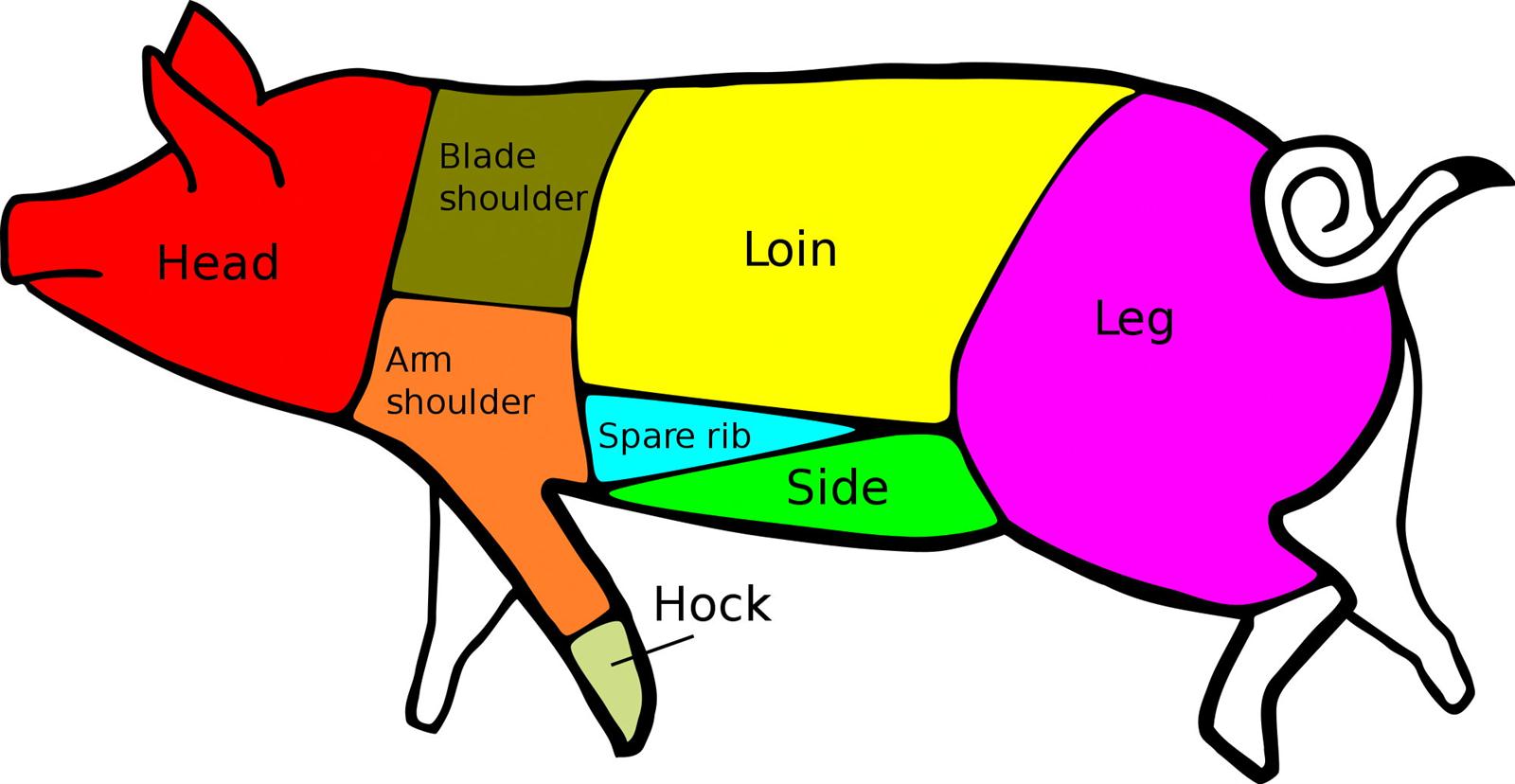
pork cuts

Head: This can be used to make brawn, stocks, and soups. After boiling the ears can be fried or baked and eaten separately, which are crunchy due to corliage bones. It is considered a delicacy.

Spare Rib: This is the shoulder and contains the shoulder blade. It can be boned out and rolled up as a roasting joint, or cured as “collar bacon”. Not to be confused with the rack of spare ribs from the front belly. Boston Butt, or Boston-style Shoulder, cut comes from this area, and may contain the shoulder blade.

Hand/Arm: This can be cured on the bone to make a ham, or used in sausages.

Loin: This can be cured to give back bacon or Canadian-style bacon. The loin and belly can be cured together to give a side of bacon. The loin can also be divided up into roasts (blade loin roasts, center loin roasts, and sirloin roasts come from the front, center, or rear of the loin), back ribs (also called baby back ribs, or riblets), pork cutlets, and pork chops. A pork loin crown roast is arranged into a circle, either boneless or with rib bones protruding upward as points in a crown.

Belly: The belly, although a fattier meat, can be used for steaks or diced stir-fry meat. Belly pork may be rolled for roasting or cut for streaky bacon.

Legs/Hams: Although any cut of pork can be cured, technically speaking only the back leg is entitled to be called a ham. Legs and shoulders, when used fresh, are usually cut bone-in for roasting, or leg steaks can be cut from the bone. Three common cuts of the leg include the rump (upper portion), center, and shank (lower portion).

Trotters: Both the front and hind trotters can be cooked and eaten, as can the tail.

Spare rib: These are taken from the pig’s ribs and the meat surrounding the bones.

  • BACON, HAM, AND GAMMON
  • Bacon: Bacon is made by preserving the meat of carefully bred pics. The preservative used is salt (curing) and/or smoked. Salt can be applied in two ways.
  • Covering the meat by dry salt allowing at least 4 weeks penetration.
  • By using a salt solution ( brine )

This is injected into the flesh and then the meat is immersed in a salt solution for 5 days. Some times a combined method is used. Brine is injected into the meat and then it is stacked and covered by dry salt for 2 to 3 weeks. It is then matured for about 3 weeks under controlled temperature. Desirable bacteria act on meat juices. This bacon is now ready to a sale as GREEN or PALE bacon.

In certain parts of the world, the bacon is preferred smoked.

So it is then hung over smoldering wood dust for 2 days. This extracts excessive moisture and gives the bacon a distinctive flavor, preserving the qualities and act as antiseptic.

Ham: Ham and Gammon come from the hind legs of a pig. Gammon is cut off the cured porker. Ham on the other hand, is cut off at fresh pork stage and includes a substantial part of the loin. It is cured after cutting, usually by the long process of dry salting.

How useful was this post?

5 star mean very useful & 1 star means not useful at all.

Average rating 4 / 5. Vote count: 22

No votes so far! Be the first to rate this post.

We are sorry that this post was not useful for you! 😔

Let us improve this post!

Tell us how we can improve this post?

Syllabus BHM151 (T)

01 Soups

  1. Basic recipes other than consommé with menu examples
    1. Broths
    2. Bouillon
    3. Puree
    4. Cream
    5. Veloute
    6. Chowder
    7. Bisque etc
  2. Garnishes and accompaniments
  3. International soups

02 Sauces & Gravies

  1. Difference between sauce and gravy
  2. Derivatives of mother sauces
  3. Contemporary & Proprietary

03 Meat Cookery

  1. Introduction to meat cookery
  2. Cuts of beef/veal
  3. Cuts of lamb/mutton
  4. Cuts of pork
  5. Variety meats (offals)
  6. Poultry (With menu examples of each)

04 Fish Cookery

  1. Introduction to fish cookery
  2. Classification of fish with examples
  3. Cuts of fish with menu examples
  4. Selection of fish and shell fish
  5. Cooking of fish (effects of heat)

05 Rice, Cereals & Pulses

  1. Introduction
  2. Classification and identification
  3. Cooking of rice, cereals and pulses
  4. Varieties of rice and other cereals

06 i) Pastry

  1. Short crust
  2. Laminated
  3. ChouxHot water/Rough puff
    1. Recipes and methods of preparation
    2. Differences
    3. Uses of each pastry
    4. Care to be taken while preparing pastry
    5. Role of each ingredient
    6. Temperature of baking pastry

ii) Flour

  1. Structure of wheat
  2. Types of Wheat
  3. Types of Flour
  4. Processing of Wheat – Flour
  5. Uses of Flour in Food Production
  6. Cooking of Flour (Starch)

iii) Simple Breads

  1. Principles of bread making
  2. Simple yeast breads
  3. Role of each ingredient in bread making
  4. Baking temperature and its importance

07 Pastry Creams

  1. Basic pastry creams
  2. Uses in confectionery
  3. Preparation and care in production

08 Basic Commodities

i) Milk

  1. Introduction
  2. Processing of Milk
  3. Pasteurisation – Homogenisation
  4. Types of Milk – Skimmed and Condensed
  5. Nutritive Value

ii) Cream

  1. Introduction
  2. Processing of Cream
  3. Types of Cream

iii) Cheese

  1. Introduction
  2. Processing of Cheese
  3. Types of Cheese
  4. Classification of Cheese
  5. Curing of Cheese
  6. Uses of Cheese

iv) Butter

  1. Introduction
  2. Processing of Butter
  3. Types of Butter

09 Basic Indian Cookery

i) Condiments & Spices

  1. Introduction to Indian food
  2. Spices used in Indian cookery
  3. Role of spices in Indian cookery
  4. Indian equivalent of spices (names)

ii) Masalas

  1. Blending of spices
  2. Different masalas used in Indian cookery
    1. Wet masalas
    2. Dry masalas
  3. Composition of different masalas
  4. Varieties of masalas available in regional areas
  5. Special masala blends

10 Kitchen Organization and Layout

  1. General layout of the kitchen in various organisations
  2. Layout of receiving areas
  3. Layout of service and wash up