
Table of Contents
Q.1. (a) Define Strategic Management.
Strategic Management is the process of defining, planning, implementing, and evaluating a company’s long-term goals, objectives, and initiatives to create and maintain a competitive advantage. It involves the systematic analysis of both internal and external factors affecting the organization, the formulation of strategies to address opportunities and challenges, and the allocation of resources to achieve desired outcomes. Strategic management enables organizations to navigate changes in their operating environment, adapt to evolving market conditions, and capitalize on emerging opportunities for growth and profitability.
(b) What are the salient features of a mission statement?
The salient features of a mission statement are the essential elements that define an organization’s purpose, values, and guiding principles. A well-crafted mission statement provides a clear and concise description of the organization’s fundamental purpose and communicates the company’s strategic direction to stakeholders, including employees, customers, and investors. The main features of a mission statement typically include:
- Purpose: The mission statement should clearly define the organization’s reason for existing and its primary objectives. This includes the products or services it offers, the markets it serves, and the value it aims to create for its stakeholders.
- Values: A mission statement should express the organization’s core values and guiding principles, which provide a foundation for decision-making and shape the company’s culture.
- Customers: The mission statement should identify the organization’s target customer base and explain how the company seeks to meet their needs or solve their problems.
- Scope: The mission statement should define the boundaries of the organization’s operations, including the industries it operates in, the geographical areas it serves, and the markets it targets.
- Distinctiveness: A mission statement should highlight the organization’s unique strengths, competitive advantages, or points of differentiation that set it apart from its competitors.
By incorporating these salient features, a mission statement serves as a powerful communication tool that conveys the organization’s strategic direction and helps align its activities and resources towards achieving its long-term goals.
Q.2. Write short notes on any two:
(a) Importance of objectives
Objectives are crucial in guiding an organization towards achieving its goals and fulfilling its mission. They provide a clear and measurable direction for the organization’s actions, enabling employees to focus their efforts and prioritize their tasks. Objectives are important because they:
- Provide a roadmap for success by setting targets and defining the desired outcomes.
- Align individual and team efforts with the organization’s overall mission and strategy.
- Facilitate performance evaluation and progress monitoring, allowing for adjustments and improvements.
- Motivate employees by providing a sense of purpose and achievement.
- Enhance communication and coordination across the organization by creating a shared understanding of priorities and expectations.
(b) SWOT analysis
SWOT analysis is a strategic planning tool used to evaluate an organization’s strengths, weaknesses, opportunities, and threats. It helps organizations identify their internal capabilities and external factors that could impact their performance, allowing them to make informed decisions and develop effective strategies. The components of SWOT analysis include:
- Strengths: Internal attributes that provide a competitive advantage or contribute to the organization’s success.
- Weaknesses: Internal limitations or deficiencies that hinder the organization’s performance or competitiveness.
- Opportunities: External factors or conditions that could benefit the organization or create potential for growth and expansion.
- Threats: External challenges or risks that could negatively impact the organization’s performance, stability, or market position.
(c) Leadership grid
The Leadership Grid, also known as the Managerial Grid or Blake-Mouton Managerial Grid, is a framework for understanding and evaluating leadership styles based on two dimensions: concern for people and concern for production. Developed by Robert Blake and Jane Mouton, the grid identifies five primary leadership styles:
- Impoverished (low concern for people and production): Minimal effort to achieve results or maintain relationships.
- Country Club (high concern for people, low concern for production): Focus on creating a comfortable work environment, often at the expense of productivity.
- Task (high concern for production, low concern for people): Emphasis on achieving results and meeting goals, with little regard for employee needs or well-being.
- Team (high concern for people and production): Balanced focus on achieving results while maintaining positive relationships and supporting employee development.
- Middle-of-the-road (moderate concern for people and production): A compromise between task and relationship orientation, often resulting in mediocre performance.
(d) Diversification
Diversification is a corporate strategy that involves expanding an organization’s operations into new products, services, or markets to reduce risks, increase growth opportunities, and enhance overall performance. Diversification can be classified into two main types:
- Concentric Diversification: Expansion into related markets or industries, leveraging the organization’s existing capabilities, resources, and customer base. This approach allows for synergy, cost savings, and more efficient utilization of resources.
- Conglomerate Diversification (unrelated diversification): Expansion into unrelated markets or industries, which helps spread risks and capitalize on new opportunities, but requires the development of new capabilities and resources.
Diversification can provide several benefits, such as reducing dependency on a single market, improving revenue stability, and capitalizing on growth opportunities. However, it also involves risks, including potential dilution of focus, increased complexity, and challenges in managing diverse operations
Q.3. Discuss the concept of external environment with relevant examples.
The external environment refers to the factors, conditions, and influences that exist outside an organization and affect its performance, strategy, and decision-making. These factors are typically beyond the organization’s control but can significantly impact its success. A thorough understanding of the external environment is essential for organizations to adapt, innovate, and maintain a competitive edge. The external environment can be divided into several categories:
- Economic Factors: These factors include economic growth, inflation, unemployment rates, interest rates, and exchange rates. They influence consumer spending, access to capital, and the overall health of the economy, affecting businesses across all industries. For example, during periods of economic recession, organizations may experience reduced demand for their products or services, leading to lower revenues and potential downsizing.
- Technological Factors: Advances in technology, such as automation, artificial intelligence, and digital transformation, can create new opportunities or disrupt existing business models. Organizations must stay informed about technological trends and adapt their strategies to remain competitive. For example, the rise of e-commerce platforms has forced traditional brick-and-mortar retailers to develop online sales channels and enhance their digital marketing efforts.
- Political and Legal Factors: Government policies, regulations, and political stability can influence organizations’ operations, market access, and compliance requirements. For example, changes in tax policies, environmental regulations, or international trade agreements can impact an organization’s cost structure, competitiveness, and strategic decisions.
- Socio-cultural Factors: These factors include demographic trends, cultural norms, and social attitudes that influence consumer behavior and market demand. Organizations must be aware of and adapt to shifts in consumer preferences, lifestyle choices, and values. For example, the increasing awareness of environmental sustainability and ethical consumerism has led many businesses to incorporate sustainable practices and social responsibility initiatives into their operations.
- Competitive Factors: The competitive environment, including the intensity of competition, the number and size of competitors, and their strategies, can significantly impact an organization’s market position and profitability. Organizations must continually assess their competitive landscape and adapt their strategies to maintain or enhance their market position. For example, a company operating in a highly competitive market may need to invest in product innovation, differentiation, or cost reduction to stay ahead of its rivals.
By analyzing and understanding these external factors, organizations can identify opportunities, anticipate challenges, and make informed strategic decisions to navigate the dynamic and complex business environment.
OR List and give a brief on the various approaches to developing strategies.
There are several approaches to developing strategies, each with its unique focus and methodology. Some of the popular approaches are:
- SWOT Analysis: This approach involves analyzing an organization’s internal strengths and weaknesses, as well as external opportunities and threats. The goal is to leverage strengths, minimize weaknesses, capitalize on opportunities, and mitigate threats to develop a competitive advantage and achieve organizational objectives.
- Porter’s Five Forces: This framework, developed by Michael Porter, focuses on understanding the competitive forces within an industry to develop strategies for achieving a competitive advantage. The five forces include the threat of new entrants, the bargaining power of suppliers, the bargaining power of buyers, the threat of substitute products, and the intensity of competitive rivalry.
- BCG Matrix: The Boston Consulting Group (BCG) Matrix is a portfolio planning tool used to evaluate an organization’s products or business units based on their relative market share and market growth rate. This approach helps organizations allocate resources, prioritize investments, and develop strategies for growth, maintenance, or divestiture.
- Ansoff Matrix: This framework is used to explore growth strategies based on the relationship between an organization’s products and markets. The Ansoff Matrix consists of four quadrants: market penetration, market development, product development, and diversification. By evaluating opportunities within each quadrant, organizations can develop strategies to expand their market presence, innovate, or enter new markets.
- Value Chain Analysis: This approach, also developed by Michael Porter, focuses on understanding the organization’s value chain or the series of activities that create and deliver value to customers. By analyzing each activity and identifying areas for improvement or differentiation, organizations can develop strategies to enhance efficiency, reduce costs, and create a competitive advantage.
- Resource-Based View (RBV): This approach emphasizes the role of an organization’s unique resources and capabilities in determining its strategy. The goal is to identify, develop, and leverage valuable, rare, inimitable, and non-substitutable resources to achieve a sustainable competitive advantage.
- Balanced Scorecard: This approach, developed by Robert Kaplan and David Norton, integrates financial and non-financial performance measures to develop a comprehensive strategic management system. The balanced scorecard focuses on four perspectives: financial, customer, internal business processes, and learning and growth. By setting objectives, measures, and targets within each perspective, organizations can align their strategies with their vision and mission.
Each of these approaches offers a different perspective on strategy development and can be used individually or in combination to create a comprehensive and effective strategic plan. Organizations must consider their specific context, goals, and resources when selecting and applying these approaches to develop strategies that drive growth and success.
Q.4. “The Seven-S frame work provides insight into an organisation’s working and help in formulating plans for improvement”. In the light of the statement, explain McKINSEY’s framework with the help of a diagram.
McKinsey’s 7S Framework is a management model that helps organizations analyze their internal structure and develop plans for improvement. The framework consists of seven interconnected elements, often referred to as “the 7S”. These elements can be grouped into “hard” elements (Strategy, Structure, and Systems) and “soft” elements (Shared Values, Skills, Style, and Staff). The interdependence of these elements means that a change in one area will affect the others, making the 7S framework an effective tool for understanding the organization’s current state and identifying areas for improvement.
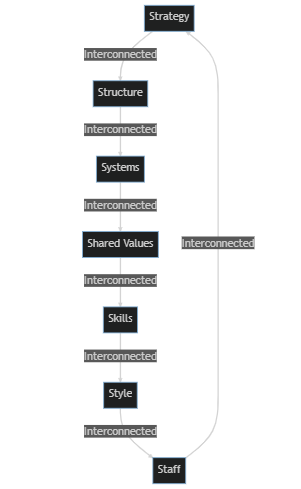
Hard Elements:
- Strategy: The organization’s long-term plan to achieve its goals and objectives, considering the external environment and competition.
- Structure: The hierarchy, division of labor, and communication channels within the organization, outlining how tasks and responsibilities are allocated.
- Systems: The processes, procedures, and tools used to conduct daily operations and ensure the organization’s smooth functioning.
Soft Elements:
- Shared Values: The core values, principles, and beliefs that guide the organization’s actions and decision-making, often reflected in the corporate culture.
- Skills: The capabilities and expertise of the organization’s employees, as well as the ability to develop and maintain those skills.
- Style: The leadership approach and management style adopted by the organization, influencing employee behavior, motivation, and performance.
- Staff: The human resources aspect, including employee recruitment, training, development, and retention policies.
By examining these seven elements, organizations can gain a deeper understanding of their internal workings, identify strengths and weaknesses, and develop plans for improvement that consider the interconnected nature of the 7S. This comprehensive approach ensures that changes made in one area are supported and reinforced by the other elements, leading to more effective and sustainable organizational development.
Q.5. Discuss Boston Consultancy Group (BCG) matrix of corporate portfolio analysis.
The Boston Consulting Group (BCG) Matrix is a corporate portfolio analysis tool that helps organizations evaluate their products or business units based on two dimensions: relative market share and market growth rate. The matrix is divided into four quadrants, each representing a different strategic category for products or business units: Stars, Cash Cows, Question Marks, and Dogs. The goal of the BCG Matrix is to help organizations allocate resources and prioritize investments to maximize the overall performance and value of their portfolio.
The four quadrants of the BCG Matrix are:
- Stars: These products or business units have a high relative market share and high market growth rate. They are market leaders with strong growth potential and require substantial investment to maintain or increase their market share. Over time, Stars are expected to become Cash Cows as the market growth slows down.
- Cash Cows: These products or business units have a high relative market share but low market growth rate. They generate significant cash flows due to their dominant position in mature markets. Cash Cows require less investment and can be used to fund the growth of Stars and Question Marks within the organization.
- Question Marks: These products or business units have a low relative market share and a high market growth rate. They are operating in growing markets but face strong competition, making their future uncertain. Question Marks require significant investment to increase market share and become Stars, but not all will succeed. Organizations need to evaluate the potential of each Question Mark and decide whether to invest, divest, or maintain their position.
- Dogs: These products or business units have a low relative market share and a low market growth rate. They are underperformers in mature markets and generally generate low profits or losses. In most cases, it is advisable for organizations to divest or discontinue Dogs to free up resources for more promising business units.
The BCG Matrix is a valuable tool for strategic planning and resource allocation. By categorizing products or business units based on their relative market share and market growth rate, organizations can identify opportunities for growth, maintenance, or divestiture, and make informed decisions about where to invest their resources for maximum returns. However, it is important to consider the limitations of the BCG Matrix, such as oversimplification, reliance on quantitative data, and changes in market dynamics, when using it as a decision-making tool.
Q.6. Throw light on Internal Factor Evaluation matrix (IFE matrix) displaying a table of strength and weaknesses of an individual hotel property.
The Internal Factor Evaluation (IFE) Matrix is a strategic management tool that helps organizations assess their internal strengths and weaknesses. The IFE Matrix focuses on the key internal factors that affect the organization’s performance, allowing decision-makers to evaluate and prioritize these factors to improve the organization’s competitive advantage.
To create an IFE Matrix for an individual hotel property, you need to follow these steps:
- List the hotel’s key internal strengths and weaknesses.
- Assign a weight to each factor based on its relative importance (total weights should sum to 1.0).
- Rate each factor on a scale of 1 to 4, with 1 representing a major weakness and 4 representing a major strength.
- Multiply the weight by the rating to get a weighted score for each factor.
- Sum the weighted scores to get the total weighted score for the hotel.
Here’s an example of an IFE Matrix for a hotel property:
Internal Factors |
Weight |
Rating |
Weighted Score |
|---|---|---|---|
Strengths |
|||
Prime location |
0.15 |
4 |
0.60 |
Highly trained staff |
0.10 |
4 |
0.40 |
Strong brand recognition |
0.10 |
3 |
0.30 |
High customer satisfaction |
0.15 |
3 |
0.45 |
Modern facilities |
0.05 |
3 |
0.15 |
Weaknesses |
|||
Limited parking space |
0.10 |
2 |
0.20 |
High staff turnover |
0.10 |
2 |
0.20 |
Limited food and beverage options |
0.10 |
2 |
0.20 |
Outdated website |
0.05 |
1 |
0.05 |
Lack of a loyalty program |
0.10 |
1 |
0.10 |
Total |
1.00 |
2.55 |
In this example, the hotel’s total weighted score is 2.55, which indicates its overall internal performance. A higher score suggests better performance, while a lower score indicates areas for improvement. The IFE Matrix provides a visual representation of the hotel’s strengths and weaknesses, allowing management to prioritize areas for improvement and build on its strengths to enhance its competitive advantage.
OR Draw a model for strategic review and evaluation.

Q.7. How do policies play a vital role in the day-to-day operations of hotel industry?
Policies play a vital role in the day-to-day operations of the hotel industry, as they serve as guidelines for employees and management to follow in various aspects of hotel operations. These policies are essential for maintaining consistency, efficiency, and professionalism throughout the organization. Some of the ways policies impact the day-to-day operations in the hotel industry are:
- Standardization: Policies help standardize procedures and processes, ensuring that all employees follow the same set of rules and guidelines. This promotes consistency in service delivery, which is crucial for maintaining a positive guest experience.
- Decision-making: Policies provide a framework for decision-making by outlining the acceptable courses of action for various situations. They help employees and management make informed decisions, ensuring that actions are in line with the hotel’s objectives and values.
- Performance evaluation: Policies serve as a benchmark for evaluating employee performance. By clearly defining expectations and standards, management can assess the performance of employees and provide feedback for improvement.
- Legal and regulatory compliance: Policies help ensure that hotels comply with relevant laws, regulations, and industry standards. They provide guidance on issues such as safety, hygiene, employment practices, and environmental management, reducing the risk of legal and regulatory violations.
- Conflict resolution: Clearly defined policies help address and resolve conflicts between employees or between employees and guests. They provide a framework for handling disputes and grievances, ensuring that issues are addressed fairly and consistently.
- Training and development: Policies serve as a basis for employee training and development programs. They help new employees understand the hotel’s expectations and procedures, and provide a foundation for ongoing training and skill development.
- Cultural alignment: Policies help create and maintain a strong organizational culture that aligns with the hotel’s mission, vision, and values. They promote a shared understanding of the hotel’s goals and expectations, fostering a sense of unity and commitment among employees.
In summary, policies play a crucial role in the day-to-day operations of the hotel industry by promoting consistency, guiding decision-making, supporting performance evaluation, ensuring compliance, resolving conflicts, facilitating training, and fostering a strong organizational culture.
OR Describe five expansion strategies adopted by companies, listing an example for each.
- Market Penetration: This strategy involves increasing market share within existing market segments. Companies aim to sell more products or services to their current customers by focusing on marketing and promotional activities, improving customer service, or lowering prices. This strategy is best suited for businesses with a strong market presence and competitive advantages.
Example: Coca-Cola focuses on increasing its market share in the beverage industry by offering various promotions and discounts to existing customers, thereby encouraging them to purchase more products.
- Market Development: This strategy involves expanding into new market segments or geographical areas. Companies identify new customer segments or untapped markets where they can sell their existing products or services. This can be achieved through exporting, opening new sales channels, or partnering with local distributors.
Example: Starbucks expanded its operations from the United States to international markets, including Europe, Asia, and Latin America, to reach new customers and increase its global footprint.
- Product Development: This strategy focuses on creating new products or services for existing markets. Companies invest in research and development to innovate and introduce new offerings that cater to the evolving needs and preferences of their current customers, aiming to gain a competitive edge.
Example: Apple constantly develops and launches new products, such as the iPhone, iPad, and Apple Watch, to maintain its position in the technology market and offer new solutions to its existing customer base.
- Diversification: This strategy involves entering new markets with new products or services, which can be related (concentric diversification) or unrelated (conglomerate diversification) to the company’s current offerings. This approach helps companies spread risk and capitalize on new opportunities for growth.
Example: Virgin Group, initially a record label, diversified into various industries, such as aviation (Virgin Atlantic), telecommunications (Virgin Mobile), and hospitality (Virgin Hotels), by leveraging its strong brand reputation.
- Integration: This strategy involves acquiring or merging with businesses in the same supply chain, either vertically (upstream or downstream) or horizontally (among competitors). Vertical integration allows companies to gain control over suppliers or distributors, while horizontal integration helps consolidate market share and achieve economies of scale.
Example: Amazon acquired Whole Foods Market to vertically integrate its business and expand its presence in the grocery industry, enabling Amazon to gain control over a vital part of its supply chain and strengthen its position in the market.