
Table of Contents
Q.1. Describe the various reasons why FMCG company would like to enter International market. Illustrate with examples. (10)
Local fast moving consumer goods (FMCG) competitors in emerging markets such as Brazil, China and India have been growing from strength to strength. While emerging market brands are still focused on fortifying their foothold in their home markets, Indian FMCG brands are making aggressive moves overseas.
Traditionally many companies have stayed focused in their domestic markets and have refrained from competing globally. They know their domestic markets better and understand that they have to make fundamental changes in the way they work to be able to compete globally.
But increasingly companies are choosing or are being forced to sell their products in markets other than their domestic markets. It has become imperative for most companies to compete in foreign markets.

Reasons for company going global
1. Domestic markets are saturated and there is pressure to raise sales and profits. Most companies have very ambitious sales and profit targets. If such figures have to be realized, companies have to move out of their domestic markets.
2. Domestic markets are small. Companies which have ambitions to become big will have to look for bigger markets outside their boundaries.
3. Domestic markets are growing slowly. Most companies are no longer content to grow incrementally. If such companies have to achieve high growth rates, they have to obtain some of their sales from international markets.
4. In some industries like advertising, customers want their suppliers to have international presence so that suppliers can contribute in most of the markets where the buyer is operating. For instance, a multinational will choose an advertising agency which has a presence in all the markets where the multinational is selling its product. The customer does not want the hassle of hiring a separate advertising agency for each of its markets. This process will be replicated in more industries.
A multinational company seeking materials and equipment’s would want its supplier to supply to all its international manufacturing locations. The supplier is forced to develop competencies and resources at many international locations to be able to serve the international manufacturing locations of its buyer.
5. Some companies will have to move out of their domestic markets when their competitors have done so, if they want to maintain their market share. If the competitor is allowed to pursue its international growth alone, the competitor is likely to plough back some of the earnings from its international operations to the domestic market, making it difficult for the companies which refrained from pursuing international markets, to focus on the domestic market. In other cases, a domestic player would start operations in the home country of its global competitor, to divert the attention and resources of its competitor towards operations at home to safeguard its home market.
6. Developed markets have high cost structures and companies may move their operations to regions and countries where costs of production are lower. Once a company starts operating in a geographical region, it becomes easier and profitable to market their products in that area.
7. Countries and regions are at different stages of development, and their growth rates and potential are different. Companies do not like to concentrate all their efforts in limited regions and want to spread out their risk. Such companies will look for markets which are likely to behave differently from their existing ones in terms of economic parameters like growth rate, size, affluence of customers, stage of market development, etc.
A company would not like all its markets to be under recession or inflation simultaneously, and would not like all its markets to be in mature stage, or in growth stage. Having different type of markets will make revenues and profits more consistent. The investment requirements would also be more balanced.
8. Even if a company decides to concentrate on its domestic market, it will not be allowed to pursue its goals unhindered. Multinational companies will enter its market and make a dent in its market share and profit. The company has no choice but to enter foreign markets to maintain its market share and growth.
9. Companies are realizing that it is no longer an option to stay put in one’s domestic market. The ability to compete successfully in domestic markets will depend upon their ability to match the resources and competencies of multinational companies, with whom they have to compete in their domestic markets.
And once they decide to take on the multinational companies on their home turf, they have to improve their resources and competencies to be able to match those of the multinational companies. They will also learn about the ways of operation of multinational companies. This experience will be helpful when they have to protect their domestic markets against the multinational companies.
The boundary between a company’s domestic market and other markets is getting blurred. Only a company which is internationally competitive can protect its domestic market. No market is or will be protected from incursion by multinational companies. A company’s only choice is to go global, even if its prime interest is to protect its domestic turf.
For example
Dabur, Godrej and Emami are not resting on their dominant positions in India, and are instead looking to increase capital expenditures from US$218.8 million to US$656.5 million, in order to establish a stronger market position abroad. Godrej made seven international acquisitions in 2019, Marico made two, Dabur made two and Emami, one.
Q.2. Explain the concept of ERPG model in the evolution of global marketing. Give suitable examples. (10)
Depending on the kind and degree of its involvement in foreign marketing, a firm has to re-orient and re-organise its activities to cope with the different levels of operational responsibilities inherent in such involvement. To throw some light on this issue, some guidelines are available from what is called the EPRG framework . The EPRG framework attempts to identify four broad types of orientation of a firm towards internationalization of its operations. These are: Ethnocentrism, Polycentrism, Regiocentrism and Geocentrism (EPRG).
1. Ethnocentric Orientation
The ethnocentric orientation of a firm considers that the product, marketing strategies and techniques applicable in the home market are equally applicable in the overseas markets as well. Foreign markets are looked upon merely as an extension of the home market. In such a firm all foreign marketing operations are planned and carried out from the home base. with little or no difference in product formulation and specifications, pricing strategy, distribution and promotional measures in the home and overseas markets. The firm generally depends on its foreign agents and export-import merchants for its export sales.
Example
Example of ethnocentric approach company are Japanese firms such as Panasonic, Sony and Hitachi. In Mastec organization, the staffing approach for subsidiaries in Thailand, Vietnam and India adopted ethnocentric system due to lack of competency of HCNs and the needs for corporate communication.
2. Polycentric Orientation
When a firm adopts polycentric approach to overseas marketing it attempts to organize its international marketing activities on country-by-country basis. Each country is treated as a separate market entity and individual strategies are worked out accordingly. Local assembly or production facilities and marketing organizations are created or serving the market needs in each country.
Polycentrism could be most suitable for firms seriously committed to international marketing and have the resources for investing abroad for fuller long-term penetration into chosen overseas market.
Examples
Take McDonald’s as an example. The familiar offerings in their restaurants in the United States may be somewhat less familiar if you venture abroad. In India, where many people do not eat beef, McDonald’s offers the McAloo Tikki, a vegetable patty with characteristic Indian spices.
3. Regiocentric Orientation
In regiocentric approach, the firm adopts a regional marketing policy covering a group of countries which have comparable market characteristics. The operational strategies are formulated on the basis of the entire region rather than individual countries and production and distribution facilities are created to serve the whole region with effective economy of operations and closer control and coordination.
Example
Coca-Cola and Pepsi are regiocentric companies. Regiocentric strategy assumes that all countries of the region can be regarded as a single market. This allows for much greater economy of scale than the polycentric strategy.
4. Geocentric Orientation
In geocentric orientation, the firm adopts a worldwide approach to marketing and its operations become truly global in character. In a global enterprise, the management establishes manufacturing and processing activities at specific points around the world in order to serve the various national or regional markets through a complicated but well-coordinated system of productive and distributive network. There are close similarities between regiocentric and geocentric approaches to international marketing, except perhaps that the geocentric orientation calls for a much greater scale of operation, coordination and organizational set-up in order to cater to markets of heterogeneous characteristics which are usually more pronounced in geocentrism compared with regiocentrism. Car manufacturers, led by Ford, are adopting just such an approach on a worldwide basis. For example the name Ford is the same worldwide. The logo is the same. Ford’s light blue colour is the same.
Q.3. A number of documents are used in Export – Import trade. Define the following documents briefly:
a. C&F
Cost and Freight (CFR) means that the seller must pay the costs and freight in order to transport the goods to the port of destination in question. The risk of the loss of or damage to the goods, as well as any additional costs as a result of events after the goods are delivered onboard the vessel, transfers from the seller to the buyer when the goods pass the ship’s railing in the shipping port.
The term CFR obliges the seller to clear the goods. This term can only be used for transport by sea and inland shipping traffic.
b. Airway Bill
An air waybill (AWB) or air consignment note is a receipt issued by an international airline for goods and an evidence of the contract of carriage, it is a document of title to the goods. Hence, the air waybill is non-negotiable.
The air waybill is the most important document issued by a carrier either directly or through its authorized agent. It is a non-negotiable transport document that covers the transport of cargo from airport to airport. By accepting a shipment, an IATA cargo agent is acting on behalf of the carrier whose air waybill is issued.
Air waybills have eleven digit numbers which can be used to make bookings, check the status of delivery, and a current position of the shipment.
Air waybills are issued in eight sets of different colours. The first three copies are classified as originals. The first original, green in colour, is the issuing carrier’s copy. The second, coloured pink, is the consignee’s copy. The third, coloured blue, is the shipper’s copy. A fourth brown copy acts as the Delivery Receipt or proof of delivery. The other four copies are white.
c. Ocean Bill of Lading
An ocean bill of lading is a document required for the transportation of goods overseas across international waters. An ocean bill of lading serves as both the carrier’s receipt to the shipper, and as a collection document or an invoice. The contract is a legally binding document between both the shipper and the carrier of the shipment.
A bill of lading is a legal document or contract between the shipper and carrier which details the type, quantity, and destination of goods being carried. The bill of lading serves as a receipt of shipment when the goods are delivered at the predetermined destination. There are different kinds of bills of lading, each with unique stipulations and conditions.
An ocean bill of lading allows the shipper to move goods across international waters. This document or contract provides the specifics involving the nature of the shipment including what and how much material is being transported, along with where the goods will be shipped. Other information outlined in the contract includes the value of the goods shipped and the type of packing used during transport.
The shipper receives the contract when the goods are picked up. The document must be signed by both the shipper and the carrier. Once the shipment is complete, the document is given to the receiver. Upon delivery and receipt, the receiver must also sign the contract.
d. Bill of Exchange
A bill of exchange is a binding agreement by one party to pay a fixed amount of cash to another party as of a predetermined date or on demand. Bills of exchange are primarily used in international trade. Their use has declined as other forms of payment have become more popular. There are three entities that may be involved with a bill of exchange transaction.
A bill of exchange is transferable, so the drawee may find itself paying an entirely different party than it initially agreed to pay. The payee can transfer the bill to another party by endorsing the back of the document.
e. Shipment advice
A shipment advice is a commercial document , which is issued by the exporter, who is the beneficiary of the letter of credit, in order to give shipment details to the importer, who is the applicant of the letter of credit.
The shipment advice should be issued by the exporters.
The shipment advice should be created as soon as the shipping details are available. In a letter of credit transaction, the shipment advice should be created and dispatched within 3 or 5 days after the date of shipment.
The main function of the shipment advice is to allow importers to arrange transport insurance in a timely manner.
Especially, this document is vital importance in situations where importers have to arrange the transport insurance, such as FCA, FOB, CFR, FAS, CPT and EXW deliveries.
Q.4. What is institutional set up for exports in India? Discuss any two commodity boards. (10)
Institutions engaged in export effort fall in six distinct tiers. At the top is the Department of Commerce in the Ministry of Commerce and Industry. This is the main organization that formulates and guides India’s trade policy. At the second tier, there are advisory bodies to ensure that export problems are comprehensively dealt with after mutual discussions between the Government and the Industry. At the third tier are the commodity specific organizations, which deal with problems relating to individual commodities and/or groups of commodities. The fourth tier consists of service institutions, which facilitates and assist the exporters to expand their operations and reach out more effectively to the world markets. The fifth tier consists 44 of Government trading organizations specifically set up to handle export/import of specified commodities and to supplement the efforts of the private enterprise in the field of export promotion and import management. Agencies for export promotion at the State level constitute the sixth tier.
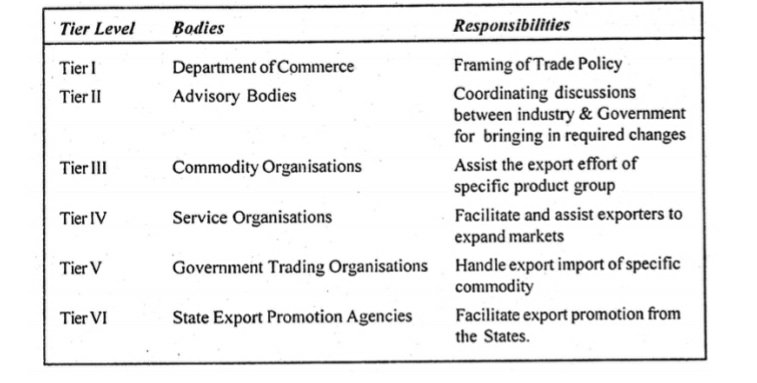
Institutional framework
Commodity boards
There are nine statutory boards, which deal with the issues related to production, marketing and development of commodities as under:
1. The Tea Board
2. The Coffee Board
3. The Coir Board
4. The Central Silk Board
5. The All-India Handlooms and Handicraft Board
6. The Rubber Board
7. The Cardamom Board
8. The Tobacco Board
9. The Spices Board
A. The Tea Board
Tea Board was set up as a statutory body on 1st April, 1954 as per Section (4) of the Tea Act, 1953. As an apex body, it looks after the overall development of the tea industry. The Board consists of 32 Members, including Chairman and Deputy Chairman appointed by the Government of India representing different sections of the Tea industry.
The Board’s Head Office is situated in Kolkata and there are two Zonal offices-one each in North Eastern Region at Jorhat in Assam and in Southern Region at Coonoor in Tamil Nadu. Besides, there are 18 regional offices spread over in all the major tea growing states and four metros. For the purpose of tea promotion, three overseas offices are located at London, Dubai and Moscow.
In order to meet the developmental needs of the small sector which accounts for more than 1/3rd of national tea production, separate directorate has been set up during the year under report. The functions and responsibilities of Tea Board include increasing production and productivity, improving the quality of tea, market promotion, and welfare measures for plantation workers and supporting Research and Development. Collection, collation and dissemination of statistical information to all stake holders are yet another important function of the Board. Being the regulatory body, the Board exerts control over the producers, manufacturers, exporters, tea brokers, auction organizers and warehouse keepers through various control orders notified under Tea Act.
2. The Rubber Board
The Rubber Board is a statutory organisation constituted under Section (4) of the Rubber Act, 1947 and functions under the administrative control of Ministry of Commerce and Industry. The Board is headed by a Chairman appointed by the Central Government and has twenty seven members representing various interests of natural rubber industry.
The Board’s headquarters is located at Kottayam in Kerala. The Board is responsible for the development of the rubber industry in the country by way of assisting and encouraging research, development, extension and training activities related to rubber. It also maintains statistical data of rubber, takes steps to promote marketing of rubber and undertake labour welfare activities.
The activities of the Board are exercised through nine departments viz. Rubber Production, Research, Processing & Product Development, Training, License & Excise Duty, Statistics and Planning, Market Promotion, Finance & Accounts and Administration. The Board has five Zonal Offices and 43 Regional Offices. It has a Central Rubber Research Institute in Kottayam and 10 regional research stations located in various rubber growing states of the country. It also has a Rubber Training Institute located at Kottayam.
Q.5. Elaborate the role of E – marketing and advertising in International hotel business. Give suitable examples. (10)
E-marketing is the new trend of marketing extensively acquiring by hotel industry. The traditional marketing strategy of hotel industry now not performing very well. In place e-marketing is taking the drivers seat.
E-marketing is also known as Internet marketing, web marketing, online marketing or digital marketing. It is growing at a dramatic pace in the hospitality industry and is significantly impacting the business behaviors since it drives more revenue than traditional marketing.
The rapid spread in the usage of the internet and the increase in access to ecommerce and online bookings has definitely been a boon to the hospitality industry. The increasing incidence of guests booking their hotel rooms online has not only improved the booking rate of hotels but has also let them pass on hefty discounts to the customers which would otherwise had to be shared with the travel agents and other intermediaries. In other words, the advent of online booking has been a win-win situation for the hotels and the customers. Next, with so many guests from around the world flocking to the internet to book their rooms and plan their itineraries, hotels are turning to online marketing of their products. This has the effect of reaching out to a wider guest base as the hotels need not constrain their marketing efforts to nearby places and geography is no longer a limiting factor for hotels. The death of distance happened with globalization where the service providers and the customers were brought together by the internet irrespective of where they are and where they wanted to transact business. Similarly, online marketing by hotels has the benefit of the hotels reaching out to customers all over the world and in turn, the tourists and business travelers from anywhere can book their hotel rooms everywhere without any restraint.
Online Marketing by Hotels and its Advantages
Online marketing by hotels has the added advantage of improving the brand image of the hotel by ensuring that customer reviews of the hotels and the glitzy marketing of the hotels have the intended effect of enhancing the reputation of the hotels. As most of us go by word of mouth recommendations that influence our consumer behavior, favorable customer reviews of hotels on sites like Make my Trip, Travel Advisor, and other content aggregators has the effect of more customers booking rooms in the hotels that attract positive reviews from satisfied customers. Conversely, those hotels that are ranked below and have disgruntled customers writing bad reviews find themselves out of favor with new customers.
This “electronic word of mouth” that happens because of travel websites and websites devoted to customers around the world who might be planning their trips to various destinations has greatly contributed to loyal customers and returning customers for the hotels that actualize customer delight and customer satisfaction. Not only that, as marketing theory states that returning customers are very valuable because the marketing effort can then focus on new customers and the returning customers lead to cost efficiencies is a strong point in favor of hotels undertaking extensive online marketing.
The hospitality industry is now moving towards a paradigm and a business model where the service providers and the customers interact directly leading to the removal of the intermediary layer. The airline industry was the first to phase out the intermediaries with airlines first reaching out to flyers online and the travel agents facilitating the process. This gradually phased out the travel agent intermediary layer with most bookings now being done online. The hotels are following suit, which means that the costs entailed because of the intermediaries can now be saved leading to value addition to the customers who can avail of the discounts. Indeed, many leading hotels now accept bookings directly on their websites.
As the internet is supposed to add value to all stakeholders in the value chain, the experience of the hospitality industry is a case in point about how the online transactions can result in a win-win situation for all. Further, the concomitant processes of globalization and the increased use of the internet and social media have ensured greater efficiencies in the processes and induced synergies between different players in the value chain. Finally, the world is not enough in this paradigm as the potential opportunities for expansion of the hotels’ customer base and the customer experience are unlimited.
A successful e-marketing strategy should comprise a set of specific e-actions that help hoteliers reach their planned objectives. These e-actions can be grouped into the following five main sections
1. Search Engine Marketing (SEM):
• Search Engine Optimization (SEO)
• Sponsored search
2. Social Media marketing
3. Mobile advertising
4. Email advertising
5. Display advertising
The online marketing is doubtless one of nowadays most powerful advertising methods. All companies, and notably in the Tourism and Hospitality industry, are fiercely competing to lead and overwhelm the online space in order to shift market shares from competition, increase their online traffic and make more profits. In addition, International hotel chains are considerably reducing their offline marketing budgets year on year for the benefit of the online ones.
However, it is always required for any company wishing to succeed its e-marketing strategy, to ensure that all of its online space is well managed and that it is entirely under control. Moreover, updates and innovations in the online world are a must to attract customers and keep their interest constantly stimulated.
Q.6. What is the impact of social and cultural environment in International business? Give examples from hospitality services industry. (10)
In a globalised economy, cultural sensitivity is essential. As more companies grow, and the global marketplace becomes more accessible for small businesses, multinational and cross-cultural teams are becoming more common. This means that it is crucial, now more than ever, for businesses to understand the culture of their foreign market if they wish to succeed internationally.
Culture is the ideas, customs, and social behaviour of a particular person or society.
Businesses do not exist in a vacuum, and even the most successful business must be aware of changes in the cultures and societies in which it does business. As society and culture change, businesses must adapt to stay ahead of their competitors and stay relevant in the minds of their consumers.
• A major socio-cultural factor influencing businesses and business decisions is changing consumer preferences. What was popular and fashionable 20 years ago may not be popular today or 10 years down the road. Different styles and priorities can undermine long successful products and services. For example, a clothing company must constantly be aware of changing preferences when creating new products or it will quickly become outdated.
• Changes in demographics are also a significant factor in the business world. As populations age, for example, markets for popular music and fashions may shrink while markets for luxury goods and health products may increase. Additionally, changes in the proportion of genders and different racial, religious and ethnic groups within a society may also have a significant impact on the way a company does business.
• Advertising is perhaps the area of business most closely in touch with socio-cultural changes. Advertising often seeks to be hip and trendsetting, and to do this, advertising agencies and departments cannot lose track of the pulse of the societies in which they engage in business. Changes in morals, values and fashions must all be considered when creating outward facing advertising.
• In addition to a company’s interactions with the market and its customers, socio-cultural factors also impact a company’s internal decision- making process. For example, changing gender roles and increasing emphasis on family life have led to increased respect for maternity and even paternity leave with organizations. Additionally, attitudes towards racial discrimination and sexual harassment have changed drastically over the years as a result of socio-cultural change.
In a business context, culture relates to what behaviour is common and accepted professionally in one location, compared to another. What may be acceptable business practice in one country, may be very different from the approach that is used by businesses overseas. Therefore, recognising how culture can affect international business is something that should be understood in order to avoid misunderstandings between colleagues and clients, and also to make sure that businesses are presenting themselves to their new market in the best way they can.
• Communication plays an important role in international business, and sometimes effective communication can be the difference between succeeding or failing in a new market. Effective communication is particularly important for international businesses as there is a risk of your messages getting ‘lost in translation’. There are several things that need to be considered when looking at how effective your business’ communication is at an international level.
• The first thing that should be considered when looking into communication is any language barriers that may hinder the communication between you and your new market. However, this goes deeper than just the language that is used to communicate, it’s how the messages are conveyed that’s important. Language barriers not only relate to people speaking different languages, but also to the tone used in those languages. For example, in countries like the US or Germany, it is common for people to speak loudly and be more assertive when sharing ideas amongst colleagues. However, in countries like Japan people typically speak more softly and have a more passive tone when making suggestions to colleagues.
• Another thing to consider are the basic customs, mannerisms and gestures that are commonly accepted in that culture. Behaviour that might be commonplace in one culture could be unusual or potentially offensive to a client or colleague overseas. Professor Jean Vanhoegaerden gives the example of a business handshake being the norm in European and US cultures, but in some Middle Eastern cultures, handshakes are seen differently. For example in some cultures, handshakes must involve the right hand only as the left hand is seen to be less hygienic.
Businesses who are looking to operate internationally need to be aware of language barriers, tone and body language. Cross-cultural communication can be a challenge, but approaching cultural differences with sensitivity, openness, and curiosity can help businesses succeed internationally.
Businesses also need to be aware that different cultures have different attitudes towards business.
Eg – Scandinavian countries such as Sweden emphasise social equality and therefore they tend to have a relatively flat organisational hierarchy. This relates to their informal approach to communication and cooperation normally at the heart of their organisations. In Japan, their traditional values of relative status and respect for seniority are reflected in their organisations and there is a very clear organisational structure. This means that senior management command respect at all times and expect a level of formality from junior members of their teams.
These different cultural attitudes towards management can, therefore, make it difficult to define roles in multinational teams. Therefore, it is important for businesses to be aware of their target market’s cultural approach towards the organisational structure.
Or Write short note on any two: (2×5=10)
a. International Product Policy
A firm’s product policy reflects its marketing orientation. Following the framework of IPLC, a firm may begin exporting the products it sells in the domestic market. Alternatively, it may recognise the significant differences in customer needs, conditions of product use, etc., and may plan for exporting different products or product versions to meet the specific needs of each of its different global market segments. In the latter case, the exporting firm would thus offer a large product mix.
The other option available to exporting firms is to develop a new product for the export markets. This new product may be the result of the firm’s own R&D acquisition or joint venture with a business partner in the host country. Interesting examples, here, include Coca-Cola Corporation which having entered Japan in 1958 had added Fanta and Sprite by 1970 and still later introduced fruit drink products, carbonated orange fruit drinks and also potato chips which were not even sold by the company in its US market. Similarly, IBM developed EPABX within the U.K. An International marketer may use one of the following five strategies:
a. Product communications extension
This strategy is very low cost and merely takes the same product and communication strategy into other markets. However it can be risky if misjudgements are made. For example CPC International believed the US consumer would take to dry soups, which dominate the European market. It did not work.
b. Extended product- communications adaptation
If the product basically fits the different needs or segments of a market it may need an adjustment in marketing communication only. Again this is a low cost strategy, but different product functions have to be identified and a suitable communications mix developed.
c. Product adaptation – communications extension
The product is adapted to fit usage conditions but the communication may stays the same. The assumption. is that the product will serve the same function in foreign markets under different usage conditions.
d. Product adaptation – communications adaptation
Both product and communication strategies need attention to fit the peculiar need of the market.
e. Product invention
This need a totally new idea to fit the exclusive conditions of the market. This is very much a strategy which could be ideal an a Third World situation. This development. costs may be high, but the advantages are also very high.
This choice of strategy depends on the most appropriate product/market analysis and is a function of the product itself defined in terms of the function or need it serves, the market defined in terms of the conditions under which the product is used, the preferences of the potential customers and the ability to buy the product in question, and the costs of adaptation and manufacture to the company considering these product- communications approaches.
b. Export Promotional Council
At present there are 20 Export Promotion Councils (EPC’s) whose basic objective is to promote and develop the exports of the country. Each council is responsible for the promotion of a particular group of products, projects and services. The present set up of EPCs covers following sectors:
• Engineering
• Overseas Construction
• Electronics & Computer Software
• Plastics & Linoleums
• Basic Chemicals, Pharmaceuticals, & Cosmetics
• Chemicals & Allied Products
• Gems & Jewellery
• Leather
• Sports Goods
• Cashew
• Shellac
• Apparel
• Synthetic & Rayon
• Indian Silk
• Carpet
• Handicrafts
• Wool and Woollens
• Cotton Textiles
• Handloom
• Power loom
Role
EPCs are non-profit organizations. They are supported by financial assistance from the Central government. The main role of the EPCs is to project India’s image abroad as a reliable supplier of high quality goods and services. In particular, the EPCs encourage and monitor the observance of international standards and specifications by exporters. The EPCs also keep themselves abreast of the trends and opportunities in international markets for goods and services and assist their members in taking advantage of such opportunities in order to expand and diversify exports.
Functions
Major Functions of EPCs include
a. To provide commercially useful information and assistance to their members in developing and increasing their exports,
b. To offer professional advise to their members in areas such as technology upgradation, quality and design improvement, standards and specifications, product development, innovation etc.,
c. To organize visits of delegations of its members abroad to explore overseas market opportunities; and
d. To organize participation in trade fairs, exhibitions and buyer-seller meets in India and abroad.
e. To promote interaction between the exporting community and the Government, both at the central and state levels,
f. To build a statistical base and provide data on the exports and imports of the country, exports and imports of their members, as well as other relevant international trade data.
The EPCs issues Registration-Cum-Membership Certificate (RCMC) to its members which is mandatory for getting export incentives.
c. Indian Trade Promotion Organisation (ITPO)
ITPO is a premier trade promotion agency of India, which provides a broad spectrum of services to trade and industry so as to promote India’s exports. The instruments of trade promotion used by ITI’O include organizing trade fairs/exhibitions in India and abroad, buyer and seller meeting and contact promotion programmes apart from information dissemination for products and markets. ITPO also maintains a database of export worthy units which are enrolled as members of ITPO and provides with a package of services which includes live trade enquiries from ITPO’s foreign offices, product development, details of importers and arranging meetings with visiting delegations etc. Its head office is in New Delhi.
India Trade Promotion Organisation (ITPO) was incorporated by merger of Trade Development Authority (TDA), a Registered Society under Ministry of Commerce & Industry, with Trade Fair Authority of India (TFAI) with effect from 1 January 1992. TFAI was earlier incorporated, under Section 25 of the Indian Companies Act, 1956, on 30 December 1976 by amalgamating 3 organisations of the Government of India viz. India International Trade Fair Organisation, Directorate of Exhibitions & Commercial Publicity and Indian Council of Trade Fairs & Exhibitions and commenced operations with effect from 1 March 1977.
ITPO has four Regional Offices:
• Chennai
• Kolkata
• Mumbai
• Bangalore
The Regional Offices, through their respective profile of activities, ensure a concerted and well coordinated trade promotion drive throughout the country.
Q.7. Develop an Ad campaign for an Indian MNC hotel chain launching a 300 room hotel in Dubai from January 2019. How can a hotel market its accommodation in off-season? (10)
Ad campaign
Hotel marketers have to work hard for attention these days. Travelers are constantly bombarded with marketing messages from independent properties to global chains, and the industry is overflowed with competition and noise.
The best multimedia marketing campaigns that cut through the noise are original, inspiring, and tailored on a channel-by-channel basis to drive maximum engagement. Increasingly, they’re light on brand-focused messaging and heavy on value-driven content that addresses the needs, interests, and questions of their intended audience.
In the hotel industry, a range of hotels are thinking beyond conventional strategies and pushing the boundaries of multimedia marketing.
The 5-star Atlantis Hotel in Dubai spared no expense and splashed out on creating a stunning Facebook-themed hotel room.
The ‘Atlantis Fan Suite’ is packed with social media-inspired decor and technology, including a wall-mounted ‘Poke’ button that guests can press to order room service, a digital mirror that lets them check their Facebook Newsfeed, and a chair that connects to Facebook Live. Guests can also access the suite using their Facebook details.
To win a free night’s stay, participants need to like the hotel’s Facebook page, and then select their preferred dates and complete a form on the Atlantis Fan Suite website. The hotel is picking a new winner every day until the end of 2018.
The competition is supported by an impressive multimedia campaign, including a dedicated microsite, additional social media activity across Twitter and Instagram, an on-air giveaway on local radio, and a 90-second YouTube video that shows lucky winners having a blast in the Fan Suite and around the hotel.
Competition winners have also been sharing their photos and favorable comments across their own social channels, adding additional exposure to this attention-grabbing concept.
Strategies to help attract more and more guests to property even during low season are-
1. Implement seasonal or progressive pricing
Seasonal pricing involves setting promotional pricing rates during the off season, and also, premium pricing schedules during the peak season. As the name suggests, your prices for rooms go up and down depending on the demand of a particular season.
2. Reward loyal customers
Hoteliers have been using loyalty programs to drive customer loyalty to acquire as well as to retain customers for years. Loyalty and bonus programs can also go a long way in attracting more people to your property during mid or low season.
3. Introduce holiday packages
Offering holiday packages or retreats is probably one of the best ways to lure guests during shoulder and low seasons. You can expand your products via packaging, for example, special-occasion packages for accommodation and restaurants to encourage longer visits.
4. Organize events
Events and activities are one of the biggest causes of seasonality as events are a great way to attract people. You can use this to your advantage, especially during the low season when people have nothing much to do. From hosting your own events, like local food fest to collaborating with local authorities by sponsoring a popular event, options to attract guests through events are endless.
5. Provide niche facilities
Niche offerings are becoming more and more popular these days. McKinsey notes, “In a world where it is less expensive and easier than ever for companies to address more targeted needs, and where consumers have never had more choices at their fingertips, satisfying the gen pop is becoming less and less viable as an objective or requirement.”
6. Manage stay patterns
Another way to increase hotel occupancy during the shoulder days is to manage stay patterns of your guests. Shoulder days are the low-occupancy days before and after high occupancy time-period. To maximize occupancy and revenue across these days, you can implement length-of-stay controls or restrictions.
Or Discuss the techniques involved in conducting international marketing research. (10)
The techniques of conducting international marketing research can be divided into two broad categories, which are complementary in practice. These are: Desk Research and Survey Research (which is also called field research ).
1. Desk Research
Desk research basically involves collection of information from documentary sources or other published and unpublished sources. In other words, information and data already exist in published or unpublished form. Through desk research the sources of such data are searched and relevant documents, publications etc. are collected. This stage of searching for sources of published or what is also called secondary data, is also referred to as bibliography research or library research. Search for the sources of secondary data or the collection of documents etc. is only the preliminary part of desk research. The actual desk research involves compilation, processing and analysis of secondary data in accordance with the objectives of research.
In international marketing research, desk research plays a very important role. In respect of most of the countries, a good amount of general economic, political and market information is available from secondary sources. Information on the countries’ industrial and economic profile, government policies and regulations, size, composition and destination of foreign trade and host of other general information is often available for desk research. Very often only desk research may serve the purpose when limited and general types of information is required. Desk research also provides background information for selection of the most promising foreign markets for in-depth investigation. It can also point out specific factors that should be carefully looked into. Desk research therefore could be used for general and limited information on foreign markets as well as the preliminary step for effective planning and conduct of survey research in foreign countries.
Sources of Data
The key to successful desk research is the knowledge of how to find out relevant sources of required data and how to collect and make use of them. There could be numerous specific sources of information but it is neither possible nor necessary to tap all such sources. It is therefore necessary to classify sources according to their relative importance. The principal sources of information can be classified under specific categories like
a. Government sources
b. Semi-government sources
c. Private sources, and
d. International sources
Web Sites
A lot of information is available on websites of the above mentioned sources.
For example ESOMAR, a leading international association for marketing and opinion research has very useful information on its website www.esomar.org ESOMAR unites 4000 members spread over 100 countries. It offers a wide scope of publications.
Also most of the leading newspapers and magazines are available in some form on the internet. These can be ‘used as an invaluable resource on companies and markets.
Internet can also give you access to libraries, government statistic, company information, product design and much more.
Limitations of desk research
• The data may have been collected and manipulated for a specific use, therefore it may be incomplete, ambiguous or out of context.
• Data maybe compiled in different ways in different countries making comparability difficult.
• Data may be corrupted by methodological and interpretive problems, for example, definitional error, sampling error, section error, non response error, language, social organisations, trained workers, etc.
• Data may be non-existent, unreliable or incomplete thus making inter country comparisons very difficult.
• Data may be inflated or deflated for political purposes.
2. Survey Research
The main difference between desk research and survey research is that is case of desk research the data are already available to research whereas in case of survey research data are generated in course of doing the research. Most of the desk research on foreign market can be done in the exporter’s country itself but survey research has to be carried out with the potential markets abroad through direct contact with people there. Often desk research provides the general background or framework for planning and conducting survey research for collection of primary information specific to exporter’s needs.
A variety of techniques are used for gathering first-hand information in the field. Different techniques are useful for different kinds of investigations-some of them are quite complicated, costly and time-consuming, such as psychological and projective techniques or techniques of product testing: However, there are four basic techniques which are most commonly used in international market surveys. These are :
• Personal interview
• Telephone interview
• Mail or postal survey
• Online survey
Q.8. Explain the 7P’s of market mix and how can you apply to marketing of hospitality services? (10)
The marketing concept dictates that marketing decisions should be based upon customer needs and wants. Buyers purchase goods and services to satisfy their needs and wants. Thus when a buyer engages in a market transaction he perceives a bundle of benefits and satisfactions to be derived from that transaction. However he does not usually divide the market offering into its component parts.
The formulation process of marketing mixes in services markets is much the same as in other types of markets typically this involves:
a. Separating the offering into its components or sub mixes;
b. Coordinating the sub mixes into the marketing mix.
The specific marketing mix adopted by a particular organization will of course vary according to circumstances (e.g. level of demand, range of service being offered). The marketing mix process then is a constant one of fashioning and reshaping the component elements in response to changing market circumstances and needs.
Also the precise elements and their importance within any marketing mix at any point in time will vary. The outline that follows therefore indicates some of the key areas to which marketing managers need to devote their attention in formulating their marketing mixes for services markets. It is illustrative not comprehensive. Service organizations will almost certainly need to adapt it in their strategy planning.
Marketing Mix
1. Product
The service product requires consideration of the range of services provided, the quality of services provided and the level of services provided. Attention will also need to be given to matters like the use of branding, warranties and after-sale service. The service product mix of such elements can vary considerably and may be seen in comparisons of service range between a small local building society and one of the largest in the country; or between a small hotel offering a limited menu range and a four star hotel offering a wide range of meals.
2. Price
Price considerations include levels of prices, discounts allowances and commissions, terms of payment and credit. Price may also pay a part in differentiating one service from another and therefore the customers perceptions of value obtained from a service and the interaction of price and quality are important considerations in many service price sub mixes.
3. Place
The location of the service providers and their accessibility are important factors in services marketing. Accessibility relates not just to physical accessibility but to other means of communication and contact. Thus the types of distribution channels used (e.g. travel agents) and their coverage is linked to the crucial issue of service accessibility.
4. Promotion
Promotion includes the various methods of communicating with markets whether through advertising, personal selling activities, sales promotion activities and other direct forms of publicity, and indirect forms of communication like public relations.
Expanded mix for services
Because services are usually produced and consumed simultaneously, customers are often present in the firm’s factory, interact directly with the firm’s personnel, and are actually part of the service production process. Also, because services are intangible customers will often be looking for any tangible cue to help them understand the nature of the service experience.
These facts have led services marketers to conclude that they can use additional variables to communicate with and satisfy their customers. For example, in the hotel industry the design and decor of the hotel as well as the appearance and attitudes of its employees will influence customer perceptions and experience.
5. People
All human actors who play a part in service delivery and thus influence the buyer’s perceptions: namely, the firm’s personnel, the customer, and other customers in the service environment. All of the human actors participating in the delivery of a service provide cues to the customer regarding the nature of the service itself. How these people are dressed, their personal appearance their attitudes and behaviours all influence the costumers perceptions of the service.
The service provider or contact person can be very important. In fact, for some services, such as consulting, counselling, teaching, and other professional relationship – based services, the provider is the services. In other cases the contact person may play what appears to be a relatively small part in service delivery, for instance, a telephone installer, an airline baggage handler, or an equipment delivery dispatcher. Yet research suggests that even these providers may be the focal point of service encounters that can prove critical for the organization.
6. Physical Evidence
The environment in which the service is delivered and where the firm and customer interact, and any tangible components that facilitate performance or communication of the service. The physical evidence of service includes all of the tangible representations of the services – such as brochures, letterhead, business cards, report formats, signage, and equipment. In some cases it includes the physical facility where the service is offered, for example, the retail bank branch facility.
In other cases, such as telecommunication services, the physical facility maybe irrelevant. In this case other tangibles such as billing statements and appearance of the repair truck may be important indicators of quality. Especially when consumers have little on which to judge the actual quality of service they will rely on these cues just as they rely on the cues provided by the people and the service process. Physical evidence cues provide excellent opportunities for the firm to send consistent and strong messages regarding the organization’s purpose, the intended market segments, and the nature of the service.
7. Process
The actual procedures, mechanism and flow of activities by which, the service is delivered the service delivery and operating systems. The actual delivery steps the customer experiences, or the operational flow of the service, will also provide customers with evidence on which to judge the service.
Some services are very complex, requiring the customer to follow a complicated and extensive series of actions to complete the process. Highly bureaucratized services frequently follow this pattern, and the logic of the steps involved often escapes the customer.
Another distinguishing characteristic of the process that can provide evidence to the customer is whether the service follows a production-line/standardized approach or whether the process is an empowered/customized one. None of these characteristics of the service is inherently better or worse than another.
Rather, the point is that these process characteristics are another form of evidence used by the consumer to judge service. For example, two successful airline companies, Southwest in the United States and Singapore Airlines, follow extremely different process models. Southwest is no-frills (no food, no assigned seats), no exceptions, low-priced airline that offers frequent, relatively short length domestic flights.
All of the evidence it provides is consistent with its vision and market position. Singapore Airlines, on the other hand, focuses on the business traveller and is concerned with meeting individual traveller needs. Thus, its process is highly customized to the individual, and employees are empowered to provide nonstandard service when needed. Both airlines have been very successful.
The three new marketing-mix elements (people, physical evidence, and process) are included in the marketing mix as separate elements because they are within the control of the firm and any or all of them may influence the customer’s initial decision to purchase a service, as well as the customer’s level of satisfaction and repurchase decisions.
Or What is International Product Life Cycle? Discuss various stages. (10)
International product life cycle discusses the consumption pattern of the product in many countries. This concept explains that the products pass through several stages of the product life cycle. The, product is innovated in country, usually a developed country, to satisfy the needs of the consumers. The innovator country wants to exploit the technological breakthrough and start marketing the products in foreign country.
Gradually foreign country also starts production and becomes efficient in producing those commodities. As a result, the innovator country starts losing its export market and finds the import of that product advantageous. In this way, the innovator country becomes the importer of the products. Terpstra and Sarathy have identified four phases in. the international product life cycle.
1. Export strength is evident by innovator country
Products are normally innovated in the developed countries because they possess the resources to do so. The firms have the technological know how and sufficient capital to invest on the research and development activities. The need of adaptation and modification also forces the production activities to be located near the market to respond quickly to the changes. The customers are affluent in the developed countries who may prefer to buy the new products. Thus, the manufactures are attracted to produce the goods in the developed country. The goods are marketed in the home country. After meeting the demand of the home country, the manufacturers start exploring foreign markets and exporting goods to them. This phase exhibits the introduction and growth stage of the product life cycle.
2. Foreign production starts
The importing firms in the middle income country realise the demand potential of the product in the home market. The manufacturers also become familiar in producing the goods. The growing demand of the products attracts the attention of many firms. They are tempted to start production in their country and gradually start exporting to the low income countries. The large production in the middle income country reduces the export from the innovating country. This shows the maturity stage of product life cycle where the production activities’ start shifting from innovating country to other countries.
3. Foreign production becomes competitive in export market
The firms in low income country also realise the demand potential in the domestic market. They start producing the products in their home country by exploiting cheap labour. They gain expertise in manufacturing the commodity. They become more efficient in producing the goods due to low cost of production. Gradually they start exporting the goods to other countries. The export from this country replaces the export base of innovating country, whose export has been already declining. This exhibits the ,declining stage of product life cycle for the innovator country. In this stage, the product gets widely disseminated and other countries start imitating the product. This is the third phase of product life cycle where the products start becoming standardized.
4. Import Competition begins
The producers in the low income importing country gain sufficient experience in producing and marketing the products. They attain the economies of scale and gradually become more efficient than the innovator country. At this stage, the innovator country finds the import from this country advantageous. Hence, the innovator country finally becomes the importer of that product. In this fourth stage of product life cycle the product becomes completely standardized.
In simple words, the theory of IPLC brings out that advanced (initiating) countries play the innovative role in new product development. Later for reasons of comparative advantage or factor endowments and costs, such a product moves over to other developed countries or middle. income countries and ultimately gets produced and exported by less developed countries. Not surprisingly, therefore, that countries such as Taiwan, Hong Kong, Korea, Singapore and India have emerged as major exporters of growing range of products to USA and Western Europe during the last decade and a half.
Q.9. What are the factors influencing the market selection decisions? Explain giving examples.
Every company while selecting a particular country as a market, attempts at achieving the best fit between the market requirements and the company’s abilities in meeting these requirements. As a result, the factors that come into consideration, while planning the international market selection, are country market factors and company factors.
These factors are-
1. Country Market Factors
The country market factors may again be subdivided under three heads viz:
a. Product Factors
The product characteristics and the transaction characteristics play a vital role in market selection and segmentation process. The degree of product specialisation, the value, the level of standardisation and the position in IPLC (International Product Life Cycle) all influence the market selection process.
The degree of product specialisation will by itself eliminate several country markets. Thus IBM wishing to market super computers would find small market because of the product specialisation and value factors. On the other hand, Nestle may choose virtually any country as its market.
Similarly, the degree of standardisation may also influence the market selection process. Here standardisation refers to standardisation of both pre transaction and post transaction measures like after sales service. Thus, a company maybe forced to eliminate certain country markets either because the product does not meet with the country specific market requirements or because it does not have an established after sales service.
The position of the product on the PLC (Product Life Cycle Curve) of any given market and on the IPLC also influences the market selection and segmentation process. Most companies infact enter international markets not by choice but by the fact that they find their domestic markets drying up. The desire to survive and grow forces them to go into international markets. Even then, they must establish the position of the product on the PLC. Thus, product position on PLC influences the market selection process.
b. Market Factors
The cultural, political and economic analysis helps in determining the nature of market for undertaking the market selection and segmentation process. Questions regarding the size, stability, growth potential, uncertainty and competition get answered. These questions help in deciding which markets to eliminate and which markets to concentrate upon. Consideration to such factors is necessary for aligning the market requirement with company abilities through a marketing strategy. Very often a company may have to choose between size and growth potential. The emphasis it lays on a particular variable through its strategy may entirely be an outcome of the company’s abilities and goals.
c. Marketing Factors
The company being an economic entity is influenced by economic gains while selecting and segmenting a particular market. It considers the costs and the nature of the costs against profitability of the market or the sales while assessing the choice of the market. The cost is the outgrowth of product characteristics and market characteristics.
2. Company Factors
As, the process of market selection involves a match between market factors and company factors, it becomes necessary to understand the company factors. The company factors may be divided under three heads-the management’s risk consciousness, the company goals, and the company’s resources. The management’s risk consciousness determines how the company will perceive various risks while undertaking country market analysis.
Or What are the main methods of export pricing? What are the dangers in attempting to set prices globally? (10)
The export pricing strategies used in International Marketing are as follows:
1. Sliding-Down the Demand Curve
This resembles the above strategy except that in this case the company reduces prices faster and further than it would be forced to do in view of potential competition. A company pursuing this strategy has the objective to become established in foreign markets as an efficient producer at optimum volume before foreign or domestic competitors can get entrenched.
This is primarily used by companies introducing product innovations. Here the strategy involves starting-out with almost the entire emphasis on pricing on the basis of what the market will bear and moving from this point toward cost pricing at a measured pace.
The pace must be slow enough to pick-up profits but fast enough to discourage competitors from entering the market. Companies following this strategy are seeking to recover development costs as they become an established entity in the market.
2. Skimming the Market
A simple, and somewhat unusual, objective might be to make the largest short run profit possible and retire from the business. This involves the strategy of getting the highest possible price out of a product’s distinctiveness in the short-run without worrying about the long-run company position in the foreign market. A high price is set until the small market at that price is exhausted.
The price may then be lowered to tap a second successive market or income level. However, little thought is given to the company’s permanent position in the field. This strategy may be used either because the company feels that there is no permanent future for the product in a foreign market or markets or that its costs are high and a competitor may come in and take the market away.
3. Penetration Pricing
This strategy involves establishing a price sufficiently low to rapidly create a mass market. Emphasis is placed on value rather than cost in setting the price. Penetration pricing involves the assumption that if the price is set to bring in a mass market, the effect of this volume will be to lower costs sufficiently to make the price yield a profit.
In an industry of rapidly decreasing costs, penetration pricing can accelerate the process. The strategy also involves the assumption that demand is highly elastic or that foreign purchasers buy primarily on a price basis. This strategy may be more appropriate than skimming for multinational companies facing the demand conditions of the less developed countries.
An extreme form of penetration pricing is expansionistic pricing. This is the same as penetration pricing except that it goes much lower in order to get a larger percentage of the customers who are potential buyers at very low prices. This strategy assumes:
a. A high degree of price elasticity of demand, and
b. Costs extremely susceptible to reduction with volume output.
This may be based on experience-curve pricing.
4. Pre-emptive Pricing
Setting prices so low as to discourage competition is the objective of pre-emptive pricing. The price will be close to total unit costs for this reason. As lower costs result from increased volume, still lower prices will be quoted to buyers. If necessary to discourage potential competition prices may even be set temporarily below total cost. The assumption is that profits will be made in the long run through market dominance. This approach, too, may utilize experience curves.
5. Extinction Pricing
The purpose of extinction pricing is to eliminate existing competitors from international markets. It may be adopted by large, low-cost producers as a conscious means of driving weaker, marginal producers out of the industry. Since it may prove highly demoralizing, especially for small firms and those in newly developing countries, it can slow down economic advancement and thus retard the development of otherwise potentially substantial markets.
Pre-emptive and extinction pricing strategies are both closely associated with ‘dumping’ in international markets. Actually, they are merely variations of the dumping process, depending upon the domestic or ‘home’ market price. Although they may serve to capture initially a foreign market and may keep-out, or drive-out, competitors, they should be used only with extreme caution.
There is the ever present danger that Foreign Governments will impose arbitrary restrictions on the import and sales of the product, consequently closing the market completely to the producer. More importantly, once customers have become used to buying at low prices it may prove difficult, if not impossible, to raise them subsequently to profitable levels.
Dangers in attempting to set prices globally
Setting prices for international markets is not an easy task. Decisions with regards to product, price, and distribution for international markets are unique to each country and will inevitably differ from those in the domestic market.
Furthermore, other factors such as: the rate of return, market stabilization, demand and competition-led pricing, market penetration, early cash recovery, prevention of competitive entry, company and product factors, market and environmental factors are all important in the decision making process.
When pricing for international markets, one has to take into consideration local culture, language, geography, climate, education, religion, attitudes and values. Firms need to examine carefully target market country’s characteristics and purchasing behaviours, to select an appropriate pricing strategy.
In developing a sound pricing strategy, firms must be aware of foreign consumers’ preferences, perceptions, and purchasing behaviours with respect to various price levels.
Q.10. Choose the correct options: (10×1=10)
a. SEZ stands for
1. International Zone
2. Special Economic Zone
3. State Economic Corridor
4. None of the above
Ans – 2. Special Economic Zone
b. International marketing should primarily focus on
1. Product
2. Place
3. Promotion and Pricing
4. All of the above
Ans – 4. All of the above
c. DGFT denotes
1. Foreign Protocol
2. Direct Foreign Trade
3. Director General of Foreign Trade
4. None of the above
Ans – 3. Director General of Foreign Trade
d. The global marketing conceptual framework consists of how many phase:
1. Four
2. Eight
3. Twelve
4. Seven
Ans – 4. Seven
e. EPRG framework denotes:
1. Ethnocentric
2. Polycentric
3. Regiocentric and Geocentric
4. All of the above
Ans – 4. All of the above
f. EPC stands for :
1. Export Promotion Council
2. Export and Planning Committee
3. Export Import Corporation
4. None of the above
Ans – 1. Export Promotion Council
g. FCA is:
1. Foreign Cargo Agent
2. Free Carrier
3. Freight Carriage
4. None of the above
Ans – 2. Free Carrier
h. The headquarters of WTO ( World Trade Organization) are located in :
1. Madrid
2. Manila
3. Geneva
4. New York
Ans – 3. Geneva
i. Importer Exporter Code (IEC) is obtained from :
1. WTO
2. Exim Bank
3. Regional Licensing Authority
4. None of the above
Ans – 3. Regional Licensing Authority or DGFT
j. EOU denotes:
1. Export oriented units
2. Export output
3. Export of utilities
4. None of the above
Ans – 1. Export Oriented Units