
Table of Contents
Q.1. Discuss in detail the various theories applicable in International trade. (10)
Theories of International Trade
Historically, nations have been trading with each other for hundreds of years for profit or because they do not have enough resources (land, labour and capital) to satisfy all the needs of consumers.
In economics, three theories have been propounded for explaining tile reason for foreign trade. These theories are equilibrium theory.
The Theory of Relative Advantage
The theory of relative advantage deals with the trade of goods and commodities. It is based on the premise that a nation gains by trading with other nations in those goods in which it has an advantage over the other nations in terms of cost of production.
This advantage in terms of cost of production could be absolute or comparative. Let us illustrate this further using the classical theory to explain these concepts:
A. Factor endowments
Each country has different types and amounts of resources that will determine what they can or cannot produce. The combination of these resources (land, labour, capital and enterprise) is referred to as a country’s factor endowment.
Factor endowments are determined by:
• Geographical features such as climatic conditions and natural resources
• Historical development and political stability
• Social and demographic issues
• Economic development, size and quality of the workforce and access to capital
• Entrepreneurial skills and the freedom to pursue entrepreneurial activities.
For example, India has a large supply of natural resources such as coal, iron ore and cheap manpower. Japan has a highly skilled workforce that uses advanced technology to produce cars and electrical equipments. China has a large population and can supply cheap labour to produce competitively priced textile, clothing and footwear products. Bolivia, however is a land locked country with few natural resources and an unstable political environment.
Because of the different factor endowments, trade would be beneficial for each of these countries. Trade allows ‘countries to have access to goods and services that are not produced or cannot be produced efficiently.
B. The theory of absolute advantage
The Scottish economist Adam Smith first explained the theory of absolute advantage in 1776. He argued that a country has an absolute advantage in the production of a good when it can produce more of that good with a given amount of resources than another country. It would be in the interest of each of these countries to specialize in production of the commodity in which it has an absolute cost advantage and trade.
This way the productivity of both nations increases and thereby both nations stand to gain.
Thus while India can produce tea more cheaply than Great Britain and Britain can produce engineering goods more cheaply than India, it would be in the interest of both countries to concentrate on the production of the goods in which they have absolute cost advantage and then to trade. Of course the cost advantage in production must be greater than the cost of transportation incurred in moving the goods.
When each country specialises in the production of the goods in which they have an absolute advantage, increase in the production of all the goods could occur. It is quite realistic to think that one country has an absolute advantage over another country in the production of some goods. Finland has done this recently by specialising in the production and distribution of mobile handsets.
C. Theory of comparative advantage
Adam Smith’s theory of absolute advantage is a simple explanation of the benefits of international trade. However, if one country has an absolute advantage in the production of all goods, there will be benefits from trade.
In 1817, David Ricardo, a classical economist developed the principal of comparative advantage to explain this situation. The principal is based on the relative efficiencies of production where each country has a comparative advantage in producing the commodity in which it has the lower opportunity cost.
All these models are based on the following assumptions:
• There must be demand for these products.
• The production gains are greater than the cost of trading.
• Products must be identical i.e. product differentiation concept does not exist.
• There must be an effective market information so that the traders are aware of the cost differentials as they exist.
• The differentials must be large enough to interest the entrepreneur.
• Tariffs must not exceed the difference in cost after transportation and profits are considered.
• No other political or financial restrictions inhibit the trading process.
Q.2. Enumerate upon the differences between domestic and international marketing. Give relevant examples applicable in hotel industry. (10)
Domestic marketing
Domestic marketing comprises of the marketing strategies used by a company to attract customers and compel them to purchase a product or service within a local market. The marketing activities in domestic marketing are restricted to the local boundaries, and a limited number of customers are served.
Domestic marketing has several advantages. It is more convenient to carry out as it has to deal with just a single form of competition and economic issues. No communication barriers are faced as the local customers can easily comprehend the message of the company. In addition, the company can easily acquire and understand data regarding the trends of the local market and the requirements, tastes and preferences of consumers. This allows companies to take decisions and formulate marketing strategies in a more effective manner. There are also lower risks in domestic marketing and limited investments are required.
However, the scope of local markets is quite narrow and growth is limited. Hence, many companies aim to expand their operations to the international market.
Example – Patanjali marketing its products only in India.
International marketing
International marketing is the kind of marketing that focuses on a wider customer base, one that extends the national boundaries. Customers from all over the world are targeted in international marketing. This kind of marketing is quite complicated and requires significant financial investments.
There are different laws and regulations pertaining to business in each country, and it is important for a country seeking to gain entry into a foreign market to first become aware of these rules. The requirements and preference of customers may also be different; hence, the marketing strategies should be developed according to these different needs and requirements.
Companies need to put in more time and effort to carry out international marketing. In addition, it is also much more risky than domestic marketing. The international market is quite uncertain and companies should always be prepared to handle any changes that take place suddenly.
Examples:
When McDonalds entered in India, they did an extensive research before zeroing upon the menu on offer for the Indian consumers. The entire menu was tailor made as per Indian consumer taste. The company stuck to 40% Pure Vegetarian offering unlike any other overseas market. McDonald’s also made sure to respect Indian culture by not serving beef or pork recipes which on the other hand were popular ingredients in other markets. McDonalds also made sure to create recipes with Indian spices to match the local taste.
Difference between domestic marketing and international marketing
The main difference between domestic marketing and international marketing has been explained below:
1. Meaning
In domestic marketing, the company is involved in the production, promotion, distribution and sale of products and services within its own country. However, in international marketing, these activities extend beyond the boundaries of the company’s own country to offer goods and services to various countries across the globe.
2. Growth opportunities
Domestic marketing has a limited scope and offers little opportunities for growth, whereas the scope of international marketing is vast, offering numerous growth opportunities.
3. Area covered
Domestic marketing covers a limited area within a single country, whereas in international marketing, an extensive area is covered, spanning across several countries.
4. Government intervention
There is less intervention from the government in domestic marketing in comparison to international marketing. This is because in international marketing, the company has to consider the laws and regulations of various countries.
5. Risks involved
Lower risks are involved in domestic marketing, and fewer challenges are experienced because of the limited scope of this form of marketing. On the other hand, high risks and challenge are involved in international marketing because of issues like socio-cultural differences, exchange rates, uncertainty of entering a foreign market, and so on.
6. Technology use
In domestic marketing, there is limited use of technology. International marketing, in contrast, can take advantage of the latest technologies being used in different countries.
7. Research required
A company involved in domestic marketing does not have to carry out a lot of research because they cover a limited area. In addition, since they are catering to only the local market, they are already aware of conditions prevailing in the market. On the other hand, foreign markets need to be studied extensively because the company is not aware of the conditions prevailing in those markets.
8. Customer characteristics
Domestic marketing deals with a single type of consumers that have similar characteristics. On the other hand, international marketing caters to different kinds of customers that have distinct characteristics, tastes and preferences.
9. Financial resources
Domestic marketing requires fewer financial resources and capital investment, whereas significant investments are needed to carry out international marketing.
10. Limitations
Not many limitations are experienced in domestic marketing. However, international marketing faces several limitations, including language barriers, cross-cultural differences, differences in customs and norms of different societies, exchange rate fluctuations, and so on.
Or Discuss the role of banks in International trade.
International Trade shapes our everyday lives and the world we live in. In nearly every instance that we make a purchase or sale, we are participating in the global economy. Whole products and or their component parts come to our store shelves from all over the world. Most international trade consists of the purchase and sale of industrial equipment, consumer goods, oil and agricultural products. Services such as banking, insurance, transportation, telecommunications, engineering and tourism account for one-fifth of the world global trade.
Banks are important facilitators of international trade. Besides providing liquidity they guarantee payment for around a fifth of world trade. The banking sector thus plays an important role in international business. Today, almost all Banks have formed collaborative alliances and established correspondent banking relationships with Banks in other countries to better serve their international business community. Banks play a key role in forming a bond of trust between buying and selling agents executing transactions in international markets. Local Banks have intermediary Banks outside the country, which assist in effecting international payments hence the receipt and payment for goods and services by local people.
Banks play a pivotal role in foreign trade through the provision of the financial structure and instruments necessary for the conduct of business transactions between foreign buyers and sellers. Banks ensure safety and transparency in the flow of documents and money. Buyers (importers) of goods from abroad, the sellers (exporters) will want to be assured of payment, and as a buyer one would want assurance that all terms and conditions of the purchase agreement are kept. This requires then that the Banks come in to broker an agreement and work as an intermediary between the importer and the exporter.
Banks play a major role by providing assistance in many ways to facilitate International Trade business which encompasses financing working capital requirements, financing capital goods, identification of potential markets for International Trade, identification of buyers and sellers, facilitating payment for International Trade transactions, issuing Import Letters of Credit, pre an post shipment financing and guaranteeing payment under Letters of Credit issued by other Banks.
The most common instrument used for payment and shipment control is a letter of credit issued by the bank of the buyer in favor of the seller. After the Bank of the buyer approves the issuance of the letter of credit, the issued letter of credit is sent to the advising bank that establishes the authenticity of the instrument and informs the beneficiary of receipt. The advising bank may confirm the letter of credit after checking the terms and conditions for payment by adding its own guarantee to that of the issuer. Commercial Banks facilitate trade and the payment of funds through documents. After all of the terms and conditions for shipment and quality standards have been checked via the presentation of proper documentation, the issuing bank pays the seller for the goods.
The Post Shipment facility provides short-term financing to exporting manufacturers, distributors and service providers. Businesses receive financing in the form of a loan equivalent to invoice value of export sales, which must be repaid from the assigned proceeds of payments. The Post Shipment facility aims to bridge the gap between the settlement of production costs and export sales receipts, allowing a business to accelerate cash flow and shorten operating cycles. The advantages of this financing mechanism are that the exporter’s working capital cycle is shortened therefore allowing for increased production levels and exporters are able to convert a credit sale into a cash sale, thereby freeing up their capital for further exports
Pre-shipment financing is a short-term loan or direct financing that a commercial bank extends to an approved company to assist in the payment of inventory, may it be raw materials, semi-finished or finished products. Once goods are received, the exporter can now prepare products for local sale or export. The Pre Shipment Facility is offered at competitive rates and is designed for trade transactions that are short-term and self-liquidated. Advantages associated with this type of financing include; the company is offered credit terms so that it can add flexibility to its cash flow and thereby manage the business more efficiently; provides extra time for the goods to clear customs and be resold before you need to pay for the goods and also suppliers are assured payment upon request from the exporter.
Q.3. Discuss the various characteristics that determine the business and market environment of a country. Enumerate the characteristics in detail. (10)
Seven essential characteristics of business environment are
1. Totality of External Forces
Business Environment is the sum total of all the external factors that influence the functioning of the business.
Hence, it can be called as the comprehensive mega force consisting of all external inputs.
2. Specific and General Forces
Business Environment is made up of both specific and general forces. Specific forces refer to the customers, competitors, investors etc. which have a direct effect on the day to day working of the business while the general forces refers to social, political, legal, technological and other forces which indirectly affect the operations of a business.
3. Inter-Relatedness
Various elements of business environment are very closely related to each other. For example, at present there has been an increase in demand for products like diet colas, fat free cooking oil, sugar free products etc. due to increase in awareness for good health among the consumers.
The different factors of business environment are co-related. For example, let us suppose that there is a change in the import-export policy with the coming of a new government.
In this case, the coming of new government to power and change in the import-export policy are political and economic changes respectively. Thus, a change in one factor affects the other factor.
4. Dynamic Nature
Business environment is dynamic in nature i.e. it keeps on changing. For example, change in government policies, change in taste and choice of the consumer, change in technology etc. Such changes could be triggered by internal or external factors.
As is clear that environment is a mixture of many factors and changes in some or the other factors continue to take place. Therefore, it is said that business environment is dynamic.
5. Uncertainty
Business environment is very uncertain as one cannot predict as to what will happen in future especially in case of fashion industry, film industry and information technology. Its dynamic nature makes it all more challenging to handle uncertainty.
Nothing can be said with any amount of certainty about the factors of the business environment because they continue to change quickly. The professional people who determine the business strategy take into consideration the likely changes beforehand.
But this is a risky job. For example, technical changes are very rapid. Nobody can anticipate the possibility of these swift technical changes. Anything can happen, anytime. The same is the situation of fashion.
6. Complexity
Many forces constitute the business environment. Thus, it becomes very difficult to know exactly the relative influence of a particular force (social, economic, technological etc.) on the functioning of a business enterprise as all these factors are related to one another.
Managers constantly need to simplify this complexity as much as possible all the time. For example, if there is change in demand of a product, it becomes very difficult to determine the separate influence of social, political, technological, economic or legal forces etc. on such a change.
Environment comprises of many factors. All these factors are related to each other. Therefore, their individual effect on the business cannot be recognised. This is perhaps the reason which makes it difficult for the business to face them.
7. Relativity
Different countries and different regions have different business environment. Thus, business environment is a relative concept. For example, technology in Japan differs from that in India or say Pakistan, China etc. Hence, a multinational enterprise has to keep this aspect in mind while formulating its policies for different countries.
Business environment is related to the local conditions and this is the reason as to why the business environment happens to be different in different countries and different even in the same country at different places.
Or The EPRG framework has implications on the strategy formulation process. Explain with relevant examples. (10)
Depending on the kind and degree of its involvement in foreign marketing, a firm has to re-orient and re-organise its activities to cope with the different levels of operational responsibilities inherent in such involvement. To throw some light on this issue, some guidelines are available from what is called the EPRG framework . The EPRG framework attempts to identify four broad types of orientation of a firm towards internationalization of its operations. These are: Ethnocentrism, Polycentrism, Regiocentrism and Geocentrism (EPRG).
1. Ethnocentric Orientation
The ethnocentric orientation of a firm considers that the product, marketing strategies and techniques applicable in the home market are equally applicable in the overseas markets as well. Foreign markets are looked upon merely as an extension of the home market. In such a firm all foreign marketing operations are planned and carried out from the home base. with little or no difference in product formulation and specifications, pricing strategy, distribution and promotional measures in the home and overseas markets. The firm generally depends on its foreign agents and export-import merchants for its export sales.
Example
Example of ethnocentric approach company are Japanese firms such as Panasonic, Sony and Hitachi. In Mastec organization, the staffing approach for subsidiaries in Thailand, Vietnam and India adopted ethnocentric system due to lack of competency of HCNs and the needs for corporate communication.
2. Polycentric Orientation
When a firm adopts polycentric approach to overseas marketing it attempts to organize its international marketing activities on country-by-country basis. Each country is treated as a separate market entity and individual strategies are worked out accordingly. Local assembly or production facilities and marketing organizations are created or serving the market needs in each country.
Polycentrism could be most suitable for firms seriously committed to international marketing and have the resources for investing abroad for fuller long-term penetration into chosen overseas market.
Examples
Take McDonald’s as an example. The familiar offerings in their restaurants in the United States may be somewhat less familiar if you venture abroad. In India, where many people do not eat beef, McDonald’s offers the McAloo Tikki, a vegetable patty with characteristic Indian spices.
3. Regiocentric Orientation
In regiocentric approach, the firm adopts a regional marketing policy covering a group of countries which have comparable market characteristics. The operational strategies are formulated on the basis of the entire region rather than individual countries and production and distribution facilities are created to serve the whole region with effective economy of operations and closer control and coordination.
Example
Coca-Cola and Pepsi are regiocentric companies. Regiocentric strategy assumes that all countries of the region can be regarded as a single market. This allows for much greater economy of scale than the polycentric strategy
4. Geocentric Orientation
In geocentric orientation, the firm adopts a worldwide approach to marketing and its operations become truly global in character. In a global enterprise, the management establishes manufacturing and processing activities at specific points around the world in order to serve the various national or regional markets through a complicated but well-coordinated system of productive and distributive network. There are close similarities between regiocentric and geocentric approaches to international marketing, except perhaps that the geocentric orientation calls for a much greater scale of operation, coordination and organizational set-up in order to cater to markets of heterogeneous characteristics which are usually more pronounced in geocentrism compared with regiocentrism. Car manufacturers, led by Ford, are adopting just such an approach on a worldwide basis. For example the name Ford is the same worldwide. The logo is the same. Ford’s light blue colour is the same.
Q.4. Explain the process of market selection. What factors influence international market selection? (10)
Process of Market Selection
Step 1: Market Definition
When a company is forced with heterogeneous international market, it becomes imperative for the company to define the market. Market definition is usually one dimensional i.e. a company can define the market in terms of country characteristics or in terms of product characteristics. Such a definition must also include a time frame and a reference to competition. The time frame is essential not only from the point of performance measurement and control but also for giving direction. Thus, a short-term market definition would involve a tactical concern.
Step 2: Market Segmentation
Having defined the market it becomes necessary for the company to identify the relevant segment. This is done through market segmentation which is the process of dividing the total market into one or more parts, each of which tends to be homogeneous in all significant aspects. The basic criteria for segmenting international markets maybe any one or combination of the following : geographic segmentation, demographic segmentation, psychographic segmentation, behavioural segmentation and benefit segmentation.
Step 3 : Determining the Markets
The next step in the process is usually associated with companies who have been in the export market for long. They must know which market to build, which to divest and which to abandon in order to optimize their return on investment. In other words they must define the direction of growth.
Factors influencing International Market Selection
Every company while selecting a particular country as a market, attempts at achieving the best fit between the market requirements and the company’s abilities in meeting these requirements. As a result, the factors that come into consideration, while planning the international market selection, are country market factors and company factors.
These factors are-
1. Country Market Factors
The country market factors may again be subdivided under three heads viz:
a. Product Factors
The product characteristics and the transaction characteristics play a vital role in market selection and segmentation process. The degree of product specialisation, the value, the level of standardisation and the position in IPLC (International Product Life Cycle) all influence the market selection process.
The degree of product specialisation will by itself eliminate several country markets. Thus IBM wishing to market super computers would find small market because of the product specialisation and value factors. On the other hand, Nestle may choose virtually any country as its market.
b. Market Factors
The cultural, political and economic analysis helps in determining the nature of market for undertaking the market selection and segmentation process. Questions regarding the size, stability, growth potential, uncertainty and competition get answered. These questions help in deciding which markets to eliminate and which markets to concentrate upon. Consideration to such factors is necessary for aligning the market requirement with company abilities through a marketing strategy. Very often a company may have to choose between size and growth potential. The emphasis it lays on a particular variable through its strategy may entirely be an outcome of the company’s abilities and goals.
c. Marketing Factors
The company being an economic entity is influenced by economic gains while selecting and segmenting a particular market. It considers the costs and the nature of the costs against profitability of the market or the sales while assessing the choice of the market. The cost is the outgrowth of product characteristics and market characteristics.
2. Company Factors
As, the process of market selection involves a match between market factors and company factors, it becomes necessary to understand the company factors. The company factors may be divided under three heads-the management’s risk consciousness, the company goals, and the company’s resources. The management’s risk consciousness determines how the company will perceive various risks while undertaking country market analysis.
Or Describe the components of international advertising strategy. Give relevant examples. (10)
Advertising must only be undertaken for a specific purpose(s) and this purpose must be translated into objectives. Whilst difficult to directly attribute to advertising, persuasive advertising’s ultimate objective is to obtain sales. Other objectives include building a favourable image, information giving, stimulating distributors or building confidence in a product Whatever objective(s) are pursued, they must be related to the product life cycle and the stage the product is in.
Two broad elements dominate advertising strategy. These are
1. Creative strategy
2. Media strategy
These two strategies are interlinked and interdependent. They are practically two sides of the same coin-one cannot be formulated in the absence of the other. In formulating international advertising strategy in creative and media terms, the advertiser comes across a host of environmental problems and limitations which would vary from market to market. Since the advertiser cannot alter these given conditions and limitations in a foreign country, the creative and media considerations have to be adapted to these conditions.
1. Creative Strategy
Versatility and creativity are key concepts in developing the creative strategy for an international advertising campaign. In formulating creative content of foreign advertising, the main factors to be considered include:
• Language factors
• Legal factors
• Cultural factors
• Production and cost factors
a. Language Factors
Language is one of the most formidable barriers to effective advertising communication. The problem involves not merely the different countries or even different languages in the same country, it also involves linguistic nuances and semantics, literacy rate, prevalence of idioms and dialects etc. Illiteracy for example, severely limits the number of people in a country who can be reached through print media like newspapers, magazines, etc. Many countries are multilingual such as India, Canada, Switzerland, Israel, Russia, with different communication media for people speaking different languages. This linguistic pattern in a country creates serious problems for economic and effective advertising communication.
b. Legal Factors
In many countries, particularly in the developed countries, advertising is closely regulated, requiring modifications of the creative approach from country to country. Law pertaining to advertising may restrict the amount spent on advertising, the use of particular media, advertising of certain kinds of products, the use of certain types of copy and visuals, comparative advertising, misleading and unfair advertising, use of foreign-made commercials and the like.
c. Cultural Factors
The advertising communication is often impeded by the great diversity of cultural heritage. Culture is pervasive in all marketing activities, including advertising. The fundamental problem of foreign marketing is the distance-not merely physical distance but distance in terms of market characteristics and foreign consumers’ habits, attitudes and modes of thoughts. Cultural factors largely mould and shape people’s value-system, perception, faith and beliefs, aesthetic values and the like. People perceive and interpret advertising message in the light of their cultural background.
d. Production and Cost Factors
The facilities for and cost of production of advertisement substantially vary from country to country causing severe production limitations. Poor quality of printing and reproduction or non-availability of high grade paper, for example, are genuine handicaps for creative work. The necessity for low cost reproduction in small markets poses another problem. Production an ‘cost limitations exist nearly in all advertising media.
2. Media Strategy
Media strategy is crucial for effectiveness of international advertising and is closely linked with the creative strategy, for media availability is one of the limiting factors in creativity. Although nearly every sizeable country has some kinds of mass communication media in the form of the press, television, radio, cinema, outdoor etc., there are a number of specific considerations, problems and differences encountered from one country to another. Primary areas that are of special concern to the international advertiser include: availability, coverage and cost.
a. Availability
The availability of advertising media differs substantially from country to country. Normally, media availability is closely related to the socio-economic development of countries. Some countries have too few advertising media and others have far too many. In some countries Government does not allow advertising through certain media-specially television and radio-or some media are not allowed to advertise certain products. For example, advertising of products like tobacco, alcohol etc. are prohibited in many countries.
b. Coverage
The media coverage implies the number of people who are collectively exposed to different media like the press, television cinema or radio, available in a country. That is, how many people watch television or listen to radio, how many people see movies in cinema houses and so forth. This provides an estimate of the proportions of total population in a country who are exposed to different media.
c. Cost
The basic media cost involves the cost of space in the print media and the cost of time in electronic media, with wide variations according to special positions and special time segments. The media prices are normally quoted by the individual units of media but prices are susceptible to negotiation specially between the media owners and advertising agencies. Iris to be noted that the price of individual media unit is determined on the basis of the coverage potential of the media.
Q.5. Write short notes on any two of the following : (2×5=10)
a. International Product Life Cycle
International product life cycle discusses the consumption pattern of the product in many countries. This concept explains that the products pass through several stages of the product life cycle. The, product is innovated in country, usually a developed country, to satisfy the needs of the consumers. The innovator country wants to exploit the technological breakthrough and start marketing the products in foreign country.
Gradually foreign country also starts production and becomes efficient in producing those commodities. As a result, the innovator country starts losing its export market and finds the import of that product advantageous. In this way, the innovator country becomes the importer of the products. Terpstra and Sarathy have identified four phases in. the international product life cycle.
1. Export strength is evident by innovator country
Products are normally innovated in the developed countries because they possess the resources to do so. The firms have the technological know how and sufficient capital to invest on the research and development activities. The need of adaptation and modification also forces the production activities to be located near the market to respond quickly to the changes. The customers are affluent in the developed countries who may prefer to buy the new products. Thus, the manufactures are attracted to produce the goods in the developed country. The goods are marketed in the home country. After meeting the demand of the home country, the manufacturers start exploring foreign markets and exporting goods to them. This phase exhibits the introduction and growth stage of the product life cycle.
2. Foreign production starts
The importing firms in the middle income country realise the demand potential of the product in the home market. The manufacturers also become familiar in producing the goods. The growing demand of the products attracts the attention of many firms. They are tempted to start production in their country and gradually start exporting to the low income countries. The large production in the middle income country reduces the export from the innovating country. This shows the maturity stage of product life cycle where the production activities’ start shifting from innovating country to other countries.
3. Foreign production becomes competitive in export market
The firms in low income country also realise the demand potential in the domestic market. They start producing the products in their home country by exploiting cheap labour. They gain expertise in manufacturing the commodity. They become more efficient in producing the goods due to low cost of production. Gradually they start exporting the goods to other countries. The export from this country replaces the export base of innovating country, whose export has been already declining. This exhibits the ,declining stage of product life cycle for the innovator country. In this stage, the product gets widely disseminated and other countries start imitating the product. This is the third phase of product life cycle where the products start becoming standardized.
4. Import Competition begins
The producers in the low income importing country gain sufficient experience in producing and marketing the products. They attain the economies of scale and gradually become more efficient than the innovator country. At this stage, the innovator country finds the import from this country advantageous. Hence, the innovator country finally becomes the importer of that product. In this fourth stage of product life cycle the product becomes completely standardized.
In simple words, the theory of IPLC brings out that advanced (initiating) countries play the innovative role in new product development. Later for reasons of comparative advantage or factor endowments and costs, such a product moves over to other developed countries or middle. income countries and ultimately gets produced and exported by less developed countries. Not surprisingly, therefore, that countries such as Taiwan, Hong Kong, Korea, Singapore and India have emerged as major exporters of growing range of products to USA and Western Europe during the last decade and a half.
b. India Trade Promotion Organisation
ITPO is a premier trade promotion agency of India, which provides a broad spectrum of services to trade and industry so as to promote India’s exports. The instruments of trade promotion used by ITI’O include organizing trade fairs/exhibitions in India and abroad, buyer and seller meeting and contact promotion programmes apart from information dissemination for products and markets. ITPO also maintains a database of export worthy units which are enrolled as members of ITPO and provides with a package of services which includes live trade enquiries from ITPO’s foreign offices, product development, details of importers and arranging meetings with visiting delegations etc. Its head office is in New Delhi.
India Trade Promotion Organisation (ITPO) was incorporated by merger of Trade Development Authority (TDA), a Registered Society under Ministry of Commerce & Industry, with Trade Fair Authority of India (TFAI) with effect from 1 January 1992. TFAI was earlier incorporated, under Section 25 of the Indian Companies Act, 1956, on 30 December 1976 by amalgamating 3 organisations of the Government of India viz. India International Trade Fair Organisation, Directorate of Exhibitions & Commercial Publicity and Indian Council of Trade Fairs & Exhibitions and commenced operations with effect from 1 March 1977.
ITPO has four Regional Offices:
• Chennai
• Kolkata
• Mumbai
• Bangalore
The Regional Offices, through their respective profile of activities, ensure a concerted and well coordinated trade promotion drive throughout the country.
c. Export Promotion Council
At present there are 20 Export Promotion Councils (EPC’s) whose basic objective is to promote and develop the exports of the country. Each council is responsible for the promotion of a particular group of products, projects and services. The present set up of EPCs covers following sectors:
• Engineering
• Overseas Construction
• Electronics & Computer Software
• Plastics & Linoleums
• Basic Chemicals, Pharmaceuticals, & Cosmetics
• Chemicals & Allied Products
• Gems & Jewellery
• Leather
• Sports Goods
• Cashew
• Shellac
• Apparel
• Synthetic & Rayon
• Indian Silk
• Carpet
• Handicrafts
• Wool and Woollens
• Cotton Textiles
• Handloom
• Powerloom
Role
EPCs are non-profit organizations. They are supported by financial assistance from the Central government. The main role of the EPCs is to project India’s image abroad as a reliable supplier of high quality goods and services. In particular, the EPCs encourage and monitor the observance of international standards and specifications by exporters. The EPCs also keep themselves abreast of the trends and opportunities in international markets for goods and services and assist their members in taking advantage of such opportunities in order to expand and diversify exports.
Functions
Major Functions of EPCs include
a. To provide commercially useful information and assistance to their members in developing and increasing their exports,
b. To offer professional advise to their members in areas such as technology upgradation, quality and design improvement, standards and specifications, product development, innovation etc.,
c. To organize visits of delegations of its members abroad to explore overseas market opportunities; and
d. To organize participation in trade fairs, exhibitions and buyer-seller meets in India and abroad.
e. To promote interaction between the exporting community and the Government, both at the central and state levels,
f. To build a statistical base and provide data on the exports and imports of the country, exports and imports of their members, as well as other relevant international trade data.
The EPCs issues Registration-Cum-Membership Certificate (RCMC) to its members which is mandatory for getting export incentives.
Q 6. Discuss the techniques of interviewing as part of marketing research. (10)
A variety of techniques are used for gathering first-hand information in the field.
Different techniques are useful for different kinds of investigations-some of them are quite complicated, costly and time-consuming, such as psychological and projective techniques or techniques of product testing: However, there are four basic techniques which are most commonly used in international market surveys. These are :
1. Personal Interview
The face-to-face personal interview is the most effective and reliable method of collecting information at the consumer as well as industrial levels of market research. For personal interview, the interviewee or the respondent is selected using one of the any sampling methods.
The interview may be conducted either in a structured, semi-structured or unstructured manner. The structured interview is conducted strictly in accordance with the structured questionnaire mostly using close-ended questions. The questions are asked in the same language and the same sequence and appropriate answers are marked/ticked as pre-coded on the questionnaire or recorded verbatim in case of open-ended questions. Unstructured interview allows for a more free exchange between the interviewer and the respondent, without sticking to a set list of questions as in the case of structured interview. The semi-structured interview is a combination of the two types mentioned above.
2. Telephone Interview
The telephone interview serves limited but very useful purpose. It is limited to only those who could be contacted over the telephone and is more suitable for asking a few short and simple questions. It is quick and less time consuming. It is often used to identify the right kind of respondents for subsequent personal interviews or to contact busy executives for quick interviews.
3. Mail Survey
The mail or postal survey can be conducted in a foreign market from the researcher’s home country. The mailing list of respondents (like importers) can be prepared and questionnaires sent by mail for filling in and returning by the respondents. Although the method is least expensive, it is most unreliable and the response is usually very low.
4. Online Survey
There are number of similarities between online and mail surveys, arising out of common methodology of self administered questionnaires. However, they differ in the means through which they are carried out. Online survey can either be conducted through e-mail or they can be posted on the web and the URL provided to respondents. A study conducted by Ray et-al in 2001 shows the following discipline wise demographic of use of online surveys : Marketing (70%), information system (27%) management (2%) and economics (1%).
Advantages of online survey
• Short Response Time
• Low financial resource implications
• Researcher’s control of the sample
• Saves time & resources associated with the data entry process as data are directly loaded in the data analysis software.
Or Discuss the international distribution channels in International Marketing. (10)
Distribution has two elements, the institutional and the physical.
Physical distribution aspects cover transport and warehousing. The longer the channel, the more likely that producer’s profits will be indirectly reduced. This is because the end product’s price may be too expensive to sell in volume, sufficient for the producer to cover costs. Yet cutting channel length may be impossible, as country infrastructure requirements may dictate they being there.
International marketers have the options of organizing distribution of their goods in foreign markets through the use of indirect channels, i.e. using intermediaries, direct channels or a combination of the two in the same or different markets.
1. Indirect Distribution
Indirect channels are further classified based on whether the international marketer makes use of domestic intermediaries. An international marketer therefore, can make use of the following types of intermediaries for distribution in foreign markets.
a. Domestic Overseas Intermediaries
• Commission buying agents
• Country-controlled buying agents
• Export management companies (EMCs)
• Export merchants
• Export agents
• Piggy backing
b. Foreign Intermediaries
• Foreign Sales Representatives
• Foreign Sales Agents
• Foreign Stocking and Non-Stocking Agents
• State Controlled Trading Companies
2. Direct Distribution
The options available to international marketer in organising direct distribution include sending missionary skies representatives abroad from the headquarter, setting up of local sales/branch office in the foreign country or for a region, establishing a subsidiary abroad, entering into a joint venture or franchising agreement.
Companies having long-term interest in international marketing find it expedient to deploy their own sales force in foreign markets. This helps them in increasing their sales volume through committed market development activities, better control and motivation of foreign intermediaries being used, and paving the way for smoother transition to direct distribution and marketing.
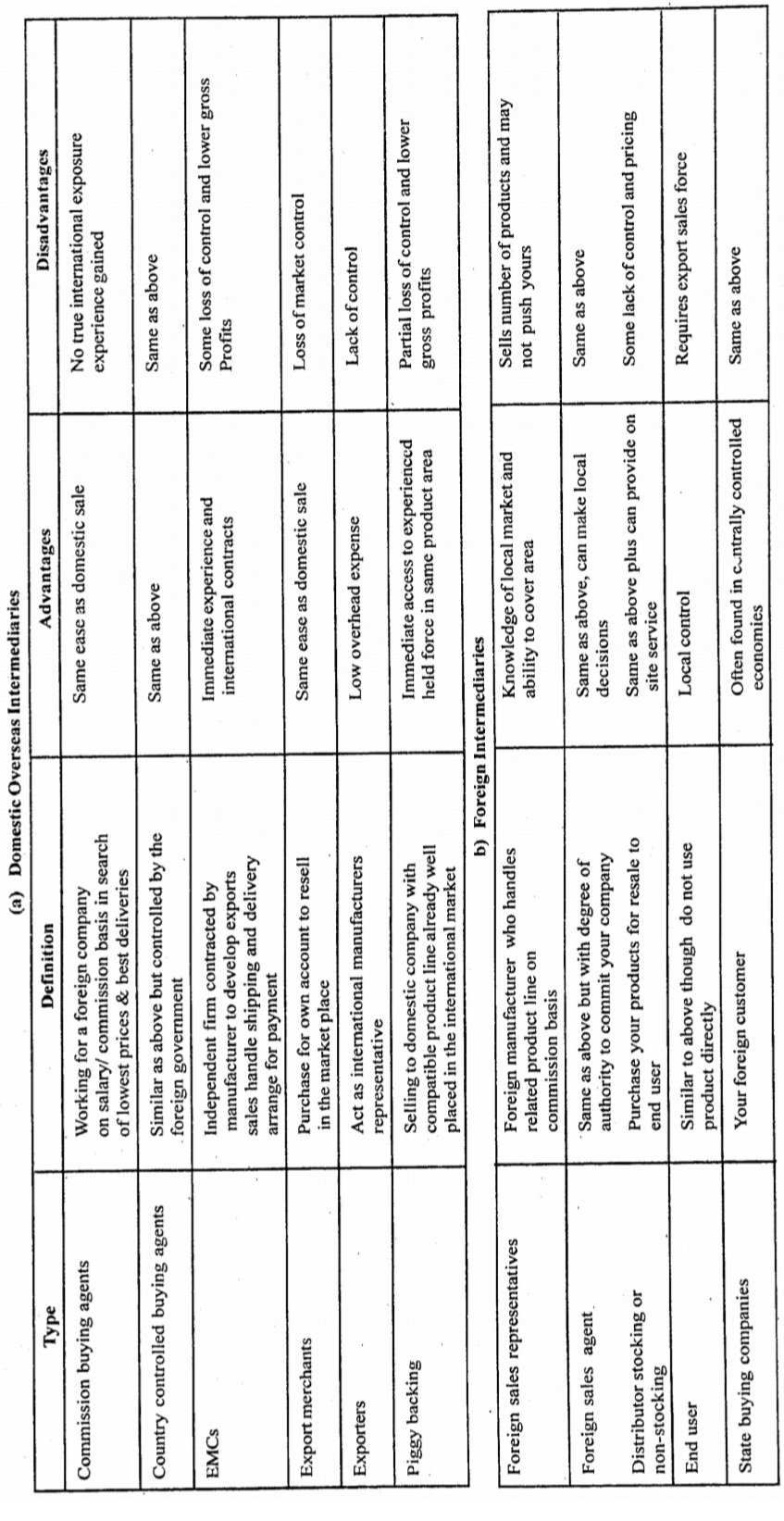
Intermediaries in International Marketing
Q.7. List and discuss in detail the various documents connected with import. (10)
Documentation and procedures, though complex and cumbersome, are integral part of international marketing operations. Full knowledge and accurate compliance of procedures and documentation formalities ant as essential as looking into areas of marketing mix to ensure success in international marketing.
Documentation and attendant formalities become necessary to ensure compliance of contract obligations of the concerned parties i.e., the exporter, importer and intermediaries.
In India, several documents have been prescribed to ensure compliance of Export Trade Control, Foreign Exchange Regulations, Quality Control and Pre-shipment Inspection, Central Excise etc.
Certifications and documentation for imports in Importing country
The documents required in importing country to take delivery of imported cargo is based on the product importing, multilateral trade agreements, bilateral or unilateral trade agreements, and other trade policies of Importing country government. The import documents required in Importing country also depends up on the nature of goods importing (General goods, Personal effects, Dangerous goods, Livestock etc.) ,regular trade policy of Importing country Government, specific goods importing to Importing country (Arms and ammunition, health products, food products, chemicals etc.)
A. Import Customs clearance documents required in Importing country
1. Customs Entry document: (specified by Importing country customs) prepared by importer’s customs broker or Importer
2. Customs bond if applicable for specific goods importing to Importing country or to claim import benefits from Importing country government
3. Legal Undertaking (LUT) if applicable to claim import benefits from Importing country government or to import specific products
4. Customs declarations wherever applicable: Importing country import customs clearance declarations as per specified format of importing country’s government.
5. Import License if applicable to be obtained from government agency of Importing country.
Insurance Certificate issued by the government authorized insurance service provider
6. Certificates of Inspection if applicable: Some of the importers demands exporter (seller) through LC or Purchase order to inspect export goods to Importing country by an internationally recognized inspection agency like SGS, BVQI, or other Quality inspecting agency. etc.
7. ATA CARNET/Temporary shipment certificate if applicable
8. Purchase order or Letter of Credit between Importing country importer and overseas supplier of goods.
9. Commercial Invoice cum packing list issued by seller of goods
10. Certificate of Origin issued by competent authority of origin country of goods.
11. Certificate of Analysis – The buyer may insist the seller to enclose certificate of analysis about the goods. The same certificate helps Importing country customs authorities to confirm the product imported to Importing country.
12. Certificate of Free Sale – If goods are not commercially involved, a certificate of sale is attached by exporter along with goods dispatched.
13. Weight Certificate – Weight certificate issued by exporter is required at various circumstances like satiability of flight, satiability of vessel, International road safety rules, import or export duty calculation, claiming export/import benefits from government etc.
14. Consular Invoice – Some of the importing countries insists embassy attested documents which is mandatory at importing country to customs clear goods.
B. Documents required for customs in Importing country for specific products
1. Health Certificate
2. Ingredients Certificate
3. Inspection Certificate
4. Pre-Shipment Inspection certificate
5. Phytosanitary Certificate/quarantine certificate
6. Radiation Certificate
7. Electronic Export Information
8. Certificate of Health or Sanitation
9. Generic Certificate of Origin
10. Dangerous Goods Certificate
11. Fisheries Certificate
12. Fumigation Certificate
13. Halal Certificate
14. Dock Receipt and Warehouse Receipt
15. ISPM 15 (Wood Packaging) Marking certificate
16. Product manual or Product catalogue
17. Certified Engineer’s Report
18. Chartered engineer’s certificate
19. Product specification certificate
C. Bank Import documents in Importing country
1. Bill of Exchange
2. Purchase order or Letter of Credit
3. Commercial Invoice cum packing list
4. Pro forma Invoice
5. Certificate of Origin
6. Insurance Certificate
7. Certificates of Inspection
8. Electronic Export Information
9. Certificate of Health or Sanitation
Q.8. Explain the following terms: (5×2=10)
a. Bill of lading
Of all the documents, bill of lading is unquestionably the most important and valuable document. Issued by the shipping company, a bill of lading is
• A receipt/acknowledgement of cargo delivered for transportation.
• A contract of agreement between the shipper and the carrier specifying their respective responsibilities and obligations.
• A document of title to goods and provides interested parties including banks with title to the goods mentioned therein.
• A collateral, that can be used for any advances made to the seller or to the buyer in the process of financing the shipment.
Bills of lading are prepared by the shippers on printed forms supplied by the shipping company concerned and necessary particulars are entered therein the blank spaces provided for the purpose. Normally, a bill of lading shows the date of shipment., port of shipment, name of the carrying vessel, name of the consignor, consignee and notify party, port of discharge, number, contents and identification marks of packages and goods shipped, and the amount of freight `paid’ or to ‘pay’.
Bill of Lading can be of various types
1. Received for Shipment B/L
2. On Board Shipped B/L
3. Clean B/L
4. Claused or Dirty B/L
5. Combined B/L
6. Through B/L
7. Trans-shipment B/L
8. Charter Party B/L
b. IMF (International Monetary Fund)
The International Monetary Fund (IMF) is an organization of 190 countries, working to foster global monetary cooperation, secure financial stability, facilitate international trade, promote high employment and sustainable economic growth, and reduce poverty around the world.
The IMF’s primary purpose is to ensure the stability of the international monetary system—the system of exchange rates and international payments that enables countries (and their citizens) to transact with each other. The Fund’s mandate was updated in 2012 to include all macroeconomic and financial sector issues that bear on global stability.
The International Monetary Fund (IMF) is an international financial institution, headquartered in Washington, D.C., working to foster global monetary cooperation, secure financial stability, facilitate international trade, promote high employment and sustainable economic growth, and reduce poverty around the world while periodically depending on the World Bank for its resources.
Formed in 1945, at the Bretton Woods Conference primarily by the ideas of Harry Dexter White and John Maynard Keynes, it came into formal existence in 1945 with 29 member countries and the goal of reconstructing the international payment system. It now plays a central role in the management of balance of payments difficulties and international financial crises. Countries contribute funds to a pool through a quota system from which countries experiencing balance of payments problems can borrow money.
Its main purpose is to promote international monetary co-operation, facilitate international trade, foster sustainable economic growth, reduce poverty around the world, make resources available to members experiencing balance of payments difficulties, prevent and assist with recovery from international financial crises.
c. Airway Bill
An air waybill (AWB) or air consignment note is a receipt issued by an international airline for goods and an evidence of the contract of carriage, it is a document of title to the goods. Hence, the air waybill is non-negotiable.
The air waybill is the most important document issued by a carrier either directly or through its authorized agent. It is a non-negotiable transport document that covers the transport of cargo from airport to airport. By accepting a shipment, an IATA cargo agent is acting on behalf of the carrier whose air waybill is issued.
Air waybills have eleven digit numbers which can be used to make bookings, check the status of delivery, and a current position of the shipment.
Air waybills are issued in eight sets of different colours. The first three copies are classified as originals. The first original, green in colour, is the issuing carrier’s copy. The second, coloured pink, is the consignee’s copy. The third, coloured blue, is the shipper’s copy. A fourth brown copy acts as the Delivery Receipt or proof of delivery. The other four copies are white.
d. Inspection certificate
Inspection certificate, sometimes called as certificate of inspection or pre-shipment inspection certificate, is a trade document used in international trade transactions, issued generally by an independent inspection company after conducting a related inspection, certifying whether or not the goods are in question are in conformity with the specifications stated on the sales contract.
An inspection certificate, which is issued by an independent trustable company, verifies whether or not the goods are in conformity with the sales contract in regards to quality, quantity, tariff classification, import eligibility and price of the goods for customs purposes.
Inspection certificates can be classified under two main categories:
• Commercial Inspection Certificates
• Official Inspection Certificates
In some instances buyers could not trust the sellers’ production quality or else conditions may dictate that the quality of the goods must be approved before they will be dispatched from the exporter’s factory.
In such a circumstance, an independent company, which is trustable by both buyer and seller, must be checking the goods and verifies its findings with a certificate specifying whether or not the goods are in conformity with the sales contract.
This example illustrates the function of a commercial inspection and commercial inspection certificate.
In addition to commercial inspection certificates, it is possible to talk about some form of official inspection certificates, which are requested by the custom offices of some importing countries during the import procedures.
For example all goods that will be exported to Iraq should accompany a pre-shipment inspection certificate, which confirms the quality, quantity, tariff classification, import eligibility and price of the goods for customs purposes.
e. Commercial Invoice
The commercial invoice is a legal document between the exporter and the buyer (in this case, the foreign buyer) that clearly states the goods being sold and the amount the customer is to pay. The commercial invoice is one of the main documents used by customs in determining customs duties. A commercial invoice is a bill for the goods from the seller to the buyer. These documents are often used by governments to determine the true value of goods when assessing customs duties. Governments that use the commercial invoice to control imports will often specify its form, content, number of copies, language to be used and other characteristics.
The commercial invoice is one of the most important documents in international trade and ocean freight shipping. It is a legal document issued by the seller (exporter) to the buyer (importer) in an international transaction and serves as a contract and a proof of sale between the buyer and seller.
Unlike the Bill of Lading, the commercial invoice does not indicate the ownership of goods nor does it carry a title to the goods being sold. It is, however, required for customs clearance purposes to calculate and assess the duties and taxes due.
The commercial invoice details the price(s), value, and quantity of the goods being sold. It should also include the trade or sale conditions agreed upon by both buyer and seller of the transaction being carried out.
It may also be required for payment purposes (such as in the event of payment via Letter of Credit and may need to be produced by the buyer to its bank to instruct the release of funds to the seller for payment.
Q.9. Explain the 7 P’s of Marketing Mix. (10)
A marketing mix is a set of actions that businesses and marketers use to help promote their brand, or to sell a product or service they offer. When selling a new product or service, it’s important to create a marketing mix strategy that essentially blends the key marketing ingredients together to achieve the desired result.
Marketing is a continually evolving discipline and as such can be one that companies find themselves left very much behind the competition if they stand still for too long.
The 4 Ps have been associated with the Marketing Mix since their creation by E. Jerome McCarthy in 1960.
In the late 70’s it was widely acknowledged by Marketers that the Marketing Mix should be updated. This led to the creation of the Extended Marketing Mix in 1981 by Booms & Bitner which added 3 new elements to the 4 Ps Principle. This now allowed the extended Marketing Mix to include products that are services and not just physical things.
The Seven Ps of Marketing is a relatively simple framework that can be used by any organisation or manager to plan marketing activities and a marketing strategy.
It is useful because it ensures that you look across each area together, and consider how they might be related.
1. Product
A marketing mix always begins with a product to sell. In the early development phase of your product, it is extremely important to carry out extensive research on the life cycle of the product you are creating. All products have their own life cycle including the growth phase, the maturity phase, and the sales decline phase. Once a product reaches the sales decline phase, marketers need to find new ways to increase sales again.
When developing the right product, it’s important to ask yourself a series of questions to make sure your product is better than your competitors, i.e. what does the client want from the product? Or, how, where and why the client uses the product?
2. Place
Place’ describes where and how your customers will buy your product or service, and how it will reach them.
In a marketing mix, place refers to the position and distribution of the product you are selling in a place that is accessible to your target audience, this could be a high street shop, an online store, or mail order. Examples of distribution strategies include: intensive, exclusive, selective and franchising.
To make sure you position your product in the best possible place, it’s vital to understand your customer and what their shopping habits may be. Therefore, to develop a distribution strategy, you need to ask yourself the following questions:
• Where do clients look for my product?
• Where do clients usually shop for products?
• Should I sell the product online?
3. Price
Pricing is an extremely important component to your marketing mix as it determines your profit and costing of your product. Altering the price of a product can affect the entire marketing strategy, whilst also affecting the sales and demand of your product.
As a newcomer to the market, it’s tempting to set your prices high, especially if you know your product is worth the price you are asking for. However, it’s unlikely that your target audience will be willing to pay the price, simply because your brand is only starting out so you’re not as recognisable or trustworthy – this comes with time.
Pricing also helps consumers to determine the perception of your product. For example, a lower priced product is deemed less inferior in terms of quality and ability, as opposed to a highly priced product.
4. Promotion
In a marketing mix, promotion is an element that can boost sales and brand recognition through advertising, sales promotion, sales organisation, and public relations.
Promotion is how you communicate what you do and/or sell to your customers.
‘Promotion’ includes a whole range of activities, from branding through social media activity and advertising to sales management and special offers. It is designed to show customers why they should buy your product or service, and should therefore focus on benefits, and not just features.
When promoting a product, you may decide on all of the promotion elements above, or simply choose the techniques that will target your audience more effectively.
The promotional strategy you use is also dependent on your budget, your communication and how you want to get your message across, and your target market.
5. People
Another important element in the marketing mix is people. This includes whether or not your target audience is large enough, and if there is a large enough demand for your product or not.
Consumers aren’t the only important people to consider in your marketing strategy, you also have to take into the account the people who will be delivering the marketing and sales of your product. To make sure you deliver excellent service and marketing, you’ll need people who are fully trained for the job, whether this is customer service assistants, copywriters, designers or a sales representative for example.
6. Process
As for processes in the marketing mix, the process of your organisation can affect the performance of the service you provide, involving the delivery of your product to consumers. As a business, it’s crucial to make sure you’re easy to do business with, meaning you’re efficient, helpful and timely.
By making sure your business has a good process in place, you will also save time and money due to greater efficiency, and your standard of service to customers will remain consistent, which is excellent for developing a brand reputation and customer loyalty.
Processes was originally added for service industries, but there is increasing recognition that processes also affect customer experience in product companies.
The experience starts from the first point of contact, and goes on until after the sale, including after-sales service. The process of handling customers at first contact, during sales and beyond, is therefore crucial to overall customer satisfaction.
7. Physical Evidence
The final P in a marketing mix stands for physical evidence and it refers to everything your customers sees or hears when interacting with your business. This includes your branding, your product packaging, a physical space such as a shop, and even the way your staff and sales representatives act and dress – it’s not all about the product! The way that you portray your brand physically has a great impact on consumers and can either lead or an increase, or decrease, in sales.
Physical evidence refers to what the customer ‘sees’ of your product. It shows them what it would be like to own or use it.
Each of the 7Ps found in a marketing mix work together to ensure your business is a success. The 7Ps also have an impact on your positioning, targeting, and segmentation decisions, so it’s crucial to understand their benefits to create your own marketing mix.
Q.10. Choose the correct options: (10×1=10)
a. Study of International Marketing should focus primarily on
1. Place
2. Promotion and Pricing
3. Product
4. All of the above
Ans – 4. All of the above
b. When management believe or assumes that the home country is superior and the needs of the home country are most relevant in terms of doing business internationally, then management is thought to have an __________________ business orientation.
1. Ethnocentric
2. Regiocentric
3. Geocentric
4. Polycentric
Ans – 1. Ethnocentric
c. Who explained the theory of absolute advantage in 1776
1. Paul Adams
2. Adam Smith
3. David Ricardo
4. Michael Porter
Ans – 2. Adam Smith
d. Which of the following activity is not the part of global marketing arena:
1. Export Marketing
2. International Marketing
3. Multinational Marketing Global Marketing
4. Local market
Ans – 4. Local Market
e. Agencies for export promotion at state level function in how many tiers :
1. Two
2. Four
3. Six
4. Eight
Ans – 3. Six
f. Indian Institute of Foreign Trade (IIFT) is situated in
1. Mumbai
2. Chennai
3. New Delhi
4. Cochin
Ans – 3. New Delhi
g. An exporting firm is subject to political risk which includes :
1. Domestication
2. Blockage of Funds
3. Expropriation
4. All of the above
Ans – 4. All of the above
h. Which of the following is not an auxiliary document
1. Dock Challan
2. Shipping Bill
3. Shipping Order
4. Mate receipt
Ans – 2. Shipping Bill
i. OGL stands for
1. On Government License
2. Open General License
3. Off Good Lading
4. None of the above
Ans – 2. Open General License
j. Which are not the main factors in formulating creative content of foreign advertising include
1. Geographical Factors
2. Legal Factors
3. Cultural Factors
4. Production and cost factors
Ans – 1. Geographical Factors