
Table of Contents
Q.1. There are several modes of entry into International business like licensing, joint venture, etc. Discuss each of the methods in detail. (10)
Once the firm has taken the decision to enter into the field of international business it must analyse the basic strategies/methods of entry.
There are basically five different strategies available for entry into a foreign market.
1. Exporting
This is most commonly used methods for entering foreign markets. Commonly used in India, this method involves production of goods and services in the home country followed by distribution into foreign market. This method is commonly adopted by countries entering into the foreign market for- the first time since it minimizes the financial risks involved.
2. Licensing
When the company wants to protect its patent and trade mark rights, it simply licenses the production of its product in the foreign market to another company in return for a fixed royalty. This is done when either the market has developed very fast or when export barriers have been erected.
3. Joint Venture
When a company does not possess the capacity to analyse and handle a particular market, it enters into a joint venture. The primary reason for sharing the control of the market is to protect itself against political and economic risks. Joint ventures are increasingly seen in the world market because of this very reason. The other reasons for its existence and growth are
a. When the company does not possess competent personnel to handle foreign market or when it -is short of capital
b. When a company feels that it would be to their Mutual advantage to enter in joint venture because of specific resources possessed by the other partner (e.g. distribution network, knowledge of culture).
c. Where wholly owned activities are not permitted by the foreign governments.
4. Manufacturing
When the company moves along its life cycle (with reference to international business) it develops an international orientation. This motivates it to invest in foreign market and develop its own manufacturing and marketing systems within that market.
The primary reason for this is to reduce the additional costs involved in foreign marketing.
It has to pay no duties on products produced within a foreign country. The transportation cost is also minimized. It can take advantage of low cost labour and thereby minimize its production costs. In an effort to become competitive in the world markets increasing number of firms are undertaking this mode of entry. Nestle India and Hindustan Lever are illustrations of this mode of entry.
5. Management Contracts
A country may not posses the required managerial or technical talent and therefore may not be in a position to exploit its imported assets procured in aid or assets maintained by an expropriated company.
In such a situation a company may sign a management contract with such a country’s government / company to manage the assets till such time that it has available to it the resources necessary for managing the assets. e.g. foreign companies managing refineries/ petrochemical plants in the Middle East.
This is not a common phenomena in international business but for some technologically oriented firm it does represents an entry mode.
Vern Terpstra has given a proposition on basic modes of entry in light of production i.e., where does the production taken place.
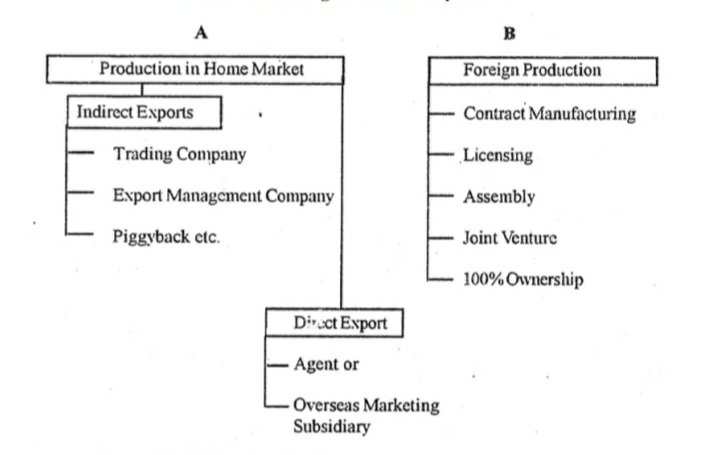
Alternatives Foreign Market Entry Modes
Q.2. Discuss India’s foreign trade practices since Independence. (10)
Foreign Trade is the important factor in economic development in any nation. Foreign trade in India comprises of all imports and exports to and from India. The Ministry of Commerce and Industry at the level of Central Government has responsibility to manage such operations. The domestic production reveals on exports and imports of the country. The production consecutively depends on endowment of factor availability. This leads to relative advantage of the financial system. Currently, International trade is a crucial part of development strategy and it can be an effective mechanism of financial growth, job opportunities and poverty reduction in an economy. According to Traditional Pattern of development, resources are transferred form the agricultural to the manufacturing sector and then into services.
Foreign trade in India began in the period of the latter half of the 19th century. During the Second World War, India accomplished huge export surplus and accumulated substantial amount of real balances. There was a huge pressure of restricted demand in India during the Second World War. The import requirements were outsized and export surpluses were lesser at the end of the war. Before independence, India’s foreign trade was associated with a colonial and agricultural economy. Exports consisted primarily of raw materials and plantation crops, while imports composed of light consumer merchandise and other manufactures. The structure of India’s foreign trade reflected the organized utilization of the country by the foreign leaders.
Since last six decades, India’s foreign trade has changed in terms of composition of commodities. The exports included array of conventional and non-traditional products while imports mostly consist of capital goods, petroleum products, raw materials, intermediates and chemicals to meet the ever increasing industrial demands. The export trade during 1950-1960 was noticeable by two main trends. First, among commodities which were directly based on agricultural production such as tea, cotton textiles, jute manufactures, hides and skins, spices and tobacco exports did not increase on the whole, and secondly, there was a significant boost in the exports of raw manufactures such as iron ore. In the period of 1950 to 1951, main products dominated the Indian export sector. These included cashew kernels, black pepper, tea, coal, mica, manganese ore, raw and tanned hides and skins, vegetable oils, raw cotton, and raw wool. These products comprised of 34 per cent of the total exports. In the period of 1950s there were balance of payments crunch. The export proceeds were not enough to fulfil the emerging import demand. The turn down in agriculture production and growing pace of development activity added pressure. The external factors such as the closure of Suez Canal created tension on the domestic financial system. The critical problem at that moment was that of foreign exchange scarcity.
The Second Five Year Plan with its emphasis on the development of industry, mining and transport had a large foreign exchange factor. This tension on the balance of payments required the stiffening of import strategy at a later stage.
In the age of globalisation, India is new entrant to expand international trend. In 1991, the government initiated some changes in its strategy on trade, foreign Investment, Tariffs and Taxes under the name of “New Economic Reforms”. Indian government mainly concentrated on reforms on Liberalization, openness and export sponsorship activity. It is witnessed that foreign Trade of India has considerably revolutionized export in the Post reforms period. Trade Volume increased and the composition of exports has undergone several noteworthy changes. In Post – reform Period, the major provider to export’s growth has been the manufacturing sector.
Though India has steadily opened up its wealth, its tariffs are high as compared with other countries, and its conjecture norms are still restricted. Foreign trade in India in legal term is the Foreign Trade (Development and Regulation) Act, 1992. The Act provide with the development and regulation of foreign trade by assisting imports into, and supplementing exports from India. To fulfil the requirements of the Act, the government may make necessities for assisting and controlling foreign trade, may forbid, confine and regulate exports and imports, in all or particular cases as well as subject them to exclusion. Government is endorsed to devise and declare an export and import policy and also amend the same from time to time, by notification in the Official Gazette, and is also authoritative to appoint a ‘Director General of Foreign Trade’ for the purpose of the Act, including formulation and accomplishment of the export-import policy.
Nonetheless, presently, the government has made policy on trade and investment policy that has established an obvious change from protecting ‘producers’ to benefiting ‘consumers’. It is reflected in its foreign trade strategy of India for 2004/09 which indicated that “for India to become a major player in world trade we have also to make possible those imports which are required to stimulate our economy”. With numerous economic alterations, globalisation of the Indian economy has been the foremost factor to formulate the trade policies. The announcement of a new Foreign Trade Policy of India for a five year period of 2004-09, substituting until now taxonomy of EXIM Policy by Foreign Trade Policy is major step in the development of foreign trade policy. This policy made the overall development of India’s foreign trade and offers guidelines for the development of this sector.
The objective of the Foreign Trade Policy is to twofold India percentage share of global merchandise trade and to act as an effectual instrument of economic growth by giving a thrust to employment generation, especially in semi-urban and rural areas. The growth performance of exports has been a result of watchful effort of the Government to lessen transaction costs and assist trade. The guidelines of the Foreign Trade Policy (2004-09) for a five year period clearly articulate objectives, strategies and policy initiatives that has been involved in putting exports on a higher growth line.
There are numerous challenges and issues in foreign trade. These include burden of export promotion schemes, danger of circular trading, and risk of importing outdated machinery. Sometimes policy fails to take a holistic view of trade issues. Other issue is relative importance of the home market, the nature or the degree of State intervention and recessionary conditions in the global market. India’s exports have suffered due to structural constraints operating both on the demand and supply side. On the demand side exports have continued to undergone the problems of adverse world trading environment, protectionist sentiments in the developed countries in the guise of technical standards, environmental and social concerns and tariff differentials in imports by the developed countries. At the supply end, the factors that have constrained exports from India include infrastructure constraints, high transaction costs, inflexibilities in labour laws, quality problems, constraints in attracting FDI in the export sector, etc.
It is summarized that foreign trade has significant function in the fiscal development of any nation. India has made strong foreign trade policies and reformed these from time to time with the process of globalisation and liberalization. Since 1991, India’s foreign trade considerably transformed. India’s major exports include manufacturing and engineering goods. India has good trading relations with all developed countries in the world. More than fifty percent of India’s total export trade is with Asia and ASEAN region and about sixty percent of India’s total imports is with the same countries.
India’s wealth previously was agricultural economy. India’s major requirement use to be food grains and other goods in import with fast industrialization, the composition of India’s imports goods changed and needed chemicals, fertilizers and machinery which were required to meet the developmental requirements of country. In the composition of export; country sells agricultural products such as tea, spices, and other raw materials. However, with the industrialization of the financial system, compositions of exports changed. Currently, India exports products such as machinery chemicals and marine products. This may enhance the fiscal condition of India.
Or Discuss in detail the various documents connected with Import. (10)
Documentation and procedures, though complex and cumbersome, are integral part of international marketing operations. Full knowledge and accurate compliance of procedures and documentation formalities ant as essential as looking into areas of marketing mix to ensure success in international marketing.
Documentation and attendant formalities become necessary to ensure compliance of contract obligations of the concerned parties i.e., the exporter, importer and intermediaries.
In India, several documents have been prescribed to ensure compliance of Export Trade Control, Foreign Exchange Regulations, Quality Control and Pre-shipment Inspection, Central Excise etc.
Certifications and documentation for imports in Importing country
The documents required in importing country to take delivery of imported cargo is based on the product importing, multilateral trade agreements, bilateral or unilateral trade agreements, and other trade policies of Importing country government. The import documents required in Importing country also depends up on the nature of goods importing (General goods, Personal effects, Dangerous goods, Livestock etc.) ,regular trade policy of Importing country Government, specific goods importing to Importing country (Arms and ammunition, health products, food products, chemicals etc.)
A. Import Customs clearance documents required in Importing country
1. Customs Entry document: (specified by Importing country customs) prepared by importer’s customs broker or Importer
2. Customs bond if applicable for specific goods importing to Importing country or to claim import benefits from Importing country government
3. Legal Undertaking (LUT) if applicable to claim import benefits from Importing country government or to import specific products
4. Customs declarations wherever applicable: Importing country import customs clearance declarations as per specified format of importing country’s government.
5. Import License if applicable to be obtained from government agency of Importing country.
Insurance Certificate issued by the government authorized insurance service provider
6. Certificates of Inspection if applicable: Some of the importers demands exporter (seller) through LC or Purchase order to inspect export goods to Importing country by an internationally recognized inspection agency like SGS, BVQI, or other Quality inspecting agency. etc.
7. ATA CARNET/Temporary shipment certificate if applicable
8. Purchase order or Letter of Credit between Importing country importer and overseas supplier of goods.
9. Commercial Invoice cum packing list issued by seller of goods
10. Certificate of Origin issued by competent authority of origin country of goods.
11. Certificate of Analysis – The buyer may insist the seller to enclose certificate of analysis about the goods. The same certificate helps Importing country customs authorities to confirm the product imported to Importing country.
12. Certificate of Free Sale – If goods are not commercially involved, a certificate of sale is attached by exporter along with goods dispatched.
13. Weight Certificate – Weight certificate issued by exporter is required at various circumstances like satiability of flight, satiability of vessel, International road safety rules, import or export duty calculation, claiming export/import benefits from government etc.
14. Consular Invoice – Some of the importing countries insists embassy attested documents which is mandatory at importing country to customs clear goods.
B. Documents required for customs in Importing country for specific products
1. Health Certificate
2. Ingredients Certificate
3. Inspection Certificate
4. Pre-Shipment Inspection certificate
5. Phytosanitary Certificate/quarantine certificate
6. Radiation Certificate
7. Electronic Export Information
8. Certificate of Health or Sanitation
9. Generic Certificate of Origin
10. Dangerous Goods Certificate
11. Fisheries Certificate
12. Fumigation Certificate
13. Halal Certificate
14. Dock Receipt and Warehouse Receipt
15. ISPM 15 (Wood Packaging) Marking certificate
16. Product manual or Product catalogue
17. Certified Engineer’s Report
18. Chartered engineer’s certificate
19. Product specification certificate
C. Bank Import documents in Importing country
1. Bill of Exchange
2. Purchase order or Letter of Credit
3. Commercial Invoice cum packing list
4. Pro forma Invoice
5. Certificate of Origin
6. Insurance Certificate
7. Certificates of Inspection
8. Electronic Export Information
9. Certificate of Health or Sanitation
Q.3. Enumerate the differences between Domestic Marketing and International Marketing. (10)
Domestic marketing
Domestic marketing comprises of the marketing strategies used by a company to attract customers and compel them to purchase a product or service within a local market. The marketing activities in domestic marketing are restricted to the local boundaries, and a limited number of customers are served.
Domestic marketing has several advantages. It is more convenient to carry out as it has to deal with just a single form of competition and economic issues. No communication barriers are faced as the local customers can easily comprehend the message of the company. In addition, the company can easily acquire and understand data regarding the trends of the local market and the requirements, tastes and preferences of consumers. This allows companies to take decisions and formulate marketing strategies in a more effective manner. There are also lower risks in domestic marketing and limited investments are required.
However, the scope of local markets is quite narrow and growth is limited. Hence, many companies aim to expand their operations to the international market.
International marketing
International marketing is the kind of marketing that focuses on a wider customer base, one that extends the national boundaries. Customers from all over the world are targeted in international marketing. This kind of marketing is quite complicated and requires significant financial investments.
There are different laws and regulations pertaining to business in each country, and it is important for a country seeking to gain entry into a foreign market to first become aware of these rules. The requirements and preference of customers may also be different; hence, the marketing strategies should be developed according to these different needs and requirements.
Companies need to put in more time and effort to carry out international marketing. In addition, it is also much more risky than domestic marketing. The international market is quite uncertain and companies should always be prepared to handle any changes that take place suddenly.
Difference between domestic marketing and international marketing
The main difference between domestic marketing and international marketing has been explained below:
1. Meaning
In domestic marketing, the company is involved in the production, promotion, distribution and sale of products and services within its own country. However, in international marketing, these activities extend beyond the boundaries of the company’s own country to offer goods and services to various countries across the globe.
2. Growth opportunities
Domestic marketing has a limited scope and offers little opportunities for growth, whereas the scope of international marketing is vast, offering numerous growth opportunities.
3. Area covered
Domestic marketing covers a limited area within a single country, whereas in international marketing, an extensive area is covered, spanning across several countries.
4. Government intervention
There is less intervention from the government in domestic marketing in comparison to international marketing. This is because in international marketing, the company has to consider the laws and regulations of various countries.
5. Risks involved
Lower risks are involved in domestic marketing, and fewer challenges are experienced because of the limited scope of this form of marketing. On the other hand, high risks and challenge are involved in international marketing because of issues like socio-cultural differences, exchange rates, uncertainty of entering a foreign market, and so on.
6. Technology use
In domestic marketing, there is limited use of technology. International marketing, in contrast, can take advantage of the latest technologies being used in different countries.
7. Research required
A company involved in domestic marketing does not have to carry out a lot of research because they cover a limited area. In addition, since they are catering to only the local market, they are already aware of conditions prevailing in the market. On the other hand, foreign markets need to be studied extensively because the company is not aware of the conditions prevailing in those markets.
8. Customer characteristics
Domestic marketing deals with a single type of consumers that have similar characteristics. On the other hand, international marketing caters to different kinds of customers that have distinct characteristics, tastes and preferences.
9. Financial resources
Domestic marketing requires fewer financial resources and capital investment, whereas significant investments are needed to carry out international marketing.
10. Limitations
Not many limitations are experienced in domestic marketing. However, international marketing faces several limitations, including language barriers, cross-cultural differences, differences in customs and norms of different societies, exchange rate fluctuations, and so on.
Or Write Short Note on: (5+5=10)
a. Indian Institute of Foreign Trade
IIFT was set up in 1964 by the Government of India as an autonomous organization which is engaged in following activities.
a. Training of personnel in modern techniques of international business,
b. Organization of research in areas of foreign trade,
c. Conducting marketing research, field surveys, commodity surveys, market surveys; and
d. Dissemination of information arising from its activities relating to research and market studies.
Right from its inception, IIFT has been an important supporting factor in the Indian industry’s international thrust. IIFT also conducts basic foundation programmes in international business besides conducting Management Development Programmes and research. The institute has achieved high standards of excellence in occupying a unique position today as a premier institution that focuses on international trade.
The Indian Institute of Foreign Trade (IIFT) was established in 1964 as an autonomous body under the Ministry of Commerce & Industry to contribute in the skill building for the external trade sector of India. The Institute was granted “Deemed to be University” status in 2002. The National Assessment and Accreditation Council (NAAC) has recognized IIFT as Grade ‘A’ Institution in 2005 as well as in 2015. Its head office is located in New Delhi.
b. Export Promotion Council
At present there are 20 Export Promotion Councils (EPC’s) whose basic objective is to promote and develop the exports of the country. Each council is responsible for the promotion of a particular group of products, projects and services. The present set up of EPCs covers following sectors:
• Engineering
• Overseas Construction
• Electronics & Computer Software
• Plastics & Linoleums
• Basic Chemicals, Pharmaceuticals, & Cosmetics
• Chemicals & Allied Products
• Gems & Jewellery
• Leather
• Sports Goods
• Cashew
• Shellac
• Apparel
• Synthetic & Rayon
• Indian Silk
• Carpet
• Handicrafts
• Wool and Woollens
• Cotton Textiles
• Handloom
• Powerloom
Role
EPCs are non-profit organizations. They are supported by financial assistance from the Central government. The main role of the EPCs is to project India’s image abroad as a reliable supplier of high quality goods and services. In particular, the EPCs encourage and monitor the observance of international standards and specifications by exporters. The EPCs also keep themselves abreast of the trends and opportunities in international markets for goods and services and assist their members in taking advantage of such opportunities in order to expand and diversify exports.
Functions
Major Functions of EPCs include
a. To provide commercially useful information and assistance to their members in developing and increasing their exports,
b. To offer professional advise to their members in areas such as technology upgradation, quality and design improvement, standards and specifications, product development, innovation etc.,
c. To organize visits of delegations of its members abroad to explore overseas market opportunities; and
d. To organize participation in trade fairs, exhibitions and buyer-seller meets in India and abroad.
e. To promote interaction between the exporting community and the Government, both at the central and state levels,
f. To build a statistical base and provide data on the exports and imports of the country, exports and imports of their members, as well as other relevant international trade data.
The EPCs issues Registration-Cum-Membership Certificate (RCMC) to its members which is mandatory for getting export incentives.
Q.4. Write short note on: (5+5=10)
a. International Product Life Cycle
International product life cycle discusses the consumption pattern of the product in many countries. This concept explains that the products pass through several stages of the product life cycle. The, product is innovated in country, usually a developed country, to satisfy the needs of the consumers. The innovator country wants to exploit the technological breakthrough and start marketing the products in foreign country.
Gradually foreign country also starts production and becomes efficient in producing those commodities. As a result, the innovator country starts losing its export market and finds the import of that product advantageous. In this way, the innovator country becomes the importer of the products. Terpstra and Sarathy have identified four phases in. the international product life cycle.
1. Export strength is evident by innovator country
Products are normally innovated in the developed countries because they possess the resources to do so. The firms have the technological know how and sufficient capital to invest on the research and development activities. The need of adaptation and modification also forces the production activities to be located near the market to respond quickly to the changes. The customers are affluent in the developed countries who may prefer to buy the new products. Thus, the manufactures are attracted to produce the goods in the developed country. The goods are marketed in the home country. After meeting the demand of the home country, the manufacturers start exploring foreign markets and exporting goods to them. This phase exhibits the introduction and growth stage of the product life cycle.
2. Foreign production starts
The importing firms in the middle income country realise the demand potential of the product in the home market. The manufacturers also become familiar in producing the goods. The growing demand of the products attracts the attention of many firms. They are tempted to start production in their country and gradually start exporting to the low income countries. The large production in the middle income country reduces the export from the innovating country. This shows the maturity stage of product life cycle where the production activities’ start shifting from innovating country to other countries.
3. Foreign production becomes competitive in export market
The firms in low income country also realise the demand potential in the domestic market. They start producing the products in their home country by exploiting cheap labour. They gain expertise in manufacturing the commodity. They become more efficient in producing the goods due to low cost of production. Gradually they start exporting the goods to other countries. The export from this country replaces the export base of innovating country, whose export has been already declining. This exhibits the ,declining stage of product life cycle for the innovator country. In this stage, the product gets widely disseminated and other countries start imitating the product. This is the third phase of product life cycle where the products start becoming standardized.
4. Import Competition begins
The producers in the low income importing country gain sufficient experience in producing and marketing the products. They attain the economies of scale and gradually become more efficient than the innovator country. At this stage, the innovator country finds the import from this country advantageous. Hence, the innovator country finally becomes the importer of that product. In this fourth stage of product life cycle the product becomes completely standardized.
In simple words, the theory of IPLC brings out that advanced (initiating) countries play the innovative role in new product development. Later for reasons of comparative advantage or factor endowments and costs, such a product moves over to other developed countries or middle. income countries and ultimately gets produced and exported by less developed countries. Not surprisingly, therefore, that countries such as Taiwan, Hong Kong, Korea, Singapore and India have emerged as major exporters of growing range of products to USA and Western Europe during the last decade and a half.
b. WTO
The World Trade Organization came into being in 1995. One of the youngest of the international organizations, the WTO is the successor to the General Agreement on Tariffs and Trade (GATT).
So while the WTO is still young, the multilateral trading system that was originally set up udder GATT is well over 50 years old. The WTO’s overriding objective is to help trade flow smoothly, freely, fairly and predictably.
It does this by:
• Administering trade agreements
• Acting as a forum for trade negotiations
• Settling trade disputes
• Reviewing national trade policies
• Assisting developing countries in trade policy issues, through technical assistance and training programme
• Cooperating with other international organizations
Structure
The WTO has more than 140 members, accounting for over 97% of world trade. Around 30 others are negotiating membership. Decisions are made by the entire membership. This is typically by-consensus. A majority vote is also possible but it has never been used in the WTO, and was extremely rare under the WTO’s predecessor, GATT. The WTO’s agreements have been ratified in all members’ parliaments.
Functional Areas
• Goods
It all began with trade in goods. From 1947 to 1994, GATT was the forum for negotiating lower customs duty rates and other trade barriers; the text of the General Agreement spelt out important rules, particularly non-discrimination.
• Services
Banks, insurance firms, telecommunications companies, tour operators, hotel chains and transport companies looking to do business abroad can now enjoy the same principles of freer and fairer trade that originally only applied to trade in goods.
• Intellectual Property
The WTO’s intellectual property agreement amounts to rules for trade and investment in ideas and creativity. The rules state how copyrights, patents, trademarks, geographical names used to identify products, industrial designs, integrated circuit layout-designs and undisclosed information such as trade secrets – “intellectual property” – should be protected when trade is involved.
• Dispute Settlement
The WTO’s procedure for resolving trade quarrels under the Dispute Settlement Understanding is vital for enforcing the rules and therefore for ensuring that trade flows smoothly. Countries bring disputes to the WTO if they think their rights under the agreements are being infringed. Judgements by specially-appointed independent experts are based on interpretations of the agreements and individual countries’ commitments.
• Policy Review
The Trade Policy Review Mechanism’s purpose is to improve transparency, to create a greater understanding of the policies that countries are adopting, and to assess their impact. Many members also see the reviews as constructive feedback on their policies.
All WTO members must undergo periodic scrutiny, each review containing reports by the country concerned and the WTO Secretariat.
• Development and Trade
Over three quarters of WTO members are developing or least-developed countries.
All WTO agreements contain special provision for them, including longer time periods to implement agreements and commitments, measures to increase their trading opportunities and support to help them build the infrastructure for WTO work, handle disputes, and implement technical standards.
• Technical Assistance and Training
The WTO organizes around 100 technical cooperation missions to developing countries annually. It holds on average three trade policy courses each year in Geneva for government officials. Regional seminars are held regularly in all regions of the world with a special emphasis on African countries. Training courses are also organized in Geneva for officials from countries in transition from central planning to market economies.
Or Discuss the nature of International Marketing. (10)
In International Marketing one of the task of the marketing manager is to mold the endogenous and exogenous factors in the light of opportunities and threats facing the company.
These endogenous and exogenous factors might again be controllable or uncontrollable. Therefore the manager is basically framing his controllables in the light of uncontrollables.
The controllables for a marketing manager include the four P’s of marketing and resources within the company. Whereas, the uncontrollables can again be classified into domestic uncontrollables and foreign uncontrollables.
Choosing the First Market
Many businesses expect to expand internationally by targeting countries. But one country may comprise several markets. Which markets within that country do you target first?
Choosing the first Country
For a start, that’s the wrong question. As you already know, Indian and American aren’t languages, but rather names for the denizens of India and America. Therein lies the problem.
In reality an Introduction Few international marketers recognize that it takes more than a border to make a market. From an International Marketing perspective, the political entity must combine with language and culture to create a distinct market.
Considerations:
• Japan is a homogeneous market where everyone speaks Japanese. Total: One market.
• Canada is a multicultural country where English and French are the official languages, thus comprising two distinct markets. Total Provincial variation aside, these two linguistic markets, plus a growing population of Mandarin speakers in Vancouver and Toronto, mean that Canada actually comprises three markets.
• Switzerland has three major linguistic populations-French, German, and Italian-and a splinter group of Romanic speakers. Total: Three or four markets, depending on the commercial reach of Romanic.
Bottom Line: Considering the linguistic and cultural variations within a single country, the question becomes “Which market first?” instead of “Which country first?” In some cases, it may make sense to target only one of the markets within a country, national laws permitting.
While in national marketing the manager is involved in co-ordinating the domestic controllables and uncontrollable, in international marketing a new set of uncontrollable variables enter into the fray. They include the economic, political, cultural, legal and other environmental conditions prevalent in the foreign country.
These new variables complicate the task of international marketing and magnify the risks involved. For an international businessman, this means that he has to be alert to the changes taking place in both his home country and in the country he has business interests in.
Philip Cateora and L. Graham have shown the interplay of these controllables and uncontrollables with the help of an Exhibit which has been presented below as
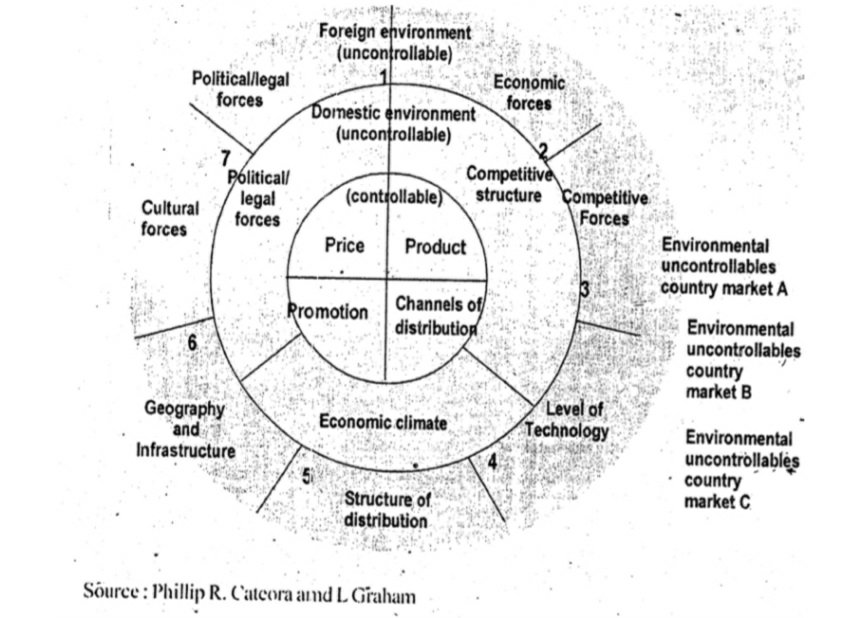
The International Marketing Task
Q.5. Discuss ‘Culture’ and the various elements of Culture that influence Trade. (10)
Culture
Cultural dimension is one of the important dimensions of international marketing environment, other dimensions being political, economic, legal, technological, geographic etc. It influences all aspects of consumer behaviour and is pervasive in all marketing activities like product design, packaging, pricing, promotion, distribution, communication etc.
According to Elbert W Steward and James A Glynn “Culture consists the thought and behavioral patterns that members of a society learn through language and other forms of symbolic interaction – their customs, habits, beliefs and values, the common viewpoints that bind them together as a social entity.
Culture can be defined as a “sum total of man’s knowledge, beliefs, art, morals, laws, customs and any other capabilities and habits acquired by man as member of society.
Elements of culture
Culture includes all facets of life. In order to obtain a total picture of a culture it is necessary to investigate every possible side of it. For facilitating an accurate study of culture, the anthropologists have evolved a “cultural scheme” which embodies the various elements of culture. The main elements included within the meaning of the term `culture’ are:
1. Material Culture
Material culture can be classified into two parts: technology and economics.
Technology includes the ways and means applied in making material goods – it is the technical know-how in the possession of people in a society. Economic refers to the manner in which the people of a society employ their resources and capabilities to generate social welfare and benefits. Economics includes activities like production and distribution of goods and services, consumption function, means of exchange and generation of income derived from the creation of utilities and similar activities.
Material culture thus influences the level of demand, types and quality of goods in demand and their consumption pattern in a society. The marketing implications of material culture of a society are obviously many. The goods and services that are acceptable in one market may not be acceptable in another market because of differences in the material cultures of two societies.
For example, sophisticated electronic appliances widely in demand in the technologically and economically advanced Western countries, may not find a market in less developed countries of Asia, Africa or Latin America. .
2. Social Institutions
Social institutions existing in a society affect marketing system in a variety of ways.
• Social organization
Social organizations, educational systems, political structures mould the pattern of living and interpersonal relationships of people in a society. These institutions collectively influence the behavioural norms, codes of social conduct; value system etc. and thereby affect the entire consumption pattern of a society, which is of direct relevance to marketing.
• Education
Educational systems affect not only the level of literacy but also the development of various mental faculties and skills. In countries where the literacy rates are low, for instance, the conventional forms of printed communication will not work.
• Political structures
Similarly certain types of political institutions govern the growth of marketing organizations as well as several other marketing functions and business systems.
Social institutions thus exert notable influence on all aspects of marketing including product formulations and design, pricing structure, distribution network, promotional methods and the like.
3. Man and the Universe
Man and the universe is a relationship that generally results in the form of religious beliefs and related power structure. Religions are a major determinant of the moral and ethical values and influence people’s attitude, habits and outlook on life, which are reflected in their consumption pattern. Dr. Ernest Dichter found: “In Puritanical cultures it is customary to think of cleanliness as being next to godliness. But in catholic and Latin countries, to fool too much with one’s body, to overindulge in bathing or toiletries, has the opposite meaning. It is that type of behaviour which is considered immoral and improper.”
The religious faith and belief thus affect people’s consumption habits and their attitudes to goods and services as well as promotional messages, which should be in consonance with the religious faith to be acceptable.
4. Aesthetics
The man expresses his inner urge for creativity through aesthetics, i.e. the arts, folklore, music, drama, dance and the like. The aesthetics of a particular society are embedded in its culture and are expressed through various symbols and forms. The aesthetics are of special interest to the marketer because of their role in interpreting symbolic meanings of the various methods of creative expressions, color and norms of beauty in a particular culture. In the absence of culturally correct interpretation of a society’s aesthetic values, product styling or promotional message, for instance, would seldom be successful.
5. Language
Language is an important element of culture. Language is a set of symbols used to assign and communicate meaning. It is through language that most of the marketing communications take place. It enables us to name or label the things in our world so we can think and communicate about them. An international marketer should have a thorough understanding of the language of the market particularly the semantic differences and idiomatic nuances which are essential characteristics of all languages of the world. For example, the dictionary translations could be quite different from the idiomatic interpretation of the language. When literal translations are made of brand names or advertising messages from one language to another by people who know the language but not the culture, serious mistakes may occur. In Canada, for example, a family brand name – `Big John’ – was translated into French as `Gros Jos’ which is a colloquial French expression for a woman with `big breasts’.
Or Discuss the various Regional Economic Grouping in International Trade. (10)
Regional Groupings can be classified, conceptually, into five major types:
1. Preferential Trading Arrangement
Where the member countries lower barriers to imports of identified products from one another.
A preferential trade area is a trading bloc that gives preferential access to certain products from the participating countries. This is done by reducing tariffs but not by abolishing them completely. It is the first stage of economic integration.
2. Free Trade Area
Where barriers to trade in respect of all items among member countries are completely eliminated while each member country follows its own policy in regard to trade with lion-member countries.
FTA consists of a number of countries within which trade is free in the sense that customs duties are not levied at the frontier on trade but, in practice, it is limited to specified products with specified exceptions. Exceptions arise out of the typical national needs of protecting specific sectors from international competition. Though tariff barriers on intra-trade are removed, each country maintains its separate customs barriers on trading with non-member countries. This causes serious problems in administering the free trade arrangement. Suppose there are two countries, A and B which are members of FTA. C is a non-member which exports garments to A and B. the import duty on imports of garments is 20 percent in A and 30 percent in B. Exporters in C, faced with this situation, would attempt to ship the garments to A and once the goods are cleared through customs, reship the consignment to B, provided the re-routing costs are lower than the differential in customs duties. To avoid this problem, FTA introduces the system of rules of origin, whereby only goods originating wholly or substantially in the number countries would be eligible for free trade within the area. The most important experiment in this field had been the European Free Trade Area (EFTA) which, however, lost its significance when some EFTA members joined the European Economic Community. Since 1977, there is free trade in Europe for trade in Europe for industrial products.
3. Customs Union
Where, apart from elimination of all barriers to trade among themselves, the member countries follow a common policy in regard to their trade with non-members.
Like FTA, there are no internal tariff barriers on intra-union trade. But, in addition, the members countries give up their individual tariff schedules and erect a common external tariff barrier for trade with non-union members.
A customs union is like a single nation, not only in internal trade, but also in presenting a common front to the rest of the world with its common external tariff.
A customs union is more difficult to achieve than a free trade area because each member must yield its sovereignty in commercial policy matters, not just with members nations but with the whole world.
Its advantages are: (i) stronger economic integration and (ii) elimination of administrative problems of a free trade area.
4. Common Market
Where the region becomes a common market for all factors of production including labour, services and capital.
Common market is the succeeding stage of economic integration. In addition to the characteristics of a customs union, a common market also allows free movement of labor and capital within the member countries. A common market goes beyond a customs union because it seeks to standardize all Government regulations affecting trade. The European Economic Community is the most successful experiment, so far, as a common market. There are other examples of common market:
(i) Central American Common Market consisting of Costa Rica, EI Salvador, Guatemala, Honduras and Nicaragua.
(ii) Andean Common Market comprising Peru, Venezuela, Colombia, Ecuador and Bolivia.
5. Economic Community
Where the member countries follow common policies in respect of all economic matters.
An economic union is a type of trade bloc which is composed of a common market with a customs union. The participant countries have both common policies on product regulation, freedom of movement of goods, services and the factors of production (capital and labour) and a common external trade policy.
The regional groupings that exist today fall in one or more of the above categories or are variations/combinations of some forr/forms, the Bangkok Agreement among Bangladesh, India, Laos, South Korea and Sri Lanka is a specimen of a preferential trading arrangement: E’FTA and NAFTA are free trade areas: there are a number of examples of customs union and common market: they include Central American Common Market, Caribbean Common Market, ANDEAN Cornman Market and Arab Common Market while the European Union ii perhaps, the best example of evolution of a regional grouping through the stages of customs union to common market to economic community.
Q.6. Explain the following: (5+5=10)
a. ‘Political Risk’ in International Business
An international business entity is a guest of the host country and, therefore, the host country reserves the right of not only allowing it access but also of expropriating it. It also can influence the scale and dimensions of the operations through its policies.
Political risk is thus the vulnerability of returns of a project to the political acts of a sovereign government. This definition gives rise to several issues but the most important issue is that political risk is associated with blockage of funds and expropriation (or domestication of investment) by the foreign government, for a firm operating across its national borders. The exporting firm also faces political risks because political developments also affect the areas of import restriction, tax controls, price controls, exchange regulations, counter trade etc. which can create a major impact on the value of the exporting firm and its survival.
1. Blockage of Funds
An issue associated very closely with the subject of political risk is a temporary or permanent blocking of funds. Blockage of funds refers to the fact that although a business entity may own the funds and still hold property rights, it cannot export its earnings. This was a common problem faced by Indians during Idi Amin’s rule in Uganda. Although the government did not formally make any announcements regarding take over of property, it had become almost impossible for the firms to repatriate their earnings in any form.
2. Domestication
Domestication refers to transfer of control of foreign investment to national ownership to bring the firm’s activities in line with national interests. It differs from expropriation in the sense that It is a gradual encroachment of freedom of operation of a foreign operator.
There are three types of domestications. They are; firm initiated domestication, government initiated domestication, and predetermined domestication. Whereas firm initiated and predetermined domestication involves low level of risk, government initiated domestication is ranked at par with expropriation. The difference in risk profile is a product of discount factor used in the capital budgeting decision. While in case of predetermined and self-initiated domestication, the firm has the freedom to use discount rates having known the project life, in the case of government initiated domestication both variable are unknown or unplanned for. Besides, in a government initiated domestication programme, the economics of the operation may go haywire as companies are instructed to sell off a certain percentage of their stake by a given date.
3. Expropriation
The most extreme case of political vulnerability is expropriation. Expropriation refers to the government confiscation of property with or without proper reimbursement. Even where reimbursement is forthcoming, it doesn’t equate with the value of the firm, which is the summation of future earnings by a firm. Reimbursement is often fixed keeping in mind the book value of assets. Modem economic history is replete with cases of expropriation. It may occur for a number of reasons, including the desire to retain national assets, as a “hostage” situation in international disputes, for example the seizure of Union Carbide’s assets after the Bhopal disaster in India.
While these risks are faced by firms operating within the boundaries of the host countries, companies operating from outside the political boundaries are also influenced by political risks.
These risks often manifest themselves in form of exchange control, import restrictions, tax controls, price control, counter trade and other similar measures. These risks are often interlinked with economic problems and perception of the government regarding these economic problems. Normally, when a government perceives a trade gap emerging, it may announce a measure or a combination of these measures. It may also be a result of the economic direction that a government wishes to impart to its country. Thus, when India decided to focus on self- reliance, several import restrictions were imposed.
b. Bill of Lading
Of all the documents, bill of lading is unquestionably the most important and valuable document. Issued by the shipping company, a bill of lading is
• A receipt/acknowledgement of cargo delivered for transportation.
• A contract of affreightment between the shipper and the carrier specifying their respective responsibilities and obligations.
• A document of title to goods and provides interested parties including banks with title to the goods mentioned therein.
• A collateral, that can be used for any advances made to the seller or to the buyer in the process of financing the shipment.
Bills of lading are prepared by the shippers on printed forms supplied by the shipping company concerned and necessary particulars are entered therein the blank spaces provided for the purpose. Normally, a bill of lading shows the date of shipment., port of shipment, name of the carrying vessel, name of the consignor, consignee and notify party, port of discharge, number, contents and identification marks of packages and goods shipped, and the amount of freight `paid’ or to ‘pay’. Bills of lading are normally issued in sets of four. Three copies duly signed are delivered to the shipper, while the fourth copy is unsigned and retained by the shipper’s master for his own use. Different copies are sent by different mails to reduce the risk involved by delay or loss in transit. Goods are released at the port of destination against one of the copies of the bill of lading presented first and other copies becoming void. Banks invariably take possession of full set of bi 11 of lading, the number comprising the full set being indicated by the bill of lading itself.
Bills of lading may be issued either in negotiable or non negotiable form. A negotiable bill of lading is issued to the order of consignee, or endorsed either in blank by a shipper or endorsed to the order of named party.
Bill of Lading can be of various types as discussed below :
1. Received for Shipment B/L
It is issued by the shipping company when goods have been given into the custody of the shipping company but have not yet been placed on board the ship.
2. On Board Shipped B/L
It certifies that the goods have been received on board the ship.
3. Clean B/L
It indicates a clean receipt. In other words, it implies that there was no defect in the apparent order and condition of the goods at the time of receipt or shipment of goods by the shipping company, as the case may be.
4. Claused or Dirty B/L
This bill bears a superimposed clause of annotation, which expressly declares a defective condition of the goods. The clause may state “package number 20 broken” or “bale number 20 hook-damaged”. By superimposing such clauses on the B/L, the shipping company limits its responsibility at the time of delivery of goods at the destination. It is very important to note that only a clean B/L is acceptable for negotiation of documents with the bank.
5. Combined B/L
It covers several modes of transport for performing the complete journey from the exporting country to the importer’s warehouse. For example, part of the journey may be completed by ship while subsequent parts may be undertaken by road, rail and air.
6. Through B/L
It covers goods being transhipped enroute but where the first carrier had the responsibility as the principal carrier for all stages of the journey. For example, goods may be shipped from Bombay to Dubai and transhipped from Dubai to port in Latin America.
7. Trans-shipment B/L
It has similar characteristic as the Through B/L except that in this case the first carrier acts only as an agent for effecting Trans-shipment of cargo.
8. Charter Party B/L
It covers shipment on a chartered ship.
The contract or the letter of credit will specify the nature of bill of lading that the exporter has to procure for the importer. Generally, the importers insist on the “clean on-board shipped” bill of lading, with the prohibition of the trans-shipment of goods.
Q.7. Write short note on : (5+5=10)
a. IMF (International Monetary Fund)
The International Monetary Fund (IMF) is an organization of 190 countries, working to foster global monetary cooperation, secure financial stability, facilitate international trade, promote high employment and sustainable economic growth, and reduce poverty around the world.
Created in 1945, the IMF is governed by and accountable to the 190 countries that make up its near-global membership.
The IMF’s primary purpose is to ensure the stability of the international monetary system—the system of exchange rates and international payments that enables countries (and their citizens) to transact with each other. The Fund’s mandate was updated in 2012 to include all macroeconomic and financial sector issues that bear on global stability.
The International Monetary Fund (IMF) is an international financial institution, headquartered in Washington, D.C., working to foster global monetary cooperation, secure financial stability, facilitate international trade, promote high employment and sustainable economic growth, and reduce poverty around the world while periodically depending on the World Bank for its resources.
Formed in 1945, at the Bretton Woods Conference primarily by the ideas of Harry Dexter White and John Maynard Keynes, it came into formal existence in 1945 with 29 member countries and the goal of reconstructing the international payment system. It now plays a central role in the management of balance of payments difficulties and international financial crises. Countries contribute funds to a pool through a quota system from which countries experiencing balance of payments problems can borrow money.
Its main purpose is to promote international monetary co-operation, facilitate international trade, foster sustainable economic growth, reduce poverty around the world, make resources available to members experiencing balance of payments difficulties, prevent and assist with recovery from international financial crises.
According to the IMF itself, it works to foster global growth and economic stability by providing policy advice and financing the members by working with developing countries to help them achieve macroeconomic stability and reduce poverty. The rationale for this is that private international capital markets function imperfectly and many countries have limited access to financial markets. Such market imperfections, together with balance-of-payments financing, provide the justification for official financing, without which many countries could only correct large external payment imbalances through measures with adverse economic consequences. The IMF provides alternate sources of financing.
Upon the founding of the IMF, its three primary functions were: to oversee the fixed exchange rate arrangements between countries, thus helping national governments manage their exchange rates and allowing these governments to prioritize economic growth, and to provide short-term capital to aid the balance of payments. This assistance was meant to prevent the spread of international economic crises. The IMF was also intended to help mend the pieces of the international economy after the Great Depression and World War II as well as to provide capital investments for economic growth and projects such as infrastructure.
b. World Bank
The World Bank is an international financial institution that provides loans and grants to the governments of low and middle income countries for the purpose of pursuing capital projects. It comprises two institutions: the International Bank for Reconstruction and Development (IBRD), and the International Development Association (IDA). The World Bank is a component of the World Bank Group.
The World Bank was created at the 1944 Bretton Woods Conference, along with the International Monetary Fund (IMF). The president of the World Bank is, traditionally, an American. The World Bank and the IMF are both based in Washington, D.C., and work closely with each other.
Although many countries were represented at the Bretton Woods Conference, the United States and United Kingdom were the most powerful in attendance and dominated the negotiations. The intention behind the founding of the World Bank was to provide temporary loans to low-income countries which were unable to obtain loans commercially. The Bank may also make loans and demand policy reforms from recipients.
Its headquarters is in Washington DC. Its current president is David Malapass.
The World Bank Group is an extended family of five international organizations, and the parent organization of the World Bank, the collective name given to the first two listed organizations, the IBRD and the IDA:
• International Bank for Reconstruction and Development (IBRD)
• International Development Association (IDA)
• International Finance Corporation (IFC)
• Multilateral Investment Guarantee Agency (MIGA)
• International Centre for Settlement of Investment Disputes (ICSID)
The President of the Bank is the president of the entire World Bank Group. The president is responsible for chairing meetings of the Boards of Directors and for overall management of the Bank. Traditionally, the President of the Bank has always been a US citizen nominated by the United States, the largest shareholder in the bank (the managing director of the International Monetary Fund having always been a European). The nominee is subject to confirmation by the Board of Executive Directors, to serve for a five-year, renewable term. While most World Bank presidents have had banking experience, some have not.
Amid the global fight with the COVID-19 pandemic, in September 2020, the World Bank announced a plan worth $12 billion in order to supply “low and middle income countries” with a vaccine once it is approved. The plan is set to affect over two billion people worldwide.
Q.8. Enumerate in detail the various documents required in Export. (10)
Export from India required special document depending upon the type of product and destination to be exported. Export Documents not only gives detail about the product and its destination port but are also used for the purpose of taxation and quality control inspection certification.
Export Documents Checklist Required for Export Shipment from India
1. Bill of Lading/Airway Bill/Lorry Receipt/Railway Receipt/Postal Receipt
An AWB or BL is issued by the carrier of the goods, after the C&F (Cost and Freight) agent hands over the Mate’s Receipt to the carrier, who analyzes it against the cargo. A master AWB/BL is issued by the main carrier of the goods while a House AWB/BL is issued by the freight forwarder.
2. Commercial Invoice cum Packing List
(As per the Central Board of Excise and Customs circular under the Customs Act, separate commercial invoice and packing list are acceptable)
3. Shipping Bill/Bill of Export/Postal Bill of Export
Shipping Bill/ Bill of Export is the main document required by the Customs Authority for allowing shipment. A shipping bill is issued by the shipping agent and represents some kind of certificate for all parties, included ship’s owner, seller, buyer and some other parties. For each one represents a kind of certificate document.
However, besides these core three, there are other documents which you may require when you try to ship overseas. A list of the paperwork typically required in the export of goods is given below.
Other list of Documents required for Export Shipping
4. Proforma Invoice
The first document in many cases is the proforma invoice, which will give the buyer all the information about the item, price, delivery, payment terms. etc.
5. Export Order/Purchase Order
Based on the proforma invoice, the buyer places the order with the exporter, specifying their details and requirements, in the Purchase Order.
6. Commercial Invoice
Once the goods are packed and ready, a Commercial Invoice is prepared by the exporter. The Customs counter signs it before shipping.
7. Packing List
If there is more than one item to be exported, a packing list, listing the various items to be shipped, is mandatory.
8. Certificate of Origin
Certificate of Origin is a notarized affidavit which indicates the place where the goods are manufactured.
9. Bill of exchange
This is an internal document that is generated by the exporter which instructs the importer to pay the amount mentioned to the exporter or the payee bank.
10. Letter of Credit
Although not part of the shipment process, a Letter of Credit is an essential document generated while honoring a buyer’s purchase order. It is issued by the buyer’s bank, which undertakes to pay you at the end of the credit period on behalf of the buyer. However, it is not required if the payment is in the Documents against Payments or Documents against Acceptance modes.
11. Inspection/Quality check
An importer can insist on inspection or QC of the goods before shipping to verify quality, as well as check for adherence to proper packing parameters. The exporter should keep documents verifying such fulfilment ready as well.
12. Phyto-sanitary certificates and fumigation certificates
These certificates can be demanded by the buyer, with the latter being even mandatory in many countries. These quality and goodness tests may be named differently depending on product and country but are essentially documentation proving adherence to international quality standards and norms. Exporters must ensure they keep them ready before packaging.
13. Marine Insurance policy
This is required for the safety coverage of the goods dispatched overseas.
14. Mate’s Receipt
With documents like a Certificate of Origin, Commercial Invoice, Export Order, Letter of credit, Certificate of Inspection and Marine Insurance Policy in place, the cargo can enter the port and onto the dock. Once the shipment is loaded into the carrier, the Mate’s Receipt is issued, confirming the same.
15. Airway Bill (AWB)
An AWB is issued by the carrier of the goods, after the C&F (Cost and Freight) agent hands over the Mate’s Receipt to the carrier, who analyzes it against the cargo. A master AWB is issued by the main carrier of the goods while a House AWB is issued by the freight forwarder.
16. FEMA Declaration for exporters
This declaration is a requirement which replaced the erstwhile Self-Declaration Form, as per the notifications of Indian customs, indicating the exporter’s agreement to adhere to the tenets of the Foreign Exchange Management Act (FEMA), 1999.
17. Let Export Order
The LEO is issued by the customs officer after the completion of export customs clearance procedures. It is proof that all export customs formalities have been completed.
18. Export General Manifest
The Manifest is filed by the shipping carrier after the movement of goods from the exporting country. It is registered with Customs and initiates the generation of the official proof of export, i.e. the export promotion copy of the shipping bill.
Q.9. What are International Distribution Channels in International Marketing? (10)
Distribution has two elements, the institutional and the physical.
Physical distribution aspects cover transport and warehousing. The longer the channel, the more likely that producer’s profits will be indirectly reduced. This is because the end product’s price may be too expensive to sell in volume, sufficient for the producer to cover costs. Yet cutting channel length may be impossible, as country infrastructure requirements may dictate they being there.
International marketers have the options of organizing distribution of their goods in foreign markets through the use of indirect channels, i.e. using intermediaries, direct channels or a combination of the two in the same or different markets.
1. Indirect Distribution
Indirect channels are further classified based on whether the international marketer makes use of domestic intermediaries. An international marketer therefore, can make use of the following types of intermediaries for distribution in foreign markets.
a. Domestic Overseas Intermediaries
• Commission buying agents
• Country-controlled buying agents
• Export management companies (EMCs)
• Export merchants
• Export agents
• Piggy backing
b. Foreign Intermediaries
• Foreign Sales Representatives
• Foreign Sales Agents
• Foreign Stocking and Non-Stocking Agents
• State Controlled Trading Companies
2. Direct Distribution
The options available to international marketer in organising direct distribution include sending missionary skies representatives abroad from the headquarter, setting up of local sales/branch office in the foreign country or for a region, establishing a subsidiary abroad, entering into a joint venture or franchising agreement.
Companies having long-term interest in international marketing find it expedient to deploy their own sales force in foreign markets. This helps them in increasing their sales volume through committed market development activities, better control and motivation of foreign intermediaries being used, and paving the way for smoother transition to direct distribution and marketing.
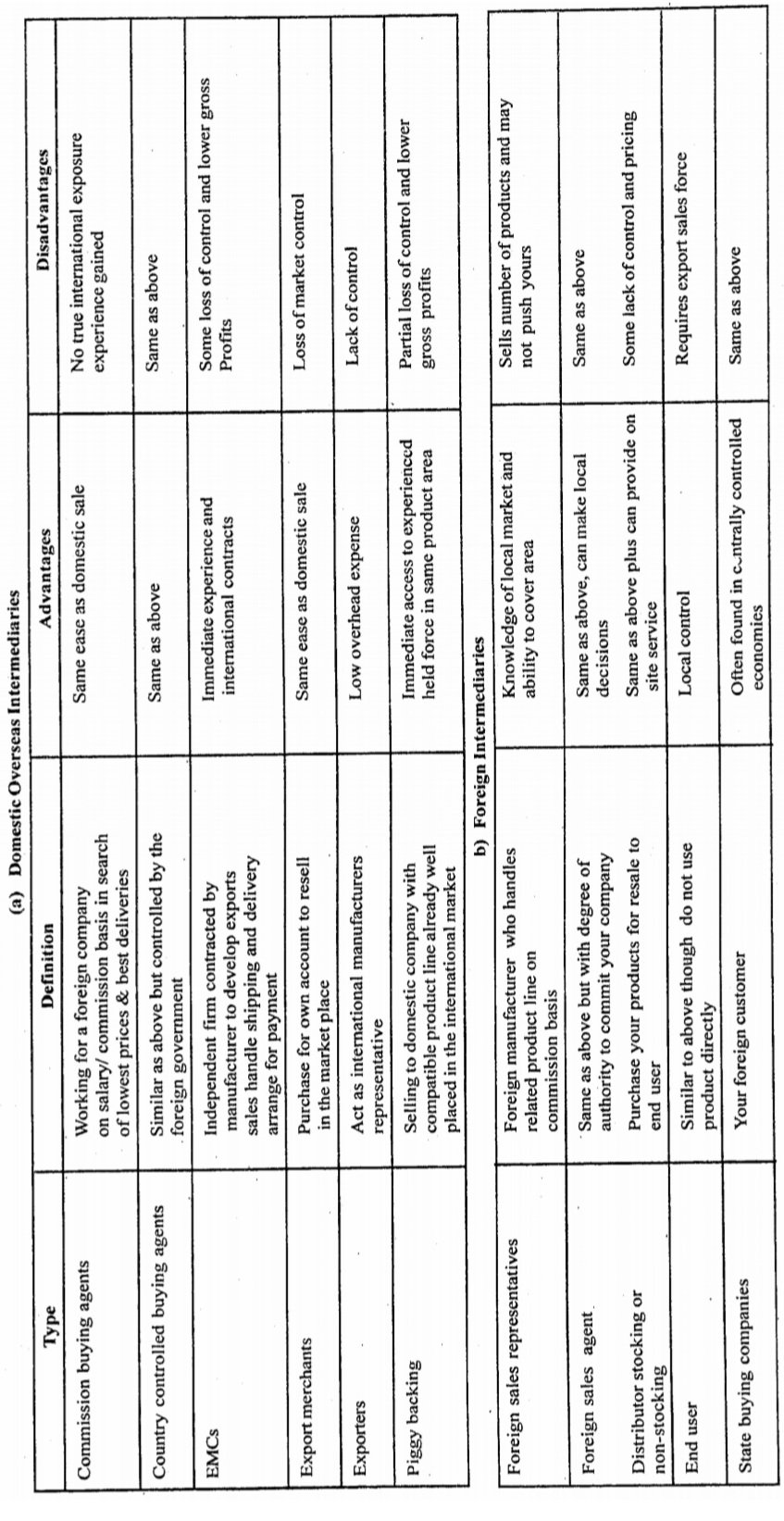
Intermediaries in International Distribution
Q.10. Mention the differences between International Marketing and Export Marketing. (10)
Export Marketing
Export marketing is nothing but marketing in foreign environment. (This concept assumes foreignness of the new environment because of its constant reference to the domestic market and environment). In this stage of marketing the concern merely expands the market size. It applies the same marketing mix even in the foreign environment. It makes no effort to adapt its marketing mix or product to the market needs and requirement. The emphasis in this stage of marketing is on expanding the market size and not the marketing mix. The company follows a binary orientation when marketing the home country and foreign country orientation.
Export marketing is the practice by which an organization offers items or administrations to an unfamiliar nation. Items are delivered or disseminated from the organization’s nation of origin to purchasers in global areas. However, there is a distinction between items that are accessible to unfamiliar nations and items that are explicitly advertised to unfamiliar clients. This where the significance of a fare promoting plan comes in.
Exporting is one aspect of international marketing.
Exporting is a mode of entry which a business follows to expand its operations abroad. There are different modes of entries like Joint venture, merger and acquisition etc. and companies follow whichever suits their business goals and ambitions.
Exporting is an aspect of international marketing. It refers to the sale of an item that is produced domestically to overseas markets. An automobile, for example, that is produced in the United States might be exported for sale in Europe. If so, the car is said to be an “export,” and exporting it would be part of an international marketing campaign on the part of the company that produces it.
International Marketing
The second phase that company enters with reference to global orientation is international marketing. in this stage the firm retains its binary orientation but adapts its marketing mix to the requirement of the new environment. Thus while it thinks of profitability vis-à-vis the parent company it makes sure that the product is marketed with the best mix that it can design. (In its activities the company changes its stature).
International marketing covers the effective tools and techniques which can be adopted while making your product or service global. It also discuses about the Strategies that need to be followed by the marketer before entering into a particular country. Since, Wrong marketing and Branding can harm the goodwill of a company. Therefore it’s very essential to follow the norms and strategies in the international marketing domain.
International marketing is a broad subject which covers the know how to make your product reach to international markets. It covers the barriers and challenges that businesses and marketers face when doing trade internationally.
International marketing is a broad term that describes the process of marketing a good overseas. This includes all of the things that are part of a domestic marketing strategy, including advertising and distribution, but in an overseas context. For example, a key component of international marketing would be figuring out how to advertise in culturally-appropriate ways to create demand in foreign markets. It would also include the logistics of producing, warehousing, and distributing goods internationally. This might include actually producing the goods overseas.