
Table of Contents
Q.1. What do you understand by service product ? Discuss in brief the characteristics of services. (20)
Services
The term service is rather general in concept, and it includes a wide variety of services. There are the business and professional services such as advertising, marketing research, banking, insurance, computer-programming, legal and medical advice. Then there are services which are provided by professionals but consumed for reasons not of business, rather for leisure, recreation, entertainment and fulfilment of other psychological and emotional needs such as education, fine arts, etc.
Kotler offers one such definition: “A. service is any activity or benefit that one party can offer to another that is essentially intangible and does not result in the ownership of anything. Its production may or may not be tied to a physical product”.
Services can be described on the basis of type of process used in the delivery of the service. The three kinds of delivery processes that are applicable in case of service products are line operations, job shop operations and intermittent operations. Self-service restaurants and shops are examples of line operations.
The most important issue in the service product is understanding what benefits and satisfaction the consumer is seeking from the service. From the view-point of a restaurant’s manager, the restaurant simply provides food. But the customers coming to the restaurant may be seeking an `outing’, an atmosphere different from home, relaxation, entertainment or even status. The marketing of services can be a success only if there is a match between the service product from the consumer’s view-point and the supplier’s view-point. To find this match, as a manager you would have to analyse your service at the following levels:
1. Customer Benefit Concept
The service product which you offer in the market place must have its origin in the benefits which the customers are seeking. But the problem is that customers themselves may not have a clear idea of what they are seeking or they may find it difficult to express or it may be a combination of several benefits and not a single one. Over a period of time, the benefits sought may also change. This change in customers may come about by a satisfactory or unhappy experience in utilising the service, through increased sophistication in service use and consumption, and changing expectations. All these make the issue of marketing a service product very complex.
2. Service Concept
Using the customer benefits as the starting point, the service concept defines the specific benefits which the service offers. At the generic level the service concept refers to the basic service which is being offered. A centre for the performing arts may offer entertainment and recreation. But within this broad framework, there can be specific choice paths for satisfying the entertainment objective, such as, drama, musical concerts, mime, poetry recitation, dance etc. Defining the service concept helps answer the fundamental question, `What business are we in?’
3. Service Offer
Having defined the business in which you are operating, the next step is to give a specific shape and form to the basic service concept. To refer to the example of centre for the performing arts, the service concept is to provide entertainment. The service offer is concerned with the specific elements that will be used to provide entertainment: drama, music, mime, poetry recitation, dance. In the category of musical concerts the choice may be vocal or instrumental, within. vocal whether light or classical, Hindustani, Carnatic or Western. While these represent the intangible items of the service offer, the physical infrastructure of the centre, in terms of its setting capacity, comfortable seats, quality and acousticsprovision of air-conditioning, snack bar and toilets are the tangible items. The tangible aspects can be controlled by offering the best possible benefit, but the quality and performance of the actors, singers, musicians cannot be controlled.
Theoretically, a manager must control both the tangible and intangible components. But in practice, he can control only the tangible components and lay down norms for the intangible components (e.g. maximum duration of recital, brief introduction before each dance item, etc.)
4. Service Forms
In what form should the services be made available to the customers is another area of decision-making. Should all the shows of the centre be available in a package deal against a yearly membership fee or a seasonal ticket? Should there be daily tickets with the consumer having freedom to watch any one or more performances being staged on that particular day? Or should each performance have a separate entrance ticket, with a higher priced ticket for a well-known performer. Service form refers to the various options relating to each service element. The manner in which they are combined gives shape to the service form.
5. Service Delivery System
When you go to your bank to withdraw money from your account, you either use a cheque or a withdrawal slip in which you fill all the particulars and hand it over to the clerk, who, after verifying the details, gives you money. The cheque or withdrawal slip and the clerk constitute the delivery system. In a restaurant, the waiters are the elements of the delivery system. The two main elements in a delivery system are the people and the physical evidence. The competence and public relations ability of a lawyer represent the `people’ component, while his office building, office door, letterhead, etc. are all elements of the `physical evidence’. The physical evidence components have also been called `facilitating goods’ and `support goods’. These are the tangible elements of the service and they exert an important influence on the quality of the service as perceived by the consumers.

Conceptualisation of the service product
Characteristics of Services
Services have a number of unique characteristics that make them so different from products. Some of the most commonly accepted characteristics are:
1. Intangibility
When you buy a cake of soap, you can see, feel, touch, smell and use to check its effectiveness in cleaning. But when you pay fees for a term in college, you are paying for the benefit of deriving knowledge and education which is delivered to you by teachers. In contrast to the soap where you can immediately check its benefits, there is no way you, can do so in case of the teachers who are providing you the benefits.
Teaching is an intangible service. When you travel by aeroplane, the benefit which you are deriving is a service (transportation) but it has some tangible aspects such as the particular plane in which you fly (Boeing, Avro, Concorde, and the food and drink which is served). In this case the service has both a tangible and intangible aspect as compared to teaching which has no tangible aspect at all. This continuum highlights the fact that most services are in reality a combination of product and service having both tangible and intangible aspects. There are only a few truly pure tangible products or pure intangible services.
The distinguishing feature of a service is that its intangible aspect is dominant J. Bateson has described the intangible characteristics of services which make them distinct from products. These intangible features are:
• Service cannot be touched
• Precise standardisation is not possible
• There is no ownership transfer
• Service cannot be patented
• Production and consumption are inseparable
• There are no inventories of the service.
2. Inseparability
In most cases service cannot be separated from the person or firm providing it. Service is provided by a person who possesses a particular skill (singer), by using equipment to handle a tangible product (dry cleaning) or by allowing access to or use of physical infrastructure (hotel, train). A plumber has to be physically present to provide the service, the beautician has to be available to perform the massage. This is in direct contrast to products which can be produced in the factory today, stocked for the next two, three or more months and sold when an order is procured.
3. Heterogeneity
The human element is very much involved in providing and rendering services and this makes standardisation a very difficult task to achieve. The doctor who gave you his complete attention in your last visit may behave a little differently the next time.
The new bank clerk who cashes your cheques may not be as efficient as the previous one and you have to spend more time for the same activity. This is despite the fact that rules and procedures have been laid down to reduce the role of the human element and ensure maximum efficiency. Airlines, restaurants, banks, hotels have a large number of standardised procedures. You have to reserve a room in a hotel and this is a straight forward procedure for which all the steps are clearly defined. Human contact is minimal in the computerised reservation systems, but when you go to the hotel there will be a person at the reception to hand over the key of your room. The way this person interacts with you will be an important factor in your overall assessment of the service provided by the hotel. The rooms, the food, the facilities may be all perfect, but it is the people interacting with you who make all the difference between a favourable and unfavourable perception of the hotel.
4. Perishability
Services cannot be stored and are perishable. A car mechanic who has no cars to repair today, or spare berths on a train, unsold seats in a cinema hall represent service capacity which is lost forever. Apart from the fact that a service not fully utilised represents a total-loss, the other dimension of this perishability aspect is that most services may face a fluctuating demand. There is a peak demand time for buses in morning and evening (office hours), certain train routes are always more heavily booked than others. This fluctuating demand pattern aggravates the perishability characteristic of services.
5. Ownership
When you buy a product you become its owner-be it a pencil, book, shirt, refrigerator or car. In the case of service, you may pay for its use but you never own it. By buying a ticket you can see the evening film show in the local cinema theatre; by paying wages you can hire the services of a chauffer who will drive your car; by paying the required charges you can have a marketing research firm survey into the reasons for your products’ poor sales performance, etc. In case of service, the payment is not for purchase, but only for the use or access to or for hire of items or facilities.
A service is purchased for the benefits it provides. If we closely examine the reasons why products are purchased, we find that they are bought not because of their physical, tangible features but because they provide certain intangible benefits and satisfactions.
Q.2. Define Market Segmentation. Discuss in brief the basis for Segmentation. (20)
Market Segmentation
Market segmentation is a marketing term that refers to aggregating prospective buyers into groups or segments with common needs and who respond similarly to a marketing action. Market segmentation enables companies to target different categories of consumers who perceive the full value of certain products and services differently from one another.
Companies can generally use three criteria to identify different market segments:
a. Homogeneity, or common needs within a segment
b. Distinction, or being unique from other groups
c. Reaction, or a similar response to the market
For example, an athletic footwear company might have market segments for basketball players and long-distance runners. As distinct groups, basketball players and long-distance runners respond to very different advertisements.
Market segmentation is an extension of market research that seeks to identify targeted groups of consumers to tailor products and branding in a way that is attractive to the group. The objective of market segmentation is to minimize risk by determining which products have the best chances for gaining a share of a target market and determining the best way to deliver the products to the market. This allows the company to increase its overall efficiency by focusing limited resources on efforts that produce the best return on investment (ROI).
Objectives of Market Segmentation
- The objective is to enable the company to differentiate its products or message according to the common dimensions of the market segment.
- Market segmentation allows a company to increase its overall efficiency by focusing limited resources on efforts that produce the best return on investment (ROI).
Bases for Segmentation
1. Benefit segmentation
In benefit segmentation you segment the market on the basis of what people say or the benefits they seek from the product.
Yankelovich applied benefits segmentation to the purchase of watches. He found that buyers bought for lowest price (23%), durability and general product quality (46%), and as symbols of some important occasion (31%).
One of the most successful benefit segmentations was reported by Russell Haley who coined the phrase benefit segmentation. According to him the oral hygiene (toothpaste) market can be divided into four distinct benefit segments depending on which of the following is sought:
• Flavour and product appearance
• Brightness of teeth
• Decay prevention
• Low price
2. Demographic basis
Instead of focusing on the differences in benefits sought, we might divide people in the market on the basis of demographic variables such as .age, sex, family size, income, occupation, education, location, religion, race and nationality. Demographic variables are the most popular bases for distinguishing customer groups.
3. Social class
Demographic variables can be combined to form social classes. Social class is defined in terms of a number of demographic variables varying from a single indicator like occupation to the use of a combination of factors like occupation, source of income, type of home or residential area. Social class has a strong influence on the person’s preferences in regard to clothing, home furnishings, leisure activities,’ reading habits, and so on,
4. Family life cycle
Another basis for segmentation that draws on demographic factors is family life cycle, where each stage in the cycle is a combination of age, marital status and age of children. A household with a young family tends to have different wants from an older married couple whose family is grown up. One family life cycle is:
• Young single people, not living at home
• Young married, no children
• Young married, youngest child under six
• Young married, youngest child six or over
• Older married, with dependent children
• Older married, no children living at home
• Older, single
5. Psychographic basis
We can also segment the market on the basis of life style or mode of living. This helps us to understand what those who are in the market do. Some of the products where life style approach has been used for segmenting the market are cars, women’s clothing, cigarettes, cosmetics, alcoholic beverages and furniture. Volkswagen, for example, has designed life style automobiles: a car for `the good citizen’ emphasizing economy, safety and ecology; and a car for the `car freak’ emphasizing handling, manoeuvrability, and spottiness.
6. Usage Rate
Usage rate is one of them and is sometimes used as a dependent variable with demographic or personality variables used as its predictors or independent variables.
The aim is to identify the `heavy users’ so as to focus directly on their wants and to appeal to them directly. Soft drinks and cigarettes are two important products where this approach is used. To explain, it is the younger group which falls in the category of heavy users so far as the soft drinks market is concerned. The main attempt of the companies selling this product is to focus on this group and to appeal to them directly.
7. Brand Loyalty
Another basis is brand-loyalty, with companies making direct appeal to the loyal user. Some important examples are the toothpaste market, the beer market, and the cigarette market. Companies selling in a brand-loyal market have a hard time gaining more market share. Similarly, companies that enter a brand-loyal market have a hard time getting in.
Q.3. What is Marketing Organisation? Explain in brief any two methods of designing a marketing organisation. (20)
Organization
An organization is a group of people that is structured and managed to achieve a common goal. Every organization have a defined structure that determines relationship between its members, and assigns their roles, responsibilities, and authority.
Marketing Organization
Marketing organization is a group of marketing persons brought together to make decisions on marketing areas like product, price, place, and promotion. Marketing organization is the foundation of effective sales planning for systematic execution of plans and policies. Marketing organization provides a system of relationships among various marketing functions to be performed by proper coordination among marketing persons.
Definition of Marketing Organization
“Marketing organization can be defined as a formal or informal group of individuals working together to reach quantitative and qualitative marketing objectives by making decisions on product, price, place, and promotion.”
Two methods of designing a market organisation
The major types of organizational design are based on:
• Functional
• Product
• Market
• Combination or matrix considerations
1. Functional Organizational Design
Functional design assigns departments, groups, or individual responsibilities for specific activities. these activities include SEO, content marketing, pricing, marketing research, website design, and marketing planning and services.
Depending on the size and scope of its operations, the marketing organization may include some or all these activities. The functional approach is often used when a single product or a closely related line is marketed to one target market.
Departures from a functional organizational structure may occur under one or more of the following conditions:
• The business unit serves multiple target markets. Where the needs and requirements of the end-user in the target market are different and marketing activities must vary.
• The line or mix of products require technical expertise due to product complexity, type of application, and other factors.
• Special marketing situations occur. Things like planning for implementing a new product, entering a new market, and developing a distribution channel.
Marketing organizational approaches address these factors, recognizing that in nearly every marketing organization, functional considerations influence the design to some degree.
2. Product Organization Design
The product mix may require special attention to the company’s organizational design. New products may not receive the attention they need unless someone is assigned the responsibility for planning and coordination.
This problem may occur with existing products when a business has several products and each involves technical an/or application differences.
Organizational schemes for managing products can be categorized according to whether they are temporary or permanent. Also, whether the people involved are assigned full-time or part-time.
Several organizational approaches to product management are shown in figure

Organizational approaches for Managing Products
The choice of a product-related organization approach depends on the situation and on marketing management preferences. Factors that often influence a decision are the nature and scope of products offered.
These included:
• The amount of new product development
• The extent of coordination necessary among functional areas
• The management of technical problems previously encountered with
• New products and existing products
The functional organizational structure may use a temporary task force to manage and coordinate the development of a new product. Soon after commercial introduction, the company shifts responsibilities for the product to the functional organization. The task force’s purpose is to set the initial direction for a new product so that it will be properly launched.
Q.4. What is meant by consumer behaviour? What are the personal factors that affect consumer behaviour ? (20)
Consumer behavior
Consumer behavior is the study of consumers and the processes they use to choose, use (consume), and dispose of products and services, including consumers’ emotional, mental, and behavioral responses.
Consumer behavior incorporates ideas from several sciences including psychology, biology, chemistry, and economics.
Consumer behavior is important because this way marketers can understand what influences consumers’ buying decisions.
By understanding how consumers decide on a product they can fill in the gap in the market and identify the products that are needed and the products that are obsolete.
Studying consumer behaviour also helps marketers decide how to present their products in a way that generates maximum impact on consumers. Understanding consumer buying behaviour is the key secret to reaching and engaging your clients, and convert them to purchase from you.
There are three categories of factors that influence consumer behavior
1. Personal factors
An individual’s interests and opinions that can be influenced by demographics (age, gender, culture, etc.).
2. Psychological factors
An individual’s response to a marketing message will depend on their perceptions and attitudes.
3. Social factors
Family, friends, education level, social media, income, they all influence consumers’ behavior.
Personal factors that affect consumer behaviour
A consumer’s purchase decisions are also affected by his personal characteristics such as age, sex, stage in family life-cycle, education, occupation, income, life-style, his overall personality and overall self-concept.
1. Demographic factors and life-cycle stage
The first factor influencing a buyer’s decision is his age. The need for different products and services changes with age. Babies and children have special needs for products such as milk powder, baby foods and toys. Young adults need clothes, recreational and educational facilities, transportation and a host of other age and fashion related consumption needs.
There are certain physiological differences between men and women which result in their having different consumption needs. Women need specialised medical facilities for pregnancy and delivery. Their requirement of clothes and cosmetics is different from that of men. Each gender thus has its own need for specific products and services. Consumption behaviour is also influenced by the specific stage of the family life cycle.
2. Education and Occupation
Education widens a person’s horizons, refines his tastes and makes his outlook more cosmopolitan. An educated person, as compared to soinebody less educated, is more likely to consume educational facilities, books,- magazines and other knowledge oriented products and services. For instance, in India, we find that educated families are more inclined towards adopting family planning than families which have no educational background.
The occupation also shapes the consumption needs. People following specialised occupations such as photography, music, dance, carpentry, etc. need special tools and equipment. But, apart from this specific need, the status and role of a person within an organisation affects his consumption behaviour. Chief executives would buy three-piece suits of the best fabric., hand made leather briefcase and use services of airlines and five star hotels. A junior manager or blue collar worker in the same organisation may also buy a three-piece suit but he compromises on quality.
3. Income
The income which a person earns is an extremely important influence on his consumption behaviour. He may aspire to buy certain goods and services but his income may become a constraint. Income in this context really refers to the income available for spending (i.e. income after tax, provident fund and other statutory deductions). The person’s attitude towards spending versus saving and his borrowing power are also important influencing factors. Small size packaging in sachets for products such as tea, shampoo, toothpaste are meant for the lower income customers who cannot afford a one time large outlay of money on such products.
Products which are considered luxuries are more income sensitive than products which fall in the category of necessities. If you are marketing a luxury product you must keep a close watch on income and saving trends to avoid ‘decrease in sales resulting from recession. To avoid sales decline you may need to re-position the product, change the marketing mix or both.
4. Personality
Personality is sum total of an individual’s psychological traits, characteristics, motives, habits, attitudes, beliefs and outlooks. Personality is the very essence of individual differences. In consumer behaviour, personality is defined as those inner psychological characteristics that both determine and reflect how a person responds to his environmental stimuli. Personality is enduring and ensures that a person’s responses are consistent over time.
5. Life-Style
Life-styles are defined as patterns in which people live, as expressed by the manner in which they spend money and time on various activities and interests. Life-style is.a function of our motivations, learning, attitudes, beliefs and opinion, social class, demographic factors, personality etc. While reading this unit, you are playing the role of a student. But at the same time you also have your career, family and social roles to play. The manner in which you blend these different roles reflects your life-style.
Q.5. What is the difference between consumer and industrial products? State the reasons why organisations generally diversify their range of products. Substantiate your answer with suitable examples. (20)
Consumer Products
Consumer goods are those which are used by ultimate consumers or households and in such form that they can be used without further commercial processing. Consumer goods can be divided into
1. Convenience Goods
2. Shopping Goods
3. Durables or Durable Goods
4. Non-durables or Non-durable Goods.
1. Convenience Goods
These are goods which consumers generally purchase frequently without making an effort or as a habit. The purchase is almost spontaneous and the person has already a predetermined brand in mind. These convenience goods include soaps, newspapers, toothpastes, toiletries, cigarettes, etc. Often convenience goods are bought impulsively or spontaneously. For example, when a person goes shopping around and see a product which attracts his eyes, he buys it on impulse. Such goods are not purchased on regular basis.
2. Shopping Goods
These are goods which are purchased after going around shops and comparing the different alternatives offered by different manufacturers and retailers. In this case, emphasis on quality, price, fashion, style, etc. are of great importance. A common example, in the Indian context, would be the purchase of sarees by ladies. Generally, ladies go looking around from shop to shop before they make their final selection.
Hence, the expression `shopping’ goods. These also include durables such as furniture and refrigerators. That is why a large variety of goods offered at a retail outlet increases sales of this type of goods. A manufacturer should also attempt to have his product properly displayed and offered at most retail outlets.
3. Durable Goods
These are goods which are `durable’ or which last for some time. Examples of such goods would be electric irons, refrigerators, television sets, etc. This type of product requires more selling effort from the salesman. The question of after sales service and repairs is also of importance as `selling points’ or `benefits’ which the customer would like to have. Therefore, in case of refrigerators, the number of years of guarantee, particularly for the compressor, is an important consideration when a consumer makes his final selection.
4. Non-durable Goods
These are goods which get depleted on consumption. For example a bottle of soft drink is consumed at once on one occasion within a matter of minutes. Soap obviously takes a little longer. However, in both these cases, the goods are consumed very fast. The advantage of these goods is that they are purchased very often and therefore there are many repeat purchases once the customer is satisfied with one product. Therefore, one must ensure quality and appropriateness of price. These are the products that have to be advertised heavily, with a view to inducing people to try them out, and thus, build up brand preference and brand loyalty.
5. Services
Services are specially mentioned here (although they do not constitute products) because it is generally thought that marketing is related to products alone. It should be remembered that marketing ideas and practices are equally applicable to services with slight adaptations in certain decisional areas. Services in content are different from products. For example, courts offer a service. So are hospitals, the fire department, the police and the post office.
Industrial Products
These are products which are sold primarily for use in manufacturing other goods or for rendering some service. These include items like machinery, components and raw materials which form the bulk of industrial goods. Raw materials are sold in a different way from normal consumer products like chocolates, which require no personal selling. Raw materials on the other hand require a certain amount of technical knowhow on the part of the seller. The same would apply to component parts also. Machinery is also sold generally through the salesforce, particularly if it is of the heavy type. It is obvious that the latter cannot be stocked in retail outlets. The type of product determines the type of marketing mix which has to be adopted. Industrial goods also include supplies and services. supplies may be like lubricant and oil or typing paper in connection with the office. supplies are similar to convenience goods. They are purchased with very little effort and repurchased once the consumer is satisfied. They are also marketed through retail outlets. industrial services include maintenance and repairs. for example, persons having typewriters naturally want them to be looked after on a regular basis generally by the same (regular) maintenance person who is normally an outsider. similarly, after purchasing a computer, service is necessary. these services are often provided by small producers or by the manufacturer of the original equipment itself.
Reasons why organisations generally diversify their range of products
In addition to achieving higher profitability, there are several reasons for a company to diversify. For example:
• Diversification mitigates risks in the event of an industry downturn.
• Diversification allows for more variety and options for products and services. If done correctly, diversification provides a tremendous boost to brand image and company profitability.
• Diversification can be used as a defense. By diversifying products or services, a company can protect itself from competing companies.
• In the case of a cash cow in a slow-growing market, diversification allows the company to make use of surplus cash flows.
• To gain stability in the firm’s earnings and organisation.
• To attain efficiency in the utilisation of a firm’s resources — human, physical and financial.
• To increase sales of basic products and exploit the value of an established trade mark.
• To increase the profits by offering different types of products.
• To meet the demands and convenience of the diversified retailers.
Q.6. Write short note on any two of the following : (10×2=20)
a. Functions of Packaging
Packaging should perform the following basic functions
1. Protection
Of the five functions, this is the one which is the oldest and most basic. The primary function is to protect the products from the environmental and physical hazards to which the product can be exposed to, in transit from the manufacturer’s plant to the retailer’s shelves and while on display on the shelves.
The specific types of hazards against which protection has to be sought would obviously vary from product to product. It is however possible to identify the principal hazards which are almost universal.
These are:
• Breakage/damage due to rough mechanical or manual handling during transportation
• Extremes of climatic conditions which can lead to melting, freezing
• Contamination, either bacterial or non-bacterial, such as by dirt or chemical elements
• Absorption of moisture or odours of foreign elements
• Loss of liquid or vapour
• Pilferage during transit or storage.
2. Appeal
The package is increasingly being used as a marketing tool, especially in certain types of consumer products such as perfumes or several other gift articles. The importance also substantially due to the changed structure of retail business, especially the emergence of self-service stores.
In the case of consumer products, package serves as a silent salesman. This is true irrespective of whether the product is a luxury, semi-luxury or an ordinary everyday product. The following characteristics have been identified to help a package perform the self-selling tasks:
• The package must attract attention
• The package must tell the product story
• The package must build confidence
• The package must look clean and hygienic
• The package must be convenient to handle, to carry out, to store and to use
• The package must reflect good value
3. Performance
This is the third function of a package. It must be able to perform the task for which it is designed. This aspect becomes crucial in certain types of packaging. For example, an aerosol spray is not only a package but also an engineering device. If the package does not function, the product itself becomes totally useless.
4. Convenience
The package must be designed in a way which is convenient to use. The important point to be appreciated, however, is that it should be convenient not only to the endusers but also to the distribution channel members, such as wholesalers and retailers. From their standpoint, the convenience will relate to handling and stocking of packages. The specific attributes they would seek in a package in this context are:
• The package must be convenient to stock
• The package must be convenient to display
• The package does not waste shelf-space
• The package retains its looks during the shelf-life
• The master packages/cartons are easy to dispose of.
Because of the increasing concern with solid-waste disposal, the last factor has assume importance in the developed countries, though India has not yet reached this stage. This, however, becomes a matter of importance while deciding on the transport packaging for export markets.
From the standpoint of the domestic or institutional endusers, the convenience would refer to the ease of using the package, such as opening and closure of the package, then repetitive use value, disposability, etc.
5. Cost-effectiveness
The package finally must be cost-effective. Packaging cost as a percentage of product cost varies dramatically from one industry to another, from less than one per cent in engineering industry to more than 10 per cent in the cosmetics industry. It is important to appreciate that while analysing packaging costs, it is not enough to consider only the costs of package. This is only one, though the most important element of the total costs associated with packaging. Cost in this chain consist of:
• Package costs incurred in inward delivery to the factory when the product is purchased from outside.
• Storage and handling costs of the empty packages
• Filling costs, including quality control and handling of filled packages.
• Storage costs of the filled packages
• Transport cost for distributing filled packages.
• Insurance cost for the transit period.
• Losses due to breakage/spoilage of the product.
b. Legal Dimensions of Packaging
While managing the packaging function, constant attention needs to be given to the various regulations that the government has laid down in this respect. Government regulations are many and encompass areas such as the use of a specific packaging material for certain products, consumer protection, transportation of hazardous cargo, etc. The most pervasive among these is the regulation relating to the information a manufacturer is obliged to provide in the package itself on the product. This is commonly known as labelling requirement and covers a host of commodities.
Principal among these are food products, cosmetics, pharmaceuticals, etc. Label is defined as a display of written, printed or graphic matter on the container or the package of the container.
A label need not be only a fulfilment of legal requirement. In fact, properly conceived, a good label can be an important sales instrument.
Since a label is the nearest source of information on a product, a buyer who otherwise may be ignorant of the product or loyal to a different brand, can be persuaded to read the label, and may in fact try the product, even if he had no such premeditation. This is especially true of purchase made in super markets or departmental stores.
A good label is one which helps a potential buyer to make his decision by providing relevant and correct information. Apart from the information which must be statutorily given, the label should therefore provide:
• Picture of the product, accurate as to size, colour and appearance
• Description of raw products used along with methods of processing
• Directions for use, including cautions against misuse
• Possible adverse effects, if any
• Brand name
Statutory requirements relate generally to
• Net weight, when packed
• Date of manufacture
• Date of expiry
• Maximum retail price including or excluding local taxes
• Directions for use, including dosage requirements
• Directions for storage.
c. Monopolistic Competition
Monopolistic competition is a market situation, in which there are many sellers of a particular product, but the product of each sellers is in some way differentiated in the minds of consumers from the product of every other seller. None of the sellers is in a position to control a major part of the total supply of the commodity but every seller so differentiates his portion of the supply from the portions sold by others, that buyers hesitate to shift their purchases from his product to that of another in response to price differences. At times, one manufacturer may differentiate his own products.
For example, a blade manufacturer in lndia manufactures more than 25 brands of blades. This differentiation of product by each manufacturer by giving it a brand name gives him some amount. of monopoly if he is able to create a goodwill for his product and he may be able to charge higher prices thereof to some extent. Still, his product will have to compete with similar products of other manufacturers which puts a limit on his pricing discretion. If he charges too high a price, consumers may shift their loyalty to other competing suppliers. You can find it out yourself by going to the market, as a large number of consumer goods like toothpastes, soaps, cigarettes, radios, etc. are subject to a large degree of product differentiation as a means of attracting customer.
As long as a consumer has an impression that a particular product brand is different and superior to others, he will be willing to pay more for that brand than for any other brand of the same commodity. The differences real or illusory, may be built up in his mind by
• Recommendations by friends,
• Advertising,
• His own experience and observation.
The producer gains and retains his customers by
• Competitive advertising and sales promotion
• The use of brand names quite as much as by
• Price competition.
Product differentiation is more typical of the present day economic system, than either pure competition or monopoly. And, in most cases, an individual firm has to face monopolistic competition. It tries to maintain its position and promote its sales by either
• Hanging its price and indulging in price competition, or
• Intensifying the differentiation of its product, and/or
• Increasing its advertisement and sales promotion efforts.
Q.7. What do you understand by Personal Selling? Describe the steps involved in selling process. (20)
Personal Selling
Personal selling, as the name implies, is an individual to individual selling. It, therefore, carries the distinctive advantage of flexibility in terms of tailoring the sales presentation to the needs of the buyer. Another unique advantage comes from its two-way communication, and human interaction thereby providing instant feedback.
These two unique advantages make personal selling the most result-oriented promotion method.
Generally speaking, the nature of goods marketed, as well as the distribution system adopted, determine the role of personal selling in a firm. Therefore, personal selling is used extensively in the case of industrial goods, where the salesperson performs functions such as assisting the customer in designing the product specifications, product installation, product commissioning, solving technical problems through providing service after sales and helping customer to have optimal utilization of the product. In the case of consumer goods, on the other hand, the role of personal selling gets usually restricted to the dealer level. The scope of the tasks performed include obtaining periodic orders, ensuring supplies, offering tips to dealers on product display and attaining desired levels of stock movement. Similarly, the role played by personal selling is more in a firm which uses door-to-door selling method through its sales force than in the firm which sells through large stockiest, distributors or sole-selling agents.
Steps involved in Personal Selling
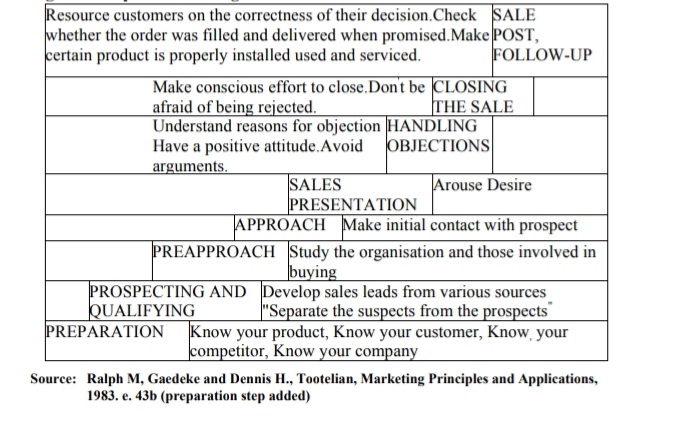
Steps in Selling Process
Step 1 – Preparation
Before starting the selling job, a salesperson should make a valuable investment of time and resources to know the products he will be selling, know the customers (i.e. customer types, buying motives and buying process) to whom he will be selling; know the competitors against whom he will be selling, and finally know the philosophy, policies and range of products of his company, In short, he should be well equipped with the fundamentals of selling.
Step 2 – Prospecting
This step of the selling process deals with locating and preparing a list of prospective customers. Prospects can be located through
• Identifying the potential of buying more in the existing customers
• Recommendations of existing customers,
• Winning back lost customers,
• Attracting competitor’s customers,
• Customers’ information request from advertisement,
• Newspaper announcements,
• Public records,
• Directories like telephone, trade association etc.,
• Other salesmen,
• References from friends, neighbours and business associates,
• Cold canvassing, that is, going from door-to-door.
The located prospects should first he qualified broadly in terms of
• Whether they want the product and how intense their want is,
• Whether they have the adequate purchasing power, and
• Whether and who possesses the power or authorisation to purchase and spend the required money.
The qualifying of prospects is the process of separating the prospects from the suspects.
It is worth-mentioning here that the ability to prospect is the most essential ability of a successful salesperson. A good salesperson keeps examining, weeding out the already tapped prospects and updating his lists of prospects, and remains in constant search of new prospects.
Step 3 – Preapproach
The qualifying process of separating prospects from suspects further requires that the salesperson should possess detailed information relating to the prospects in terms of existing products consumed, their scale of operation, product range, their buying size, frequency, budget and the process, etc. In short, obtain customer orientation. The sources of information for the purpose include company annual reports, other salespersons, other suppliers to the prospects, census of manufacturers, professional journals, newspapers and market intelligence, The availability of the above information in as detailed a manner as possible will help the salesperson in ranking the prospect in terms of their priority to the company. Good salespersons use the above information in classifying the prospects in A, B and C categories in terms of the immediacy of the attention to be given to them.
Step 4 – Approach
`First impression counts’. As such, this step needs to be carefully planned. This step has two distinct parts. One, of meeting the customer with a positive set of mind, and the second, is make an impact on him. For the former, referrals of reliable persons known to prospects, canine after fixing an appointment, use of door openers, help. For the latter the salesperson should equip himself with the key benefit to be emphasised, samples or new literature to be handed over, etc.
Step 5 – Sales Presentation
Through advance information relating to the prospect every effort should be made to match the product offered to the needs/problems faced by the customer. The sales presentation should generally go according to the AIDA-attention, interest, desire, and action approach. How can this be done? Use of key benefit or a problem solver, or a unique act of the salesperson results in gaining attention. When used attentively this part also provides opportunity to get the main point of the initial statements made by the prospect.
Step 6 – Handling Objections
It is in the last phase of the sates presentation step that the prospects start expressing doubts, or raising objections whether relating to price, need for more time to think, satisfied with the existing product/supplier or product quality claims.
These doubts or objections should be welcome and they should be answered with confidence. There is certainly no doubt that the prospect has to be thoroughly, convinced that the product would satisfy his need. The ability of the salesperson of mind reading of the prospects, enables him to anticipate the prospect’s objections and reactions.
Step 7 – Closing the Sale
Closing is that aspect of the selling process in which the salesperson asks the prospect to buy the product. There is a critical point during each presentation when the salesperson should ask for the order. Pending the location of the critical point, as the objections are being met, the salesperson should help reduce the choice of options, summarise the benefits of buying, and the consequences of not buying, and if need be, make use of the big idea appeal of buying `now’ at that moment.
The salesperson should have the ability of catching the buying signals given by the prospect and should act on them fast. Some such signals are changing the sitting/standing position and moving closer to the product; reading the instructions on the product; perusing the testimonials; showing hesitation in being able to afford; asking for another demonstration, if applicable; checking the warranty or asking questions relating to warranty terms. These signals, show that the time is ripe to start taking the order.
Step 8 – Post-sale Follow-up
The selling process does not come to an end by writing the order. A few repetitions reassuring the benefits of the product keep the customer sold.
Follow-up provides an opportunity to ensure that the product is being rightly used, and if necessary to re-explain the method of using, handling, and storing of the product when not in use. This builds favourable feelings and nurtures strong buyer-seller relationships. Post-sale follow-up not only reinforces the customer’s confidence in the salesperson and his company but also tends to keep competition out. This also helps generate repeat business and valuable word-of-mouth publicity. The follow-up is a good source of feed back too.
Q.8. What is Sales Forecast? Discuss the various methods used for preparing the sales forecast of hospitality organisation. (20)
Sales Forecast
A sales forecast predicts the value of sales over a period of time. It becomes the basis of marketing mix and sales planning.
1. Short term Sales Forecast
A short-term sales forecast (say for a period of one year) when linked to the sales budget helps in the preparation of an overall budget for the firm as a whole. The short-term sales forecast in effect also provides the essential financial dimension to sales in terms of expected sales revenue and expenses required. Also, it helps in assessing the cash inflow and outflow needs and their sources.
2. Long term Sales Forecast
A long-term sales forecast (say for a period of 5 years or so) on the other hand, focuses on capital budgeting needs and process of the firm. It provides for changing the marketing strategy of the firm, if needed, and includes reference to emerging product market needs, new market segments to be catered, review of distribution network and promotional programmes, organisation of salesforce, and marketing set up. The long-term sales forecast triggers the task of aligning the production, procurement, financial and other functional needs of the firm with the finalised sales forecast.
The Preparation of Sales Forecast
The preparation of a sales forecast requires
• The availability of historical information on the product and industry sales
• Identification of product sales determinants
• Prediction regarding the behaviour of market forces for the period under forecast
• Use of appropriate techniques for forecasting
• Judgement of executives preparing the sales forecast
• The firm’s market share objective
Approaches to Sales Forecast
1. Breakdown Approach
Under this approach, the head of the marketing function initially develops a general economic and market sales potential for a specific period. The firm’s sales potential is then derived from it. The example of a colour television receiver company developing its sales forecast given in the beginning of this unit relates to the use of the breakdown approach.
2. Market Build-up Approach
In this approach the task of sales forecasting begins by first estimating the sales at the product, product lines, customer groups or geographical area level. The estimates of the different product, product lines, customer groups or geographical areas are then aggregated and reviewed in the light of the firm’s objectives, available resources, as well as competitors activities before the sales forecast is finalised. The example of a leading automobile engine manufacturing company given in the beginning of this lesson relates to the use of both a breakdown approach and a market build-up approach.
Methods used for preparing the sales forecast of hospitality organisation
1. Executive Judgement
It is an efficient method of sales forecasting. Based on the past performance, insights gained and intuition of the executive(s), this method of sales forecasting works out fairly well particularly when the market is stable. However, this method generally suffers from difficulty in realistically reflecting changes in the market. Salesforce composite method and jury of executive opinion are the two popular forms of this method of sales forecasting.
2. Surveys
A second way of sales forecasting is by surveying the customers, salesforce, experts, etc. and ascertaining their predictions. Customer surveys can provide information relating to type and quantity of products which customers intend purchasing.
Salesforce surveys can provide estimates of overall territory off-take, company’s share and the share of the major competitors. Dealers survey may also form part of the salesforce survey if a firm so desires. Expert surveys provide sales forecast as the experts and industry consultants look at it. They bring in an outsider’s view to the company’s internal forecast and help many a times by adding new dimensions for consideration of management.
3. Time Series Analysis
Using the historical sales data, this method tries to discover a pattern or patterns in the firm’s sales volume over time. The identification of the patterns helps in sales forecasting.
Time series analysis helps locate the trend, seasonal, cyclical and random factor changes associated with the past sales data. In this way, it improves the prediction from the past sales data. Experience reveals that time series analysis for sales forecasting are quite accurate for short and medium term forecasts and more so when demand is stable or follows the past behaviour.
Some of the popular techniques of time series analysis are: moving averages, exponential smoothing, time series extrapolation, and Box-Jenkins technique.
4. Correlation and Regression Methods
These methods attempt at examining the relationship between past sales and one or more variables such as population, per capita income or gross national product, etc.
The use of regression analysis is done in order to determine whether any relationship exists between the past sales, and changes in one or more economic, competitive or internal variables to a firm. The accuracy of forecasts made by using correlation and regression methods is generally better than the other methods. Typical forecasting applications of these methods are sales forecasts by product class. Though the correlation method helps in identifying the association between the factors, it does not explain any cause and effect relationship between them.
5. Market Tests
Market tests are basically used for developing one time forecasts particularly relating to new products. A market test provides data about consumers’ actual purchases and responsiveness to the various elements of the marketing mix. On the basis of the response received to a sample market test and providing. for the factor of a typical market characteristic as well as learning from the market test, product sales forecast is prepared.
Substantial fluctuation that one finds in reality from market to market limit the accuracy of sales forecasts made by this method,, unless the market test is designed systematically.
6. Combining Forecasts and Using Judgment
Experience brings out that the forecasts resulting from the use of multiple methods in a combined way greatly surpass most individual methods of sales forecasts. Research also supports the combined use of quantitative and qualitative methods of sales forecasting in a given situation rather than using either of the two. Application of judgment to quantitatively arrived forecasts should be done in a structured manner with a view to adding insights and realism to the forecasts so arrived at, since a forecast is a prediction and needs the subjective perception too.
Q.9. Write a detailed note on cyber marketing and its role in hospitality marketing. Substantiate your answer with suitable examples. (20)
Cyber Marketing
Cyber marketing term became popular when computers started getting used in marketing extensively. Earlier, computers were used more for storing, processing and reporting of various marketing related information. But, with the entry of internet the online data handling possibilities have virtually exploded the use of computer. This application has multiplied the use of computers at consumers homes faster than among the organisations. This fact has helped marketers substantially to look into cyber marketing. As a result, cyber marketing today is also seen more as internet based marketing rather than just computer based marketing.
Cyber marketing profitably reinforces the concepts of marketing with the power of internet. Thus, it strengthens the existing delivery of marketing outputs and also opens newer avenues of marketing which were not possible to achieve before the’ arrival of internet. For example, a marketer today can keep track of millions of customers simultaneously, segment them online, offer customised products to individual customers, fix different prices, provide varying contents and styles of information and deliver the products through appropriate modes of distribution to each of these customers. The details of such transactions and the characteristics of each of these customers can be stored for their dynamic utilisation in future marketing opportunities with the customers. These possibilities were only the dreams of earlier marketers.
Role of Cyber Marketing in Hospitality Industry
Cyber Marketing is also known as Internet marketing, web marketing, online marketing, E- Marketing or digital marketing. It is growing at a dramatic pace in the hospitality industry and is significantly impacting the business behaviors since it drives more revenue than traditional marketing.
1. Search Engine Marketing (SEM)
The large majority of Internet surfers use search engines to find information about hotels or travel destinations online. This makes search engines one of the most effective tools in driving targeted traffic to a hotel’s or destination’s website. In the hospitality sector, hoteliers have two options with regard to SEM:
• Search Engine Optimization (SEO)
SEO attempt to improve a website’s organic (i.e. non-sponsored) search rankings in Search Engine Results Pages (SERPs) by increasing the content’s relevance to search terms.
• Sponsored search
Sponsored search corresponds to search ads that allow a hotel /chain to be included in the sponsored results of a search for selected keywords. This action is generally undertaken through a bidding process on keywords. The Search Engines provide the mechanism for the sponsored search process to occur. This process is continually evolving and gaining complexity year on year.
2. Social Media marketing
Social Media websites such as Facebook, Twitter, YouTube,… possess the advantage that they can spread any information or update posted rapidly to a very wide audience. Furthermore, sharable videos (i.e. choosing an engaging storyline and telling it with compelling visuals) constitute an amazing tool that keeps users’ attention and subtly persuade them along the way words can’t.
3. Mobile Advertising
Mobile advertising is growing rapidly since mobile devices have multiplied, connectivity speeds have improved and screen resolutions have advanced. For these reasons, the online experience should be seamless across devices.
4. Email advertising
Email advertising, also known as email marketing, is considered as a powerful e-marketing tool for hoteliers since it creates direct revenue opportunities for past, present and future guests. However, as emails and/or e-newsletters might be unsolicited, senders should either offer recipients an opt-out option or get their prior consent (opt-in). In fact, experience shows that permission-based email marketing is one of the most cost-effective and efficient marketing tools available.
5. Display advertising
Display advertising conveys its advertising message visually using text, logos, animations, videos, photographs or other graphics.
Q.10. Write short note on any two of the following: (10×2=20)
a. Promotion Mix
In our daily life we all are exposed to various tools of promotion aiming at communicating one thing or the other to us. To illustrate, while at home welcome across advertisements when reading a newspaper, watching TV, listening to radio or even examining the water, electricity or telephone, bills. On our way to the office similar communications face us on bus panels, roadside hoardings, neon sighs, posters and banners etc. And, while at a retail shop these take the shape of traffic builders, product displays, streamers, hangers, bins etc.,all sharing information relating to a specific product of a company.
Listed above are just a few types of the various promotion tools available to a marketer. Before proceeding further, let us take a look at the definitions of the four major methods of promotion. These are: advertising, personal selling, sales promotion and publicity. The committee on Definitions of the American Marketing
Association defined these components as under:
• Advertising
Any paid form of non-personal presentation and promotion of ideas, goods, or services by an identified sponsor. It includes the use of such media as magazines, newspapers, outdoor posters, direct mail novelties, radio, television, bus posters, catalogues, directories, programmes and circulars.
• Personal selling
Oral presentation in a conversation with one or more prospective purchasers for the purpose of making sales.
• Sales promotion
Those marketing activities–other than personal selling, advertising, and publicity-that stimulate consumer purchasing and dealer effectiveness such as displays, shows and exhibitions, demonstrations, coupons, contests, and other non-routine selling efforts. These are usually short-term activities.
• Publicity
Non-personal stimulation of demand for a product, service or business unit by generating commercially significant news about it in published media or obtaining favourable presentation of it on radio, television or stage. Unlike advertising, this form of promotion is not paid for by the sponsor.
Packaging, public relations and role of other elements of marketing mix in promotion
Although definitions vary about the number of components that constitute promotion, , marketing practice brings out that almost all marketing activities influence the promotion function. Notably, packaging performs the promotion function in addition to providing protection to the product. By incorporating creativity in its design, a package can add the `pick-me-up’ appeal to the product and also help to communicate its features, uses and benefits more effectively. The promotion aspect of packaging is witnessing a hit of revolution in India now a days with the introduction of innovative, packages in, the field of consumer goods. For example, package design of Pepsi and edibile oils etc.
Public relation, likewise, performs an important role in promotion insofar as it helps to create a favorable image of the firm and allows the public to experience better satisfaction in dealing with the firm.
High and consistent product quality, provision of superior customer service, price promotions as a way of increasing short-term sales and compatibility between the character of distribution outlets and the product are the other ways which contribute to the promotion function of this firm.
Major determinants of the promotion mix
1. Type of product
2. Nature of Market
3. Stage of product in its life-cycle
4. Available budget, and
5. Company policy.
b. Promotion Budget
The promotion budget influences the level of promotional activity as well as the promotion mix used by the firm. Budgeting for promotion is yet another area where a lot of subjectivity prevails regarding what is the right amount to be spent on the promotion function. Pending any clear cut relationship between the promotion expenditure and the achievement of promotion objectives, recourse is made to certain rules of the thumb.
These are:
• Incremental promotional expenditure yields, incremental sales to a certain extent
• a minimum level of promotion activity must be exceeded for promotion to have a meaningful effect. Often such a minimum level of promotion is set by the competitor or more appropriately by an average of the industry
• promotion activities when well integrated with other elements of the marketing mix produce greater than the planned results.
The substance of the findings is that results of the promotion function should be constantly monitored in order to establish more reliable parameters of cost-benefit relationships. Further, cost-benefit analysis should formthe basis of the tradeoff before promotion budget is finalised by using any one of the following methods.
• Percent-of-Sales
This method views promotion budget determination by linking the appropriation to a fixed percentage of sales of the company products. Such sales may relate to the previous year, an average of sales of the previous few years, projected sale of the next year or years or an average of the previous few years sales, as well as the projected sales of the next few years.
This method though simple to use fails to account for the changing promotional costs, and relating the appropriations made to the product-market needs. Particularly difficulties are faced if the sales curve of a company is not smooth, hence resulting in lower outlays for the years that follow the bad sales years. Also the forecasted sales realisations remain uncertain. The ways out attempted have been the adjustment provision of a fixed percentage to the average expenditure of the: past (i.e., last year plus 15%), or use of this method in combination with the others that are discussed below.
• Fixed-sum per unit
Very much like the per cent-of-sales, under this method the promotion budget is determined by allocating a fixed amount of money per physical unit of product for either past of future sales or a combination of the two. The only differentiating point of this method from the per cent-of-sales method is that the base for budgeting, instead of being rupee sales, is the number of product units sold or targeted to be sold. This method, thus, has almost the same strengths and weaknesses as the ones associated with per cent-of-sales method, namely, simplicity in the determination but arbitrariness in arriving at the percentage or per unit allocation.
• Affordable funds
Continuing to think on the plane that promotion expenditure is one of those business costs which are desirable or avoidable as per the convenience of the top management, the funds for promotion are appropriated on discretionary basis under this method. No wonder then, that companies adopting this method find their promotion appropriations fluctuating from year to year depending on the top management’s thinking for the year.
• Competitive parity
Incorporating a measure of competitiveness in planning, this method guides the budget determination in terms of relativity to what the competitors are likely to allocate. Being a slightly more market-oriented method than the ones ‘ discussed so far, when based on the representative average of the industry promotion expenditure, it becomes a good norm to moderate the promotion expenditure of a company.
• Objective and task method
This is one of the most scientific methods of budget determination. It approachesthe budget exercise by first setting the specific objectives to be achieved. It then identifies the tasks involved in achieving the said objectives followed by ascertaining the costs involved in the performance of each task required. The result of the exercise is an estimation of the amount required for accomplishing the set promotion goals. Typical objectives might be to increase awareness say by 15% or increase message/theme recall say by 25%.
Indeed, it a good method as far as promotion budgeting for new products is concerned, or when a new thrust to the image of a company and its products is to be provided.
This method presupposes that objectives set are realistic and promotion results can be measured precisely. These assumptions continue to be the subject of unending debate at the one end, and of pursuit of research on the other: It is as a result of the continuing research that some models for promotion budgeting have been developed and are now being refined to be of practical utility to the marketer.
• The practice
In practice most companies make use of more than one method for determining the promotion budget. The research into the practices of the companies in India in this regard revealed the above finding. Among the individual methods used “affordable funds” method emerged as the most popular. There were, however, quite a few companies which had started using the approach of `objective and task’ in setting their promotion budget either exclusively or in combination with other methods. Most of such companies were dealing in consumer goods.
The practices of the companies using a combination of methods for determining promotion budget pointed to the efforts they were putting in to gather competitive promotion outlays and its apportioning to various promotion components.
c. Marketing Communication
The word `communication’ is based on the Latin word meaning `common’. Thus the term communication has come to mean sharing something of common use.
The Marketing Communication refers to the means adopted by the companies to convey messages about the products and the brands they sell, either directly or indirectly to the customers with the intention to persuade them to purchase.
In other words, the different medium that company adopts to exchange the information about their goods and services to the customers is termed as Marketing Communication.
The marketer uses the tools of marketing communication to create the brand awareness among the potential customers, which means some image of the brand gets created in their minds that help them to make the purchase decision.
In marketing, communication has a very important place. It is that function of marketing which is charged with the task of informing the target customer about the nature and type of the firm’s products and services, their unique benefits, uses and features as well as the price and-place at which those would be available in the market-place. Since marketing communications aim at influencing the consumer behaviour in favour of the firm’s offerings, these are persuasive in nature. These persuasive communications are more commonly called `Promotion’ and constitute one of the Ps of the marketing mix.
A study of marketing communication, therefore, is a study of the promotion function of marketing. Notwithstanding the continuing debate whether promotion is the first element of the marketing mix or the last, the fact remains that sound management of the marketing function is dependant on the effective management of its promotion function. For example, in the success of the following products and services the promotion function played a role of greater importance: Hot-shot camera, Maggie 2-minute noodles, Khaitan fans, and UTI’s ULIP scheme. to mention only a few.
Similarly, the examples of the products which misfired due to faulty management of the promotion function are not far to seek.
With growing competition in the market place as well as the customers becoming better informed and more choosy it is imperative now that marketing communications of the right kind only are made to the right group of target buyers.