
Table of Contents
Q.1. How does social marketing differ from business marketing in terms of objectives, approaches and applicability of the ’four P’s ? Explain with examples. (20)
Social Marketing
Social marketing is the systematic application of marketing, along with other concepts and techniques, to achieve specific behavioural goals for a social good.
Social marketing can be applied to promote merit goods, or to make a society avoid demerit goods and thus to promote society’s well being as a whole.
For example, this may include asking people not to smoke in public areas, asking them to use seat belts, or prompting to make them follow speed limits.
Objectives Of Social Marketing
• In social marketing, the goal is to improve a condition of public health or safety.
• We need to pay attention to a communication objective, identify a target audience, design a compelling message, find support for it and look for success indicators.
• We also need to spend some money, not a lot necessarily, but some.
• In using persuasion and the media to affect social change, those in the public health and prevention fields have entered a new era.
Approaches in Social Marketing
Approaches in Social Marketing includes asking to do specific things to the people for the good social cause. It can be in form any form of advertisement.
The 4 P’s in Social Marketing
1. Product: Think about a tangible object or service you can provide to support or facilitate behaviour change. Can you offer a new product/service or adapt one that already exists? Product examples include in-home blood pressure monitoring kits, improved HIV tests, journals to plan and track food intake, cessation counselling.
2. Price: Consider interventions that would decrease the costs to the individual of taking the desired action (not only monetary cost, but emotional, psychological and time costs). List out the “price” or barriers for your audience segment to carry out the desired behaviour, then brainstorm interventions to diminish those barriers. For example, instituting a walking club program at the workplace for those who cite lack of support and lack of time as barriers to regular exercise.
3. Place: Think about where and when the audience will perform the behavior or access the new or adapted product/service. How can you make it convenient and pleasant (even more so than the competing behavior)? Examples include placing condom vending machines in bar restrooms, offering help lines that are available 24 hours a day, having breastfeeding consultants check-in on new mothers after they leave the hospital. Also think about your “sales force” – the people that will take your program to the audience. Consider the need for peer educators, counselors or others who can make your program or its activities more accessible.
4. Promotion: Use your market research to determine the communication channels and activities that will best reach your audience to promote the benefits of the desired behavior. What advertising or public relations media do they pay attention to (e.g., radio, newspaper, postcard racks)? What special promotional items would they use (e.g., water bottles, refrigerator magnets, notepads)? What special events do/would they attend (concerts, health fairs, conferences)? How can you include influencing audiences? Be sure to promote the Product, Price and Place features that you want the audience to know about.
Business Marketing
Business marketing is a marketing practice of individuals or organizations (including commercial businesses, governments and institutions). It allows them to sell products or services to other companies or organizations that resell them, use them in their products or services or use them to support their works. It is a way to promote business and improve profit too.
Objectives of Business Marketing
In business marketing a company’s marketing objectives for a particular product might include increasing product awareness among targeted consumers, providing information about product features and reducing consumer resistance to buying the product.
Approaches in Business Marketing
In Business Marketing the approaches include direct sales, direct mail (postcards, brochures, letters, fliers), tradeshows, print advertising (magazines, newspapers, coupon books, billboards), referral (also known as word-of-mouth marketing), radio, and television.
The 4 P’s in Business Marketing
The four Ps are the four essential factors involved in marketing a good or service to the public.
These are the four Ps: the product (the good or service); the price (what the consumer pays); the place (the location where a product is marketed); and promotion (the advertising). The concept of the four Ps has been around since the 1950s; as the marketing industry has evolved, the concepts of people, process, and physical evidence have become important components of marketing a product, too.
1. Product
Product refers to a good or service that a company offers to customers. Ideally, a product should fulfill an existing consumer demand. Or a product may be so compelling that consumers believe they need to have it and it creates a new demand. To be successful, marketers need to understand the life cycle of a product, and business executives need to have a plan for dealing with products at every stage of their life cycle. The type of product also partially dictates how much businesses can charge for it, where they should place it, and how they should promote it in the marketplace.
2. Price
Price is the cost consumers pay for a product. Marketers must link the price to the product’s real and perceived value, but they also must consider supply costs, seasonal discounts, and competitors’ prices. In some cases, business executives may raise the price to give the product the appearance of being a luxury. Alternatively, they may lower the price so more consumers can try the product.
3. Place
When a company makes decisions regarding place, they are trying to determine where they should sell a product and how to deliver the product to the market. The goal of business executives is always to get their products in front of the consumers that are the most likely to buy them.
4. Promotion
Promotion includes advertising, public relations, and promotional strategy. The goal of promoting a product is to reveal to consumers why they need it and why they should pay a certain price for it.
Q.2. Write short notes on any two of the following: (10×2=20)
a. Marketing Mix
Marketing is performed within a certain environment which itself is always changing. The marketing activities have, therefore, to change in consonance with environment to be continuously effective. In order to appreciate this process it is easier to divide the marketing activities into four basic elements, which are together referred to as the marketing mix. These four basic elements are:
1. Product
2. Price
3. Promotion, and
4. Place (or physical distribution).
As all these four start with the letter `P’ they are, at times, referred to as the four Ps of the marketing mix or the 4Ps in marketing.
The word product stands for the goods or services offered by the organisation: Once the needs are identified, it is necessary to plan the product and after that keep on analysing whether the product still satisfies the needs which were originally planned for, and if not, to determine the necessary changes.
Price refers to the money value that the customer has to pay. The product has to be adequately priced. This involves considerations of the profit margin, the cost, the possibility of sales at different prices and the concept of the right price.
Promotion is the aspect of selling and advertising, or communicating the benefits of the product or service, to the target customers or the market segment involved in order to persuade them to purchase such products or services. It includes selling through advertising as well as the sales force. Besides, a certain amount of promotion is done through special seasonal discounts, competitions, special price reductions, etc. collectively called sales promotion.
Finally, physical distribution refers to the aspect of the channels of distribution through which the product has to move before it reaches the consumer. It also includes the logistics aspects of distribution such as warehousing, transportation, etc. needed for geographical distribution of the products.
It is also concerned with the selection of distribution channels. The organisation must decide whether it should sell through wholesalers (who buy in large quantities and sell to retailers) and then to retailers (i.e., the shopkeepers, who ultimately sell to consumers), or whether directly to the consumers. There are many ways in which a product can be moved from the producer to the consumer. The optimum method has to be determined in terms of both consumer satisfaction and profitability to the organisation, or optimum use of the organisation’s resources.
b. Market Segmentation
Market segmentation is a marketing term that refers to aggregating prospective buyers into groups or segments with common needs and who respond similarly to a marketing action. Market segmentation enables companies to target different categories of consumers who perceive the full value of certain products and services differently from one another.
Companies can generally use three criteria to identify different market segments:
a. Homogeneity, or common needs within a segment
b. Distinction, or being unique from other groups
c. Reaction, or a similar response to the market
For example, an athletic footwear company might have market segments for basketball players and long-distance runners. As distinct groups, basketball players and long-distance runners respond to very different advertisements.
Market segmentation is an extension of market research that seeks to identify targeted groups of consumers to tailor products and branding in a way that is attractive to the group. The objective of market segmentation is to minimize risk by determining which products have the best chances for gaining a share of a target market and determining the best way to deliver the products to the market. This allows the company to increase its overall efficiency by focusing limited resources on efforts that produce the best return on investment (ROI).
Companies can segment markets in several ways
1. Geographically
Customers can be divided into different segments on such geographic units such as nations, states, regions, cities etc. Their preferences may vary because of their geographic differences.
2. Demographically
Customers are divided into different segments based on age, gender, income, family, educational level, occupation, life cycle, etc.
3. Psychographically
Customers are divided into different segments based on their social class, lifestyle, and personality characteristics.
4. Behaviorally
Customers are also divided on the basis of their knowledge, attitude, use, or response to a product or service.
Objectives of Market Segmentation
The objective is to enable the company to differentiate its products or message according to the common dimensions of the market segment.
Market segmentation allows a company to increase its overall efficiency by focusing limited resources on efforts that produce the best return on investment (ROI).
c. Physical Evidence
Cleanliness in doctor’s clinic, exterior appearance and interior decor of restaurant, the comfort of the seating arrangement in a cinema hall, adequate facility for personal needs at the airport all contribute towards the image of the service (organisation) as perceived by the customer. The common element in these is that they are all physical, tangible and controllable aspects of a service organisation. They constitute the physical evidence of the service.
There may be two kinds of physical evidence:
1. Peripheral evidence; and
2. Essential evidence,
Peripheral evidence is actually possessed as a part of the purchase of service but by itself is of no value. Airline ticket, cheque book, receipt for a confirmed reservation in a hotel are examples of peripheral evidence. A cheque book is of value only if you have money in the bank-without that it is of no significance.
Peripheral evidence adds on’ to the – value of essential evidence. In a hotel you may find matchbox, writing pad, pen, complimentary flowers and drinks, which you may take away. These are representations of peripheral evidence. Such evidence must be designed keeping in mind the overall image which the organisation wishes to project and the reminder value of the evidence in its ability to remind the customer about the organisation.
Whereas peripheral evidence is possessed and taken away by the customer the essential evidence cannot be possessed by the customer; the building, its size and design, interior Layout and decor, logo and mnemonic device of the organisations are constituents of the essential evidence. The essential evidence is a very critical input in determining the atmosphere and environment of the service organisation. Contrast the essential evidence of a Five-star hotel (its long driveway, grand entrance manned by a liveried doorman, sophisticated decor of lobby) with that of a fast food outlet (with bright colours, loud music, bright lights) and judge the kind of rich and formal atmosphere of the former with the relaxed and casual atmosphere of the latter.
Physical evidence can be used to build a strong association in the customers’ minds and also to differentiate your service from the competition.
Q.3. How are product life cycle and marketing inter-related ? Explain with the help of examples from hospitality industry. (20)
Product Life Cycle
1. The Introduction Stage
In the introductory stage, there is likely to be no profits or more likely a loss. This loss may continue for some time depending on the market factors. At this stage, considerable amount of funds are being devoted to promotional expenses with a view to generate sales while the volume of the sales is low. Thus in the beginning, there is likely to be a loss and later on, as the sales grow, the profit might accrue.
2. The Growth Stage
In case the product launched is successful, the sales must start picking up or rise more rapidly. The next stage is then reached which is known as the `growth stage’. Here the sales would climb up fast and profit picture will also improve considerably. This is because the cost of distribution and promotion is now spread over a larger volume of sales. As the volume of production is increased, the manufacturing cost per unit tends to decline. Thus, from the point of view of product strategy, this is a very critical stage.
3. The Maturity Stage
It is too optimistic to think that sales will keep shooting up. At this stage, it is more likely that the competitors become more active. In case your product is a novel one, by now competition would have come out with a similar product in the market to compete with yours. Therefore, the sales are likely to be pushed downwards by the competitors while your promotional efforts would have to be increased to try and sustain the sales. Thus the sales reach a plateau. This is called the `maturity stage’ or `saturation’. At this point it is difficult to push sales up. With regard to the `profit’ picture, the profits are likely to stabilise or start declining as more promotional effort has to be made now in order to meet competition. Unless of course, you have the largest market share with your product and it needs no extra push in the market.
4. The Decline or Obsolescence Stage
Thereafter the sales are likely to decline and the product could reach the `obsolescence’ stage. Steps should be taken to prevent this obsolescence and avoid the decline. This decline that generally follows could be due to several reasons such as consumer changes and tastes, improvement in technology and introduction of better substitutes. This is the stage where the profits drop rapidly and ultimately the last stage emerges. Retaining such a profit after this stage may be risky, and certainly not profitable to the organisation.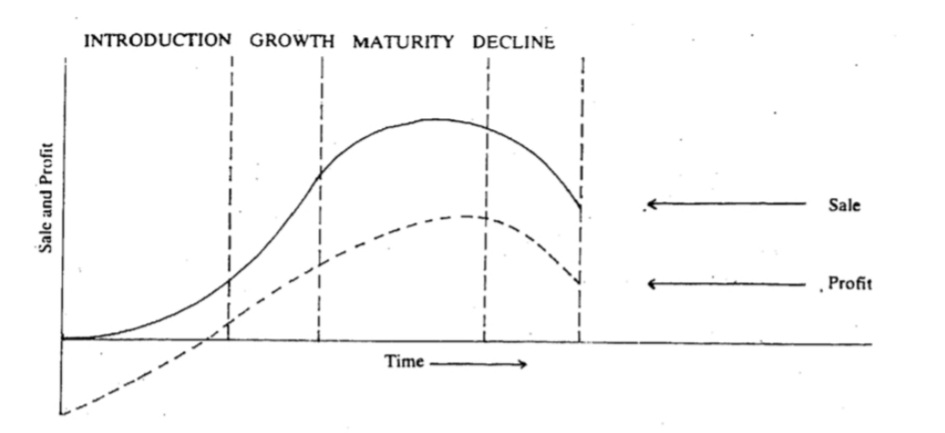
The product life cycle
Marketing Mix at each stage
At the introductory stage, we have to increase and thus spend a lot on physical distribution and promotion. This is because we have to create, an awareness and acceptance of our product. We must also increase its availability. Very often in India, it is noticed that a product is advertised but is not available at the distribution outlets.
This is a waste of promotional expenses. We must make optimum use of the available resources of the organisation. Thus distribution should be arranged before the product is launched.
In any case, in these two areas substantial amounts would have to be spent. We have to also counter the reluctance of customers to change their established patterns and make them purchase our product, particularly if it is of a novel nature. As against this, if it is a novel one, people may even buy it out of sheer `curiosity’.
Next in the growth stage when the sales shoot up and we are satisfied with the profit generated by the product, competitors will now enter the market and perhaps offer new product features. Therefore, we may have to think of improving our product so that we do not reach the ultimate `decline’ stage too quickly. The promotional expenditure is maintained at the same level or is raised slightly in order to meet competition.
Next stage is called the maturity stage. This stage generally lasts longer than the other stages and poses problems for the management in maintaining the sales level. Actually, there is a slow down in the growth rate of the sales in case of such matured products. The decline can be arrested by improvements in the product and promotion. We should, however, at this time seriously think in terms of a new product, mix, that is, the elimination or redesign of the current product within the near future.
Finally, the decline stage catches up. The decline’ may be slow or rapid. It may be due to better substitute products, better competition, technological advances with which we have not kept up and several other reasons. Such a product now proves expensive for the organisation. One must, therefore, be willing to consider the elimination of such marginal or unprofitable products. Eventually, the last weapon is to reduce the price.
This is dangerous because this is a very time when extra promotional effort is required to be put in to prop up the product’s sales. Reducing the price may soon land the company in a loss situation.
Q.4. Define marketing research. Discuss the scope of marketing research with suitable examples. (20)
Marketing Research
The American Marketing Association defines marketing research as ” the systematic gathering, recording and analysing of data about problems related to the marketing of goods and services”. Crisp has defined marketing research as “…the systematic, objective and exhaustive search for and study of the facts relevant to any problem in the field of marketing”.
Market research is an organized effort to gather information about target markets and customers: know about them, starting with who they are. It is a very important component of business strategy and a major factor in maintaining competitiveness. Market research helps to identify and analyze the needs of the market, the market size and the competition. Its techniques encompass both qualitative techniques such as focus groups, in-depth interviews, and ethnography, as well as quantitative techniques such as customer surveys, and analysis of secondary data.
It includes social and opinion research, and is the systematic gathering and interpretation of information about individuals or organizations using statistical and analytical methods and techniques of the applied social sciences to gain insight or support decision making.
Scope of Marketing Research
Marketing research (MR) is concerned with all aspects of marketing, relating to product design and development, product-mix, pricing, packaging, branding, sales, distribution, competition, target customer segments and their buying behaviour, advertising and its impact. Specifically, the scope of MR includes customers, products, distribution, advertising, competitive information and macro-level phenomenon.
1. Marketing is concerned with identifying and fulfilling customer needs and wants
Thus, MR should precede marketing. The unfulfilled wants should first be identified and translated into technically and economically feasible product ideas, which then should be marketed to the customers. But mere identification of customer wants is not enough. Marketing requires continuous effort to improve the existing product, increase sales and beat the competition. For this it is important to know who the customers are for your products (whether housewives, teenagers, children), what their socio-economic profile is (in terms of income, education, cultural, religious and professional background) and where they are concentrated in terms of location. Besides this information, it is also important for you to know the process by which a prospective customer arrives at a decision to buy your product. If you know the sequential steps in the purchase process and the influencing variables in each, you can design appropriate strategies to exert a positive impact on them, and thus ensure an actual purchase. The study of consumers and their purchase behaviour is so important that there is a separate, special body of knowledge known as Consumer Behaviour.
2. The second area which is of direct concern for MR is product and product design
MR is helpful in determining the final design of the product and its physical attributes of colour, size, shape, packaging, and brand name. It is useful in arriving at the right combination of product mix, the number of variations of the basic product, accessories and attachments. It can also help decide the quantities to be produced according to the projected demand estimates. MR can also be used to gauge customer reactions to different prices.
3. Marketing research helps in discovering what types of distribution channels and retail outlets are most profitable for your product
On the basis of comparative information for different channels and different types of outlets you can choose the combination most suitable for your product. Distributor, stockist, wholesaler, retailer may represent one kind of distribution channel in contrast to another in which you may use only the distributor and retailer.
Example:
A firm is marketing refrigerators through distributors and retailers in the Eastern zone. The understanding between the firm and distributors is that the latter will provide the after-sales-service. Analysing the sales figures, the firm finds that the sales level in East zone is much lower than in the other zones. Marketing research reveals that one of the reasons for this low sales performance is the poor after sales service provided by the distributor. In a high value, durable product such as refrigerator the quality of after sales service is an important factor influencing the customers’ purchase decision regarding the specific brand to buy. The firm decides to do away with the distributor and instead opens its own branch office. The new distribution channel comprising branch office and retailers is operationally more expensive, but the company can now control the quality of after sales service as well as the other marketing inputs. The result is improved sales and the incremental cost associated with the new distribution network is justified.
4. Most companies provide advertising support for their products
In some cases the amount spent on advertising may be small, while in others it may run into crores of rupees. Irrespective of the actual amount spent on advertising, each firm would like to maximise the return on every rupee that it spends. Marketing research can help the firm to do this. Research can provide information on the most cost-effective media help determine the advertising budget, measure the effectiveness of specific advertisements; advertising campaigns and the entire advertising strategy. Research also provides information on the size and type of audiences for different advertising media channels. This information can be used to refine the advertising strategy to make it more relevant and sharply focused. Advertising research is also useful in determining customer perceptions about the image of specific branches and companies.
5. Marketing research is being increasingly used at the macro-level
Government spends colossal amounts on various socio-economic development schemes and projects. If the objectives of these projects are not in tune with the prevailing consumer tastes, attitudes and values, the entire amount may prove to be a total waste. Just as a business organisation needs MR to monitor the efficacy of its strategy in achieving the objectives, so does the government, and its departments.
Recently Doordarshan conducted audience research for determining the most popular and unpopular programmes and the consumer preference for changes in programme content and timings. For conducting this research, Doordarshan inserted a detailed questionnaire in the leading national newspapers and invited viewers to fill it in and send it back to them. On the basis of this information, Doordarshan plans to revamp its programmes and timing schedules to cater to the large majority of viewers.
Q.5. What are the different levels of consumer decision-making? Explain the process of consumer decision making. (20)
Levels of consumer decision
As a buyer or consumer you are all the time making decisions such as what product to buy (a book or a shirt as a birthday present for your friend), Which brand (Lux, Liril, Hamam, Rexona or OK toilet soap) from where (Super Bazar, nearby corner shop, chemist), etc. Table presents a summary of the different levels of purchase related decisions most commonly encountered by consumers. The table highlights the broad range of choices the consumers have to select from when making a decision, starting from the generic product category level to the brand level and retail outlet level.

Level of consumer decision
1. Routinised response behaviour (RRB)
This occurs when the consumer already has some experience of buying and using the product. He is familiar with the various brands available and the attributes of each and has a well established criteria for selecting his own brand. Consumers do not give much thought or time when buying such products and already have a preferred brand. The degree of involvement in buying such products is low. Frequently purchased and low cost products such as razor blades, coffee powder, toothpaste, soap, soft drinks, etc. fall in this category.
2. Limited Problem Solving (LPS)
In this type of buying behaviour, the consumer is familiar with the product and the various brands available, but has no established brand preference. The consumer would like to gather additional information about the brands to arrive at his brand decision. For instance a housewife buys refined vegetable oil for her cooking. She is familiar with the concept of vegetable oil (as opposed to say vanaspati and ghee) and also knows that Postman, Dalda and Ruby are some of the prominent brands available. But to establish her choice of brand, she would like to check with her friends and regular shopkeeper about the attributes of each.
3. Extensive Problem Solving (EPS)
Extensive problem solving occurs when the consumer is encountering a new product category. He needs information on both the product category as well as the various brands available in it. This kind of decision is by far the most complex.
Process of Decision Making
The most basic and important requirement for the marketer is to understand how consumers make choices. Ajzen and Fishbein have attempted to explain human choice behaviour in their theory of reasoned action which states that:
“Generally speaking-human beings are usually quite rational and make systematic use of information available to them. People consider the implications of their actions before they decide to engage or not to engage in a given behaviour.”
Thus, making a decision is a rational and conscious process in which the consumer evaluates each of the available alternatives to select the best amongst them. Each decision you make involves an elaborate mental thought process, a degree of active reasoning, though on the surface it may not always seem to be so. This may be because over a period of time you have taken certain decisions so many times that they now seem to be made almost automatically but that is not true at all.
There are three factors which influence the degree of active reasoning that is undertaken by the consumer in his process of decision-making.
These are:
1. Involvement
When a product is perceived to be of great personal importance to the customer, such as personal clothing, or its purchase involves a great deal of money or risk such as jewellery, car, house, company shares, the level of involvement in making the decision is likely to be very high. The consumer is likely to spend a great deal of time before arriving at the final decision. In contrast, when buying items which do not reflect much on the consumer’s personality or their purchase involves small amounts of money .or the risk associated with them is not high, the degree of involvement of the consumer is likely to be low. Products such as shoes, polish, toilet soap, toothpaste, biscuits etc. would fall in this category.
2. Differentiation
When the consumer perceives that the various alternatives which are available are very different from one another in terms of their features and benefits offered, he is likely to spend more time in gathering information about and evaluating these different features. On the other hand, in case of products which are not very different from one another either in terms of their features or benefits offered, the consumer is bound to perceive them as being almost the same and buy the first available product/brand which satisfies his minimum expectation. He will not like to spend much time in evaluating the various alternatives. The various brands of washing powder available in the market today are an excellent example of low level of differentiation with the consumer perceiving the different brands to be offering almost identical benefits. All the brands, such as Nirma, Vimal, Vijay, etc. look similar with identical packing and carry almost the same price tag.
3. Time Pressure
When you are under pressure to make a decision quickly, you cannot afford to spend a long time finding out about the various products or brands. We would probably buy whatever is readily available. While traveling in your car to a hill station your car tyre bursts and you need to buy a new one. At that time you would buy the brand that is available at whatever price without giving it too much thought. But under a different situation, when you need to buy new tyres, you would certainly like to find the features of nylon and radial tyres and evaluate various brands e.g. Modi, MRF, Dunlop and Apollo etc. on their individual advantages and disadvantages.
Q.6. Write a detailed note on marketing communication. Explain with the help of examples. (20)
Marketing Communication
The word `communication’ is based on the Latin word meaning `common’. Thus the term communication has come to mean sharing something of common use.
The Marketing Communication refers to the means adopted by the companies to convey messages about the products and the brands they sell, either directly or indirectly to the customers with the intention to persuade them to purchase.
In other words, the different medium that company adopts to exchange the information about their goods and services to the customers is termed as Marketing Communication.
The marketer uses the tools of marketing communication to create the brand awareness among the potential customers, which means some image of the brand gets created in their minds that help them to make the purchase decision.
In marketing, communication has a very important place. It is that function of marketing which is charged with the task of informing the target customer about the nature and type of the firm’s products and services, their unique benefits, uses and features as well as the price and-place at which those would be available in the market-place. Since marketing communications aim at influencing the consumer behaviour in favour of the firm’s offerings, these are persuasive in nature. These persuasive communications are more commonly called `Promotion’ and constitute one of the Ps of the marketing mix.
A study of marketing communication, therefore, is a study of the promotion function of marketing. Notwithstanding the continuing debate whether promotion is the first element of the marketing mix or the last, the fact remains that sound management of the marketing function is dependant on the effective management of its promotion function. For example, in the success of the following products and services the promotion function played a role of greater importance: Hot-shot camera, Maggie 2-minute noodles, Khaitan fans, and UTI’s ULIP scheme. to mention only a few.
Similarly, the examples of the products which misfired due to faulty management of the promotion function are not far to seek.
With growing competition in the market place as well as the customers becoming better informed and more choosy it is imperative now that marketing communications of the right kind only are made to the right group of target buyers.
Process of communication
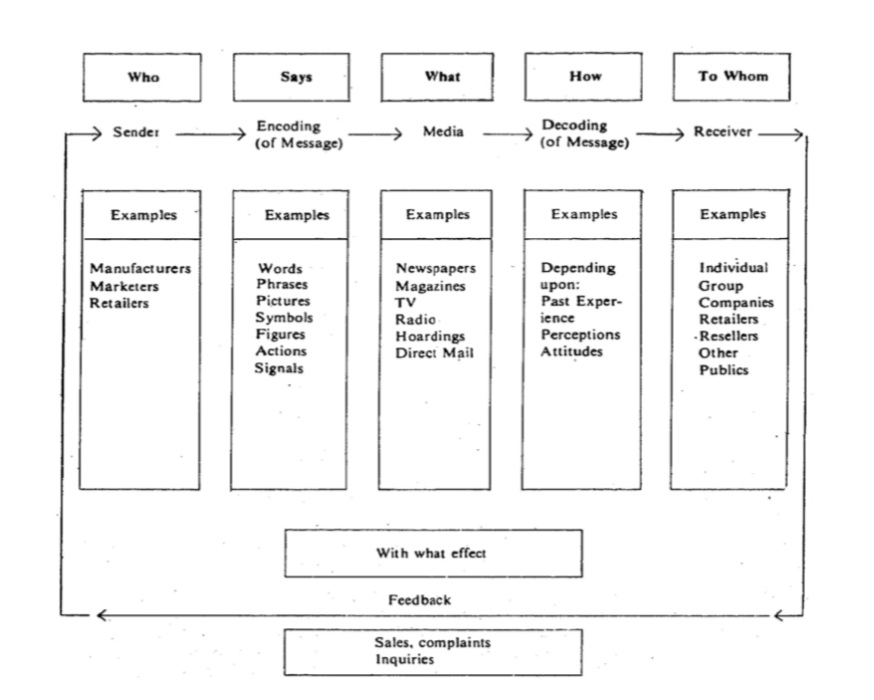
Elements of communication process
Communication will be complete only when the receiver understands in the same sense what the sender wished to convey. The effectiveness of the communication process, therefore, is dependent upon the level of congruity and compatibility obtaining among the various elements of the communication process, i.e., between the sender and the message, the message and the media, the media and the receiver, and so on. Incongruity and/or incompatibility between the various elements of the communication process might make the promotion function, and in turn the marketing function, ineffective as is reported to have happened in the following two cases for example:.
1. It is said that peanut butter, launched more than a decade ago in India failed to take off primarily due to its manufacturer’s inability to get the concept of peanut butter perceived distinctively from that of the pasteurised butter.
2. Not much different was the fate of an advertising campaign of a leading US detergent marketer who while extending the campaign to the vernacular press of the middle east erred in not reversing the direction of the visuals used, to make these compatible with the right to left reading characteristic of the media. Consequently, what the readers saw was white and bright clothes when washed in the company’s brand of detergent came out dirty and soiled, thus going totally contrary to what the advertiser desired.
Q.7. What are the factors that influence the price of a product ? Explain with the help of suitable examples. (20)
The pricing decisions for a product are affected by internal and external factors.
A. Internal Factors
1. Cost
While fixing the prices of a product, the firm should consider the cost involved in producing the product. This cost includes both the variable and fixed costs. Thus, while fixing the prices, the firm must be able to recover both the variable and fixed costs.
2. The predetermined objectives
While fixing the prices of the product, the marketer should consider the objectives of the firm. For instance, if the objective of a firm is to increase return on investment, then it may charge a higher price, and if the objective is to capture a large market share, then it may charge a lower price.
3. Image of the firm
The price of the product may also be determined on the basis of the image of the firm in the market. For instance, HUL and Procter & Gamble can demand a higher price for their brands, as they enjoy goodwill in the market.
4. Product life cycle
The stage at which the product is in its product life cycle also affects its price. For instance, during the introductory stage the firm may charge lower price to attract the customers, and during the growth stage, a firm may increase the price.
5. Credit period offered
The pricing of the product is also affected by the credit period offered by the company. Longer the credit period, higher may be the price, and shorter the credit period, lower may be the price of the product.
6. Promotional activity
The promotional activity undertaken by the firm also determines the price. If the firm incurs heavy advertising and sales promotion costs, then the pricing of the product shall be kept high in order to recover the cost.
B. External Factors
1. Competition
While fixing the price of the product, the firm needs to study the degree of competition in the market. If there is high competition, the prices may be kept low to effectively face the competition, and if competition is low, the prices may be kept high.
2. Consumers
The marketer should consider various consumer factors while fixing the prices. The consumer factors that must be considered includes the price sensitivity of the buyer, purchasing power, and so on.
3. Government control
Government rules and regulation must be considered while fixing the prices. In certain products, government may announce administered prices, and therefore the marketer has to consider such regulation while fixing the prices.
4. Economic conditions
The marketer may also have to consider the economic condition prevailing in the market while fixing the prices. At the time of recession, the consumer may have less money to spend, so the marketer may reduce the prices in order to influence the buying decision of the consumers.
5. Channel intermediaries
The marketer must consider a number of channel intermediaries and their expectations. The longer the chain of intermediaries, the higher would be the prices of the goods.
Q.8. What is the role of advertising ? Explain the different kinds of advertising objectives. (20)
Role of Advertising
Advertising is an impersonal mass selling and communication method. It makes use of various types of media to reach the target public in a short-time. Being persuasive in nature, advertising broadly aims at gaining exposure, creating awareness, changing attitudes of target customers in favour of sponsor’s products and services, and also at effecting sales and improving corporate image. Besides, it can also act as a good offensive/defensive tool in managing competition.
In the pursuit of its purpose, the economic and social effects of advertising have become the subjects of continuing debate. A quick flavour of the arguments put forward on both the sides can be had from figure. The figure presents two viewpoints, one considering advertising as an information disseminating utility function and the other viewing advertising as a source of market power.
On balance, advertising has carved an indispensable place for itself in the marketing mix of a firm. Philip Kotler very aptly refers to the following situations where advertising is likely to make greater contribution. The situations are:
• When buyer awareness is minimal
• When industry sales are rising rather than remaining stable or declining
• When the product has features normally not observable to the buyer
• When the opportunities for product differentiation are strong
• When primary instead of secondary motives can be tapped.
Are, there some limitations to the role of advertising? The answer obviously is in the. affirmative. Advertising, in the words of Richard H. Stansfield, cannot do the following:
• Sell a bad product twice
• Sell an overpriced or otherwise non-competitive product
• Sell ,a poorly distributed product
• Sell a seasonal product out of season (significantly)
• Sell products to persons having no use for them
• Work overnight
• Do the selling job alone.
The usefulness of advertising, which as for long been accused as a capitalist tool and a bane of market economy, is now being realised by planned and communist economies too. While Yugoslavia, USSR, Poland and Hungary shed their hostility to advertising quite a few years ago, China is welcoming advertisement propelled marketing now, China will be hosting the Third World Advertising Congress in Beijing during June 1987. The Economic Times in its marketing and advertising column reported that China’s advertising expenditure in 1985 was around $ 200 million.
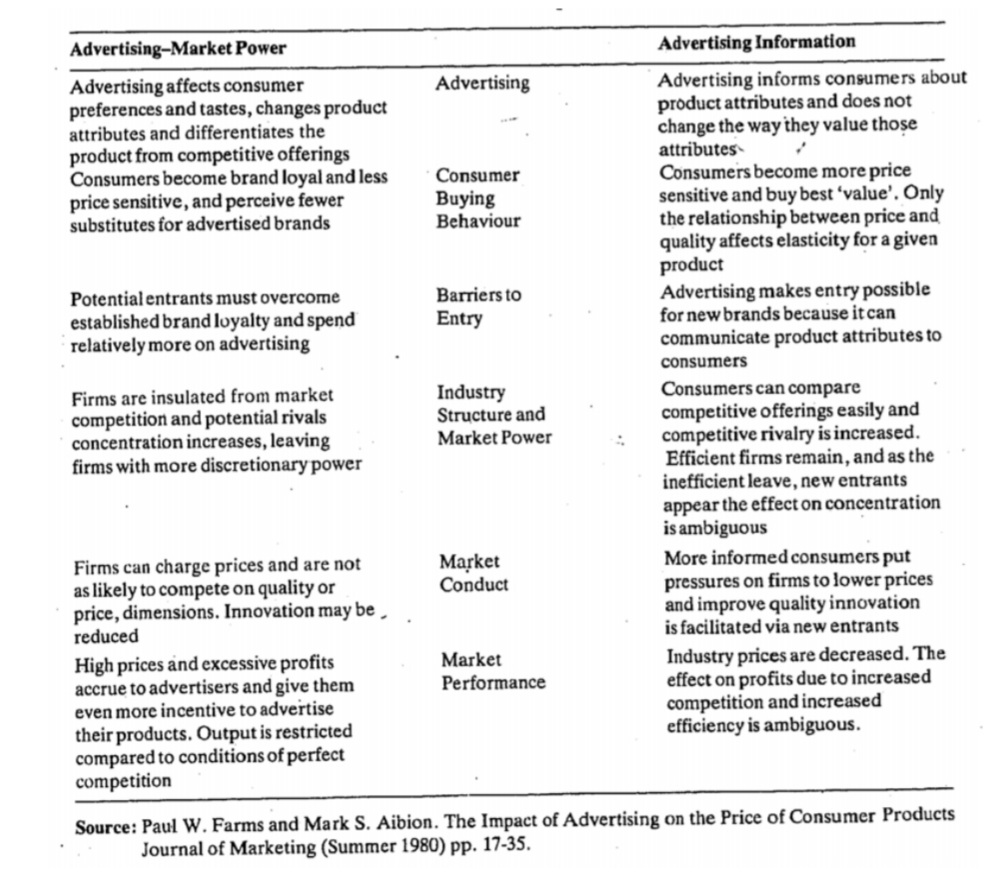
Role of Advertising- Two view
Advertising Objectives
An advertisement is either good or bad in its ability to achieve its objectives. Though advertising is largely informative and persuasive in nature, yet to do a good job, the objectives of each advertising campaign need to be clearly spelt out in measurable terms, in order to focus clearly on the target audience, and on the time period over which these are to be achieved.
Russel H. Colley called for the need to provide explicit link between advertising goals and advertising results in his pioneering approach nicknamed DAGMAR-Defining Advertising Goals for Measured Advertising Results. Colley distinguished 52 advertising goals that might be used in connection with a single advertisement, a year’s campaign for a product or a company’s entire advertising philosophy. Some of such goals are:
• Announce a special reason for `buying now’ (price, premium and so on)
• Build familiarity and easy recognition of the package or trade mark
• Place advertiser in position to select preferred distributors and dealers
• Persuade prospect to visit a show room, ask for a demonstration
• Build up the morale of company salesforce
• Correct false impression, misinformation and other obstacles to sales
• Implant information or attitude regarding benefits and superior features of brand.
According to DAGMAR, the communication task of the brand is to gain (a) awareness, (b) comprehension, (c) conviction, (d) image, and (e) action. Advertising goals should, therefore, be specific to the communication task(s) to be performed.
The process of advertising goal-setting thus, should begin by understanding the dynamics of the consumer behaviour and the market environment in order to carry out the task of marketing communication effectively.
Advertising is only one of the factors influencing sales, the other being:
a. different elements of the marketing mix
b. the competitive position of the firm
c. the purchasing power and the need of the buyer.
Also, the impact of advertising often occurs over the long-run and not necessarily immediately, since consumers may belong to different stages of the product adoption process at a point of time. The advertising objectives are to:
• Inform and build awareness
• Create brand knowledge
• Reinforce positive attitudes about the brand
• Precipitate buying action
• Increase sales
• Build up an image.
To facilitate the realisation of advertising objectives, it is necessary that these are laid down in specific operational terms and are linked to the time span during which these are to be accomplished
Q.9. Write short notes on any two of the following : (10×2=20)
a. Sales Promotion
Of all the methods of promotion that constitute the promotion mix, sales promotion is the only method that makes use of incentives to complete the `push-pull promotional strategy of motivating the salesforce, the dealer and the consumer in transacting a sale.
There is no single universally accepted definition of sales promotion. One can, however, gather its essence by perusing a few definitions. Let us look at some of the popular definitions of sales promotion.
According to American Marketing Association, sales promotion refers to “those activities other than personal selling, advertising and publicity, that stimulate consumer purchasing and dealer effectiveness, such as display shows and exhibitions, demonstrations, and various other non-recurrent selling efforts not in ordinary routine.”
This definition suggests that sales promotion is a catch-all for all those promotion activities which do not fall clearly into advertising, personal selling or publicity.
Roger A. Strang offers a sim sales Promotion pler definition “Sales promotion are short term incentives to encourage purchase or sale of a product or service.”
Stanley defines sales promotion as ” All the marketing and promotion activities, other than advertising, personal selling, and publicity, that motivate and encourage the consumer to purchase by means of such inducements as premiums, advertising specialities, samples, cents-off coupons, sweepstakes, contests, games, trading stamps, refunds, rebates, exhibits, displays, and demonstrations. It is employed as well, to motivate retailers’, wholesaler; the manufacturer’s salesforces to sell through the use of such incentives as awards or prizes (merchandise, cash and travel), direct payments and allowances, cooperative advertising, and trade shows.
It offers a direct inducement to act by providing extra worth over and above what is built into the product as its normal price. These temporary inducements are offered usually at a time and place the buying decision is made.
Sales promotion deals with promotion of sales by the offer of incentives which are essentially non-recurring in nature. It is also known by the names of Extra-Purchase-Value (EPV) and Below-the-line selling.
Like in other market economies, the use of sales promotion is catching on in India. In terms of volume, the number of sales promotion schemes offered to the consumers alone nave grown by over seven times in the first three years of the eighties as against the average in the seventies. The schemes offered at the dealer level also nearly doubled during the period 1978-79 and 1982-83. In terms of the expenditure incurred, the large size companies are stated to be spending between 40 and 50 per cent of their advertising and sales promotion budget on this activity.
Product group-wise, the major users of sales promotion are: tea, coffee and beverages, soaps, toiletries, detergents and washing soaps; toothpaste; textiles; food products and baby foods; household remedies; and consumer durables like fans, refrigerators, sound systems television and household appliances.
Among the various types of sales promotion schemes used contests at the consumer, dealer and salesforce levels have made a significant headway.
Sales Promotion Objectives
• Increase sales (in general, and focusing on new uses, increased usage, upgrading unit of purchase, winning sales of fading brands etc.)
• Make the sale of slow-moving products faster
• Stabilise a fluctuating sales pattern
• Identify and attract new customers
• Launch a new product quickly
• Educate customers regarding product improvements
• Reduce the perception of risk associated with the purchase of a product
• Motivate dealers to stock and sell more, etc.
b. Sales Forecast
A sales forecast predicts the value of sales over a period of time. It becomes the basis of marketing mix and sales planning.
1. Short term Sales Forecast
A short-term sales forecast (say for a period of one year) when linked to the sales budget helps in the preparation of an overall budget for the firm as a whole. The short-term sales forecast in effect also provides the essential financial dimension to sales in terms of expected sales revenue and expenses required. Also, it helps in assessing the cash inflow and outflow needs and their sources.
2. Long term Sales Forecast
A long-term sales forecast (say for a period of 5 years or so) on the other hand, focuses on capital budgeting needs and process of the firm. It provides for changing the marketing strategy of the firm, if needed, and includes reference to emerging product market needs, new market segments to be catered, review of distribution network and promotional programmes, organisation of salesforce, and marketing set up. The long-term sales forecast triggers the task of aligning the production, procurement, financial and other functional needs of the firm with the finalised sales forecast.
The Preparation of Sales Forecast
The preparation of a sales forecast requires
• The availability of historical information on the product and industry sales
• Identification of product sales determinants
• Prediction regarding the behaviour of market forces for the period under forecast
• Use of appropriate techniques for forecasting
• Judgement of executives preparing the sales forecast
• The firm’s market share objectives.
c. Direct Selling
Channels of distribution can be grouped under two major headings:
1. Direct Selling by manufacturer
2. Indirect Selling through middlemen.
For direct selling, the first option involves supplying the product to the customer using your own salesmen and arranging your own deliveries. The second option is using the medium of post office. You obtain orders from your customers who respond by mail or telephone to your advertisements or to letters mailed directly to their houses. You deliver your products to them through mail or through some other carrier. The next alternative is to establish your own retail stores. Bata Ltd., for example, has established its own retail stores throughout the country. This practice has also been adopted on a smaller scale by a number of textile mills who have their own retail shops like Calico Mills, Raymonds, DCM etc., has franchised a number of retailers to sell their products to the consumers.
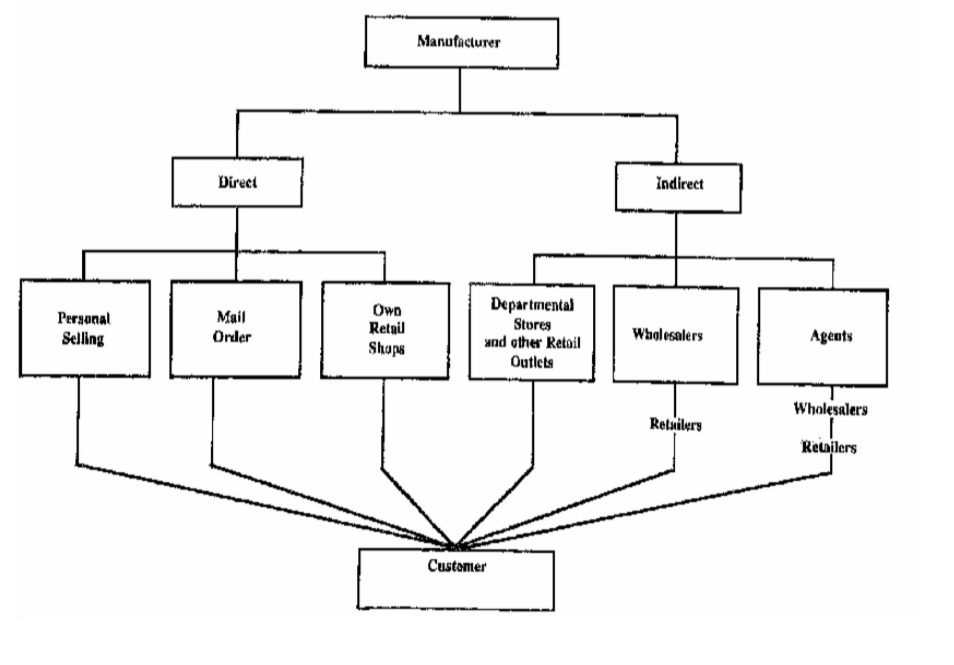
Alternative channel of distribution
Example-
An example of direct selling is provided by Eureka Forbes Ltd. (EFL) a Bombay based company, which markets vacuum cleaners and water purifying equipment. It believes that if the market is in the customer’s house, the best way to get there is to knock at the door. The company has clearly demonstrated that door-to-door selling can be effective in Indian conditions. Its salesforce of over 500 people spread out over nearly 40 branch offices in 29 towns make it the country’s largest commercial direct sales organisation. Between 1982-83 and 1985-86, their sales of vacuum cleaners, water purifiers etc. have gone up from Rs. 3.3 crores to Rs. 11 crores. They took the cue from Electrolux, the world’s leading manufacturer of vacuum cleaners, and a firm believer in door-to-door selling. During the last few months EFL has tried to reach the customers through distributors also.
The main point in favour of direct selling is the need to:
1. Enlighten about additional features
2. Educate the user about how to use it.
Q.10. What is cyber marketing? How is it different from conventional marketing ? Explain with the help of suitable examples. (20)
Cyber Marketing
Cyber marketing term became popular when computers started getting used in marketing extensively. Earlier, computers were used more for storing, processing and reporting of various marketing related information. But, with the entry of internet the online data handling possibilities have virtually exploded the use of computer. This application has multiplied the use of computers at consumers homes faster than among the organisations. This fact has helped marketers substantially to look into cyber marketing. As a result, cyber marketing today is also seen more as internet based marketing rather than just computer based marketing.
Cyber marketing profitably reinforces the concepts of marketing with the power of internet. Thus, it strengthens the existing delivery of marketing outputs and also opens newer avenues of marketing which were not possible to achieve before the’ arrival of internet. For example, a marketer today can keep track of millions of customers simultaneously, segment them online, offer customised products to individual customers, fix different prices, provide varying contents and styles of information and deliver the products through appropriate modes of distribution to each of these customers. The details of such transactions and the characteristics of each of these customers can be stored for their dynamic utilisation in future marketing opportunities with the customers. These possibilities were only the dreams of earlier marketers.
Differences between Cyber Marketing and Traditional Marketing
1. Cost
One of the most notable differences between traditional and cyber marketing is pricing. Traditionally, print ads in newspapers and magazines, road-side billboards, and radio and television commercial spots all carry price tags that reflect both the quality of the ad and the market the advertisement reaches. Likewise, printed marketing materials, including brochures, signs, sales fliers and business cards, all carry a price associated with paper quality, design and printing. Cyber marketing venues can also carry a cost, though there are currently numerous forms of cyber marketing that are virtually free. Email marketing campaigns and newsletters, business blogs, Facebook business pages and websites often start with no- or low-cost options, making them a viable alternative to traditional marketing, especially for small businesses with limited marketing budgets.
2. Immediacy
Print and broadcast marketing techniques require time to go from concept to finished product and delivery. Drafts must be completed, mock-up or demo advertisements reviewed and tweaked and then advertising time slots and placement determined. Even when the message is in place, broadcast materials do not reach the full intended audience all at one time, and mailed marketing materials take days to arrive at their destinations. Cyber marketing, on the other hand, is instantaneous. While you still put time and thought into the content and design process, marketing campaigns can be implemented at the click of a mouse.
3. Tracking
Cyber marketing is easy to track. Software email marketing programs can tally the number of people who view a message, and with the case of online sales, track the number of ads that lead to purchases. Traditional advertising is more difficult to track unless a marketer conducts focus groups and surveys to gauge which marketing vehicles generate the most leads.
4. Audience
Traditional marketing may be more effective in reaching target demographics that don’t utilize the Internet on a regular basis or conduct their commerce through cyber means. For example, a senior citizen who prefers to get her news through the daily newspaper will be easier to reach via print ads, while a young child who watches afternoon cartoons will be easier to reach through television ads. On the flip side, demographics that are never without technology at their fingertips, such as teenagers and Millennials, may be easier to each through mobile cyber marketing campaigns.