
Table of Contents
Q.1. Define the concept of “Social Marketing”. How does social marketing differ from business marketing in terms of objectives, approaches and the application the four Ps? (20)
Social Marketing
Social marketing is the systematic application of marketing, along with other concepts and techniques, to achieve specific behavioural goals for a social good.
Social marketing can be applied to promote merit goods, or to make a society avoid demerit goods and thus to promote society’s well being as a whole.
For example, this may include asking people not to smoke in public areas, asking them to use seat belts, or prompting to make them follow speed limits.
Objectives Of Social Marketing
• In social marketing, the goal is to improve a condition of public health or safety.
• We need to pay attention to a communication objective, identify a target audience, design a compelling message, find support for it and look for success indicators.
• We also need to spend some money, not a lot necessarily, but some.
• In using persuasion and the media to affect social change, those in the public health and prevention fields have entered a new era.
Approaches in Social Marketing
Approaches in Social Marketing includes asking to do specific things to the people for the good social cause. It can be in form any form of advertisement.
The 4 P’s in Social Marketing
1. Product: Think about a tangible object or service you can provide to support or facilitate behaviour change. Can you offer a new product/service or adapt one that already exists? Product examples include in-home blood pressure monitoring kits, improved HIV tests, journals to plan and track food intake, cessation counselling.
2. Price: Consider interventions that would decrease the costs to the individual of taking the desired action (not only monetary cost, but emotional, psychological and time costs). List out the “price” or barriers for your audience segment to carry out the desired behaviour, then brainstorm interventions to diminish those barriers. For example, instituting a walking club program at the workplace for those who cite lack of support and lack of time as barriers to regular exercise.
3. Place: Think about where and when the audience will perform the behavior or access the new or adapted product/service. How can you make it convenient and pleasant (even more so than the competing behavior)? Examples include placing condom vending machines in bar restrooms, offering help lines that are available 24 hours a day, having breastfeeding consultants check-in on new mothers after they leave the hospital. Also think about your “sales force” – the people that will take your program to the audience. Consider the need for peer educators, counselors or others who can make your program or its activities more accessible.
4. Promotion: Use your market research to determine the communication channels and activities that will best reach your audience to promote the benefits of the desired behavior. What advertising or public relations media do they pay attention to (e.g., radio, newspaper, postcard racks)? What special promotional items would they use (e.g., water bottles, refrigerator magnets, notepads)? What special events do/would they attend (concerts, health fairs, conferences)? How can you include influencing audiences? Be sure to promote the Product, Price and Place features that you want the audience to know about.
Business Marketing
Business marketing is a marketing practice of individuals or organizations (including commercial businesses, governments and institutions). It allows them to sell products or services to other companies or organizations that resell them, use them in their products or services or use them to support their works. It is a way to promote business and improve profit too.
Objectives of Business Marketing
In business marketing a company’s marketing objectives for a particular product might include increasing product awareness among targeted consumers, providing information about product features and reducing consumer resistance to buying the product.
Approaches in Business Marketing
In Business Marketing the approaches include direct sales, direct mail (postcards, brochures, letters, fliers), tradeshows, print advertising (magazines, newspapers, coupon books, billboards), referral (also known as word-of-mouth marketing), radio, and television.
The 4 P’s in Business Marketing
The four Ps are the four essential factors involved in marketing a good or service to the public.
These are the four Ps: the product (the good or service); the price (what the consumer pays); the place (the location where a product is marketed); and promotion (the advertising). The concept of the four Ps has been around since the 1950s; as the marketing industry has evolved, the concepts of people, process, and physical evidence have become important components of marketing a product, too.
1. Product
Product refers to a good or service that a company offers to customers. Ideally, a product should fulfill an existing consumer demand. Or a product may be so compelling that consumers believe they need to have it and it creates a new demand. To be successful, marketers need to understand the life cycle of a product, and business executives need to have a plan for dealing with products at every stage of their life cycle. The type of product also partially dictates how much businesses can charge for it, where they should place it, and how they should promote it in the marketplace.
2. Price
Price is the cost consumers pay for a product. Marketers must link the price to the product’s real and perceived value, but they also must consider supply costs, seasonal discounts, and competitors’ prices. In some cases, business executives may raise the price to give the product the appearance of being a luxury. Alternatively, they may lower the price so more consumers can try the product.
3. Place
When a company makes decisions regarding place, they are trying to determine where they should sell a product and how to deliver the product to the market. The goal of business executives is always to get their products in front of the consumers that are the most likely to buy them.
4. Promotion
Promotion includes advertising, public relations, and promotional strategy. The goal of promoting a product is to reveal to consumers why they need it and why they should pay a certain price for it.
Q.2. Why marketing mix is an important determinant of a hotel chain success? What problems a marketier faces in determining a suitable marketing mix for services industry? (20)
Marketing Mix
The marketing principles can be cleft down within 4 Ps of marketing. The four p’s comprises of the primitive aspects tangled in the process of marketing. The elements of marketing mix assist and support the sellers to identify the needs and want of their potential buyers. The four Ps are also known as marketing mix elements.
1. Product
Product here exemplifies to the goods and services a business sells to its potential customer. In order to peddle up the sale one must furnish the proper and adequate information about their particular good and service to the targeted customer. The product must be capable of resolving and fulfilling the requirements of customer. Component of selling the good comprises figuring out the potential buyers in the market.
2. Price
The chunk of money that a supplier sets for his product is labeled as price. Setting the price needs keen thought and analysis, mainly for inexperienced or new business owners who mistakenly sense to offer the minimum price or they would end up in achieving zero sales. Pricing is computed in many ways, like cost-plus, based on value or combative.
3. Place
The way of distributing the product is considered as third ‘P’ of marketing that is considered as — place. Analysing the geographical areas where buyers look for the product and service. It refers to the geographical location of the availability of products.
4. Promotion
The element ‘promotion’ in the marketing mix comprises the advertising and events to support the certain service and product. Various strategies are made to promote the product in the market. In order to make the end users aware of the product marketers initiate different promotional strategies to uphold their goods and services.
Apart from these 4 Ps marketing has several other elements which are 7Ps of marketing
5. Packaging
Packaging means the way your product or service looks from the outer part. One should remember that customer gets affected and makes their views about the product by looking at the way of packaging. If packaging forms fine impression on the customer it can accelerate the sales without a doubt. The layout and designing of the product from outside plays an important role in the sales.
6. Process
The process is an integrated buying exposure. From the prime segment of contact, generally the network or website, to distribution of the good or service. Nonetheless, the process doesn’t block there, because there’s the post sales service, and creating decent relations with customers even after the purchasing process.
7. Physical Evidence
Physical Evidence also indicates about the experience of ultimate customers. A customer does not hold the proper knowledge and apprehension about the product when he or she buys a product for the first time. One requires to provide the consumers with physical evidence that can initiate the confidence in them.
Importance of Marketing Mix
Each aspect of business builds upon marketing. Marketing is a significant role player in the performance of business. The importance of marketing can be understood through the points mentioned below:
1. Exchange and progression of goods
Marketing is highly beneficial in deportation, transaction and progression of goods and services. Products and services are contrived available to consumers by numerous intermediaries like wholesalers and vendors. Marketing is profitable to manufacturer and consumers both.
2. Rising the living standard
Through the availability of continuous supply of goods and services to customers at a nominal price, marketing has a significant role in establishing living standards of the society. Community consists of three genres of people that are wealthy, middle and poor. All the things which are accounted by these three classes of society are outfitted by marketing.
3. Increase in employment
Marketing is a complicated practice involving numerous people in under one segment. The chief marketing activities include buying, selling, transporting, storing etc. Every function comprises of different activities which are performed by a large variety of individuals. Hence it helps in raising the level of employment. According to the sources almost 40% of the whole population is reliant on marketing directly or indirectly. The widened role of marketing has immensely increased the employment level for people.
4. Opening of income and revenue
Marketing caters various opportunities to bring in profits in the practice of buying and selling the products and goods, through slashing time, place and tenure utilities. That income and investment can be used as profits in future ventures. Marketing must be given the utmost significance, as the initial and conclusive survival of the company gambles upon the potency of the marketing operation.
5. Support for Making Decisions
A businessman goes through several complications during the process of creation and distribution of goods and services. He/she requires the exact and relevant information and queries related to their product and service. Marketing process ease this complexity of businessmen by forming a direct link between manufacturer and consumer.
6. Opening of new ideas
Marketing concept is deeply dynamic and progressive. It has altered and modified several aspects for the better functioning of certain activities. With the changes in taste and preferences of consumers marketing accord understanding and apprehension accordingly.
7. Advancement of Economy
Marketing is considered and characterized as a wizard that sets the economy whirling. An organized marketing structure helps the economy to rise and lessens the burden of weaker economy.
Problems in implementing Marketing Mix
1. Multicollinearity
When marketing activities coincide in time they create collinearity in the model. This means that the input variables move together or share information. My recommendation here is to either remove highly correlated input variables or use principal component analysis (PCA) to remove the information overlap.
2. No standards of measurement
It’s hard to compare performance in the industry when there is no consensus on how the effectiveness of marketing efforts should be measured. The effects of a marketing campaign can be immediate and long term. In general estimated increment lift is straight forward but estimating repeat sales or delayed customer acquisition is not. Regardless of your definition of impact the gains must be compared against the costs using a performance metric.
3. Lack of transparency
Most marketing mix modelling today is being done by consulting firms on behalf of their corporate clients. All modelling vendors that I have worked with consistently reject requests for details about the models. Instead they call that information proprietary and release only the ROMIs and optimization plans. Without the ability to review the model themselves clients have no means for validating or confirming the accuracy of the models. In this case I recommend that you withhold a portion of locations or time periods from the data set you are sending to the vendor. When they have completed the modelling process send them only the input data for the missing locations/date periods. They will estimate results and you can compare those to the real results that were withheld. This is called hold-out sampling.
4. Measuring advertising Content
The content of an advertisement is difficult to quantify. There may be different promotional offers, humour, visuals, celebrity, etc. For TV commercials modellers tend to use Gross Rating Points (GRPs) to measure reach and frequency. But two commercials may have the same GRP count but appeal to consumers very differently.
5. Dynamic Effects
When we start a new campaign the effect is not immediate. In fact it may take months to gain full effectiveness of a new series of commercials. This is called the wear-in phase of the campaign. As you can guess when a commercial is becoming stale we call that the wear-out phase. During the wear-in and wear-out phases the incremental lift of each GRP is reduced.
6. Non Linear Effects
Customer response from some activities is pretty consistent. Generally, if you spend 10% more in Google AdWords on the same campaign of keywords you will probably get a 10% increase in the number of conversions from that campaign. That’s a linear relationship which is easy to model. On the other hand, traditional media like TV and print have a more complex relationship with incremental customer demand. There is research that shows that a minimum threshold of advertising must be reached in some channels to have any effect. Along the same vein, these channels generate almost no incremental demand after reaching a saturation point. This means traditional media is often better modeled with an S-shaped curve rather than the straight linear regression model.
7. Corporate Management
When you first implement a media mix optimization strategy the expectations of management may need some management themselves. Most likely the State of Data will initially only provide insights rather than full blown optimization. I recommend that you start with “Test & Learn” plans to confirm these insights. As your State of Data improves you can start tackling larger more complex optimization tasks.
Q.3. What do you mean by “Marketing Research” ? Explain the marketing research procedure. (20)
Marketing Research
The American Marketing Association defines marketing research as ” the systematic gathering, recording and analysing of data about problems related to the marketing of goods and services”. Crisp has defined marketing research as “…the systematic, objective and exhaustive search for and study of the facts relevant to any problem in the field of marketing”.
Market research is an organized effort to gather information about target markets and customers: know about them, starting with who they are. It is a very important component of business strategy and a major factor in maintaining competitiveness. Market research helps to identify and analyze the needs of the market, the market size and the competition. Its techniques encompass both qualitative techniques such as focus groups, in-depth interviews, and ethnography, as well as quantitative techniques such as customer surveys, and analysis of secondary data.
It includes social and opinion research, and is the systematic gathering and interpretation of information about individuals or organizations using statistical and analytical methods and techniques of the applied social sciences to gain insight or support decision making.
Marketing Research Procedure
Marketing research is undertaken in order to improve the understanding about a marketing situation or problem and consequently improve the quality of decision-making related to it. The usefulness of the marketing research output will depend upon the way the research has been designed and implemented at each stage of the process. There are five steps in every marketing research process:
• Problem definition
• Research design
• Field work
• Data analysis
• Report presentation and implementation
1. Problem Definition
A problem is any situation which requires further investigations. However, not all marketing problems need formal investigation or research. Many problems are of a routine and trivial nature which can be solved immediately after ascertaining all the facts of the case.
Some problems faced by marketing managers are such that they can be handled on the basis of past experience and intuition. Such decisions can only be made if the manager has been in the line for at least a couple of years. Decisions made on judgement may not always turn out to be correct, but the problem may not be important enough to justify substantial time, money and effort to be spent on solving it. But when the problem is critical, spending resources to initiate formal marketing research is warranted. Also when the problem is such that the manager has no past experience to guide him (as in case of a new product launch) or the decision will have a critical impact on the future of the company (diversification into new markets, new products) it is worthwhile to undertake research and make decisions on the basis of concrete results rather than mere hunch or judgement.
It is very important that you define the problem for research properly. It is correctly said that `a problem well defined is half- solved.’ Clear, precise, to the point statement of the problem itself provides clues for the solution. On the other hand, a vague, general, or inaccurate statement of the problem only confuses the researcher and can lead to wrong problems being researched and useless results generated.
2. Research Design
The research design spells out how you are going to achieve the stated research objectives. The data collection methods, the specific research, instrument and the sampling plan that you will use for collecting data and the corresponding cost are the elements that constitute the research design.
a. Data Collection Methods
The kind of data which has already been collected by another organisation and not by you is known as secondary data. This secondary data already exists in an accessible form; it only has to be located.
Original data collected specifically for a current research are known as primary data. Primary data can be collected from customers, retailers, distributors, manufacturers or other information sources. Primary data may be collected through any of the three methods: observation, survey and experimentation.
b. Research Instrument
In the observation method, the researcher may use a camera, tape recorder or tally sheet (a sheet in which the number of times an event occurs is recorded). Whatever the instrument used, the researcher must ensure that the instrument is appropriate to the occasion and is reliable.
In the survey method the most commonly used instrument is the questionnaire. This is a written and organised format containing all the questions relevant to soliciting the required information.
c. Sampling Plan
After preparing equipment for observation, you have to identify the source of your information, the source is also called the `population’ or `universe’. For conducting marketing research you would rarely gather information from the entire population, rather you would select a small group known as sample which has all the characteristics of the population, and conduct research among the sample group.
3. Field work
This is the stage where the research design has to be converted from the planning stage to that of implementation. To achieve the stated research objectives data has to be collected. This data collection is known as field work. The two stages in field work are planning and supervision.
• Planning
It has to be planned how many people will be assigned to the field, what will be their geographical areas of coverage; how many days will be required for the entire operation and what is the pattern to be used for choosing sample units (every fourth household in a lane, all flats with an even number in an apartment `block’ etc.).
All this planning has to be done in accordance with the details spelt out in the sampling plan.
• Supervision
Supervision is an extremely important input to ensure that the data collected is genuine and accurate. Most field work is carried out by a team of field surveyors, and each team is assigned to a supervisor. The team members would plan their daily area of field work in consultation with the supervisor. The supervisor may accompany different team members on different days. In the evening the team would meet the supervisor, hand over the data which they have collected and sort out any problems they may have faced.
4. Data analysis
After you have collected the data, you need to process, organise and arrange it in a format that makes it easy to understand and directly helps the decision-making process. Raw data has to be processed and analysed to obtain information. There are three phases for analysing the data:
• Classifying the raw data in a more orderly manner,
• Summarising the data,
• Applying analytical methods to manipulate the data to highlight their inter-relationship and quantitative significance.
• Classifying the raw data
The most commonly used classification in marketing research are quantitative, qualitative, chronological and geographical.
• Summarising the data
The first step in summarising the data is the tabulation. Individual observations or data are placed in a suitable classification in which they occur and then counted. Thus we know the number of times or the frequency with which a particular data occurs.
5. Report presentation and implementation
The final step is the preparation, presentation and implementation of a report giving the major findings and recommendations. A typical format of the report may comprise of the following sections:
a. Objectives and methodology in which the research objectives are stated and details of the sampling plan are described.
b. Summary of conclusions and recommendations in which the main findings of the research are highlighted. On the basis of the findings, some recommendations may be made.
c. Sample and its characteristics which contains descriptions of the sampling units in terms of their geographical location, socio-economic profile and other relevant details.
d. Detailed findings and observations in which the data which has collected is presented in a form which is easily comprehensible to the user. The data may be presented in tabular form or graphically in a bar chart, pictogram or pie diagram or in a combination of all these.
e. Questionnaire and supporting research instruments are presented in the last section.
Q.4. Discuss the importance of sub-culture in segmenting the Indian market for food products. Give suitable examples. (20)
Sub-culture
Within the large framework of a society there exist many sub-cultures. A sub-culture is an identifiable distinct, cultural group, which, while following the dominant cultural values of the overall society also has its own beliefs, values and customs that set them apart from other members of the same society.
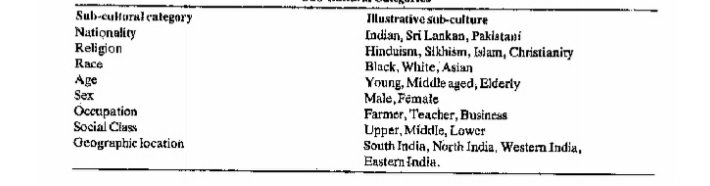
Sub-culture categories
These sub-cultures offer readymade market segments to the marketer who can position his product to meet the specific needs, motivation, perception and attitudes of each sub-culture. However, the marketer may need to modify both his product and advertising appeal to suit their specialised needs.
Every member of a society is a member of several sub-groups, (such as an elderly, Keralite, Christian, Woman, teacher) and the consumer’s purchase decision is a result of the influence of these various sub-groups. The marketer must understand how the specific sub-cultural groups interact, with each other and exert their influence on the member’s consumption behaviour.
Importance of sub-culture in segmenting the Indian market for food products
• It helps the marketers to design products which are in line with the consumer expectation. The overall market is comprised with Asians, Africans, Hispanics, and Indians etc. The consumer differs in terms of consumption patterns, financial health and technical acumen.
• Understanding and studying them helps the firm to segment the market and target the customers. Studying their beliefs, values, and customs could help the marketer to understand their motivations, perceptions, and attributes. The society is a collection of people from various cultures. This helps the marketer to predict the specific need of such groups.
• Marketers must understand the dynamics of various subcultures existing within the cultural group by conducting extensive market research so as to understand the consumption patterns of members of a subculture.
• The products should be designed keeping the interests of the prospective buyers and also the way they are used by consumers. This helps the marketer to avoid the permanent animosity in the minds of consumers.
The growing concern for the environment has also led marketers to consider another issue which is the packaging of the products. Use of bio-degradable and Eco friendly materials is preferred and helps to generate a positive attitude not only towards the product but also for brand.
Eg – The easiest example is food for children. There are various levels of food for children, each specific to the age groups targeted within the ‘children’ target market. To access the appropriate market, marketing must be applied to that specific group, or their parents. When one looks at children, we realize the age groups are extremely different and the different foods are not all appropriate for all children. For example, baby foods can be for ages up to six months, or the time when teeth come in. There are baby foods that are not appropriate for small babies. Foods and texture would be difficult for them to eat.
Q.5. Explain the meaning of product diversification. Also distinguish between related and unrelated diversification. (20)
Product Diversification
Product diversification is the practice of expanding the original market for a product. This strategy is used to increase the sales associated with an existing product line, which is especially useful for a business that has been experiencing stagnant or declining sales.
As soon as a manufacturer offers more than one product, it is described as product diversification. Generally, diversification is categorised into two types:
1. Related Diversification and
2. Unrelated Diversification.
Where the new products introduced in the product mix are similar to the existing product, diversification is described as ‘related’. When a company accepts new products which are very different from the existing products, the diversification is said to be `unrelated’.
Objectives of Product Diversification
1. To gain stability in the firm’s earnings and organisation.
2. To attain efficiency in the utilisation of a firm’s resources — human, physical and financial.
3. To increase sales of basic products and exploit the value of an established trade mark.
4. To increase the profits by offering different types of products.
5. To meet the demands and convenience of the diversified retailers.
6. To make profitable use of marketing opportunities.
Related Diversification
Related Diversification is the most popular distinction between the different types of diversification and is made with regard to how close the field of diversification is to the field of the existing business activities.
Related Diversification occurs when the company adds to or expands its existing line of production or markets. In these cases, the company starts manufacturing a new product or penetrates a new market related to its business activity. Under related diversification the company makes easier the consumption of its products by producing complementing goods or offering complementing services. For example, a shoe producer starts a line of purses and other leather accessories; an electronics repair shop adds to its portfolio of services the renting of appliances to the customers for temporary use until their own are repaired
Some of the probable reasons for companies undertaking related diversification are:
1. To make a more effective use of the existing selling and distribution facilities,
2. To use its under-utilised production capacity,
3. To meet varied customer needs,
4. To take advantage of its existing reputation in a particular type of products, and
5. To increase the sale of existing products.
Unrelated Diversification
When the new products offered or introduced are quite different from the existing ones, the company is said to have adopted the strategy of unrelated diversification.
For example, if a consumer products’ manufacturer diversifies into the manufacture of raw materials such as chemicals or industrial products, such diversifications would be described as unrelated diversification. This naturally involves heavier costs and management challenges. This is the reason why related diversification is more popular.
Hindustan Lever was basically a consumer products company. It was forced into unrelated diversification because of its desire to grow in the face of Foreign Exchange Regulation Act and Industrial Licensing Policy. Today this company is a leading manufacturer of sodium tripoly phosphate (STPP), glycerine, nickel catalyst and fine chemicals. It is also producing a plant-growth nutrient, a product of its own research innovation, branded `Paras’. It is supposed to increase cereals and vegetable yields considerably. Thus, this company has now diversified into unrelated products.
Take another well known company which has a varied product mix-Godrej; it not only makes cosmetics, but also steel furniture, animal feeds and its popular locks. It can be seen that this company has also adopted unrelated diversification as its product mix strategy.
Q.6. Write short note on : (2×10=20)
a. Product Life Cycle
Product Life Cycle has following stages :-
1. The Introduction Stage
In the introductory stage, there is likely to be no profits or more likely a loss. This loss may continue for some time depending on the market factors. At this stage, considerable amount of funds are being devoted to promotional expenses with a view to generate sales while the volume of the sales is low. Thus in the beginning, there is likely to be a loss and later on, as the sales grow, the profit might accrue.
2. The Growth Stage
In case the product launched is successful, the sales must start picking up or rise more rapidly. The next stage is then reached which is known as the `growth stage’. Here the sales would climb up fast and profit picture will also improve considerably. This is because the cost of distribution and promotion is now spread over a larger volume of sales. As the volume of production is increased, the manufacturing cost per unit tends to decline. Thus, from the point of view of product strategy, this is a very critical stage.
3. The Maturity Stage
It is too optimistic to think that sales will keep shooting up. At this stage, it is more likely that the competitors become more active. In case your product is a novel one, by now competition would have come out with a similar product in the market to compete with yours. Therefore, the sales are likely to be pushed downwards by the competitors while your promotional efforts would have to be increased to try and sustain the sales. Thus the sales reach a plateau. This is called the `maturity stage’ or `saturation’. At this point it is difficult to push sales up. With regard to the `profit’ picture, the profits are likely to stabilise or start declining as more promotional effort has to be made now in order to meet competition. Unless of course, you have the largest market share with your product and it needs no extra push in the market.
4. The Decline or Obsolescence Stage
Thereafter the sales are likely to decline and the product could reach the `obsolescence’ stage. Steps should be taken to prevent this obsolescence and avoid the decline. This decline that generally follows could be due to several reasons such as consumer changes and tastes, improvement in technology and introduction of better substitutes. This is the stage where the profits drop rapidly and ultimately the last stage emerges. Retaining such a profit after this stage may be risky, and certainly not profitable to the organisation.

The product life cycle
b. New Product development strategy
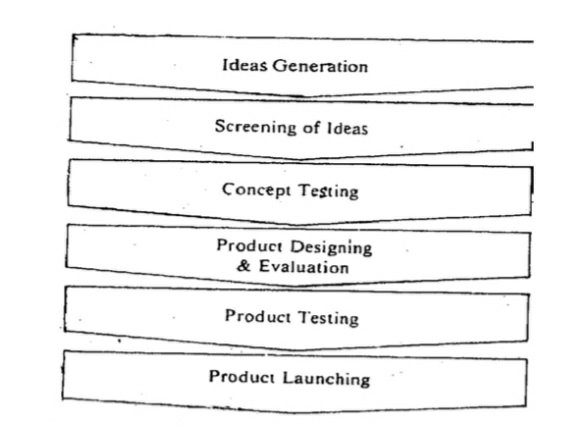
Stages in New Product Development
1. Generation of New Product Ideas
The first step obviously is to get ideas with regard to possible new products think of the sources from which you can get such product ideas? Answer can be Customers, Company Salesmen, Competitors, Company Executives, Employees within the organisation including technical people.
As marketing is aimed at satisfaction of consumer needs, an alert marketer can get some ideas from the customers for possible new products by keeping his eyes and ear open and more particularly the mind to perceive even needs which are so far unexpressed. For example, in case of refrigerators, some one conceived the idea of having a `two-door’ refrigerator, another conceived the idea of the ball point which obviated the need for constantly filling fountain pens. Thus, new ideas can come from customer needs or problems requiring solution.
2. Evaluation or Screening of the Ideas
From the first stage, we have received a number of ideas-good and bad. We have now to screen and evaluate them to reduce their number to what is likely to be useful. This is known as the `evaluation’ or `screening’ of ideas stage in this process.
Poor ideas must be dropped immediately because unnecessary cost has to be incurred to process them further. The ideas must be consistent with the company’s philosophy; objectives and strategies and be in terms of the resources available in the organisation. In general the ideas are screened in terms of
1. Possible Profitability
2. Good Market Potential (Market size)
3. Availability of Production Facility
4. Availability of Raw Materials for such a product, if selected
5. Availability of Finance
6. Availability of Managerial Ability
7. Uniqueness of Product
3. Product Concept Development and Evaluation
Particularly when the product idea is rather revolutionary, the concept itself must be tested. For example, people talk about `battery driven cars’ to save on petrol. This is a concept which has to be tested in the environment in which the product is sought to be introduced. As already indicated, Hindustan Lever failed with their Hima peas and Fast Foods. This was a failure of concept testing. The mention of the failure of Hindustan Lever is not to run down the performance of this excellent company but to emphasise that good companies introduce a number of products some of which may fail.
4. Product Designing and Evaluation
If the product idea or the concept passes the test, we then proceed to the engineering or the production or the R&D stage. So far what we had was only a description or an idea. Now this has to be converted into a product. Prototypes are developed and tested. The .est can be done under laboratory or field conditions. At this stage of product development, the technical problems, if any, must be solved. This is because the product must not suffer from complaints regarding quality in use. Even a small defect might shorten the life cycle of the product as well as spoil the company’s image.
5. Product Testing Stage
Apart from mechanical performance, customer acceptance is essential. In fact, the following can be stated as requirements for the new product, after it is designed:
1. Satisfactory performance
2. Customer acceptance
3. Economical production
4. Adequate distribution
5. Adequate servicing arrangements where required, and
6. Effective packaging and branding.
A market test should, therefore, be conducted before launching the new product. This will help us find out whether the product can be launched successfully on a commercial scale or not.
6. Launching The New Product
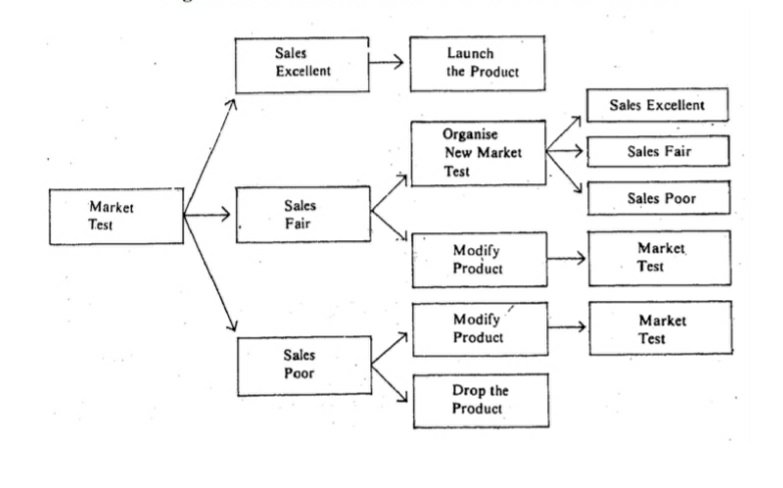
Market Test Decision Tree
Q.7. How do the stages of product life cycle and product positioning affect pricing decisions regarding the product of a tour operator company? Explain with suitable examples. (20)
Just like people, most products go through several distinct phases during their lifetime. Once products are introduced, they’ll go through periods of growth, maturity and eventual decline. That’s referred to as the product life cycle, and understanding how it works can guide you in setting the price of your products and in tweaking your business strategy.
Looking at the Life Cycle
The gestation period for a new product is usually referred to as the development stage. That’s when the original idea is transformed into prototypes, tested, and sometimes given to small groups of users for evaluation and feedback. You don’t have a marketable product yet at that stage, so it doesn’t directly play into your pricing strategy.
Phases in the Life Cycle
The next step is the introduction phase, where your product is rolled out to the market to sink or swim. If it finds willing buyers, you’ll move on to the next phase in the product life cycle, which is growth. That’s the exciting time when your product is gaining traction, and you’re breaking into new markets and demographics.
Eventually, your growth will plateau, as the market for your product becomes saturated, and your sales come more from replacement purchases than from new purchases; that’s called the maturity stage. Finally, comes decline, the period in which your product is being edged out of its market by newer or – maybe – better products. Your pricing strategy should recognize, and take advantage of, your product’s place in its life cycle.
Setting the Initial Price
There are two ways you can go with pricing when you first introduce your product. If it’s a big advance over the older products in your niche or if it does something entirely new or represents a new technology, you may be able to demand a premium price for your product in its early days. That helps you recover your R&D costs in a hurry, and early adopters are often not price-sensitive, if your product meets a real need.
On the other hand, if your product is so different that people need to try it to really grasp its potential, you might need to offer it at a reduced introductory price, just to attract attention and generate some word of mouth. You might even need to give away free samples, which is what 3M had to do when it introduced Post-it Notes.
The Growth Phase
During the growth phase, you’ll be able to ramp up production, which helps bring down your cost per unit. If you’re able to reduce your selling price while keeping your profit margins healthy, you’ll be in a position to profit happily from your product’s popularity. One way to maximize your revenues is by plowing some of those profits into opening new markets and distribution channels, so that you can capitalize on your product while it’s at its hottest. At this point, you’ll have paid down much of the product’s R&D cost, so it’s time to start funnelling a few dollars into your next product, and for improvements on your current one.
The Maturity Phase
Eventually, any product reaches a point of stability, where your markets are fully penetrated, and growth gradually slows to a relative standstill. Even if your product originally was a ground-breaking product, you probably now have competitors who offer something similar. This is the stage in which you stand to make the most money from your product, because you’ll already have plenty of awareness in the marketplace, and your R&D costs are long-since paid off.
As long as you can find ways to differentiate yourself from your competitors, your product can continue to be a cash cow. Even in a scenario in which cost-cutting rivals force you to reduce your prices, you should have plenty of room to make a buck.
The Decline Phase
It’s simple folk wisdom that “all good things must come to an end,” and that’s the case for most products, as well. Over time, new products or new technologies come along, and sales of your product will begin to ebb. At this stage, you’ll probably have worked out all the kinks in your manufacturing process, and your costs now are as low as they’ll ever be, so you have the option of lowering prices to keep the product as attractive as possible. Ideally, you’ll also have new products at various stages of their own life cycles, so the drop in demand for one won’t create a crisis for your business.
Postponing Product Decline
Most products rise and fall, but a few manage to remain solid sellers year after year, despite the maturity of their markets. Coca-Cola has been at the mature stage of its life cycle for a century or so, and it continues to lead in its market segment. That’s unusual, and most companies need to put in a bit more effort just to stay in the game.
The usual strategy is to find ways to refresh your product, through new features or added abilities. Just think: How many times has your favorite laundry detergent been “new and improved” in your lifetime? If you can find enough ways to keep your product competitive with its peers, then, sometimes, you can prolong that profitable maturity stage for a very long time.
Q.8. Explain how media planning is done for services industry? Describe the parameters used for measuring advertising effectiveness. (20)
Media Planning
Media planning includes decisions relating to (i) which media should be used, and (ii) when and how often should advertisements be placed in the selected media. The basic purpose of media planning is to optimise the communication reach to the relevant audience within the available budget.
Media planning is the series of decisions involved in delivering the promotional message to the prospective consumers. It is the process of directing the advertising message to the target audience by using the appropriate channel at the proper time and place.
The media plan marks on the best way to get the advertiser’s message to the market. Generally, the goal of the media plan is to find that combination of media that allows the marketer to communicate the message in the most effective manner to the largest number of potential customers at the lowest cost.
Media planning assists in controlling wasteful advertising. It ensures die optimum-utilisation of resources spent on advertising. In media plan, media objectives are decided keeping in view the advertising objectives of the organisation. Media plan specifies media strategies. Media strategy means plans of action designed to attain media objectives.
Steps involved in the Media Planning Process
Following are the steps which are involved in media planning are:
Step 1. Market Analysis
Every media plan begins with the market analysis of environmental analysis. Complete review of internal and external factors is required to be done.
At this stage media planners try to identify answers of the following questions:
i. Identification of the Target Audience:
Which is the audience for our product? This happens to be the most important consideration in the media decisions. We first examine our market plans and advertising plans. These provide us details about the audience for our product.
Detailed studies of our audience can be made. We can describe our audience in terms of age, religion, sex, education – these are demographic characteristics. We can describe it in terms of their income and occupation.
The target audience can be classified in terms of age, sex, income, occupation and other variables. The classification of target audience helps media planner to understand the media consumption habit, and accordingly choose the most appropriate media or media mix. Different customers differ with regard to age, income, education level, personality, attitude etc. If target audience or customers are educated and young, print media and T.V., can be selected. If number of target customers is more, then mass-media like, T.V., Newspapers will be suitable.
ii. Study of Factors Affecting Media Planning:
There are various factors which affect media planning.
While making media planning, the media-planner must consider these factors which are described as follows:
a. Internal Factors – Internal factors are those factors which are directly related to company like size of company, advertising budget, size of organization, distribution strategy of organization, potential market area etc. Advertising budget is very important factor, while selecting media planning. If size of ad-budget is more, then costly media like T.V. can be selected. If size of ad budget is small, the cheap media will be selected.
b. External Factors – External factors includes media coverage, media image, media adopted by competitors etc. while selecting the media, the advertiser must consider the media selected by competitors and leaders of that industry. Along with cost of various media should be compared.
iii. Identifying the Geographical Area:
Total geographical area of target market is identified. Those areas, where the sale of the company’s product is more, are identified. For low potential market area, smaller advertising budget is allocated. The geographical area also includes whether advertising should be done at local level or national level or international level.
Step 2. Message Distribution
The first step in the setting up of objectives was the definition of the target audience. The next step is the distribution of message to this audience. The number of messages and the frequency of their appearance matter a lot.
We have to decide whether a single message is sufficient or there should be several repetitions of the same. These lead us to the concepts of reach and frequency, which are to be balanced.
The overall constraint on both these concepts is the advertising budget. We also have to calculate the total message weight of the campaign.
Step 3. Selecting Suitable Media
For selecting appropriate media, different media are compared on the basis of cost per reader, cost per viewer, media-image, etc. While selecting media, the advertiser should ensure that media matches with features of target audience. The selected media should match with message-requirements, e.g. If message involves demonstration, then media with audio visual effects will be selected. While selecting suitable media, availability of media should also be kept in mind. It is possible that a particular media suits our requirements, but it is already booked, so some other media will have to be selected.
Step 4. Selecting Optimum Media-Mix
If the advertiser feels that no single media is sufficient in itself in achieving advertising objectives then different media can be used in combination and their optimum mix is decided by the advertiser. By combining different media, advertiser can increase coverage and improve the chances of achieving advertising goals. Overall ad-budget also influences the ration of different elements of media mix.
Step 5. Selecting Suitable Media Vehicle within Each Selected Media
After selecting media, appropriate media vehicles are to be selected. For example, after deciding that advertising is to be done through newspaper, it is decided that in which newspaper it is be done-whether through Indian Express, Tribune, or Hindustan Times, etc.
If it is decided that advertising is to be done through magazine, then out of various magazines, appropriate magazine/magazines are selected. If advertising is to be done through television, then it is decided that at which T.V. channel or in which T.V. programme advertisement is to be given. Suitable media vehicles are selected to attain media objectives.
Step 6. Media Scheduling
In media scheduling, decisions regarding date or time when these advertisements are to be shown are taken. In media-scheduling, time-gap in two advertisements is also decided. Purpose of media-scheduling is to issue advertisements at appropriate time with appropriate frequency so that target audience can be contacted at minimum advertising cost.
It helps to control wasteful advertising expenses. If advertisement is related to product to be used by school/college going children, then it is better to show the advertisement in the evening time in T.V. programmes. If the product is of seasonal nature, then ad should be shown more frequently in the season period and less frequently in the off season period.
Step 7. Executing Advertising Programme
After selecting media and deciding its schedule, advertising department is given the task of designing suitable advertising copy and executing it in the selected media. Some companies assign this task of designing advertising to professional advertising agencies.
Step 8. Follow-Up and Evaluation
After implementing advertising programme, advertiser evaluates its effectiveness to know whether media objectives have been achieved, whether media-plan has contributed in achieving overall advertising-objectives. Answers to these questions help the advertiser to know success or failure of media strategy. If our media strategy is not effective, then corrective actions will be taken for future media planning, so that in future, better media-plans can be made.
Parameters used for measuring advertising effectiveness
Measuring advertising effectiveness is one of those areas of advertising about which nothing can be said for sure. Advertising communications have a time lag between buyer’s awareness and action. But, if the lag happens to be longer and/or the competitor happens to be more aggressive the decay or forgetting effect of the advertisement may set in soon. It is, thus, very difficult to define the appropriate advertising level and which advertisement will produce how much effect.
The advertising effectiveness, therefore, is measured by examining the following:
• Communication effectiveness of the advertising campaign and
• Sales-effect of advertising efforts.
Measuring Communication Effectiveness
The effectiveness of advertising, therefore, depends on why and how the communications are made. The communication effectiveness of an advertising campaign can be measured both before and after its release. The three major methods used for pretesting advertisements are :
• Asking consumers of specialists to rate or rank alternative advertisements in terms of elements such as attractiveness, liking, and interest of the theme, slogan and illustration used in the advertisement copy. This method of pretesting is called ‘Direct Ratings’ method.
• Checking the extent of recall of both the overall advertisement as well as its content. This, is done by first making available, to select consumers, a set of advertisements. This type of pretesting can be done both by providing aid/lead to the consumer to recall, or can be unaided. The purpose is to ascertain the extent of recall of the alternative advertisements, and the reasons that make an advertisement stand out. This method is called Portfolio Test method.
• The third method makes use of equipment and gadgets to measure consumer’s physiological reactions like pupil dilation, heart beat, etc, on seeing an advertisement. These tests popularly call as `Laboratory tests help in the measurement of attractiveness of the advertisement to a consumer.
Measuring Sales Effectiveness
Sales being the result of both advertising as well as other elements of the marketing mix, it is very difficult to isolate and relate advertising to sales. However, it can be done to some degree of accuracy by:
• Measuring sales that take place in response to mail order offers in select sales territories
• Counting of inquiry coupons received and relating them to the sales effected out of them
• Conducting experiments by varying advertising efforts is isolated sales territories and comparing sales results, or
• Establishing historical relationship between advertising expenditure, media used and sales over a sufficiently long duration.
Q.9. Explain the need for evaluating sales forecast and its relationship with sales budget and profit planning. Give suitable examples. (20)
Evaluation of Forecast
Managers face a great deal of difficulty in evaluating their forecasts. The task becomes more difficult when the manager lacks any specific criteria for evaluating the forecast. Survey of literature suggests the consideration of the following important factors when evaluating forecasts. These factors are: understanding of the state of the art of forecasting techniques, the availability of reliable data bases, and knowledge about monitoring environmental changes. The value and outcome of the evaluation process depends on the firm’s data base and the forecasting manager’s experience, the manager’s knowledge of the forecasting Methods, and models, and his ability to understand the past and present changes.
The Forecasting Audit
In the final analysis, forecasting is more of an art than a science; nothing can currently replace experience and good judgement. Professor J. Scott Armstrong of Wharton School, U.S.A., suggests a Forecast Audit Checklist consisting of 16 questions covering the forecasting process, assumptions and data, uncertainty and costs. More no’s to the questions will indicate negligence on the part of the manager and also lead him to think ideas on how to improve the forecasting process.
It is also said that the ultimate test of how good a sales forecast is whether it can improve the firm’s marketing strategy.
Relating the Sales Forecast to Sales Budget and Profit Planning
In order to achieve forecasted sales and planned profits, a certain level of sales inputs are a must. The required sales inputs when expressed in monetary term result in the preparation of the sales budget. Since the sales inputs have to be deployed in anticipation of the sales results which may or may not be achieved on the expected lines suggest caution to be exercised while expending the sales budget.
Profitable marketing suggests a break up of the sales budget on product-wise, territory sales-wise and time-period-wise in the first instance. The second basic requirement relates to close monitoring of the actual sales against the targets on a continuing basis.
The thumb rule is that not more than 40 per cent of the, sales budget should be spent in the first six months of the budget year. The underlying logic is that since a sales forecast is based on assumption, sales efforts should be spent in conjunction with the culmination of reality as assumed.
The dynamic nature of the market, therefore, requires that the managers must feel the pulse of the market particularly with regard to customer behaviour, competitors plans and reactions as well as the way the market environment unfolds itself. In case the market reality is markedly different from the forecasted one a thorough probe and necessary modification may be required in the deployment of sales inputs, budget and even in the profit plan.
In a nutshell, sales forecasting should be treated as a dynamic activity particularly in relation to the sales budget and profit plan of the firm. For, if forecasting is not practised as a dynamic activity then there may be little to regulate the continued use of sales budget and erosion of profitability. It is important, therefore, to use simple yet comprehensive sales. information formats to monitor the market and conduct sales analysis at a regular periodicity.
Q.10. Write Short Note on: (2×10=20)
a. Regulatory Role of government
There are four important roles played by the Government in an economy these are :
1. The regulatory role
2. The promotional role
3. The entrepreneurial role, and
4. The planning role
There is a direct relationship between Government and Business. A large part of the economy in a number of countries is regulated by the Government. The regulatory role may take any of these several forms :
1. The Government may determine the conditions under which persons or associations may enter certain lines of business. This may be enforced by issuing a charter, a franchise, or a licence for starting a business.
2. The Government may regulate the conduct of business once it has been- set up. This may be done through controls that merely lay down general standards, prohibitions and some conditions that interfere with matters that may be considered managerial.
3. Public control may extend to the results of business operations as in the limitation of public-utility profits, ceiling on profits and the imposition of excess profit tax.
4. The Government may control the relationships between the various segments of the economy so that the conflicts of interest of concentration of economic power may be avoided. Such controls may be in the form of restrictions on monopolies and unfair trade practices, interlocking of directors among corporations, the abolition of certain kinds of holding companies, the enactment of certain labour laws, etc.
Government tries to influence, regulate, intervene and also control the marketing system of country with the sole objective of ensuring a fair and equitable treatment of millions of producers and endusers of various products and services. In addition, the government also seeks to manage shortages through a legislative process. In addition, one of the other expected role of public policy is to improve the efficiency of marketing systems. These are brought about in three ways.
Through normal regulative activities including price controls, control of product; quality and quantity, controls over market participation, sales taxation, and antitrust regulations.
Through provision of marketing infrastructure and market information. Such resources and services as credit, training, storing, transportation and marketing research are provided by the public sector to help private enterprise especially small-scale private traders and producers.
A number of laws affecting business have become operational over the years. The important ones affecting marketing `are listed below:
1. The Indian Contract Act, 1872
2. The Indian Sale of Goods Act, 1930
3. The Industries (Development and Regulation) Act, 1951
4. The Prevention of Food Adulteration Act, 1954
5. The Drugs and Magic Remedies (Objectionable Advertisements) Act, 1954
6. The Essential Commodities Act, 1955
7. The Companies Act, 1956
8. The Trade and Merchandise Marks Act, 1958
9. The Monopolies and Restrictive Trade Practices Act,. 1969 (MRTP Act)
10. The Patents Act, 1970
11. The Standards of Weights and Measures Act, 1976
12. The Consumer Protection Act, 1986.
b. Cyber Marketing
Cyber Marketing refers to the use of computers empowered with internet to promote products and services in the target market segment. It includes all possible means of advertising through internet like emails, websites, online banners, online forums and social media.
Cyber marketing term became popular when computers started getting used in marketing extensively. Earlier, computers were used more for storing, processing and reporting of various marketing related information. But, with the entry of internet the online data handling possibilities have virtually exploded the use of computer. This application has multiplied the use of computers at consumers homes faster than among the organisations. This fact has helped marketers substantially to look into cyber marketing. As a result, cyber marketing today is also seen more as internet based marketing rather than just computer based marketing.
Cyber marketing profitably reinforces the concepts of marketing with the power of internet. Thus, it strengthens the existing delivery of marketing outputs and also opens newer avenues of marketing which were not possible to achieve before the’ arrival of internet. For example, a marketer today can keep track of millions of customers simultaneously, segment them online, offer customised products to individual customers, fix different prices, provide varying contents and styles of information and deliver the products through appropriate modes of distribution to each of these customers. The details of such transactions and the characteristics of each of these customers can be stored for their dynamic utilisation in future marketing opportunities with the customers. These possibilities were only the dreams of earlier marketers.
Cyber Marketing is also known as Internet marketing, web marketing, online marketing, E- Marketing or digital marketing. It is growing at a dramatic pace in the hospitality industry and is significantly impacting the business behaviours since it drives more revenue than traditional marketing.
Cyber marketing has now become an indispensable segment of e-commerce as well as the internet and World Wide Web related topics. Cyber marketing simply refers to a technique of attracting potential customers by advertising your products or services on the Internet.
In other words, cyber marketing is a blend of internet technology and marketing principles that is adopted by business owners to find profitable customers and to interact with them in order to enhance their business activities, thereby ensuring improved ROI (Return on Investment.) Benefits derived from the adoption of cyber marketing techniques are immense. First of all, it enables to minimize business costs and helps you to reach a substantial number of customers and that too within minimal time frame.
Also, a significant benefit of cyber marketing is that it enables you to win profitable customers. Exceptionally low marketing costs, high profit margin, increased customer loyalty, round the clock services, and expansion in customer base are the other obvious benefits of cyber marketing.