
Table of Contents
Q.1. Discuss the various theories of selling. Illustrate with examples, the theory of selling best suited for hospitality industry. (20)
There are three main theories of selling –1. AIDAS Theory
This theory is based on the premise that during a sales presentation, the prospect consciously goes through five different stages. These are ATTENTION, INTEREST, DESIRE, ACTION AND SATISFACTION. In fact the name of this theory has been derived from the initial letters of these five words. The proponents of this theory believe that the sales person should design his presentation in such a manner, which takes care of all these stages of the process of selling.The details of five components of AIDAS theory are
a. Attention
The sales person should attract the prospect to his presentation before he actually goes into the details of the same. This is to ensure that the prospect becomes receptive to the presentation.Unless the sales person’ involves the prospect’s mind in the presentation his total effort may go unnoticed or unregistered. Drawing the propect’s attention, therefore, tantamount to dissociating him from other assignments and involving him in the presentation, both physically and mentally, so as to gain maximum from the sales meeting.
b. Interest
Once the salesperson has successfully gained -the prospect’s attention, he/she should maintain the interest of the prospects’ throughout the presentation. In other words, the sales person should ensure that the prospect remains glued to his presentation throughout its length and that he does not wander away from the same. The sales person should be aware of the interest, likes, dislikes, attitude and motivation of the prospect and should proceed with the presentation, keeping in view all these factors.c. Desire
The next step in the sales process, as per AIDA’s theory, is to create a strong desire in the prospect’s mind to purchase his product. The sales person should consciously try to bring the prospect into this stage of readiness to the point of buying his product.He should concentrate on projecting the benefits of his product to the prospect. He should go even to the extent of presenting benefits according to the motivation of the prospect.
The sales person should also be prepared to anticipate the resistance to his sales presentation in terms of objections or questions from the prospect. Not only that, he should be prepared with several answers and explanations to the anticipated objections.
d. Action
Once the sales person has been successful in taking his prospect through the three stages, as discussed above, he should induce the prospect into actually buying the product. It would be interesting for us to understand that even after going through the three stages of attention, interest and desire, the prospect may still have some doubt or some inertia which will stop him from taking the final decision of actually buying the product. Hence, it becomes an important task of the sales person to help his prospect in taking the final decision.e. Satisfaction
Once the prospect has placed an order, the sales person should ensure that the prospect carries the impressions of having taken the right decision. He should always thank the prospect and even go to the extent of saying, “I appreciate your choice sir, you have taken an excellent decision”.The sales person should also ensure that the delivery of the order takes place within the time frame and all other promises are kept, regarding installation, free servicing, etc. Moreover, the sales person should try to keep in touch with his prospects and should keep enquiring about the efficient performance of his purchase.
2. Right Set of Circumstances Theory
The advocates of this theory opine that all the circumstances, which led to the sales were appropriate or “right” for the sales to have taken place. In other words, if the sales person is successful in securing the prospect’s attention, maintaining his interest and inducing his desire to buy the product, the sales will result. Moreover, if the sales person is highly skilled, he will take control of the presentation, which would lead to sales.3. Buying – Formula Theory
In the earlier theories, emphasis was laid on the sales person or the seller. In this theory the emphasize is on the buyer. This theory emphasises on the needs or problems of the buyer. The sales person assist the buyer in finding an appropriate solution to the problem. This solution may be in terms of a product or service.The Buying – Formula theory is based on the analysis of the sequence of events that goes in the buyers’ mind during the sales presentation. Thus, the theory emphasises on the factors internal to the prospect and the factors, which are external, i.e., influence of the sales person on his prospect’s decision to buy his product. The theory is based on the presumption that the sales person will take care of the external factors.
The sequence of events in a prospect’s mind can be represented as:
NEED ——–> SOLUTION——->PURCHASE
There are all the chances that a continuous relationship will develop between the prospect and the sales person. As a result of sales, the satisfaction will also come in the sequence. This sequence can be presented as:
NEED ——–> SOLUTION——->PURCHASE——>SATISFACTION
Furthermore, whenever a need is felt, the solution is available in the form of a product or service or both. A product or a service belongs to some manufacturer or a marketing agency. The product, service or the manufacturer may also have a brand name.
Example
If some one is feeling hungry, he/she has a need. The solution lies in food. So the sequence of events in his/her mind will progress from need (hunger) to solution (food). The next step will be “What food,”, whether it is Indian, continental, or Chinese. This step will ensure the decision on the product (fast-food). Now the person will think about the brand in the fast-food category. It may be Narula’s, Wimpy’s, Chotiwala’s, Udipi’s, etc. On taking this decision about the brand the person will purchase the food. His satisfaction or dissatisfaction will depend on the delivery time, taste, quality, seating space, etc.
This sequence of events may thus be represented as:
NEED ——–> SOLUTION——->BRAND NAME ——> PURCHASE——>SATISFACTION/DISSATISFACTION
In practice, most of the sales presentations or the personal selling efforts are based on one or a combination of these theories.
Q.2. What are the different types of sales presentations ? What are the factors that help in making an effective presentation? (20)
A presentation is a commitment by the presenter to help the audience to do something for solving a problem. An interesting thing to note is that in a presentation commitments are made by the presenter and the audiences are making judgement, simultaneously. The presenter advocates and audience evaluate, to render a verdict. In terms of content and structure, presentations and speeches have a good deal in common with formal reports – many of them are oral version of a written document.
Types of Sales Presentations
1. Canned Presentation
Canned presentations are those presentations where text of the presentation is carefully worded, tested and finally written down. Each sales person is expected to memorise it and strictly follow the contents in the defined order, while making a presentation. This presentation method is most commonly used in non-technical product selling, like, Pharmaceuticals, telephone selling, door to door selling, etc.The specific advantages of this technique are that one can finish the presentation in a short-time and still have a successful close. The other advantage of this method is that it require lesser time in training the field sales personnel.
The disadvantage of such technique is that the prospect has limited participation. He might view it, as a high pressure selling and defer taking a purchase decision.
2. Planned Presentation
It is, no doubt carefully planned and organised but still it has a personal touch of the individual making the presentation. In this method, the training department provides just a format and the individual sales person then writes explanations, descriptions and illustrations.The advantage of this presentation method is that it appears more conversational and less formal, as the sales person is using his own wordings. As a result, in this presentation method the prospect also gets involved and his doubts and questions can be carefully handled.
3. Audio-Visual Presentation
For such presentation the sales persons heavily depend on the AV aids. These aids range from charts, slides, video films, prototypes, computer based presentations to the use of actual product. In advertising industry, computer software industry, such presentation methods are used. In these presentations the speaker or the sales person takes the back ,seat and the prospect’s attention remains centred around the AV aids.Such aids are typically used, not only to gain the attention but in the absence of these it might be difficult to explain or demonstrate.
Take for example, in door-td-door selling of vacuum-cleaners or photocopying machines, where ‘the actual product is used as a integral or central ‘character’ of the presentation. In the absence of which the sales person might find it difficult to sell.
4. Problem Solving Presentation
This is a two-step presentation method. The first stage is to study the individual prospect’s needs and the second is suggesting a proposition. Thus helping the prospect to solve the problem. Such method is commonly used in insurance sector where the insurance agent ask the prospect about the requirements and accordingly, he proposes a specific policy, its advantages and benefits. Similar methods are also used in management consultancy assignments relating to all functions or high-tech customised products.Having understood the various types of presentation methods being following in different product categories, we appreciate the relevance of it in the sales job. Let us now systematically discuss the structure of a typical presentation, presentation strategy and the skills required at the end of each speaker.
Factors that helps in making effective presentation
1. Start Ralf Way
In preparing your presentation, may be you should start about halfway through. There isn’t an audience in the world that hasn’t said to itself, “When is the presenter going to stop talking about his business and start about mine”. So instead of “Opening Remarks”, why not structure your outline to begin with, ” an issue of direct concern to my audience”. The sooner you can stop being self-conscious and start being audience-conscious, the better your chances of winning a positive verdict.2. Plan Out Content
Content is always the first requirement of any presentation. Once content breaks down, delivery is never far behind. If you don’t know your subject, your voice is going to tighten. If you don’t believe what you are saying, your gestures are going to be half-hearted. If you get a question that catches you unprepared, your body language is going to answer for you. How much substance do you need in order to feel supremely confident about your next presentation? The answer is, have in your head about seven times as much information as you are likely to use in your presentation.3. Clarity
It’s impossible to be too clear. Many presentations are so muddled that members of the audience say to themselves, “What in the world is that person talking about?” or, “What on earth am I doing hereHere is a simple but effective exercise: Ask yourself “If I were going to put a fifteen-word headline on my presentation, what would it say?” Isolate the meat of what you want to communicate and make sure you say it – clearly, prominently. Also ask yourself, “What do I really want my audience to do as a result of this presentation?
4. Partial Receptivity
Keep in mind that your audience is going to remember about one quarter of what you say. A surprising number of presenters will assume that once a statement is made, the audience retains it. Iii reality, an average audience retains approximately 25 per cent of a presentation if the verbal content is given visual reinforcement (slides, charts, videotapes). If the presenter is simply standing there, going through a manuscript, flooding the atmosphere with words, he or she will be lucky to have one tenth of the total message retained by the audience.5. Encourage Participation
Participation by your audience will help them remember you and your message, but “handle with care”. Participation can backfire. You, the presenter, can ask you-audience to do almost anything. Most audiences are surprisingly agreeable. They will do almost anything. Nonetheless, a few words of caution.6. Control Nervousness
Nervousness is not all bad, but it can become serious when your audience becomes more concerned about your nerves than your subject. Nervousness is the number one problems of people who make important presentations in advertising, or in any other business. But nervousness (sometimes known as “stage freight”), is not all bad.7. Eye Contact
Eye contact is the strongest force in your favour during a “Live” Presentation. When you make your next presentation, you will know whether you are making eye contact or not because you can see your audience.There is a big difference between staring at people and eye contact. Staring is intimidating, confrontational. Eye contact reduces the distance between people. It reaches out, asks for understanding on a one-to-one basis.
8. Body Language
“People may lie, but body language never does.” Body language, once you have learned how to read it, is going to tell you more than what your audience will say.You can rate people by their body language, and use your ratings to apportion the amount of time you spend with each member of your audience. Obviously, you will want to work a little harder – with eye contact and participation techniques – on the person who is scoring low on your body language scale.
Q.3. Define Negotiation. Explain the steps of negotiation that are commonly followed and practiced. (20)
Negotiation
Negotiation can be defined as a process for resolving conflict between two or more parties where both or all modify their demands to achieve a mutually acceptable solution.• Negotiation is a process of resolving conflicts and if there are no conflicts, there is no need to negotiate.
• There is a need to resolve conflicts, more so with our customers. If we don’t resolve conflicts we may even loose them.
• Negotiation does not mean persuading the others to accept our offer. Rather we should listen to others, and their propositions. If possible modify one stand or suggest/guide the others to modify there demand.
• Through negotiations we try o reach at a mutually acceptable compromise to solve a problem.
Steps of Negotiation
1. Prepare
What you do, or don’t do, before you arrive at the negotiating table will become evident when you get to negotiations. If you are not fully prepared you can only react to events, you cannot lead them. In the preparation phase you define what needs to be achieved and also decide how it will be achieved, As a negotiator you must know what you want in the short term and in the long term. You must be clear why you want them. You must be aware of your opponents expectations and environment. For easy understanding we can sub-divide preparation under a number of key headings: – objectives, information, concessions, strategy and tasks.The first priority in preparation is to decide your objectives as everything else will follow this.
2. Discussion or Arguing
The second step in the process of negotiation is the discussion. This step is also called arguing. Within the second step of discussion we will also look at another important aspect of negotiations i.e. signalling.When the parties involved in negotiation first meet each other, they are aware of the conflict of issues between them. In the instance where the parties have not met each other before this they are most wary of each other. Thus, during the opening phase of the negotiations the atmosphere tends to be very tense.
The discussion step is a major opportunity as you can gain all kind of information regarding the other party’s behaviour, his intentions, his objectives from him only. To gather more and more useful information about your opponent, however you must avoid the habit of interrupting your opponent when he is speaking.
3. Signalling Behaviour
When you are involved in negotiations the way to handle concessions with confidence is to develop skills in signaling behavior. A good negotiator always tests how strong is his opponent’s apparent stonewall position. This is the same situation which any salesman recognizes when he is facing objections from his customers. The first thing that a good salesman does in such a situation is to test whether the objection is real or false. So he will ask his customer, “If I was able to overcome this problem, would you be prepared to buy?”For a real objection the customers answer to above question is yes. With the help of signals, the parties involved in negotiations indicate their willingness to negotiate.
4. Proposing
Discussions, opinions and prejudices cannot be negotiated, only proposals can. When an argument is prolonged, the way out is by a signal which leads to a proposal. In the context of negotiation a proposal is an offer which establishes a realistic opening position.When you are presenting an initial proposal you would most likely state your ideal position, and your language will effect the firmness of your position, `I had expected much better service’.
When you present a secondary proposal you are trying to initiate a move forward to common ground. Thus the language used for secondary proposals in most cases is tentative.
5. Packaging the Offer
Offer moves the negotiations into the bargaining arena. But before the bargaining begins, one should package the offer, suitably.What is an offer: In the context of negotiations, an offer is a considered activity in response to the opening moves of the negotiation. When you present an offer, you present the variables in a form which more clearly matches the other party’s interests and inhibitions.
Before presenting the offer you must think carefully and creatively about all the possible variables.
6. Bargaining
Bargaining is about exchange – you give up something and gain something. This is the most intense phase of negotiation.The single most important rule of bargaining is to make all propositions and concessions, conditional. Thus while bargaining you give away nothing absolutely nothing free. You always use the big IF.
“If you agree to X, I will agree to Y’
Another point to keep in mind is put your bargaining proposals as statements and not as questions ‘
If you inform the discounts, and promise to deliver in seven days, then I will process the order’.
Very often in negotiation, a party will present a list of demands, objections, requirements etc. followed by the `logical’ suggestion that each item is dealt with one at a time. If other party presents such an idea, don’t agree to such a demand. Always try to ensure that you keep all the issues in dispute linked. If you agree to negotiate item by item the other party has good chances of squeezing you.
7. Closing and Agreeing
The purpose of closing is to lead both the parties to final agreement. Thus closing must be credible. Your closing package must meet enough of your opponents needs to be acceptable.Two common types of closes used during negotiations are concession close and summary close.
Concession Close: When you use a concession close you terminate the bargaining step by offering a concession to secure agreement.
Summary Close: Summary close terminates the bargaining step by summarizing everything that has been agreed upto then, highlighting the concessions that the customers have secured from your side, and emphasizing the benefits of agreeing to what is on the table.
Agreeing is the last step towards which both the parties have been working. The purpose of closing is to secure agreement to what is on offer. It is of utmost importance that both or all the parties involved are absolutely clear on what they have agreed to before they leave the table.
8. Deadlock
During any of the steps negotiations could enter deadlock. A deadlock stops the negotiation process deadlock has a price. Its most obvious price is the fact that the time spent in trying to negotiate a deal becomes a dead loss to the organisation, if the deadlock is irresolvable.Deadlocks occur in many negotiations despite the best efforts of the negotiators. Some deadlocks are temporary, others can be permanent. The way to handle deadlock is to keep your emotions, prejudices out of the issue and work towards finding some common objectives. Your basic intention should be to get negotiation process moving again, so as to enable a solution, acceptable to both parties.
Q.4. Differentiate between Recruitment and Selection process. What are the selection tools commonly used in the hospitality industry ? (20)
Differences
The process of recruitment involves the development of suitable techniques for attracting more candidates to a position vacancy, while the process of selection involves identifying the most suitable candidate for the vacancy. Recruitment precedes the selection process, and the selection process is only completed when a job offer is created and given to the selected candidate by appointment letter.1. Recruitment is the process of finding candidates for the vacant position and encouraging them to apply for it. Selection means choosing the best candidate from the pool of applicants and offering them the job.
2. Recruitment is a positive process aimed at attracting more and more job seekers to apply. Selection is a negative process, rejecting unfit candidates from the list.
3. Of the two, recruitment is relatively simpler. Recruitment has the recruiter paying less attention to scrutinizing individual candidates, whereas selection involves a more thorough examination of candidates where recruiters aim to learn every minute detail about each candidate, so they can choose the perfect match for the job.
4. Recruitment is less time-consuming and less economically demanding, as it only involves identifying the needs of the job and encouraging candidates to apply for them. Selection involves a wide range of activities, which can be both time-consuming and expensive.
5. In recruitment, communication of vacancy is done so through various sources such as the internet, newspaper, magazines, etc., and distributes forms easily so candidates can apply. During the selection process, assessment is done so through various evaluation stages, such as form submission, written exams, interviews, etc.
Selection Tools used in Hospitality Industry are
1. Application Form
It is one of the two most widely used selection tools (the other is the interview).Generally, the application forms used by most of the companies fall under two categories
a. Short Application Form
Short application form is ordinarily used as an initial screening device. It asks for the factual information about the candidate in brief, so as to serve its purpose of eliminating the obviously unqualified applicants at the least cost and quickly. It includes items such as personal background, education and experience. This form can either be provided by the company or in the alternate, the applicants are asked to apply by sending their bio-data in brief.b. Detailed Applications Form
Detailed application form is more extensive and covers each topic in depth. It is designed by each company according to its own information requirements. It varies widely from one company to another, for the designing depends upon the detailed description of the sales job. For example; a detailed application for sales engineer will be quite different from the detailed application form for medical representative.2. Interview
The interview is the most widely used selection tool and in some companies, it comprises the entire selection system. This tool may be used as preliminary interview for initial screening of applicants and plays an important part in the subsequent stages of the hiring process as final interview. This is the most satisfactory tool to find out something about conversational ability, general appearance, personal impact on others and certain behavioural aspects. Personality traits like initiative, imagination, aggressiveness, tactfulness; enthusiasm can ‘Come out, when an applicant is talking.a. Patterned interview
Also called guided interview, this method employs a list of prepared questions that the interviewer asks in order to obtain the required information.b. Unstructured interview
Also called a non-directed interview, this method has no set format or plan. It involves a relaxed discussion in which the interviewee is encouraged to talk.c. Semi-structured interview
Also called an outline interview, this interview format combines the characteristics of both structured and unstructured interviews.d. Stress interviewing
An interview technique in which stress is placed on an applicant through interruption, criticism or silence.e. Rating scales
A widely used sales evaluation method that uses specific desired traits, behaviour factors or performance criteria.3. Psychological Tests
Use of psychological tests as selection tool, though still in its infancy, is increasing for the reasons like-greater importance being given to selection as the sales management is becoming more formalised, rising cost of selection and training, increased size of sales force and increased knowledge of psychological tests and their applications. Psychological testing refers to having the recruit answer a series of written questions, the proper answers to which have been previously determined.Types of Psychological Tests
A. Tests of Ability
a. Tests of mental ability
Give the administrator some idea of the man’s present abstract intelligence. These tests are designed to show how well a person reasons, thinks, and understands and thus measure the abilities like problem solving and learning. Beyond a minimum level, this type of intelligence is seldom of vital importance in selling. In the alternate, if the sales job requires a man with higher than average intelligence, because of its being a complex job, then probably such intelligence tests should be made a part of the selection process.b. Tests of special abilities
These tests measure the sales aptitude and the special abilities required for a person to be successful in sales position. Sales aptitude tests are designed to find out the recruit’s behaviour in certain common selling and social situations.B. Tests of Habitual Characteristics
These tests gauge how the prospective employee would normally act in his daily work, i.e. when he is not at his best behaviour.a. Attitude tests
Are more appropriate as morale measuring techniques. They are used to ascertain employee’s feelings towards working conditions, pay, advancement opportunities and like. Used as sales personnel selection device, they make limited contribution by identifying abnormal attitudes on general subjects.b. Personality tests
Success in selling depends mainly on the multitude of behaviour traits called personality. By adroitly asking many questions concerning what the test taker would do in certain situations, how he feels about certain things and what his attitudes are towards various occurrences, the test hopes to uncover specific personality traits. These tests attempt to identify and measure the traits like stability, tact and diplomacy, self-sufficiency, self-control, dominance,-initiative, etc.c. Interest tests
The basic assumption implicit in the use of interest tests is that a relationship exists between interest and motivation. Hence, if two persons have equal ability the one with greater interest in a particular job will be more successful salesman. Interest tests measure the extent to which one’s interests are similar to those of successful people in a given occupation: Probably, a person who scores low on an interest test will not make a good salesman. These tests are relatively easy and inexpensive to administer.C. Achievement Tests
Provide an assessment of expertise, an applicant possesses in such areas as customer relations, marketing channels. product, etc. These tests seek to deter-nine how much an individual has learned from his education, training and his knowledge about certain subjects.Q.5. Write short notes on any two : (2×10=20)
a. Formulation of Sales Strategy
The sales management function, comprises the management of the sales personnel and activities that make up the corporate sales effort. Sales managers are entrusted with the ‘task of organising, planning and implementing the sales effort so as to achieve corporate goals related to market share, sales volume and return on investment. The task involves the sales manager in a set of activities both within the organisation, and outside with other organisations.
Sequential stages of this process are –
1. Assessment of Competitive Situation and Corporate Goals
The sales objective is directly affected by the corporate mission or goal which in turn identifies the specific set of common needs and wants the company would like to satisfy. Another input in objective setting is the macro business environment. Variables in the political, economic, social and technological environment have significant bearing on what and how much the company would be able to sell. The environmental scan thus provides pointer to a company’s specific opportunities and threats, strengths and weaknesses.2. Setting Sales Objectives
Sales objectives, are intended to direct the available sales resources to their most productive use. These also serve as standards against which actual performance is compared. The sales objectives are stated in quantitative and qualitative terms. The qualitative goals generally relate to strengthening dealer relationships, developing good consumer support, nullifying product misinformation, attaining desired corporate image.3. Determination of the Type of Sales Force Needed
The quality of the sales personnel needed, would depend upon the quality of contribution that top management expects the sales organisation to make as well as the actual workload that is expected to be generated. Specifically, it would depend upon the role that the salesmen are expected to perform. If the company has decided to do significant amount of preselling through its advertising the salesman’s job is considerably simplified and this has implication for the type of salesmen needed.Companies like Instrumentation Ltd., Kota, manufacturing sophisticated technical equipment expect their sales engineers to carry out the entire span of activities from commissioning and installation of. equipment to after sales service. You can therefore clearly envisage that the type of sales personnel would vary across organisations, depending upon the role that has, been decided for them in the-organisation. Some of the factors that influence the type of sales person are product characteristics, customer characteristics, competitors practices channel design and corporate marketing policy.
4. Determination of the Size of the Sales Force
Another key decision is the determination of the number of sales persons needed to achieve the sales objectives. Recruiting more than the optimum number would mean that the company ‘is bearing unnecessary costs at-the expense of its net profits.Recruiting less than optimum would mean losing opportunities for exploiting sales prospects. It is not easy to prescribe an ideal sales force size as the important determinants of sales force size-market size, and potential, competitive activity, allocation of sales task between the channel and corporate organisation differ from company to company. With respect to their own set of variables, companies do try to arrive at an ideal figure by using various methods such as
a. The incremental method,
b. the workload method and the
c. sales potential method.
5. Organising the Sales Effort – Territory Design
Personal selling objectives set the tone of the selling activities to be performed in an organisation. Defining these activities and their level of performance would lead you to an estimate of how many sales personnel at various levels are required in the organisation. The strategic decisions here include the organisational structure of the sales force and the choice of the field sales organisation.Companies may treat their entire market as their total field of operation and assign sales duties to their personnel indiscriminately but more often than not they prefer to divide the market into sales territories either on the basis of geographical size or sales potential , or both because of valid reasons.
6. Establishing and Managing Channels Support and Coordination
The channels of distribution usually act as the only point of contact the final buyer has with the manufacturer. They together with the sales organisation of the manufacturers collectively bear the responsibility, of consummating exchanges with the final buyers. When indirect distribution-is adopted, it is -imperative that the sales organisation initiates dealer cooperation programmes. Dealer support typically has to be, ensured in the area of maintenance of adequate stocks of the products and local promotion in the form of point purchase displays and local advertising. Another key area of support is the provision of market feedback the norms of which must be decided between the dealer network and the manufacturing organisation. The management of manufacturer dealer cooperation, includes inter aliasa. Choice of appropriate dealer incentive programmes to stimulate distributive outlets to greater setting effort.
b. Deciding upon procedures for sharing information with the dealer network.
c. Deciding upon measures to ensure and promote dealer loyalty.
b. Personal Selling
`Personal Selling’ is a highly distinctive form of promotion. It is basically a two way communication involving not only individual but social behaviour also. It aims at bringing the right products to the right customers.
It takes several forms. including calls by company’s sales representative, assistance by a sales clerk, an informal invitation from one company executive to another.
It is employed for the purpose of creating produce awareness, stimulating interest, developing brand preference, negotiating price etc.
Personal selling is an act of convincing the prospects to buy a given product or service. It is the most effective and costly promotional method. It is effective because there is face to face conversation between the buyer and seller and seller can change its promotional techniques according to the needs of situation. It is basically the science and art of understanding human desires and showing the ways through which these desires could be fulfilled.
Features of Personal Selling
The main features of personal selling are
1. It is a face to face communication between buyer and seller.
2. It is a two way communication.
3. It is an oral communication.
4. It persuades the customers instead of pressurizing him.
5. It provides immediate feedback.
6. It develops a deep personal relationship apart from the selling relationship with the buyers and customers.
Personal Selling Process
1. Prospecting and evaluating
The effort to develop a list of potential customers is known as prospecting. Sales people can find potential buyers, names in company records, customer information requests from advertisements, telephone and trade association directories, current and previous customers, friends, and newspapers. Prospective buyers predetermined, by evaluating (1) their potential interest in the sales person’s products and (2) their purchase power.2. Preparing
Before approaching the potential buyer, the sales person should know as much as possible about the person or company.3. Approach and presentation
During the approach, which constitutes the actual beginning of the communication process, the sales person explains to the potential customer the reason for the sales, possibly mentions how the potential buyer’s name was obtained, and gives a preliminary explanation of what he or she is offering. The sales presentation is a detailed effort to bring the buyer’s needs together with the product or service the sales person represents.4. Overcoming objections
The primary value of personal selling lies in the sales person’s ability to receive and deal with potential customers’ objections to purchasing the product. In a sales presentation many objections can be dealt with immediately. These may take more time, but still may be overcome.5. Closing the sale
Many sales people lose sales simply because they never asked the buyer to buy. At several times in a presentation the sales person may to gauge how near the buyer is to closing.6. Follow up
To maintain customer satisfaction, the sales person should follow up after a sale to be certain that the product is delivered properly and the customer is satisfied with the result.c. Training Methods
Methods of Training
A. On-the-job Training Method
This is the most common method of training in which a trainee is placed on a specific job and taught the skills and knowledge necessary to perform it.On-the-job training methods are as follows:
1. Job rotation
This training method involves movement of trainee from one job to another gain knowledge and experience from different job assignments. This method helps the trainee understand the problems of other employees.2. Coaching
Under this method, the trainee is placed under a particular supervisor who functions as a coach in training and provides feedback to the trainee. Sometimes the trainee may not get an opportunity to express his ideas.3. Job instructions
Also known as step-by-step training in which the trainer explains the way of doing the jobs to the trainee and in case of mistakes, corrects the trainee4. Committee assignments
A group of trainees are asked to solve a given organizational problem by discussing the problem. This helps to improve team work.5. Internship training
Under this method, instructions through theoretical and practical aspects are provided to the trainees. Usually, students from the engineering and commerce colleges receive this type of training for a small stipend.B. Off-the-job Methods
On the job training methods have their own limitations, and in order to have the overall development of employee’s off-the-job training can also be imparted. The methods of training which are adopted for the development of employees away from the field of the job are known as off-the-job methods.
The following are some of the off-the-job techniques:
1. Case study method
Usually case study deals with any problem confronted by a business which can be solved by an employee. The trainee is given an opportunity to analyse the case and come out with all possible solutions. This method can enhance analytic and critical thinking of an employee.2. Incident method
Incidents are prepared on the basis of actual situations which happened in different organizations and each employee in the training group is asked to make decisions as if it is a real-life situation. Later on, the entire group discusses the incident and takes decisions related to the incident on the basis of individual and group decisions.3. Role play
In this case also a problem situation is simulated asking the employee to assume the role of a particular person in the situation. The participant interacts with other participants assuming different roles. The whole play will be recorded and trainee gets an opportunity to examine their own performance.4. In-basket method
The employees are given information about an imaginary company, its activities and products, HR employed and all data related to the firm. The trainee (employee under training) has to make notes, delegate tasks and prepare schedules within a specified time. This can develop situational judgments and quick decision making skills of employees.5. Business games
According to this method the trainees are divided into groups and each group has to discuss about various activities and functions of an imaginary organization. They will discuss and decide about various subjects like production, promotion, pricing etc. This gives result in co-operative decision making process.6. Grid training
It is a continuous and phased programme lasting for six years. It includes phases of planning development, implementation and evaluation. The grid takes into consideration parameters like concern for people and concern for people.7. Lectures
This will be a suitable method when the numbers of trainees are quite large. Lectures can be very much helpful in explaining the concepts and principles very clearly, and face to face interaction is very much possible.8. Simulation
Under this method an imaginary situation is created and trainees are asked to act on it. For e.g., assuming the role of a marketing manager solving the marketing problems or creating a new strategy etc.9. Management education
At present universities and management institutes gives great emphasis on management education. For e.g., Mumbai University has started bachelors and postgraduate degree in Management. Many management Institutes provide not only degrees but also hands on experience having collaboration with business concerns.10. Conferences
A meeting of several people to discuss any subject is called conference. Each participant contributes by analysing and discussing various issues related to the topic. Everyone can express their own view point.Q.6. What is the need of identifying Sales Territories? What are the steps and approaches in Territory Planning and Design? (20)
Sales Territories
A sales territory is defined as a group of present and potential customers assigned to an individual salesperson, a group of salesperson, a branch, a dealer, a distributor, or a marketing organization at a given period of time.
Territories are defined on the basis of geographical boundaries in many organizations. Though the geographic market may have a heterogeneous mix of both existing and potential customers, a decision on the basis of geographic coverage has distinctive advantages.
Need for Establishing Sales Territories
Sales territories are set up and subsequently revised according to prevailing market conditions so as to facilitate the planning and control of sales operations.
The need for establishing sales territories includes
1. Preserving Proper Market Coverage
Sometimes a company loses its business to competitors for want of proper market coverage. In case the sales management fails to match selling efforts with sales opportunities effectively, such a situation may arise in which the competitors get much of the supply orders. To overcome this type of problems, the management must establish sales territories, if the company does not have them, or revise that it has good territorial design permits sales personnel to spend sufficient time with customers and prospects.This helps them to become thoroughly conversant with customers’ problems and requirements. Successful selling is based upon helping customers solve their problems.
2. Controlling Selling Expenses
Good territorial design together with careful assignment of sales persons results in low selling expense and high sales volumes. Controlling selling expenses does not mean minimizing the expenses, but to obtain the best relation between value of selling expenses and value of sales volumes. Short-term reductions in the selling expenses ratio are not always desirable, the long-term result is important.Rises in selling expenses may not be followed immediately by increased sales volumes and higher sales volumes in future. The intelligent setting up or designing, or revising of sales territories is one step management takes to see that selling expense in terms of money are spent to the best advantage.
3. Assisting in Evaluating Sales Personnel
Well-designed sales territories assist management in evaluating performance of sales personnel. When the total market is divided into different territories, analysis of sales person’s performance reveals the strengths and weakness in different areas in relation to sales quotas allotted to each, and necessary adjustment can be taken in selling strategies.4. Contributing to Sales Force Morale
Good and effective territorial designs help in maintaining morale of sales force. Well-designed territories are convenient to sales personnel to cover their respective territories and find that their efforts produce results. Good territorial design with intelligent salesperson assignment helps to make each person as productive as possible and make for high earnings, self-confidence and job satisfaction. In addition to these, sales force morale in high because excellence in planning territories.5. To Establish Coordination between Personal Selling and Advertising Efforts
In most situations personal selling or advertising along cannot accomplish the entire selling task efficiently or economically. By blending personal selling and advertising, management takes advantages of greater performance. Prior to launching an advertising campaign for a new consumer product, sales personnel call upon dealers to outline the marketing plan’s objectives, provide them with tie-in displays and other promotional materials, and make certain that adequate supplies of the product are on hand in the retail outlets.Territorial assignments make every dealer the responsibility of some salesperson, and proper routing ensures that sales personnel contact all dealers at proper times relative to the breaking of the consumer advertising campaign. In situations where sales personnel do work related to the advertising efforts, the results are more satisfactory if the work is delegated on a territory-by-territory basis rather than for the entire market.
Steps in Territory Planning
Territory Planning is another very important aspect of the total Sales Planning exercise. It should be carried out as systematically and as -scientifically as possible.Various steps to a scientific Territory Planning are as follows:
1. Salesman’s Capacity
A proper analysis should be made as to how many customers / prospects can a salesman meet in a day. The number of customers thus obtained should be multiplied with the number of. working days in a month, say 25 working days. The resultant number should determine the territory. For example, a salesman in a consumer product company is expected to call on 40 customers a day. This number when multiplied by 25 (working days in a month) would give us a figure of 1000. Thus, the salesman should be given a territory consisting of 1000 customers.For a company in pharmaceutical industry the call average is 10 doctors / customers per day, and for a sales man in industrial products the call average is 4 to 5. Their territories -can be worked out, accordingly.
2. Frequency of Calls per Month
The Sales Management should also decide the frequency of calls per month to each customer. An A class customer can be visited twice – a – month also, while B and C class customers can be visited once – a – month. The sales man should devote time with individual customers on the basis of the sales potential of each customer. More the potential, more should be the time devoted.3. Parity in Sales Potential
Various territories should have some parity in sales potential. This enables more realistic appraisal of various salesmen though there would be some difference in the capacity of various salesmen to perform. One territory of sales potential of Rs. 1,00,000/- can not be compared with the other with potential of Rs. 50,000/- .4. Minimize Travel Time and Expenses
The territory should be planned in such a manner where maximum amount of salesman’s time is spent in interacting with the customers rather than in travelling.This would automatically reduce the expenses also. It will be worthwhile for us to discuss here various alternatives of shapes of a territory which can be of use to optimise the travel time, expenses and results (in terms of sales) . There are three general shapes in use. These are the circle shape, the clover leaf shape and the wedge shape.
The circle shape is appropriate for a territory where the concentration of customers is more or less the same throughout the territory. The salesman is based at a town which is near the center of his complete territory. This shape ensures almost equal concentration of the salesmen to all his customers because the time involved in travelling to any area of his territory will be the same.
5. Suitably Station the Salesman
The salesman should be based at a, place in his total territory, with the highest concentration of customers.Q.7. Evaluate the role of Sales Executive in Hospitality Sector. Substantiate your answer with suitable examples. (20)
Sales management function in an organisation is mainly concerned with the attainment of goals related to sales volume, contribution to profits and sustained growth of the company. The sales executive who is in charge of the sales operation carries the major burden of this responsibility and is expected to make a significant contribution to these general objectives.Functions of the Sales Executive
This changing emphasis in the role of the sales manager has implications for nearly all the aspect of his personnel related as well as other responsibilities. The sales executive basically performs two distinct kinds of functions the operating functions and the planning functions.
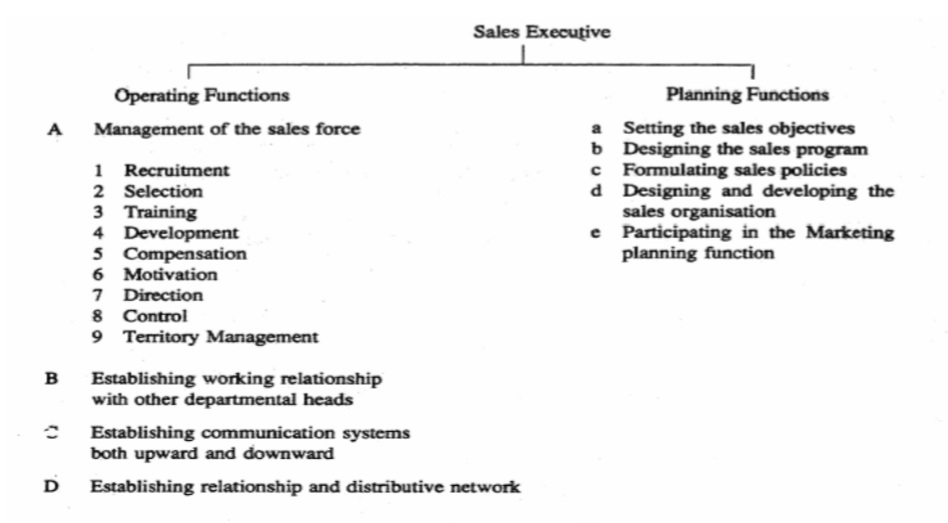
Function of Sales Executive
1. Sales Manager as a Coordinator
In order to be effectively discharged, the sales function needs to be closely coordinated with related functions like pricing, promotion and distribution. An important responsibility that the sales manager has is to coordinate personal selling with the functions so that the overall marketing programme may be made more effective.2. Coordination with Promotion Management
Though sales managers are not’ directly responsible for designing the promotional policies, they provide valuable inputs in their formulation. Coordinating the promotional functions with the activities of the sales organisation is imperative because not only are the two functions interdependent, the sales executive is also responsible to quite an extent for the implementation of the promotional programmes. Sales personnel have to be responsible for coordinating dealer effects with advertising programs and for getting their cooperation for point of purchase displays.The sales executive must also ensure that sales personnel are fully informed about the latest advertising and other promotional campaigns so that they can maximise the total promotional effort. Further, the role of personal selling, an important ingredient of the promotional mix needs to he coordinated with the rest of the promotional mix elements in terms of total promotion cost and the expectation from personal selling. In particular, advertising efforts needs to be synchronised with personal selling, to enable the latter to capitalise on it.
3. Coordination with Distribution Channels
The important areas of dealer activities which need to be coordinated with the sales effort are: gaining distribution support and overcoming obstacles to product distribution, ensuring dealer identification, reconciling sales and distribution goals and sharing promotional tasks with the dealer. Even if advertising of the product has been successful in creating a pull for the company’s products, no sales will result if final buyers do not have information on the local outlets that stock the product. Dealer identification becomes even more crucial in case of new products.The perception of business goals may differ between the channel members and the manufacturing organisation and this may lead ‘to conflict between the two entities.
Through coordination between the activities of the dealer and those of the organisation, sales executives can prevent this conflict to a certain extent. Regular sharing of information with the middlemen regarding the company programmes and policies, goes a long way in reducing disharmony. Similarly, by making the information about dealer activities and needs available to the organisation, the sales executive can ensure that the organisation will be in a position to render promotional and other assistance to the middlemen.
4. Coordination with the Pricing Function
Though the sales manager’s role in formulating pricing policies is only advisory, he is responsible for the implementation of the pricing policy. As price is an important variable affecting sales, all price changes need to be coordinated with sales policies as well as with related areas like distribution. The sales executive because of his intimate knowledge of the market and market behaviour, becomes an important source of information when changes in pricing policies are being planned. On the operational side, compensating changes in the marketing mix need to be made to offset the negative impact of the price change: the advertising campaign may need to be changed, sales presentations may need to be altered, even packaging may need to be changed to justify the price rise. In order to make it a coordinated effort, however, the sales executive would need to coordinate the personal selling activities with the pricing changes and its resultant effects.Example
The hotel sales executive’s role is important to the success of any hotel establishment.
The job description gives a list of the typical duties, tasks, and responsibilities to expect to be assigned by most hirers if you are seeking the position:
• Make lists of potential clients and conduct surveys to identify customers actively seeking a hotel
• Contact customers via calls or arranged meetings to discover their needs and requirements
• Prepare and present sales proposal to potential clients, highlighting the best features and qualities of the hotel
• Provide customers with a list of available services and their accompanying prices and offer discounts when necessary
• Assist clients in selecting the most appropriate service that best meet their specifications and needs
• Oversee the booking and reservation of space in a hotel to ensure availability and proper arrangement
• Collaborate with other hotel staff to ensure clients have a good time
• Monitor the customer service quality of the hotel to ensure customers are tended to appropriately
• Conduct price negotiations with customers on behalf of the hotel management to reach a favourable bargain for both parties
• Process and facilitate requests for customized services such as room redecoration, equipment, and switch
• Coordinate and organize the details of an event such as catering, lodging, seating, and security
• Resolve and quell misunderstandings within a hotel premises
• Maintain contact with clients to obtain feedback and to discuss opportunities for future business deals
• Set annual budgets and implement strategies effective for achieving set targets
• Conduct assessment of sales performance to make necessary adjustments to increase patronage.
Q.8. What is the role of Sales Display ? How will you manage displays effectively in the hospitality industry? (20)
Meaning of Sales Displays
Believing in the concept of “come and get it, we have it”, dales displays are in-store presentations and exhibitions of the products along with the relevant information.Effective displays increase the interest of the shoppers in the products on display and lead to increasing the level of the pass-by ratio and hence the sales. Sales displays have come to form an integral part of store atmospherics and play a useful role in retail store promotions.
Role of Sales Display
According to Lewison and Delozier, sales displays are used to:• maximize product exposure
• enhance product appearance
• stimulate product interest
• exhibit product information
• facilitate sales transaction
• ensure product security
• provide product storage
• remind Customers of planned purchases, and
• generate additional sales of impulse items.
In pursuit of the above objectives, displays perform a three-fold job:
• attract people who otherwise might not go into the store, such as passers-by out window shopping, to come inside,
• after they are inside the store, whether they came in to buy or just to look, expose them to buying suggestions by counter displays and literature, and
• those who come in to buy something, induce them. to buy a larger supply by smart packaging or display, or to buy additional products.
The power of sales displays in accomplishing the above objectives can be felt by visiting retail stores say Bata, Raymond’s, Intershoppe, Akbarally’s, Flury’s, Benetton, Singer’s Kitchen Collection, Usha-Shriram, Titan Watches and Ceat Shoppe to name a few.
In short, sales displays project a retail outlet, as well as a product’ s personality, create store atmospherics, stimulate desire to buy, trigger moods and act as silent sales people.
Managing Display Effectively
In order to get maximum advantage from sales displays it is necessary that these be organized and managed effectively.’The process of display management can be divided into two phases
1. Planning of Sales Displays
The planning phase of sales-displays covers dimensions such as :• optimal use of display space
• use of cost-effective fixtures for display which provide maximum exposure to the merchandise
• type and pattern of displays to be used and their suitability with both the available store space as well as store layout ; and
• cost and frequency of change of displays in the retail store.
2. Execution of Sales Displays
This phase of display management includes• ensuring adequate stock of merchandise to be displayed as well as in inventory
• earmarking area and allocation of speck space of different displays and fixtures
• checking the quality and features of the display fixtures procured for use in displays
• attending to display related aspects such as store name board, store front, display window size, style and colour of display signs to be used, and display window lighting and atmospherics including floors, walls, ceilings, ventilation, cooling, heating etc.
• organizing men and materials for the display including selection of outside experts, if any, and coordination with other employees of the store
• instructing store staff on handling of displays and merchandise, and – arranging for timely advertising and publicity of the store.
Ovid Riso stated the following requirements for a good product display
1. It must be easy to set up, and sturdy to stand up well. Should have its own easel or base and not require fastening, tacking or attaching to any other fixture.
2. It should illustrate the product in use if there is the slightest chance if consumer cannot see at a glance exactly how to use it.
3. It should be colourful, well designed and simple.
4. It should be informative, including the price.
Obtaining Retailer’s Cooperation
Sales displays at the retail store can be organized either singly by the store owners or jointly with the manufacturers of the products. The manufacturers sponsored product displays at retail stores carry one more important dimension. This relates to selling of the display scheme to the retailers and obtaining their cooperation for proper usage of display material and scheme.Motivating and Training Retailers
This relates to the zeal with which the retailers support the manufacturer’s efforts. In other words, for maximising results from sales displays, participating retailers need to be convinced of the objectives, and trained as well as motivated to get their utmost cooperation in the conduct of sales displays.Q.9. How will you motivate the sales person? Explain with the help of suitable examples from the hospitality industry. (20)
Sales Person can be motivated by the following ways
1. Clarity of Job
Clarity of job and what is expected from the salesperson is a great motivator. The objectives when duly quantified and well defined properly connected and linked with the reward and recognition serve as source of motivation to the salesperson.2. Sales Targets or Quotas
If a sales target or quota is to be effective in motivating a salesperson, it must be regarded as fair and attainable and yet offer a challenge to him. Because the salesperson should regard the quota as fair, it is usually sensible to allow him to participate in the setting of the quota. However, the establishment of the quotas is ultimately the sales manager’s responsibility and he will inevitably be constrained by overall company objectives. If sales are planned to increase by 10 per cent, then salesmen’s quotas must be altered in a manner consistent with this objective.Variations around this average figure will arise through the sales managers knowledge of individual salesperson and changes in commercial activity within each territory; for example, the liquidation of a key customer in a territory may be reflected in a reduced quota. Quotas can be set on Rupees sales, unit volume, margin, selling effort or activity and product type. The attainment of a sales target or quota usually results in some form of financial benefit to the salesperson.
3. Sales Contest
The sales contest is an important tool to motivate salesperson. The purpose of the sales contest varies widely. It may encourage a higher level of sales in general, to increase the sales of a slow-moving product or to reward the generation of new customers. It provides an incentive to show better performance and secure more satisfactory results. However, sales contest have a few disadvantages, one such disadvantage is that it can encourage cheating. For example, in one company which used a sales contest to promote sales at a series of promotional events around country with its dealers salesperson “stored up” orders achieved prior to the events in order to increase the apparent number of orders taken at the events.Also, contests, by pitching salesperson against salesperson, militate against the spirit of mutual help and cooperation which can improve salesforce performance.
4. Sales Conventions and Conferences
These are the devices of group motivation. They provide opportunities for salesperson to participate, gain social satisfaction and express their views on matters directly affecting their work. They promote team work, dissolve social barriers, inspire and raise salesperson’s morale. Most of the companies in India are now-a-days adopting this method to motivate their salesforce.5. Positive Affect
The positive affect method is also an important techniques for motivating the salesforce to their best. The proper application of praise, positive feedback, and human warmth and understanding can impel others to perform up to their capabilities. This must be done in a genuine way and not be perceived as overtly-self serving.Another form of motivation through positive affect occurs via small group and peer relations. Friendship, support and comradeship frequently serve as vehicles for creating positive feeling towards the company and job.
6. Leadership Style of the Manager
Leadership style of the manager plays an important role in motivating the salesperson. Inspirational leadership, which refers to influence through referent power, identification or charismatic charm is an important tool in the motivational strategy of the management. It infuses the images and expectations for extremes of effort, sacrifice, achievement and in general “the right stuff’. It is practiced through the use of professional speakers special audio tapes and video tapes designed to arouse and stimulate salesperson. It also tries to create and perpetuate certain corporate myths and success stories, which indirectly motivates salesperson to perform at their best.7. Freedom to Work
In order to perform the onerous duties and responsibilities, the salesperson must be given a reasonable amount of freedom and discretion in performing their job.Likert in his studies has mentioned that lack of enough discretion has a negative impact on employees job satisfaction. Discretion and freedom may be accomplished by allowing salesperson to develop their own call patterns, more control over the types of promotional packages that are offered to their customers etc.
Freedom or autonomy satisfies the psychological needs and is like power pay (which is a reward), making the job of salesperson mere important in the organisation.
8. Reward and Recognition
Although sales quotas, sales contests, conventions and conferences have positive carry over effects, these are short lived techniques of motivating salesmen. On the other hand reward and recognition on salesperson accomplishments are more enduring and relatively economic methods of motivation. Some of the ways to extend recognition and honour to salesperson include conferment upon the title of “salesman of the month/ year.” Congratulation telegrams from members of top management, sales trophies, offering membership of social clubs, mention in company newsletter, certificate etc. Recognition and honour satisfy salesperson’s need for self-esteem and self-respect. These are like status pay – a public acknowledgement of the value that management places upon an individual.9. Persuasion
One of the more common and recommended forms for inducing high levels of to convince salesperson that it is in their own best interests to act in a preferred way. Persuasion has the advantage of getting people to conclude that their actions were performed out of their own free will. This leads to higher levels of self direction than reward or coercive modes of influence where one perceives he or she acts more as a function or external compulsion than internal volition.10. Financial Incentives
Financial incentives are definitely a motivating factor, but it varies at the hierarchical level of the salesperson. The need is great at lower end of the salesperson. It not only keeps sales-person on the company rolls but also motivates them to contribute to the growth of the company and thereby get grown individually. It is also important managerial tool to control and direct salesforce to attain the sales objectives.Example
a. Hold regular meetings with your sales team
b. Encourage a team environment
c. Execute a field trip or outing
d. Allocate funds and invest in new sales tools
e. Personalize an individual motivation plan
f. Implement a reasonable and effective commission structure
g. Look at different daily, weekly or monthly incentives
Q.10. Write short notes on any two: ( 2×10=20)
a. Non Verbal Communication
Non-verbal means of communication include all communication forms that involves neither written nor spoken words, but occur without the use of words.Some of the types are as follows:
• Body Movements : Kinesics
• Space : Proxemics
• Voice Patterns : Paralanguage
• Time : Chronemics
• Touch
• Colour
• Layout/Design/Graphics
• Objects
Kinesics
When communicating. with others in a face-to-face situation our entire body participates in communication, which is called body language, like• Facial Expression
• Eye Contact
• Gestures
• Posture, movements etc.
Like all other forms of communication, non-verbal message should be sincerely planned otherwise gesture & body movements usually appear to be just that faked.
Use gestures naturally to reinforce the meaning you are expressing through words.
Too much shuffling of gestures, postures is distracting & annoying.
Space : Proxemics
Special change gives tone to a communication. It accents it and at times even overrides the spoken words. Proxemics involves how we arrange personal space and what we arrange in it. It is said that each one of us have four space circles around us, which are as follows:First, consider the one & half feet circle around you. Only special but a few people are permitted here – Intimate Space.
Second, inspect the four feet, beyond the first circle, friendly conversations and spontaneous communications normally occur here – Personal Space
Third, examine the personal space 4-12 feet around you. It is used more formally – i.e., for business or social situations
Last, observe the space beyond 12-16 feet things of least significance occur here – Public Space
A “Superior” can, by placing himself physically extremely close to a subordinate create a certain type of atmosphere or otherwise.
Voice & Non-Verbal Vocalisation – Paralanguage
When we speak apart from the spoken words, the manner in which a word was spoken, relates to paralanguage. In paralanguage we consider two aspects. First is the voice set which includes various measurements of voice in terms of intensity are pitch. Rhythm and resonance. These can be measured through some physical instruments used for measuring sound.The second is the -un-Verbal Vocalisation which includes laughing, crying, verbal pause & interludes of silence like: “AH’s,” “OH’s” etc.
b. Performance Evaluation of a Sales Personnel
Every sales manager is engaged in the task of appraising and evaluating his salesmen continuously, in an informal way. Informal evaluation however is not enough to arrive at realistic and astute assessment of the worth of a salesman in absolute or relative terms. The ultimate goal of any evaluation programme is to make a salesman more valuable to the company.In order to achieve this the evaluation programme must involve :
a. A study of the salesman himself – his skills, habits, aptitudes and attitudes.
b. A study of his selling record – his efforts and accomplishments.
c. An analysis of the direction the development function is to take.
Evaluating salesmen’s performance is a complex task not only because salesmen are required to perform a variety of activities, but also because different types of selling situations require different kind of selling skills, which may not lend themselves to equitable comparisons.
In addition, salesmen differ in terms of selling acumen and personal qualities, then territories differ and they are required to spend a large part of their time away from their immediate supervisor. A good monitoring system, as you have learnt in the preceding section, becomes a basis for developing an appraisal system and for evaluating sales performance.
Performance evaluation consists of setting performance standards, both quantitative and qualitative and then periodically comparing them with actual sales performance to judge salesmen in terms of their contribution to the sales objective. The concept of productivity is relevant here. A salesman is considered to be productive only when the results achieved by him offset not only the costs incurred by the company on his account, but also show some contribution towards the corporate profit. Appraisal and performance evaluation systems besides enabling the sales manager in judging the contribution of his sales team and improving its efficiency have also been found to be useful in :
a. Developing salesmanship as an interpersonal influence process.
b. Motivation of salesmen and supervisory leadership.
c. Identifying the need for continuous training and development of salesforce.
d. improving selling aids like demonstration materials, working documents etc.
e. Determining and restructuring salesmen’s territories and work assignments.
f. Improving sales planning for example, planning call cycles routes and visits, job preparation etc.
g. Introducing sound compensation and incentive systems supported by a national evaluation system.
c. Sales Budgeting methods
A sales budget is a financial plan depicting how resources should best be allocated to achieve the forecasted sales. The purpose of sales budgeting is to plan for and control the expenditure of resources (money, material, people and facilities) necessary to achieve the desired sales objectives. Sales forecast and sales budget are therefore intimately related as much as that if the sales budget is inadequate, the sales forecast will not be achieved, or if the sales forecast is increased the sales budget must be increased accordingly. Sales budget by relating sales obtained and resources deployed also acts as a means for evaluating sales planning and sales effort. It aims at attaining maximum profits by directing the emphasis on most profitable segments, customers and products.Purpose of Sales Budget
A sales budget generally serves three basic purposes.1. A Planning Tool
In order to achieve goals and objectives of the sales department, sales manager must outline essential tasks to be performed and compute the estimated costs required for their performance. Sales budgeting, therefore, helps in profit planning and provides a guide for action towards achieving the organisational objectives.2. An Instrument of Coordination
As we all know selling is only one of the important functions of marketing. To be effective it needs support from other elements of the marketing mix. The process of developing realistic sales budget draws upon backward and forward linkages of selling with marketing and in turn brings about necessary integration within the various selling and marketing functions, and co-ordination between sales, finance, production and purchase function.3. A Tool of Control
The sales budget on adoption becomes the mark against which actual results are compared.Method of Budgeting
1. What is affordable
This method is generally used by firms dealing in capital industrial goods. Also, companies giving low emphasis to sales and marketing function or having small size of operation make use of this judgemental method.2. Rules of Thumb
Such as a given percentage of sales. Mass selling goods and companies dominated by finance function are major users of this method.3. Competitive parity
Large sized companies whose products face tough competitions and need effective marketing to maintain profits make use of this method. The use of this method presumes knowledge of the competitors activities and resource allocation.4. Objective and Task Method
A systematic method help in determination of the sales budget by identifying the objective of sales function, and then ascertaining the selling and related tasks required to achieve each objective.Later, the cost of each task/activity is calculated to arrive at the total budget. The finalisation of the budget may require adjustment both in the objectives as well as in the way the task may be performed.