
Table of Contents
Q.1. Describe the process of sales strategy formulation. Explain with the help of suitable examples from the hospitality industry. (20)
The sales management function, comprises the management of the sales personnel and activities that make up the corporate sales effort. Sales managers are entrusted with the ‘task of organising, planning and implementing the sales effort so as to achieve corporate goals related to market share, sales volume and return on investment. The task involves the sales manager in a set of activities both within the organisation, and outside with other organisations.
Sequential stages of this process are –
1. Assessment of Competitive Situation and Corporate Goals
The sales objective is directly affected by the corporate mission or goal which in turn identifies the specific set of common needs and wants the company would like to satisfy. Another input in objective setting is the macro business environment. Variables in the political, economic, social and technological environment have significant bearing on what and how much the company would be able to sell. The environmental scan thus provides pointer to a company’s specific opportunities and threats, strengths and weaknesses.2. Setting Sales Objectives
Sales objectives, are intended to direct the available sales resources to their most productive use. These also serve as standards against which actual performance is compared. The sales objectives are stated in quantitative and qualitative terms. The qualitative goals generally relate to strengthening dealer relationships, developing good consumer support, nullifying product misinformation, attaining desired corporate image.3. Determination of the Type of Sales Force Needed
The quality of the sales personnel needed, would depend upon the quality of contribution that top management expects the sales organisation to make as well as the actual workload that is expected to be generated. Specifically, it would depend upon the role that the salesmen are expected to perform. If the company has decided to do significant amount of preselling through its advertising the salesman’s job is considerably simplified and this has implication for the type of salesmen needed.Companies like Instrumentation Ltd., Kota, manufacturing sophisticated technical equipment expect their sales engineers to carry out the entire span of activities fromcommissioning and installation of. equipment to after sales service. You can therefore clearly envisage that the type of sales personnel would vary across organisations, depending upon the role that has, been decided for them in the-organisation. Some of the factors that influence the type of sales person are product characteristics, customer characteristics, competitors practices channel design and corporate marketing policy.
4. Determination of the Size of the Sales Force
Another key decision is the determination of the number of sales persons needed to achieve the sales objectives. Recruiting more than the optimum number would mean that the company ‘is bearing unnecessary costs at-the expense of its net profits.Recruiting less than optimum would mean losing opportunities for exploiting sales prospects. It is not easy to prescribe an ideal sales force size as the important determinants of sales force size-market size, and potential, competitive activity, allocation of sales task between the channel and corporate organisation differ from company to company. With respect to their own set of variables, companies do try to arrive at an ideal figure by using various methods such as
a. The incremental method,
b. the workload method and the
c. sales potential method.
5. Organising the Sales Effort – Territory Design
Personal selling objectives set the tone of the selling activities to be performed in an organisation. Defining these activities and their level of performance would lead you to an estimate of how many sales personnel at various levels are required in the organisation. The strategic decisions here include the organisational structure of the sales force and the choice of the field sales organisation.Companies may treat their entire market as their total field of operation and assign sales duties to their personnel indiscriminately but more often than not they prefer to divide the market into sales territories either on the basis of geographical size or sales potential , or both because of valid reasons.
6. Establishing and Managing Channels Support and Coordination
The channels of distribution usually act as the only point of contact the final buyer has with the manufacturer. They together with the sales organisation of the manufacturers collectively bear the responsibility, of consummating exchanges with the final buyers. When indirect distribution-is adopted, it is -imperative that the sales organisation initiates dealer cooperation programmes. Dealer support typically has to be, ensured in the area of maintenance of adequate stocks of the products and local promotion in the form of point purchase displays and local advertising. Another key area of support is the provision of market feedback the norms of which must be decided between the dealer network and the manufacturing organisation. The management of manufacturer dealer cooperation, includes inter aliasa. Choice of appropriate dealer incentive programmes to stimulate distributive outlets to greater setting effort.
b. Deciding upon procedures for sharing information with the dealer network.
c. Deciding upon measures to ensure and promote dealer loyalty.
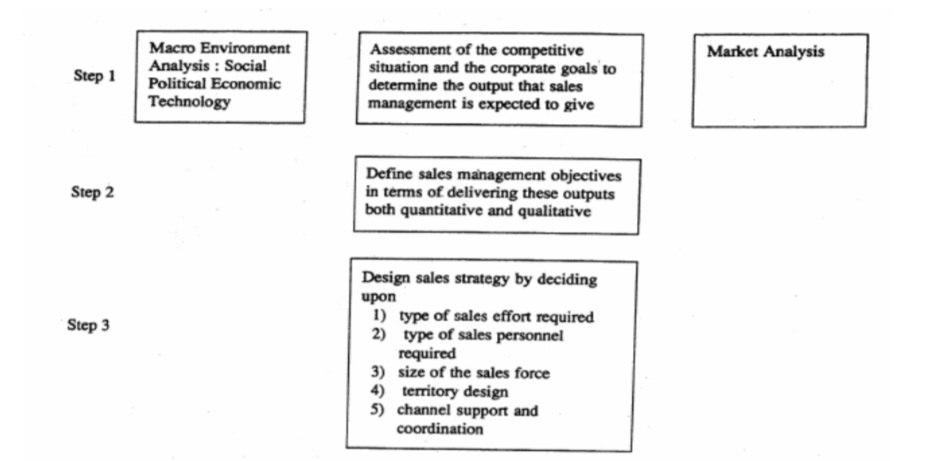
Strategy process formulation
Q.2. Enumerate the qualities of a good sales personnel. Also mention the scope of personal selling activities in the hospitality industry. (20)
Qualities of a Good Sales Person
Some people says salesmen are born salesmen, while others believe that training can help in making good salesmen. Irrespective of these opinions, good salesman has certain qualities and abilities as a result he is able to perform better than others.Philip Kolter has identified two basic qualities of a good’ sales person namely, empathy and persuasion. But others have listed more. Some of the qualities of a good sales person are as follows
1. Ability to estimate customer’s needs and desires
He is alert and quickly determines what the customer wants and the best way to sell.2. Ambition
He likes to do a good job and is interested in getting ahead with your company.3. Appearance
Appearances mean a lot toady and the successful salesman is neat and organised. He presents himself well in person. Also, he keeps his desk. books and manuals neat and ready for use.4. Business Sense
He understands that you are in business to make a profit and quickly learns the ins- and -outs of your organisation.5. Courtesy
He reveals a sincere desire to help customers and treats them as guests even when he visits their places of business.6. Creativeness
Imagination, vision and the ability to create ideas make your man dynamic.7. Curiosity
He wants to learn all he can about his job, his products and his customers.8. Enthusiasm
There is nothing that can drain away a prospect’s buying interest more than a half-dead salesman. Dullness should be left at home. A salesman must radiate enthusiasm during and after the sales call.9. Figure Sense
He should have the mathematical ability to figure and fill up order form correctly and to make the necessary reports.10. Flexibility
A good salesman is able to adapt himself to a variety of customers. Each contact may require a adapting the sales talk, speech habits and even appearance.11. Friendliness
A salesman should be able to make people like him and he must like to meet people.12. Handwriting
He must write legibly so that his paper work can be readily understood by his office people and by his customers.13. Health
Good health generates energy and energy is needed to sell. Poor health prevents many salesmen from fulfilling their potentials.14. Integrity
A salesman must be trusted to do his job well. He cannot help but he successful when his customers trust him.15. Interest in his job
He likes selling and working for your company. .16. Knowledge
In some business, an applicant must also have a through knowledge of the highly specialized products or services his employer offers. In some cases, this knowledge can be gained only by years of experience.17. Loyalty
He must be able to impress upon his customers the idea that his company is the best in the business.18. Mental abilities
He has the intelligence to understand your products and those of your competitors. He must know how to use words, to understand and direct people’ and to remember names and faces. He should also be able to understand prospective customers and know how to act under varying conditions.19. Motivation
He must have more than just an interest is selling. Psychologists have found certain predominant patterns in men who have become realty successfully sales men. They live in the present and not in the future. They do want power over others and prefer not to work under close supervision.20. Originality
He is constantly searching for new ideas to be used in selling your products and will suggest better ways of doing things.21. Persuasiveness
Very few products of any type actually sell themselves. They must be sold. Your man must have the ability to get people to agree, There are situations when persuasiveness may vary keeping in view the consumer’s response.22. Poise
His maturity is reflected in his behaviour. He should be positive and confident, energetic and business-like. He should be able to demonstrate to your customers that he knows what he is talking about.23. Self-starter
Your man works well without constant supervision and is able to make decisions on his own.24. Speech
He can speak clearly and maturely in a natural tone. He can emphasize sales points with sincerity and friendliness.25. Speech
He can speak clearly and maturely in a natural tone. He can emphasize sales points with sincerity and friendliness.Scope of personal selling activities in the hospitality industry
A typical day in a sales person’s life includes making certain number of calls, opening of new accounts, analysing the account lost, if any, sales presentation, closing of initiated sales preparing daily reports and keeping records of transactions.
1. Problem Solving Activity for the Customer
Problem solving requires substantial knowledge and decision making skill. In the case where prospective. customers are not aware of utility of products or services in question, there is a problem. The sales person can contribute by identifying and suggesting best solution for it. In many sales situations, these activities make up a substantial part of the total sales effort.2. Co-ordinating Buyers and Sellers Activities
With the multifarious and complex system of todays business situation there is a need for a catalyst to bring together and work with the parallel departments of supplier and customer.Most of the sales persons are in position to perform this function.
3. Mostnding Conventions
In conventions organised by company, sales persons interact with their peers about work situations and problems and arrive at a consensus of opinion on issues which impinge on their work. Conventions range in nature from company convention to industry -,convention. They may be local, national or international in nature. These are important motivational and inspirational tools for the sales persons whose broad purposes are to:• Provide strength to the sales persons identity with the company to executive.
• Exchange information with sales persons.
• Provide specialised training.
• Provide sales persons with a change of pace.
4. Attending Trade Show
Trade shows are held seasonally or annually. Sales persons usually attend these trade fair not only to achieve sales, but also to understand competition’s products and prices. Technological, advancement in different area is also communicated to them through these trade shows. Ever since Trade Fair Authority of India has been set up various types of fairs and exhibitions including the Annual India International Trade Fair are being held more regularly.5. Attending Educational Workshops
Many lines of sales work afford the opportunity for continued formal education throughout a career. Many companies like NTPC, GNGC, TISC®, etc. require their sales persons to follow a continued programme of studies in addition to company training.6. Keeping Records
The job of sales person is not finished until the paper work is completed. A sales person has to prepare daily call reports including new accounts opening report, account closing reports etc. It is understandable that these records not only keep track of their day to day activities, but also provide past and present data to undertake any future assessment.Q.3. Write a detailed note on the importance and application of computerisation and information technology on sales management. Substantiate your answer with suitable examples from the hospitality industry. (20)
Marketing professionals use computer technology to plan, manage and monitor campaigns. By analyzing and manipulating data on computers, they can increase the precision of marketing campaigns, personalize customer and prospect communications, and improve customer relationship management. Computer technology also makes it easier for marketing professionals to collaborate with colleagues, agencies and suppliers.
1. Improve Marketing Precision
With computers, marketing teams store, analyze and manage large volumes of data on prospects and customers. Understanding the demographics, purchasing histories and product preferences of different groups and individuals enables marketers to target products and campaigns with greater precision and to personalize communications.2. Increase Campaign Capacity
With cloud resources, marketers can quickly increase computing capacity when they need it. By purchasing additional computing capacity from a cloud service provider, rather than investing in fixed systems, marketers can handle peaks in demand. Increasing website capacity to handle large numbers of campaign responses, for example, ensures that customers do not experience long waiting times. Marketers also use cloud computing to provide the additional capacity for test marketing and to manage large-scale email campaigns.3. Automate Marketing Campaigns
Marketing automation is now an essential element in lead management, the process of converting sales leads to customers. Marketing automation identifies a prospect’s level of interest or intent to buy based on the response to a series of emails. The team can then follow up with detailed information or a sales call, depending on the response.4. Open New Communication Channels
Computer technology gives marketers the opportunity to build dialog and strengthen relationships with customers and prospects. Marketers must respond to consumers’ growing use of the Internet and social media. By monitoring discussions on social networks and product review sites, marketers can gain insight into consumer attitudes and take the opportunity to respond and build dialog.5. Provide Efficient Sales Support
Field sales teams and distributors require access to marketing support material, such as brochures, presentations, product data sheets, and advertising or email templates. By storing digital versions of campaign material in a secure Web portal and providing access to authorized users, marketers can simplify distribution of support material and increase control over its use.6. Improve Collaboration
Using desktop video or Web-conferencing tools, marketers can collaborate with colleagues in sales and product development or account teams in advertising agencies and public relations consultancies. Collaboration tools can speed product development by making it easy for teams to meet and take decisions, rather than trying to arrange face-to-face meetings. Agency teams can discuss or review campaign proposals and changes to ensure they meet deadlines.Q.4. What do you understand by sales presentation? List and explain presentation skills that help in making an effective presentation. (20)
Sales Presentation
A presentation is a commitment by the presenter to help the audience to do something for solving a problem. An interesting thing to note is that in a presentation commitments are made by the presenter and the audiences are making judgement, simultaneously. The presenter advocates and audience evaluate, to render a verdict. In terms of content and structure, presentations and speeches have a good deal in common with formal reports – many of them are oral version of a written document.Skills that helps in making effective presentation
1. Start Ralf Way
In preparing your presentation, may be you should start about halfway through. There isn’t an audience in the world that hasn’t said to itself, “When is the presenter going to stop talking about his business and start about mine”. So instead of “Opening Remarks”, why not structure your outline to begin with, ” an issue of direct concern to my audience”. The sooner you can stop being self-conscious and start being audience-conscious, the better your chances of winning a positive verdict.2. Plan Out Content
Content is always the first requirement of any presentation. Once content breaks down, delivery is never far behind. If you don’t know your subject, your voice is going to tighten. If you don’t believe what you are saying, your gestures are going to be half-hearted. If you get a question that catches you unprepared, your body language is going to answer for you. How much substance do you need in order to feel supremely confident about your next presentation? The answer is, have in your head about seven times as much information as you are likely to use in your presentation.3. Clarity
It’s impossible to be too clear. Many presentations are so muddled that members of the audience say to themselves, “What in the world is that person talking about?” or, “What on earth am I doing hereHere is a simple but effective exercise: Ask yourself “If I were going to put a fifteen-word headline on my presentation, what would it say?” Isolate the meat of what you want to communicate and make sure you say it – clearly, prominently. Also ask yourself, “What do I really want my audience to do as a result of this presentation?
4. Partial Receptivity
Keep in mind that your audience is going to remember about one quarter of what you say. A surprising number of presenters will assume that once a statement is made, the audience retains it. Iii reality, an average audience retains approximately 25 per cent of a presentation if the verbal content is given visual reinforcement (slides, charts, videotapes). If the presenter is simply standing there, going through a manuscript, flooding the atmosphere with words, he or she will be lucky to have one tenth of the total message retained by the audience.5. Encourage Participation
Participation by your audience will help them remember you and your message, but “handle with care”. Participation can backfire. You, the presenter, can ask you-audience to do almost anything. Most audiences are surprisingly agreeable. They will do almost anything. Nonetheless, a few words of caution.6. Control Nervousness
Nervousness is not all bad, but it can become serious when your audience becomes more concerned about your nerves than your subject. Nervousness is the number one problems of people who make important presentations in advertising, or in any other business. But nervousness (sometimes known as “stage freight”), is not all bad.7. Eye Contact
Eye contact is the strongest force* in your favour during a “Live” Presentation. When you make your next presentation, you will know whether you are making eye contact or not because you can see your audience.There is a big difference between staring at people and eye contact. Staring is intimidating, confrontational. Eye contact reduces the distance between people. It reaches out, asks for understanding on a one-to-one basis.
8. Body Language
“People may lie, but body language never does.” Body language, once you have learned how to read it, is going to tell you more than what your audience will say.You can rate people by their body language, and use your ratings to apportion the amount of time you spend with each member of your audience. Obviously, you will want to work a little harder – with eye contact and participation techniques – on the person who is scoring low on your body language scale.
Q.5. Write short notes on any two of the following: (2×10=20)
a. Communication Process
The most simple model of the communication process can be :
Sender ————————>————– Message ————————>———— Receiver
The model indicates the essential elements of communication, viz., the sender and the receiver, and the message that is exchanged between them. If any one of the three elements is missing, communication does not take place. However, the process of communication is a much more complex phenomenon consisting of at least five elements which are subject to various influences.
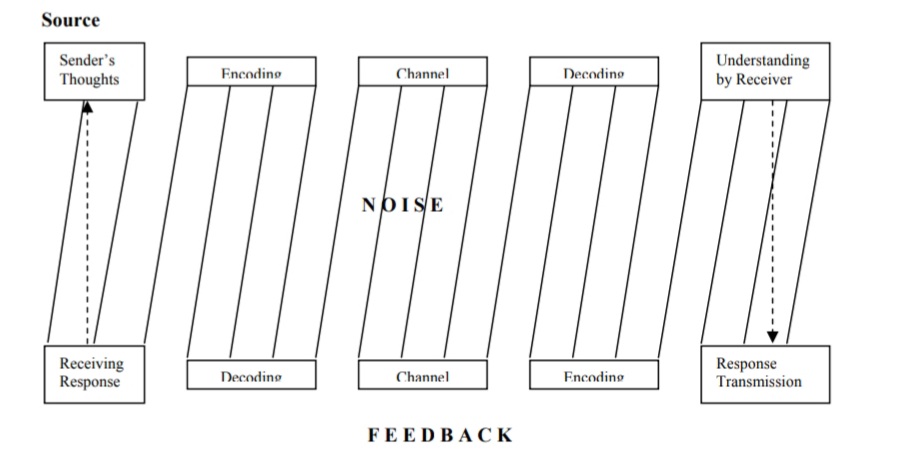
Model of communication process
1. Source
In this model the first element is the source of the communication from where the communication originates. The source or sender can be a person, a number of persons, or even a machine like a satellite or computer. The sender initiates communication because he or she has some need, thought, idea or information that he or she wishes to convey to the other person, persons or machine. If, for example, an accidental fire has broken out in a part of Hotel, the security officer (source) will need to convey the message immediately to the guests (receiver). Fire alarm (machine) will do the same in place of the security officer.2. Encoding Message
The next element in the process is that of encoding the information to be transmitted. Encoding enables the thoughts to be put in the form of symbols. Normally language provides the symbols that are used in the transmission of thoughts to another person. However, language is not the only means to convey the thoughts, needs or information. There are non-verbal means, e.g., gestures, which provide another form through which thoughts can be transmitted.3. Channel
The next element in the process of communication is the channel through which the communication is transmitted. It is the link that joins the sender and the receiver. The most commonly used channels are sight and sound. In the organisational environment, the channel could take the form of face-to-face conversation, written memos, telephonic exchanges, group meetings, computerised Local Area Network (LAN), etc.4. Decoding
Decoding and understanding the message constitute the last two elements in the process of communicating from sender to receiver. The receiver in the first instance receives the message and decodes it, that is to say, interprets and translates it into thoughts, understanding and desired response. A successful communication occurs when the receiver decodes the message and attaches a meaning to it which very nearly approximates the idea, thoughts or information the sender wished to transmit.5. Feedback
Response and feedback complete the two-way process of communication. It is through the feedback that the source (sender) comes to know if the message was correctly received and understood. In case it is found that the message has been received incorrectly, it is possible to make corrections subsequently but for this the response has to be timely.6. Noise
Surrounding the entire spectrum of communication is the noise that affects the accuracy and fidelity of the message communicated. Noise is any factor that disturbs, confuses or otherwise interferes with communication. It can arise at any stage in the communication process. The sender may not be able to encode the message properly or may not be properly audible. The message may get distorted by other sounds in the environment. The receiver may not hear the message, or comprehend it in a manner not entirely intended by the sender of the message.b. AIDAS Theory of Selling
This theory is based on the premise that during a sales presentation, the prospect consciously goes through five different stages. These are ATTENTION, INTEREST, DESIRE, ACTION AND SATISFACTION. In fact the name of this theory has been derived from the initial letters of these five words. The proponents of this theory believe that the sales person should design his presentation in such a manner, which takes care of all these stages of the process of selling.
The details of five components of AIDAS theory are
a. Attention
The sales person should attract the prospect to his presentation before he actually goes into the details of the same. This is to ensure that the prospect becomes receptive to the presentation.Unless the sales person’ involves the prospect’s mind in the presentation his total effort may go unnoticed or unregistered. Drawing the propect’s attention, therefore, tantamount to dissociating him from other assignments and involving him in the presentation, both physically and mentally, so as to gain maximum from the sales meeting.
b. Interest
Once the salesperson has successfully gained -the prospect’s attention, he/she should maintain the interest of the prospects’ throughout the presentation. In other words, the sales person should ensure that the prospect remains glued to his presentation throughout its length and that he does not wander away from the same. The sales person should be aware of the interest, likes, dislikes, attitude and motivation of the prospect and should proceed with the presentation, keeping in view all these factors.c. Desire
The next step in the sales process, as per AIDA’s theory, is to create a strong desire in the prospect’s mind to purchase his product. The sales person should consciously try to bring the prospect into this stage of readiness to the point of buying his product.He should concentrate on projecting the benefits of his product to the prospect. He should go even to the extent of presenting benefits according to the motivation of the prospect.
The sales person should also be prepared to anticipate the resistance to his sales presentation in terms of objections or questions from the prospect. Not only that, he should be prepared with several answers and explanations to the anticipated objections.
d. Action
Once the sales person has been successful in taking his prospect through the three stages, as discussed above, he should induce the prospect into actually buying the product. It would be interesting for us to understand that even after going through the three stages of attention, interest and desire, the prospect may still have some doubt or some inertia which will stop him from taking the final decision of actually buying the product. Hence, it becomes an important task of the sales person to help his prospect in taking the final decision.e. Satisfaction
Once the prospect has placed an order, the sales person should ensure that the prospect carries the impressions of having taken the right decision. He should always thank the prospect and even go to the extent of saying, “I appreciate your choice sir, you have taken an excellent decision”.The sales person should also ensure that the delivery of the order takes place within the time frame and all other promises are kept, regarding installation, free servicing, etc. Moreover, the sales person should try to keep in touch with his prospects and should keep enquiring about the efficient performance of his purchase.
c. Sales Display in Hospitality
Meaning of Sales Displays
Believing in the concept of “come and get it, we have it”, dales displays are in-store presentations and exhibitions of the products alongwith the relevant information.Effective displays increase the interest of the shoppers in the products on display and lead to increasing the level of the pass-by ratio and hence the sales. Sales displays have come to form an integral part of store atmospherics and play a useful role in retail store promotions.
Role of Sales Display
According to Lewison and Delozier, sales displays are used to:• maximize product exposure
• enhance product appearance
• stimulate product interest
• exhibit product information
• facilitate sales transaction
• ensure product security
• provide product storage
• remind Customers of planned purchases, and
• generate additional sales of impulse items.
In pursuit of the above objectives, displays perform a three-fold job:
• attract people who otherwise might not go into the store, such as passers-by out window shopping, to come inside,
• after they are inside the store, whether they came in to buy or just to look, expose them to buying suggestions by counter displays and literature, and
• those who come in to buy something, induce them. to buy a larger supply by smart packaging or display, or to buy additional products.
The power of sales displays in accomplishing the above objectives can be felt by visiting retail stores say Bata, Raymond’s, Intershoppe, Akbarally’s, Flury’s, Benetton, Singer’s Kitchen Collection, Usha-Shriram, Titan Watches and Ceat Shoppe to name a few.
In short, sales displays project a retail outlet, as well as a product’ s personality, create store atmospherics, stimulate desire to buy, trigger moods and act as silent sales people.
Q.6. Differentiate between Recruitment and Selection process. What are the sources of recruitment in the hospitality industry? (20)
Differences
The process of recruitment involves the development of suitable techniques for attracting more candidates to a position vacancy, while the process of selection involves identifying the most suitable candidate for the vacancy. Recruitment precedes the selection process, and the selection process is only completed when a job offer is created and given to the selected candidate by appointment letter.1. Recruitment is the process of finding candidates for the vacant position and encouraging them to apply for it. Selection means choosing the best candidate from the pool of applicants and offering them the job.
2. Recruitment is a positive process aimed at attracting more and more job seekers to apply. Selection is a negative process, rejecting unfit candidates from the list.
3. Of the two, recruitment is relatively simpler. Recruitment has the recruiter paying less attention to scrutinizing individual candidates, whereas selection involves a more thorough examination of candidates where recruiters aim to learn every minute detail about each candidate, so they can choose the perfect match for the job.
4. Recruitment is less time-consuming and less economically demanding, as it only involves identifying the needs of the job and encouraging candidates to apply for them. Selection involves a wide range of activities, which can be both time-consuming and expensive.
5. In recruitment, communication of vacancy is done so through various sources such as the internet, newspaper, magazines, etc., and distributes forms easily so candidates can apply. During the selection process, assessment is done so through various evaluation stages, such as form submission, written exams, interviews, etc.
Sources of Recruitment are
1. Advertisements
Advertisements are both a source of recruits and a method of reaching them. Newspapers, magazines and trade journals are the most widely used media for advertisements Advertisements ordinarily produce large number of applicants in a very short time and at a low cost. However, this factor may be offset by the increased expense of carefully screening the large number of prospects and the average quality of applicants may be of questionable character.Recruitment advertisements usually include information about the company, nature of the job, specific qualifications required and compensation. The specific details in the advertisement vary with the company and its situation. The quality of prospects recruited by advertisement may be increased by careful selection of media and by proper statements of information in the advertisement. An advertisement in trade journal assures responses from people who are already in the profession and would be interested in selling. The amount and type of information given in the advertisement affects the quality and quantity of the applicants. The more the information given in the advertisement, the more it serves as a qualitative screening device. A firm, by stating minimum qualifications rather than optimum requirements can generate large number of applications, requiring more careful screening.
2. Employment Agencies
Many companies use employment agencies to get the recruits for the sales positions. To use this source effectively, sales manager must ensure that the agency understands the company and its needs thoroughly. Whenever an agency is used, it should have the clear understanding of the job’s objective, job specifications and the literature about the company. Also agencies need time to learn about an employing firm and its unique requirements-thus considerable gains accrue from continuing relationships with agencies that perform satisfactorily. If the agency is selected carefully and good long-term relations are established with it, the dividends can be satisfying.3. Educational Institutions
This source includes colleges, universities, technical and vocational institutes. This source is, tapped for getting qualified people for entry level positions in sales. Students from technical/ vocational institutes or with specific subjects like Physics, Biology, Hotel Management are recruited by the companies, where selling requires specialised knowledge and skills for that particular industry. College graduates are generally taken by the companies having formal sales training programme or for simple selling jobs.Recruits from educational institutions are more easily adaptable than their more experienced counterparts. They have no developed loyalties for a firm or industry and they probably have not acquired any bad work habits. Usually, they have acquired certain social graces, are more poised and mature. They are supposed to have developed their ability to think, to reason logically and to express themselves reasonably well.
4. Salesmen of Non-competing Companies
Individuals currently employed as salesmen for non-competing companies are often the attractive recruiting prospects. Such people already have selling experience, some of which may be readily transferable. For those, who have worked for companies in related industries-there is additional attraction of knowing something about the product and the market. Recruits from this source presumably have some selling skills and thus reduce the amount of training required. A firm that hires salesmen from other companies should be especially careful to determine, why the man is interested in changing jobs and why he wants to work for the hiring company. People hired from other companies may not have the same degree of loyalty, that recruits possess when promoted from within.5. Salesmen of Competing Companies
The question of whether to hire competitors’ salesmen is argued on ethical grounds and from an economic standpoint. It is considered unethical to recruit the competitors’ salesmen actively, after he has spent the money on hiring and training them. Furthermore, these salesmen may be able to divulge company secrets to the competitors. It is also seen as an attempt to take away competitors’ customers. From an economic point of view, these are mixed feelings regarding this source. On one hand, they know the product, customers and competitors. They also are experienced sellers and, therefore, no money is required to be spent for their training. On the other hand, it is a costly source as generally, higher pay must be offered to them to leave their organisations. Some sales managers, as a matter of policy, refrain from hiring competitors’ salespersons, as their loyalty towards company is questionable.6. Internal Transfers
The persons working in other departments of the company maybe transferred as salesmen to the sales department. This is generally used along with the other recruitment sources.Transfers are good prospects for sales positions, whenever product knowledge makes up a substantial portion of sales training. They are also familiar with company’s objectives, policies and programmes. The accuracy of evaluating these men is more, as the management is able to observe their and evaluate their potential as salesperson before they are transferred to sales department. Factory and office employees may consider the transfer to sales department as promotion, which helps in increasing their moral and loyalty.
7. Recommendations of Present Salesmen
A company’s sales force is a good source of leads to new recruits. Salesmen typically have wide circles of acquaintances, since both on and off the job, they continually meet new people and generally have many friends with similar interests. Their contacts may yield good sales people because of their understanding of the job and the kind of salesmen required by the company. However, management faces the risk that the salesmen may recommend friends or business associates on the basis of personal feelings rather than on an impartial evaluation of prospects’ qualifications.The firm should be able to weed them out through its selection process. When an applicant recommended by a salesmen is to be turned down, management should explain clearly but diplomatically to the salesman why his recruit is not being accepted. Sales people are valuable source of recommendations.
Q.7. What are the different compensation packages available to sales personnel ? How are these compensation packages designed? (20)
Types of Compensation Packages
1. Direct
The direct compensation package for a salesman is more or less the same in all companies. A company employing technical person as salesman for selling, say, industrial or electronic products may offer a high basic salary. Sometimes, when the product is in the introductory stage the function of the salesman is to create new markets and make customers understand how to use the product as in the case of a new consumer durable product like Vacuum Cleaners or a new electronics products used by certain industries; the basic salary of the salesman may be on the higher side. The direct compensation package of a salesperson thus consists of the basic pay + allowances covering all travel and entertainment expenses etc. In case, the salesman to stay overnight his boarding and lodging allowances are also provided for. All the me expenses needless to say, are budgeted and controlled as per the salesman’s route into cycle of travelling. The salesman is normally required to present necessary vouchers to get his; expenses reimbursed.The basic salary and other allowances are revised from time to time. They also increase with promotion of the salesman. More important than the basic salary are the other benefits available to the salesman.
2. Indirect
These consist of financial as well as non-financial incentives.The financial incentives are again in more than one form:
1. Salary plus commission on sales above a certain amount
Herein, the salesman receives direct salary and a commission in addition to it. Every salesman is assigned a fixed quota, territory wise/customer wise to be achieved in a fixed period of time. The commission is awarded on achievement of the targeted quota. Again, a fixed percentage of sales achieved over and above the target is also set. This type of compensation scheme ensures a direct salary as well as an in-built motivation system through incentives.
This method for compensation with an in-built incentive scheme is adopted by most consumer non-durable as well as consumer durable companies. Certain industrial product companies and financial service companies, insurance companies, also are increasingly adopting this method.
2. Salary plus share in profits
This is not a very prevalent method. It is generally suggested for a company stilling high value items with high profit margins. The incentive here is based on profits earned. Herein, the selling expenses to sell a product may also be large and this is incorporated in the profit sharing scheme as acts as a control mechanism. Also salespeople working to obtain contracts are generally given a share in profits rather than awarded on direct sales.
Non-financial incentives
The trend these days is to provide other non-financial incentives like :a. Training programme
b. Awards, recognitions and prizes.
Most companies offer training programmes for their salesmen. On an average a salesman has to undergo a training course every one or two years. These programmes enable interaction between salesmen of different territories as well as provide them with latest developments in the field. These training programmes are viewed as an indirect benefit by the salesmen. They may be held in the company premises or preferably at an outdoor locale. They break the monotony of the salesman’s job as well as make him feel a part of the company team. A sense of belonging is cultivated which also motivates him. Certain companies with foreign holding companies may also send their salesmen for training abroad providing them with good opportunities to learn about their field.
In addition to training programmes the award ceremonies for outstanding achievements in sales are held in exotic locales like hill stations or five-star hotels.
The awards are presented through foreign dignitaries or important people in the field, thus providing the salesman with the much needed recognition.
Designing of Compensation Packages
Criteria which must be kept in mind while designing a salesforce compensation package. These are primarily1. The budget set for the compensation of salesforce;
2. A proper study of job requirements is the second step followed by a concise job description;
3 Defining the organisational hierarchy of the salesforce the role and function of each responsible person in the structure;
4. The current trend in the competitors selling similar products in the similar markets;
5. The company’s policy of motivating salespeople whether through an in-built incentive system or through provision of indirect benefits like entertainment allowance/liberal travelling allowances, other out of pocket expense reimbursements;
6. Formal and compulsory training programmes for all sales personnel to make them feel a part of the company as well as to develop their skill and provide them with the necessary break from the monotony of daily routine sales reports;
7. Human resource development programmes to create a feeling attachment towards the task at hand and imbibe the culture of the organisation.
The present day trends lay greater emphasis on the last two mentioned considerations along with a direct compensation programme inclusive of direct salary. With selling having become more and more difficult a satisfactory compensation package is a must to avoid high turnover within the salesforce.
There are some factors which affects the design of compensation package
1. The Relation with product life Cycle
The amount of selling effort is directly related with the stage at which a product is in its life cycle. The compensation structure is a function of selling effort. So, in effect, the compensation structure is an indirect function of the selling effort.2. Compensation Related with Demographic Characteristic
In practical situations the compensation package preferred by the salespeople depends upon their demographic characteristics also. Their age and size of family or number of dependents play an important part in the preference for a basic salary and/or incentives. However, this cannot be generalised and depends largely on the individual.Q.8. What is sales control system? What are the purposes and methods of sales control ? (20)
Sales Control
A sales control system can be set-up by a firm by instituting action on the following five steps:1. Setting detailed objectives (at least around key result areas)
2. Establishing standards for appraising performance.
3. Gathering information on actual sales activities and results.
4. Comparison of actual results with established standards.
5. Taking remedial actions (need based).
The existence of a comprehensive sales information system in the firm is a pre-requisite for an effective sales control system. Such an information system can be built by regularly recording sales by unit, by value, by customer, by sales person, by territory, by distribution outlet, by cash or credit. In addition to invoice, other important information sources include despatch notes, credit notes, customer call reports, daily activity (and time spent) reports, journey plans, sales quotation slips, sales expense forms, discount and allowances records, customer complaints, warranty claims settled, market intelligence including sales promotion special reports sent by sales person. In short, only comprehensive sales information system can lead to timely and meaningful sales control.
Purpose of Sales Control
By comparing the actual sales results with the objectives set and diagnosing the causes for the variance between the two, sales control assists the sales manager :• To initiate remedial steps
• To revise the sales policy and the strategies followed
• To implement steps for improving the productivity of the salesforce
• To improve the quality of target setting, sales planning and budgeting functions
• To increase sales profitability
Methods of Sales Control
Three most commonly used methods of sales control are1. Sales Analysis
Sales analysis is a detailed examination of sales volume by territory, sales person customer, product line, etc. It works on a basic principle that the trends of the total sales volume conceal rather than reveal the market reality. Researches point out that in most sales organisations a large percentage of the customers, orders, products or territories bring in .only a small percentage of the total sales volume as well as net profits. This situation is popularly referred as 80-20 principles i.e. 80 per cent of the orders, customers, territories or products contribute only 20 per cent of the sales or profit. Conversely, 20 per cent of these selling units account for 80 per cent of the volume or profit. Likewise, there are examples of Iceberg principle which show that the total sales volume may reveal only about ten per cent of the real market situation which is above the surface and the mighty 90 per cent may remain unknown. It is, therefore, strongly recommended that for unearthing the reality and gaining meaningful insights regarding company’s selling strengths and weaknesses sales must be analysed on the bases discussed belowa. Sales Analysis by Territory
In this method sales managers scan the total sales on territory basis. It assumes that each quota assigned to sales person was based on, air and sound measurement of potential. In addition, any unusual conditions in the individual territories such as intense competition, strike by labour union or transportation etc. which made an adverse effect. on sales of the company’s product was considered in order to guide further sales analysis.b. Sales Analysis by Sales person
Concentrating on the territory, the Sales Manager should see the sales performance of all the sales persons working in the territory.c. Sales Analysis by Product Line
The Sales Manager should see his sales performance based on product line.d. Sales Analysis by Customer
Customer-wise break-up of sales attained by an organisation is also focused by Sales Manager.2. Marketing Cost Analysis
Attainment of targeted sales volume is only one part of fulfilment of the sales objective of the firm, the other important part being the level of selling costs incurred to attain the given sales volume. It is not mere sales rather sales with budgeted profits or expenses that really matter.Marketing cost analysis is a detailed examination of the costs incurred in the organisation and administration of the sales and marketing function and its impact on sales volume. It is a fact finding analysis which relates costs to sales volume and resultant profitability.
It pre-supposes the existence of a good costing and financial accounting system in the firm. By relating sales, cost and financial dimension of each selling transaction and activity it can generate:
• Cost of goods per rupee of sales
• Profit per rupee of sales
• Profit per segment, channel, territory, product pack, sales person, etc.
• Sales volume and turnover of receivables.
• Turnover of stock and profitability
• Average value of orders
• Average cost per orders
• Total value of orders
• Inquiry – order conversion ratio and cost
• Number of inquiries generated say in response to advertisement, sales person call, Direct mail etc
It would be worth repeating that the above listed valuable information can only be generated by systematizing the cost accounting system in the firm. This costing system among other, dimensions should be set up sales function-wise, cost centre-wise and as a criteria for allocation and absorption of selling marketing and other general management costs.
3. Sales Management Audit
Sales management audit is a comprehensive, systematic, independent and periodic audit of the sales policy, objectives strategies, organization and procedures followed by the firm.The purpose of sales management audit is to evaluate the soundness of the sales management of the firm. It examines the validity of the very basis and assumptions on which the sales function is planned and managed. It appraises the suitability of the prevailing sales management system in the emerging market environment of tomorrow. By critically evaluating the strength of the sales management against the changing market environment it points out to the emerging areas of opportunity as well as the areas which need intervention.
Some of the aspects covered in the sales management audit include
• Appropriateness of selling function objectives
• Role of the selling function in the promotion-mix and sales-marketing integration
• Organization and work-norms of the sales force and its size
• Recruitment, selection, promotion policy, compensation and motivation of salesforce
• Basis of sales quota, sales budget, territory allocation and their market need suitability
• Quality of salesforce, appraisal criteria and training and development of sales personnel
Sales management audit, is relatively a new technique of sales management control. Its conduct and format is yet to be standardized and so is its coverage. From the limited experience it is felt that if conducted by outside professionals it benefits the company immensely. In the case of a leading consumer durables company this audit inter alia resulted in the re-organisation of its sales department from the functional system to product manager system, as also a change in its selling system from selling through distributor to retailers. This change carried out two years ago has improved the market share as well as profitability of the company. In the case of another company dealing in vanaspati and edible oils, the sales audit brought out the redundancy of the position of Assistant Sales Officer between the sales supervisor and regional sales manager.
Q.9. Discuss the need of Sales Budgeting. Also explain the preparation of a Sales Budget, with the help of suitable examples. (20)
A sales budget is a financial plan depicting how resources should best be allocated to achieve the forecasted sales. The purpose of sales budgeting is to plan for and control the expenditure of resources (money, material, people and facilities) necessary to achieve the desired sales objectives. Sales forecast and sales budget are therefore intimately related as much as that if the sales budget is inadequate, the sales forecast will not be achieved, or if the sales forecast is increased the sales budget must be increased accordingly. Sales budget by relating sales obtained and resources deployed also acts as a means for evaluating sales planning and sales effort. It aims at attaining maximum profits by directing the emphasis on most profitable segments, customers and products.
Need of Sales Budget
A sales budget generally serves three basic purposes.1. A Planning Tool
In order to achieve goals and objectives of the sales department, sales manager must outline essential tasks to be performed and compute the estimated costs required for their performance. Sales budgeting, therefore, helps in profit planning and provides a guide for action towards achieving the organisational objectives.2. An Instrument of Coordination
As we all know selling is only one of the important functions of marketing. To be effective it needs support from other elements of the marketing mix. The process of developing realistic sales budget draws upon backward and forward linkages of selling with marketing and in turn brings about necessary integration within the various selling and marketing functions, and co-ordination between sales, finance, production and purchase function.3. A Tool of Control
The sales budget on adoption becomes the mark against which actual results are compared.Preparation of Sales Budget
Preparation of sales budget is one of the most important elements of the sales planning process.Generally three basic budgets are
• The sales budget
• The selling expense budget
• The sales department administrative budget.
Mostly sales organisations have their own specified procedures, formats and timetables for developing the sales budget. While all sales budgets relate to the sales forecast, the steps taken in systematic preparation of budget can be identified in the following
sequence.
1. Review and Analysis of Marketing Environment
Generally companies prepare sales budget on the principle of bottom up planning with each echelon. To prepare a tentative budget of revenue and expenses, depending on the organisational structure of the sales department, each departmental head is asked to predict their sales volume and expenses for the coming period and their contribution of overhead. For example, in a leading tyre company each District sales manager prepares his/her district budget and submits to the Regional or Divisional office, where they are added together and included with divisional/regional budget. In turn these divisional budgets are submitted to the sales manager for the particular product or market groups. At the end of this chain of subordinates’ budgets, the top executives in the sales department scan and prepare a final sales budget for the company. Now the marketing budget is combined with the budgets of the sales department and the staff marketing departments, to give a total of sales revenues and of selling and other marketing expenses for the company. Some of the common items in each sales budget include the following:• Salaries, sales persons, administrative support etc.
• Direct selling expenses – travel, lodging, food, entertainment.
• Commissions on sales, Bonus
• Benefits packages covering medical insurance, gratuity and retirement contribution
• Office expenses-mailing, telephone, office supplies and other miscellaneous costs
• Advertising and promotional materials, selling aids, contest awards, product samples. catalogues, price-lists etc.
This review of past budget performance helps the sales manager to minimise variances in the coming period.
2. Communicating Overall Objectives
Sales executives at the top level must communicate their sales goals and objectives to the marketing department and argue effectively for an equitable share of funds. The chief sales executive of the firm should encourage participation of all superiors and managers in the budgets process so that, as a part of its development, they will accept responsibility for it and later enthusiastically implement it3. Setting a Preliminary Plan for Allocation of Resources and Selling Efforts to Different Activities
Particularly products, customers and territories, so that revisions can be made in this initial sales budget. The sales manager must emphasize that the budgets should be as realistic as possible at each stages of its development, so that it can maximise its favourable impact on the firm. When budget goals are achieved through a co-operative team effort, a strong feeling of organisational confidence is created. In case of failure to stay within budgets, sales manager should stress on rewards and public commendations to encourage positive attitudes towards budget goals and pride in their achievement.4. Selling the Sales Budget to Top Management
The top sales and marketing executive must visualise that every budget proposal they are presenting to the top management must remain in competition with proposal submitted by the heads of other divisions. Each and every division- usually demands for an increased allocation of funds. Unless sales managers rationally justify each item in their budgets on the bass of profit contribution, the item may not get due consideration by the top management.Q.10. Write short notes on any two of the following: (2×10=20)
a. Negotiation Strategies
Negotiation can be defined as a process for resolving conflict between two or more parties where both or all modify their demands to achieve a mutually acceptable solution.
• Negotiation is a process of resolving conflicts and if there are no conflicts, there is no need to negotiate.
• There is a need to resolve conflicts, more so with our customers. If we don’t resolve conflicts we may even loose them.
• Negotiation does not mean persuading the others to accept our offer. Rather we should listen to others, and their propositions. If possible modify one stand or suggest/guide the others to modify there demand.
• Through negotiations we try o reach at a mutually acceptable compromise to solve a problem.
During the negotiation process, as the discussion happen you would be reacting to the other party’s continents in various ways.
However three natural reactions that are commonly observed in most people are:
1. Strike Back
In this strategy you respond to your customer in the same tone and language as he is doing to you. Occasionally striking back will show your prospective that you can also play the same garime and will make him stop. But more often this strategy will land you in a futile and costly confrontation.2. Give in
Many times your customer may succeed in making you feel so uncomfortable with the negotiations that you give in just to be done with it. Giving in results in an unsatisfactory outcome specially for you. Giving in also gives you a reputation for weakness that your opponent and others may try to exploit in the future.3. Break Off
At rimes, the negotiation process can come to such a stage, that avoidance is a perfectly appropriate strategy. Sometimes it is better to end a business relationship if continuing wear being taken advantage of or getting into fights again and again. But the costs of a break off are high. Breaking off is frequently a hasty reaction that you come to regret later.b. Sales Territory Planning
Sales Territory Planning is another very important aspect of the total Sales Planning exercise. It should be carried out as systematically and as -scientifically as possible.
Various steps to a scientific Territory Planning are as follows
1. Salesman’s Capacity
A proper analysis should be made as to how many customers / prospects can a salesman meet in a day. The number of customers thus obtained should be multiplied with the number of. working days in a month, say 25 working days. The resultant number should determine the territory. For example, a salesman in a consumer product company is expected to call on 40 customers a day. This number when multiplied by 25 (working days in a month) would give us a figure of 1000. Thus, the salesman should be given a territory consisting of 1000 customers.For a company in pharmaceutical industry the call average is 10 doctors / customers per day, and for a sales man in industrial products the call average is 4 to 5. Their territories -can be worked out, accordingly.
2. Frequency of Calls per Month
The Sales Management should also decide the frequency of calls per month to each customer. An A class customer can be visited twice – a – month also, while B and C class customers can be visited once – a – month. The sales man should devote time with individual customers on the basis of the sales potential of each customer. More the potential, more should be the time devoted.3. Parity in Sales Potential
Various territories should have some parity in sales potential. This enables more realistic appraisal of various salesmen though there would be some difference in the capacity of various salesmen to perform. One territory of sales potential of Rs. 1,00,000/- can not be compared with the other with potential of Rs. 50,000/- .4. Minimize Travel Time and Expenses
The territory should be planned in such a manner where maximum amount of salesman’s time is spent in interacting with the customers rather than in travelling.This would automatically reduce the expenses also. It will be worthwhile for us to discuss here various alternatives of shapes of a territory which can be of use to optimise the travel time, expenses and results (in terms of sales) . There are three general shapes in use. These are the circle shape, the clover leaf shape and the wedge shape.
The circle shape is appropriate for a territory where the concentration of customers is more or less the same throughout the territory. The salesman is based at a town which is near the center of his complete territory. This shape ensures almost equal concentration of the salesmen to all his customers because the time involved in travelling to any area of his territory will be the same.
5. Suitably Station the Salesman
The salesman should be based at a, place in his total territory, with the highest concentration of customers.c. Methods of Training
Methods of Training
A. On-the-job Training Method
This is the most common method of training in which a trainee is placed on a specific job and taught the skills and knowledge necessary to perform it.On-the-job training methods are as follows:
1. Job rotation
This training method involves movement of trainee from one job to another gain knowledge and experience from different job assignments. This method helps the trainee understand the problems of other employees.2. Coaching
Under this method, the trainee is placed under a particular supervisor who functions as a coach in training and provides feedback to the trainee. Sometimes the trainee may not get an opportunity to express his ideas.3. Job instructions
Also known as step-by-step training in which the trainer explains the way of doing the jobs to the trainee and in case of mistakes, corrects the trainee4. Committee assignments
A group of trainees are asked to solve a given organizational problem by discussing the problem. This helps to improve team work.5. Internship training
Under this method, instructions through theoretical and practical aspects are provided to the trainees. Usually, students from the engineering and commerce colleges receive this type of training for a small stipend.B. Off-the-job Methods
On the job training methods have their own limitations, and in order to have the overall development of employee’s off-the-job training can also be imparted. The methods of training which are adopted for the development of employees away from the field of the job are known as off-the-job methods.The following are some of the off-the-job techniques: