
Table of Contents
Q.1. Discuss the factors responsible for interdependence of sales and distribution. What are the key decision areas in sales management which are particularly relevant to sales strategy formulation ?
Interdependence of Sales and Distribution
Apart from the important fact that in most organisations both sales management and the management of channels of distribution are the responsibility of the sales manager and should be viewed as jointly, contributing to the accomplishment of the marketing task, some other pointers towards the interdependence of these two vital functions are as under:
a. All organisations use their own sales force or distribution network to reach out to their customers. The emerging practice is to use own sales force to sell to wholesalers/ semi wholesalers who in turn sell to retailers. Very few firms (unlike say Brooke Bond) use their own sales force to reach upto the retail level). As both the sales and distribution functions are simultaneously performed to accomplish the firm’s sales objectives their dependence on each other for the effective attainment of overall marketing goals becomes obvious. In other words, activities of the sales organisation would have to be coordinated with channel operations if sales goals haves to be effectively realised.
b. The decision of the organisation to allocate certain responsibility in the exchange process to its channel members would define the scope of responsibility of its own sales force and thereby would determine the type of personnel and training required.
c. Even though, an organisation may decide to deal directly with its wholesaler, semi wholesaler, retailer or consumer, it is required to decide upon the type of help it will provide to the first and subsequent level of intermediaries. Since the requirements of each of the above types of first level contact entities are different from that of the other, the company’s sales task would have to be defined in context of first level of contact chosen by it.
d. The choice before an organisation to have direct distribution, indirect distribution or a combination of the two is of strategic importance and depends upon factors such as the degree of control, flexibility, costs and financial requirements etc. Marketing through channels implies lower degree of control but would also mean lesser funds tied up in maintaining inventory and lower fixed and variable costs of managing the channels. Depending upon it own set of variables the organisation would try and optimise the effectiveness of the exchange process through the use of some combination of the two. Necessarily then the scope of one (i.e. distribution) would define that of the other (sales management).
e. To implement overall marketing strategy, the manufacturers need the cooperation of distribution outlets in terms of adequate stock maintenance, in-store displays, local advertising, point of purchase, promotion. Within the corporation, the sales organisation is the initiator as well as the implementer of these dealer support operations. The effective functioning of dealer-sales organisation relationship often becomes the key to successful working operations within the organisation. This would mean that the sales management has the responsibility of structuring organisational relationship within their own department and with interacting organisational entities so that the sales task can be performed and co-ordinated with the overall marketing goals.
Key decision areas in sales management which are particularly relevant to sales strategy formulation are –
a. Deciding upon type and quality of sales personnel required
b. Determination of the size of the sales force
c. Organisation and design of the sales department
d. Territory design
e. Recruitment and training procedures
f. Task allocation
g. Compensation of sales force
h. Performance appraisal and control system
i. Feedback mechanism to be adopted
j. Managing channel relationship
k. Coordination with other Marketing department
Q.2. Write short notes on: (2×10=20)
a. AIDAS Theory
This theory is based on the premise that during a sales presentation, the prospect consciously goes through five different stages. These are ATTENTION, INTEREST, DESIRE, ACTION AND SATISFACTION. In fact the name of this theory has been derived from the initial letters of these five words. The proponents of this theory believe that the sales person should design his presentation in such a manner, which takes care of all these stages of the process of selling.
The details of five components of AIDAS theory are
a. Attention
The sales person should attract the prospect to his presentation before he actually goes into the details of the same. This is to ensure that the prospect becomes receptive to the presentation.
Unless the sales person’ involves the prospect’s mind in the presentation his total effort may go unnoticed or unregistered. Drawing the propect’s attention, therefore, tantamount to dissociating him from other assignments and involving him in the presentation, both physically and mentally, so as to gain maximum from the sales meeting.
b. Interest
Once the salesperson has successfully gained -the prospect’s attention, he/she should maintain the interest of the prospects’ throughout the presentation. In other words, the sales person should ensure that the prospect remains glued to his presentation throughout its length and that he does not wander away from the same. The sales person should be aware of the interest, likes, dislikes, attitude and motivation of the prospect and should proceed with the presentation, keeping in view all these factors.
c. Desire
The next step in the sales process, as per AIDA’s theory, is to create a strong desire in the prospect’s mind to purchase his product. The sales person should consciously try to bring the prospect into this stage of readiness to the point of buying his product.
He should concentrate on projecting the benefits of his product to the prospect. He should go even to the extent of presenting benefits according to the motivation of the prospect.
The sales person should also be prepared to anticipate the resistance to his sales presentation in terms of objections or questions from the prospect. Not only that, he should be prepared with several answers and explanations to the anticipated objections.
d. Action
Once the sales person has been successful in taking his prospect through the three stages, as discussed above, he should induce the prospect into actually buying the product. It would be interesting for us to understand that even after going through the three stages of attention, interest and desire, the prospect may still have some doubt or some inertia which will stop him from taking the final decision of actually buying the product. Hence, it becomes an important task of the sales person to help his prospect in taking the final decision.
e. Satisfaction
Once the prospect has placed an order, the sales person should ensure that the prospect carries the impressions of having taken the right decision. He should always thank the prospect and even go to the extent of saying, “I appreciate your choice sir, you have taken an excellent decision”.
The sales person should also ensure that the delivery of the order takes place within the time frame and all other promises are kept, regarding installation, free servicing, etc. Moreover, the sales person should try to keep in touch with his prospects and should keep enquiring about the efficient performance of his purchase.
b. Buying Formula Theory
In the earlier theories, emphasis was laid on the sales person or the seller. In this theory the emphasize is on the buyer. This theory emphasises on the needs or problems of the buyer. The sales person assist the buyer in finding an appropriate solution to the problem. This solution may be in terms of a product or service.
The Buying – Formula theory is based on the analysis of the sequence of events that goes in the buyers’ mind during the sales presentation. Thus, the theory emphasises on the factors internal to the prospect and the factors, which are external, i.e., influence of the sales person on his prospect’s decision to buy his product. The theory is based on the presumption that the sales person will take care of the external factors.
The sequence of events in a prospect’s mind can be represented as:
NEED ——–> SOLUTION——->PURCHASE
There are all the chances that a continuous relationship will develop between the prospect and the sales person. As a result of sales, the satisfaction will also come in the sequence. This sequence can be presented as:
NEED ——–> SOLUTION——->PURCHASE——>SATISFACTION
Furthermore, whenever a need is felt, the solution is available in the form of a product or service or both. A product or a service belongs to some manufacturer or a marketing agency. The product, service or the manufacturer may also have a brand name.
Example
If some one is feeling hungry, he/she has a need. The solution lies in food. So the sequence of events in his/her mind will progress from need (hunger) to solution (food). The next step will be “What food,”, whether it is Indian, continental, or Chinese. This step will ensure the decision on the product (fast-food). Now the person will think about the brand in the fast-food category. It may be Narula’s, Wimpy’s, Chotiwala’s, Udipi’s, etc. On taking this decision about the brand the person will purchase the food. His satisfaction or dissatisfaction will depend on the delivery time, taste, quality, seating space, etc.
This sequence of events may thus be represented as:
NEED ——–> SOLUTION——->BRAND NAME ——> PURCHASE——>SATISFACTION/DISSATISFACTION
In practice, most of the sales presentations or the personal selling efforts are based on one or a combination of these theories.
Q.3. Describe the use of computers in sales management system. Do you think computerisation in the sales function can be used as a distinct competitive advantage ? Discuss with examples.(20)
Use of Computers in Sales Management Systems
1. Informations are Stored in Data Base
The system maintains the list of items that an organisation can supply and costs and prices thereof, list of customers – past and present, the.list of employees and the targets given to them month wise, quarter wise, year wise or any other practice that the company follows in this respect, list of approved transporters, customers credit ratings, stocks available at various warehoused, excise and tax structures for various items being supplied by the organisation and archival informations about orders received in past.
2. Flow the Information is Stored
The information is stored in terms of fields, records and files. The hierarchical arrangement of these are Field, Record, File.
Field is the smallest unit of information like Date, Month, Year, GR no., Transporters Code, Employee Code, Item Code, Cost, Customer Code, Invoice no. etc.
A collection of relevant fields make a record such as despatch particulars which may consist of Invoice no. Transporters code, GR no., GR Date, GR Month, GR Year, Destination.
A collection of relevant records constitutes a file, such as file for Employees which would have records of each employee, with fields for employee code, employee name, target for various months, his present location etc.
Files are categorised depending upon the purpose of creating the file and their volatility, which is a measure of the extent to which the contents of the file change with time. Broadly there categories are:
• Master file
• Transaction file
• Work file
• Security file
• Audit file
No system can be created without the first two files, namely master file and transaction file, Creation of other three would depend upon the software being used and the way the elements of the system have been defined, designed and integrated.
3. Data is Accessing or Viewing
Normally the Sales Management System is made available to each and every possible user of the data bank of the system through LAN. The users are provided the login code, and the system is designed in such a way that it is menu driven. The word menu driven means that at every stage, the computer offers to the user various options to choose from in a logical sequence. System designer, normally provides a users manual which describe step wise procedures for login and subsequent progress into the system. Software for most of the analysis that the users may have to do, too are part of the system, and the user has only to choose the report that needs from the menu options and the computer software does the analysis and make the result available in a formatted form.
4. Informations Sought from Computerised System
The informations sought from the system would, off course, depend upon the nature of the, business as well as on the type and size of organisation and the practices followed in the organisation. Here is a list of some of the informations that most of the organisation, would seek or would do the analysis, form time to time.
A. For pending orders
• Details of an order.
• Status of an order
• Details of all pending orders – status wise / area wise / region wise / company wise
• Details of orders under a particular status.
• Total qualities of various items
B. For analysis and Monitoring
• Target Vs Booking – area wise / region wise / individual wise / company wise
• Bills Receivable Age Analysis – area wise /region wise / individual wise / total
• Todays Collection / Todays Billing / Todays Booking
• Analysis of Time Gap between Date of Order and Receipt of Goods by Customer, between Date of BDI and Acceptance, between Date of Acceptance and Date of Despatch etc.
• Delay Analysis between Required Date of Despatch and Actual Date of Despatch.
5. Set up a Sales Management System
There are three persons who have to interact amongst themselves for implementing a useful and efficient Liles Management Systems. They are:
• Initiator and controller
• Users; and
• System analyst and programmers.
Head of the Sales Administration is normally the person who acts as Initiator and the ownership of the data in the system is his and therefore in that sense is the controller of the System.
Users are all those departments and specific individuals who need access to the data in the system for doing their jobs. This would mean all the people in the Sales Administration, some people in Accounts, some people in Factory, almost all people at the Warehouses, and practically every member of Sales Team.
System Administrator is the person who is responsible for deciding and providing the hardware and software for establishing the LAN and who designs the system on computer.
Computerisation in the sales function can be used as a distinct competitive advantage as it makes the work and system easier for organisation, employee, management.
Q.4. What do you understand from “Structure of a Presentation“ ? Do you need it in a sales presentation ?Discuss. (20)
Structure of Presentation
It is a problem for a person to structure the presentation appropriately so as to clearly decide from where to start and where to end. A presentation has four parts: opening, body, closing and question and answer. It is suggested that in a presentation first, tell what you will tell, secondly, actually tell them and thirdly, tell the audience what you have told them.
1. Opening or Introduction of a Presentation
The opening of a presentation is very important. It is in the first a few minutes you gain or lose the audience. The major purpose of the introduction are:
• To catch the audience attention and arouse their interest
• To relate the speakers’ purpose with the audience interest
• To build the focus for the contents
Although these points appear so simple, but spending say ten per cent time of your presentation on this phase of the presentation would help you considerably in providing clarity to your audience.
2. Body of Presentation
The body of the presentation should relate to the selected important points (3-4) you want to make. You want the structure of your presentation to be clear and you don’t want to lose the audience’s attention.
At Times, during your presentation you realise that you have started loosing audience. From their body-language you an able to make out that they are not with you.
These situations are, infact, difficult to handle. Because, in such situations, there is no point to keep the presentation continued. You have to adopt a strategy to gain their attention.
Some of the suggestions far gaining audience attention are as follows:
• Emphasising structure and help the audience follow your presentation by summarising your remarks as you go along and by Emphasising the transition (links) from one idea to the next.
• Holding the audience’s attention not only by relating the subject to the audience’s needs or by using clear language but by introducing variety in your speech or presentation.
• You may pause for questions and comments as it shifts the audience from listening to participating.
• Visual aids can be used to provide clarification and stimulation.
• Variety in your tone and gestures will help in breaking the monotony of your voice.
• Consider the use of humour. Sometimes humour helps in stearing through difficult situations.
It is interesting to observe that when you are going deeper into the subject, the audience start drifting away from you. It is rather difficult to retain the audience attention through-out the presentation, unless you make deliberate efforts. The above stated points are some of the suggestions which can help you in retaining your audience or customers.
3. Ending a Presentation
As the audience’s attention peaks at this stage it helps in further clarity. The final summing is not a place to introduce new ideas. It is suggested that you should begin your conclusions by telling listeners that you are about to finish . They will make one final effort to listen to you, intently. It is also suggested that during the concluding stage restate the next step. Some presentations require the audience to reach a decision or to take specific action. In these cases the summing must cover the specific action to occur and who would be responsible for doing what. Take for example, in a sales presentation sales person may be required to ensure on-time delivery and installation. Thereafter, the final installment of the payment will be made by the customer.
Your final words should round tip the presentation. You want to leave the audience with a satisfied feeling, feeling of completeness. It is, therefore, important that you should always end on a positive note. Your final remarks should be enthusiastic and memorable.
Irrespective of whether you accept questions, as you go along or you defer them till the end, this phase of a presentation is most important. It is only helps in providing better clarity but also in removing some misconceptions, if any, among you audience, about your product or company.
4. Question and Answer Period
Majority of the speakers avoid or discourage this period, without realising that providing opportunity for questions and answers, facilitates interactions. The thumb rule is. to encourage questions throughout, in a smaller group and ask a large audience to defer questions until later. But do provide time for this stage as it shifts the audience from listening to participating.
In each and every sales presentations we need to follow a structure a presentation as it makes easy for the presenter and audience also to understand
Q.5. Explain the significance, purpose, objective and types of Sales Displays. (20)
Meaning of Sales Displays
Believing in the concept of “come and get it, we have it”, dales displays are in-store presentations and exhibitions of the products along with the relevant information.
Effective displays increase the interest of the shoppers in the products on display and lead to increasing the level of the pass-by ratio and hence the sales. Sales displays have come to form an integral part of store atmospherics and play a useful role in retail store promotions.
Significance of Sales Display
1. Drive brand image and brand sales.
2. Strengthen brand awareness and support brand recognition at the point-of-sale.
3. Increase sales and multiple sales through the presentation of merchandise, windows and POS material.
4. Present concept and colour, coordinate merchandise.
5. Create comfortable, enjoyable, and exciting shopping environment for consumers.
6. Bring about maximum product exposure.
7. Provide sales and product information to customers.
8. Ensure security and allow strong of stock.
9. Generate additional sales through impulse buying.
Objective of Sales Display
According to Lewison and Delozier, sales displays are used to:
• Maximize product exposure
• Enhance product appearance
• Stimulate product interest
• Exhibit product information
• Facilitate sales transaction
• Ensure product security
• Provide product storage
• Remind Customers of planned purchases, and
• Generate additional sales of impulse items.
In pursuit of the above objectives, displays perform a three-fold job:
• Attract people who otherwise might not go into the store, such as passers-by out window shopping, to come inside,
• After they are inside the store, whether they came in to buy or just to look, expose them to buying suggestions by counter displays and literature, and
• Those who come in to buy something, induce them. to buy a larger supply by smart packaging or display, or to buy additional products.
The power of sales displays in accomplishing the above objectives can be felt by visiting retail stores say Bata, Raymond’s, Intershoppe, Akbarally’s, Flury’s, Benetton, Singer’s Kitchen Collection, Usha-Shriram, Titan Watches and Ceat Shoppe to name a few.
In short, sales displays project a retail outlet, as well as a product’s personality, create store atmospherics, stimulate desire to buy, trigger moods and act as silent sales people.
Types of Sales Display
1. Assortment Display
In this type of display a retailer puts on display a wide variety of merchandise for the customer. This display is organized in two ways – open and closed. The open display provides an opportunity to the customer to feel or try the product. Self service stores, Super Bazars, Kendriya phandars and ready-to-wear garment stores commonly use open displays. The closed displays, on the other hand, keep the products within the glass windows or pre-packaged form. Counter service retail stores and those stores that sell expensive items (say jewellery) or fragile products generally use closed displays.
2. Theme Displays
These displays work on the principle of unifying the merchandise on display around a common theme or event, and accordingly call for the creation of appropriate mood or atmosphere in the store. These displays aim at enhancing customer enjoyment while involving him more deeply in the merchandise and the event. The theme may relate to national, international or local event, a season, festival or even could be internal to the store. Some popular themes include Republic, Independence and 2nd October Days at Khadi Gramudyog, New Year, Christmas, Easter, Diwali, Pooja and even off-season sale themes at other stores. Bridal themes at saree shops, holidays themes at travel agency firms, school opening themes at shoe. stores, etc. are some more examples of theme displays.
3. Life-Style Displays
Using the market segmentation approach life-style displays are used by retail stores focusing on the activities, interests and attitudes of a segment of customers. The purpose is to make the retail store appear homely for the target customer and give him the feeling that he has come to the right place for shopping. Benzer, Sheetal, Roopam and FUs garment stores, Usha-Shriram household furniture and items represent some examples of these displays.
4. Coordinated or Ensemble Displays
Using the approach of suggestive. selling, in this type of display generally a mannequin is dressed in matching say combination of shoes, socks, pants or short, shirt or T-shirt, sports jacket and even tennis racket and bags as at Bata’s, “Power” range stores or Raymond’s shops. The customers are thus provided with the ease to buy related Raymond’s items in one department or place instead of going over to different departments or stores. Ensemble displays focus on selling a concept rather than just a product.
5. Unit Displays
Unlike the related displays, the unit displays use merchandise that is identical in size, colour, shape, use etc. for display together as one unit and at one place. Generally the display of knives or spoons in cutlery, shoes, bags, shirts etc. as seen in a good number of stores follows this pattern.
6. Classification Dominance Displays
This type of display focuses on exhibiting a large variety of width and depth of the product lines carried by the store. This is organized on product basis which are put in vertical order for displays on the walls, on the selling floor or sometimes all over.
7. Rack Displays
These are mainly used by clothing and household goods retailers for neatly hanging or presenting the ‘products. A variety of vertical chrome or steel tubing racks in circular and side wards shapes as well as mobiles are used for display.
Cut Cases and Dump Bins also find use as inexpensive and effective displays. Used at wholesale and large discount sale stores, merchandise is left open in these cases and bins for providing ease of handling to shoppers.
Some other complementary materials that aid in making sales displays attractive include window streamers, stickers, posters, hangers, counter cards, dummy cartons and balloons.
8. Videotape Displays
An interesting development in retailing in the developed countries is the growing use of audio-visual merchandising. These displays use technology to “speak” to and show shoppers the available merchandise. These pre-recorded audio/video devices include “shelf talkers” and “rear screen projections” thus adding anew dimension to products needing demonstration.
Q.6. Discuss in detail the activities involved in managing the Sales Force. For travel and tourism industry, what are the recruitment sources for salesmen ? Give suitable examples. (20)
Activities involved in managing the Sales Force
1. Setting Sales Objectives
All good managers, before setting out to accomplish a-task, first give much thought to what the task should or must be.
In other words, they set objectives. Sales objectives should meet the situation by which marketing objectives are generally evaluated. They would be precise, measurable, include a time-frame and be reasonable, given the organisation’s resources, overall promotional strategy and the competitive environment in which it operates.
2. Organising the Sales Force
Since non-retail sales forces should normally contact their customers either face to face or by telephone, sales departments have some responsibility. Contacting customers regularly leads to a better understanding of customers’ problems and needs and provides the sales representatives with an opportunity to develop personal relationship with the client.
3. Recruiting and Selecting the Sales Force
The third important function of the sales manager is the personnel one. It starts with finding and hiring individuals in sales department of an organisation. Finding the person who is both interested in a sales job and qualified to fill it requires that the sales position be systematically evaluated so as to determine what it requires. No one is a ‘born salesperson’.
These requirements must be carefully thought out and matched with job candidates, not only for the sake of the sales organisation but also for the sake of the individuals hired. Clearly, the task is to get the right persons for the job.
4. Training the Sales Force
After sales personnel have been recruited and selected, they must be trained. Training programmes vary from company to company. Some companies use an apprentice-type system by sending the newcomer into the field with an experienced sales person to ‘learn the art of selling’.
Others put the recruit through an intensive training programme at headquarters or at a regional office before actually putting him (or her) out in the field. A few organisations believe in a ‘sink or swim’ method whereby new people are sent out on their own to succeed or fail.
5. Compensating the Sales Force
Sales work is generally visible. It involves the attempt to achieve clearly measurable results. For this reason, most sales managers feel that sales people who achieve the highest performance, in terms of some specific measure, should receive the highest compensation.
Financial incentives are not the only motivations of a sales person, but they are important and deserve the sales manager’s close attention. The ideal compensation plan for sales people should be simple so that disagreements over the size of pay and bonuses might be avoided.
6. Motivating the Sales Force:
For some people, selling itself is highly motivating. Yet most sales people need occasional support from management. Sales contests, bonus plans, prizes and trips to be made and sales conferences in exciting cities, like New York, Paris, Tokyo and London can all be of great help to the sales manager who is seeking to keep sales force motivation high.
7. Evaluating and Controlling the Sales Force
An organisation’s overall marketing plan must be translated into a series of area sales plans or sales plans that specify regional, district, or other territorial goals. Evaluation of a sales manager’s or a sales representative’s performance is based on whether he (she) meets the prescribed goal or objective.
8. Managing Sales Agents
Many marketing organisations have no sales force of their own because they use selling agents or manufacturers’ agents. In these organisations sales managers face the problem of managing sales people who are not under their direct control. Dealing with agents may require special care and skill but good sales managers can prove their worth by handling these relationships fairly and smoothly.
Sources of Recruitment are
1. Advertisements
Advertisements are both a source of recruits and a method of reaching them. Newspapers, magazines and trade journals are the most widely used media for advertisements Advertisements ordinarily produce large number of applicants in a very short time and at a low cost. However, this factor may be offset by the increased expense of carefully screening the large number of prospects and the average quality of applicants may be of questionable character.
2. Employment Agencies
Many companies use employment agencies to get the recruits for the sales positions. To use this source effectively, sales manager must ensure that the agency understands the company and its needs thoroughly. Whenever an agency is used, it should have the clear understanding of the job’s objective, job specifications and the literature about the company. Also agencies need time to learn about an employing firm and its unique requirements-thus considerable gains accrue from continuing relationships with agencies that perform satisfactorily. If the agency is selected carefully and good long-term relations are established with it, the dividends can be satisfying.
3. Educational Institutions
This source includes colleges, universities, technical and vocational institutes. This source is, tapped for getting qualified people for entry level positions in sales. Students from technical/ vocational institutes or with specific subjects like Physics, Biology, Hotel Management are recruited by the companies, where selling requires specialised knowledge and skills for that particular industry. College graduates are generally taken by the companies having formal sales training programme or for simple selling jobs.
4. Salesmen of Non-competing Companies
Individuals currently employed as salesmen for non-competing companies are often the attractive recruiting prospects. Such people already have selling experience, some of which may be readily transferable. For those, who have worked for companies in related industries-there is additional attraction of knowing something about the product and the market. Recruits from this source presumably have some selling skills and thus reduce the amount of training required. A firm that hires salesmen from other companies should be especially careful to determine, why the man is interested in changing jobs and why he wants to work for the hiring company. People hired from other companies may not have the same degree of loyalty, that recruits possess when promoted from within.
5. Salesmen of Competing Companies
The question of whether to hire competitors’ salesmen is argued on ethical grounds and from an economic standpoint. It is considered unethical to recruit the competitors’ salesmen actively, after he has spent the money on hiring and training them. Furthermore, these salesmen may be able to divulge company secrets to the competitors. It is also seen as an attempt to take away competitors’ customers. From an economic point of view, these are mixed feelings regarding this source. On one hand, they know the product, customers and competitors.
6. Internal Transfers
The persons working in other departments of the company maybe transferred as salesmen to the sales department. This is generally used along with the other recruitment sources.
Transfers are good prospects for sales positions, whenever product knowledge makes up a substantial portion of sales training. They are also familiar with company’s objectives, policies and programmes. The accuracy of evaluating these men is more, as the management is able to observe their and evaluate their potential as salesperson before they are transferred to sales department.
7. Recommendations of Present Salesmen
A company’s sales force is a good source of leads to new recruits. Salesmen typically have wide circles of acquaintances, since both on and off the job, they continually meet new people and generally have many friends with similar interests. Their contacts may yield good sales people because of their understanding of the job and the kind of salesmen required by the company. However, management faces the risk that the salesmen may recommend friends or business associates on the basis of personal feelings rather than on an impartial evaluation of prospects’ qualifications.
The firm should be able to weed them out through its selection process. When an applicant recommended by a salesmen is to be turned down, management should explain clearly but diplomatically to the salesman why his recruit is not being accepted. Sales people are valuable source of recommendations.
Q.7. What is the importance of training for sales personnel ? Also explain areas of sales training and methods of identifying training needs. (20)
Importance of training for Sales Personnel
1. Improving Communication Skills
While many salespeople enjoy talking to people, they may not possess well-rounded communication skills. Sales training should help to foster key skills such as listening to gain an understanding of what the prospect truly wants and needs, as well as the art of asking the right questions during the presentation. Training should also involve learning how to effectively communicate with all types of personalities and diverse populations.
2. Learning Sales Methodology
Sales training can teach the salesperson a proven methodology that has proven to be successful. This gives the salesperson a road map to keep her on track throughout the presentation instead of simply “winging it.” A key component of most sales methodologies is the development of various closing techniques to gain a buying commitment from the prospect. Trainees should learn how to look for the various signals that indicate the prospect is ready to buy.
3. Overcoming Objections
Objections are a normal part of the sales process, as prospects tend to seek reasons not to buy. An improperly trained salesperson may simply agree with the objection and stop selling. On the other hand, the most successful salespeople expect to receive objections during their presentation. Sales training can teach salespeople how to anticipate objections as well as techniques for overcoming them. A commonly used training technique is role playing, where the “prospect” offers numerous objections to the trainee during a mock presentation.
4. Developing Administrative Skills
Some salespeople have a tendency to focus solely on the “people” aspects of the position, such as prospecting and making sales calls, while overlooking the administrative tasks. Effective sales training points out the importance of functions such as tracking daily activities, keeping accurate records and analyzing closing ratios. This information can help the salesperson better manage their time, increase organization and determine areas that need improving. Training can include how to use software programs that can simply the administrative process and save precious time.
5. Sales Skills
Of the many Sales Skills required, negotiation is one. Everybody needs to negotiate from time to time; at work, at home, as a leader, as sales person, and as a consumer. For some it seems easy, but others view the process of negotiation as a source of conflict to be resisted and avoided if possible. Negotiation is a process and a skill that can be developed.
Areas of Sales Training
The purpose of a sales training programme is to impart training in the following broad areas mentioned below:
• Company’s knowledge – nature of industry to which the organisation is related. The organisational place in its industry and industrial practices
• Product knowledge and applications
• Sales techniques – the selling process, negotiation skills, sales presentation, handling complaints, post sales follow-ups, etc.
• Reporting systems
Depending upon the contents of training programme the training methods or technique are selected.
Methods of identifying training needs
For the success of any training it is of utmost importance that the training needs are identified, objectively and correctly. Training need analysis will help in identifying employees who need training and also you can set specific criteria’s to measure the results of training.
Some of the methods used for identifying training needs are :
1. Self Observation
Observations can work only when a salesman is observed doing his job, continuously for a specific period, by an observer.
Advantages : Observation gives you an idea about the actual working of a salesman. It is a low cost technique with minimum disruption to the work. Also, in this technique you yourself observe the salesman and thus the bias is avoided , in the observations.
Disadvantages : The major disadvantage of this technique is that the salesperson may not act normally when someone is with him as lat feeis scrutinized. Also you may not observe all the attributes due to infrequency of occurrence of some attributes. Another disadvantage of this technique is that sometimes it is difficult to record the observation data.
2. Reports
Any organization will have number of reports that record different aspects of job performance regularly, like, work records, sales output, sales trend, etc. A careful study of these reports can help in identifying training needs.
Advantages : You have a long track record of performance which can be used. The salesman is not aware that you are watching him. In this method, you do not incur any additional cost.
Disadvantages : As the quantum of information available through the sales reports is large, his method is time consuming.
3. Surveys and Questionnaires
These are the written forms that are completed and returned either by the Salesperson himself or by his manager, after filling them up.
Advantages : These forms bring out opinions and facts about a current situation by questioning the people involved. These are useful in getting information from a large or geographically dispersed people. The respondents can complete them at their convenience, without any distraction.
Disadvantages : If the questions are not framed in a simple language, the respondents may not understand the questions. Secondly, only those people who are interested, will generally send their reply to a survey.
4. Face to Face Interviews
A face to face interview is the process of meeting a salesperson individually to discuss issues that concerns him the most.
Advantages : These interviews are helpful when you are dealing with sensitive issues that require explanatory answers. Another advantage of this process is that you can clarify things by asking questions and also you can observe the non-verbal clues.
Disadvantages : The salesperson may not like such interviews where you are making notes. Face to face interview is also a time consuming process.
5. Focus Groups
In a focus group, 10-15 salespersons meet to discuss a topic and exchange views, attitudes to give suggestions. Such discussions are useful when handling an undefined issue.
Advantages : Focus groups offer valuable but general data. With the help of focus group discussions you can identify questions and issues that can be used to conduct specific surveys.
Disadvantages : A focus group has to be followed by other hypes of surveys for getting specific information. A focus group is time consuming and in such studies it is difficult to quantify results.
Q.8. What specific points you would consider while territory planning for travel and tourism company ? Explain each of them briefly. (20)
Points that should be consider while territory planning are
1. Salesman’s Capacity
A proper analysis should be made as to how many customers / prospects can a salesman meet in a day. The number of customers thus obtained should be multiplied with the number of. working days in a month, say 25 working days. The resultant number should determine the territory. For example, a salesman in a consumer product company is expected to call on 40 customers a day. This number when multiplied by 25 (working days in a month) would give us a figure of 1000. Thus, the salesman should be given a territory consisting of 1000 customers.
For a company in pharmaceutical industry the call average is 10 doctors / customers per day, and for a sales man in industrial products the call average is 4 to 5. Their territories -can be worked out, accordingly.
2. Frequency of Calls per Month
The Sales Management should also decide the frequency of calls per month to each customer. An A class customer can be visited twice – a – month also, while B and C class customers can be visited once – a – month. The sales man should devote time with individual customers on the basis of the sales potential of each customer. More the potential, more should be the time devoted.
3. Parity in Sales Potential
Various territories should have some parity in sales potential. This enables more realistic appraisal of various salesmen though there would be some difference in the capacity of various salesmen to perform. One territory of sales potential of Rs. 1,00,000/- can not be compared with the other with potential of Rs. 50,000/- .
4. Minimize Travel Time and Expenses
The territory should be planned in such a manner where maximum amount of salesman’s time is spent in interacting with the customers rather than in travelling.
This would automatically reduce the expenses also. It will be worthwhile for us to discuss here various alternatives of shapes of a territory which can be of use to optimise the travel time, expenses and results (in terms of sales) . There are three general shapes in use. These are the circle shape, the clover leaf shape and the wedge shape.
The circle shape is appropriate for a territory where the concentration of customers is more or less the same throughout the territory. The salesman is based at a town which is near the center of his complete territory. This shape ensures almost equal concentration of the salesmen to all his customers because the time involved in travelling to any area of his territory will be the same.
5. Suitably Station the Salesman
The salesman should be based at a, place in his total territory, with the highest concentration of customers.
Q.9. Discuss the process of developing sales organisation. What are the factors which affect the size of a sales organisation ? (20)
Process of developing Sales Organisation
Sales organisations develop in response to market and company requirements. Primary to the development of a sales organisation is the identification of the expectations that the top management has in respect of the sales function and the place, of the sales department in the total organisational structure. The objectives of the sales organisation need to be defied in the light of the corporate’ objectives and may be both quantitative and qualitative. The step that follows is the identification of the necessary activities that need to be performed if these quantitative and qualitative objectives are to be achieved. The analysis of the type and volume of activities needed to be performed will lead you to an assessment -of how many executive and operating. positions would be required, and how would these positions relate to each other.
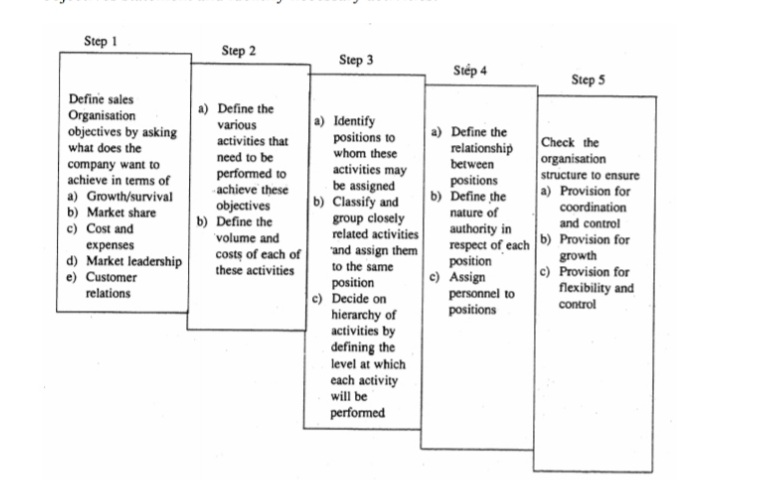
Process of developing a sales organisation
Next, we must define the positional levels at which these activities will be performed. Similar activities and tasks will have to be grouped together and assigned the positions, such that each position has adequate tasks to perform which are also varied enough to provide challenge and motivation. The number of the different classes of activities assigned to a single position would depend upon the degree of specialisation associated with each position.
Once the different positions and .the activities associated with them have been decided upon, these positions have to be assigned to personnel. An interesting dimension in sales organisation exercises has been whether to build positions around individuals, to take advantage of the special capabilities of a particular individual or to recruit individuals specifically to fill in the identified positions.
Not with standing this, people charged with the planning of organisations prefer to let individuals adapt to, or acquire skills for particular position rather than building positions around individuals.
A decision that has to be taken along with the identification of positions, is that of the relationship between these positions in the organisation – how many individuals would a person have reporting to him, who shall be accountable to whom, which positions in the structure would have the authority to command and which shall only advise and guide. In other words, the delegation of authority, span of control and the lines of authority, both line and staff have to be decided upon. The span of control has direct bearing on the coordination responsibility of the higher level executives and care should be taken that it is not too wide to tax the capabilities of top management and lead to weaker coordination of subordinate activities.
Sales organisations have to be responsive to changing market trends, growth in both products and markets as well as to competitive requirements. While designing a sales organisation therefore a key consideration is the provision of flexibility, effective coordination procedures and defined lines of communication.
Factors Affecting Structure of Sales Organization
The following are the factors affecting structure of sales organization:
1. Nature of the Product
The nature of the product affects the structure of the sales organization.
In the case of consumption goods likes soaps, oils, cosmetics, etc., the size of the sales organization may be bigger to handle a large number of customers.
2. Scale of Production
The volume of production and the quantities involved in each sale will also affect the structure of the sales organization.
3. Area of Operation
If the marketing area of the product is national or International, the size of the sales structure will be big.
4. Business Size
If the size of the business is small, a simple sales structure may be sufficient.
5. Distribution Channels
If the company distributes the goods directly through its shops, the sales structure will be large and complex.
6. Financial Resources
A concern with limited financial resources can distribute its products through the agency system.
7. Ability of Managers
Competent sales managers may initiate new sales plans and policies.
8. Management Policy
Where the management centralizes the various functions like advertising, publicity, credit, repairs, and maintenance and establishes regional or diversion offices, the sales organization will be large and complex.
9. Sales Policy
If the company sells the entire products to the sole selling agent, the organization structure will be small.
10. Price Structure
In the case of low priced goods, the demand and the number of customers may be big.
Q.10. Write short notes on (10×2=20)
a. Preparation of Sales Budget
Mostly sales organisations have their own specified procedures, formats and timetables for developing the sales budget. While all sales budgets relate to the sales forecast, the steps taken in systematic preparation of budget can be identified in the following
sequence.
1. Review and Analysis of Marketing Environment
Generally companies prepare sales budget on the principle of bottom up planning with each echelon. To prepare a tentative budget of revenue and expenses, depending on the organisational structure of the sales department, each departmental head is asked to predict their sales volume and expenses for the coming period and their contribution of overhead. For example, in a leading tyre company each District sales manager prepares his/her district budget and submits to the Regional or Divisional office, where they are added together and included with divisional/regional budget. In turn these divisional budgets are submitted to the sales manager for the particular product or market groups. At the end of this chain of subordinates’ budgets, the top executives in the sales department scan and prepare a final sales budget for the company. Now the marketing budget is combined with the budgets of the sales department and the staff marketing departments, to give a total of sales revenues and of selling and other marketing expenses for the company. Some of the common items in each sales budget include the following:
• Salaries, sales persons, administrative support etc.
• Direct selling expenses – travel, lodging, food, entertainment
• Commissions on sales, Bonus
• Benefits packages covering medical insurance, gratuity and retirement contribution
• Office expenses-mailing, telephone, office supplies and other miscellaneous costs
• Advertising and promotional materials, selling aids, contest awards, product samples. catalogues, price-lists etc.
This review of past budget performance helps the sales manager to minimise variances in the coming period.
2. Communicating Overall Objectives
Sales executives at the top level must communicate their sales goals and objectives to the marketing department and argue effectively for an equitable share of funds. The chief sales executive of the firm should encourage participation of all superiors and managers in the budgets process so that, as a part of its development, they will accept responsibility for it and later enthusiastically implement it
3. Setting a Preliminary Plan for Allocation of Resources and Selling Efforts to Different Activities
Particularly products, customers and territories, so that revisions can be made in this initial sales budget. The sales manager must emphasize that the budgets should be as realistic as possible at each stages of its development, so that it can maximise its favourable impact on the firm. When budget goals are achieved through a co-operative team effort, a strong feeling of organisational confidence is created. In case of failure to stay within budgets, sales manager should stress on rewards and public commendations to encourage positive attitudes towards budget goals and pride in their achievement.
4. Selling the Sales Budget to Top Management
The top sales and marketing executive must visualise that every budget proposal they are presenting to the top management must remain in competition with proposal submitted by the heads of other divisions. Each and every division- usually demands for an increased allocation of funds. Unless sales managers rationally justify each item in their budgets on the bass of profit contribution, the item may not get due consideration by the top management.
b. Sales Forecasting
Sales forecasting is an estimation of projected sales for a time period. Simply speaking, the process of sales forecasting involves reviewing performance, history of the product or service, and relates it to the marketing and sales effort of the firm within the anticipated market environment (economic, competitive, technological, public policy etc.) and buyer behaviour.
Sales forecasts are time span related and therefore are termed as, short term forecast – covering time period of upto a year, medium team forecasts-for a time period of around five years. The exact time period for which a forecast is developed is dependent on the product/ market characteristics as well as the purpose for which it is developed and hence may very from company to company.
Notwithstanding thus the longer the time span covered, the more qualitative will be the forecast, and the shorter the time span covered, the more quantitative the forecast.
Time series (trend fitting, moving average), carnations and regression, customer/ dealer surveys and executive judgement are the most commonly used methods for preparing sales forecasts. The selection of the appropriate forecasting method(s) depends upon (i) its purpose (ii) availability of reliable and relevant data and (iii) market conditions. For increased usefulness, the overall sales forecasts should be broken down by product, month, territory, geographical area, and segment wise as per the needs of the company.
The pay off of sales forecasting lies in the accuracy of the forecasts made. Since the attainment of sales forecasts require the deployment of resources in its anticipation, the manager must do his best to make the forecast come true. Evaluation of the approach and methods used for sales forecasting as well as monitoring of the actual and its comparison with the estimated performance form part of the regular activities of the manager.