
Table of Contents
Q.1. Discuss the concept of the external environment with relevant examples. (10)
An external environment is a group of factors or conditions that are outside the organization but affect it in some extent. In business, this term commonly applies to elements related to out of control dimensions such as society, economy, regulations and political system.
An external environment is composed of all the outside factors or influences that impact the operation of business. The business must act or react to keep up its flow of operations.
The external environment of an organisation contributes the OPPORTUNITIES and THREATS of an organisation.
The external environment is divided into two parts:
1. Directly interactive forces include owners, customers, suppliers, competitors, employees, and employee unions. Management has a responsibility to each of these groups.
2. The second type of external environment is the indirectly interactive forces. These forces include sociocultural, political and legal, technological, economic, and global influences. Indirectly interactive forces may impact one organization more than another simply because of the nature of a particular business. For example, a company that relies heavily on technology will be more affected by software updates than a company that uses just one computer. Although somewhat removed, indirect forces are still important to the interactive nature of an organization.
Every organization must understand key aspects of its external environment because institutions do not exist alone. They interact with other entities and are influenced by a wide range of events, situations and other player’s decisions that are out of its control. No matter how the firm controls its internal processes, there are many other aspects that also impact the performance and ultimately affect profitability and growth.
Government decisions, competitor movements and changes in the socio-economic environment are some issues that must be known and understood by the company. Identification and comprehension of those elements allows more complete analysis of risks and potential threats. Monitoring trends and forecasting events support better strategies because the firm can take advantage of positive situations and minimize the effect of adversities.
Example
Ranbaxy is a growing company operating in a niche of the pharmaceutical industry. It has been very successful with a narrow portfolio but now the Board of Directors decided to analyze market possibilities in other pharmaceutical categories.
In this regard, they started studying the external environment. The analysis allowed the Board to identify were some risks related to competitors because of the potential introduction of large multinationals. It was also possible to identify regulatory constraints because the government imposes stricter demands in these new categories. Finally, consumers associations were more inclined to react negatively to new companies, since they had bad experiences in the past in some of the researched categories.
Nevertheless, the Board of Directors recognized opportunities in some of them. Thanks to the information gathered and analyzed in relation to the external environment the company was able to define a coherent growth strategy that positively impacted its performance.
Q.2. Explain BCG matrix with neat diagram in detail. (10)
BCG Matrix
The Boston Consulting group’s product portfolio matrix (BCG matrix) is designed to help with long-term strategic planning, to help a business consider growth opportunities by reviewing its portfolio of products to decide where to invest, to discontinue or develop products. It’s also known as the Growth/Share Matrix.
Product Life Cycle. A new product progresses through a sequence of stages from introduction to growth, maturity, and decline. This sequence is known as the product life cycle and is associated with changes in the marketing situation, thus impacting the marketing strategy and the marketing mix.
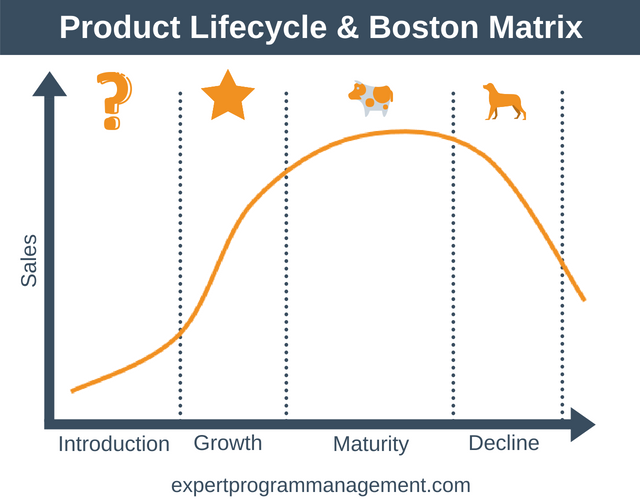
The Boston Consulting group’s product portfolio matrix (BCG matrix) is designed to help with long-term strategic planning, to help a business consider growth opportunities by reviewing its portfolio of products to decide where to invest, to discontinue or develop products. It’s also known as the Growth/Share Matrix.
The Matrix is divided into 4 quadrants based on an analysis of market growth and relative market share, as shown in the diagram below.
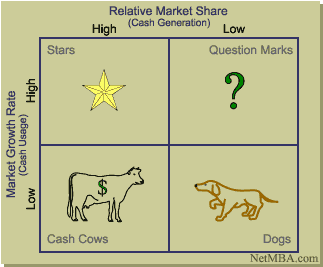
1. Dogs: These are products with low growth or market share.
2. Question marks or Problem Child: Products in high growth markets with low market share.
3. Stars: Products in high growth markets with high market share.
4. Cash cows: Products in low growth markets with high market share
Considering each of these quadrants, here are some recommendations on actions for each:
1. Dog products
The usual marketing advice here is to aim to remove any dogs from your product portfolio as they are a drain on resources.
For example, in the automotive sector, when a car line ends, there is still a need for spare parts. As SAAB ceased trading and producing new cars, a whole business emerged providing SAAB parts.
2. Question mark products
As the name suggests, it’s not known if they will become a star or drop into the dog quadrant. These products often require significant investment to push them into the star quadrant. The challenge is that a lot of investment may be required to get a return. For example, Rovio, creators of the very successful Angry Birds game has developed many other games you may not have heard of. Computer games companies often develop hundreds of games before gaining one successful game. It’s not always easy to spot the future star and this can result in potentially wasted funds.
3. Star products
Can be the market leader though require ongoing investment to sustain. They generate more ROI than other product categories.
4. Cash cow products
The simple rule here is to ‘Milk these products as much as possible without killing the cow! Often mature, well-established products. The company Procter & Gamble which manufactures Pampers nappies to Lynx deodorants has often been described as a ‘cash cow company’.
Benefits of the BCG-Matrix
• The BCG-Matrix is helpful for managers to evaluate balance in the companies’ current portfolio of Stars, Cash Cows, Question Marks and Dogs.
• BCG-Matrix is applicable to large companies that seek volume and experience effects.
• The model is simple and easy to understand.
• It provides a base for management to decide and prepare for future actions.
• If a company is able to use the experience curve to its advantage, it should be able to manufacture and sell new products at a price that is low enough to get early market share leadership. Once it becomes a star, it is destined to be profitable.
Limitations of the BCG-Matrix
• It neglects the effects of synergies between business units.
• High market share is not the only success factor.
• Market growth is not the only indicator for attractiveness of a market.
• Sometimes Dogs can earn even more cash as Cash Cows.
• The problems of getting data on the market share and market growth.
• There is no clear definition of what constitutes a “market”.
• A high market share does not necessarily lead to profitability all the time.
• The model uses only two dimensions – market share and growth rate. This may tempt management to emphasize a particular product, or to divest prematurely.
• A business with a low market share can be profitable too.
• The model neglects small competitors that have fast growing market shares.
Or Explain SPACE Matrix with neat diagram in detail. (10)
SPACE Matrix
It is used to determine what type of a strategy a company should undertake. The Strategic Position & Action Evaluation Matrix or short a SPACE matrix is a strategic management tool that focuses on strategy formulation especially as related to the competitive position of an organization.
To explain how the SPACE matrix works, it is best to reverse-engineer it. First, let’s take a look at what the outcome of a SPACE matrix analysis can be, take a look at the picture below. The SPACE matrix is broken down to four quadrants where each quadrant suggests a different type or a nature of a strategy:
• Aggressive
• Conservative
• Defensive
• Competitive
This is what a completed SPACE matrix looks like:
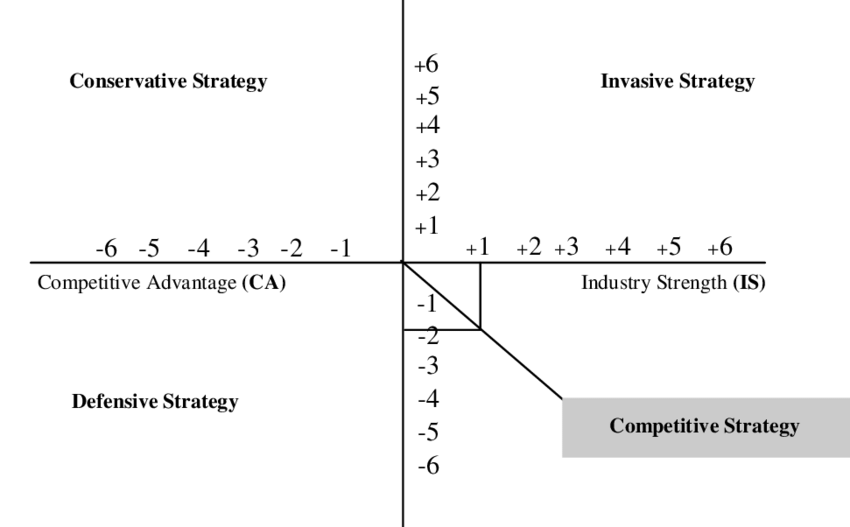
SPACE matrix strategic management tool example
This particular SPACE matrix tells us that our company should pursue an aggressive strategy. Our company has a strong competitive position it the market with rapid growth. It needs to use its internal strengths to develop a market penetration and market development strategy. This can include product development, integration with other companies, acquisition of competitors, and so on.
Now, how do we get to the possible outcomes shown in the SPACE matrix? The SPACE Matrix analysis functions upon two internal and two external strategic dimensions in order to determine the organization’s strategic posture in the industry. The SPACE matrix is based on four areas of analysis.
A. Internal strategic dimensions
• Financial strength (FS)
• Competitive advantage (CA)
B. External strategic dimensions
• Environmental stability (ES)
• Industry strength (IS)
There are many SPACE matrix factors under the internal strategic dimension. These factors analyze a business internal strategic position. The financial strength factors often come from company accounting. These SPACE matrix factors can include for example return on investment, leverage, turnover, liquidity, working capital, cash flow, and others. Competitive advantage factors include for example the speed of innovation by the company, market niche position, customer loyalty, product quality, market share, product life cycle, and others.
Every business is also affected by the environment in which it operates. SPACE matrix factors related to business external strategic dimension are for example overall economic condition, GDP growth, inflation, price elasticity, technology, barriers to entry, competitive pressures, industry growth potential, and others. These factors can be well analyzed using the Michael Porter’s Five Forces model.
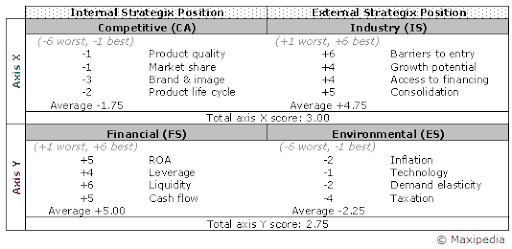
The SPACE matrix calculates the importance of each of these dimensions and places them on a Cartesian graph with X and Y coordinates.
The following are a few model technical assumptions:
• By definition, the CA and IS values in the SPACE matrix are plotted on the X axis.
• CA values can range from -1 to -6.
• IS values can take +1 to +6.
• The FS and ES dimensions of the model are plotted on the Y axis.
• ES values can be between -1 and -6.
• FS values range from +1 to +6
Q.3. Define Strategy. List the Characteristics of good Mission statement. (5)
Originally the word strategy was derived from the Greek word Strategos which means generalship. This word was initially used only by the military, and it meant the planning and action taken by an official to offset actual or potential actions of competitors.
In dictionary today strategy is defined as A plan of action designed to achieve a long-term or overall aim. This definition in context of modern organisations is more relevant.
Strategy can be majorly classified in two types:
1. Master Strategy
A Master Strategy refers to the determination of the mission and long-term objectives of an organization and the policies necessary for achieving the mission and objectives.
2. Programme Strategy
Programme Strategies are specific action plans drawn up to accomplish any established objectives within the time frame. Thus if an organization has set the long term objective of growth in turnover, it may require programme strategies involving improvement in product design or market penetration or sales promotion.
Characteristics of good Mission Statements
Mission statements can and do vary in length, contend, format, and specificity. Most practitioners and ians of strategic management consider an effective statement to exhibit nine characteristics or components. Because a mission statement is often the most visible and public part of the strategic management process, it is important that it includes all of these essential components.
Effective mission statements should be:
• Broad in scope
• Generate range of feasible strategic alternatives
• Not excessively specific
• Reconcile interests among diverse stakeholders
• Finely balanced between specificity & generality
• Arouse positive feelings and emotions
• Motivate readers to action
• Generate the impression that firm is successful, has direction, and is worthy of time, support, and investment
• Reflect judgments re: future growth
• Provide criteria for selecting strategies
• Basis for generating & screening strategic options
• Are dynamic in orientation
Or List the various approaches adopted while developing strategies. Explain any two approaches in brief (5)
Various approaches adopted while developing strategies are –
1. Adaptive Approach
2. Intuition Approach
3. Strategic Factor Approach
4. Entrepreneurial Approach
1. Adaptive Approach
Adaptive approach of strategic decision making is basically reactive and tries to assimilate the change in decision- making context—various factors, particularly envirovmental ones, affecting strategic decisions. Various features of strategic decision making under ADAPTIVE APPROACH are as follows:
• Decision making is basically meant for problem solving rather than going for new opportunities. Adaptation process is adopted to meet the threats by changed environment as against the decision making to meet the anticipated changes in environment which entrepreneurial approach suggests.
• Decision are made in sequential, incremental steps, one thing at a time necessitated by environmental changes i.e.to maintain flexibility to adapt the decisions to more pressing needs.
• Various interest groups and stakeholders put considerable pressure on decision making process so as to protect their own interests. Thus the ultimate decision is a compromised one which may be sometimes, at the cost of optimising organisational effectiveness.
2. Intuition Approach
The basic premise of this approach is that the strategy evolves in the mind of the chief executive without ever being explicitly and without the aid of formal procedures. Intuition, Steiner, has observed, is an excellent approach if it is brilliant. Along with intuition, personal judgment is also a necessary element in this approach. In the United States, Alfred Sloan of General Motors Corporation, Henry Ford of Ford Motor Car Company, and in India J R D Tata, G M Modi, G D Birla, to name a few among the pioneer industrialists, are often remembered for their imagination , drive and expensive vision, which led to corporate growth and prosperity in different fields. The strategies developed by each of them over the years may be attributed to their intuition and judgment.
3. Strategic Factor Approach
Identification of key strategic factors may lead to the assessment of organizational strengths and weaknesses in respect of these factors. Organizational strength on any factor can be defined as the contribution made by the factor towards the achievement of the organizational objectives. A factor may not necessarily contribute directly to the achievement of overall objectives but may contribute indirectly by achieving a lower level objective. An organizational weakness on a factor can be defined as the negative contribution of the factor in achieving the organizational objectives. Another way for assessing strengths and weaknesses is to make a comparative analysis of these factors with those of the competitors. For the assessment of organizational strengths and weaknesses, some techniques or tools likefinancial analysis, key factor rating, and functional area profile and resource-development matrix have been developed.
4. Entrepreneurial Approach
The thrust under this approach is related with the role of the manager as an entrepreneur. Drucker has depicted the role of an entrepreneurial manager as that of a systematic risk-maker and risk-taker, looking for and finding opportunity. Entrepreneurship is essentially the acceptance of change as an opportunity and the acceptance of the leadership in change as the unique task of the entrepreneur. The roll of an entrepreneur is opportunity focused and not problem focused. Briefly speaking, this general description of the entrepreneurial manager indicates what is expected of him, but it does not enlighten us on how he should go about performing his role.
Q.4. Differentiate between Backward integration and forward integration strategy. (5)
Forward Integration
Forward integration is a business strategy where the company merge with or acquire a company that provides services to deliver the product to the end customer. This alliance can be with an intermediate distributor or a retailer.
E.g. If a brewery enters into an alliance with a company selling beer, this is a form of forward Integration
Disney provides a sound real life company example of forward integration where the company purchased more than 300 retail stores that sell merchandise based on Disney characters and movies.
Backward Integration
If the company decides to enter into an alliance with a manufacturer or a supplier by way of acquisition or merger, this is called backward integration. This is done in order to achieve improved efficiency and cost savings.
E.g. A bakery business purchasing a wheat processor or a wheat farm is a form of backward integration since it is a supplier of ingredients
Ford Motor Company incorporated subsidiaries that supply key inputs to its vehicles such as rubber, metal and glass. Other popular global companies such as Amazon.com and Tesco have collaborated with suppliers in a similar way.
Key differences
• In forward integration, the company acquire or merge with a distributor.
• The main purpose of forward integration is to achieve larger market share.
&
• Backward integration is where the company acquire or merge with a suppler or manufacturer.
• The main purpose of backward integration is to achieve economies of scale.
Or Explain diversification strategy in detail with its sub- catogeries. (5)
The Expansion through Diversification is followed when an organization aims at changing the business definition, i.e. either developing a new product or expanding into a new market, either individually or jointly. A firm adopts the expansion through diversification strategy, to prepare itself to overcome the economic downturns.
It is divided into two categories:
1. Related/ Concentric Diversification
This type of diversification involves enlarging the production portfolio by adding new products with the aim of fully utilising the potential of the existing technologies and marketing system. The concentric diversification can be a lot more financially efficient as a strategy, since the business may benefit from some synergies in this diversification model. It may enforce some investments related to modernizing or upgrading the existing processes or systems. This type of diversification is often used by small producers of consumer goods, e.g. a bakery starts producing pastries or dough products.
2. Unrelated/ Heterogeneous (conglomerate) diversification
This type of diversification is moving to new products or services that have no technological or commercial relation with current products, equipment, distribution channels, but which may appeal to new groups of customers. The major motive behind this kind of diversification is the high return on investments in the new industry. Furthermore, the decision to go for this kind of diversification can lead to additional opportunities indirectly related to further developing the main company business – access to new technologies, opportunities for strategic partnerships, etc.
Q.5. Write short note on the following (any two) (2.5×2=5)
a. Advantages of Formal policies
Some of the benefits of formal policies include:
• Helping staff to make decisions more efficiently .
• Providing instruction on how to do tasks
• Creating confidence and reduce bias in decision-making
• Protecting staff from acting in a manner that might endanger their employment.
• Protecting staff from acting in a manner that might endanger the safety of themselves and others.
• Help staff to initiate actions and take responsibility without constant reference to management.
• Increase the accountability of business or organisation’s and its staff
The creation of policies is actually good evidence of proactive or forward-thinking management.
b. Styles of leadership
Some of the important leadership styles are as follows:
1. Autocratic leadership style
In this style of leadership, a leader has complete command and hold over their employees/team. The team cannot put forward their views even if they are best for the team’s or organizational interests. They cannot criticize or question the leader’s way of getting things done. The leader himself gets the things done. The advantage of this style is that it leads to speedy decision-making and greater productivity under leader’s supervision. Drawbacks of this leadership style are that it leads to greater employee absenteeism and turnover. This leadership style works only when the leader is the best in performing or when the job is monotonous, unskilled and routine in nature or where the project is short-term and risky.
2. The Laissez Faire Leadership Style
Here, the leader totally trusts their employees/team to perform the job themselves. He just concentrates on the intellectual/rational aspect of his work and does not focus on the management aspect of his work. The team/employees are welcomed to share their views and provide suggestions which are best for organizational interests. This leadership style works only when the employees are skilled, loyal, experienced and intellectual.
3. Democrative/Participative leadership style
The leaders invite and encourage the team members to play an important role in decision-making process, though the ultimate decision-making power rests with the leader. The leader guides the employees on what to perform and how to perform, while the employees communicate to the leader their experience and the suggestions if any. The advantages of this leadership style are that it leads to satisfied, motivated and more skilled employees. It leads to an optimistic work environment and also encourages creativity. This leadership style has the only drawback that it is time-consuming.
4. Bureaucratic leadership
Here the leaders strictly adhere to the organizational rules and policies. Also, they make sure that the employees/team also strictly follows the rules and procedures. Promotions take place on the basis of employees’ ability to adhere to organizational rules. This leadership style gradually develops over time. This leadership style is more suitable when safe work conditions and quality are required. But this leadership style discourages creativity and does not make employees self-contented.
c. Marketing Policy
Usually, a documented set of broad guidelines, formulated after an analysis of all internal and external factors that can affect a firm’s objectives, operations, and plans. Formulated by the firm’s board of directors, corporate policy lays down the firm’s response to known and knowable situations and circumstances. It also determines the formulation and implementation of strategy, and directs and restricts the plans, decisions, and actions of the firm’s officers in achievement of its objectives. Also called company policy.
Marketing Policy
It is designed to meet the company’s marketing objectives by providing its customers with value. The policies formulated to meet a company’s marketing objectives is called marketing policy.
d. Need of environmental studies
1. Primary influencers Environmental analysis gives the strategic manager time to anticipate opportunities & to plan alternative responses to those opportunities. It also helps them to develop an early warning system to prevent threats or develop strategies that can turn a threat to the organization’s advantage.
E.g.: – Standard chartered bank is the oldest foreign bank operating in India, since 1858. But it had missed the opportunity that suddenly opened up for the multinational banks in India in the eighties. Over the years it has acquired the image of a standby player in the market dominated by aggressive competitors. The bank could not understand its environment in advance. Once the CEO of the bank stated that “a lack of directions, a lack of focus & the absence of clearer perception of the business has left the bank behind.”Hence the bank went out of business due to their failure in anticipating environmental changes.
2. Managers need to search the environment to determine
a. What factors in the environment present threats to the company’s present strategy & accomplishment of objectives?
b. What factors in the environment present opportunities for a greater accomplishment of objectives through an adjustment in the company’s strategy?
3. Without systematic environmental search & diagnosis, the time pressure of managerial jobs can lead to inadequately thought out responses to environmental changes.
4. Firms that do environmental analysis are more effective than those which don’t. Successful firms do more & better analysis than the failing firms.
5. The extent & sophistication of the analysis must meet the demand of the environment.
Q.6. With a neat diagram, Explain McKinsey’s framework. (5)
The McKinsey 7S Framework is a management model developed by well-known business consultants Robert H. Waterman, Jr. and Tom Peters (who also developed the MBWA– “Management By Walking Around” motif, and authored In Search of Excellence) in the 1980s. This was a strategic vision for groups, to include businesses, business units, and teams. The 7S are structure, strategy, systems, skills, style, staff and shared values.
The model is most often used as a tool to assess and monitor changes in the internal situation of an organization.
The model is based on the theory that, for an organization to perform well, these seven elements need to be aligned and mutually reinforcing. So, the model can be used to help identify what needs to be realigned to improve performance, or to maintain alignment (and performance) during other types of change.
Whatever the type of change – restructuring, new processes, organizational merger, new systems, change of leadership, and so on – the model can be used to understand how the organizational elements are interrelated, and so ensure that the wider impact of changes made in one area is taken into consideration.
Objective of the model
• To analyze how well an organization is positioned to achieve its intended objective
Usage
• Improve the performance of a company
• Examine the likely effects of future changes within a company
• Align departments and processes during a merger or acquisition
• Determine how best to implement a proposed strategy.
The Seven Interdependent Elements
• The basic premise of the model is that there are seven internal aspects of an organization that need to be aligned if it is to be successful
A. Hard Elements
• Strategy
• Structure
• Systems
B. Soft Elements
• Shared Values
• Skills
• Style
• Staff

Q.7. Match the following: (5)
a. Turn around. i. New Market New Product
b. Conglomerate. ii. Resource Reallocation
c. Market Penetration iii. Continuous losses
d. Stability. iv. Existing Product
e. Liquation. v. No Profit
| a. Turn around. | No Profit |
| b. Conglomerate. | New Market New Product |
| c. Market Penetration | Existing Product |
| d. Stability. | Resource reallocation |
| e. Liquation. | continuous loss |
Q.8. Fill in the blanks (5×1=5)
a. …….GOAL……… is where the organisation wants to go from where it is at present.
b. The process of translating, putting into action or execution of strategy is known as …… Strategic Management..
c. ……. ORGANISATIONAL ANALYSIS….. is the process of identifying and evaluating an organisation’s specific characteristics.
d. ……… Unrelated /Conglomerate……… diversification is also known as heterogeneous diversification.
e. ….SPACE…….. matrix is developed on determining attractiveness scores for various strategies.