
Table of Contents
Q.1. Discuss the responsibilities of a professional manager. How can a manager contribute towards a better quality of life in society ? Give suitable examples. (20)
Responsibilities of Professional Manager
1. Responsibility towards Customers
A firm’s responsibility towards its customer is in terms of ensuring that the desired quality of product at a reasonable price is made easily available to the customers. It is the responsibility of the manager to provide the right match between quality and price.
2. Responsibility towards Shareholders
The main responsibility of the manager is to ensure the security of the shareholders’ capital. The manager must ensure that the firm does not become bankrupt. In other words, the manager must, at least, ensure the survival of the firm. The manager has to ensure that the shareholders are able to earn profit on their capital.
3. Responsibility towards Employees
Employees are the most important resource. The manager has to ensure that employees are getting a fair deal in terms of wages and salaries. The responsibility of a manager is to ensure that all dealings with the employees are fair. Whether it is determining the profit linked bonus that is being calculated or the provident fund of a retired employee, which has to be paid, you must ensure that the employees are not cheated, harassed or embarrassed.
4. Responsibility towards Suppliers
Suppliers provide the raw materials, components and parts necessary for the production of products. The manager’s responsibility towards suppliers of funds, i.e., banks and other financial institutions, is that not only he has to make the interest payments, but make the repayment on time as per the agreed repayment schedules.
5. Responsibility towards Distributors and Retailers
A manager is responsible for ensuring regular supplies to the distributors. The products that are supplied to the distributor must be checked for quality to ensure that second grade or inferior quality goods are not shipped.
6. Responsibility towards Industry and Competition
A manager is responsible to register the firm as a member of industry association and comply with all its rules and regulations.
7. Responsibility towards Union
A manager should acknowledge employees’ union as a friend rather than as a foe of the firm. Most problems with unions arise because of the assumption of the managers that unions have no constructive contribution. A responsible manager must understand and appreciate the fact that the management and union have a great degree of mutual dependence and the union cannot further its interests at the cost of the firm’s interests and vice versa.
8. Responsibility towards Society
The manager has responsibility towards his surroundings and the people living in the vicinity of his factory and office. Firms behave irresponsibly when they pollute the environment by releasing harmful gasses, discharging toxic effluents into nearby rivers, lakes or seas, and dumping their waste matter in surrounding lands. A manager should make sure that the operations of the firm do not obstruct, disturb, disrupt or destroy physical structures (historical buildings, monuments), the flora and fauna, and animal and human life.
9. Responsibility towards Government
A manager should ensure that the constitution and operations of the firm are within the legal framework as specified by the government.
Manager’s contribute towards a better quality of life in society
A truly responsible manager not only takes steps to prevent or minimise any negative impact of his or her firm’s operations on the society, but also takes the initiative in playing a more positive role towards society.
Tata Steel’s attempts at educating people about leprosy through advertisements in newspapers and magazines is an example of the useful and constructive role firms can play in creating a more harmonious society. Many companies have founded educational institutions and free medical facilities for the benefit of society at large. Irrespective of the motivation behind such acts, the result is a tangible benefit for use by all society members. In times of calamities such as earthquakes and floods, many companies finance teams of doctors and rescue workers for relief work. In our aim towards a peaceful and prosperous society we need business firms who are willing to step out of the narrow confines of their offices into the larger arena of society and take bold decisive actions to create a better quality of life for all of us.
In the tourism sector, firms have a responsibility towards the upkeep of the destination and towards the host population. Employing locals, respecting local customs, etc. are the ways through which a firm can act responsibly in this regard.
Q.2. Define MIS. What factors must be considered while designing an effective MIS for a hospitality organisation? (20)
MIS
Management Information System (MIS) refers to that system by which information is collected processed and presented to management to help it in making better decisions.
A manager makes decisions all the time and anything that helps improve the decision-making will obviously lead to better results. As we discussed in the previous section, the systems concept implies an input, a process, and an output. In case of MIS, data is the input which is processed to provide output in the form of information reports, summaries, etc. To be really useful the output must aid the manager’s decision-making process. If it does not do so, it is not a management information system, but just an information system. An effective MIS should be:
a. Timely: A market research report, pointing out the unacceptability of milk sold in plastic containers in retail stores, presented to the manager after he has already launched his product in the market is of little use. Information is useful only when it is within the time limits of the decision.
b. Accurate: If the information presented is inaccurate, the manager who takes a decision based on this will invariably end up making a mistake. However, it is not possible to have hundred per cent accurate information. But the way to overcome this is to indicate the expected range of deviation or the level of inaccuracy. Thus the manager acting on the basis of this information knows the risk he or she is taking.
c. Relevant: Volumes of reports (however excellent they may be) on the export potential of cashew nut to a manufacturer of sports goods are of no value simply because it is outside his or her area of interest and activities. The manager, himself or herself, can make an important contribution in ensuring that the information received is relevant to his decision-making. To do so he or she must provide an answer to the question “What do I need to know?”
A manager’s requirement of information depends on the level of management at which one is operating. In any organisation there are three broad levels of management i.e., top, middle and operating management. It is the type of decisions made by one level that distinguishes it from the others.
Designing MIS
While designing the MIS, the different types of information required by different managers must be kept in mind. The manager at the top needs more information about the environment. Regarding the internal operations of the company, the top manager is only concerned with the results as reflected in profits, sales volume, turnover, etc. Moreover, these results should be presented in a summary rather than detailed format.
The middle level manager is interested in finding out why the results were not as per the expected plan, knowing about the deviations of the critical variables and taking corrective action. The operating manager’s concern is with details, like the number of hours each machine operated, number of units produced per hour, etc. Most of the internal organisational information is generated at this level but as it moves upward it is reduced to a summary highlighting only the critical performance variables.
In designing an effective MIS, the manager must understand the nature and flow of information.
Information regarding government policy, legislation, competition, etc. is generated in the environment but is collected and used within the organisation. Similarly, the firm or an organisation may send out information to the environment in the form of annual reports, company balance sheets, press-releases.
Besides this, the company managers and employees are also information carriers. Within an organisation, information may flow from operating level towards top management level ( bottom to top) and from top to bottom. Reports, summaries and feedback about impact of decisions flow from bottom to top and decisions, instructions flow from top to bottom. Information also flows sideways from one manager to another at the same managerial level.
Q.3. What are the skills required at the top management level? Explain the role of top level executive in institution building. (20)
Top Management Skills
Important functions of a Top Manager are:
1. Building an efficient and strong team of people at the middle management level so that they can really work for him or her and the organisation. Manager as a top person can always encourage some persons to learn some of your management as well as managerial skills to keep the organisation functioning by their strong and mutually supporting activities.
2. Managers may like to monitor and review the functioning of the organisation at different time intervals to ensure a correct way of functioning. They may also make sure that your team of people is open to problems of their own group as well as appreciate problems of similar kind occurring at various levels in other organisations. Many times we are successful in resolving our problems concerning people or their work by borrowing experience of others.
3. Managers may like to search for competent people at all levels and reward them for their competence and dedication. They search for competence is a significant way to enhance the competence of the organisation.
4. As a chief executive, they have to keep in touch with and share ideas with policy makers and planners as well as intellectuals who bring in deep insight to understand and plan for the future. They may like to join meetings and debates of such nature which will make them think about their own skills in this regard.
They may like to develop in themselves a kind of skill to be involved with the organisation yet remain detached about it. This sense of remaining detached, yet knowing what is happening is one of the very important work values existing in our culture and tradition. They may be deeply involved to become a very effective top person in the day-to-day operations of the organisation and its results.
Roles of a Top Level Executive in Institution Building
This requires a kind managerial skill that helps in building an institution or organisation. Pareek (1981) assumes eight main roles of the top level executive which are required for institution building.
1. The very first role is the identity creating role of the top level manager. They create a special place for the organisation by making it unique in one or more than one respect. They may have good employee welfare measures that make the employees happy. They may also be known for their technological innovations and users of your technology outside the organisation are happy about it. Thus, they are known with the managers identify with the above two areas which are created and they have also made or established thr organisation’s identity that way.
2. The second role is the enabling role of the top level executive. Your job here is to develop various kinds of resources such as men, material, facilities for work as well as a good work atmosphere. Your men can be trained and updated in their skills. Your materials or inputs as well as outputs can be multiplied. You can even give employees a very challenging as well as satisfying atmosphere to work by knowing their ability as well as willingness to work. You can certainly improve their efficiency as well as morale.
3. The third role of the top level person is the synergising role. You may feel that you have to multiply your resources, both human and material, to achieve the goal of your organisation. Collectively these resources can contribute to achieve the goal of your organisation. It means much more than mere aggregate of men or material or money. It means proper utilisation of men, material and money, particularly when such resources are scarce. This role of the top executive is a challenging one, as he or she has to uniquely combine resources with their maximum utilisation.
4. The fourth role is known as the balancing role of the top executive. Your role as a manager is to make your subordinates conform to rules, expectations, regulations or procedures if you have to achieve the goal of the organisation. Such conformity may not be so much stressed that it destroys the creative potential of the employees. How can then the organisation grow ? Allow your people to be creative, to be able to move in new directions and respond to the new challenges and pressures from the environment. Thus, a balance between the conformity and creativity should be maintained by you. The organisation can stabilise its work processes and encourage people to achieve the result as innovations are made by the people to move in new directions.
5. The fifth role of the top level executive is the linkage building role. As a top manager, you must realise the social obligations of your organisation to the benefit of other organisations as well as the community and society at large. You may like to link your organisation with other technical or financial organisations or government agencies or policy making bodies who may have similar goals like yours. For example, your research and development unit of the industry can have links with a similar unit in educational or research organisations. You may also like to get support from financial institutions to develop your research and development activity. You may like to link your activity with the community where you work. A rural development centre’s activity at a technical education institution can be very well linked with community development programmes in rural areas on issues like health, sanitation, education, tourism development, etc.
6. The sixth role of a top executive is the futuristic role. You may like to expand or diversify or change or reorganise your organisation for meeting new demands and pressures. You should be prepared for the importance of the role your organisation can play in future.
7. Making impact is the seventh role of a top executive. This means making an impact of one’s organisation on others. A leading manufacturing organisation of a product can be very influential in several ways to influence the policies in the field in which it operates. Examples of electronic goods such as television , transistor, calculators and computers are not rare, where superior technology in the manufacturing process is ever on the increase.
8. Last but the least is to provide super-ordination to the employees working under a top executive. You can think of giving a sense of fulfilment to the members of your organisation by building in them a sense of pride that they are working in a very important field of work, which is so important for the society. For example, members of a tourism department, oil or steel organisation would be highly motivated and satisfied people as their work is of importance to the society. This sense of pride has to be brought out by you as a top manager.
Q.4. What are the different types of managerial decisions ? Discuss one model of decision making process. (20)
Types of Managerial Decision
1. Programmed and non-programmed decisions
Programmed decisions are concerned with the problems of repetitive nature or routine type matters.
A standard procedure is followed for tackling such problems. These decisions are taken generally by lower level managers. Decisions of this type may pertain to e.g. purchase of raw material, granting leave to an employee and supply of goods and implements to the employees, etc. Non-programmed decisions relate to difficult situations for which there is no easy solution.
These matters are very important for the organisation. For example, opening of a new branch of the organisation or a large number of employees absenting from the organisation or introducing new product in the market, etc., are the decisions which are normally taken at the higher level.
2. Routine and strategic decisions
Routine decisions are related to the general functioning of the organisation. They do not require much evaluation and analysis and can be taken quickly. Ample powers are delegated to lower ranks to take these decisions within the broad policy structure of the organisation.
Strategic decisions are important which affect objectives, organisational goals and other important policy matters. These decisions usually involve huge investments or funds. These are non-repetitive in nature and are taken after careful analysis and evaluation of many alternatives. These decisions are taken at the higher level of management.
3. Tactical (Policy) and operational decisions
Decisions pertaining to various policy matters of the organisation are policy decisions. These are taken by the top management and have long term impact on the functioning of the concern. For example, decisions regarding location of plant, volume of production and channels of distribution (Tactical) policies, etc. are policy decisions. Operating decisions relate to day-to-day functioning or operations of business. Middle and lower level managers take these decisions.
An example may be taken to distinguish these decisions. Decisions concerning payment of bonus to employees are a policy decision. On the other hand if bonus is to be given to the employees, calculation of bonus in respect of each employee is an operating decision.
4. Organisational and personal decisions
When an individual takes decision as an executive in the official capacity, it is known as organisational decision. If decision is taken by the executive in the personal capacity (thereby affecting his personal life), it is known as personal decision.
Sometimes these decisions may affect functioning of the organisation also. For example, if an executive leaves the organisation, it may affect the organisation. The authority of taking organizational decisions may be delegated, whereas personal decisions cannot be delegated.
Models of Decision Making Process
1. Econologic Model or Economic Man Model
The econologic model represent the earliest attempt to model decision process. Briefly, this model rests on two assumptions:
1. It assumes people are economically rational; and
2. That people attempt to maximise outcomes in an orderly and sequential process.
Economic rationality, a basic concept in many models of decision making, exists when people attempt to maximise objectively measured advantage, such as money or units of goods produced. That is, it is assumed that people will select the decision or course of action that has the greatest advantage or payoff from among the many alternatives. It is also assumed that they go about this search in a planned, orderly, and logical fashion.
A basic econologic decision model is shown below. The figure suggests the following orderly steps in the decision process:
1. Discover the symptoms of the problem or difficulty,
2. Determine the goal to be achieved or define the problem to be solved,
3. Develop a criterion against which alternative solutions can be evaluated,
4. Identify all alternative courses of action,
5. Consider the consequences of each alternatives as well as the likelihood of occurrence of each,
6. Choose the best alternative by comparing the consequences of each alternative (step5) with the decision criterion (step3), and
7. Act or implement the decision.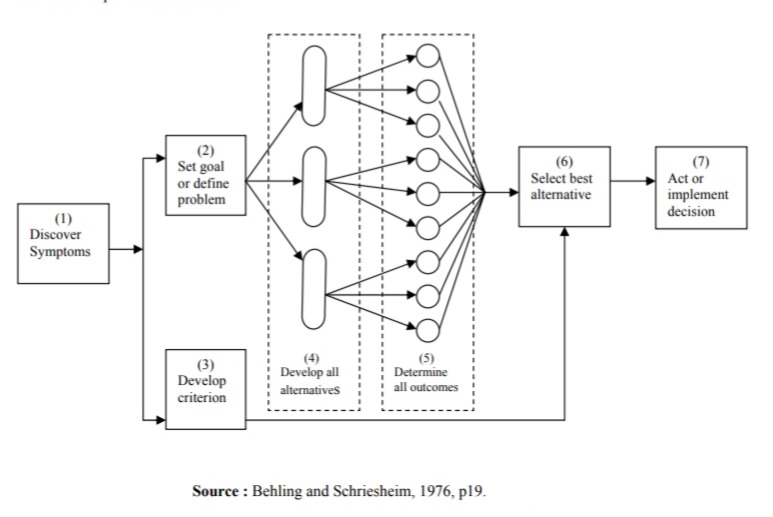
An Econologic Model of Decision making
The economic man model represents a useful prescription of how decisions should be made, but it does not adequately portray how decisions are actually made. If you look closely in this prescriptive model you shall be able to recognise some of the assumptions it makes about the capabilities of human beings:
• First, people have the capability to gather all necessary information for a decision, i.e., people can have complete information.
• Second, people can mentally store this information in some stable form, i.e., they can accurately recall any information any time they like,
• Third, people can manipulate all this information in a series of complex calculations design to provide expected values, and
• Fourth, people can rank the consequences in a consistent fashion for the purposes of identifying the preferred alternative.
As we can possibly imagine, the human mind is simply incapable of executing such transactions at the level and magnitude required for complex decisions. To that extent, this model is unrealistic. However, due to the advent of sophisticated data storage, retrieval and processing machines, it is now possible to achieve economic rationality to some extent.
2. Bounded Rationality Model or Administrative Man Model
3. Implicit Favourite Model or Gamesman Model
Q.5. Write short notes on any two: (10×2=20)
a. Levels of Manager
A manager is responsible for combining and coordinating the people, the technology, the job task and other resources to effectively achieve the objectives of an organisation. You may be a manager in charge of constructing a plant or managing a bank or supervising a group of life insurance agents or training a football team. In most of the situations, you have others who are your subordinates reporting to you. The subordinates themselves may be managers having subordinates below to report to them. Therefore, we talk of levels of managers in an organisation.
1. The First Level Managers
These managers are in direct contact with the employees, who usually produce the goods or service outputs of an organisation. They are referred to as supervisors or foremen in some organisations. You may be associated with the employees who directly produce goods or render service outputs. Hence, you may belong to the first level managers. In some government offices, the superintendent of the of office supervising the work of typists, despatch clerks, etc. belong to this category.
In this industry, it is the foreman, who is in direct contact with the rank-and file workers, producing goods or services. In the tourism industry, in many sectors the first level managers are in direct contact with the customers also.
2. The Middle Level Managers
These managers are those with a number of responsibilities and linking or connecting activities. They direct the activities of the first level managers. For example, a district educational officer or a block development officer belongs to the middle level with the principals of schools and gram sevaks reporting to the district educational officer and block development officer respectively.
3. The Top Level Managers
The top level managers are a small group of policy makers responsibility for the overall strategic management of the organisation. It is the responsibility of the top managers to develop the objectives and strategies of the organisation. It is the top management that must sense the demands of the political, social and competitive environments on the organisation. A President or a Chief Executive or a District Magistrate are examples of top managerial level.
b. Limitations of MBO
In practical implementation you could sometimes encounter one or more of the following limitations of MBO:
1. Problems in joint objectives setting among unequal
MBO implies a process of point to point or consultative objective setting between the superior and the subordinate. But this very relationship, based upon status, may prove to be a hindrance in free and frank open communication between the two, and stall the process of setting goals in an objective manner.
2. Problems of MBO being effective at the lowest level
Theoretically, MBO is supposed to percolate throughout the organisation right down to the lowest level since the manager as well as the worker at each level have set their own agreed upon objectives. However, in reality, the workers or managers at the lower levels often do not have the full freedom to set their own objectives. This is because MBO operates from top to down, starting with the corporate objectives. Thus, the process of objective setting implies that the objectives at the lower level have already been locked in and managers down the line have to match their own objectives with those of the level above them only.
If the process of objectives setting is reversed to overcome this limitation, and objectives are first set at the lowest level, it would mean that the entire organisation is being guided by people who have less experience, less education, less knowledge and awareness.
3. It is difficult to implement in a situation of change
MBO assumes a stable environment in which the objectives once set will hold good till they are achieved. In reality, however, many unforeseen changes may occur which may render the objective impossible to achieve, or irrelevant, or invalid. In a situation where sudden changes occur frequently MBO is difficult to implement.
4. There have been cases where MBO has totally failed.
The most commonly encountered reasons for the failure of MBO are:
• Lack of top management support and commitment,
• Lack of or inadequate planning and preparation,
• Lack of information and education,
• Very short time horizon,
• Overemphasis on appraisal,
• Poor understanding of the role of MBO, and
• Lack of clear cut policy towards MBO.
c. Types of conflicts
Types of Conflicts
1. Conflict within an Individual
There could be conflict within oneself – the intrapersonal conflict. Basically, there are three types of such conflicts. You may have an excellent job offer in a city you are not willing to go to. In such a case, you are attracted to and repelled by the same object − an approach-avoidance conflict.
Similarly you may be attracted to two equally appealing alternatives like seeing a movie or going for a picnic − an approach-approach conflict. You may also be repelled by two equally unpleasant alternatives like the threat of being dismissed if you fail to report against a friendly colleague who is guilty of breaking the organisation’s rules − an avoidance-avoidance conflict.
2. Conflict between Individuals
Conflict can also take an interpersonal form. Conflict between individuals takes place owing to several factors, but most common are personal dislikes or personality differences. When there are only differences of opinion between individuals about task-related matters, it can be construed as technical conflict rather than interpersonal conflict. Of course, technical and interpersonal conflicts may influence each other due to role-related pressures. The sales manager may put the blame for low sales volume on the production manager not meeting his or her production schedule and may start disliking the production manager as an incompetent person. It is often very difficult to establish whether a conflict between two parties is due to manifest rational factors, or it emanates from hidden personal factors.
3. Conflict between an Individual and a Group
These types of intragroup conflicts arise frequently due to an individual’s inability to conform to the group norms. For example, most groups have an idea of a “fair day’s work” and may pressurise an individual if he or she exceeds or falls short of the group’s productivity norms. If the individual resents any such pressure or punishment, he or she could come into conflict with other group members.
Usually, it is very difficult for an individual to remain a group-member and at the same time, substantially deviate from the group norm. So, in most cases, either one conforms to the group norm or quits (or is rejected by) the group. Of course, before taking any such extreme step, he/she or the other group members try to influence each other through several mechanisms leading to different episodes of conflict.
4. Conflict between Groups within an Organisation
Intergroup conflicts are one of the most important types of conflicts to understand, as typically, an organisation is structured in the form of several interdependent task-groups. Some of the usually chronic conflicts in most of the organisations are found at this level, e.g., Union vs. Management, one Union vs. another Union; one functional area like production vs. another functional area like maintenance; direct recruits vs. promotees, etc. The newly emerging field of Organisational Politics has started systematically investigating such types of conflict.
5. Conflict between Organisations
Conflict between organisations is considered desirable if limited to the economic context only. The laissez-faire economy is based on this concept. It is assumed that conflict between organisations leads to innovative and new products, technological advancement, and better services at lower prices.
Besides these five types of conflict, today one also comes across certain other forms. For example, a tourist organisation may come into conflict with the local bodies or host population because of a variety of factors or difference in approach towards local customs, environment protection and so on.
Another could be a conflict between the organisation and the government.
Q.6. What is meant by ‘resistance to change’ in organisation ? Discuss the strategies of implementing change. (20)
Resistance to Change
Resistance to change in a typical organization refers to an employee’s behaviour designed to discredit, delay or prevent instructions of change in an organization. However, resistance to change can be individual as well as organizational.
Reasons why employees show resistance to change?
• Job security – Fear of losing job
• Change in working climate
• Obsolescence of skills
• Change in social interactions and relationships
• Change in role or status
Reasons why organizations show resistance to change?
• Lack of resources
• Difficulty in implementing structural or technological changes
• Lack of vision, Motivation, Knowledge
• Due to Sunk Costs associated with change
Levels of Resistance to Change
1. Individual Level
At an individual Level, there is resistance to change due to the following reasons:
Job security, Ego Defensiveness, Social Displacement, Skill Obsolescence, Embracing Status Quo, Group resistance or Peer Pressure, Fear of economic Loss, Low tolerance to change, etc
2. Organizational Level
At an organizational level, there is resistance to change due to:
• Threat to existing power and influence in the organization
• A rigid organization structure favours stability more than innovation
• Unfavourable Organization Culture and Norms
• Resource constraints
• Sunk Costs associated with organizational change
Strategies for implementing change
Most managers who have been responsible for implementation have developed a personal perspective consisting of assumption and strong feelings about how change should be introduced. These philosophies fall into two camps, either “tops-down” or “bottom-up”.
1. The Tops-down Strategy
The advocates of this strategy believe that, in general, people resist changes and require direction and structure for their well being as well as to work efficiently and effectively. The basic psychological contract between employees and management, it is assumed, is one in which the employee provides work, effort and commitment and expects in return pay, benefits, and a clear definition of what is expected to be done. It follows that it is the management’s responsibility to design the changes it deems appropriate and to implement these thoroughly but quickly by directives from the top.
2. The Bottom-up Strategy
The advocates of this approach profess what to them is a more enlightened view of human nature. They argue that people welcome change and the opportunity to contribute to their own productivity, especially if the change gives them more variety in their work and more autonomy. These managers assume people have a psychological contract which includes an expectation that they be involved in designing change as well as in implementing it. Commitment to change, they say, follows from involvement in the total change process and is essential to successful implementation.
Which is more correct? Is the question of correctness the right question to ask? What is your philosophy of change? If your answer to the question was, in effect, “the correct strategy of change depends on the circumstances”, you are in agreement with the currently very popular contingency school.
Contingency Approach
According to the contingency school, the choice of an appropriate strategy and the implementation diagnosis consists of assessing eight independent variables or factors in the organisation.
Based on the diagnosis which evolves, the basic implementation strategy will consist of selecting values along the continuum for the three dependent variables.
Once the value of these variables has been located, and if the answers to the diagnostic for the independent variables fall towards the left of the continuum, then the implementation strategy would also be leftwards. On the other hand, if the values of variables tend towards the right side of continuum then the implementation strategy would also be rightwards. Thus, for example, if there is very little time available, the crisis or need for change is clear to all, it is a small organisation, and so on, the appropriate change strategy is tops-down, directive, and fast.
Q.7. What is organisational culture ? Explain the determinants of organisational culture. (20)
Organisational Culture
Every organisation has some characteristics which are common with any other organisation. At the same time, each organisation has its unique set of characteristics and properties. This psychological structure of organisation and its sub-units is usually referred to as Organisational Culture.
For a layman, culture is a commonly experienced phenomenon and many words like, climate, atmosphere, environment and milieu are often used interchangeably to describe it. In fact, most of the studies which have tried to measure an organization’s “Culture” have operationalised it in terms of “Organisation Climate”. A couple of formal definitions of organisation climate are given below:
1. “Organisational climate is a relatively enduring quality of the internal environment that is experienced by the members, influences their behaviour, and can be described in terms of values of a particular set of characteristics of the organisation” (Renato Tagiuri, 1968).
2. “Organisational climate is the set of characteristics that describe an organisation and that
a. Distinguish one organisation from other organisations
b. are relatively enduring over time and
c. influence the behaviour of the people in the organisation” (Forehand & Gilmer 1964).
Compare these two definitions of “Organisational Climate” with a definition of “Organisational Culture” as given by Stephen P. Robbins (1986): “Organisational culture is a relatively uniform perception held of the organisation, it has common characteristics, it is descriptive, it can distinguish one organisation from another and it integrates individual, group and organisation system variables.”
Determinants of Organisational Culture
Determinants are the causes, while dimensions are the components of Organisational Culture.
They are-
1. Economic Condition
Several dimensions of OC are influenced by an organisation’s position on the economic cycle. The economic condition of any organisation influences whether its budget should be “tight” or “loose”. In times of prosperity- when budgets are more loose than tight – the organisation tends to be more adventure some. On the other hand, tight budget would lead to an air of caution and conservatism within an organisation. Few managers are willing to suggest new programmes (probably deserving merit) when the order from above is to exercise tight control over expenses. So, dimensions of OC like “Risk-taking”, “Control”, “Progressiveness and Development” etc. are directly influenced by economic conditions.
2. Leadership Style
The leadership style prevailing in an organisation has a profound influence in determining several dimensions of OC. The influence is so pervasive that you may often wonder whether OC is a product of the philosophy and practices of prominent persons in an organisation.
3. Organisational Policies
Specific organisational policies can influence a specific dimension of OC to quite an extent. For example, if the company policy states that layoffs will be used only as a last resort to cope with business downturn, then it would, in general, foster an internal environment that is supportive and humanistic.
Similarly, if you are working in a company where it is agreed that the first beneficiaries of increased profit would be the employees of that organisation and shareholders would get second priority, then the OC will be characterised by High Reward Orientation and probably by High Progressiveness and Development.
4. Managerial Values
The values held by executives have a strong influence on OC because values lead to actions and shape decisions. Values add to perceptions of the organisation as impersonal, paternalistic, formal, informal, hostile or friendly.
5. Organisational Structure
The design or structure of an organisation affects the perception of its internal environment. For example, a bureaucratic structure has an OC much different from a System 4 organisation. What is a System 4 organisation? According to Rensis Likert, all organisations can be classified into four major groups, depending upon the way basic organisational processes are conducted. These major groupings are as follows:
System 1 – Exploitative Authoritative
System 2 – Benevolent Authoritative
System3 – Consultative
System 4 – Participative
6. Characteristics of Members
Personal characteristics of the members of an organisation also affects the climate prevailing in the organisation. For example, an organisation with well educated, ambitious and younger employees is likely to have a different OC than an organisation with less educated, and less upwardly mobile, older employees. The former might inculcate an environment of competitiveness, calculated risk-taking, frankness of opinions, etc.
7. Organisational Size
In a small sized organisation it is much easier to foster a climate for creativity and innovation or to establish a participative kind of management with greater stress on horizontal distribution of responsibilities. On the other hand, in a large organisation it is easier to have a more authoritative kind of management with stress on vertical distribution of responsibilities. This in turn leads to distinct environments as has been explained with the help of the concept of System 4 organisation.
Q.8. Define Communication Process. What are the various channels of communication? (20)
The most simple model of the communication process can be :
Sender ————————>————– Message ————————>———— Receiver
The model indicates the essential elements of communication, viz., the sender and the receiver, and the message that is exchanged between them. If any one of the three elements is missing, communication does not take place. However, the process of communication is a much more complex phenomenon consisting of at least five elements which are subject to various influences.
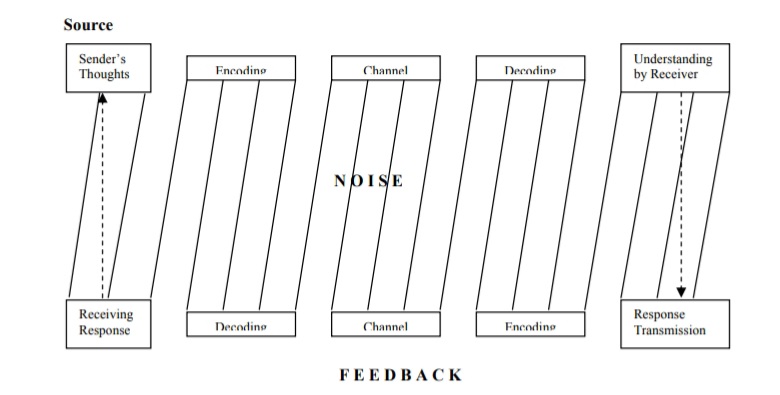
Model of communication process
1. Source
In this model the first element is the source of the communication from where the communication originates. The source or sender can be a person, a number of persons, or even a machine like a satellite or computer. The sender initiates communication because he or she has some need, thought, idea or information that he or she wishes to convey to the other person, persons or machine. If, for example, an accidental fire has broken out in a part of Hotel, the security officer (source) will need to convey the message immediately to the guests (receiver). Fire alarm (machine) will do the same in place of the security officer.
2. Encoding Message
The next element in the process is that of encoding the information to be transmitted. Encoding enables the thoughts to be put in the form of symbols. Normally language provides the symbols that are used in the transmission of thoughts to another person. However, language is not the only means to convey the thoughts, needs or information. There are non-verbal means, e.g., gestures, which provide another form through which thoughts can be transmitted.
3. Channel
The next element in the process of communication is the channel through which the communication is transmitted. It is the link that joins the sender and the receiver. The most commonly used channels are sight and sound. In the organisational environment, the channel could take the form of face-to-face conversation, written memos, telephonic exchanges, group meetings, computerised Local Area Network (LAN), etc.
Outside the organisation, the channels could be letters or circulars, magazines, radio programmes or TV shows, teleconferencing, sattellite communications, Wide Area Network (WAN), etc. For communication to be effective the channel used should be appropriate for the message as well as the receiver. For an urgent message telegram, telephone or e-mail would be the appropriate channel. Again, the channel chosen would be influenced by the consideration as to whom the message is being directed.
4. Decoding
Decoding and understanding the message constitute the last two elements in the process of communicating from sender to receiver. The receiver in the first instance receives the message and decodes it, that is to say, interprets and translates it into thoughts, understanding and desired response. A successful communication occurs when the receiver decodes the message and attaches a meaning to it which very nearly approximates the idea, thoughts or information the sender wished to transmit.
5. Feedback
Response and feedback complete the two-way process of communication. It is through the feedback that the source (sender) comes to know if the message was correctly received and understood. In case it is found that the message has been received incorrectly, it is possible to make corrections subsequently but for this the response has to be timely.
Sender’s efforts to communicate are aimed at eliciting the desired response. However, a communication may result in producing any of the three outcomes : a desired change may occur, an undesired change may occur or no change may take place. We consider communication as successful only when it produces the desired response.
6. Noise
Surrounding the entire spectrum of communication is the noise that affects the accuracy and fidelity of the message communicated. Noise is any factor that disturbs, confuses or otherwise interferes with communication. It can arise at any stage in the communication process. The sender may not be able to encode the message properly or may not be properly audible. The message may get distorted by other sounds in the environment. The receiver may not hear the message, or comprehend it in a manner not entirely intended by the sender of the message.
Channels of Communication
1. Formal
A formal communication takes place between a superior and subordinate in the form of instructions and directions. Such a flow takes place in the downward direction. Another formal communication takes place between subordinate and superior when reporting on performance is made by the subordinate. Since the subordinate initiates communication to the superior, the flow is upward. We call this upward communication. The upward communication can take the form of progress reports, tour reports, occupancy status, budget reports, profit and loss statements, requests for grants, etc.
Again formal communication may take place between one division of an organisation and another. This could be either lateral or diagonal. There is substantial formal communication between production foreman and maintenance foreman, between production manager and quality control manager, between tours division and ticketing division or between front office and house keeping. Formal communication may pass across organisational levels also : for example, communication between line and staff units takes place very frequently across organisational levels. Such communication helps tremendously in the coordination of activity.
Finally, formal communication may also arise between the organisation and outside parties, e.g., suppliers, customers, Government, etc. This may happen when the management is required to provide information on certain aspects of working of organisation. Communication of this kind is usually one-way.
2. Informal
Communication that takes place without following the formal lines of communication is said to be informal communication. This channel is not created by management and is usually not under the control of management. An informal system of communication is generally referred to as the ‘grapevine’ because it spreads throughout the organisation with its branches going out in all directions in utter disregard of the levels of authority and linking members of the organisation in any direction.
The informal communication arises as a result of employee needs for information which are not met by the formal channels. It has been observed that problems relating to work and unfavourable reactions to various organisational practices are transmitted through information communication. Since the channels are flexible and establish contacts at personal levels among members of the organisation at different hierarchical levels, the grapevine spreads information faster than the formal system of communication.
About 10 to 40 per cent of employees receive information (or misinformation) about the organisation and its members through informal channels of communication.
Q.9. What do you understand by interpersonal skills? How can one develop interpersonal skills? (20)
Interpersonal skills are the skills we use every day when we communicate and interact with other people, both individually and in groups. They include a wide range of skills, but particularly communication skills such as listening and effective speaking. They also include the ability to control and manage your emotions.
It is no exaggeration to say that interpersonal skills are the foundation for success in life. People with strong interpersonal skills tend to be able to work well with other people, including in teams or groups, formally and informally. They communicate effectively with others, whether family, friends, colleagues, customers or clients. They also have better relationships at home and at work.
Interpersonal skills are sometimes referred to as social skills, people skills, soft skills, or life skills.
However, these terms can be used both more narrowly and more broadly than ‘interpersonal skills’.
We define interpersonal skills as:
“The skills you need and use to communicate and interact with other people.”
This definition means that interpersonal skills therefore include:
1. Communication skills,
which in turn covers:
• Verbal Communication
– what we say and how we say it;
• Non-Verbal Communication
– what we communicate without words, for example through body language, or tone of voice; and
• Listening Skills
– how we interpret both the verbal and non-verbal messages sent by others.
2. Emotional intelligence
– being able to understand and manage your own and others’ emotions.
3. Team-working
– being able to work with others in groups and teams, both formal and informal.
4. Negotiation, persuasion and influencing skills
– working with others to find a mutually agreeable (Win/Win) outcome. This may be considered a subset of communication, but it is often treated separately.
5. Conflict resolution and mediation
– working with others to resolve interpersonal conflict and disagreements in a positive way, which again may be considered a subset of communication.
6. Problem solving and decision-making
– working with others to identify, define and solve problems, which includes making decisions about the best course of action.
Developing Interpersonal Skills
1. Have a positive attitude
2. Learn easy way to problem solving
3. Master good communication skills
4. Add inclusiveness to your work dictionary.
5. Learn some managing tactics
6. Start taking responsibilities
7. Don’t ditch your etiquette’s
8. Develop social and general awareness about things.
9. Don’t complain about work
10. Become a bit more appreciative.
11. Be an ardent listener.
12. Pay Attention to Others
13. Try to Solve Conflicts
Q.10. Write short notes on any two: (10×2=20)
a. Formal Groups
These groups are established by the organisation to accomplish specific tasks. According to Cartwright and Zander (1947) these include command groups which consist of managers and their direct subordinates; and committees and task forces which are created to carry out specific organisational assignments or activities. Command groups and committees continue to exist whereas task forces are usually established to solve a particular problem. They are disbanded after the work is done.
Formal Groups Committees
Formal groups are established by the organisation to accomplish specific tasks. These groups include command groups, committees and task forces. Here, we further clarify committee organisation as an important type of formally designated group and its implication for management.
Committees are special kinds of groups which serve the following purposes in an organisation:
• Exchanging views and information,
• Recommending action,
• Generating ideas, and
• Making decisions
The size of the committee is usually kept small to encourage good quality of decisions. Communication among members is thus limited to few. With increase in the size of committee, many members feel less willing or threatened to participate actively.
The chairperson of the committee provides directions to the committee to fulfil the objectives of the committee. He or she should :
• be a person of open mind and a careful listener,
• allow members to voice their opinions,
• not place his or her opinion above those of others,
• involve everyone in the activities of the committee,
• have active interest in the purpose of the committee and in the ideas of the members, and
• help the committee focus on the task at hand and on the progress made.
The members of the committee should:
• cooperate with each other to achieve the purpose of the committee,
• have stronger motivation to accomplish the task,
• have effective communication with each other, and
• generate more ideas in the group.
b. Methods of Control
Aurthur Bedeian discusses nine methods of control and classifies them into three categories based on their frequency of use :
1. Constant Controls
a. Self-control
Managers need to exercise more self-control to minimise the need for other control methods and making control in the organisation acceptable and effective. Self-control means giving a fair day’s work for a fair day’s pay, reporting to work on time, discharging duties and responsibility properly and respecting the rights of others in the organisation. Respect for self control in an organisation can be a motivating factor. A sense of appreciation for self-control can be promoted among employees through training in behaviour modification.
b. Group Control
Work groups are a source of control. Group-defined norms exert greater influence in organisations than the norms that managements may choose to set unilaterally and thrust on groups. Group norms and group control can aid or hinder formal authority. Organisations would do well to develop and use group control processes to reinforce formal authority. While in some organisations group control processes helped increase output and improve quality, in others they resulted in restricting output. For group norms to contribute to organisational goals, there should be a climate of trust and openness, a culture of cooperation than confrontation.
c. Policies/Procedures/Rules
These are essentially bureaucratic control mechanisms referred to in the discussion on control strategies. They reflect past managerial experience and include a variety of aspects concerning how to make certain decisions, deal with resources, etc. If the policies, procedures and rules are properly formulated, clearly communicated and implemented consistently throughout the organisation, they can be effective in controlling individual and work group behaviour.
2. Periodic Methods
a. Management Information Systems
A Management Information System is a mechanism designed to collect, combine, compare, analyse and disseminate data in the form of information.
As such, management information systems link the various decision-making centres within an enterprise and serves a useful function in providing feedback for control purposes.
b. External Audits
The annual financial audit by an outside accounting firm is one form of external audit, mainly of the finances of an organisation. Forward looking progressive private companies have in the past sought to have a social audit, not for evaluating financial performance, but to find out whether and how well they have been discharging their social obligations.
c. Budgets
Budgets are plans that deal with the future allocation and utilisation of various resources to different enterprise activities over a given period of time. Budgets help establish plans and also serve as the basis for measuring or evaluating the standards of performance. Budgetary control is a good example of bureaucratic control strategy.
3. Occasional Controls
a. Special Reports
These have a special role. Special reports can be commissioned by an organisation when its normal control systems point to the need for detailed investigation or study of a particular operational aspect. When major policy decisions of strategic importance are taken, special reports may be commissioned. These include situations where the organisations find the need for overcoming the existing difficulties, moderanisation, expansion, diversification, merger, acquisition etc. Special reports vary in content and style depending upon the purpose. They could be prepared internally by managers in the organisation or by consultants or outside institutions.
Special reports are a valuable method for controlling in turbulent environments, warranting changes in products and markets, technology and production processes, organisational structure, etc.
b. Personal Observation
Managers can know what is happening in an organisation by relying on information provided by others as also by finding out for themselves. First hand knowledge has to be critical to be effective.
c. Project Controls
Various methods have been developed for controlling specific enterprise projects. The best example is the network analysis using the PERT tool. PERT is an acronym for Programme Evaluation and Review Technique. It is a diagram showing the inter-relationships between the events and activities that comprise a project. It is a detailed, easy-to-communicate means for determining current status of a project, stimulate alternative plans and schedules and controlling activities.
c. Matrix Structure
The matrix structure is a combination of the product and functional organisation and is usually created for executing a project, which requires the skilled services of a functional man as well as the specialised knowledge of a product man. Large turn-key projects in specialised fields require a matrix structure.
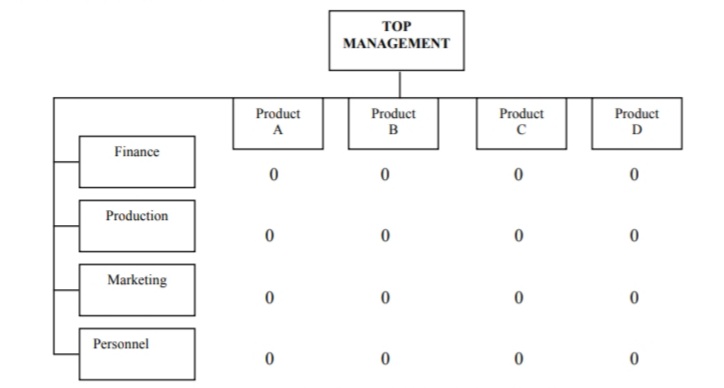
Matrix organisation
The distinguishing characteristic of a matrix structure is that it operates under a dual authority. A person is accountable to two bosses at the same time, one his or her usual boss and the other, the boss for the duration of the project. Obviously the problems emanating from this type of structure relate to conflicting roles and authority arising out of an ambiguous demarcation of authority and responsibility.