
Table of Contents
Q.1. What do you understand by a Professional Manager ? What are the different tasks of a Professional Manager ? (20)
A professional manager is an expert, trained and experienced enough to adeptly manage any type of organization be it a manufacturing house, a service organization, a hospital or a government agency.
Professional managers
• Are objective, focussed and performance oriented.
• Help in meeting competitive challenges of business.
• Are creative and dynamic.
• Follow management practices based on world wide experiences and information.
• Apply theories of management to solve emerging organizational problems.
Some Professional Manager Tasks
1. Providing direction to the firm
The first task, envisioning goals, is one of the tasks that should never be delegated. This is the ability to define overarching goals that serve to unify people and focus energies. It’s about effectively declaring what’s possible for the team to achieve and compelling them to accomplish more than they ever thought possible.
2. Managing survival and growth
Ensuring survival of the firm is a critical task of a manager. The manager must also seek growth. Two sets of factors impinge upon the firm’s survival and growth. The first is the set of factors which are internal to the firm and are largely controllable. These internal factors are choice of technology, efficiency of labour, competence of managerial staff, company image, financial resources, etc. The second set of factors are external to the firm like government policy, laws and regulations, changing customer tastes, attitudes and values, increasing competition, etc.
3. Maintaining firm’s efficiency
A manager has not only to perform and produce results, but to do so in the most efficient manner. The more output a manager can produce with the same input, the greater will be the profit.
4. Meeting the competition challenge
A manager must anticipate and prepare for the increasing competition. Competition is increasing in terms of more producers, products, better quality, etc.
5. Innovation
Innovation is finding new, different and better ways of doing existing tasks. To plan and manage for innovation is an on-going task of a manager. The manager must maintain close contact and relation with customers. Keeping track of competitor’s activities and moves can also be a source of innovation, as can improvements in technology.
6. Renewal
Managers are responsible for fostering the process of renewal. Renewing has to do with providing new processes and resources. The practices and strategy that got you where you are today may be inadequate for the challenges and opportunities you face tomorrow.
7. Building Human Organization
Man is by far the most critical resource of an organization. A good worker is a valuable asset to any company. Every manager must constantly look out for people with potential and attract them to join the company.
8. Leadership
Organizational success is determined by the quality of leadership that is exhibited. “A leader can be a manager, but a manager is not necessarily a leader,” says Gemmy Allen (1998). Leadership is the power of persuasion of one person over others to inspire actions towards achieving the goals of the company. Those in the leadership role must be able to influence/motivate workers to an elevated goal and direct themselves to the duties or responsibilities assigned during the planning process. Leadership involves the interpersonal characteristic of a manager’s position that includes communication and close contact with team members. The only way a manager can be acknowledged as a leader is by continually demonstrating his abilities.
9. Change management
A manager has to perform the task of a change agent. It’s the managers task to ensure that the change is introduced and incorporated in a smooth manner with the least disturbance and resistance.
10. Selection Information technology
Today’s managers are faced with a bewildering array of information technology choices that promise to change the way work gets done. Computers, the Internet, intranets, telecommunications, and a seemingly infinite range of software applications confront the modern manager with the challenge of using the best technology.
Example
A professional manager or a chief administrative officer for a city has duties which include meeting with elected council to determine polices that are determined by the council and to notify council members and citizens about the local government operations. Discussing of certain reforms, installing a bridge, setting up new traffic plans, or proposing a new building-all these and many more things which can affect community life are some of the responsibilities of the professional manager in a township. He is also responsible for preparing the annual budget, presenting it to elected officials for sanction and then implementing it, after it is approved. Listening to citizen grievances with regards to administration, civic problems, law and order and presenting the matter to the elected officials for appropriate actions are some of the tasks of a professional manager who is in charge of the administration of a city.
Q.2. What are the different managerial levels? How does the skills required at each level vary? (20)
Levels of Manager
A manager is responsible for combining and coordinating the people, the technology, the job task and other resources to effectively achieve the objectives of an organisation. You may be a manager in charge of constructing a plant or managing a bank or supervising a group of life insurance agents or training a football team. In most of the situations, you have others who are your subordinates reporting to you. The subordinates themselves may be managers having subordinates below to report to them. Therefore, we talk of levels of managers in an organisation.
1. The First Level Managers
These managers are in direct contact with the employees, who usually produce the goods or service outputs of an organisation. They are referred to as supervisors or foremen in some organisations. You may be associated with the employees who directly produce goods or render service outputs. Hence, you may belong to the first level managers. In some government offices, the superintendent of the of office supervising the work of typists, despatch clerks, etc. belong to this category.
In this industry, it is the foreman, who is in direct contact with the rank-and file workers, producing goods or services. In the tourism industry, in many sectors the first level managers are in direct contact with the customers also.
2. The Middle Level Managers
These managers are those with a number of responsibilities and linking or connecting activities. They direct the activities of the first level managers. For example, a district educational officer or a block development officer belongs to the middle level with the principals of schools and gram sevaks reporting to the district educational officer and block development officer respectively.
3. The Top Level Managers
The top level managers are a small group of policy makers responsibility for the overall strategic management of the organisation. It is the responsibility of the top managers to develop the objectives and strategies of the organisation. It is the top management that must sense the demands of the political, social and competitive environments on the organisation. A President or a Chief Executive or a District Magistrate are examples of top managerial level.
Managerial Skills at Various levels
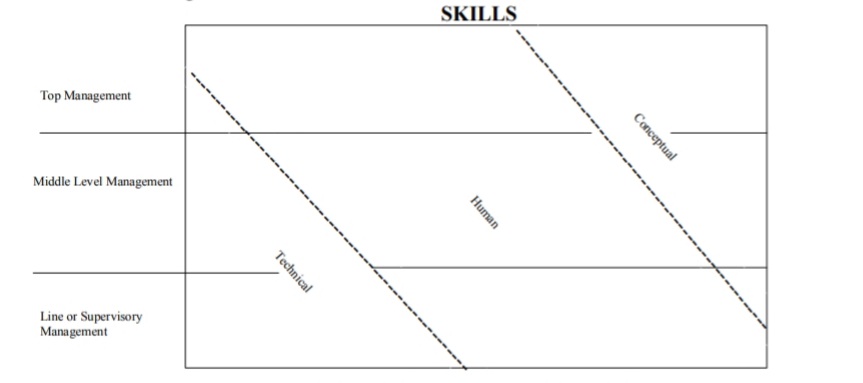
The skills refer to the personal ability put to use by the manager in specific position that he or she holds in the organisational hierarchy.
As one moves up in the hierarchy of the managerial positions, the responsibility increases. The fundamental functions of a manager such as planning, organising, leading, controlling and decision-making are the skills required to be mastered by the managers. In order to exercise these functions, one has also to keep in mind, the type of job, the size of organisation, the skills and experiences of the people one works with and the time available at his or her disposal to do these management functions.
Katz (1974) talks of three types of skills that are recognised by all managers. These are the technical, the human and the conceptual skills. The use of these skills differs for various levels of managers.
1. Technical Skill
It is the ability to work with resources in a particular area of expertise. A surgeon must know how to do surgery. An accountant must know how to keep the accounts. Without the technical skill, one is not able to manage the work effectively. The first line supervisor in a manufacturing industry needs greater knowledge about the technical aspects of the job compared to the top boss. In a small manufacturing organisation, even the top boss who owns the company needs to know a lot of technical skills.
2. Human Skill
Human skill is the manager’s ability to work effectively as a group members and to build cooperative effort within the team he or she leads. Every managerial level requires interaction with other people, whereas technical skill is primarily concerned with working with things (processes or physical objects). The first level manager is involved on a regular basis with the personal problems and life events of many non- managers. It is therefore natural that he or she must be able to work through these personal situations and effectively lead subordinates. He or she has to perceive and reorganise the perception of his or her superiors, equals and subordinates and his or her own behaviour subsequently.
3. Conceptual Skill
This skill means the ability to see the organisation as a whole and it includes recognising how the various functions of the organisation depend on one another. It also makes the individual aware how changes in any one part of the organisation affect all the others. It extends to visualising the relationship of the individual business to the industry, the community and the political, social and economic forces of the nation as a whole. Thus the manager gains insight into improving the overall welfare of the total organisation.
Q.3. Discuss the techniques used in the different steps of decision making process. (20)
Techniques used in the different steps of decision making process are
1. Identification of Alternatives
Generation of a reasonable number of good alternatives is usually no problem. Occasionally, however, developing a variety of good alternatives can be a complex matter requiring creativity, thought, and study.
Three means of generating alternatives are particularly well-known. These are brainstorming, synectics, and nominal grouping.
a. Brainstorming
Developed by Alex F. Osborn, brainstorming is the oldest and best known technique for stimulating creative thinking. It involves the use of a group whose members are presented with a problem and are asked to develop as many potential solutions as possible. Members of the group may all be employees of the same firm or outside experts in a particular field . Brainstorming is based on the premise that when people interact in a free and uninhibited atmosphere they will generate creative ideas.
b. Synectics
Developed by William J.J. Gordon, synectics is a more recent and formalised creativity technique for the generation of alternative solutions. The term synectics is derived from a Greek word meaning “the fitting together of diverse elements.” The basic intent of synectics is to stimulate novel and even bizarre alternatives through the joining together of distinct and apparently irrelevant ideas.
c. Nominal Grouping
Developed by Andre Delbecq and Andrew Van De Ven, nominal grouping differs from both brainstorming and synectics in two important ways. Nominal grouping does not rely on free association of ideas, and it purposely attempts to reduce verbal interaction. From this latter characteristics a nominal group derives its name; it is a group “in name only”.
2. Evaluation and Selection
Evaluation of various identified possible courses of action constitutes the second step of decision-making. Having identified a ‘reasonable’ number of alternatives as a manager you should now be in a position to judge the different courses of action which have been isolated. Each alternative must be evaluated in terms of its strengths and weaknesses, benefits and costs, advantages and disadvantages in achieving organisational goals. Since there are usually both positive and negative aspects of every alternative, most evaluations involve a balance or trade-off of anticipated consequences. Needless to say, such assessment should be as objective as possible.
Evaluation of the relative merits of various alternatives may be performed by a single manager or by a group. An evaluation may be completely intuitive or it may be scientific, using analytical tools and procedures associated with what is known as operations research (OR). More than likely, it will employ a combination of both approaches. Whatever the basis of evaluation, the more systematic the assessment, the more likely it is that the resulting judgements will be accurate and complete.
Once appropriate alternatives have been identified and evaluated, you must select the one alternative with the greatest perceived probability of meeting organisational objectives. Of course, it is entirely possible that the decision maker may be made to go back and identify other alternatives if none are judged to be acceptable.
3. Implementation of Decision
Once a plan (course of action) has been selected, appropriate actions must be taken to assure that it is implemented . Implementation is crucial to success of an enterprise. Indeed, it is considered by some to be the key to effective planning. The best plans in the world are absolutely worthless if they cannot be implemented. The activities necessary to put plans into operation must be skilfully initiated. In this respect, no plan is better than the actions taken to make it a reality.
With selection of a course of action, you must make detailed provisions for its execution. We must communicate the chosen course of action, gather support for it, and assign resources to see that it is carried out. Development of a sound means of implementation is every bit as important as the decision as to which course of action to pursue. All too often, even the best plans fail as a result of being improperly implemented.
In service industries like tourism extra caution is required while implementing decisions for a bad service cannot be withdrawn or withheld at the time of its simultaneous production and consumption.
Q.4. What do you understand by managerial ethos? Explain the stages of socialisation process. (20)
Managerial Ethos
Ethos refers to the habitual character and values of individuals, groups, races, etc. Managerial ethos is concerned with the character and values of managers as a professional group. Contemporary managers hold some specific values which affect work and some of these are autonomy, equity, security, and opportunity.
1. Autonomy
These managers tend to allow enough latitude to individual employees as long as the use of this freedom does not violate the basic norms of the organization. In the last two decades, some management practices have been innovated which are in keeping with this value of autonomy.
2. Equity
Equity refers to justice in rewarding performance. Modern managers strongly feel that a person must get a reward proportionate to his input.
Security(providing security both economically and emotionally): Keeping a person on his toes by making him feel insecure is slowly but steadily getting discredited as a management philosophy. Even the societies which have practiced “hire and fire” policy are unmistakably shifting towards providing security of the job.
3. Opportunity
Providing enough career advancement opportunities to employees is yet another contemporary managerial value.
Besides these four values which affect a manager’s work, the manager may have a strong “Work Value”. Work Value refers to the worth a person ascribes to the opportunity of work. If you have a “strong” work value you are going to identify the worth or value of work to you in more ways than one.
4. Security (providing security both economically and emotionally)
Keeping a person on his toes by making him feel insecure is slowly but steadily getting discredited as a management philosophy. Even the societies which have practiced “hire and fire” policy are unmistakably shifting towards providing security of job.
Managerial Ethos Characteristics
Apart from these values, the managerial ethos requires the below characteristics as well.
1. Action goal orientation
Persons with a high sense of adequacy have clear goals about their future and are directed by these goals. They are action oriented to reach their clear goals
Pro-action/Pro-active: Proactive people do things on their own without having to be told by anyone. Such an initiative taking behavior leads to a high level of activity and experimentation.
2. Internal resources
Managers with a high sense of adequacy are aware of their internal strengths and are guided by these strengths. They are aware of their weaknesses but this awareness does not deter them from acting positively or to look for opportunities for continuous self-improvement. They are open to feedback and ready to learn from experience.
3. Problem-solving attitude
A superior ethos requires that managers view themselves as problem solvers, rather than problem-avoiders. These managers have a positive orientation to problem situations and do not want to run away from problems. They tend to approach problem situations with optimism because they have an internal locus of control, i.e., a strong belief that they can change the environment through their own efforts.
4. Pro-action
Proactive people do things on their own without having to be told by any one. Such initiative taking behaviour leads to a high level of activity and experimentation. As contrasted to these people are reactive persons or conformists who spend most of their lives in doing things that others expect them to do. Reactive people are outer-directed, whereas proactive ones are inner-directed. A superior managerial ethos requires more of pro-action than reaction.
Socialisation Process
Socialisation process has three stages
1. Pre-arrival
This stage tries to ensure that prospective members arrive at an organisation with a certain set of values, attitudes and expectations. This is usually taken care of at the selection stage itself. Selectors try to choose the “right type” of people, who they feel, will be able to “fit” the requirements of an organisation.
Thus an organisation, even before allowing an outsider to “join”, makes an attempt to ensure a proper match which contributes towards the creation of a uniform culture within the organisation. The views of the founding fathers of an organisation as well as the ethos of the present top management influences, consciously or inadvertently, the selection of the parameters of this “proper match”.
2. Encounter
After gaining an entry into the organisation a new member faces an encounter stage. There is always a possibility of difference between his or her expectations of an organisation and the OC. If the expected image and OC matches, then the encounter stage passes off smoothly leading to confirmation of the image. If the imbalance between the two is acute, the person has usually two choices open. First, the person undergoes further socialisation which detaches him or her from previous expectations, replaces these with another set of expectations and thus helps him or her get adjusted to the prevailing system.
Second, he or she drops out due to disillusionment. In both the cases the final result is the same: the status quo of traditions and customs maintained.
3. Metamorphosis
People who had discovered an anomaly between their expectations and OC, but decided not to drop out enter into the metamorphosis stage. As they must sort out their problems and go through changes, this is called metamorphosis. When this metamorphosis is complete, the members develop a uniform perception of OC and feel ‘comfortable’ with the organisation and job. Successful metamorphosis results in the member’s productivity being as per organisation’s ‘norm’, ‘average’ commitment and lowered propensity to leave the organisation. All these are indications of “typical” or “normative” behaviour.
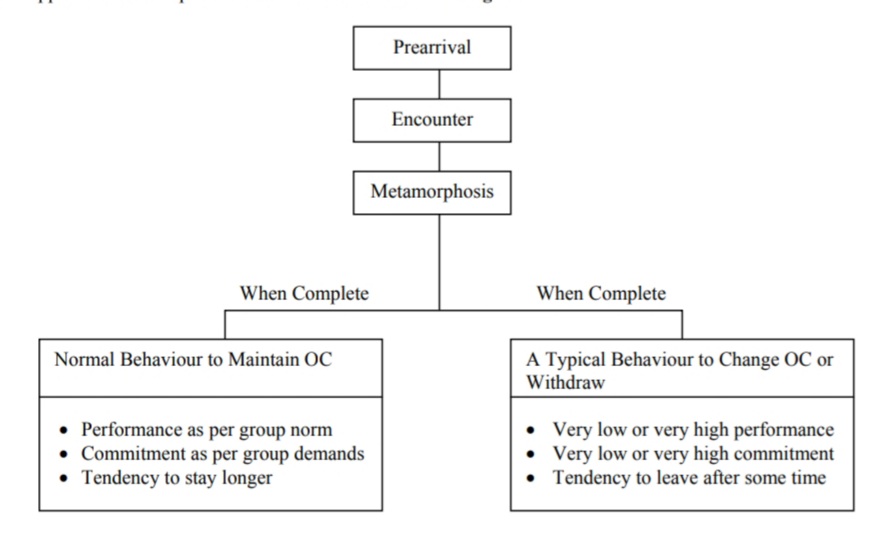
Socialisation Process and its Impacts on Organisational Culture
Q.5. Write short notes on any two: (10×2=20)
a. Benefits of MBO
Benefits –
The benefits accruing from MBO can be discussed in terms of the specific benefits to the subordinate, the superior and the organisation:
1. Benefits to subordinates
Includes greater role clarity, measurement of performance and increased job satisfaction. When specific objectives have been agreed upon, the subordinate knows exactly what he or she has to achieve and can plan various activities towards this end. Role and goal clarity ensure that there is no wastage of scarce organisational resources, on the one hand, and single minded dedication to achievement of objectives on the other.
MBO implies regular feedback and measurement of performance against objectives. This serves as a great motivating factor for people to put in their best effort to achieve the objectives. It also helps to weed out the non-performer and identify the real contributors.
Clear, specific objectives and unbiased feedback about performance contribute to increased job satisfaction as compared to a situation where a person does not know what is expected of him or her and how, if at all the performance will be judged. Job satisfaction emanates from the feelings of having done a job well to the best of your capability as well as public recognition and approval for it. The former is possible only when there are specific objectives while the latter can occur only if there is a system of review and reward. A worker or manager who derives satisfaction from his or her job will work harder in order to improve the performance while a dissatisfied, discontented manager will make a negative contribution. Thus MBO can serve to bring about a change and put people on the self-propelling cycle of role clarity, increased job satisfaction and increased productivity.
2. Benefits to Superiors
The benefits accruing to the subordinate will, of course, also accrue to the superiors. But besides these, the other specific benefits for superiors are that MBO motivates subordinates, strengthens superior-subordinate relationship, and provides an objective appraisal method.
MBO is based on the concept of participation and this leads to greater motivation. Setting objectives implies that both the superior and the subordinate have to sit across the table and openly discuss their respective roles, work, obstacles, and competencies. Such candid discussion always leads to increased mutual trust and confidence in each other and provides an enduring bond to the relationship.
One of the biggest advantages of MBO is that it provides an objective basis for reviewing performance on the basis of achievements rather than personality traits. Reviewing a person on the basis of personality not only puts him or her on the defensive but serves no purpose from the organisation’s point of view. The only thing that matters is results. People are retained by organisations to produce results and not because they are sociable, soft spoken, introverted or possess any other such personality characteristic which has no bearing on their competence or capability.
3. Benefits to the organisation
MBO focuses on managerial effectiveness as a central value in the entire organisation. And this emphasis permeates down to the lowest level, influencing each manager and worker. This shows up in all the decisions which each manager makes and the overall performance of the organisation is improved. Secondly, MBO with its focus on objectives improves concentration and co-ordination of managerial effort. There is maximum utilisation of resources and conflicting pulls in opposite directions are avoided. Thirdly, the periodic review in MBO helps identify advancement potential of workers and managers. It also helps in identifying who are under-utilised or not making the full contribution. Lastly, MBO creates many centres of accountability as against one centralised accountability point. It is not only the managing director or proprietor who is accountable for producing the desired results but each manager is responsible for achieving the agreed upon objectives. Thus, MBO leads to greater decentralisation in terms of setting and achieving objectives.
b. Group Dynamics
Group Dynamics is concerned with the interactions and the forces operating among group members in any situation. In the 1930s Kurt Lewin had popularised this term. You are already familiar with the three styles of leadership, i.e. Authoritarian, Democratic and Laissez-faire, which Lewin (1939)and his associates had developed by creating three different social situations for the three styles of leadership.
In course of time, various meanings were attached to the term ‘group dynamics’ (Kelly 1974). One of the meanings suggests how a group should be organised and conducted. In democratic leadership, member participation and overall cooperation are emphasised.
Another meaning of Group Dynamics is that it is a set of techniques which through various group exercises tries to make the leader as well as the member effective. An attempt is made to make the members play their roles in a management situation of group discussions, team building, finding out various solutions to problems by brainstorming and understanding oneself in relation to others while transacting or interacting with others. Such exercises are also provided in situations where only members are present and no leader exists to direct or control the group. All these exercises are techniques to develop both the individual as well as the organisation in which he or she works. The last meaning of the term Group Dynamics is closest to Lewin’s use of the term suggesting internal nature of the groups as to how they are formed, what their structures and processes are, how they function and affect individual members, other groups and the organisation.
c. Organisational culture
Every organisation has some characteristics which are common with any other organisation. At the same time, each organisation has its unique set of characteristics and properties. This psychological structure of organisation and its sub-units is usually referred to as Organisational Culture.
For a layman, culture is a commonly experienced phenomenon and many words like, climate, atmosphere, environment and milieu are often used interchangeably to describe it. In fact, most of the studies which have tried to measure an organization’s “Culture” have operationalised it in terms of “Organisation Climate”. A couple of formal definitions of organisation climate are given below:
1. “Organisational climate is a relatively enduring quality of the internal environment that is experienced by the members, influences their behaviour, and can be described in terms of values of a particular set of characteristics of the organisation” (Renato Tagiuri, 1968).
2. “Organisational climate is the set of characteristics that describe an organisation and that
a. Distinguish one organisation from other organisations
b. are relatively enduring over time and
c. influence the behaviour of the people in the organisation” (Forehand & Gilmer 1964).
Compare these two definitions of “Organisational Climate” with a definition of “Organisational Culture” as given by Stephen P. Robbins (1986): “Organisational culture is a relatively uniform perception held of the organisation, it has common characteristics, it is descriptive, it can distinguish one organisation from another and it integrates individual, group and organisation system variables.”
Q.6. What do you understand by delegation of authority ? What are the essential pre-requisites for effective delegation ?
Delegation of Authority
The process by which authority passes from one managerial level to another is known as delegation. As organisations grow in size and complexity, no one person can perform all the tasks or exercise all the authority that is needed to accomplish goals. Delegation of authority is not the same as division of work.
As Henry Fayol pointed out : “Division of work permits reduction in the number of objects to which attention and effort must be directed and has been recognised as the best means of making use of individuals and of groups of people”.
Delegation of authority denotes the superior vesting decision-making power in his or her subordinate. No one can delegate an authority which one does not have.
Delegation is one of the most important skills a manager must possess. The overworked managers are often those who do not know how to delegate and they lack the skill to get results through others. An individual can perform limited work in a day, all by himself or herself. But through delegation – through dividing the load and sharing one’s responsibilities with others – one can accomplish much more. No manager and no organisation can run smoothly and effectively without delegation.
The amount of delegation marks the effectiveness of the manager and influences the relationship between the superior and the subordinate.
Delegation is the process where a manager divides the work assigned to him or her so as to get help from others in accomplishing the same. It involves the following four steps that are indivisible :
• determination of results expected,
• assignment of tasks,
• delegation of authority for accomplishing these tasks, and
• exaction of responsibility for their accomplishment.
These four steps have three elements : responsibility, authority and accountability.
Delegation is the entrustment of responsibility and authority to another and the creation of accountability for performance. Let us briefly consider these three elements :
a. Responsibility
Responsibility refers to the activities which must be performed to carry out the task assigned. Responsibility can be delegated.
b. Authority
Authority refers to the powers and rights entrusted to enable performance of the task assigned or delegated. Certain authority is imperative to shoulder a given responsibility. In organisations people derive authority mainly from two sources : a) position and b) personal. Position authority is related to powers of decision-making, reward and punishment. Personal authority refers to the expert knowledge and certain qualities which are part of the personality of an individual manager. Position authority can be delegated, but not personal authority. Authority could be formal or informal. Here we refer to formal authority that is clear, structured and communicated to all.
c. Accountability
Accountability is the obligation to carry out responsibility and exercise authority as per established standards or norms. It is an obligation to account for, and report upon, the discharge of responsibility or use of authority. Accountability can not be delegated. The person who delegates continues to be responsible to his or her superior for what had been delegated by him or her.
Essential pre-requisites for effective delegation
Delegation is an art, not a science. It depends on the personality, skills and attitudes concerning two actors :
delegator (one who delegates) and delegate ( one who was delegated). The following are some of the essential prerequisites for effective delegation.
a. Climate of openness, trust and confidence among employees at all levels and a culture of team work and cooperation.
b The two psychological hurdles in delegation, namely lack of faith in the competence of subordinates and fear that the subordinates may outshine them deter managers from delegating. The managers should not have any feeling of insecurity that by delegating they would be making themselves redundant.
c. Goals should be established and made clear : Every person in an organisation should know what his or her contribution to the organisation is. In accomplishing the goals, one can formulate the objectives of delegation too so that delegation is done with a purpose and becomes effective.
d. People who carry out work should have clearly defined responsibility and authority. Job descriptions or position guides should clearly state the objectives, responsibilities, relationships and limits of authority of each position. Clear definition of responsibility and authority at each position eliminates the scope for confusion that duplication and overlap in entrustment of duties would cause.
e. Motivation is important because the manager who wants to delegate should be able to motivate people to do what he or she wants to do, willingly and enthusiastically.
f. Make delegation complete : Delegation is supposed to reduce a manager’s workload. But, if not properly done, it may increase the workload. There are often problems as to whether, at what stage and how often should the subordinate check back with the boss.
g. Train : Managers should help in preparing their subordinates to accept delegation. Such need is all the more felt in case of subordinates who show a tendency to depend on the bosses than be independent. Managers should, therefore, carefully identify the weaknesses, develop potential and attitudes conducive to accepting and making a success of delegated authority. Training in delegation should include appraisal of current performance, counselling for improvement and coaching on the job.
h. Establishment controls : Even after delegation the manager continues to be accountable. So there is need for him or her to control without limiting the effectiveness of delegation. The more complete is the delegation the more comprehensive should the system of control be. Self-control is the best in establishing controls for delegation. The person to whom responsibility and authority are delegated should participate in setting standards that are to measure his or her performance so that one can understand and accept them.
Q.7. Discuss the process and strategies of Conflict Management. (20)
Process of Conflict
1. Potential Antagonism
The first stage is the presence of antecedent conditions that creates opportunities for conflict to arise. They need not necessarily lead to conflict and may be present in the absence of conflict as well. You may refer to this stage as the source of conflict. Some of these antecedent conditions refer to scarcity of resources, heterogeneity of members and diversity of goals, values, perception; degree of dependence between groups; insufficient exchange of information, etc.
2. Cognition and Personalisation
The antecedent conditions may or may not lead to conflict. They must be perceived as threatening if conflict is to develop. The situation may be ignored if it is seen as minimally threatening. Moreover, if a conflict is perceived, it does not mean that it is personalised (“felt conflict”). However, if feelings are generated, they tend to influence the perception of the conflict. It is at the felt level, when individuals become emotionally involved and parties experience feelings of threat, hostility, fear or mistrust.
3. Conflictive and Conflict handling Behaviour
Manifest behaviour is the action resulting from perceived and /or felt conflict. At this stage, a conscious attempt is made by one party to block the goal achievement of the other party. Such behaviour may range from subtle, indirect and highly controlled forms of interference to more open forms of aggressive behaviour.
Most conflict-handling behaviours are displayed in several forms like resignation and withdrawal, appeasement and compromise, confrontation and collaboration, etc. These behaviours are often referred to as conflict management styles and stem from the strategies of conflict stimulation or conflict resolution.
4. Aftermath
The interplay between different forms of overt conflict behaviour and conflict handling strategies of stimulation or resolution influence the consequences. These consequences (in terms of performance of the group, the level of satisfaction and quality of relationship in the involved parties, change of structure and policies etc.) in turn influence the antecedent conditions and probability of future conflict. Sometimes, the aftermath sows the seeds of yet another conflict episode in which case the entire process is repeated.
On the basis of four-stage conflict -process model you can now define conflict as the process which begins when A, as one party perceives that B, as the other party, is making some conscious efforts to frustrate A in pursuing his or her interest. Party A and/or B, may be an individual and/or group(s).
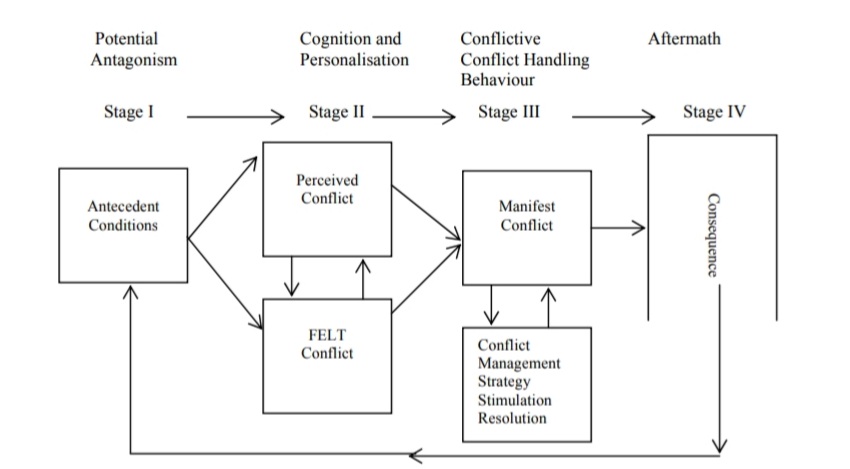
The Conflict Process
Strategies of conflict management
1. Stimulating Productive Conflict
Most of us since childhood have been taught to avoid conflict and even disagreement. How many times have you heard the statements “Don’t Argue”, “Stop fighting” or “It’s better to turn the other cheek”?
However, this tendency to avoid conflict is not always productive and there are times when there is a need to stimulate conflict. In an interesting experiment, series of groups were formed to tackle a problem.
2. Resolving Inter-party Conflict
The primary dimension along which intergroup conflict-resolution strategies vary is how openly you as a manger should address the conflict. The chief characteristic of conflict-avoidance strategies is that they attempt to keep the conflict from coming into the open. The goal of conflict-defusion strategies is to keep the conflict in abeyance and to “cool” the emotions of the parties involved. Conflict-containment strategies allow some conflict to surface, but tightly control which issues are discussed and the manner in which they are discussed. Conflict-confrontation strategies are designed to uncover all the issues of the conflict and try to find a mutually satisfactory solution.
A. Conflict-avoidance Strategies
a. Ignoring the Conflict
This strategy is represented by the absence of action. Managers, often avoid dealing with dysfunctional aspects of conflict. Unfortunately, when you avoid searching for the causes of the conflict, the situation usually continues or becomes worse over time. Although ignoring the conflict generally is ineffective for resolving important policy issues, there are some circumstances in which it is at least a reasonable way of dealing with problems.
b. Imposing a Solution
This strategy consists of forcing the conflicting parties to accept a solution devised by a higher-level manager. Imposing a solution does not allow much conflict to surface, nor does it leave room for the participants to air their grievances, so it also generally is an ineffective conflict-resolution strategy. Any peace that it does achieve is likely to be short-lived. Because the underlying issues are not addressed, the conflict reappears in other guises and in other situations.
B. Conflict-defusion Strategies
a. Smoothing
One way you can deal with conflict is to try to “smooth it over” by playing down its extent or importance. You may try to persuade the groups that they are not so far apart in their viewpoints as they think they are, point out the similarities in their positions, try to “pat” group members whose feelings have been hurt, or play down the importance of the issue. By smoothing the conflict, you can hope to decrease its intensity and avoid escalation or open hostility. Like forcing a solution, smoothing generally is ineffective because it does not address the key points of conflict. However, smoothing sometimes can serve as a stop−gap measure to let people cool down and regain perspective.
b. Appealing to Superordinate Goals
You can defuse conflicts by focusing attention on the higher goals that the groups share or the long-range aims that they have in common. This tends to make the current problem seem insignificant beside the more important mutual goals. However, finding superordinate goals that are important to both groups is not easy. Achieving these goals requires co-operation between the groups, so the rewards for achieving the goals must be significant. The most successful, and most frequently used, superordinate goal is organisational survival, i.e., if the subunits do not cooperate sufficiently, the continued existence of the larger organisation itself will be severely jeopardised.
C. Conflict-containment Strategies
a. Using Representatives
One of the strategies you can use to contain conflict is the use of representatives. In order to decide an issue, you can meet with representatives of the opposing groups rather than deal with the groups in their entirety. The rationale is that the representatives know the problems and can argue the groups’ point of view accurately and forcefully.
Resolving conflict through representatives is more effective before positions become fixed or are made public. After positions become fixed, representatives become even more intransigent, and “given in” is more likely to be attributed to the personal failure of the representatives than to situational factors.
b. Structuring the Interaction
Some managers assume that one way to decrease conflict is to increase the amount of contact between the groups (if the groups interacted more, they would like each other better and fight less). In reality, increased interaction can add fuel to the fire; the two groups may spend their time looking for additional reasons to reinforce their negative stereotypes of each other.
However, structuring the interaction between the groups can be effective in resolving conflict by providing a framework on how many issues are discussed and the manner in which they are discussed.
c. Bargaining
Bargaining is the process of exchanging concessions until a compromise solution is reached. Bargaining can lead to the resolution of a conflict, but usually without much openness on the part of the groups involved and without much real problem solving. Typically, in bargaining each side begins by demanding more than it really expects to get. Both sides realise that concessions will be necessary in order to reach a solution, but neither side wants to make the first concession because it may be perceived as a sign of weakness. Thus, each party signals a willingness to be flexible in exchanging concessions without actually making an explicit offer; a tacit proposal can be denied later if it fails to elicit a positive response from the other party.
D. Conflict-confrontation Strategies
Problem Solving
Problem solving is an attempt to find a solution that reconciles or integrates the needs of both parties who work together to define the problem and to identify mutually satisfactory solutions. In problem solving, there is open expression of feelings as well as exchange of task-related information.
There are two preconditions for successful, integrative problem solving. The first is a minimal level of trust between the groups. Without trust, each group will fear manipulation and may not reveal its true preferences. Secondly, integrative problem solving takes a lot of time and can succeed only in the absence of pressure for a quick settlement. However, when the organisation can benefit from merging the differing perspectives and insights of the two groups in making key decisions, integrative problem solving is especially needed.
E. Organisational Redesign
Redesigning or restructuring the organisation can be an effective, inter-group conflict-resolution strategy. This is especially true when the sources of conflict result from the coordination of work among different departments or divisions. Unlike the other strategies discussed so far, you may note, organisational redesign can be used both to resolve the conflict or to stimulate it.
One way of redesigning organisations is to reduce task inter-dependence between groups and to assign each group clear work responsibilities (i.e., create self-contained work-groups) to reduce conflict. This is most appropriate when the work can be divided easily into distinct projects. Each group is provided with clear project responsibilities and the resources needed to reach its goals. A potential cost of this strategy is duplication and waste of resources, particularly when one group cannot fully utilise equipment or personnel.
Q.8. Define Communication Process. What are the various barriers to effective communication? (20)
Communication Process
The most simple model of the communication process can be :
Sender ————————>————– Message ————————>———— Receiver
The model indicates the essential elements of communication, viz., the sender and the receiver, and the message that is exchanged between them. If any one of the three elements is missing, communication does not take place. However, the process of communication is a much more complex phenomenon consisting of at least five elements which are subject to various influences.
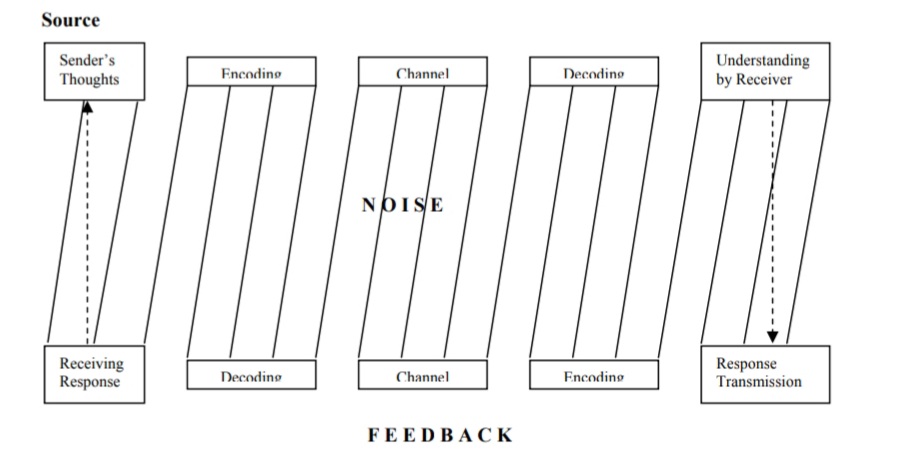
Model of communication process
1. Source
In this model the first element is the source of the communication from where the communication originates. The source or sender can be a person, a number of persons, or even a machine like a satellite or computer. The sender initiates communication because he or she has some need, thought, idea or information that he or she wishes to convey to the other person, persons or machine. If, for example, an accidental fire has broken out in a part of Hotel, the security officer (source) will need to convey the message immediately to the guests (receiver). Fire alarm (machine) will do the same in place of the security officer.
2. Encoding Message
The next element in the process is that of encoding the information to be transmitted. Encoding enables the thoughts to be put in the form of symbols. Normally language provides the symbols that are used in the transmission of thoughts to another person. However, language is not the only means to convey the thoughts, needs or information. There are non-verbal means, e.g., gestures, which provide another form through which thoughts can be transmitted.
3. Channel
The next element in the process of communication is the channel through which the communication is transmitted. It is the link that joins the sender and the receiver. The most commonly used channels are sight and sound. In the organisational environment, the channel could take the form of face-to-face conversation, written memos, telephonic exchanges, group meetings, computerised Local Area Network (LAN), etc.
4. Decoding
Decoding and understanding the message constitute the last two elements in the process of communicating from sender to receiver. The receiver in the first instance receives the message and decodes it, that is to say, interprets and translates it into thoughts, understanding and desired response. A successful communication occurs when the receiver decodes the message and attaches a meaning to it which very nearly approximates the idea, thoughts or information the sender wished to transmit.
5. Feedback
Response and feedback complete the two-way process of communication. It is through the feedback that the source (sender) comes to know if the message was correctly received and understood. In case it is found that the message has been received incorrectly, it is possible to make corrections subsequently but for this the response has to be timely.
6. Noise
Surrounding the entire spectrum of communication is the noise that affects the accuracy and fidelity of the message communicated. Noise is any factor that disturbs, confuses or otherwise interferes with communication. It can arise at any stage in the communication process. The sender may not be able to encode the message properly or may not be properly audible. The message may get distorted by other sounds in the environment. The receiver may not hear the message, or comprehend it in a manner not entirely intended by the sender of the message.
Barriers To Effective Communication
The process of communication has multiple barriers. The intended communique will often be disturbed and distorted leading to a condition of misunderstanding and failure of communication. The Barriers to effective communication could be of many types like linguistic, psychological, emotional, physical, and cultural etc. We will see all of these types in detail below.
1. Linguistic Barriers
The language barrier is one of the main barriers that limit effective communication. Language is the most commonly employed tool of communication. The fact that each major region has its own language is one of the Barriers to effective communication. Sometimes even a thick dialect may render the communication ineffective.
As per some estimates, the dialects of every two regions changes within a few kilometers. Even in the same workplace, different employees will have different linguistic skills. As a result, the communication channels that span across the organization would be affected by this.
Thus keeping this barrier in mind, different considerations have to be made for different employees. Some of them are very proficient in a certain language and others will be ok with these languages.
2. Psychological Barriers
There are various mental and psychological issues that may be barriers to effective communication. Some people have stage fear, speech disorders, phobia, depression etc. All of these conditions are very difficult to manage sometimes and will most certainly limit the ease of communication.
3. Emotional Barriers
The emotional IQ of a person determines the ease and comfort with which they can communicate. A person who is emotionally mature will be able to communicate effectively. On the other hand, people who let their emotions take over will face certain difficulties.
4. Physical Barriers to Communication
They are the most obvious barriers to effective communication. These barriers are mostly easily removable in principle at least. They include barriers like noise, closed doors, faulty equipment used for communication, closed cabins, etc. Sometimes, in a large office, the physical separation between various employees combined with faulty equipment may result in severe barriers to effective communication.
5. Cultural Barriers of Communication
As the world is getting more and more globalized, any large office may have people from several parts of the world. Different cultures have a different meaning for several basic values of society. Dressing, Religions or lack of them, food, drinks, pets, and the general behaviour will change drastically from one culture to another.
6. Organisational Structure Barriers
As we saw there are many methods of communication at an organizational level. Each of these methods has its own problems and constraints that may become barriers to effective communication. Most of these barriers arise because of misinformation or lack of appropriate transparency available to the employees.
7. Attitude Barriers
Certain people like to be left alone. They are the introverts or just people who are not very social. Others like to be social or sometimes extra clingy! Both these cases could become a barrier to communication. Some people have attitude issues, like huge ego and inconsiderate behaviours.
8. Perception Barriers
Different people perceive the same things differently. This is a fact which we must consider during the communication process. Knowledge of the perception levels of the audience is crucial to effective communication. All the messages or communique must be easy and clear. There shouldn’t be any room for a diversified interpretational set.
9. Physiological Barriers
Certain disorders or diseases or other limitations could also prevent effective communication between the various channels of an organization. The shrillness of voice, dyslexia, etc are some examples of physiological barriers to effective communication. However, these are not crucial because they can easily be compensated and removed.
10. Technological Barriers & Socio-religious Barriers
Other barriers include the technological barriers. The technology is developing fast and as a result, it becomes difficult to keep up with the newest developments. Hence sometimes the technological advance may become a barrier. In addition to this, the cost of technology is sometimes very high.
Most of the organizations will not be able to afford a decent tech for the purpose of communication. Hence, this becomes a very crucial barrier. Other barriers are socio-religious barriers. In a patriarchal society, a woman or a transgender may face many difficulties and barriers while communicating.
Q.9. What are the different approaches to coordination ? Identify the problems of and approaches to inter-departmental coordination. (20)
Interdepartmental cooperation and coordination are imperative for the success of any organisation. Coordination is easy, if the degree of differentiation among different departments is less. Successful companies evolve effective mechanisms and procedures to strike a balance between the requisite degree of differentiation and requisite degree of inter-dependence among departments/functions.
James D Thompson classified internal interdependence of work units/functions into three types :
1. Pooled indirect interdependence, sequential (one-way)
Pooled Indirect Interdependence is a situation where the activities of different departments or divisions are not directly dependent on each other. For example, the advertising department of a hotel is essentially independent from front office and house keeping departments. Yet, they are inter-dependent in the sense that each is part of the same enterprise. Failure of either could threaten the entire company and thus other departments. Each department makes a discrete contribution to the organisation and is, in turn, supported by it. The degree of coordination required here is minimum.
2. Sequential (one-way) interdependence
In cases where the outputs from one department become the inputs for the other, sequential (one-way) interdependence exists.
3. Reciprocal (two-way) interdependence
Reciprocal (two-way) interdependence occurs when output from one becomes input for the other and vice-versa. For example, such two-way interdependence occurs between maintenance and operations units in a tourist transport company. Here close coordination is needed because problems in either will be quickly felt by the other.
Thompson lists three main categories of integrated mechanisms to achieve coordination :
a. Integration through standardisation. This involves establishing rules or procedures that channel the actions of each job holder or department into a direction consistent with the actions of others.
b. Plans and schedules can be established to integrate the actions of separate units. Integration through planning is somewhat more flexible than standardisation in that the plans can be modified quickly.
c. Integration can also occur through “mutual adjustment”. This involves transmission of information directly between people and the mutual adjustment of their actions in the light of that information.
The traditional bureaucratic approach which is common to most of our organisations relies heavily on coordination through standardisation and planning. Three mechanisms are available for the purpose. Firstly, an elaborate system of rules and procedures is worked out to deal with recurrent problems. Secondly, non-routine problems are handled by referring up to the hierarchy. Where matters of policy and procedure requires some deliberation; committee meetings are held. These committee meetings are scheduled at regular intervals in stable conditions. They are also held at short notice, if the need arises.
The advantage of a bureaucratic system is that it operates smoothly and effectively in normal and predictable conditions. But it is inadequate to meet the requirements of an organisation in an ever changing turbulent environment. Often managers complain, “If we had to go through the formal channels, we would never be able to get things done on time”. This could well be an exaggeration. Carefully structured bureaucratic systems of formal coordination minimise the dependence on informal systems. There is need for a balance rather than excessive reliance on formal or the informal system.
Van de Ven et al discuss three principal modes of coordination :
• Impersonal mode, i.e., coordination through setting programmes and procedures
• Personal mode, i.e., coordination through feedback
• Group mode, i.e., committee, task force, meetings, etc.
The choice of the modes is dependent upon conditions of certainty, problems of inter-dependence and size of work units (in terms of number employed). As uncertainty increases, group mode becomes appropriate since coordination requires discussions at lateral levels in a hierarchy. As inter-dependence increases, there is greater need for personal and group modes. As the organiation grows large and complex, the structure needs to be more formal with greater stress on impersonal mode.
Whatever be the approach, wherever the organisation chooses to vest a manager in a coordinating role, it should ensure that he or she is given proper authority. Only then can the exercise influence meaningfully over departmental heads. There should be clarity about the role, responsibilities, authority and accountability. The coordinators should be non-controversial and acceptable to the departments or groups they are called upon to coordinate. Coordinators should have the resources and staff.
Problems in Inter-departmental Coordination
Common warning signs of interdepartmental conflict include the following :
a. Persistent conflict between departments : When the same matters of conflict keep recurring between or among departments, conflict becomes embedded and persistent. If this is not diagnosed and dealt early enough, the departments involved start accepting it as normal and the outcomes arising out of such conflict tend to be taken for granted.
b. Proliferation of committees : While committees are constituted in organisations to bring about effective coordination on important issues affecting more than one department, their proliferation may paradoxically reveal the basic weakness in the organisation, viz., lack of coordination.
Proliferation of coordination committees fudge inter-departmental disputes and delay the resolution of inter-departmental conflict.
c. Overloading of top management : One common tendency among departmental heads is to expect the general manager or the chief executive to intervene in matters requiring coordination between departments. If issues are not resolved often enough by departmental heads among themselves, the top management will be preoccupied more with such matters than deal with their main function of policy, planning and relationships with important constituents outside the organisation. Top management overload is another sign of inadequate coordination.
d. The ritual of ‘red tape’ : Coordination can take place through use of formal procedures. For example, the procedure may require that the two concerned departments should consult each other on certain specified matters. But managers may not follow this or take it seriously. When procedures are not followed or cut short, problems may aggravate. The purpose of adhering to procedures is not to perpetuate the red tape as a ritual. Where procedures are redundant or inappropriate, they need to be modified, than being ignored.
e. Empire-building : Once coordination is provided at a level higher than the departments, the persons performing the role of coordinators may like to perpetuate the institution of coordination and strengthen their role by consciously endeavouring to avoid direct cooperation and coordination among departments. Where coordination seeks to monopolise and block initiatives at departmental level to achieve harmony in goals and actions at peer level, the writing on the wall is clear.
f. Complaints from constituents : Lack of inter-departmental coordination leads to unsatisfactory performance and affect the quality of service and relations between the organisation and its constituents like the customers, suppliers, Government, etc. When different departments of an organisation provide conflicting information, it affects the credibility of the organisation.
Q.10. Write short notes on : (10×2=20)
a. Path Goal Leadership Theory
Theory by House (1971) states that the leader smooth out the path towards goals and provides rewards for achieving them.
As a leader, you should understand the needs of the people and their desire to work or behave in a way that accomplishes goals that satisfy those needs. This theory is based on a situation of the above kind. If you know the need of the person and his or her desire to work and he or she is able to accomplish the work, you can reward to make him or her feel happy and satisfied. In essence, you are doing three things; One, you are motivating the members of the group by clarifying the path to personal rewards that result from attaining personal goals. You have thus ‘fixed’ him or her on the job and made him or her see that his or her performance can lead to positive or negative rewards. Two, you have already made the path-goal clear to the member and also told him or her about what the job-requires. You need not say too many things about the job to him or her as this may decrease the interest in the work and deter performance. Three, you must offer the reward to the member of the group who actually accomplishes the task. Your rewards may be a praise or increase in the pay or promotion of the member to a higher position. Your judgement about the desirability of the member to a higher position is crucial. Your judgement about the desirability of the member’s effort and the goal helps you to decide whether a reward can be given.
It is very important for the leader to know every member as a person, in order to use a style to get the best out of the member. For example, a task-oriented leader is preferred by a highly achievement-oriented member, whereas a person-oriented leader is preferred by a person who needs a good deal of affiliation with others. Similarly it does good for the leader to know each situation to adjust his or her style of functioning for better results. With a clear task on hand, members feel satisfied if the leader is supporting them. They may not show a lot of output, but they are satisfied. On the other hand with a less clear or more vague task on hand, members show more output, if the leader directs them to work better. The member in this situation may not be very satisfied.
In most of the Indian work settings, it is usually observed that members are quite dependent on the leader or the superior. They also are quite conscious of their status, but have very little commitment to work. Singh (1980) suggests that the leader who is task-oriented and nurtures the dependence of members on him is most effective in dealing with such members. He or she can get the work done in his nurturant task style from the members of group. To a great extent, he knows characteristics of the members’ work group, which he utilises in making the leadership style-oriented, effective and getting the work done.
It is clear that a leader is a person who has ability to persuade others to get the work done. You must have seen a person having the title of a leader. He or she may by very popular, but may not have the ability of leadership. Many leaders try to become popular by agreeing with everyone, thus avoiding any kind of conflict. Their influence on the subordinate or members of the work group may not be very lasting. There are leaders, who by virtue of their ability to exercise authority and power show better influence on members. It is therefore necessary for you to understand the authority of a leader and his or her sources of power, which help him or her to exercise influence on the subordinates.
b. Johari Awareness Model
The Johari Window is a conceptual model for studying interpersonal awareness. It was developed by Joseph Luft and Harry Ingham ( the name Johari combines their first names). It is a schematic model that shows how people expose themselves to others and receive feedback from others in their interpersonal relationships.
As shown in Figure , the Johari Window has four parts: Arena, Blindspot, Closed and Dark. Arena represents the “Public self” that is known to the self and others. The Blindspot area is known to others, but not to the self. The Closed area is the “private self” which is known to the self, but not to others. The Dark area is neither known to the self nor to others.
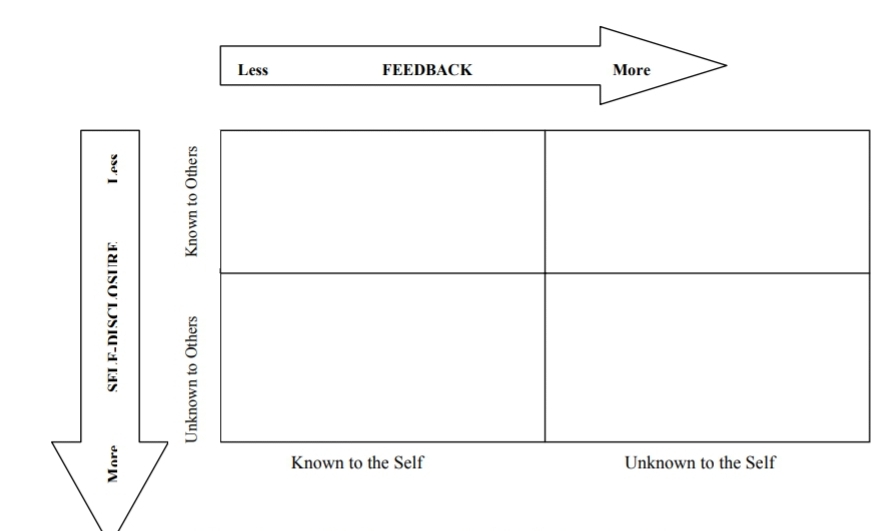
The Johari Awareness Model
The implication of this model is that if Arena is very small, there is very little free and spontaneous interaction. On the other hand, the larger the Arena, the greater the chance for participants in any relationship to make correct perceptual judgements about each other. This accurate perceptual judgement helps them to develop realistic mutual expectations. Meeting these expectations increases their level of trust and influence, and it helps them maintain a mutually satisfying relationship. As Arena expands, the Closed area or private self shrinks and it becomes less necessary to hide or deny things one knows or feels. The Blindspot takes longer to reduce because self-concept protection mechanisms are involved.
Arena can be expanded by means of self-disclosure and feedback. These two variables are shown as two large arrows in the figure and range from less to more. Self-disclosure means revealing oneself to another person and sharing one’s feelings, emotions, facts and knowledge with that individual. Self-disclosure is an act of showing respect for, and sharing intimacy with another person. Such an act requires trust in another person and is likely to encourage the other person to follow suit. But self-disclosure involves both rewards and costs. Being open (more self-disclosure) offers the possibility of self- understanding, growth and better interpersonal adjustments. On the other hand, when we disclose ourselves to another, we are taking the risk of being rejected, misinterpreted or short changed. However, unless someone takes the risk and initiates self-disclosure, the relationship will not develop.
Feedback reduces the Blindspot area and helps us increase our self-awareness, since we often do not know how others view us. We can guess how they see us by their reactions, but these reactions are often not clear and likely to be misperceived. Unless we receive feedback as to how they see us, or what kind of effects our behaviours have on them, we are likely to be blind to their feelings and reactions.
The feedback given by others can hope to reduce Blindspot only if it has the following characteristics (Anderson, 1970):
1. Intended to help the recipient.
2. Given directly, with real feelings and based on a foundation of trust between the giver and receiver.
3. Descriptive rather than evaluative.
4. Specific rather than general, with good, clear and preferably recent examples.
5. Given at a time when the recipient appears to be in a condition of readiness to accept it.
6. Checked with others to be sure that they support its validity.
7. Includes only those things that the recipient might be expected to be able to do something about.
8. Does not include more than the recipient can handle at any particular time.
Interpersonal awareness can be increased in several ways. When you feel that something is wrong with a relationship but the problem area cannot be identified, you may take one of the following actions:
1. Ask the other party how the relationship is working out for him or her (i.e., solicit feedback). Take the initiative in expressing your concerns and feelings (i.e., initiate self-disclosure) and listen to the feedback with empathy and without any attempt to defend. The feedback obtained may not be satisfactory but at least opens the door for improvement.
2. Ask yourself whether you are fulfilling the psychological contract. Take stock of your perceptions of mutual expectation and see if each of you is meeting these expectations . Keeping in mind the characteristics of effective feedback, communicate your concerns to your partner.