
Table of Contents
Q.1. What do you understand by managerial obsolescence ? Discuss the tasks of a professional manager in a tourism concern. (20)
Managerial Obsolescence
Managers and executives, after 20 to 25 years of work experience, often find themselves having reached a plateau where, on the one hand, the prospect of enhanced status, increased pay and perks are no longer motivators enough to work hard; and on the other, they find they are unable to relate to the latest managerial knowledge and skills and feel totally lost. In both cases, these managers cease to be productive and become a drag on the organisation in terms of their heavy cost and inability to make meaningful contribution. This is the problem of managerial obsolescence, that is when managers become unproductive, or out of date, or both. In the situation where lack of motivation seems to be the cause, the solution lies in redesigning their job content to make it more meaningful. For example, an aerospace company designates its senior engineering managers as consultants to its groups of young engineers, thus providing the right outlet for their rich experience.
Training programmes aim to provide or improve knowledge and skills which can help the manager improve his or her performance on the job. Many companies regularly sponsor their senior managers to attend such training programmes. Other companies invite experts to their own company premises to conduct these programmes and workshops. Training programmes, refresher courses, and basic courses in functional areas are the solution for managers facing knowledge obsolescence.
These training programmes are not restricted to senior managers alone. In fact, younger managers can also benefit from these programmes, especially those which provide knowledge of other functional areas such as production for non-production managers. Also beneficial for the young managers are workshops aimed at training them for the top level management posts.
Tasks of a professional manager
Some Professional Manager Tasks
1. Providing direction to the firm
The first task, envisioning goals, is one of the tasks that should never be delegated. This is the ability to define overarching goals that serve to unify people and focus energies. It’s about effectively declaring what’s possible for the team to achieve and compelling them to accomplish more than they ever thought possible.
2. Managing survival and growth
Ensuring survival of the firm is a critical task of a manager. The manager must also seek growth. Two sets of factors impinge upon the firm’s survival and growth. The first is the set of factors which are internal to the firm and are largely controllable. These internal factors are choice of technology, efficiency of labour, competence of managerial staff, company image, financial resources, etc. The second set of factors are external to the firm like government policy, laws and regulations, changing customer tastes, attitudes and values, increasing competition, etc.
3. Maintaining firm’s efficiency
A manager has not only to perform and produce results, but to do so in the most efficient manner. The more output a manager can produce with the same input, the greater will be the profit.
4. Meeting the competition challenge
A manager must anticipate and prepare for the increasing competition. Competition is increasing in terms of more producers, products, better quality, etc.
5. Innovation
Innovation is finding new, different and better ways of doing existing tasks. To plan and manage for innovation is an on-going task of a manager. The manager must maintain close contact and relation with customers. Keeping track of competitor’s activities and moves can also be a source of innovation, as can improvements in technology.
6. Renewal
Managers are responsible for fostering the process of renewal. Renewing has to do with providing new processes and resources. The practices and strategy that got you where you are today may be inadequate for the challenges and opportunities you face tomorrow.
7. Building Human Organization
Man is by far the most critical resource of an organization. A good worker is a valuable asset to any company. Every manager must constantly look out for people with potential and attract them to join the company.
8. Leadership
Organizational success is determined by the quality of leadership that is exhibited. “A leader can be a manager, but a manager is not necessarily a leader,” says Gemmy Allen (1998). Leadership is the power of persuasion of one person over others to inspire actions towards achieving the goals of the company. Those in the leadership role must be able to influence/motivate workers to an elevated goal and direct themselves to the duties or responsibilities assigned during the planning process. Leadership involves the interpersonal characteristic of a manager’s position that includes communication and close contact with team members. The only way a manager can be acknowledged as a leader is by continually demonstrating his abilities.
9. Change management
A manager has to perform the task of a change agent. It’s the managers task to ensure that the change is introduced and incorporated in a smooth manner with the least disturbance and resistance.
10. Selection Information technology
Today’s managers are faced with a bewildering array of information technology choices that promise to change the way work gets done. Computers, the Internet, intranets, telecommunications, and a seemingly infinite range of software applications confront the modern manager with the challenge of using the best technology.
Example
A professional manager or a chief administrative officer for a city has duties which include meeting with elected council to determine polices that are determined by the council and to notify council members and citizens about the local government operations. Discussing of certain reforms, installing a bridge, setting up new traffic plans, or proposing a new building-all these and many more things which can affect community life are some of the responsibilities of the professional manager in a township. He is also responsible for preparing the annual budget, presenting it to elected officials for sanction and then implementing it, after it is approved. Listening to citizen grievances with regards to administration, civic problems, law and order and presenting the matter to the elected officials for appropriate actions are some of the tasks of a professional manager who is in charge of the administration of a city.
Q.2. What do you understand by Management Information System (MIS) ? What factors should be kept in mind while designing an effective MIS for a large size tour operator firm? (20)
MIS
Management Information System (MIS) refers to that system by which information is collected processed and presented to management to help it in making better decisions.
A manager makes decisions all the time and anything that helps improve the decision-making will obviously lead to better results. As we discussed in the previous section, the systems concept implies an input, a process, and an output. In case of MIS, data is the input which is processed to provide output in the form of information reports, summaries, etc. To be really useful the output must aid the manager’s decision-making process. If it does not do so, it is not a management information system, but just an information system.
An effective MIS should be:
a. Timely: A market research report, pointing out the unacceptability of milk sold in plastic containers in retail stores, presented to the manager after he has already launched his product in the market is of little use. Information is useful only when it is within the time limits of the decision.
b. Accurate: If the information presented is inaccurate, the manager who takes a decision based on this will invariably end up making a mistake. However, it is not possible to have hundred per cent accurate information. But the way to overcome this is to indicate the expected range of deviation or the level of inaccuracy. Thus the manager acting on the basis of this information knows the risk he or she is taking.
c. Relevant: Volumes of reports (however excellent they may be) on the export potential of cashew nut to a manufacturer of sports goods are of no value simply because it is outside his or her area of interest and activities. The manager, himself or herself, can make an important contribution in ensuring that the information received is relevant to his decision-making. To do so he or she must provide an answer to the question “What do I need to know?”
A manager’s requirement of information depends on the level of management at which one is operating. In any organisation there are three broad levels of management i.e., top, middle and operating management. It is the type of decisions made by one level that distinguishes it from the others.
Designing MIS
While designing the MIS, the different types of information required by different managers must be kept in mind. The manager at the top needs more information about the environment. Regarding the internal operations of the company, the top manager is only concerned with the results as reflected in profits, sales volume, turnover, etc. Moreover, these results should be presented in a summary rather than detailed format.
The middle level manager is interested in finding out why the results were not as per the expected plan, knowing about the deviations of the critical variables and taking corrective action. The operating manager’s concern is with details, like the number of hours each machine operated, number of units produced per hour, etc. Most of the internal organisational information is generated at this level but as it moves upward it is reduced to a summary highlighting only the critical performance variables.
In designing an effective MIS, the manager must understand the nature and flow of information.
Information regarding government policy, legislation, competition, etc. is generated in the environment but is collected and used within the organisation. Similarly, the firm or an organisation may send out information to the environment in the form of annual reports, company balance sheets, press-releases.
Besides this, the company managers and employees are also information carriers. Within an organisation, information may flow from operating level towards top management level ( bottom to top) and from top to bottom. Reports, summaries and feedback about impact of decisions flow from bottom to top and decisions, instructions flow from top to bottom. Information also flows sideways from one manager to another at the same managerial level.
Q.3. What are the various levels of managers in an organisation? Discuss the level-wise skill set required in management. (20)
Levels of Manager
A manager is responsible for combining and coordinating the people, the technology, the job task and other resources to effectively achieve the objectives of an organisation. You may be a manager in charge of constructing a plant or managing a bank or supervising a group of life insurance agents or training a football team. In most of the situations, you have others who are your subordinates reporting to you. The subordinates themselves may be managers having subordinates below to report to them. Therefore, we talk of levels of managers in an organisation.
1. The First Level Managers
These managers are in direct contact with the employees, who usually produce the goods or service outputs of an organisation. They are referred to as supervisors or foremen in some organisations. You may be associated with the employees who directly produce goods or render service outputs. Hence, you may belong to the first level managers. In some government offices, the superintendent of the of office supervising the work of typists, despatch clerks, etc. belong to this category.
In this industry, it is the foreman, who is in direct contact with the rank-and file workers, producing goods or services. In the tourism industry, in many sectors the first level managers are in direct contact with the customers also.
2. The Middle Level Managers
These managers are those with a number of responsibilities and linking or connecting activities. They direct the activities of the first level managers. For example, a district educational officer or a block development officer belongs to the middle level with the principals of schools and gram sevaks reporting to the district educational officer and block development officer respectively.
3. The Top Level Managers
The top level managers are a small group of policy makers responsibility for the overall strategic management of the organisation. It is the responsibility of the top managers to develop the objectives and strategies of the organisation. It is the top management that must sense the demands of the political, social and competitive environments on the organisation. A President or a Chief Executive or a District Magistrate are examples of top managerial level.
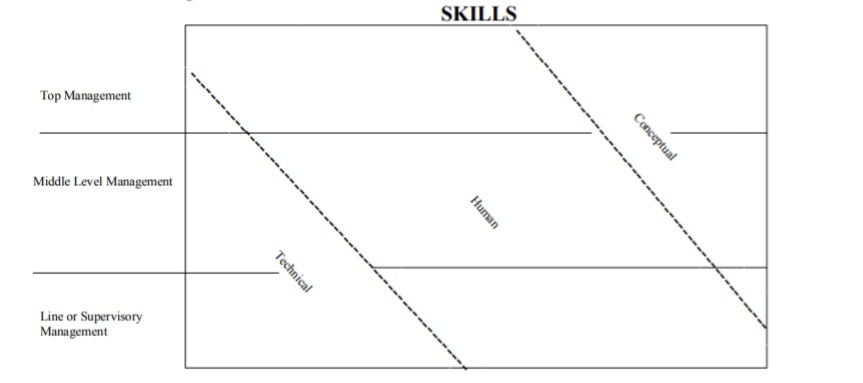
Skills at Various levels
The skills refer to the personal ability put to use by the manager in specific position that he or she holds in the organisational hierarchy.
As one moves up in the hierarchy of the managerial positions, the responsibility increases. The fundamental functions of a manager such as planning, organising, leading, controlling and decision-making are the skills required to be mastered by the managers. In order to exercise these functions, one has also to keep in mind, the type of job, the size of organisation, the skills and experiences of the people one works with and the time available at his or her disposal to do these management functions.
Katz (1974) talks of three types of skills that are recognised by all managers. These are the technical, the human and the conceptual skills. The use of these skills differs for various levels of managers.
1. Technical Skill
It is the ability to work with resources in a particular area of expertise. A surgeon must know how to do surgery. An accountant must know how to keep the accounts. Without the technical skill, one is not able to manage the work effectively. The first line supervisor in a manufacturing industry needs greater knowledge about the technical aspects of the job compared to the top boss. In a small manufacturing organisation, even the top boss who owns the company needs to know a lot of technical skills.
2. Human Skill
Human skill is the manager’s ability to work effectively as a group members and to build cooperative effort within the team he or she leads. Every managerial level requires interaction with other people, whereas technical skill is primarily concerned with working with things (processes or physical objects). The first level manager is involved on a regular basis with the personal problems and life events of many non- managers. It is therefore natural that he or she must be able to work through these personal situations and effectively lead subordinates. He or she has to perceive and reorganise the perception of his or her superiors, equals and subordinates and his or her own behaviour subsequently.
3. Conceptual Skill
This skill means the ability to see the organisation as a whole and it includes recognising how the various functions of the organisation depend on one another. It also makes the individual aware how changes in any one part of the organisation affect all the others. It extends to visualising the relationship of the individual business to the industry, the community and the political, social and economic forces of the nation as a whole. Thus the manager gains insight into improving the overall welfare of the total organisation.
Q.4. Write short notes on any two of the following: (10×2=20)
a. Managerial Skills
5 Managerial Skills are
1. Technical Skill
Technical skill is knowledge of and proficiency in activities involving methods, processes, and procedures.
Thus it involves working with tools and specific techniques. Technical skill is the ability to use the specialized knowledge, procedures, and techniques of a field of activities.
Accountants, engineers, surgeons all have their technical skills necessary for their respective professions. Most managers, especially at the lower and middle levels, need technical skills for effective task performance.
2. Conceptual Skill
Conceptual skill is the ability to see the “big picture,” to recognize significant elements in a situation and to understand the relationships among the elements.
Conceptual skill is the ability to coordinate and integrates all of an organization’s interests and activities.
It requires having the ability to visualize the enterprise as a whole, to envision all the functions involved in a given situation or circumstance, to understand how its parts depend on one another and anticipate how a change in any of its parts will affect the whole.
A manager’s ability to think in the abstract and to view the organization holistically is important.
Suggesting a new product line for a company, introducing computer technology to the organization’s operations, or entering the international market; for deciding this magnitude, a manager requires conceptual skill is his personality.
3. Interpersonal and Communication Skills
Communication skill for a manager is a must. The manager must be able to convey ideas and information to others and receive information and ideas from others effectively.
A manager’s job is to control the subordinates and gives high-level managers or administrators information about what’s going on.
Communication skill enables a manager to perform them properly. Most of his time, a manager’s job is to interact with people inside and outside of the organization.
Manager’s ability to communication with individuals and groups, controlling and motivation they are what Interpersonal and Communication skill are.
4. Decision-Making Skill
In simple words, a manager’s job is to make decisions that will lead the organization to the attainment of is goals.
Decision making skill is the skill that makes a manager able to recognize opportunities and threat and then select an appropriate course of action to tackle them efficiently so that the organization can benefit them.
Managers are not always going to make the best decision.
But a good manager most often makes a good decision and learns from the bad ones. Decision making is a skill that improves as managers gain more experience.
Training or educating is also a good method to develop the Decision making the skill of a manager.
5. Diagnostic and Analytical Skills
A good manager has Diagnostic and Analytical skills in his bags. Diagnostic skill refers to the ability to visualize the best response to a situation.
Analytical skill means, the ability to identify the key variables in a situation. Manager diagnostic skill and Analytical skill helps him to identify possible approaches to a situation.
After that is also helps a manager to visualize the result or outcomes of these approaches. This skill sounds similar to the decision making skill, but it is the skill required to make the decision.
b. Determinants of Organisational Culture
Determinants are the causes, while dimensions are the components of Organisational Culture.
They are-
1. Economic Condition
Several dimensions of OC are influenced by an organisation’s position on the economic cycle. The economic condition of any organisation influences whether its budget should be “tight” or “loose”. In times of prosperity- when budgets are more loose than tight – the organisation tends to be more adventure some. On the other hand, tight budget would lead to an air of caution and conservatism within an organisation. Few managers are willing to suggest new programmes (probably deserving merit) when the order from above is to exercise tight control over expenses. So, dimensions of OC like “Risk-taking”, “Control”, “Progressiveness and Development” etc. are directly influenced by economic conditions.
2. Leadership Style
The leadership style prevailing in an organisation has a profound influence in determining several dimensions of OC. The influence is so pervasive that you may often wonder whether OC is a product of the philosophy and practices of prominent persons in an organisation.
3. Organisational Policies
Specific organisational policies can influence a specific dimension of OC to quite an extent. For example, if the company policy states that layoffs will be used only as a last resort to cope with business downturn, then it would, in general, foster an internal environment that is supportive and humanistic.
Similarly, if you are working in a company where it is agreed that the first beneficiaries of increased profit would be the employees of that organisation and shareholders would get second priority, then the OC will be characterised by High Reward Orientation and probably by High Progressiveness and Development.
4. Managerial Values
The values held by executives have a strong influence on OC because values lead to actions and shape decisions. Values add to perceptions of the organisation as impersonal, paternalistic, formal, informal, hostile or friendly.
5. Organisational Structure
The design or structure of an organisation affects the perception of its internal environment. For example, a bureaucratic structure has an OC much different from a System 4 organisation. What is a System 4 organisation? According to Rensis Likert, all organisations can be classified into four major groups, depending upon the way basic organisational processes are conducted. These major groupings are as follows:
System 1 – Exploitative Authoritative
System 2 – Benevolent Authoritative
System3 – Consultative
System 4 – Participative
6. Characteristics of Members
Personal characteristics of the members of an organisation also affects the climate prevailing in the organisation. For example, an organisation with well educated, ambitious and younger employees is likely to have a different OC than an organisation with less educated, and less upwardly mobile, older employees. The former might inculcate an environment of competitiveness, calculated risk-taking, frankness of opinions, etc.
7. Organisational Size
In a small sized organisation it is much easier to foster a climate for creativity and innovation or to establish a participative kind of management with greater stress on horizontal distribution of responsibilities. On the other hand, in a large organisation it is easier to have a more authoritative kind of management with stress on vertical distribution of responsibilities. This in turn leads to distinct environments as has been explained with the help of the concept of System 4 organisation.
c. Risky Shift Phenomenon
Risky shift occurs when people change their decisions or opinions to become more extreme and risky when acting as part of a group, compared with acting individually; this is one form of the phenomenon known as group polarization. The result is that group decisions are bolder and more adventurous than those made by individuals alone and even riskier than the average of the individuals’ opinions and decisions before group discussion. However, sometimes people in groups shift such that the group decision is actually more conservative, which is known as cautious (or conservative) shift.
Contrary to the popular belief that groups are usually more conservative than individuals there is abundant evidence to support the proposition that groups make riskier decisions than individuals do.
There are four possible reasons.
First, risk takers are persuasive in getting more cautious companions to shift their position.
Second, as members of a group familiarise themselves with the issues and arguments they seem to feel more confident about taking risks.
Third, the responsibility for decisions making can be diffused across members of the group.
Fourth, there is the suggestion that in our culture people do not like to appear cautious in a public context.
Q.5. What do you understand by Management By Objectives (MBO) ? Discuss the various benefits and limitations of MBO. (20)
MBO
Management By Objectives (MBO) is a tool by which managers can improve their performance and increase their effectiveness. The term MBO was coined by Peter Drucker more than 35 years ago. Drucker used the term in a very broad sense to connote not just a specific tool, but rather an approach or philosophy of management. In the United States, the name most associated with MBO is that of George Odiorne. He stresses on the superior-subordinate relationship and propounds MBO as a “guide for operating the unit and assessing the contribution of each of its members”. John Humble of U.K. visualises MBO as a “system which integrates the company’s need to achieve its goals with the managers need to contribute and develop himself” and consequently places greater emphasis on corporate planning.
MBO can be defined as an approach which uses objectives as a focal point to improve managerial performance and managerial effectiveness, both at the individual and at the organisational level. These objectives serve to guide, direct, review and measure performance. However, MBO should not be thought of as merely a tool for performance appraisal. It is a far more comprehensive mechanism and provides a framework for organisational and managerial decisions.
In the MBO approach while the objectives provide the focal point, the emphasis is on improving the performance and providing better results. This is because MBO is concerned with achieving the objectives as well as the process by which they are achieved. The objectives will necessarily vary with the managerial level at which they are set. Objectives at the level of the managing director will be different from those of a branch manager or the production manager. However, all these objectives are derived from the organisation’s overall objectives and in turn are linked to the corporate plan. The fact that MBO allows for distant, intangible organisational objectives to be converted into achievable, personalised objectives (for each level of management ) is the reason for its success and popularity.
The key concepts in MBO are :
• emphasis on results rather than activities,
• objectives for specific managerial positions,
• participatory or joint objective setting,
• identification of key result areas, and
• establishment of periodic review system.
Benefits –
The benefits accruing from MBO can be discussed in terms of the specific benefits to the subordinate, the superior and the organisation:
1. Benefits to subordinates
Includes greater role clarity, measurement of performance and increased job satisfaction. When specific objectives have been agreed upon, the subordinate knows exactly what he or she has to achieve and can plan various activities towards this end. Role and goal clarity ensure that there is no wastage of scarce organisational resources, on the one hand, and single minded dedication to achievement of objectives on the other.
MBO implies regular feedback and measurement of performance against objectives. This serves as a great motivating factor for people to put in their best effort to achieve the objectives. It also helps to weed out the non-performer and identify the real contributors.
Clear, specific objectives and unbiased feedback about performance contribute to increased job satisfaction as compared to a situation where a person does not know what is expected of him or her and how, if at all the performance will be judged. Job satisfaction emanates from the feelings of having done a job well to the best of your capability as well as public recognition and approval for it. The former is possible only when there are specific objectives while the latter can occur only if there is a system of review and reward. A worker or manager who derives satisfaction from his or her job will work harder in order to improve the performance while a dissatisfied, discontented manager will make a negative contribution. Thus MBO can serve to bring about a change and put people on the self-propelling cycle of role clarity, increased job satisfaction and increased productivity.
2. Benefits to Superiors
The benefits accruing to the subordinate will, of course, also accrue to the superiors. But besides these, the other specific benefits for superiors are that MBO motivates subordinates, strengthens superior-subordinate relationship, and provides an objective appraisal method.
MBO is based on the concept of participation and this leads to greater motivation. Setting objectives implies that both the superior and the subordinate have to sit across the table and openly discuss their respective roles, work, obstacles, and competencies. Such candid discussion always leads to increased mutual trust and confidence in each other and provides an enduring bond to the relationship.
One of the biggest advantages of MBO is that it provides an objective basis for reviewing performance on the basis of achievements rather than personality traits. Reviewing a person on the basis of personality not only puts him or her on the defensive but serves no purpose from the organisation’s point of view. The only thing that matters is results. People are retained by organisations to produce results and not because they are sociable, soft spoken, introverted or possess any other such personality characteristic which has no bearing on their competence or capability.
3. Benefits to the organisation
MBO focuses on managerial effectiveness as a central value in the entire organisation. And this emphasis permeates down to the lowest level, influencing each manager and worker. This shows up in all the decisions which each manager makes and the overall performance of the organisation is improved. Secondly, MBO with its focus on objectives improves concentration and co-ordination of managerial effort. There is maximum utilisation of resources and conflicting pulls in opposite directions are avoided. Thirdly, the periodic review in MBO helps identify advancement potential of workers and managers. It also helps in identifying who are under-utilised or not making the full contribution. Lastly, MBO creates many centres of accountability as against one centralised accountability point. It is not only the managing director or proprietor who is accountable for producing the desired results but each manager is responsible for achieving the agreed upon objectives. Thus, MBO leads to greater decentralisation in terms of setting and achieving objectives.
Limitations
In practical implementation you could sometimes encounter one or more of the following limitations of MBO:
1. Problems in joint objectives setting among unequals
MBO implies a process of point to point or consultative objective setting between the superior and the subordinate. But this very relationship, based upon status, may prove to be a hindrance in free and frank open communication between the two, and stall the process of setting goals in an objective manner.
2. Problems of MBO being effective at the lowest level
Theoretically, MBO is supposed to percolate throughout the organisation right down to the lowest level since the manager as well as the worker at each level have set their own agreed upon objectives. However, in reality, the workers or managers at the lower levels often do not have the full freedom to set their own objectives. This is because MBO operates from top to down, starting with the corporate objectives. Thus, the process of objective setting implies that the objectives at the lower level have already been locked in and managers down the line have to match their own objectives with those of the level above them only.
If the process of objectives setting is reversed to overcome this limitation, and objectives are first set at the lowest level, it would mean that the entire organisation is being guided by people who have less experience, less education, less knowledge and awareness.
3. It is difficult to implement in a situation of change
MBO assumes a stable environment in which the objectives once set will hold good till they are achieved. In reality, however, many unforeseen changes may occur which may render the objective impossible to achieve, or irrelevant, or invalid. In a situation where sudden changes occur frequently MBO is difficult to implement.
4. There have been cases where MBO has totally failed.
The most commonly encountered reasons for the failure of MBO are:
• Lack of top management support and commitment,
• Lack of or inadequate planning and preparation,
• Lack of information and education,
• Very short time horizon,
• Overemphasis on appraisal,
• Poor understanding of the role of MBO, and
• Lack of clear cut policy towards MBO.
Q.6. What is meant by the term “Managerial Ethos” ? Discuss the process through which culture and ethos are maintained in an organisation. (20)
Managerial Ethos
Ethos refers to the habitual character and values of individuals, groups, races, etc. Managerial ethos is concerned with the character and values of managers as a professional group. Contemporary managers hold some specific values which affect work and some of these are autonomy, equity, security, and opportunity.
1. Autonomy
These managers tend to allow enough latitude to individual employees as long as the use of this freedom does not violate the basic norms of the organization. In the last two decades, some management practices have been innovated which are in keeping with this value of autonomy.
2. Equity
Equity refers to justice in rewarding performance. Modern managers strongly feel that a person must get a reward proportionate to his input.
Security(providing security both economically and emotionally): Keeping a person on his toes by making him feel insecure is slowly but steadily getting discredited as a management philosophy. Even the societies which have practiced “hire and fire” policy are unmistakably shifting towards providing security of the job.
3. Opportunity
Providing enough career advancement opportunities to employees is yet another contemporary managerial value.
Besides these four values which affect a manager’s work, the manager may have a strong “Work Value”. Work Value refers to the worth a person ascribes to the opportunity of work. If you have a “strong” work value you are going to identify the worth or value of work to you in more ways than one.
4. Security (providing security both economically and emotionally)
Keeping a person on his toes by making him feel insecure is slowly but steadily getting discredited as a management philosophy. Even the societies which have practiced “hire and fire” policy are unmistakably shifting towards providing security of job.
Managerial Ethos Characteristics
Apart from these values, the managerial ethos requires the below characteristics as well.
1. Action goal orientation
Persons with a high sense of adequacy have clear goals about their future and are directed by these goals. They are action oriented to reach their clear goals
Pro-action/Pro-active: Proactive people do things on their own without having to be told by anyone. Such an initiative taking behavior leads to a high level of activity and experimentation.
2. Internal resources
Managers with a high sense of adequacy are aware of their internal strengths and are guided by these strengths. They are aware of their weaknesses but this awareness does not deter them from acting positively or to look for opportunities for continuous self-improvement. They are open to feedback and ready to learn from experience.
3. Problem-solving attitude
A superior ethos requires that managers view themselves as problem solvers, rather than problem-avoiders. These managers have a positive orientation to problem situations and do not want to run away from problems. They tend to approach problem situations with optimism because they have an internal locus of control, i.e., a strong belief that they can change the environment through their own efforts.
4. Pro-action
Proactive people do things on their own without having to be told by any one. Such initiative taking behaviour leads to a high level of activity and experimentation. As contrasted to these people are reactive persons or conformists who spend most of their lives in doing things that others expect them to do. Reactive people are outer-directed, whereas proactive ones are inner-directed. A superior managerial ethos requires more of pro-action than reaction.
Cultural and Ethos are maintained through Socialisation Process
We may have often experienced that every organization has its own unique traditions and customs. Seldom are these traditions and customs explicitly spelt out, yet, over a period of time, organizations do develop long standing unwritten rules, regulations and rituals. The process through which the people are trained to accept the tradition and maintain the homogeneity of ethos and behaviors is termed as socialization.
Socialization is a process of adaptation by which `new’ members come to understand the basic values, norms and customs for becoming `accepted’ members of an organization. Though the most intense period of socialization is at the “fresher” stage of entry into an organization, the process continues throughout one’s entire career in the organization. The people who do not learn to adjust to the culture of the organization become the targets of attack and are often rejected by the organization.
Socialisation process has three stages
1. Pre-arrival
This stage tries to ensure that prospective members arrive at an organization with a certain set of values, attitudes and expectations. This is usually taken care of at the selection stage itself. Selectors try to choose the “right type” of people, who they feel, will be able to “fit” the requirements of an organization. Thus an organization, even before allowing an outsider to “join”, makes an attempt to ensure a proper match which contributes toward the creation of a uniform culture within the organization.
2. Encounter
After gaining an entry into the organization a new member faces an encounter stage. There is always a possibility of difference between his expectations of an organisation and the OC. If the expected image and OC matches, then encounter stage passes off smoothly leading to confirmation of the image. If the imbalance between the two is acute, the person has usually two choices open.
First, he undergoes further socialization which detaches him from his previous expectations, replaces these with another set of expectations and thus helps him get adjusted to the prevailing system.
Second, he drops out due to disillusionment. In both the cases the final result is the same: the status quo of traditions and customs are maintained.
In both the cases the final result is the same: the status quo of traditions and customs are maintained.
3. Metamorphosis
People who had discovered an anomaly between their expectations and OC, but decided not to drop out, enter into the metamorphosis stage. They must sort out their problems and go through changes-hence this is called metamorphosis. When this metamorphosis is complete, the members feel `comfortable’ with the organisation and job. Successful metamorphosis results in lowered propensity to leave the organisation.
For a very few persons, the metamorphosis stage may remain incomplete or unsuccessful. These people, as yet, have not been able to “accept” the OC and thereby remain nonconformist. Sometimes they continue to `fight’ the system, at least for some more time, with zeal and enthusiasm.
Sometimes an organization, anxious to break away from its stifling OC, may choose to deliberately appoint people without subjecting them to metamorphosis stage so that they bring organizational change.
Q.7. What do you understand by resistance to change ? Discuss the strategies of implementing change. (20)
Resistance to Change
Resistance to change in a typical organization refers to an employee’s behaviour designed to discredit, delay or prevent instructions of change in an organization. However, resistance to change can be individual as well as organizational.
Reasons why employees show resistance to change?
• Job security – Fear of losing job
• Change in working climate
• Obsolescence of skills
• Change in social interactions and relationships
• Change in role or status
Reasons why organizations show resistance to change?
• Lack of resources
• Difficulty in implementing structural or technological changes
• Lack of vision, Motivation, Knowledge
• Due to Sunk Costs associated with change
Levels of Resistance to Change
1. Individual Level
At an individual Level, there is resistance to change due to the following reasons:
Job security, Ego Defensiveness, Social Displacement, Skill Obsolescence, Embracing Status Quo, Group resistance or Peer Pressure, Fear of economic Loss, Low tolerance to change, etc
2. Organizational Level
At an organizational level, there is resistance to change due to:
• Threat to existing power and influence in the organization
• A rigid organization structure favours stability more than innovation
• Unfavourable Organization Culture and Norms
• Resource constraints
• Sunk Costs associated with organizational change
Strategies for implementing change
Most managers who have been responsible for implementation have developed a personal perspective consisting of assumption and strong feelings about how change should be introduced. These philosophies fall into two camps, either “tops-down” or “bottom-up”.
1. The Tops-down Strategy
The advocates of this strategy believe that, in general, people resist changes and require direction and structure for their well being as well as to work efficiently and effectively. The basic psychological contract between employees and management, it is assumed, is one in which the employee provides work, effort and commitment and expects in return pay, benefits, and a clear definition of what is expected to be done. It follows that it is the management’s responsibility to design the changes it deems appropriate and to implement these thoroughly but quickly by directives from the top.
2. The Bottom-up Strategy
The advocates of this approach profess what to them is a more enlightened view of human nature. They argue that people welcome change and the opportunity to contribute to their own productivity, especially if the change gives them more variety in their work and more autonomy. These managers assume people have a psychological contract which includes an expectation that they be involved in designing change as well as in implementing it. Commitment to change, they say, follows from involvement in the total change process and is essential to successful implementation.
Which is more correct? Is the question of correctness the right question to ask? What is your philosophy of change? If your answer to the question was, in effect, “the correct strategy of change depends on the circumstances”, you are in agreement with the currently very popular contingency school.
Contingency Approach
According to the contingency school, the choice of an appropriate strategy and the implementation diagnosis consists of assessing eight independent variables or factors in the organisation.
Based on the diagnosis which evolves, the basic implementation strategy will consist of selecting values along the continuum for the three dependent variables.
Once the value of these variables has been located, and if the answers to the diagnostic for the independent variables fall towards the left of the continuum, then the implementation strategy would also be leftwards. On the other hand, if the values of variables tend towards the right side of continuum then the implementation strategy would also be rightwards. Thus, for example, if there is very little time available, the crisis or need for change is clear to all, it is a small organisation, and so on, the appropriate change strategy is tops-down, directive, and fast.
Q.8. Discuss the importance of communication in the service industry. Explain any two types of barriers to effective communication. (20)
Communication can be in the form of speaking, writing, or body language. In the world of business, effective communication is a lynchpin in many areas including customer service, because the business that communicates better can win more customers. The average business enterprise can harness such techniques to expand its customer base, improve its business practices, conduct itself adroitly in business matters, and serve as a beacon in the tumult of modern business environments. Effective communication is also useful because it can indicate intent and future courses of action; therefore, it is vital for a business enterprise to communicate with its customers at all levels.
A business should be able to explain clearly company policies to all stakeholders, especially customers and clients. Every employee of the business should make effective communication a priority, because customers require information. Modern businesses operate in a fluid environment that has many moving parts; therefore, the customer should not be in the dark under any circumstances. Clear communication can send emphatic messages that the enterprise is serious about its business and intends to conduct itself as a responsible corporate citizen. In this context, we have to bear in mind that corporate management has a duty to communicate business policies clearly to the regular members of the company. We may expect that the same messages would be relayed to customers through certain modes of effective communication. Such communications should be emphatic, clear, and to the point.
Effective communication is an important aspect of customer service. A large enterprise or a small business may have multiple points of contact with the customer. Each point of contact is an opportunity for the business to thrive by delighting customers. The business should encourage open communications with customers at these points, because such actions can boost customer confidence and enable the business to stand apart from its competitors. Communication should be made a significant part of the corporate identity and should be meshed with the corporate DNA. We could say that the gains accrued to the enterprise are priceless when such actions are executed consistently.
The points of customer contact that are driven by written communications could be harvested for valuable clues into customer expectations. These lines of communications are critical because the writing process can relate more information than oral communications. Effective communication at these points of contact can put the customer at ease and assure him / her of the best possible service. In addition, the customer’s queries and suggestions can be analysed for information that can underpin future policy making at the company.
Effective communication need not be restricted to points of customer contact. A corporate chieftain can make it a priority to communicate personally with various stakeholders such as customers, regulators, investors, staff members, industry experts, and management personnel. This kind of communication conveys an image of resolute corporate transparency and can work wonders for the commercial fortunes of the enterprise. The open mode of such communication helps to build confidence in the business and may attract more customers. A personal message from the top of the management hierarchy can help every stakeholder to form a clear assessment of the state of the business and its future direction. Clearly, effective communication can be a major tool of doing business in modern times.
Effective communication can also be used to meet customer demand and to solve problems. Consider this: an aggrieved customer approaches a company or enterprise seeking help to resolve certain issues connected to a past transaction. The corporate point of contact chooses to hear the customer and proceeds to solve the problem. We may recommend multiple interventions on the part of the company to address the customer’s grievances and solve the immediate points of conflict. A long view may also see the company working pro-actively to ensure that similar problems do not occur with other customers. These actions can go a long way to restore business confidence and prevent customer attrition. The encounter with the said customer can be used to develop a case study to illustrate the value of effective communication at work in the corporate enterprise.
Barriers To Effective Communication
The process of communication has multiple barriers. The intended communique will often be disturbed and distorted leading to a condition of misunderstanding and failure of communication. The Barriers to effective communication could be of many types like linguistic, psychological, emotional, physical, and cultural etc. We will see all of these types in detail below.
1. Linguistic Barriers
The language barrier is one of the main barriers that limit effective communication. Language is the most commonly employed tool of communication. The fact that each major region has its own language is one of the Barriers to effective communication. Sometimes even a thick dialect may render the communication ineffective.
As per some estimates, the dialects of every two regions changes within a few kilometers. Even in the same workplace, different employees will have different linguistic skills. As a result, the communication channels that span across the organization would be affected by this.
Thus keeping this barrier in mind, different considerations have to be made for different employees. Some of them are very proficient in a certain language and others will be ok with these languages.
2. Cultural Barriers of Communication
As the world is getting more and more globalized, any large office may have people from several parts of the world. Different cultures have a different meaning for several basic values of society. Dressing, Religions or lack of them, food, drinks, pets, and the general behaviour will change drastically from one culture to another.
Hence it is a must that we must take these different cultures into account while communication. This is what we call being culturally appropriate. In many multinational companies, special courses are offered at the orientation stages that let people know about other cultures and how to be courteous and tolerant of others.
Q.9. What do you understand by strategic and operational planning ? Discuss the steps involved in planning for an enterprise. (20)
Strategic Planning
Strategic Planning, also known as long-range planning, has two important elements:
1. First it covers a longer period of time which may extend from five to twenty or more years. A capital intensive industry, e.g., a public utility service, or a company dealing in international markets must necessarily plan for a longer period.
2. Strategic planning also takes into consideration the totality of activities of the enterprise. In other words, it refers to planning for the total enterprise over a longer duration. Planning for a duration of fifteen, twenty or more years is also known as perspective planning.
Operational Planning
Operational Planning, tactical planning or short-range planning usually extends over a period of one year and is more detailed. While strategic plans indicate the activities to be undertaken or goals to be achieved in general terms, and are an instrument of planning and control in the hands of top management, operational plans are prepared in more specific terms. These plans are directly concerned with operations and deal with the various functional areas of the enterprise like production, marketing, finance, research and development, etc. They guide lower levels of managers in their day to day activities and serve as a yardstick for measuring their performance.
Steps involved in Planning
Preparing a plan is a step by step exercise. Generally speaking the following four steps will be involved in planning for an enterprise:
1. Perception of opportunities
The first step for you to take while planning is to be aware of the opportunities. Plans determine a course of action to be adopted ‘today’ in order to obtain the desired results ‘tomorrow’. In order that planning is regarded as effective, it must anticipate and meet the conditions as they develop in future. Forecasting, therefore, is a prerequisite to planning which simply stated, means making an intelligent estimate of the conditions that will exist during the plan period. For example, a demand forecast, which shows the level of demand of a particular product or service over a period of time is the first step towards production and sales planning in an enterprise. Quite often existing problems themselves induce managers to search for opportunities. A hotel Manager confronted with the problem of low occupancy and falling profit levels will be driven to seek new opportunities. Planning requires realistic diagnosis of opportunities.
2. Establishment of Goals
The second step for you is to establish goals which are to be achieved during the specified period. This implies the establishment of goals for the whole enterprise as also for each of its sub-units. Whatever the goal − profits, sales, market share− it is better if it is measurable because later you will use these goals to evaluate the performance of the unit or its managers. Various kinds of budgets and cost standards provide a means of establishing the standards.
3. Appraisal of Planning Premises
Premises refer to the factors in the environment that affect the achievement of goals. Government policy is one of those factors which can have significant impact either favourable or unfavourable on any plan formulated by an enterprise. Planning in any organisation rests on several premises, in other words, on assumption about the expected environment conditioning the plan. Obviously a change in any one or more assumed conditions will necessitate an alteration in the plans. Such assumptions relate to factors which may affect the plans either from within the enterprise or from outside. Accordingly, planning premises may be grouped as external or internal. A brief description of some of the factors that influence the formulation of the plan by an enterprise will follow later.
4. Explore and Determine Action Paths
The final step in the planning function is to explore and evaluate alternative plans of action, and determine a specific action plan. Once the goals have been established and the factor or factors affecting the plans taken care of, actual action plan in the form of programmes and budgets are formulated.
A programmes shows:
a. major steps required to reach an objective,
b. organisational unit or person responsible for each step, and
c. sequence and timing of each step.
A programme may be accompanied by a budget which indicates the financial resources allocated by the organisation for the implementation of the plan. Actually in order to achieve the overall goals of the organisation, a number of activities will have to be performed, each activity having a separate programme and separate budget within the overall programme and budget. The system under which budgets are used for purposes of planning is known as the Budgetary Planning System.
Q.10. What is interpersonal competence ? Discuss in brief, the four stages of developing interpersonal relationships. (20)
Interpersonal Competence
Interpersonal competence refers to the degree to which you are accurately aware of your impact on others and of the impact of others on you. In fact, it is your ability to engage in any mutually helpful relationships. It enables you to achieve your personal goals as well as task goals in the organisation where you are a member.
Interpersonally incompetent managers create an organisational environment in which members act very defensively to protect their own interests. Since everybody acts defensively in the organisation, where roles and relationships are basically interdependent, neither the personal goals of the members, nor the task goals can be fully realised. Problems are not confronted and are kept hidden from each other for fear that exploring the problems will only aggravate the situation. In course of time, issues which were avoided and swept under the rug assume gigantic proportions and overwhelm the members. On the other hand interpersonally competent managers allow their subordinates to challenge their views and to question the organisation’s norms, policies, rules and objectives. When these kinds of behaviours are tolerated, people are likely to discover problems and commit themselves to their solutions. In such situations the organisational effectiveness increases. Your role in the organisation can be viewed as a central role surrounded by at least three other types of roles: Superiors, Colleagues and Subordinates.
The four stages of developing interpersonal relationship
1. Forming First Impressions
First impressions, though may be inaccurate, are lasting impressions. This is because they influence the way in which people see subsequent data about the perceived object or person. So, whether or not first impressions are correct, it is important for us to make favourable impressions on other people. Initial impressions do not guarantee long-term relationship, but they are essential for entering into enduring relationships with others. Many studies have shown that much of the ground-work for subsequent relationships with others is laid in the very first stage of socialisation and this is very important in service industry. In all front line operations (e.g. guides, escorts, receptionist etc.) the first impression on customer is vital.
The first stage of socialisation has a significant implication for those who are looking for jobs. When an organisation searches for a new manager, it will probably contact between 10 to 40 potential candidates. Of these, it will probably interview between three to eight people, but only one will be selected for the position. What factors help the employer to narrow down the list ? The initial selection is probably based on substantive qualities such as educational achievement, job experience and specialisation, reference, etc. as described in the resume. But the next selection most likely results from the impression the candidates make during the job interview.
2. Developing Mutual Expectations
When people are mutually impressed, they are more likely to enter into a long-term relationship. When this happens, they develop certain expectations about each other. In work organisations, managers may expect new employees to be competent, productive, reliable and loyal and to conform to organisational norms.
New employees, on the other hand, expect their superiors to be fair, supportive and considerate of their needs.
Many of these expectations are unwritten and unspoken. People usually do not have clear ideas about what they expect from other people or from organisations, especially at the beginning of a relationship. Initial expectations are usually very general and tend to be unrealistic. Unrealistic expectations often develop because people promise more than they can deliver at the initial stage in order to impress the other party.
Parties must go beyond the stage of establishing general expectations in order to determine whether or not the relationship is satisfactory. Unless they work out more realistic expectations, the relationship becomes superficial and less meaningful. The process of working out mutual expectations involves a series of exchanges and adjustment to each other’s expectations. It also helps determine the quality or levels of customer care in tourism organisations.
A set of mutual expectations that is worked out and understood by the parties is called a psychological contract; it governs the relationships between them in day-to-day interactions. Although this contract is neither formally stated nor legally binding, it serves as the basis for evaluating the quality of the relationship.
3. Honouring Psychological Contracts
An effective interpersonal or work relationship cannot develop and be maintained unless the participants are willing to honour their psychological contracts. Each party expects the other to be faithful in the relationship, not to take arbitrary actions and to be honest with him or her. There will, of course, be times when some of these expectations cannot be fully satisfied. But when this happens, each party must be reassured that the other is acting in good faith.
What do people expect from others in working relationships ? In his study on the development of trust influence and expectations, JJ.Gabarro (1978) pointed out that executives expected three things from their colleagues: reliable character, professional competence and good judgement.
4. Developing Trust and Influence
The result of meeting the psychological contract is an increased level of trust and influence. When the parties to the contract are able to meet their mutual expectations, the relationship produces mutual trust and favourable sentiments. The more satisfactory the association becomes, the greater the influence the parties have on each other. Since the relationship is fulfilling, the parties will continually rely on it to satisfy their needs. This dependency permits them to exert influence on each other.
The increased level of influence enhances each party’s ability to affect the behaviour and thinking of the other. When a person is able to influence others, the person becomes more effective in performing a task.
The person’s effectiveness is especially increased when the task requires a high degree of interaction with other people, for the influential person is capable of enlisting the necessary support and cooperation from others.