
Table of Contents
Q.1. What is maintenance and scope of maintenance in a hotel? Describe.
Hotel maintenance is the upkeep of the various systems and components used in the hospitality industry. These systems include general building operations such as HVAC, electrical, and plumbing, but also many needs specific to hotels and their customers. These specific needs are widely varied and their scope depends on the size of the hotel and the services they offer.
Hotel maintenance may include upkeep of refrigeration, elevators, cable TV, phone lines, personal computers, room furnishings, and lighting fixtures. This wide scope of maintenance needs requires a large breadth of expertise from hotel maintenance crews. It also means that maintenance planning is crucial for hotel maintenance success.
The importance of hotel maintenance
On average, a hotel charges a little under $130 per night. If there is a significant problem in any of the rooms it rents, it means a loss of $130 each night that the room needs repairs. If the repair work requires multiple rooms to be shut down for a few days during a busy season, that amount quickly escalates.
For instance, suppose the water pressure in one floor of the building goes out during the summer. The time it takes to diagnose and repair the issue could mean a lengthy downtime. If the floor has twenty rooms, that means $2,600 in lost revenue each night.
In addition, a problem of that scope would likely be preventable, meaning a small investment in preventive maintenance would have avoided that downtime altogether.
OR
Name fuels used in hotel. What are the advantages and disadvantages of solid, liquid and gaseous fuels?
In form of its Geological existence:
- Primary Fuel– fuels which occur naturally such as coal, crude petroleum and natural gas. Coal and crude petroleum
- Secondary Fuel– fuels which are derived from naturally occurring ones by a treatment process such as coke, gasoline, coal gas etc.
In form of its state:
- Solid Fuel– Commonly used solid fuels are firewood, coal and coke. Coal is used in broilers to produce heat. Coal/ coke/ wood is used in tandoor. Common solid fuels used in industry
- Bituminous Coal
- Anthracite
- Lignite
- Coke (Produced by heating coal in a closed oven unit)
- Liquid Fuel– It is not widely used and may supplement main fuel in case of deficiency. They are majorly derived from petroleum. Commonly used liquid fuels are:
- Kerosene
- Light diesel oil (LDO)
- High speed diesel (HSD)
- Petrol
- Furnace Oil
- Gaseous Fuel– Commonly used gaseous fuels are:
- LPG: used in cooking oven. It is liquefied petroleum gas comprising mainly butane (C4H10) and propane gas (C3H8). A small percentage of hydrocarbons is also present. It is aproduct of petroleum refinery. Traces of organic sulphide known as beta – mercaptan (C2H5SH) to trace leakage.
- Natural gas: Methane (CH4) is the main constituent for natural gas and accounts for 95% by volume. Readily mingles with air and does not require any storage space
- Producer gas or coal gas : obtained as a by product during production of coke
The various advantages and disadvantages of solid fuels are given below :
Advantages
(a) They are easy to transport.
(b) They are convenient to store without any risk of spontaneous explosion.
(c) Their cost of production is low.
(d) They posses moderate ignition temperature.
Disadvantages
(a) Their ash content is high.
(b) Their large proportion of heat is wasted.
(c) They burn with clinker formation.
(d) Their combustion operation cannot be controlled easily.
(e) Their cost of handling is high.
The advantages and disadvantages of liquid fuels can be summarized as follows :
Advantages
(a) They posses higher calorific value per unit mass than solid fuels.
(b) They burn without dust, ash, clinkers, etc.
(c) Their firing is easier and also fire can be extinguished easily by stopping
liquid fuel supply.
(d) They are easy to transport through pipes.
(e) They can be stored indefinitely without any loss.
(f) They are clean in use and economic to handle.
(g) Loss of heat in chimney is very low due to greater cleanliness.
(h) They require less excess air for complete combustion.
(i) They require less furnace space for combustion.
Disadvantages
(a) The cost of liquid fuel is relatively much higher as compared to solid fuel.
(b) Costly special storage tanks are required for storing liquid fuels.
(c) There is a greater risk of five hazards, particularly, in case of highly
inflammable and volatile liquid fuels.
(d) They give bad odour.
(e) For efficient burning of liquid fuels, specially constructed burners and
spraying apparatus are required.
The advantages and disadvantages of gaseous fuels are given below :
Advantages
Gaseous fuels due to erase and flexibility of their applications, possess the
following advantages over solid or liquid fuels :
(a) They can be conveyed easily through pipelines to the actual place of
need, thereby eliminating manual labour in transportation.
(b) They can be lighted at ease.
(c) They have high heat contents and hence help us in having higher
temperatures.
(d) They can be pre-heated by the heat of hot waste gases, thereby
affecting economy in heat.
(e) Their combustion can readily by controlled for change in demand like
oxidizing or reducing atmosphere, length flame, temperature, etc.
(f) They are clean in use.
(g) They do not require any special burner.
(h) They burn without any shoot, or smoke and ashes.
(i) They are free from impurities found in solid and liquid fuels.
Disadvantages
(a) Very large storage tanks are needed.
(b) They are highly inflammable, so chances of fire hazards in their use is high.
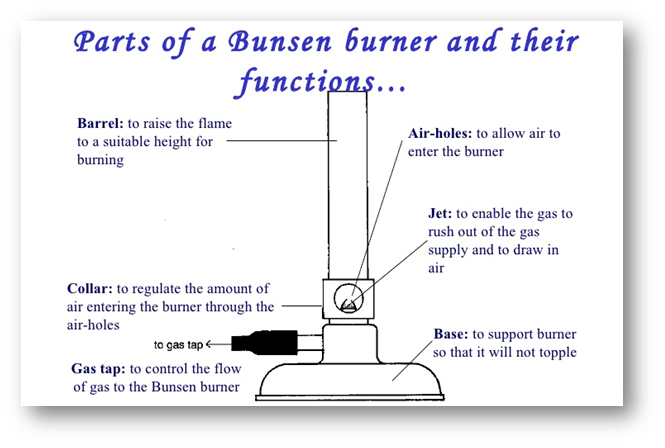
Q.2. Describe LPG and draw a labelled diagram of Bunsen burner.
LPG and its properties
LPG is mostly known as liquefied petroleum gas and is mostly used for cooking in kitchens both domestic and commercial. It’s synthesized by refining crude petroleum or “wet” natural gas. It is a colourless non pollutant fuel.
- Liquefied Petroleum Gas is a predominant mixture of Propane (C3H8) and Butane (C4H10).
- LPG may be defined as those hydrocarbons, which are gaseous at normal atmospheric pressure, but may be condensed to the liquid state at normal temperature by the application of moderate pressures.
- It is normally used as gas but are stored and transported as liquids under pressure for convenience and ease of handling.
- Liquid LPG evaporates to produce about 250 times volume of gas.
- LPG is odourless and to aid detection of leakages a foul smelling Sulphur-based additive called Ethyl-Mercaptan (CH 3 CH 2 SH) is added.
- LPG is denser than air
Ignition temperature is 500 Degree Celsius Note: LPG in cylinder is 30 kg/ Sq.cm. of pressure for commercial application and for domestic generally it is 15.5 Kgs.
Storage Requirements: All gas cylinders must be stored
- In well-ventilated area.
- Kept in upright position
- Secured with a chain or appropriate belt above the midpoint, but below the shoulder
- Should be tightly capped when not in use
- The store room should be located away from kitchens to protect cylinders catching
fire from flammable, combustible or incompatible substances - First in first out system should be used during storage
- Full cylinders should be kept separately from empty cylinders
OR
What is fuse? What is its importance? Explain various types of fuses used in
electric circuit?
It is an over-current protective device with a circuit-opening fusible part that is heated and severed by the passage of over-current through it. A fuse interrupts excessive current (blows) so that further damage by overheating or fire is prevented. Over current protection devices are essential in electrical systems to limit threats to human life and property damage. Fuses are selected to allow passage of normal current and of excessive current only for short periods. A fuse (Kit-Kat fuse) consists of a metal strip or wire fuse element, of small cross-section compared to the circuit conductors, mounted between a pair of electrical terminals, and (usually) enclosed by a non- conducting and non-combustible housing. The fuse is arranged in series to carry all the current passing through the protected circuit. The resistance of the element generates heat due to the current flow. If too high a current flows, the element rises to a higher temperature and either directly melts, or else melts a soldered joint within the fuse, opening the circuit. Fuses act as a weak link in a circuit. They reliably rupture and isolate the faulty circuit so that equipment and personnel are protected. Following fault clearance they must be manually replaced before that circuit may be put back into operation.
Importance of Fuse
i. It protects appliances against damages
ii. It also protect humans using appliances against electrical shock
iii. It prevents fire outbreaks due to overheating from excess current.
The main category of Fuses are based on the type of circuit they are used in i.e. AC Fuses and DC Fuses. Again, AC Fuses are divided in to High Voltage (HV) Fuses and Low Voltage (LV) Fuses.
High Voltage (HV) AC Fuses are used for voltages above 1000V and Low Voltage (LV) AC Fuses are used for voltages less than 1000V. Low Voltage (LV) Fuses are again classified in to Cartridge Fuses (Totally Enclosed Type), Rewirable Fuses (Semi – Enclosed Type), Switch Fuses, Drop out Fuses and Striker Fuses.
High Voltage (HV) Fuses are further divided in to Cartridge Type HRC (High Rupturing Capacity) Fuses, Liquid Type HRC Fuses and Expulsion type Fuses.
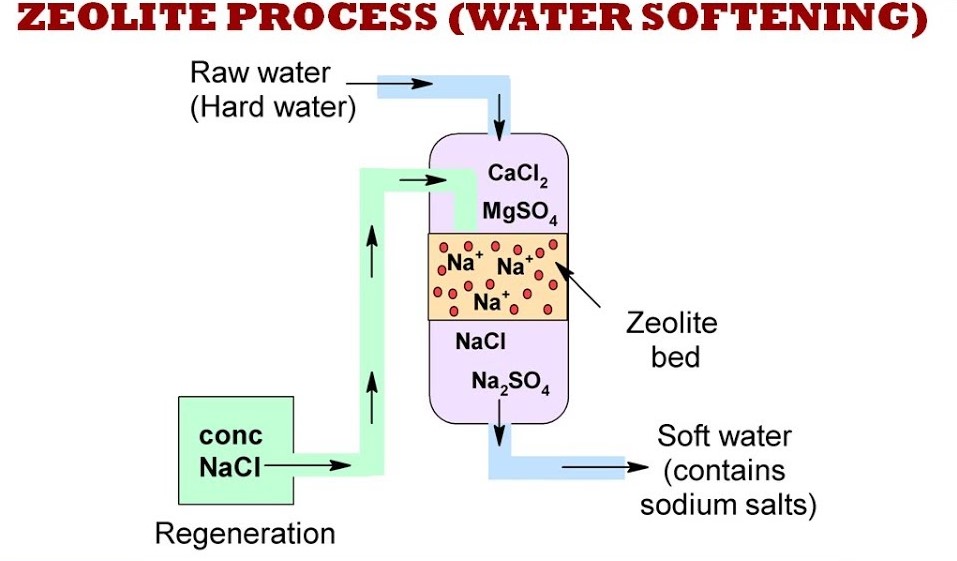
Q.3. What are different water distribution systems? Write about Zeolite process with diagram.
Water quality requirements are different for different uses in the hotel industry. For example, water lines for drinking, kitchen, and wash basins/sink must be supplied with bacteria-free soft water, while laundry and other functions can work with plain soft water. In modern establishments, laundry line is connected with drinking water line. Lavatory wash basin and water closets (WCS) may be provided with only soft water. In many modern units, waste water is collected, treated and recycled. Rain-water harvesting has assumed great importance and in many establishments this may supplement the main water supply system.
There are several water distribution systems used in hospitality and catering industries, like
- Upfeed system
- Upfeed system with circulating pumps
- Downfeed system (cold water only)
- Downfeed circulating system
- Combination system
- It is the most commonly used water distribution system where the pressure of water is sufficient to force water throughout a hotel building of six floors or less in height. The maximum number of floors which can be fed with this system depends on pressure, resistance of pipe and the height of the building.
- This system is used when the water pressure is inadequate and a circulating pump along with a return pipe is installed to increase water pressure and water to flow constantly throughout the system. This is frequently used on hot water lines to provide an adequate supply of hot water by making a provision of water heater.
- Here water is forced or pumped to a storage tank (overhead) located on the top floor of the building. When water is required, it flows by gravity from the storage tank to the tap. This system is used in very tall buildings.
- It is very similar to the circulating puffed system. This technique is frequently used with hot water to ensure adequate amount of hot water at each fixtures.
- It is a combination of upfeed and downfeed system. The upfeed system is used for the lower building levels and the downfeed system for the upper building levels. This system is probably the most efficient distribution system for multiple-floor hotel building because main water supply pressure is utilized to the full extent and additional pressure is generated by pumps to reach water on water storage tank located on the top floor of the building.
OR
Discuss the basic scientific principles behind refrigeration.
The job of the refrigeration cycle is to remove unwanted heat from one place and discharge it into another. To accomplish this, the refrigerant is pumped through a closed refrigeration system. If the system was not closed, it would be using up the refrigerant by dissipating it into the surrounding media; because it is closed, the same refrigerant is used over and over again, as it passes through the cycle removing some heat and discharging it. The closed cycle serves other purposes as well; it keeps the refrigerant from becoming contaminated and controls its flow, for it is a liquid in some parts of the cycle and a gas or vapor in other phases.
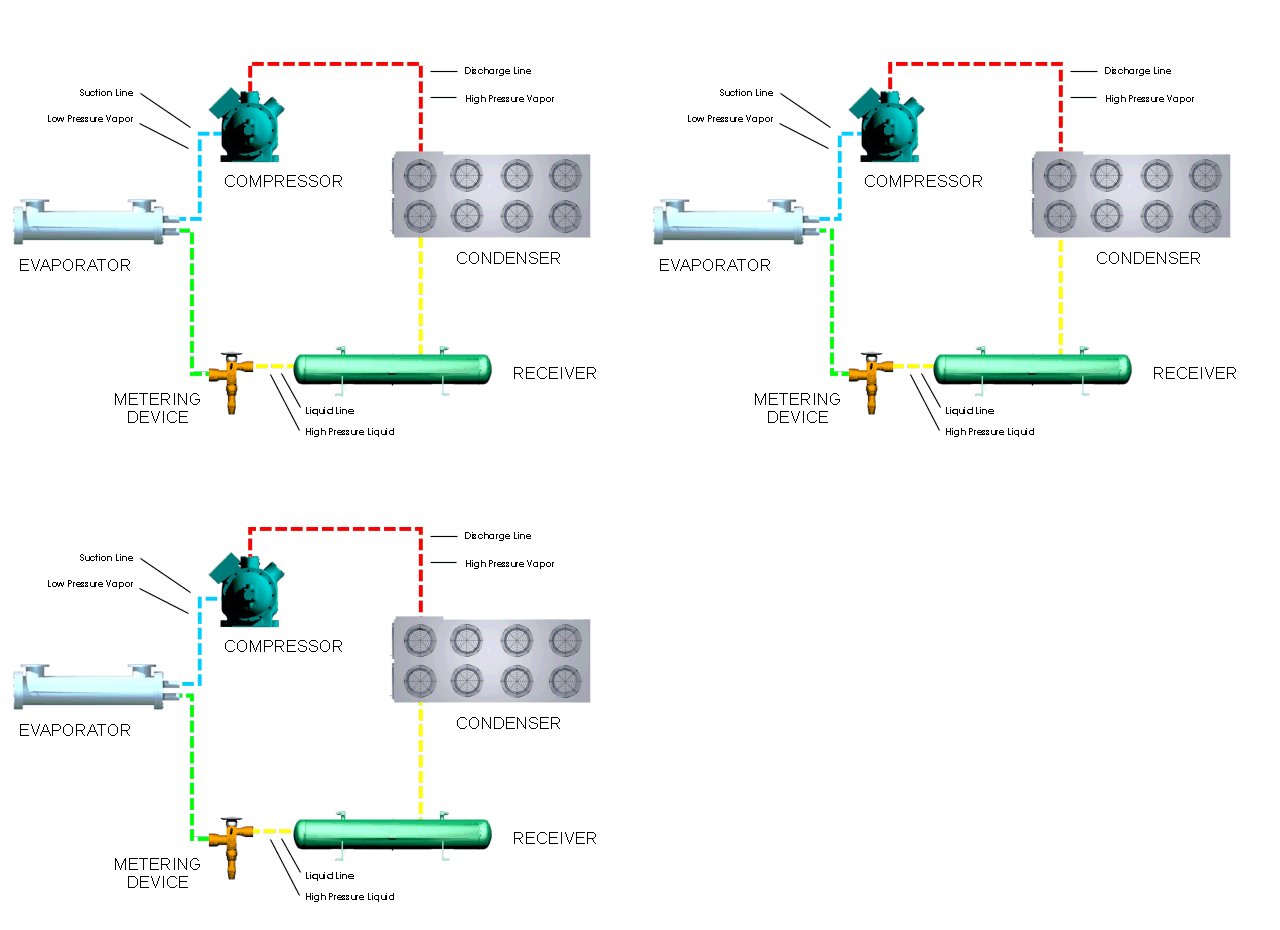
The metering device is a point where we will start the trip through the cycle. This may be a thermal expansion valve, a capillary tube, or any other device to control the flow of refrigerant into the evaporator, or cooling coil, as a low-pressure, low-temperature refrigerant. The expanding refrigerant evaporates (changes state) as it goes through the evaporator, where it removes the heat from the substance or space in which the evaporator is located.
The heat will travel from the warmer substance to the evaporator cooled by the evaporation of the refrigerant within the system, causing the refrigerant to “boil” and evaporate, changing it to a vapor. This is similar to the change that occurs when a pail of water is boiled on the stove and the water changes to steam, except that the refrigerant boils at a much lower temperature.
Now, this low-pressure, low-temperature vapor is drawn to the compressor where it is compressed into a high-temperature, high-pressure vapor. The compressor discharges it to the condenser so that it can give up the heat that it picked up in the evaporator. The refrigerant vapor is at a higher temperature than the air passing across the condenser (air-cooled type), or water passing through the condenser (water-cooled type); therefore that is transferred from the warmer refrigerant vapor to the cooler air or water.
In this process, as heat is removed from the vapor, a change of state takes place and the vapor is condensed back into a liquid, at a high-pressure and high-temperature.
The liquid refrigerant travels now to the metering device where it passes through a small opening or orifice where a drop in pressure and temperature occurs, and then it enters into the evaporator or cooling coil. As the refrigerant makes its way into the large opening of the evaporator tubing or coil, it vaporizes, ready to start another cycle through the system.
The refrigeration system requires some means of connecting the basic major components – evaporator, compressor, condenser, and metering device – just as roads connect communities. Tubing or “lines” make the system completely so that the refrigerant will not leak out into the atmosphere. The suction line connects the evaporator or cooling coil to the compressor, the hot gas or discharge line connects the compressor to the condenser, and the liquid line is the connecting tubing between the condenser and the metering device (Thermal expansion valve). Some systems will have a receiver immediately after the condenser and before the metering device, where the refrigerant is stored until it is needed for heat removal in the evaporator.
There are many different kinds and variations of the refrigeration cycle components. For example, there are at least a half dozen different types of compressor, from the reciprocating, piston through a screw, scroll and centrifugal impeller design, but the function is the same in all cases – that of compressing the heat laden vapor into a high-temperature vapor.
There are a number of different types of metering devices to regulate the liquid refrigerant into the evaporator, depending on the size of equipment, a refrigerant used, and its application.
The mechanical refrigeration system described above is essentially the same whether the system is a domestic refrigerator, a low-temperature freezer, comfort air conditioning system, industrial chiller, or commercial cooling equipment. Refrigerants will be different and the size of the equipment will vary greatly, but the principle of operation and the refrigeration cycle remains the same. Thus, once you understand the simple actions that are taking place within the refrigeration mechanical cycle you should have a good understanding of how a refrigeration system works.
Q.4. Classify fires. Write about different types of fire extinguishers.
Classes of fire : To make it easier to select the appropriate extinguishing media according to the nature of the material undergoing combustion, fires are arranged in ‘Classes’.
| Class A | Wood, paper, textile, rubbish, grass etc. | Water is the best extinguishing medium for Class A. Some Dry Chemical Powder(DCP) are also used. |
| Class B | Flammable liquids. (Oils, petrol, varnishes, paints, solvents, grease.) | Foam is the best extinguishing medium for Class B fires. Its reactivity should be ensured in case of Chemical fires. |
| Class C | Flammable gases | Dry Chemical Powder is widely used for extinguishing gaseous fires. Its ability to cut the chain reaction in the combustion process makes it suitable for the purpose. |
| Class D | Burning metal viz. Magnesium, Aluminium, Zinc, | Steam, Dry Chemical Powder be used against metal fires. |
| Class E | Fires of electrical origin involving transformers, circuit breakers, switchgears | Dry sand may be used. CO2 type extinguisher to be used. DO NOT USE WATER. |
| Class F | Cooking oil, fats (animal and vegetable) | Wet Chemicals to cool and emulsify. |
Types of extinguishers:
Multi-Purpose Dry Chemical (A, B, C)
A dry chemical agent called mono ammonium phosphate. The chemical is non-conductive and can be mildly corrosive if moisture is present. In order to avoid corrosion, it is necessary to scrub and thoroughly cleanup the contacted area once the fire is out. A dry chemical fire extinguisher is usually used in schools, general offices, hospitals, homes.
Regular Dry Chemical (B, C)
A dry chemical agent called sodium bicarbonate. It is non-toxic, non-conductive and non-corrosive. It is easy to cleanup, requiring only vacuuming, sweeping or flushing with water. Extinguishers with sodium bicarbonate are usually used in residential kitchens, laboratories, garages.
Carbon Dioxide (B, C)
Carbon dioxide removes oxygen to stop a fire but has limited range. It is environmentally friendly and leaves no residue, so cleanup is unnecessary. Extinguishers with carbon dioxide are usually used in contamination-sensitive places such as computer rooms, labs, food storage areas, processing plants, etc.
Halotron (A, B, C)
A vaporizing liquid that is ozone friendly and leaves no residue. Because it requires no cleanup, fire extinguishers with halotron are ideal for computer rooms, telecommunication areas, theaters, etc.
Foam (A, B)
Foam floats on flammable liquids to tame the fire and helps prevent reflashes. To cleanup the affected area, it must be washed away and left to evaporate. Fire extinguishers with foam are usually used in garages, homes, vehicles, workshops.
Purple K Dry Chemical (B, C)
A dry chemical called potassium bicarbonate. It is non-conductive and non-corrosive. Clean up requires vacuuming, sweeping or flushing with water. Extinguishers with potassium bicarbonate are usually used in military facilities, oil companies, vehicles, etc.
Water (A)
The most common agent is water; however, it cannot be used for class B or C fires because it is conductive. Water-based fire extinguishers are usually used in stockrooms, schools, offices, etc.
Wet Chemical fire extinguishers (F)
The potassium acetate based agent discharges as a fine mist which forms a soapy foam that suppresses any vapors and steam or the risk of fire reflash as it extinguishes the fire. Class K fire extinguishers can usually be found in commercial cooking areas such as restaurants and cafeterias.
OR
What are the types of air-conditioners? Explain the central air-conditioning
system.
Types of Air Conditioning Plants
- Centralized air – conditioning System
Unit air Conditioners
- Window type units
- Split-type units
Centralized Air Conditioning Plant
The central air conditioning plants or the systems are used when large buildings, hotels, theaters, airports, shopping malls, etc. are to be air-conditioned completely.
The air conditioning system operates essentially in a closed cycle.
Return air from different spaces in the property such as lodging rooms, dining areas, stores, banquet halls, kitchen, etc. comes back through the return duct is drawn by what is known as an extraction fan or exhauster.
This return air although a little stale is still cold/hot and relatively free from dirt and other contaminants present in the fresh air.
Instead of exhausting the entire return gas out and sucking in fresh air only, it is returned to the circuit to minimize energy requirement for cooling/heating and filtration.

Unit Air Conditioners – Window Type AC
- This is a completely self-contained unit with the compressor, condenser, evaporator, refrigerant piping, and air filter all assembled in a very compact manner.
- The window AC is usually 0.5 to 5 tons incapacity.
- The latest practice is to use sealed type compressor units so that the possibility of leakage of refrigerant is eliminated.
- There is a provision to control the fresh air intake.
- It is easy to install, operate and maintain.
- Its running cost is high.
- It requires at least one wall of the room free and open to atmosphere so that the air is discharged in the open.

Unit Air Conditioners –Split Type AC
In this system, the cold side of the unit ( such as expansion valve, evaporator coil) is physically separated from the hot side (compressor, condenser).
The refrigerant flows through a long pipeline connecting the hot side and the cold side.
The cold part inside the room and the hot part outside the building.
The main advantages of split type air conditioners are:
Low cost for relatively larger size units
Absence of noise as the compressor is placed outside the building.

Q.5. Write short notes on any two of the following:
(a) Accident and Safety Management
Managing Accidents and Incidents
Have Staff React Quickly and Efficiently: Staff needs to understand instantly what they are to do and carry out their responsibility. They have to quickly assess priorities and act on them. For example, in a slip and fall, first priority needs to be towards the guest or employee who has fallen and to make sure they are as safe as possible. Staff needs to immediately understand what they can and can’t do from a safety and medical standpoint, such as how to move an injured person, if at all. If there is a burn or cut, trained staff should immediately get necessary supplies and apply them. Be prepared to follow all proper procedures in handling any burns, including chemical. Calling for emergency help always has to be considered and acted upon quickly. Owner or other management should immediately take charge and direct other staff.
Secure the Area: There needs to be a system in place to efficiently secure the area of the accident so the injured party stays safe and no other complications occur. For example, the use of bright colored cones and wet floor signs need to be placed in specific strategic areas. It also is important that the rest of the customers or staff is kept away from the incident area.
Accident and Incident Reports: A written report should be thorough and completed as soon as possible when memory is fresh and witnesses are available. If a statement from a witness cannot be objectively verified, don’t take it as fact and phrases such as “witness alleges” or “witness claims” should be the preferred language. It may be helpful to create diagrams and take photos to enhance the clarity of the report. If appropriate, reports should be provided to the insurance company immediately.
Accident and Incident Feedback Loop: No matter how well the operation is prepared, accidents and incidents will occur. It is critical to always get better and learn from any incident that takes place and share the evaluation with the rest of the staff. Management should do a thorough analysis of the incident with feedback given to the staff. Lessons learned should be discussed with an emphasis on improvement.
The hospitality entrepreneur needs to wear a multitude of hats in carrying out their business. The prevention and management of accidents and incidents has become an area that operators more than ever must seriously pay attention to as they go about running their establishments. Having a clear set of guidelines and procedures that are ingrained in a “culture” of restaurant and hotel safety is a most valuable insurance policy to carry.
(b) Equipment Replacement Policy
Equipments, plants, and machinery are very important for achieving guest satisfaction.
A substantial part of the investment in the hotel industry is in its physical plants.
At times it is more economical to replace equipments before it completely breaks down.
Equipments / Items / Machinery / Plants replacement is categorized as:
- Equipments which gradually deteriorate due to wear and tear.
- Equipments which fail suddenly without any warning.
Factors Considered For Replacement Of Equipment’s
1. Demand for more number of equipments:
This situation arises when the existing number of a particular type of equipment cannot meet the full demand of the hotel.
Eg: A bigger DG Set is to be installed as the small DG sets installed earlier cannot meet the full demand and there is no physical space for an additional DG set. Hence the only option is to go in for a bigger DG set.
2. Excessive and frequent maintenance:
When the equipment and devices become old, they need frequent maintenance.
The frequency of maintenance becomes more and more with the passage of time and more money is spent.
Sometimes non availability of spare parts makes maintenance impossible.
In such situations, replacement becomes the only option.
3. Advanced Technology
Technological advancement is a continuous process and in a short span, we get improved version of the equipment with new technology.
Latest technology equipments become an added attraction for guests and customers.
Hotels also replace equipments to remain in business competition.
4. Decreasing Efficiency
Sometimes with time, old equipments do not give the required efficiency.
No amount of maintenance work helps to improve their efficiency.
5. Due to failure
Some equipments breakdown all of a sudden.
6. To maintain symmetry
Some equipment needs to be replaced to maintain the symmetry.
(c) Contract Maintenance
Hotel maintenance is the upkeep of the various systems and components used in the hospitality industry. These systems include general building operations such as HVAC, electrical, and plumbing, but also many needs specific to hotels and their customers. These specific needs are widely varied and their scope depends on the size of the hotel and the services they offer.
Hotel maintenance may include upkeep of refrigeration, elevators, cable TV, phone lines, personal computers, room furnishings, and lighting fixtures. This wide scope of maintenance needs requires a large breadth of expertise from hotel maintenance crews. It also means that maintenance planning is crucial for hotel maintenance success.
(d) Walk-In Freezers
Walk-in cooler and walk-in freezer mean an enclosed storage space refrigerated to temperatures, respectively, above, and at or below 32 degrees Fahrenheit that can be walked into, and has a total chilled storage area of less than 3,000 square feet; however the terms do not include products designed and marketed exclusively for medical, scientific, or research purposes.
Walk-in process cooling refrigeration system means a refrigeration system that is capable of rapidly cooling food or other substances from one temperature to another.
Q.6. Explain in brief (any ten):
(a) B.T.U. : The British thermal unit is a unit of heat; it is defined as the amount of heat required to raise the temperature of one pound of water by one degree Fahrenheit. It is also part of the United States customary units.
(b) Preventive maintenance : The technical meaning of maintenance involves functional checks, servicing, repairing or replacing of necessary devices, equipment, machinery, building infrastructure, and supporting utilities in industrial, business, governmental, and residential installations.
(c) Flame spread : Flame spread or surface burning characteristics rating is a ranking derived by laboratory standard test methodology of a material’s propensity to burn rapidly and spread flames. There are several standardized methods of determining flame spread,
(d) Incandescent lamp : An incandescent light bulb, incandescent lamp or incandescent light globe is an electric light with a wire filament heated until it glows. The filament is enclosed in a bulb to protect the filament from oxidation. Current is supplied to the filament by terminals or wires embedded in the glass.
(e) Insulators : An insulator is a material that does not conduct electrical current. Insulating materials include paper, plastic, rubber, glass and air. Vacuum is also an insulator, but is not actually a material. Most electrical conductors are covered by insulation.
(f) Escalators : An escalator is a moving staircase which carries people between floors of a building. It consists of a motor-driven chain of individually linked steps on a track which cycle on a pair of tracks which keep them horizontal.
(g) Sullage : waste water from household sinks, showers, and baths, but not waste liquid or excreta from toilets.
(h) Flash point : Flash point is the lowest temperature at which a liquid can gives off vapor to form an ignitable mixture in air near the surface of the liquid. The lower the flash point, the easier it is to ignite the material.
(i) Class C Fire : Class C fires are fires involving energized electical equipment such as computers, servers, motors, transformers, and appliances.
(j) Humidification : The process of increasing the water vapour content of a gas.
(k) r22 : Chlorodifluoromethane or difluoromonochloromethane is a hydrochlorofluorocarbon. This colorless gas is better known as HCFC-22, or R-22. It is commonly used as a propellant and refrigerant.
(l) Elbow :
Q.7. (a) Explain any two types of pollution.
Air pollution
Air pollution is contamination of the indoor or outdoor environment by any chemical, physical or biological agent that modifies the natural characteristics of the atmosphere.
Sources Of Air Pollution
- Household combustion devices.
- Motor vehicles.
- Industrial facilities.
- Forest fires
Pollutants causing Air Pollution
- Include particulate matter. (Particulate matter is the sum of all solid and liquid particles suspended in air many of which are hazardous. This complex mixture includes both organic and inorganic particles, such as dust, pollen, soot, smoke, and liquid droplets.)
- Carbon monoxide.
- Nitrogen dioxide
- Sulfur dioxide
Harmful effects of Air Pollution
- Effects on cardiovascular health
- Effects on breathing (asthma).
- Links to cancer
- Effects on children
How to control air pollution?
- Maintaining a healthy distance between the industrial and residential areas.
- The chimneys should be constructed tall in size so that the emissions must be released higher up in the environment
- The sulfur must be removed after burning.
- The gasoline must have anti-knocking agents.
- The mining area should be planted with trees.
- The coal fuel should be replaced with gas fuel to control air pollution. •
- The automobiles must be designed with an emission control system.
- The wastes must be removed and recycled in the industrial plants and refineries.
- Plants like pine and Ribes need to be planted to metabolize the nitrogen oxides and other pollutants.
- Timely servicing of the car helps to keep it in a good condition, and also minimizes fuel exhaustion
- Using public transportation helps to prevent air pollution
- Using alternative energy sources like solar energy, hydroelectric energy, and wind energy
Noise Pollution
- Noise pollution is displeasing or excessive noise that may disrupt the activity or balance of human or animal life.
- Noise means disgust or discomfort hearing from environment.
Sources of Noise Pollution
- Machines.
- Transportation systems.
- Motor vehicles.
- Aircrafts.
- Trains.
- Poor urban planning.
Effects of Noise Pollution
- Noise pollution affects both health and behavior.
- Unwanted sound (noise) can damage psychological health.
- Noise pollution can cause
- Annoyance
- Aggression .
- Hypertension .
- High stress levels .
- Hearing loss.
- Sleep disturbances, and other harmful effects.
- Chronic exposure to noise may cause noise-induced hearing loss.
- Older males exposed to significant occupational noise demonstrate significantly reduced hearing sensitivity than their non-exposed peers.
(b) List the process of sewage treatment.
The stages in the treatment of sewage are as follows:
- Primary Treatment: This removes the suspended and floating objects by means of strainer, screens, grit chamber, sedimentation tanks, septic tanks, etc. The typical materials that are removed in this stage include large objects such as sticks, rugs, rocks, sand, gravel, fats, oils, grease, etc.
- Secondary Treatment: This treatment is designed to degrade the biological and organic content of the sewage by means of microbial action. The bacteria present in the sewage consume all the organic matter.
- A tertiary process with or without disinfectant: The final treatment is performed at this stage before making eventual disposal of the treated wastewater. Tertiary treatment comprises of many processes and includes filtration, disinfection, and removal of nutrients such as nitrogen and phosphorus which encourage algae formation. Disinfection can be done with chlorine, ozone, and ultraviolet treatment. In many cases, disinfection is done as the last activity (also called effluent polishing). The purpose of disinfection is to destroy residual bacteria in water after secondary treatment, thus rendering it very safe for final disposal.
Q.8. List and explain various Audio visual equipment used in hotels
Although hotels widely differ in the types and number of AV equipments, the following are mostly included in standard hotels.
| Video Players and Recorders | Follow Spot Lights |
| Karaoke System | Loudspeaker |
| Microphone | Overhead Projectors |
| Portable Screens | Fixed Projector Screens |
| LCD/LED | CCTV |
| Desktop/Laptop Computers | Wireless Keyboards |
Q.9. Calculate the electricity bill for the month of April 2011 having the following electric
loads:
60W bulbs 10 Nos. 6 hrs/day
60W fans 10 Nos. 5 hrs/day
3 KW heater 03 Nos. 4 /hrs/day
750W iron 02 Nos. 3 hrs/day
6KW boiler 01 No. 3 hrs/day
Cost of electric energy is `3/- per unit.
Energy used by light bulbs in one day= 60w*10*6= 3.6 kwh
Energy used by fans in one day= 60w*10*5= 3 kwh
Energy used by heater in one day= 3000w*3*4= 36 kwh
Energy used by boiler in one day= 6000w*1*3= 18 kwh
Energy used by iron in one day= 750w*2*3= 4.5 kwh
Total energy used in one day = 3.6 + 3 + 36 + 18 + 4.5 = 65.1 kwh
Total energy used in 30 days ( because April has 30 days) = 65.1 x 30 = 1953 kwh
1 kwh = 1 unit
Cost per unit = Rs 3
Therefore, the bill for the entire month = 1953*3= Rs. 5859
Q.10. State true or false:
(a) Corrective maintenance is done after breakdown. True
(b) L.P.G. is a mixture of methane and butane. True
(c) Good or Ideal fuel has low ignition point. False
(d) Fuse can be used as switches. True
(e) Copper conductor is always tinned in V.I.R. cables.True
(f) The main disadvantage of hard water is bad taste. False
(g) Refrigerator cools the room. False
(h) Fire is an effect of fuel, heat and oxygen. True
(i) Switches are always connected with wire neutral. False
(j) C.P.U. stands for Control Processing Unit. False