
Table of Contents
Q.1. How is briefing carried out in a restaurant by the Team Leader and how does it help in extending good service?
Briefing is an essential communication process in the food and beverage industry, which is carried out by the team leader before the start of each shift to ensure that the staff is informed, organized, and prepared to deliver exceptional service to the guests. Here are the ways briefing is carried out in a restaurant and how it helps in extending good service:
Carrying out Briefing in a Restaurant by the Team Leader
Step 1: Start with a Warm Greeting
- The team leader starts the briefing with a warm greeting to the staff.
Step 2: Provide Information on Menu and Specials
- The team leader provides information on the menu items, specials, and promotions for the day.
- The team leader also provides information on the ingredients, allergens, and cooking methods for each dish.
Step 3: Discuss Service Standards
- The team leader discusses the service standards and expectations for the shift.
- The team leader provides information on the guest expectations, such as greetings, suggestive selling, and service timing.
Step 4: Assign Roles and Responsibilities
- The team leader assigns roles and responsibilities to each staff member, such as taking orders, serving food, and clearing tables.
- The team leader also provides information on the section assignments and table numbers.
Step 5: Review Service Procedures
- The team leader reviews the service procedures, such as greeting guests, taking orders, serving food, and handling complaints.
- The team leader also provides information on the payment and cash handling procedures.
Step 6: Encourage Questions and Feedback
- The team leader encourages questions and feedback from the staff.
- The team leader provides an opportunity for the staff to ask questions and clarify any doubts.
How Briefing Helps in Extending Good Service:
- Improves Communication: Briefing improves communication between the staff and ensures that everyone is informed about the menu items, service procedures, and guest expectations.
- Sets Clear Expectations: Briefing sets clear expectations for the staff, which helps them to perform their roles and responsibilities efficiently and effectively.
- Ensures Consistency: Briefing ensures consistency in the service standards, which helps in delivering exceptional service to the guests.
- Increases Efficiency: Briefing increases efficiency by assigning roles and responsibilities to each staff member, which reduces the chances of confusion and delays.
- Enhances Guest Satisfaction: Briefing enhances guest satisfaction by providing the staff with the necessary information and tools to deliver exceptional service, which ultimately leads to positive feedback and repeat business.
In conclusion, briefing is an important process in the food and beverage industry, which helps in ensuring that the staff is informed, organized, and prepared to deliver exceptional service to the guests. By following the above steps, the team leader can effectively carry out briefing and ensure that the staff is motivated and equipped to extend good service.
OR What are the various ways of handling tips received in lieu of good service in the restaurant?
Handling tips is an important aspect of the service industry, particularly in the restaurant industry where customers often leave tips in appreciation of good service. Here are the various ways of handling tips received in lieu of good service in the restaurant:
- Cash Tips: Cash tips are the most common form of gratuity in the restaurant industry. Staff members usually collect the tips directly from the customers and report them at the end of the shift.
- Credit Card Tips: Credit card tips are tips that are added to the credit card bill by the customer. Staff members usually report the credit card tips at the end of the shift and receive them in the form of a paycheck.
- Tip Pooling: Tip pooling is a practice in which all the tips collected by the staff members are pooled together and distributed equally among them. This method is often used in restaurants where the staff members work as a team and share their tips.
- Gratuities Included: Some restaurants include a gratuity charge in the bill for large groups or parties. The gratuity is usually a percentage of the total bill and is distributed among the staff members who served the table.
- Service Charge: Some restaurants add a service charge to the bill, which is a percentage of the total bill. The service charge is usually distributed among the staff members who served the table.
- Tipping Etiquette: Tipping etiquette varies from country to country, but in general, it is customary to leave a tip of 15-20% of the total bill in the United States. In some countries, such as Japan, tipping is not expected and can even be considered rude.
- Taxation and Reporting: Tips are taxable income and should be reported to the government. Staff members are required to report their tips to their employer, who will then report them to the government for tax purposes.
In conclusion, handling tips is an important aspect of the service industry, and it is essential to have clear policies and procedures in place for collecting, distributing, and reporting tips. By following the above methods, restaurants can ensure that their staff members are compensated fairly for their hard work and good service.
Q.2. What do you mean by Standard Operating Procedure? Draft a SOP for a speciality restaurant operational for two meal period, that is lunch and dinner.
A Standard Operating Procedure (SOP) is a documented procedure that outlines the steps to be followed to carry out a specific task or operation. It provides a set of instructions for the staff to follow, ensuring consistency and efficiency in the operation. Here is a sample SOP for a specialty restaurant operational for two meal periods, lunch and dinner:
Standard Operating Procedure for a Specialty Restaurant Operational for Two Meal Periods
Objective: To ensure consistency and efficiency in the operation of a specialty restaurant during lunch and dinner service.
Responsibilities: The restaurant manager is responsible for overseeing the implementation of the SOP, ensuring that the staff follows the guidelines and procedures outlined in the SOP.
Procedure:
- Opening Procedures
- The restaurant manager or the shift leader arrives at least 30 minutes prior to the opening time to ensure that the restaurant is clean and ready to open.
- The staff members are briefed about the day’s specials, promotions, and any changes to the menu.
- The staff members are assigned their roles and responsibilities for the shift, such as greeting guests, taking orders, serving food, and clearing tables.
- The staff members are reminded of the service standards and expectations for the shift.
- Lunch Service Procedures
- The lunch service starts at 12 pm and ends at 3 pm.
- The staff members greet guests as they enter the restaurant and escort them to their tables.
- The staff members present the menu and suggest the day’s specials.
- The staff members take the orders and input them into the POS system.
- The staff members serve the food promptly, ensuring that the timing is consistent with the service standards.
- The staff members check on the guests regularly and attend to any requests or complaints promptly.
- The staff members present the check and process the payment.
- Dinner Service Procedures
- The dinner service starts at 7 pm and ends at 11 pm.
- The staff members follow the same procedures as the lunch service, but with more attention to detail and personalized service.
- The staff members set the tables and adjust the lighting to create a comfortable and sophisticated ambiance.
- The staff members suggest wine pairings and offer recommendations for the guests.
- The staff members serve the food with proper etiquette and ensure that the timing is consistent with the service standards.
- The staff members present the check and process the payment.
- Closing Procedures
- The restaurant manager or the shift leader ensures that the restaurant is cleaned and organized before closing.
- The staff members count the cash and report the tips earned during the shift.
- The staff members report any inventory shortages or damages to the restaurant manager.
- The staff members turn off the lights, lock the doors, and ensure that the restaurant is secure.
In conclusion, the above SOP provides a set of instructions for the staff to follow during lunch and dinner service at a specialty restaurant. By following these procedures, the restaurant can ensure that the staff members are organized, efficient, and consistent in their service, which ultimately leads to a positive guest experience and repeat business.
Q.3. Explain in detail the component of cocktails and the methods of making cocktail with examples.
Cocktails are mixed drinks that typically consist of a combination of alcoholic and non-alcoholic ingredients, along with various mixers, garnishes, and flavorings. There are different components of a cocktail, which can be categorized into base spirits, mixers, modifiers, sweeteners, and garnishes. Here is a detailed explanation of these components and the methods of making cocktails, along with examples:
Components of Cocktails
- Base Spirits: Base spirits are the primary alcoholic ingredients in a cocktail. They provide the dominant flavor and character of the drink. Examples of base spirits include gin, rum, vodka, tequila, and whiskey.
- Mixers: Mixers are non-alcoholic ingredients that are used to dilute the base spirit and add volume to the drink. They also provide flavor and balance to the cocktail. Examples of mixers include fruit juices, soda, tonic water, and coconut water.
- Modifiers: Modifiers are ingredients that enhance the flavor of the base spirit and mixers. They can be alcoholic or non-alcoholic, and they are used in small amounts. Examples of modifiers include vermouth, bitters, and liqueurs.
- Sweeteners: Sweeteners are used to balance the bitterness or sourness of the cocktail. They can be natural or artificial, and they can come in different forms, such as syrups, sugars, or honey. Examples of sweeteners include simple syrup, honey syrup, and grenadine.
- Garnishes: Garnishes are decorative elements that are added to the cocktail for visual appeal and flavor enhancement. They can be fruit slices, herbs, spices, or even edible flowers. Examples of garnishes include lemon twists, mint leaves, and maraschino cherries.
Methods of Making Cocktails
- Shaken Cocktails: Shaken cocktails are made by shaking the ingredients in a cocktail shaker with ice. This method is used for cocktails that contain fruit juices, cream, or egg whites. Examples of shaken cocktails include Margarita, Daiquiri, and Ramos Gin Fizz.
- Stirred Cocktails: Stirred cocktails are made by stirring the ingredients in a mixing glass with ice. This method is used for cocktails that are made with clear spirits, such as gin or vodka. Examples of stirred cocktails include Martini, Manhattan, and Negroni.
- Built Cocktails: Built cocktails are made by layering the ingredients directly in the glass without shaking or stirring. This method is used for cocktails that contain carbonated mixers, such as soda or tonic water. Examples of built cocktails include Gin and Tonic, Rum and Coke, and Highball.
- Blended Cocktails: Blended cocktails are made by blending the ingredients in a blender with ice. This method is used for cocktails that contain fruits, cream, or ice cream. Examples of blended cocktails include Piña Colada, Strawberry Daiquiri, and Mudslide.
Examples of Cocktails
- Margarita: A shaken cocktail made with tequila, lime juice, and triple sec. It is served in a salt-rimmed glass and garnished with a lime wedge.
- Martini: A stirred cocktail made with gin and vermouth. It is served in a chilled glass and garnished with a green olive or lemon twist.
- Negroni: A stirred cocktail made with gin, vermouth, and Campari. It is served in a chilled glass and garnished with an orange twist.
- Gin and Tonic: A built cocktail made with gin, tonic water, and lime juice. It is served in a highball glass with ice and garnished with a lime wedge.
- Piña Colada: A blended cocktail made with rum, coconut cream.
Q.4. What is a bar? Explain the function of various parts of the bar.
A bar is a place where alcoholic and non-alcoholic beverages are served to customers in a social setting. It is typically located in a restaurant, hotel, or standalone establishment, and it is a popular gathering spot for socializing, networking, and entertainment. Here is an explanation of the function of various parts of the bar:
- Bar Top: The bar top is the flat surface where drinks and food are served to customers. It is typically made of wood, marble, or granite, and it is designed to be durable and easy to clean.
- Back Bar: The back bar is the area behind the bar top where bottles, glasses, and other supplies are stored. It typically includes shelving units, refrigerators, and display cases to showcase the various types of liquor and wine available.
- Speed Rail: The speed rail is a metal rack that is attached to the front of the bar top, and it holds the most frequently used liquor bottles for quick access by the bartender.
- Glassware: Glassware includes the various types of glasses used to serve drinks, such as wine glasses, beer glasses, and cocktail glasses. Each type of glass is designed to enhance the flavor and aroma of the drink it contains.
- Ice Bin: The ice bin is a large container located under the bar top where ice is stored. It is used to keep drinks cold and to chill glasses before serving.
- Sink: The sink is a fixture located behind the bar top where the bartender can wash glasses, utensils, and other equipment. It is essential for maintaining cleanliness and hygiene in the bar.
- Blender: A blender is an electrical appliance used to mix ingredients for blended drinks, such as frozen cocktails and smoothies.
- POS System: The POS (Point of Sale) system is a computerized system used to process orders, payments, and inventory tracking. It is an essential tool for managing the bar’s operations and finances.
- Tap System: A tap system is a set of faucets used to dispense beer and other carbonated beverages directly from kegs. It is an efficient way to serve large quantities of drinks quickly.
- Garnish Station: The garnish station is a designated area on the bar top where the bartender can prepare and store garnishes, such as lemon wedges, olives, and cherries. It is an important part of the presentation and flavor of many cocktails.
In conclusion, the various parts of the bar play essential roles in the function of a bar. Each part is designed to facilitate the bartender’s work and enhance the customer’s experience. By understanding the function of each part, bar staff can work more efficiently and provide better service to customers.
OR What are the responsibilities of a bartender and rules he/she should adhere to?
A bartender is responsible for serving alcoholic and non-alcoholic beverages to customers, maintaining the bar area, and ensuring customer satisfaction. Here are some of the responsibilities of a bartender:
- Greet customers: A bartender should greet customers with a friendly and welcoming attitude.
- Take orders: A bartender should take orders from customers and input them accurately into the POS system.
- Prepare drinks: A bartender should prepare drinks quickly and accurately, following the recipe and standard procedures.
- Manage inventory: A bartender should monitor the inventory of liquor, mixers, and other supplies, and place orders as needed.
- Maintain cleanliness: A bartender should clean and sanitize the bar area, including glasses, utensils, and equipment.
- Handle cash and credit card payments: A bartender should handle cash and credit card payments accurately and efficiently, following the POS system’s procedures.
- Interact with customers: A bartender should engage in conversation with customers, provide recommendations, and ensure customer satisfaction.
- Adhere to legal regulations: A bartender should adhere to the legal regulations regarding serving alcohol, such as checking IDs and refusing service to intoxicated customers.
- Follow safety guidelines: A bartender should follow safety guidelines, such as using proper techniques for handling and storing liquor and ensuring the bar area is free of hazards.
Rules that a bartender should adhere to:
- Avoid serving alcohol to underage customers or intoxicated customers.
- Refuse service to customers who exhibit aggressive or violent behavior.
- Follow the standard procedures for preparing drinks and handling cash.
- Maintain a professional and friendly demeanor with customers.
- Adhere to the legal regulations regarding serving alcohol.
- Follow safety guidelines to ensure the bar area is safe for customers and staff.
- Report any inventory shortages or damages to the bar manager.
- Maintain cleanliness and hygiene in the bar area.
In conclusion, a bartender plays an essential role in the operation of a bar. By adhering to the rules and responsibilities of the job, a bartender can ensure a positive experience for customers and a successful operation for the bar.
Q.5. Draw an organizational chart of F&B Service department of a hotel. Categorize them under various levels as per their roles.
Here is an example of an organizational chart for the F&B Service department of a hotel, categorized under various levels as per their roles:
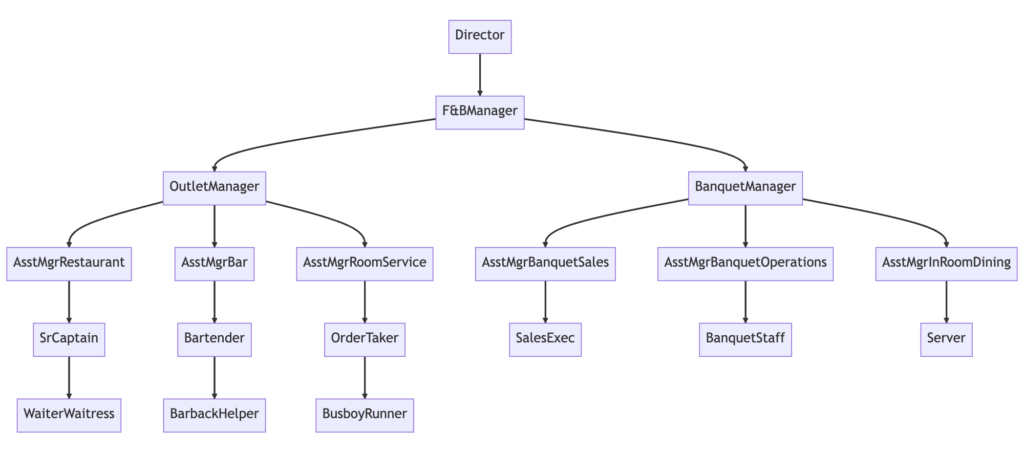
In this chart, the F&B Service Department is led by a Director, who oversees the department’s overall operation. The next level is the F&B Manager, who manages the department’s finances and ensures that the department’s objectives are met. The Outlet Manager oversees the daily operation of the restaurant, bar, and room service outlets, while the Banquet Manager is responsible for managing banquet sales and operations.
Under each manager, there are Assistant Managers who oversee specific areas of operation. For example, the Assistant Manager for the restaurant oversees the restaurant’s daily operation, and the Assistant Manager for the bar oversees the bar’s daily operation.
Under the Assistant Managers, there are Senior Captains, Bartenders, Order Takers, Sales Executives, Banquet Staff, and Servers. These are the team leaders who are responsible for the day-to-day operation of the outlets.
Finally, there are Waiters/Waitresses, Barbacks/Helpers, and Busboys/Runners who are responsible for providing excellent service to the customers. They work under the direction of the Senior Captains, Bartenders, Order Takers, Sales Executives, Banquet Staff, and Servers.
This organizational chart provides a clear structure for the F&B Service department of a hotel, ensuring that each role is clearly defined and that there is a clear chain of command from the Director down to the front-line staff.
Q.6. Give detailed job description of Chef de rang.
Chef de rang is a French term that translates to “head of the line” or “head of the rank”. In the restaurant industry, a Chef de rang is a senior front-of-house employee who is responsible for managing a team of waiters and ensuring that guests receive exceptional service.
Here is a detailed job description of a Chef de rang:
- Customer service: A Chef de rang is responsible for providing excellent customer service to guests. They should be friendly, approachable, and knowledgeable about the restaurant’s menu and wine list. They should be able to make recommendations to guests and answer any questions they may have.
- Team management: A Chef de rang is responsible for managing a team of waiters, assigning duties, and ensuring that everyone is working together to provide excellent service. They should be able to motivate and inspire their team to perform at their best.
- Order management: A Chef de rang is responsible for managing the order process, from taking orders from guests to ensuring that they are delivered accurately and on time. They should be able to communicate effectively with the kitchen staff to ensure that orders are prepared to the guest’s specifications.
- Training and development: A Chef de rang is responsible for training and developing new waiters, ensuring that they are familiar with the restaurant’s menu, policies, and procedures. They should be able to provide ongoing feedback and coaching to help their team improve and grow.
- Sales and upselling: A Chef de rang should be skilled at selling and upselling to guests, encouraging them to try new dishes, drinks, or desserts. They should be knowledgeable about the menu and able to make recommendations based on the guest’s preferences.
- Cash handling: A Chef de rang should be able to handle cash and credit card payments accurately and efficiently, following the restaurant’s procedures for managing payments and tips.
- Wine service: A Chef de rang should be knowledgeable about wine service, including how to present and open a bottle of wine, how to pour wine correctly, and how to pair wine with different types of food.
- Hygiene and cleanliness: A Chef de rang should ensure that the restaurant is clean and hygienic, following the restaurant’s procedures for maintaining cleanliness and hygiene.
- Problem-solving: A Chef de rang should be able to handle guest complaints or issues, resolving them quickly and effectively to ensure that the guest has a positive experience.
In conclusion, a Chef de rang plays a critical role in managing the front-of-house team, providing excellent service to guests, and ensuring that the restaurant runs smoothly. They should be knowledgeable, skilled, and able to handle a wide range of responsibilities to ensure that guests have an enjoyable and memorable dining experience.
Q.7. Explain the steps involved in bar operations to control the cost effectively.
Controlling costs is an essential aspect of bar operations. Here are the steps involved in bar operations to control costs effectively:
- Inventory management: The first step in controlling costs is to manage inventory effectively. This involves tracking the bar’s inventory levels, including liquor, mixers, and other supplies, and placing orders as needed. By managing inventory effectively, you can ensure that you have the right amount of stock on hand, avoid overstocking, and minimize waste.
- Recipe management: It is important to establish standard recipes for all cocktails served at the bar. This ensures consistency in the quality of drinks served and makes it easier to track the usage of ingredients. Standard recipes also help to avoid overpouring, which can increase costs.
- Portion control: Bartenders should be trained to pour drinks in specific measurements to ensure that they are not overpouring. This helps to control costs by reducing the amount of alcohol used in each drink.
- Sales analysis: It is important to analyze sales data regularly to identify trends and make informed decisions about the bar’s inventory and pricing strategy. Sales data can also be used to identify high-margin items and promote them more effectively.
- Staff training: Training staff on inventory management, recipe management, portion control, and sales analysis is crucial in controlling costs effectively. Staff should be aware of the importance of cost control and should be trained to follow standard procedures to ensure consistency and accuracy.
- Menu engineering: Menu engineering involves analyzing the menu to identify high-margin items and promote them more effectively. This can be done by adjusting pricing, highlighting certain items, or offering specials on high-margin items.
- Waste management: Waste management is another important aspect of cost control. It is important to track and minimize waste, whether it is from overpouring, spillage, or other factors. Bartenders should be trained to minimize waste and follow procedures for handling spills or other issues.
By following these steps, bar operators can effectively control costs and maximize profits while maintaining the quality of drinks and customer satisfaction.
OR List the possible frauds that the dishonest bar staff may indulge in, do recommend few methods to control the frauds.
Possible frauds that dishonest bar staff may indulge in include:
- Overpouring: Bartenders may pour more alcohol than necessary to increase sales or receive higher tips.
- Short-pouring: Bartenders may pour less alcohol than necessary to skim off the difference and sell the remaining alcohol for personal profit.
- Free drinks: Bartenders may give away free drinks to customers or friends to receive higher tips or build relationships.
- False voids: Bartenders may falsely claim that a drink was voided and then sell it to another customer or take it for personal use.
- Falsified sales: Bartenders may ring up false sales or manipulate sales data to steal money from the bar.
- Theft: Bartenders may steal money or supplies from the bar.
To control these frauds, bar owners and managers can take the following steps:
- Implement standard procedures: Establish standard procedures for all bar operations, including inventory management, recipe management, portion control, and sales analysis. Ensure that all staff members are trained to follow these procedures and are aware of the consequences of violating them.
- Implement security measures: Install security cameras and conduct regular audits to monitor bar operations and identify any potential fraud or theft.
- Conduct background checks: Conduct background checks on all new hires to ensure that they do not have a history of fraud or theft.
- Establish a culture of honesty: Establish a culture of honesty and integrity in the workplace, emphasizing the importance of ethical behavior and the consequences of dishonesty.
- Offer incentives: Offer incentives for honest behavior, such as bonuses or promotions for staff members who consistently follow standard procedures and report any potential fraud or theft.
- Review sales data regularly: Review sales data regularly to identify any anomalies or potential fraud. Conduct regular inventory checks to ensure that all supplies are accounted for and that there is no theft or waste.
By taking these steps, bar owners and managers can effectively control fraud and theft in the workplace, ensuring that customers receive quality service and the business remains profitable.
Q.8. Explain the following terms (any ten):
(a) Bar die (b) Well brand (c) Relish fork (d) Sling (e) Zester (f) Margin of safety (g) Drip rail (h) Duty roster (i) Rimmer (j) Wine bar (k) Trancheur (l) Sommelier (m) Job specification
(a) Bar die
A bar die is a tool used in bartending to create a specific shape or size of ice cube for cocktails. It is typically made of stainless steel and is used by pressing down on a block of ice to create the desired shape.
(b) Well brand
A well brand is a term used in the bar industry to describe the lower-cost, often generic brands of liquor that are kept in the well or speed rail closest to the bartender. These are typically the most frequently ordered drinks and having the well stocked with cheaper liquor can help to save money.
(c) Relish fork
A relish fork is a small, two-pronged fork that is used to serve pickles, olives, or other condiments that are typically served alongside a sandwich or burger.
(d) Sling
A sling is a type of cocktail that typically consists of a spirit (usually gin) mixed with lemon juice, sugar, and water. It is served over ice in a highball glass and often garnished with a slice of lemon or orange.
(e) Zester
A zester is a tool used in bartending and cooking to remove the zest or outermost layer of citrus fruit. It is typically a small, handheld tool with a series of sharp, small holes on one end that are used to create long, thin strips of zest.
(f) Margin of safety
Margin of safety is a term used in finance and hospitality industries to describe the difference between actual sales or revenues and the break-even point. It represents the amount of cushion a business has to cover unexpected expenses or losses.
(g) Drip rail
A drip rail is a small, recessed groove or channel that is built into the bar top to catch spills or drips from glasses or bottles. It helps to keep the bar clean and free from spills.
(h) Duty roster
A duty roster is a schedule that outlines the responsibilities and shifts for employees in a hospitality establishment. It is typically used to ensure that all shifts are covered and that employees are aware of their work schedule.
(i) Rimmer
A rimmer is a tool used in bartending to rim a glass with salt or sugar for certain cocktails such as margaritas. It typically consists of a small dish or bowl that is filled with salt or sugar, and the rim of the glass is dipped into the mixture.
(j) Wine bar
A wine bar is a type of establishment that specializes in serving a wide variety of wines by the glass or bottle. It may also offer small plates or tapas to pair with the wines.
(k) Trancheur
A trancheur is a term used in the culinary industry to describe a person who carves or slices meats at the table for guests. It is typically used in upscale dining establishments or at events where table-side service is provided.
(l) Sommelier
A sommelier is a trained wine professional who typically works in upscale dining establishments. They are responsible for selecting and recommending wines to guests, as well as managing the wine cellar and inventory.
(m) Job specification
A job specification is a detailed description of the skills, qualifications, and responsibilities required for a specific job position. It is typically used in the hiring process to help identify candidates who are best suited for the position.
Q.9. Give the recipe and the method of making the following cocktails (any two):
(i) Daiquiri
Recipe
- 2 oz light rum
- 3/4 oz lime juice
- 1/2 oz simple syrup
Method
- Fill a cocktail shaker with ice.
- Add rum, lime juice, and simple syrup into the shaker.
- Shake vigorously until the outside of the shaker is frosted.
- Strain into a chilled cocktail glass.
- Garnish with a lime wheel.
(ii) Margarita
Recipe
- 2 oz tequila
- 1 oz lime juice
- 3/4 oz orange liqueur
- Salt for rimming the glass (optional)
Method
- Rim the edge of a chilled cocktail glass with salt (optional).
- Fill a cocktail shaker with ice.
- Add tequila, lime juice, and orange liqueur into the shaker.
- Shake vigorously until the outside of the shaker is frosted.
- Strain into the prepared cocktail glass.
- Garnish with a lime wheel.
(iii) Bloody Mary
Recipe
- 1 1/2 oz vodka
- 3 oz tomato juice
- 1/2 oz lemon juice
- 3 dashes Worcestershire sauce
- 3 dashes hot sauce
- Salt and pepper to taste
- Celery stalk for garnish
Method
- Fill a tall glass with ice.
- Add vodka, tomato juice, lemon juice, Worcestershire sauce, hot sauce, salt, and pepper into the glass.
- Stir well.
- Garnish with a celery stalk.
(iv) Martini
Recipe
- 2 1/2 oz gin
- 1/2 oz dry vermouth
- 1 or 3 olives for garnish (optional)
Method
- Fill a mixing glass with ice.
- Add gin and dry vermouth into the glass.
- Stir well for about 20 seconds.
- Strain into a chilled martini glass.
- Garnish with 1 or 3 olives (optional).
Q.10. Match the following:
(a) Tequila sunrise (i) Soda, juices
(b) Boston shaker (ii) Old fashioned
(c) Angostura (iii) Curacao
(d) Planter’s punch (iv) Citrus fruit peel
(e) Blue lagoon (v) Cosmopolitan
(f) Jigger (vi) Champagne
(g) Mixes (vii) Two piece
(h) Twist (viii) Rum
(i) Stopper (ix) Grenadine
(j) Cranberry juice (x) Peg measure
| (a) Tequila sunrise | (ix) Grenadine |
| (b) Boston shaker | (vii) Two piece |
| (c) Angostura | (iv) Citrus fruit peel |
| (d) Planter’s punch | (viii) Rum |
| (e) Blue lagoon | (iii) Curacao |
| (f) Jigger | (x) Peg measure |
| (g) Mixes | (i) Stopper |
| (h) Twist | (iv) Citrus fruit peel |
| (i) Stopper | (v) Cosmopolitan |
| (j) Cranberry juice | (i) Soda, juices |