
Table of Contents
Q.1. What is a Job Description? Discuss its role in the hierarchy. (3+7=10)
This term describes the duties and responsibilities of a particular job position. In order terms, the job description is a list of ‘things to do’ of that particular job. For example, the job description of a restaurant manager is a follows:
- Responsible for the overall performance of the outlet
- Complaint handling
- Keeping track of guest history and database
- Ensuring smooth operation
- Making day-to-day sales reports
- Checking stock and inventory
- Maintaining service standards
- Other duties such as staffing and safety
OR
Discuss the role of a supervisor in an organization towards the management and staff. (10)
Role of a supervisor in an organization towards the management
Coach
A good supervisor places a high priority on coaching employees. Good coaching involves working with employees to establish suitable goals, action plans, and timelines. The supervisor delegates and also provides ongoing guidance and support to the employee as they complete their action plans. Rarely can job goals be established without considering other aspects of an employee’s life, e.g., time available for training, career preferences, personal strengths, and weaknesses, etc.
Mentor
Usually, the supervisor understands the organization and the employee’s profession better than the employee. Consequently, the supervisor is in a unique position to give ongoing advice to the employee about their job and career. The employee can look to the supervisor as a model for direction and development. An effective mentor-mentee relationship requires the supervisor to accept the responsibility of mentorship. A good supervisor can be a priceless addition to the career of an employee.
Advocate for Organization
Often, the supervisor is the first person to tell employees about new policies and programs from management. It’s not uncommon that employees are confused or frustrated by these new actions, and need further clarification and support from supervisors. In the rapidly changing world of today’s organizations, it can be a major challenge to present new programs to employees without their being frustrated or even cynical. The supervisor must be authentic, yet tactful.
Advocate for Employee
The supervisor is often responsible to represent the employee’s requests and to management, along with also representing the employee’s case for deserving a reward. For example, if an employee deserves a promotion, the supervisor often must justify the case for promotion to the supervisor’s supervisor, as well. If the employee has a rather unique personal situation that warrants special consideration by the rest of the management, the supervisor must explain this situation and how it can be handled. It’s not unusual for employees to sometimes see the supervisor as part of “management” while at other times seeing the supervisor as a personal friend.
Role of a supervisor in an organization towards the Staff
The supervisor is usually responsible to ensure that employees follow the organization’s policies and procedures, e.g., for sick time, personal leave, overtime, contact with the media or press, confidentiality about organization information, etc. Concurrently, the supervisor must follow policies and procedures for carrying out supervisory responsibilities, e.g., policies and procedures for hiring, firing, promotions, etc.
Staffing
Supervisors regularly review the needs of their employees. Consequently, they’re often the first to notice the need for a new position in the organization. In this case, the supervisor opens a new role by getting authorization from upper management. This often requires communication and justification for funds to fill the new position. The supervisor reviews advertisements for candidates, reviews resumes and conducts interviews. The supervisor recommends who should be hired from among job candidates and ensures a job offer is made to the most suitable candidate.
Employee Training and Development
Supervisors ensure new employees are oriented to the organization, its policies, facilities, etc. They develop training plans with employees to ensure employees have the necessary expertise to carry out their jobs. They provide ongoing guidance to employees, often in the forms of ongoing coaching and counseling. Supervisors often provide career counseling, as well, to help employees develop and advance in their careers.
Employee Performance Management
Supervisors ensure that job descriptions accurately record the primary responsibilities, qualifications, and terms for each job role in their group. They set performance standards for tasks, jobs, and roles of their employees. They ensure employees have appropriate and realistic job goals. They provide ongoing feedback about the employee’s performance. They conduct performance appraisals on a regular basis, including assessing how the employee has performed and what they can do to improve in their jobs. They develop performance improvement plans if an employee’s performance is not adequate.
Q.2. What are the essential behavioral traits of a Food & Beverage service steward? Prepare the ‘Job profile” of a Restaurant Manager. (10)
Essential behavioral traits of F & B service steward
The quality of service staff in any establishment reflects the quality of the establishment itself. No matter how good the food and ambiance are, poorly trained, untidy or rude staff can antagonize customers. On the other hand, if the staffs are well-trained and efficient, they can, to a certain extent, make up for other shortcomings in the services provided.
1) Personal Hygiene and Appearance·
All members of the staff should be well-groomed and clean at all times, as this gives them a sense of well-being and confidence to do their job efficiently. The hands of the waiting staff should be given special attention, as they are constantly under the scrutiny of the guests. Nails should be trimmed and kept clean. Playing with one’s hair and face should be avoided.
· Chewing gum should be avoided in all public areas of the hotel.
Minimum jewelry should be worn by the service staff. A wristwatch, finger ring, and plain earrings (for girls only) should be permitted.
If an employee has a skin problem, a doctor should be consulted immediately
Uniforms should be clean and well-pressed. Shoes should be properly polished and well-fitting.
2) Good Conduct
All service staff should be well-mannered and respectful to guests, and to senior members of the staff. They should be calm and pleasant, even in the most tiring circumstances. They should be able to satisfactorily solve any problem that may arise. In case of difficulty, a senior and experienced member of the staff should be consulted. Tact, punctuality, and honesty are admirable qualities among service personnel.
3) Good Memory
A good memory helps to improve performance. It also helps the service personnel to attend to small but important details such as remembering a guest’s name or his likes and dislikes regarding food and beverage.
4) Observation
A keen sense of observation and an eye for detail will help a member of the staff to be more efficient at his job. An ability to correctly judge people is definitely an advantage. A sense of anticipation in the service industry is an invaluable quality. The ability to anticipate what a guest or the management needs, even before it is asked for creates a very good impression.
5) Concentration and Skill
Waiting at a table requires concentration and skill. Service staff should develop a sense of urgency in the performance of their duties. Good service may not be commented upon, but bad service is surely noticed and talked about. Service should be prompt without the show of haste.
6) Salesmanship
Food and beverage service personnel are technical salespersons; hence they should have a thorough knowledge of the proper presentation and service of all the food and beverages served in the establishment. Waiters should be kept informed by their superiors of deletions or additions to the menu.
7) Ability to Assume Responsibility
All service staff should be able to cope up with the demands of the job and possess the ability to assume responsibility. They should be loyal to their employers, responsible to the guests and friendly towards their fellow workers. They should not consider any job as menial and should be willing to perform all kinds of jobs efficiently. This will help the service staff to grow in their careers and at the same time enhance the image of the establishment in the eyes of the guests.
8) Maximize Revenue
Cutting down on costs and maximizing the revenue of the establishment should be of a prime objective to all members of the staff, even to those in junior positions.
9) Punctuality
Punctuality is all-important. If staff is continually late for duty, it shows a lack of interest in his work and a lack of respect for the management and customers.
10) Local Knowledge
In the interest of customers, the staff should have a certain knowledge of the area in which they work so that they may be able to advise the guests on the various forms of entertainment offered, the best means of transport to places of interest and so on.
11) Personality
Staff must be tactful, courteous, good-humored and of an even temper. They must converse with the customer in a pleasing and well-spoken manner and the ability to smile at the right time.
12) Attitude to Customers
The correct approach towards the customer is of the utmost importance. The staff must not be servile but should anticipate the customer’s needs and wishes. A careful watch should be kept on customers at all times during the service without staring. Care should always be taken when dealing with difficult customers. (There is really no such thing as a ‘difficult’ customer – they are normal people whom one is uncertain how to deal with.) Staff should never argue with customers as this will only aggravate the situation. All complaints should be referred to someone in authority in the foodservice area.
13) Honesty
This is all-important for the staff in dealings with both the customer and the management. If there are trust and respect in the triangle of staff, customer and management relationships, then there will be a pleasant work atmosphere that encourages efficiency and a good team spirit among the food and beverage service operators.
Restaurant manager: job description
Job brief
Restaurant manager responsibilities include maintaining the restaurant’s revenue, profitability and quality goals. Restaurant managers are responsible for overseeing the efficient running and profitability of restaurants and for managing their employees.
Specific duties and the amount of customer/staff contact vary according to the size of the employer: managers in larger organizations may be mostly office-based, whereas managers of smaller establishments often have frequent contact with both customers and employees.
Responsibilities
- Coordinate daily Front of the House and Back of the House restaurant operations
- Deliver superior service and maximize customer satisfaction
- Respond efficiently and accurately to customer complaints
- Regularly review product quality and research new vendors
- Organize and supervise shifts
- Appraise staff performance and provide feedback to improve productivity
- Estimate future needs for goods, kitchen utensils, and cleaning products
- Ensure compliance with sanitation and safety regulations
- Manage the restaurant’s good image and suggest ways to improve it
- Control operational costs and identify measures to cut waste
- Create detailed reports on weekly, monthly and annual revenues and expenses
- Promote the brand in the local community through word-of-mouth and restaurant events
- Recommend ways to reach a broader audience (e.g. discounts and social media ads)
- Train new and current employees on proper customer service practices
- Implement policies and protocols that will maintain future restaurant operations
Requirements
- Proven work experience as a Restaurant Manager, Restaurant General Manager, Hospitality Manager or similar role
- Proven customer service experience as a manager
- Extensive food and beverage (F&B) knowledge, with the ability to remember and recall ingredients and dishes to inform customers and wait for staff
- Familiarities with restaurant management software, like OpenTable and PeachWorks
- Strong leadership, motivational and people skills
- Acute financial management skills
- BSc degree in Business Administration; hospitality management or culinary schooling is a plus
Q.3. Differentiate between (any four): (4×2 ½ =10)
(a) Dry martini and sweet martini
DRY MARTINI
SWEET MARTINI
A) 9/10 GIN
A) 2/3 GIN
B) 1/10 DRY VERMOUTH
B) 1/3 SWEET VERMOUTH
C) STIR; GARNISH WITH ZEST OF LEMON OR OLIVE
C) STIR; GARNISH WITH CHERRY
D)COCKTAIL GLASS
D)COCKTAIL GLASS
(b) Cocktail bar and dispense bar
COCKTAIL BAR
DISPENSE BAR
A)SERVES ALL KINDS OF COCKTAILS AND OTHER ALCOHOLIC DRINKS
A)SUITABLE FOR APERITIF, TO ACCOMPANY THE DISHES OFFERED AND DIGESTIVES
B)PRESENT IN AIRPORTS, CASINOS, HOTELS, AND SHIPS
B)PRESENT IN RESTAURANTS
C) Bartenders serve directly to guests.
C)Bartenders do not serve the public directly but pour drinks that are picked up by servers and delivered to customers
D) multiple bartenders are required.
D) a single pouring station is enough to handle the volume.
(c) Speed rail and bottle well
SPEED RAILS
BOTTLE WELL
A) The front of the station consists of a 3.5 feet bottle rail (speed rail) with a shorter hang-on rail on the front. Sometimes, there is a double rail on the hand sink as well. Speed rail contains the most frequently used (poured) liquors. Usually, well brands (brands the house pours when a drink is ordered by type rather than by name) and popular call brands (brands customers ask for by name) are set up within easy reach in the speed rails.
A) Condiment cups are used to hold garnishes and are located in double rows on the left of the ice chest, to keep them chilled. Sometimes, bottle wells replace these condiment cups and keep juices and prepared mixes cold.
(d) White lady and pink lady
WHITE LADY
PINK LADY
A)1/2 GIN
A)4/5 GIN
B)1/4 LEMON JUICE
B)1/5 GRENADINE
C)1/4 COINTREAU
D)SHAKE
C)SHAKE; GARNISHED WITH MARASCHINO CHERRY
E) COCKTAIL GLASS
D) COCKTAIL GLASS
(e) Standard operating procedure and standard recipe
STANDARD OPERATING PROCEDURE
STANDARD RECIPE
A standard operating procedure, or SOP, is a set of step-by-step instructions compiled by an organization to help workers carry out complex routine operations
A standardized recipe specifically describes the exact, measurable amount of ingredients and the method of preparation needed to consistently produce a high-quality product
SOPs aim to achieve efficiency, quality output and uniformity of performance
STANDARD RECIPE AIMS TO CONTROL COST, MAINTAIN CONSISTENCY AND IMPROVE GUEST SATISFACTION
Q.4. How the stock in a bar is replenished from the cellar? How wine beer and spirits are stored in a cellar? (5+5=10)
Issuing of beverages should take place at set times during the day and only against a requisition Note signed by an authorized person, for example, head barman, banqueting head waiter, etc.
Ideally, when the requisition is a large one it should be handed in several hours before the items are required to allow the cellar staff plenty of time to assemble the order together.
Requisition notes are usually made in duplicate, one copy being retained by the cellar man so that entries can be made to the cellar records and then it is passed to the control or accounts office, while the second copy is retained by the person who originated the requisition and handed in with the daily takings and other control documents.
The pricing of issues for beverages is different from that for food in that two prices are recorded, the cost price and the selling price. The cost price is recorded to credit the cellar account and for the trading account and balance sheet purposes.
The storage of beverage is ideally separated into five areas as follows :
- The main storage area for spirits and red wine held at a dry and draught-free temperature 30°C. This area is also used for the general collection and preparation of orders for the Various bars and the storage of keg beers when there is a reasonable turnover.
- Are frigerated area of10-15°C for the storage of white and sparkling wines.
- An area held a data temperature of 5°C for the storage of bottled beers and soft drinks.
- A totally separate area, from those above, for the storage of empty bottles, kegs, and crates. This area needs to be a slightly controlled as the beverage storage area, not only because of there turn the able value of the crates and bottles, etc. bottle prevents free access by bar staff when an empty for full bottle method of issuing Is in operation.
- Cellar: The merchandise is unpacked in the cellar and stored correctly (table wines with An alcohol content less than 16% by volume are stored on their sides, bottles of fortified wine, spirits, and vintage ports are stored upright) on shelves or racks in the same order as on the standard bottle code/bin list. The objective of preparing a standard bottle code/bin list is to eliminate the confusion of bottle sizes the spelling of names and different brands and to establish an appropriate starting point for the control of beverages. All requisitions, inventories, wine lists,etc.,are related to the code/bin list.
Q.5. Write short notes on any two: (2×5=10)
(a) Control of bar frauds
Some Common Bard Frauds and their Control
Under pouring
In this type of fraud, the pouring of the drink is intentionally done less than the required quantity. The balance of excess alcohol may be sold later. This type of fraud is particularly dangerous as this may lead to quality and quantity variation for the guest as well. It can be prevented by constant and surprise monitoring by the manager. Daily opening and closing inventory of the liquor stock and tallying the sales.
Over pouring
In this kind of fraud there is an intentional pouring of an extra measure of drink then the specified one as a matter of personal favoritism or ignorance resulting shortage. It can be prevented by correct SOP and strict control.
Substitution- Intentional replacement of a costlier variety with a cheaper one, with similar nature. This often results in serious guest complaints. It can be prevented by Guest feedback form analysis and quality check.
Dilution
Diluting liquor with water or any other substance after using part of liquor for some unauthorized interest. It can be prevented by Guest feedback form analysis and quality check. Surprise check.
Non-projected sale
Food and beverage sold under a fraud KOT and bill or an already paid KOT and bill. It can be prevented by strict vigilance and proper channel of F&B control.
(b) Developing efficiency in a fast food outlet
For an outlet to be efficient all the employees of an organization must be trained continuously so as to deliver the products and services as per the standards set by the firm to satisfy the customers.
The organization must also prepare its employees to meet the dynamic changes confidently by identifying the training needs for them and imparting training accordingly. The supervisor must list out all the jobs and prepare the knowledge and skill required to perform those jobs and design the training program accordingly. Standard operating procedures (SOP) are a detailed explanation of how a policy is to be implemented. The SOP may appear on the same form as a policy or it may appear in a separate document. The main difference between an SOP and a policy are details. An effective SOP communicates who will perform the task, what materials are necessary, where the task will take place when the task shall be performed, and how the person will execute the task.
Need for training is identified from the following:
- Frequent guests’ complaints
- Poor performances and low level of productivity
- Breakage
- Lack of interest in the job
- Accidents
- Wastage
- Frequent absenteeism
(c) Pre-function briefing
Before each function, the staff member in charge of the function shall brief all her/his staff on the way the function will take place, allocate tasks accordingly and fix time schedules.
For larger functions, especially when casual staff is involved, a table plan and a job allocation plan must be issued in order to make sure that each staff member knows her/his duties and where to perform them. If needed, a rehearsal shall be organized.
The department head should take a briefing to cover the following points:
- Where the banquet will be held
- The number of guests expected.
- Table layout specifications (including the sizes, types, and colors of table cloths and table skirts.)
- Menu for the function (including beverages, number of courses and desserts.)
- Timings of guest arrival and placement of food
- The type of event/function.
- Any Special request made by the guest.
The other subjects covered during the briefings include :
- Employee personal hygiene clean hair and fingernails, no odor
- Uniforms: correct, complete and impeccable
- Foodservice: menu, way of serving, operating equipment
- Standards of service: mention the do’s and don’ts of banquet service
- VIP guests present and special requests
- A good briefing will avoid many service problems during the function.
Q.6. Prepare the Duty roaster for the staff of a 100 cover 24×7 coffee shop. List duties to be performed by a ‘Duty Supervisor’. (10)
Ideally, there should be
One Waiter for every 20 covers, so in this case, we need 5 waiters at a time.
One station contains approx 45-50 covers, in our case, there would be two stations &
1 supervisor required per station, so we need two supervisors at a time.
As Its a coffee shop and runs 24*7
We need 5 waiters & 2 supervisors in each shift
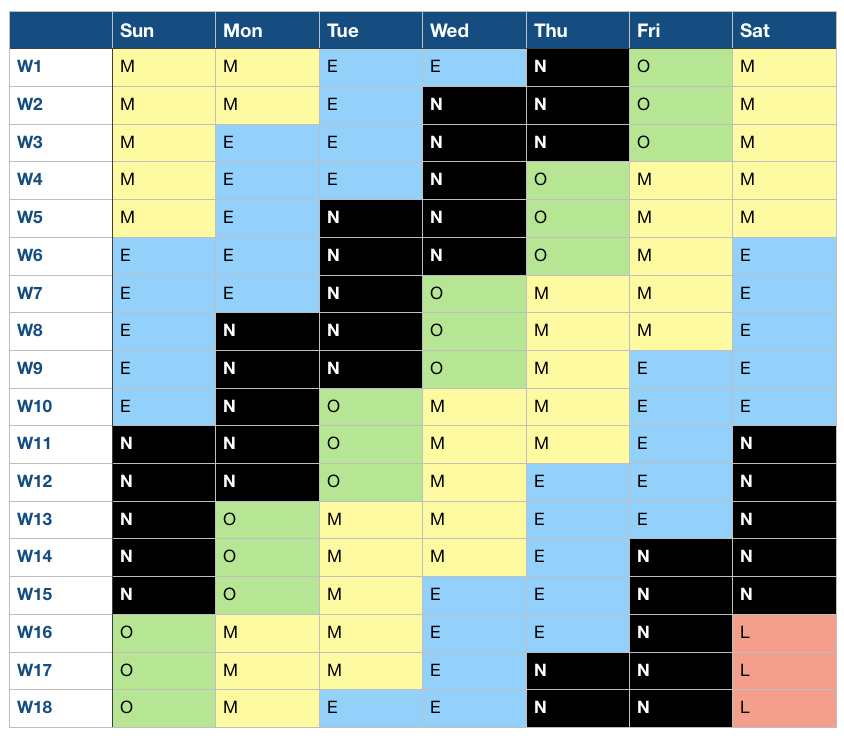
Total waiter we need = 18 waiters ( 3 extra to make up for the weekly offs)
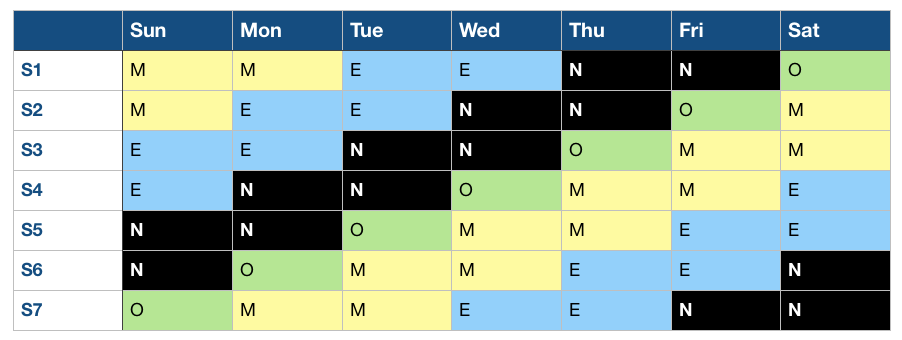
Total Supervisor we need = 7 Supervisors (1 extra to make up for weekly offs)
- M- Morning Shift (7:00- 15:00)
- E- Evening Shift. (15:00-23:00)
- N- Night Shift (23:00-7:00)
- O- Off
Duty Roaster for Supervisors
Duty Roaster for Waiters
Duty Supervisor Job Responsibilities:
Accomplishes department objectives by supervising staff; organizing and monitoring work process.
Duty Supervisor Job Duties:
- Maintains staff by recruiting, selecting, orienting, and training employees; developing personal growth opportunities.
- Accomplishes staff job results by coaching, counseling, and disciplining employees; planning, monitoring, and appraising job results; conducting training; implementing enforcing systems, policies, and procedures.
- Maintains a safe and healthy work environment by establishing and enforcing organization standards; adhering to legal regulations.
- Completes operations by developing schedules; assigning and monitoring work; gathering resources; implementing productivity standards; resolving operations problems; maintaining reference manuals; implementing new procedures.
- Controls expenses by gathering and submitting budget information; scheduling expenditures; monitoring variances; implementing corrective actions.
- Provides quality service by enforcing quality and customer service standards.
- Maintains professional and technical knowledge by attending educational workshops; reviewing professional publications.
- Contributes to team effort by accomplishing related results as needed.
Q.7. What is an SOP? Enumerate its importance in any F&B outlet. Document an SOP for service of Irish coffee. (2+4+4=10)
A standard operating procedure (SOP) is a set of written instructions that document a repetitive activity followed by an organization. The development and use of SOP are an integral part of a successful quality system as it provides individuals with information to perform a job properly and facilitates consistency in the quality of a product or service.
When the tasks in an organization are repetitive, it is required to generate a set of Standard Operating Procedures (SOPs). These make the tasks in hand easier and effective and save a great deal of time and effort. The SOPs also help to avoid common errors.
Importance of Standard Operating Procedures
Readiness for Future Growth
If your long-term goals include expanding your business to branch offices, ready-made SOPs make your proven work processes portable. New employees at new locations can uphold your reputation by using the SOPs to replicate the products and services provided at your original place of business.
Standard Operating Procedures Simplify Performance Management
Managers can use the SOP framework to develop target ranges and make assessments of individual performance. Employees who work in compliance with SOPs know exactly what is expected of them, and they plan their work schedules to meet their goals with efficiency.
When all employees follow the same processes, it’s an easy matter to measure them against the same standards. Performance can be fairly appraised. This is especially important in cases where high-performing employees are rewarded, and low-performing employees are retrained or placed on probation.
Control the Quality and Consistency of Your Product
When your business generates a product that you’re proud of, you want to maintain a high standard of quality. Standardized procedures guide workers and reduce the possibility of missed steps or other errors that impact the quality of the completed product. Meticulously followed SOPs to ensure that your product or service is created in the same way from start to finish. Providing a blueprint for the line of production creates consistency and protects the integrity of your product.
Protect Yourself from Knowledge Loss
If the details of your business processes are stored in a key employee’s head and not in a procedures manual, the loss of the employee can be disastrous. Documentation of job processes survives employee attrition due to retirement and resignation, and allow your company to carry on as usual. It’s hard to replace experienced, skilled workers, but comprehensive well-written SOPs ensure that your valuable business processes stay with your business.
Save on Training Costs
Depending on the complexity of the task and the experience of employees, SOPs may not completely substitute for training. Documented procedures are a valuable component of the new-hire toolkit, and can reduce training time. They act as reference guides and allow new employees to work independently without excessive reliance on supervisors.
New hires make ideal testing grounds for the effectiveness of SOPs. If the documented steps enable the new employee to complete the task, the procedures are sound. If any steps are unclear, confusing or no longer in use, the SOP should be updated.
SOP for service of Irish coffee
- Heat a mug with hot water. Add hot water to a mug. This should heat it up slightly. Let the water sit for a few minutes before dumping out the contents.
- Add coffee to the warmed mug. Once the mug is heated, add your freshly brewed coffee to the mug. Fill the mug up about three-quarters of the way full.
- Mix in brown sugar. Use a spoon to transfer your brown sugar to the coffee. Use the same spoon to mix the sugar until it’s completely dissolved.
- Add your whiskey. Measure out your whiskey and slowly pour it into your mug. Stir the coffee slightly to blend everything together.
- Top your coffee with whipped cream. When adding your whipped cream, pour it slowly over the back of a spoon. This will ensure the cream stays on top of the coffee.
Q.8. What are the opening and closing duties of a Bartender? (10)
Following are the opening duties of a Bartender:
- Unlock liquor cabinets and set out all liquor.
- Rinse jockey box with hot water and fill with ice.
- Set out damp bar towels for wiping down tables and bars.
- Cut fresh fruit (lemon twists, limes, oranges, and celery) and spoon out olives and cherries and place in garnish tray. Place clean ashtrays on bar and cocktail tables.
- Replenish supply of napkins, straws and stir sticks.
- Check juice mixes, particularly orange and tomato juice, for freshness.
- Mix a day’s supply of juices from concentrate.
- Collect your bank and cash tickets before customers arrive.
- Turn on the music and set the atmosphere.
- Be sure to restock beer, liquor, and wine before PM bartender begins their shift.
- Count your bank and make a money drop at the end of your shift.
The closing duties of a BarTender are as follows:
- Wipe down all liquor bottles on the front and back bar and lock the liquor in the cabinet if required. Store all fresh juices, mixes and garnishes in cooler.
- Take all ice out of the jockey box and/or meltdown with hot water and wipe out.
- Drain all sinks and wipe down.
- Run hot water through draft beer drain and wipe down.
- Restock all beer, liquor, and wine.
- Wash all dirty glassware, mixing utensils and ashtrays.
- Make out a requisition for all liquor and supplies needed.
- Wipe down all bar counters, tables, and stainless steel equipment. Turn off the music.
- Count your bank and make a money drop. Turn off lights and lock up.
OR Name ten cocktail garnishes. Indicate how each is used. (10)
Garnishes are very important for your mixed drinks. They make the drink look more presentable and they also add more flavor.
1. Limes
Wedges:
A wedge is 1/8 of a lime, lemon or orange. In other words, there are 8 wedges in lime, lemon or orange.
Lime Wedges:
Cut off the ends of the lime. Then cut the lime in half from one end to the other. Finally, cut each half into four equal wedges.
Lime Wheels:
Cut off the ends of the lime. Then cut slices from one end to the other. Use your judgment on how thick the slices should be. Finally, make one cut from the center of the lime wheel to the edge so it can sit on the glass.
When to Use:
Any time you make a drink with lemon-lime soda, tonic water and some times soda water, in drinks that contain lime juice like Cosmopolitan, and in some drinks that contain sweet and sour mix like Margaritas.
2. Lemons
Lemon Wedges:
Use the same technique as the lime wedges.
Lemon Twist:
Cut off the ends of the lemon. Then cut the rind from one end to the other making 1/3 inch strips (Make sure that you don’t cut into the meat of the lemon). Finally, peel off the strips.
Note: When you are going to use a twist, rub the rim of the glass with the twist and then twist it and drop it over the drink to add a little bit of oil.
When to Use:
Lemons are used on teas like Long Island Iced Tea and Long Beach Iced Tea. There are also used in Lemon Drop Martinis, lemonades and other drinks that contain lemon.
3. Oranges
Orange Wedges:
Use the same technique as the lime wedges.
Orange Slices:
Cut off the ends of the orange. Then cut the orange in half from one end to the other. Cut both halves in half. Finally, cut the orange quarters into wedges.
Orange Spiral:
Use a citrus stripper to make your orange spirals. Start at one end of the orange and cut around and down towards the other end making a long spiral peel.
When to Use: Oranges are used any time you use collins mix. There are also used in drinks that contain orange. The orange spirals are used in drinks like coolers.
4. Chocolate
A piece of chocolate or shaved chocolate may be used for garnish.
Shaved Chocolate:
Buy a block of chocolate and use a cheese grater to shave it.
5. Berries
It could be raspberries, blueberries, blackberries or other berries. Insert a cocktail stick into the berries and place it on top of the drink.
6. Coffee Beans
The only time that you are going to need coffee beans is when you are serving Sambuca. Just drop three coffee beans into the Sambuca. The three coffee beans represent Health, Wealth and Happiness.
7. Apple
Apple Slices:
Cut an apple in half. Then, cut each half into slices about 1/8 inch thick. Make a diagonal cut to the apple slice so it can be placed in a martini glass. Cut the apple slices right before serving the drinks.
Main Use:
Apple Martinis
8. Celery
Wash the celery with water only and cut the leaves and the base to make celery sticks.
Main Use:
Celery is used for Bloody Marries and Bloody Marias.
9. Pineapple
Pineapple Wedges:
Cut the top and bottom of the pineapple. Then cut the pineapple in half from one end to the other. Cut one half in half from one end to the other. Remove the core section of the pineapple. Finally, cut wedges.
Main Use:
Pineapple is used in many tropical mixed drinks.
10. Salt (Kosher Salt)
Kosher salt is used to coat the rim of a glass. Moist the rim of a glass with a lime wedge. Then dip it into the salt.
Main Use:
Margaritas, Bloody Marries, and Salty Dogs.
11. Strawberries
Wash strawberries with water only. If the strawberries are big, cut them in half. Just push the strawberry onto the rim of the glass.
Main Use:
Mixed drinks that have berries or strawberry liqueur-like Strawberry Margaritas and Strawberry Daiquiris.
- Banana
Banana Slices:
Cut through the peel from the middle of the banana. Make banana slices about 1/4 inch thick.
When to Use:
It could be used in many drinks that contain banana liqueur
Q.9. Write a recipe for the following cocktails (any four): (4×2 ½ =10)
(a) Margarita
Ingredients: 45 ml Blanco tequila, 21 ml lime juice, 30 ml triple sec, salt.
Procedure: Add all the ingredients to a shaker filled with ice and shake thoroughly. Strain into a chilled cocktail glass rimmed with salt. Garnish with a lime slice.
(b) Whiskey Sour
Ingredients: 45 ml whiskey, 30 ml lemon juice, 1 tsp powdered sugar, lemon slices
Procedure: Combine all the ingredients in a cocktail shaker. Add ice cubes and shake thoroughly. Strain the mixture into an old-fashioned glass. Add ice cubes. Garnish with a lemon slice.
(c) Cuba Libre
Ingredients: 30 ml white rum, 90 ml Coca-Cola.
Procedure: Add the ingredients to a highball glass filled with ice and stir. Garnish with a lime wedge.
(d) Harvey Wall Banger
Ingredients: 40 ml vodka, 90 ml orange juice, 15 ml Galliano L’Autentico liqueur.
Procedure: Add the vodka and orange juice to a tall glass filled with ice. Stir. Pour the Galliano slowly so it floats on top. Garnish with an orange slice.
(e) Tom Collins
Ingredients: 45 ml gin, 21 ml lemon juice, 21 ml sugar syrup, club soda.
Procedure: Add gin, lemon juice and sugar syrup to a shaker. Add ice and shake well. Strain into either a Highball or a Tom Collins glass filled with ice cubes. Top with club soda and garnish with a lemon slice and a cherry.
Q.10. Explain the following terms (any ten): (10×1=10)
(a) Build
The build is a drink made by pouring the ingredients one by one in the glass in which it is to be served. If ice is required, it is placed first before adding the ingredients. Example:- Cuba Libre.
(b) Bardie
The vertical structure supporting the front bar, known as the ‘bar die’ is like a wall that separates the customers from the working area. The customer side may be padded, decorated with carving, or left plain.
(c) Ullages
Ullages is the quantity of wine, liquor, or the like, remaining in a container that has lost part of its contents by evaporation, leakage, or use.
(d) Speed pourers
It is small equipment used by bartenders to pour alcohol, it fits in the bottle’s neck. The main benefit of the speed pourer is that it streamlines the flow of liquid coming out of the bottle (helping to avoid spills and splashes) while giving you greater control over the amount of alcohol that is poured.
(e) Hawthorne strainer
A cocktail strainer is a metal bar accessory used to remove ice from a mixed drink as it is poured into the serving glass. A type of sieve, the strainer is placed over the mouth of the glass or shaker in which the beverage was prepared; small holes in the device allow only liquids to pass as the beverage is poured.
(f) Ah-So
A wine opener with two parallel prongs that are wedged into the bottle on opposite sides of the cork using a rocking motion. The cork is then pulled out by lifting the Ah-So straight from the bottle. Also known as the “Butler’s Friend,” because a butler could remove the cork, fill his glass, and replace the cork without anyone knowing.
(g) Corkage
Corkage is the charge made by some restaurants for allowing customers to drink wine that has been bought from somewhere else.
(h) Rimmer
A rimmer is a bar accessory used to apply salt or sugar to the rim of a glass. It usually consists of one or more shallow plastic or metal discs that the glass is turned upside down into. The discs can be filled with either the rimming salt or sugar or sometimes something to moisten the rim of the glass such as lime juice.
(i) Call brands
Call brands are the brands requested by the guest by name. For example, Blue Sapphire Gin, Johnnie Walker, Red Label, etc.
(j) Delegation
The term delegation describes the process used by a manager to shift some of the responsibilities for the task implementation to another team member. Delegation is key to improving team members’ feelings of involvement and ownership.
(k) Bar optics
Spirit/Bar optics offer a fast and reliable way of dispensing spirits.
(l) Well brands
Well brands are house brands that are served to the guest who does not specify a particular brand of liquor. They may just ask for scotch, bourbon, rye, gin, etc.