
Table of Contents
The housekeeping staff needs to know various types of fires and fire extinguishers. The staff must be trained to handle small fires.
Fire is classified into the following types −
- Class A − Class A fire consists of ordinary combustibles such as wood, paper, trash or anything else that leaves ash behind. It needs water under high pressure to extinguish this fire.
- Class B − This fire occurs in inflammable liquids such as oil and grease and needs blankets or sand to extinguish.
- Class C − This fire occurs in electrical equipment. Use of non-conductive agent is required for extinguishing this fire.
- Class K − Class K Fires are fires that involve cooking oils, grease or animal fat and can be extinguished using Purple K, a typical agent found in kitchen or galley extinguishers.
Prevention of Fire
Fires may be prevented if fire hazards are identified & eliminated. Some unsafe practices that may lead to fires are as follows:
- Guests smoking in bed.
- The hotel not providing sand urns or sufficient & appropriate ashtrays in rooms as well as public areas.
- Using high-wattage light bulbs in lamps.
- Leaving linen chute doors open.
- Storing rags & cloths with residues of cleaning polish still on them.
- Not unplugging electrical appliances when not in use.
- Using faulty electrical equipment or sockets.
- Leaving magnifying glasses where the sun can catch them.
- Using furnishing materials that are easily combustible.
- Each establishment must conduct fire drills on a periodic basis & ensure that all staff attends these drills so that they know what is to be done during a fire emergency.
Fire Warning System
These may be electrically powered manually operated systems, automatic fire detection system, or a combination of both. The usual components of these systems are discussed here:
Fire alarms: These can be set off by smoke detectors, heat detectors, sprinkler systems, or pull stations. The most common types of fire alarms are the ones operated by pull stations located in corridors, lobbies, & near elevators.
Sprinklers: These are found in most hotel establishments, especially in corridors & rooms. They are situated on the ceiling & automatically spray water when the temperature rises above a certain level.
Smoke detectors: These are set off by smoke. The two types of smoke detectors available are photoelectric detectors & ionization detectors. Photoelectric detectors are alarms triggered off when smoke blocks a beam of light emanating from the detector. In the ionization type of detector, the alarm sounds when the detector senses a shift in electrical conductivity between two plates.
What to do in case of Fire Emergency
In case a fire breaks out, follow the guidelines given below:
- Immediately switch on the nearest fire alarm.
- If possible, attack the fire with suitable equipment, remembering to direct the extinguishers at the base of the flames. Do not attempt to fight a fire if there is any danger of personal risk.
- Close windows & switch off all electrical appliances, including fans & lights.
- Close the door to that affected area & report to your immediate supervisor for instructions.
- Carry out instructions
- Remain at the assembly point until instructed to do otherwise.
- Do not use the lifts.
Fire-fighting Equipment
Staff should be trained in operating the fire-fighting equipment. Types of fire-fighting equipment vary from simple ones such as buckets of sand & water, fire blankets, & hose reels to more complex fire extinguishers. Water buckets should be constantly checked for adequate water levels & sand buckets should be kept dry. Water should not be used in case of fire involving electricity.
Types of fire extinguishers
Fire extinguishers can be of various types:
Dry powder: These are usually meant for multipurpose use with various types of fire. They contain an extinguishing agent & use a compressed, non-flammable gas as a propellant.
Dry chemical foam: These are primarily used on flammable liquids, oils, & fats, but may have the multipurpose use.
Halon/vaporizing liquid: These contain a gas or volatile liquid that interrupts the chemical reaction that takes place when fuel burns. This type of extinguisher is often used to protect valuable electrical equipment as they leave no residue to clean up & have a limited range up to 4-6 feet.
Water-gas or soda-acid extinguishers: These extinguishers contain water & compressed gas & should only be used for Class A fires.
Carbon dioxide: These CO2-based extinguishers are most effective on Class B & C(liquids & electrical) fires. Since the gas disperses quickly, these extinguishers are only effective from a distance of 3-8 feet. The carbon dioxide is as a compressed liquid in the extinguisher; as it expands on release, it cools the surrounding air.
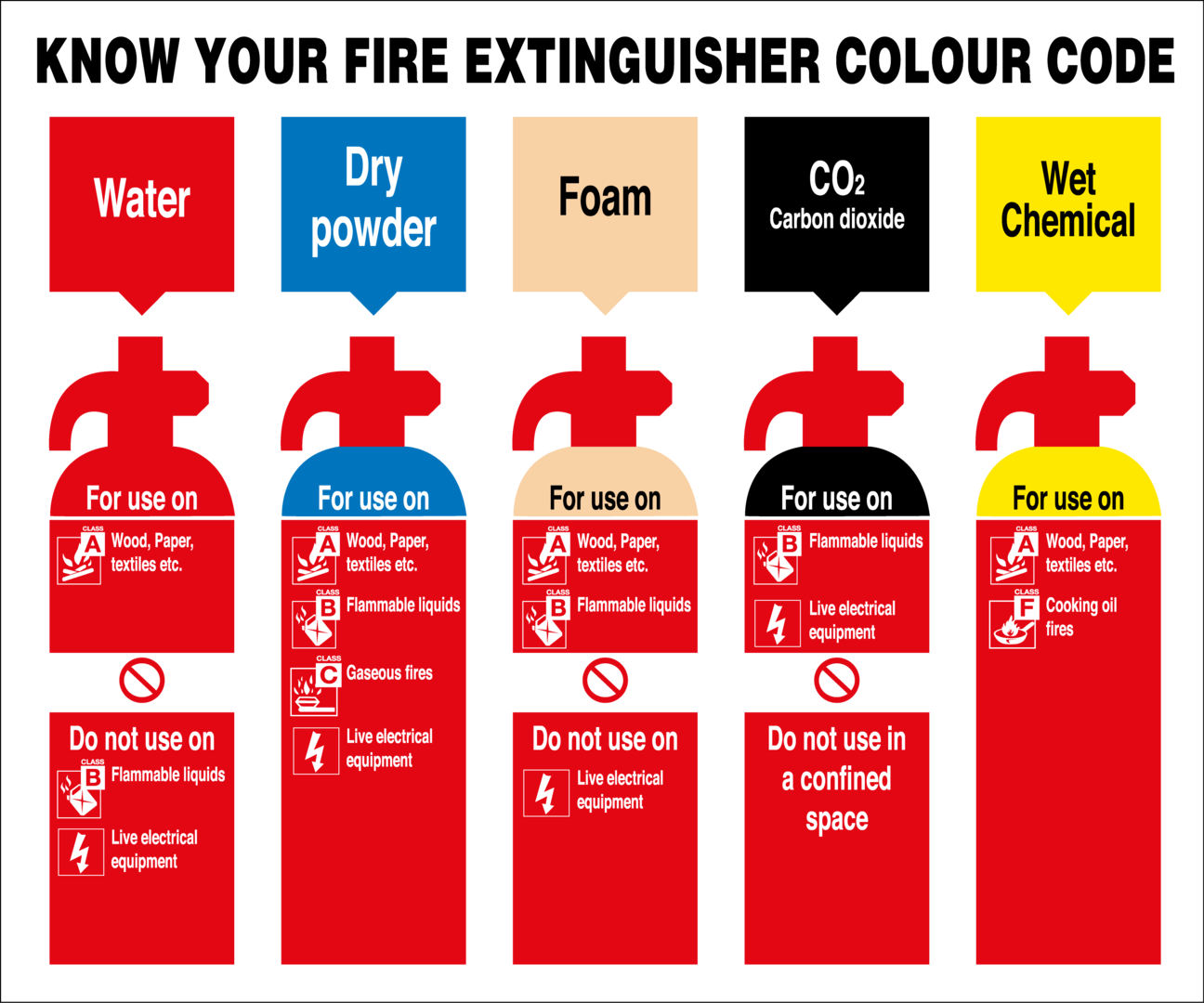
Fire-extinguisher ratings
Most fire extinguishers available are rated according to the type of fire they extinguish:
Class A extinguishers
Put out the most basic fires, such as those that started with wood or paper. Their numerical rating refers to both the amount of water inside & the extent of the fire they can extinguish.
Class B extinguishers
These types are recommended for use with fires that involve flammable liquids, such as gasoline, oil, or grease. The numerical rating refers to the number of square feet of liquid fire that the average untrained person can expect to put out using this equipment.
Class C extinguishers
These are of electrical fires. They do not have numerical ratings; it is the ‘C’ designation that shows that the extinguishing agent inside is non-conductive.
Class D extinguishers
These are for use with flammable metals & are often made for use with a specific metal. They do not have numerical ratings, nor can they be used on the other types of fires.