
Table of Contents
Q.1. Explain the usefulness of SWOT analysis in today’s competitive scenario. (10)
SWOT is an acronym for Strengths, Weaknesses, Opportunities, and Threats. By definition, Strengths (S) and Weaknesses (W) are considered to be internal factors over which you have some measure of control. Also, by definition, Opportunities (O) and Threats (T) are considered to be external factors over which you have essentially no control.
SWOT Analysis is the most renowned tool for audit and analysis of the overall strategic position of the business and its environment. Its key purpose is to identify the strategies that will create a firm specific business model that will best align an organization’s resources and capabilities to the requirements of the environment in which the firm operates.
In other words, it is the foundation for evaluating the internal potential and limitations and probable/likely opportunities and threats from the external environment. It views all positive and negative factors inside and outside the firm that affect success. A consistent study of the environment in which the firm operates helps in forecasting/predicting the changing trends and also helps in including them in the decision-making process of the organization.
An overview of the four factors (Strengths, Weaknesses, Opportunities and Threats)-
1. Strengths
Strengths are the qualities that enable us to accomplish the organization’s mission. These are the basis on which continued success can be made and continued/sustained.
Strengths can be either tangible or intangible. These are what you are well-versed in or what you have expertise in, the traits and qualities your employees possess (individually and as a team) and the distinct features that give your organization its consistency.
Strengths are the beneficial aspects of the organization or the capabilities of an organization, which includes human competencies, process capabilities, financial resources, products and services, customer goodwill and brand loyalty. Examples of organizational strengths are huge financial resources, broad product line, no debt, committed employees, etc.
2. Weaknesses
Weaknesses are the qualities that prevent us from accomplishing our mission and achieving our full potential. These weaknesses deteriorate influences on the organizational success and growth. Weaknesses are the factors which do not meet the standards we feel they should meet.
Weaknesses in an organization may be depreciating machinery, insufficient research and development facilities, narrow product range, poor decision-making, etc. Weaknesses are controllable. They must be minimized and eliminated. For instance – to overcome obsolete machinery, new machinery can be purchased. Other examples of organizational weaknesses are huge debts, high employee turnover, complex decision making process, narrow product range, large wastage of raw materials, etc.
3. Opportunities
Opportunities are presented by the environment within which our organization operates. These arise when an organization can take benefit of conditions in its environment to plan and execute strategies that enable it to become more profitable. Organizations can gain competitive advantage by making use of opportunities.
Organization should be careful and recognize the opportunities and grasp them whenever they arise. Selecting the targets that will best serve the clients while getting desired results is a difficult task. Opportunities may arise from market, competition, industry/government and technology. Increasing demand for telecommunications accompanied by deregulation is a great opportunity for new firms to enter telecom sector and compete with existing firms for revenue.
4. Threats
Threats arise when conditions in external environment jeopardize the reliability and profitability of the organization’s business. They compound the vulnerability when they relate to the weaknesses. Threats are uncontrollable. When a threat comes, the stability and survival can be at stake. Examples of threats are – unrest among employees; ever changing technology; increasing competition leading to excess capacity, price wars and reducing industry profits; etc.
Advantages of SWOT Analysis
SWOT Analysis is instrumental in strategy formulation and selection. It is a strong tool, but it involves a great subjective element. It is best when used as a guide, and not as a prescription. Successful businesses build on their strengths, correct their weakness and protect against internal weaknesses and external threats. They also keep a watch on their overall business environment and recognize and exploit new opportunities faster than its competitors.
SWOT Analysis helps in strategic planning in following manner-
• It is a source of information for strategic planning.
• Builds organization’s strengths.
• Reverse its weaknesses.
• Maximize its response to opportunities.
• Overcome organization’s threats.
• It helps in identifying core competencies of the firm.
• It helps in setting of objectives for strategic planning.
• It helps in knowing past, present and future so that by using past and current data, future plans can be chalked out.
• SWOT Analysis provide information that helps in synchronizing the firm’s resources and capabilities with the competitive environment in which the firm operates.
Or Explain the dynamics of the external environment (PESTLE ANALYSIS) (10)
A PESTEL analysis or PESTLE analysis (formerly known as PEST analysis) is a framework or tool used to analyze and monitor the macro-environmental factors that may have a profound impact on an organization’s performance. This tool is especially useful when starting a new business or entering a foreign market. It is often used in collaboration with other analytical business tools such as the SWOT analysis and Porter’s Five Forces to give a clear understanding of a situation and related internal and external factors. PESTEL is an acronym that stands for Political, Economic, Social, Technological, Environmental, and Legal factors.

1. Political Factors
These factors are all about how and to what degree a government intervenes in the economy or a certain industry. Basically all the influences that a government has on your business could be classified here. This can include government policy, political stability or instability, corruption, foreign trade policy, tax policy, labour law, environmental law and trade restrictions. Furthermore, the government may have a profound impact on a nation’s education system, infrastructure and health regulations. These are all factors that need to be taken into account when assessing the attractiveness of a potential market.
2. Economic Factors
Economic factors are determinants of a certain economy’s performance. Factors include economic growth, exchange rates, inflation rates, interest rates, disposable income of consumers and unemployment rates. These factors may have a direct or indirect long term impact on a company, since it affects the purchasing power of consumers and could possibly change demand/supply models in the economy. Consequently it also affects the way companies price their products and services.
3. Socio-Cultural Factors
This dimension of the general environment represents the demographic characteristics, norms, customs and values of the population within which the organization operates. This includes population trends such as the population growth rate, age distribution, income distribution, career attitudes, safety emphasis, health consciousness, lifestyle attitudes and cultural barriers. These factors are especially important for marketers when targeting certain customers. In addition, it also says something about the local workforce and its willingness to work under certain conditions.
4. Technological Factors
These factors pertain to innovations in technology that may affect the operations of the industry and the market favorably or unfavorably. This refers to technology incentives, the level of innovation, automation, research and development (R&D) activity, technological change, and the amount of technological awareness that a market possesses. These factors may influence decisions to enter or not enter certain industries, to launch or not launch certain products or to outsource production activities abroad. By knowing what is going on technology-wise, you may be able to prevent your company from spending a lot of money on developing a technology that would become obsolete very soon due to disruptive technological changes elsewhere.
5. Environmental Factors
Environmental factors have come to the forefront only relatively recently. They have become important due to the increasing scarcity of raw materials, pollution targets and carbon footprint targets set by governments. These factors include ecological and environmental aspects such as weather, climate, environmental offsets and climate change which may especially affect industries such as tourism, farming, agriculture and insurance. Furthermore, growing awareness of the potential impacts of climate change is affecting how companies operate and the products they offer. This has led to many companies getting more and more involved in practices such as corporate social responsibility (CSR) and sustainability.
6. Legal Factors
Although these factors may have some overlap with the political factors, they include more specific laws such as discrimination laws, antitrust laws, employment laws, consumer protection laws, copyright and patent laws, and health and safety laws. It is clear that companies need to know what is and what is not legal in order to trade successfully and ethically. If an organisation trades globally this becomes especially tricky since each country has its own set of rules and regulations. In addition, you want to be aware of any potential changes in legislation and the impact it may have on your business in the future. Recommended is to have a legal advisor or attorney to help you with these kinds of things.
Q.2. Explain the grand strategy matrix, a tool for situation analysis with a neat pictographic presentation. (10)
The Grand Strategy Matrix has become a popular tool for formulating feasible strategies, along with the SWOT Analysis, SPACE Matrix, BCG Matrix, and IE Matrix. Grand strategy matrix is the instrument for creating alternative and different strategies for the organization. All companies and divisions can be positioned in one of the Grand Strategy Matrix’s four strategy quadrants. The Grand Strategy Matrix is based on two dimensions: competitive position and market growth. Data needed for positioning SBUs in the matrix is derived from the portfolio analysis. This matrix offers feasible strategies for a company to consider which are listed in sequential order of attractiveness in each quadrant of the matrix.
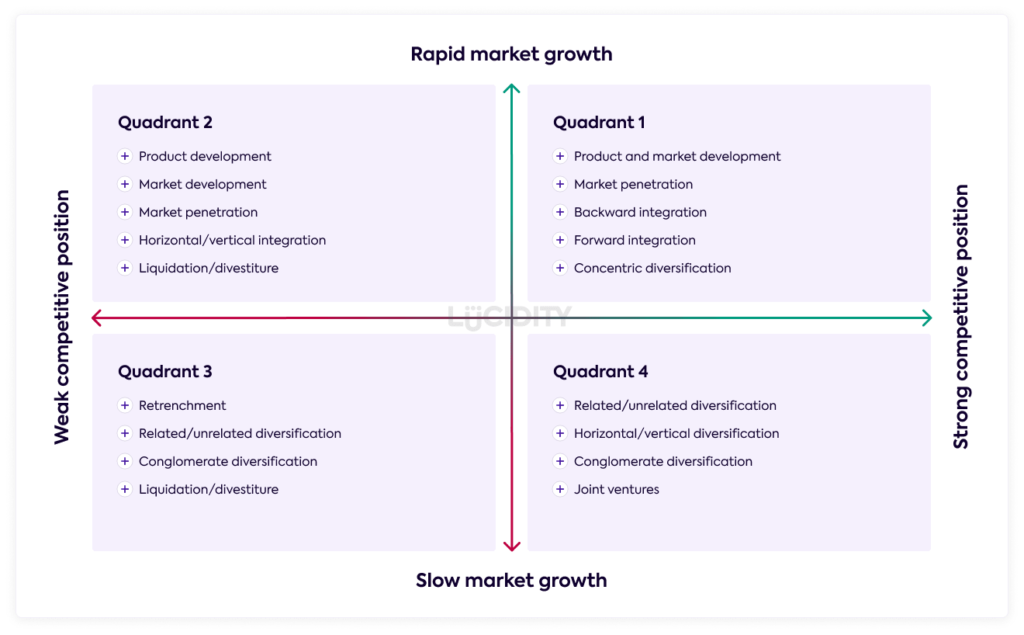
1. Quadrant I (Strong Competitive Position and Rapid Market Growth)
Firms located in Quadrant I of the Grand Strategy Matrix are in an excellent strategic position. The first quadrant refers to the firms or divisions with strong competitive base and operating in fast moving growth markets. Such firms or divisions are better to adopt and pursue strategies such as market development, market penetration, product development etc. The idea behind is to focus and make the current competitive base stronger. In case such firms possess readily available resources they can move on to integration strategies but should never be at the cost of diverting attention from current strong competitive base.
2. Quadrant II (Weak Competitive Position and Rapid Market Growth)
Firms positioned in Quadrant II need to evaluate their present approach to the marketplace seriously. Although their industry is growing, they are unable to compete effectively, and they need to determine why the firm’s current approach is ineffectual and how the company can best change to improve its competitiveness. The suitable strategies for such firms are to develop the products, markets, and to penetrate into the markets. Because Quadrant II firms are in a rapid-market-growth industry, an intensive strategy (as opposed to integrative or diversification) is usually the first option that should be considered. To achieve the competitive advantage or becoming market leader Quadrant II firms can go into horizontal integration subject to availability of resources. However if these firms foresee a tough competitive environment and faster market growth than the growth of the firm, the better option is to go into divestiture of some divisions or liquidation altogether and change the business.
3. Quadrant III (Weak Competitive Position and Slow Market Growth)
The firms fall in this quadrant compete in slow-growth industries and have weak competitive positions. These firms must make some drastic changes quickly to avoid further demise and possible liquidation. Extensive cost and asset reduction (retrenchment) should be pursued first. An alternative strategy is to shift resources away from the current business into different areas. If all else fails, the final options for Quadrant III businesses are divestiture or liquidation.
4. Quadrant IV (Strong Competitive Position and Slow Market Growth)
Finally, Quadrant IV businesses have a strong competitive position but are in a slow-growth industry. Such firms are better to go into related or unrelated integration in order to create a vast market for products and services. These firms also have the strength to launch diversified programs into more promising growth areas. Quadrant IV firms have characteristically high cash flow levels and limited internal growth needs and often can pursue concentric, horizontal, or conglomerate diversification successfully. Quadrant IV firms also may pursue joint ventures
Generally, strategies listed in the first quadrant of Grand Strategy Matrix are intended to maintain a firm’s competitive edge and boost rapid growth, while the other three quadrants represent appropriate actions to take to reach the best position, which is the first quadrant. Increasing market share, expanding to new markets and creating new products are common strategies
Or Discuss the BCG matrix of corporate portfolio analysis with neat diagram. (10)
The Boston Consulting group’s product portfolio matrix (BCG matrix) is designed to help with long-term strategic planning, to help a business consider growth opportunities by reviewing its portfolio of products to decide where to invest, to discontinue or develop products. It’s also known as the Growth/Share Matrix.

Product Life Cycle. A new product progresses through a sequence of stages from introduction to growth, maturity, and decline. This sequence is known as the product life cycle and is associated with changes in the marketing situation, thus impacting the marketing strategy and the marketing mix.
The Boston Consulting group’s product portfolio matrix (BCG matrix) is designed to help with long-term strategic planning, to help a business consider growth opportunities by reviewing its portfolio of products to decide where to invest, to discontinue or develop products. It’s also known as the Growth/Share Matrix.
Q.3. How do policies play a vital role in day to day operations of hospitality sector. (5)
A ‘Policy’ is a predetermined course of action, which is established to provide a guide toward accepted business strategies and objectives. In other words, it is a direct link between an organization’s ‘Vision’ and their day-to-day operations. Policies identify the key activities and provide a general strategy to decision-makers on how to handle issues as they arise. This is accomplished by providing the reader with limits and a choice of alternatives that can be used to ‘guide’ their decision making process as they attempt to overcome problems. I like to think of ‘policies’ as a globe where national boundaries, oceans, mountain ranges and other major features are easily identified.
Policies
• Are general in nature
• Identify company rules
• Explain why they exist
• Tells when the rule applies
• Describe who it covers
• Shows how the rule is enforces
• Describes the consequences
• Are normally described using simple sentences and paragraphs.
Benefits of the policy
Major benefits they provide are –
• Employees understand the constraints of their job without using a ‘trial and error’ approach, as key points are visible in well-written policies and procedures.
• Policies and procedures enable the workforce to clearly understand individual and team responsibilities, thus saving time and resources. Everyone is working off the same page; employees can get the “official” word on how they should go about their tasks quickly and easily.
• Clearly written policies and procedures allow managers to exercise control by exception rather than ‘micro-manage’ their staff.
• They send a “We Care!” message. ‘The company wants us to be successful at our jobs.’
• Clearly written policies and procedures provide legal protection. Juries apply the ‘common person’ standard. If written clearly so that outsiders understand, the company has better legal footing if challenged in court.
Q.4. List the elements of well drafted mission statement and give brief description. (5)
Elements of a Meaningful Mission Statement
The mission statement should be a long-run vision of what the organisation is trying to achieve—the unique aim that differentiates it from similar organisations. The need is not for a stated purpose that would enable managers to feel good. Rather, the need is for a stated mission that provides direction and significance to all members of the organisation.
In developing a statement of mission, management must take into account three key elements: the organisation’s history, its distinctive competencies, and its environment.
1. History
Every organisation, large or small, profit or non-profit, has a history of objectives, accomplishments, mistakes and policies. These critical characteristics and events of the past must be considered in formulating a mission.
2. Distinctive competencies
These refer to the things that an organization does well— so well, in fact, that they are an advantage over similar organizations. Prima facie, an opportunity may be there but the organization must have the competencies to capitalize on it.
‘An opportunity without the competence to capture it is not really an opportunity for the organization’. For example, Proctor and Gamble, engaged in health-care products, could probably enter the ‘synthetic fuel’ business but such a decision certainly would not take advantage of its major distinctive competence.
3. Environment
The organisation’s environment dictates the opportunities, constraints, and threats that must be identified before a mission statement is developed.
For example, technological developments in the communications field (such as long-range picture transmission, closed-circuit television, and the television phone) may have a negative impact on business travel and certainly should be considered in the mission statement of a large motel chain.
Q.5. State the various approaches for developing strategies. (5)
Various approaches adopted while developing strategies are –
1. Adaptive Approach
2. Intuition Approach
3. Strategic Factor Approach
4. Entrepreneurial Approach
5. Niche Approach
1. Adaptive Approach
Adaptive approach of strategic decision making is basically reactive and tries to assimilate the change in decision- making context—various factors, particularly envirovmental ones, affecting strategic decisions. Various features of strategic decision making under ADAPTIVE APPROACH are as follows:
• Decision making is basically meant for problem solving rather than going for new opportunities. Adaptation process is adopted to meet the threats by changed environment as against the decision making to meet the anticipated changes in environment which entrepreneurial approach suggests.
• Decision are made in sequential, incremental steps, one thing at a time necessitated by environmental changes i.e.to maintain flexibility to adapt the decisions to more pressing needs.
• Various interest groups and stakeholders put considerable pressure on decision making process so as to protect their own interests. Thus the ultimate decision is a compromised one which may be sometimes, at the cost of optimising organisational effectiveness.
2. Intuition Approach
The basic premise of this approach is that the strategy evolves in the mind of the chief executive without ever being explicitly and without the aid of formal procedures. Intuition, Steiner, has observed, is an excellent approach if it is brilliant. Along with intuition, personal judgment is also a necessary element in this approach. In the United States, Alfred Sloan of General Motors Corporation, Henry Ford of Ford Motor Car Company, and in India J R D Tata, G M Modi, GD Birla, to name a few among the pioneer industrialists, are often remembered for their imagination, drive and expensive vision, which led to corporate growth and prosperity in different fields. The strategies developed by each of them over the years may be attributed to their intuition and judgment.
3. Strategic Factor Approach
Identification of key strategic factors may lead to the assessment of organizational strengths and weaknesses in respect of these factors. Organizational strength on any factor can be defined as the contribution made by the factor towards the achievement of the organizational objectives. A factor may not necessarily contribute directly to the achievement of overall objectives but may contribute indirectly by achieving a lower level objective. An organizational weakness on a factor can be defined as the negative contribution of the factor in achieving the organizational objectives. Another way for assessing strengths and weaknesses is to make a comparative analysis of these factors with those of the competitors. For the assessment of organizational strengths and weaknesses, some techniques or tools like financial analysis, key factor rating, and functional area profile and resource-development matrix have been developed.
4. Entrepreneurial Approach
The thrust under this approach is related with the role of the manager as an entrepreneur. Drucker has depicted the role of an entrepreneurial manager as that of a systematic risk-maker and risk-taker, looking for and finding opportunity. Entrepreneurship is essentially the acceptance of change as an opportunity and the acceptance of the leadership in change as the unique task of the entrepreneur. The roll of an entrepreneur is opportunity focused and not problem focused. Briefly speaking, this general description of the entrepreneurial manager indicates what is expected of him, but it does not enlighten us on how he should go about performing his role.
5. Niche Approach
This approach is based on developing strategies by picking propitious niches in which the organization wishes to operate. A ‘niche’ is a sub-segment of a major market segment that no other firm has chosen to enter directly. For example, a particular buyer group, geographical area, or segment of the production line.
Q. 6. With the help of a neat diagram, explain McKinsey’s 7 frameworks in detail. (5)
The McKinsey 7S Framework is a management model developed by well-known business consultants Robert H. Waterman, Jr. and Tom Peters (who also developed the MBWA– “Management By Walking Around” motif, and authored In Search of Excellence) in the 1980s. This was a strategic vision for groups, to include businesses, business units, and teams. The 7S are structure, strategy, systems, skills, style, staff and shared values.
The model is most often used as a tool to assess and monitor changes in the internal situation of an organization.
The model is based on the theory that, for an organization to perform well, these seven elements need to be aligned and mutually reinforcing. So, the model can be used to help identify what needs to be realigned to improve performance, or to maintain alignment (and performance) during other types of change.
Whatever the type of change – restructuring, new processes, organizational merger, new systems, change of leadership, and so on – the model can be used to understand how the organizational elements are interrelated, and so ensure that the wider impact of changes made in one area is taken into consideration.
Objective of the model
• To analyze how well an organization is positioned to achieve its intended objective
Usage
• Improve the performance of a company
• Examine the likely effects of future changes within a company
• Align departments and processes during a merger or acquisition
• Determine how best to implement a proposed strategy.
The Seven Interdependent Elements
• The basic premise of the model is that there are seven internal aspects of an organization that need to be aligned if it is to be successful
A. Hard Elements
• Strategy
• Structure
• Systems
B. Soft Elements
• Shared Values
• Skills
• Style
• Staff

Q.7. With the help of appropriate examples, prepare short note (any five) (5×2=10)
a. Conglomerate diversification
Conglomerate diversification is growth strategy that involves adding new products or services that are significantly different from the organization’s present products or services. Conglomerat diversification occurs when the firm diversifies into an area(s) totally unrelated to the organization current business.
Most conglomerate diversifications are based on the rationale that expansion into unrelated industries has a very attractive potential:
“… the basic premise of unrelated diversification is that any company that can be acquired on good financial terms represents a good business to diversify into” (Thompson and Strickland ).
Typically, corporate strategists screen candidate companies using such criteria as:
• Whether the business can meet corporate targets for profitability and return on investment.
• Whether the new business will require substantial infusions of capital to replace fixed assets, fund expansion, and provide working capital.
• Whether the business is in industry with significant growth potential.
• Whether the business is big enough to contribute significantly to the parent firm’s bottom line.
• The potential for union difficulties or adverse government regulations concerning product safety or the environment.
• Industry vulnerability to recession, inflation, high interest rates, or shifts in government policy.
b. Forward Integration
Forward integration is a business strategy that involves a form of downstream vertical integration whereby the company owns and controls business activities that are ahead in the value chain of its industry, this might include among others direct distribution or supply of the company’s products. This type of vertical integration is conducted by a company advancing along the supply chain.
A good example of forward integration would be a farmer who directly sells his crops at a local grocery store rather than to a distribution center that controls the placement of foodstuffs to various supermarkets. Or, a clothing label that opens up its own boutiques, selling its designs directly to customers instead of or in addition to selling them through department stores.
c. Product development
Product development typically refers to all of the stages involved in bringing a product from concept or idea through market release and beyond. In other words, product development incorporates a product’s entire journey.
There are many steps to this process, and it’s not the same path for every organization, but these are the most common stages through which products typically progress:
• Identifying a market need
• Quantifying the opportunity
• Conceptualizing the product
• Validating the solution
• Building the product roadmap
• Developing a minimum viable product (MVP)
• Releasing the MVP to users
• Ongoing iteration based on user feedback and strategic goals
d. Market Penetration
Market penetration is a measure of how much a product or service is being used by customers compared to the total estimated market for that product or service. Market penetration can also be used in developing strategies employed to increase the market share of a particular product or service.
Market penetration can be used to determine the size of the potential market. If the total market is large, new entrants to the industry might be encouraged that they can gain market share or a percentage of the total number of potential customers in the industry.
For example, if there are 300 million people in a country and 65 million of them own cell phones, the market penetration of cell phones would be approximately 22%. In theory, there are still 235 million more potential customers for cell phones, or 78% of the population remains untapped. The penetration numbers might indicate the potential for growth for cell phone makers.
e. Joint venture
A joint venture (JV) is a business arrangement in which two or more parties agree to pool their resources for the purpose of accomplishing a specific task. This task can be a new project or any other business activity.
In a joint venture (JV), each of the participants is responsible for profits, losses, and costs associated with it. However, the venture is its own entity, separate from the participants’ other business interests. A common use of JVs is to partner up with a local business to enter a foreign market.
f. Liquidation
Liquidation in finance and economics is the process of bringing a business to an end and distributing its assets to claimants. It is an event that usually occurs when a company is insolvent, meaning it cannot pay its obligations when they are due. As company operations end, the remaining assets are used to pay creditors and shareholders, based on the priority of their claims. General partners are subject to liquidation.
The term liquidation may also be used to refer to the selling of poor-performing goods at a price lower than the cost to the business, or at a price lower than the business desires.
g. Divestiture
A divestiture is the partial or full disposal of a business unit through sale, exchange, closure, or bankruptcy. A divestiture most commonly results from a management decision to cease operating a business unit because it is not part of core competency.
A divestiture may also occur if a business unit is deemed to be redundant after a merger or acquisition, if the disposal of a unit increases the sale value of the firm, or if a court requires the sale of a business unit to improve market competition.
In its simplest form, divestiture is the disposition or sale of an asset by a company, a way to manage its portfolio of assets. As companies grow, they may find they are in too many lines of business and they must close some operational units to focus on more profitable lines.