
Table of Contents
Q.1. (a) Draw a neat diagram and label different cuts of veal.

(b) Give two examples of beef preparations with description of each.
- Steak: A steak is a slice of beef meat that is usually cooked by grilling or frying. It is usually seasoned with salt and pepper before cooking and can be served with a variety of sauces, such as béarnaise or mushroom sauce. Different cuts of beef are used for steak, each with its own flavor and texture. For example, the tenderloin steak is a lean and tender cut, while the ribeye steak is a fattier cut with a more robust flavor.
- Beef Stroganoff: Beef Stroganoff is a classic Russian dish made with sautéed beef strips in a sour cream-based sauce. The beef is first seasoned and browned in a pan with onions and mushrooms. The sauce is then made with beef broth, sour cream, and mustard, and is thickened with flour. The beef is added back into the pan with the sauce and simmered until tender. It is usually served over egg noodles or rice, and can be garnished with fresh herbs like parsley or dill.
Q.2. (a) Differentiate between fermented dough and flat dough with examples.
Fermented dough and flat dough are two types of dough used in baking. They differ in their texture, flavor, and how they are prepared.
Fermented dough is made by mixing flour, water, and yeast, and allowing the dough to rise through the process of fermentation. The yeast consumes the sugar in the dough and produces carbon dioxide, which causes the dough to rise and become light and airy. This process can take several hours or even days, depending on the type of bread being made. Examples of fermented dough include sourdough, baguettes, and ciabatta.
Flat dough, on the other hand, is made by combining flour, water, and fat to create a dough that does not rise. The dough is usually rolled out and cut into shapes before baking. Flat doughs are denser than fermented doughs and are used to make baked goods that are flat, such as cookies, crackers, and pie crusts. Examples of flat doughs include shortbread, puff pastry, and graham cracker crusts.
(b) What is Knock Back?
Knock back is a process in bread-making where the dough is punched down after its first rise. After the dough has been mixed and allowed to rise for the first time, it is gently punched down to release the air that has built up during the fermentation process. This helps to redistribute the yeast and other ingredients within the dough and produces a more uniform texture.
Knock back is typically done by pressing down on the center of the dough and gently pushing outwards, or by folding the dough over onto itself a few times. The dough is then shaped into its final form and allowed to rise again before baking.
The knock back process is important because it helps to develop the gluten in the dough, which gives bread its characteristic chewiness and structure. It also helps to produce a finer crumb and prevents the bread from collapsing during baking.
(c) Give recipe of a Choux Pastry
Choux pastry is a versatile dough used to make a variety of sweet and savory pastries, including profiteroles, éclairs, and cream puffs. Here’s a basic recipe for choux pastry:
Ingredients:
- 1 cup water
- 1/2 cup unsalted butter
- 1/4 teaspoon salt
- 1 cup all-purpose flour
- 4 large eggs
Instructions:
- Preheat the oven to 425°F (220°C). Line a baking sheet with parchment paper.
- In a medium saucepan, combine the water, butter, and salt. Heat over medium heat until the butter is melted and the mixture comes to a boil.
- Add the flour all at once and stir vigorously with a wooden spoon until the mixture comes together into a smooth dough. Continue to cook and stir for 2-3 minutes until the dough pulls away from the sides of the pan.
- Transfer the dough to a mixing bowl and let it cool for a few minutes.
- Using an electric mixer or a wooden spoon, beat the eggs into the dough one at a time, making sure each egg is fully incorporated before adding the next. The dough should be smooth, shiny, and elastic.
- Transfer the dough to a piping bag fitted with a plain round tip. Pipe the dough onto the prepared baking sheet in the desired shape and size, leaving space between each pastry.
- Bake for 10 minutes, then reduce the oven temperature to 375°F (190°C) and continue to bake for 20-25 minutes until the pastries are puffed up, golden brown, and crisp.
- Remove the pastries from the oven and use a sharp knife to make a small slit in the side of each pastry to release the steam. Let them cool completely before filling with your favorite filling.
Note: The exact baking time may vary depending on the size and shape of the pastries. Keep an eye on them during baking and adjust the time as needed.
Q.3. (a) Explain processing of cheese. Name two blue veined and two soft cheese.
Cheese is a dairy product that is made by coagulating milk proteins with an enzyme called rennet, and separating the solid curds from the liquid whey. The curds are then typically salted, shaped, and aged to produce the desired flavor and texture.
The process of making cheese involves several steps:
- Coagulation: Milk is heated and an acid or rennet is added to cause the proteins to coagulate and form curds.
- Cutting: The curds are cut into small pieces to release the whey.
- Draining: The curds are allowed to drain and the whey is removed.
- Salting: Salt is added to the curds to enhance flavor and preserve the cheese.
- Shaping: The curds are shaped into blocks or wheels and may be pressed to remove more whey.
- Aging: The cheese is aged in a controlled environment to develop its characteristic flavor and texture.
Blue veined cheeses are cheeses that have been inoculated with mold spores, which grow throughout the cheese and give it a distinctive blue or green color and a pungent flavor. Two examples of blue veined cheeses are:
- Roquefort: A French blue cheese made from sheep’s milk. It has a crumbly texture and a tangy, salty flavor.
- Gorgonzola: An Italian blue cheese made from cow’s milk. It has a creamy texture and a sharp, tangy flavor.
Soft cheeses are cheeses that are not aged or are aged for only a short period of time, resulting in a soft, spreadable texture and a mild flavor. Two examples of soft cheeses are:
- Brie: A French cheese made from cow’s milk. It has a soft, creamy texture and a mild, buttery flavor.
- Camembert: A French cheese made from cow’s milk. It has a similar texture and flavor to Brie, but is slightly stronger and earthier in flavor.
(b) Explain the processing of butter and name its different types.
Butter is a dairy product made by churning cream until it separates into butterfat and buttermilk. The process of making butter can be broken down into several steps:
- Separating cream: Fresh cream is separated from whole milk through centrifugation or other mechanical means.
- Ripening: The cream is then allowed to ripen for several hours or overnight to develop flavor.
- Churning: The cream is agitated to break down the fat globules and separate the butterfat from the buttermilk. This can be done through mechanical means or by hand using a churn.
- Washing: The butter is washed to remove any remaining buttermilk and improve its shelf life.
- Salting: Salt may be added to the butter for flavor and preservation.
- Packaging: The butter is packaged and refrigerated for storage and distribution.
There are several different types of butter, each with their own unique characteristics:
- Salted butter: Butter that has been salted to enhance flavor and preserve it for longer.
- Unsalted butter: Butter that does not contain any added salt and has a milder flavor than salted butter.
- Cultured butter: Butter made from cream that has been allowed to ferment for several hours or overnight, resulting in a tangy, complex flavor.
- Clarified butter: Butter that has been heated to remove the milk solids and water, resulting in a pure, golden liquid that can be used for high-heat cooking.
- European-style butter: Butter made from high-fat cream that has a richer, creamier flavor and a higher butterfat content than standard American butter.
- Vegan butter: A plant-based alternative to butter that is made from vegetable oils and may contain emulsifiers and other additives to mimic the texture and flavor of butter.
Q.4. Draw a labeled diagram to show the structure of wheat. Also write short note on types of wheat.

Wheat is a cereal grain that is widely used in the production of a variety of foods, including bread, pasta, and breakfast cereals. There are several different types of wheat, each with its own unique characteristics and uses:
- Hard Red Wheat: This type of wheat is high in protein and gluten, which makes it ideal for making bread, pizza dough, and other baked goods that require a strong, elastic dough.
- Soft Red Wheat: This wheat has a lower protein and gluten content than hard red wheat and is often used in the production of cakes, cookies, and other baked goods that have a tender crumb and a more delicate texture.
- Hard White Wheat: This type of wheat is similar to hard red wheat, but has a lighter color and a milder flavor. It is often used in the production of white bread and other baked goods that require a lighter texture.
- Soft White Wheat: This wheat has a low protein and gluten content and is often used in the production of pastries, cakes, and other baked goods that have a tender crumb and a delicate flavor.
- Durum Wheat: This wheat has a high protein content and a yellow color, and is most commonly used in the production of pasta, couscous, and other grain-based products.
- Spelt: This ancient grain is a distant cousin of modern wheat and has a nutty flavor and a higher protein content than traditional wheat. It is often used in the production of bread, pasta, and baked goods.
In summary, the different types of wheat offer a range of flavors, textures, and nutritional benefits that make them suitable for a wide variety of culinary applications.
OR Classify soups. Explain with example for each category.
Soups can be classified into various categories based on different culinary criteria. The four major types of soups are:
- Thin Soups: Thin soups are clear, broth-based soups that are typically served as a light appetizer or palate cleanser. Examples of thin soups include:
-
- Consommé: A clear, clarified soup made from meat or poultry stock that is seasoned with vegetables and sometimes egg whites to clarify the broth.
- Broth: A simple soup made from simmering meat, bones, or vegetables in water with seasonings.
- Thick Soups: Thick soups are hearty, filling soups that are thickened with starches, such as flour, cornstarch, or potatoes. Examples of thick soups include:
-
- Cream soup: A soup made with a roux of flour and butter and thickened with cream or milk. Examples include cream of mushroom soup and cream of broccoli soup.
- Chowder: A soup made with fish, seafood, or vegetables, and thickened with potatoes or crackers. Examples include clam chowder and corn chowder.
- Cold Soups: Cold soups are chilled soups that are typically served in the summer months as a refreshing appetizer or light meal. Examples of cold soups include:
-
- Gazpacho: A Spanish soup made with tomatoes, peppers, cucumbers, and bread, and served chilled.
- Vichyssoise: A French soup made with leeks, potatoes, and cream, and served chilled.
- International Soups: International soups are soups that are traditional to a specific country or region. Examples of international soups include:
-
- Pho: A Vietnamese soup made with beef broth, rice noodles, and herbs, and typically served with sliced beef or chicken.
- Minestrone: An Italian soup made with vegetables, beans, and pasta or rice, and typically served with grated Parmesan cheese.
In summary, soups can be categorized into thin, thick, cold, and international soups based on their culinary classification. Each type of soup offers a unique flavor, texture, and cultural significance that makes them a beloved dish around the world.
Q.5. (a) Classify mother sauces.
Mother sauces are a set of basic sauces in French cuisine that form the foundation for a variety of other sauces. The five mother sauces are:
- Béchamel Sauce: Béchamel sauce is a creamy, white sauce made from a roux of butter and flour, and milk. It is commonly used as a base for cheese sauces, creamed vegetable dishes, and soups.
- Velouté Sauce: Velouté sauce is a smooth, light-colored sauce made from a roux of butter and flour, and chicken, veal, or fish stock. It is commonly used as a base for cream sauces, mushroom sauces, and seafood dishes.
- Espagnole Sauce: Espagnole sauce, also known as brown sauce, is a rich, dark sauce made from a roux of butter and flour, and browned beef or veal stock. It is commonly used as a base for red wine sauces, meat gravies, and stews.
- Hollandaise Sauce: Hollandaise sauce is a rich, creamy sauce made from egg yolks, butter, lemon juice, and white wine. It is commonly used as a topping for eggs Benedict, grilled fish, and vegetables.
- Tomato Sauce: Tomato sauce, also known as tomato puree, is a thick, tangy sauce made from pureed tomatoes, onions, and garlic. It is commonly used as a base for pasta sauces, pizza sauces, and tomato-based soups.
(b) Write two derivatives each of hollandaise sauce, Espagnole sauce and mayonnaise sauce with basic ingredients required to prepare them.
Hollandaise Sauce:
- Béarnaise Sauce: Shallots, tarragon, vinegar, white wine, peppercorns, egg yolks, clarified butter
- Maltaise Sauce: Blood orange juice, zest, butter, egg yolks, salt, cayenne pepper
Espagnole Sauce:
- Demi-glace Sauce: Brown sauce, beef or veal stock, wine, mirepoix, tomato paste, sachet d’épices
- Bordelaise Sauce: Red wine, shallots, butter, beef or veal stock, parsley, thyme, bay leaf
Mayonnaise Sauce:
- Aioli Sauce: Garlic, olive oil, egg yolks, lemon juice, salt
- Tartar Sauce: Mayonnaise, pickles, capers, shallots, lemon juice, parsley, tarragon, salt, pepper
Q.6. Draw a well labelled layout of kitchen of a five-star hotel. Also describe its various sections.
Q.7. Classify fish with an example from each category.
OR Draw a neat diagram to show different cuts of pork.
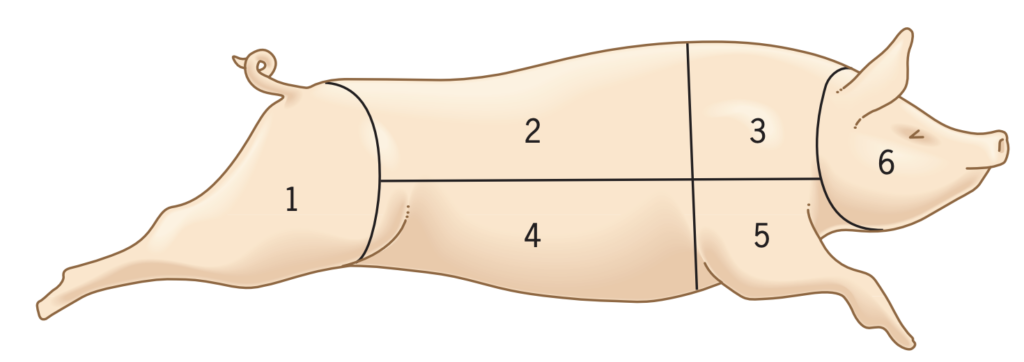
1 Leg 2 Loin 3 Spare rib of neck 4 Belly 5 Shoulder 6 Head
Q.8. Explain any ten of the following terms:
(a) Joconde sponge (b) Chateaubriand (c) Docking (d) Colocasia (e) Liasion (f) Glaze (g) Haricot (h) Allumettes (i) Court bouillon (j) Albumen (k) Par boiled rice (l) Variety of lentils
(a) Joconde Sponge: Joconde sponge is a light and airy sponge cake that is made with almond flour, sugar, eggs, and butter. It is often used as a base for cakes and desserts.
(b) Chateaubriand: Chateaubriand is a cut of beef that comes from the tenderloin. It is often served as a thick steak, and it is known for its tenderness and flavor.
(c) Docking: Docking is a process in baking where small holes are made in dough with the help of a fork. It is done to prevent the dough from rising too much during baking and to give it an even texture.
(d) Colocasia: Colocasia is a plant that is also known as taro root. Its starchy tubers are used in many cuisines around the world, including Indian, African, and Polynesian.
(e) Liaison: Liaison is a mixture of egg yolks and heavy cream that is used to thicken and enrich sauces and soups.
(f) Glaze: Glaze is a thin, shiny coating that is applied to food to enhance its appearance and flavor. It is often made with sugar, fruit juice, or honey.
(g) Haricot: Haricot is a type of bean that is also known as navy bean. It is often used in stews and casseroles.
(h) Allumettes: Allumettes are thin strips of food, such as vegetables or potatoes, that are cut into a matchstick shape. They are often used as a garnish or in dishes such as soups and salads.
(i) Court Bouillon: Court bouillon is a type of broth that is used for poaching fish and seafood. It is made with water, vegetables, herbs, and spices.
(j) Albumen: Albumen is the protein-rich part of an egg that is found in the white. It is often used in cooking and baking to provide structure and texture to dishes.
(k) Par Boiled Rice: Par boiled rice, also known as converted rice, is rice that has been partially cooked before being dried and packaged. This process helps to retain some of the nutrients and flavor of the rice.
(l) Variety of Lentils: Lentils are a type of legume that come in many different varieties, such as green, brown, red, and black. They are often used in soups, stews, and salads, and they are a good source of protein and fiber.
Q.9. Match the following:
(a) Espagnole (i) Veal
(b) Capons (ii) Brown sauce
(c) Neck end (iii) Milk
(d) Ossobuco (iv) Cock birds
(e) Fillet (v) Veal preparation
(f) Sirloin (vi) Fish (g) Bacon
(vii) Beef (h) Japonaise
(viii) Pork (i) Gazpacho
(ix) Spain (j) Pasteurization
(ix) Compound salad
Below is the matching for each given pair:
| a. Espagnole | ii. Brown sauce |
| b. Capons | iv. Cock birds |
| c. Neck end | i. Veal |
| d. Ossobuco | v. Veal preparation |
| e. Fillet | vi. Fish |
| f. Sirloin | vii. Beef |
| g. Bacon | viii. Pork |
| h. Japonaise | ix. Compound salad |
| i. Gazpacho | ix. Spain |
| j. Pasteurization | iii. Milk |
Q.10. Write short note on Indian gravies. Also discuss the importance of spices and condiments with menu examples.
Indian gravies are the base of many Indian dishes, and they come in a variety of flavors, textures, and colors. Indian gravies can be made with vegetables, meat, or a combination of both. They are often served with rice or Indian breads such as naan, roti, or paratha. There are different types of Indian gravies, such as:
- Tomato-based gravies: These gravies are made with tomatoes, onions, garlic, and ginger. They are often seasoned with cumin, coriander, and turmeric. Examples of dishes made with tomato-based gravies include butter chicken, paneer makhani, and chana masala.
- Yogurt-based gravies: These gravies are made with yogurt, onions, garlic, and ginger. They are often seasoned with cumin, coriander, and garam masala. Examples of dishes made with yogurt-based gravies include chicken korma, lamb rogan josh, and kadhi.
- Cashew-based gravies: These gravies are made with cashews, onions, garlic, and ginger. They are often seasoned with cumin, coriander, and turmeric. Examples of dishes made with cashew-based gravies include malai kofta, navratan korma, and shahi paneer.
Importance of Spices and Condiments
Spices and condiments are an essential part of Indian cooking, and they play a crucial role in creating the unique flavors and aromas of Indian food. Some of the commonly used spices and condiments in Indian cuisine include:
- Cumin: Cumin is used in many Indian dishes, and it has a warm, earthy flavor. It is often roasted before being added to dishes to enhance its flavor.
- Coriander: Coriander has a citrusy, slightly sweet flavor, and it is often used in combination with cumin.
- Turmeric: Turmeric is used to add color and flavor to Indian dishes. It has a slightly bitter, earthy flavor and is known for its anti-inflammatory properties.
- Garam Masala: Garam Masala is a blend of ground spices, including cinnamon, cardamom, cloves, and black pepper. It is often used to add depth of flavor to dishes.
- Mint: Mint is often used in Indian chutneys and is known for its refreshing flavor.
Menu Examples:
- Chicken Tikka Masala: This dish is made with tender pieces of chicken cooked in a rich tomato-based gravy, seasoned with cumin, coriander, and garam masala.
- Palak Paneer: This dish is made with spinach and paneer (Indian cheese) cooked in a creamy yogurt-based gravy, seasoned with cumin, coriander, and garam masala.
- Kadai Vegetable: This dish is made with mixed vegetables cooked in a cashew-based gravy, seasoned with cumin, coriander, and turmeric.
In conclusion, Indian gravies are a versatile base for many Indian dishes, and they come in a variety of flavors, textures, and colors. Spices and condiments play a crucial role in creating the unique flavors and aromas of Indian food, and they are used in a variety of ways to enhance the taste of Indian dishes.